Introduction
A third of family members caring for people with dementia who have been referred to secondary care services report acting abusively (Cooper et al., Reference Cooper, Selwood and Livingston2008c). Such behavior is associated with carer burden, use of unhelpful coping strategies, carer psychological morbidity, being abused by the person with dementia and caring for more hours (Cooper et al., Reference Cooper, Selwood, Blanchard, Walker, Blizard and Livingston2008b). These suggest a range of interventions which may help to reduce abuse, including respite and other social services, behavior management for the person with dementia and interventions to change the coping style or reduce the distress of family carers. There are, however, no evaluations of evidence-based interventions to reduce abuse by family carers, and such interventions are urgently needed. The new National Carers Strategy (Department of Health, 2008a) emphasizes the need for carers to be “active participants in the change process” but carers' views about what may help prevent or reduce abuse have never been systematically evaluated.
In the current CARD (Caring for Relatives with Dementia) study, we aimed to determine the views of a representative sample of family carers of people with dementia who have been referred to secondary old age psychiatry services, regarding what interventions might help reduce or prevent their abusive behavior, in order to inform the development of evidence-based interventions.
Methods
Setting and participants
We recruited consecutive family carers of people with a clinical diagnosis of dementia who were living at home and had been referred to five Community Mental Health Teams covering London and Essex (U.K.). (For more detail on the CARD study, see Cooper et al., Reference Cooper, Selwood, Blanchard, Walker, Blizard and Livingston2008b). These teams covered inner city, suburban and rural areas. We defined a family carer as a relative or friend providing care for ≥4 hours per week. Interviews took place at a time and place convenient to the carer, usually their home. Of the 356 carers initially referred to the teams, 29 were caring for less than 4 hours a week; three were caring for relatives who did not have dementia, three had no phone, one carer died before the interview, two care recipients (CR) died before the interview and seven CRs were admitted to a care home. Of the 318 eligible carers, 220 participated in the original survey (69.2% response rate).
Data collection
The study received Research Ethics Committee approval. Participants gave written informed consent. The information sheet specified that “we respect confidentiality but cannot keep it a secret if anyone is being seriously harmed.” CRs were asked for consent to access their medical notes, but were not interviewed. Where the CR lacked capacity to consent (as judged from their psychiatrist's and carer's reports), we asked carers whether they thought that the CR would have agreed when they had capacity. Three experienced psychiatrists (CC, AS, CO) carried out the interviews between January 2007 and April 2008.
Measures
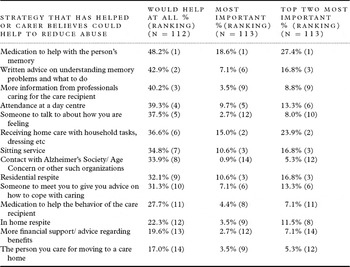
We collected sociodemographic data on: carer and CR age, sex, ethnicity; carer's relationship to the CR (spouse, child, other) and whether the carer was living with the CR. Carers completed the Modified Conflict Tactics Scale (MCTS; Beach et al., Reference Beach, Schulz, Williamson, Miller, Weiner and Lance2005; Cooper et al., Reference Cooper, Manela, Katona and Livingston2008a), a validated scale asking how often in the last three months they had acted in each of five psychologically and five physically abusive ways towards the CR. Responses were placed on a Likert scale from 0 to 4 (never to all the time). A score of ≥2 (sometimes) on one question denotes significant abuse. The carers were given these questions to complete themselves, but if they were unable to do so, the interviewer administered the questionnaire. If carers scored at least 1 on the abuse measure then we asked them to pick from a list of strategies which had either helped them already or that they thought would have the potential to help them avoid the abusive behaviors that they had reported. We then asked them to rate which of these strategies would be the most helpful and the second most helpful (see Table 1 for the list of strategies). The list of strategies were compiled by a panel of three old age psychiatrists (CC, AS, CO), and reviewed for content validity by discussion with further academic and clinical psychiatrists; their suggestions were then discussed, incorporated, and the revised list reviewed again, until saturation was reached. We also asked carers to indicate if there was anything else that they could think of that had or might have helped prevent abuse. We obtained the most recent Mini-mental State Examination (MMSE) score (Folstein et al., Reference Folstein, Folstein and McHugh1975) and medications from the CR's medical notes.
Strategies that, according to carers, have helped or could help to reduce abusive behavior

Analysis
Data were analyzed using SPSS version 14.0. We described the sample using appropriate statistics. We then reported frequencies and actual numbers for the interventions endorsed by the carers as: helpful; the most helpful strategy; and one of the two most helpful strategies.
Results
Of carers interviewed, 115/220 (52.3%) reported at least one abusive behavior. Of these, 113 (98.3%) completed the questions about how this behavior might be prevented, and were therefore included in subsequent analyses.
The age of carers ranged from 24 to 87 years (mean 61.2, SD 13.0). 76 (67.9%) of carers were female and 94 (83.9%) were of white British ethnicity. 38 (33.9%) were the spouse of the care recipient; 63 (56.3%) cared for a parent and the remaining 11 (9.9%) cared for another relative or friend. Sixty-six (59.8%) lived with the person they cared for, and 77 (68.8%) of care recipients of the carers interviewed were female. The ages of the CRs ranged from 58 to 99 years (mean 81.8, SD 8.1) and MMSE scores (available for 109 cases) ranged from 0 to 29 (mean 17.7, SD 7.6).
The three most frequently endorsed interventions to reduce abusive behavior were: medication to help the care recipient's memory (n = 54; 48.2%); written advice on understanding memory problems and what to do (n = 48; 42.9%); and more information from professionals caring for the person with dementia (n = 45; 40.2%). Medication for memory was also the intervention most frequently cited as the most important (by 18.6% (n = 21) of carers) or one of the top two most important (n = 31; 27.4%) interventions. Home care ranked second in our list of the most important (n = 17; 15.0%) and the top two most important (n = 27; 23.9%) interventions. A sitting service (to provide respite for a few hours so the carer could go out) and residential respite ranked joint third in our list of the most important (n = 12; 10.6%) and the top two most important (n = 19; 16.8%) interventions. The frequencies of other strategies used are shown in Table 1.
Only five carers suggested strategies that were not listed. These were: getting more help from family (n = 2); more service coordination (n = 1); help with rehousing nearer the care recipient (n = 1); and assistance in liaising with the job centre about problems getting work due to caring (n = 1). One husband commented that no help was needed to reduce the behaviors that scored as verbal abuse because “an argument every day has always helped us; we've been happily married 50 years.”
Discussion
Carers considered that the most important strategies to reduce elder abuse were: providing medication to help the care recipient's memory, written advice on understanding memory problems and information from professionals caring for their relative; home care services, and residential respite and sitting services.
This is, to our knowledge, the first study to ask carers their views on how abusive behavior might be prevented. Both the high completion rate and our experience as interviewers suggest that carers are interested in discussing strategies to reduce abuse. Few carers proposed any additional interventions indicating that the list we developed was comprehensive.
There is no evidence to indicate whether or not medication for memory, the most frequently endorsed strategy, would actually help to reduce abuse and it is unclear how realistic carer's beliefs were about what this medication could achieve. It is, however, possible as cholinesterase inhibitors can reduce both neuropsychiatric symptoms and carer burden (Grossberg, Reference Grossberg2008). Elder abuse is associated with distress and increased mortality in older people (Lachs et al., Reference Lachs, Williams, O'Brien, Pillemer and Charlson1998) and psychological morbidity in carers (Compton et al., Reference Compton, Flanagan and Gregg1997), but has never been evaluated as an outcome in trials of cholinesterase inhibitors. In England and Wales, the National Institute for Health and Clinical Excellence (NICE) guidance does not endorse the use of these drugs in people with mild or severe dementia due to lack of evidence of cost effectiveness. It is possible, however, that they may help reduce abuse in these groups. The survey took place at a time when media reporting of the NICE decision about the prescription of cholinesterase inhibitors was high, so it is also possible that our results reflect the strength of feeling around this issue or the feeling from those who do not know about it that there is a magic solution. In our survey, only 49 (22.3%) carers looked after someone who had been prescribed cholinesterase inhibitors, so it is unlikely that all those who rated these drugs as helpful had personal experience of them.
Carers thought that written information about dementia as well as more information from professionals might help reduce abuse. We do not know how much information these carers had already received from professionals but it is possible that this is a need that could be met without additional funding. The National Dementia Strategy (Department of Health, 2008b) cited “good-quality information for those with dementia and their carers” as a key recommendation. We did not ask the carers about the type of information they required or how it should be delivered. Psychoeducational and cognitive behavioral-based interventions that teach coping strategies have the strongest evidence base for reducing distress in carers of people with dementia (Gallagher-Thompson et al., Reference Gallagher-Thompson, Coon, Solano, Ambler, Rabinowitz and Thompson2003; Cooper et al., Reference Cooper, Balamurali, Selwood and Livingston2007). Our finding that carers prioritize a need for information about managing the illness strengthens the argument that such interventions should be widely available.
The high priority given to respite by the carers we interviewed is reflected in the U.K. government's New Carers Strategy (Department of Health, 2008a), perhaps because this document was also written after extensive consultation with family carers. Carers who provided more hours of care reported more abuse (Cooper et al., Reference Cooper, Selwood, Blanchard, Walker, Blizard and Livingston2008b), so it seems rational to suggest that respite services may reduce abuse.
Limitations
Carers completing our questionnaire did not necessarily believe that the abusive behavior they reported was problematic or abusive, so they may have chosen interventions that would be helpful in general rather than considering specifically what would help to reduce abusive behavior. We did not ask carers to differentiate between interventions that had helped them and those they thought might help, so our findings reflect a mixture of their views and personal experiences.
Conclusion
When asked what might or does prevent abuse, family carers prioritized medication for memory, good communication from professionals, written advice on memory problems, home care, residential respite and sitting services. This indicates that an intervention with some or all of these elements should be acceptable. As no interventions to reduce abuse by family carers have yet been formally evaluated, the views of family carers about what might help seems a good place to start. The next logical step would be to evaluate an intervention which focuses on the covariates of abuse and also offers carers what they want. Thus an intervention should incorporate written and verbal advice from professionals on coping with dementia and associated problem behaviors and respite care.
Conflict of interest
None.
Description of the authors' roles
AS, CC and GL designed the study and analyzed the data; AS prepared the first draft; all authors revised the content critically for important intellectual content and approved the final version.
Acknowledgments
We thank the carers and patients who took part in the study. We are grateful to Camden and Islington Foundation Trust, North Essex Partnership Foundation Trust and North East London Foundation Trust, and in particular to Drs Allen, Joels, Kirchner and Stevens. We also wish to thank the Alzheimer's Society (Islington Branch) and Shirley Nurock for assistance in developing the study.