Pseudomonas aeruginosa is an important opportunistic human pathogen causing infection in patients with impaired immune systems.Reference Kerr and Snelling 1 It is also ubiquitous in hospital water networks and thrives best in the distal parts of the water distribution system, such as taps, sinks, P-traps, or toilets.Reference Venier, Leroyer and Slekovec 2 , Reference Bedard, Prevost and Deziel 3 Although a consensus has not been reached regarding the role of hospital water supplies in P. aeruginosa acquisition by inpatients, its presence in the water supply has been identified as a risk factor for P. aeruginosa acquisition,Reference Bedard, Prevost and Deziel 3 and investigations of hospital outbreaks have frequently retrieved epidemic clones in the sinks.Reference Loveday, Wilson, Kerr, Pitchers, Walker and Browne 4 Although P. aeruginosa has a nonclonal epidemic population structure, recent studies have provided evidence of the existence of multidrug-resistant global clones, denominated high-risk clones, and globally disseminated in hospitals.Reference Oliver, Mulet, Lopez-Causape and Juan 5 We report a hospital outbreak involving 2 clones of multidrug-resistant P. aeruginosa in which the waste-pipe system was the likely reservoir for and source of contamination. The outbreak occurred from 2009 to 2013 in a hematology unit at the 1,200-bed Besançon University Hospital (eastern France). We also report the bundle of measures that facilitated the long-term control of the outbreak.
MATERIAL AND METHODS
Study Design
We performed an outbreak investigation and prospective environmental investigation. From January 2008 to November 2016, all patients admitted for more than 48 hours (n=1,966) in our 15-bed stem-cell transplantation hematology unit were screened for P. aeruginosa carriage (with stools or rectal swab) on admission and once per week thereafter, throughout their stay.
Microbiological Methods
Swabs were streaked on Pseudomonas selective agar plates containing cetrimide, which were incubated for 48 hours at 35°C. Pseudomonas aeruginosa colonies were first detected using standard microbiology methods (ie, colony morphology, positive oxidase reaction, pigment production) and identified by matrix-assisted laser desorption/ionization time-of-flight mass spectroscopy (MALDI-TOF MS) with a log value ≥2 according to the manufacturer’s recommendations (Bruker Daltonik GmbH, Bremen, Germany). Pseudomonas aeruginosa isolates were also obtained from routine diagnostic samples and identified accordingly. Susceptibility testing on all isolates was performed using disc diffusion methodology. 6 Extended-spectrum β-lactamases (ESBLs) and metallo-β-lactamases (MBLs) were screened in isolates resistant to third-generation cephalosporins using a phenotypic method described elsewhereReference Hocquet, Dehecq, Bertrand and Plesiat 7 and identified by polymerase chain reaction (PCR) and sequencing with primers targeting ESBL- and MBL-encoding genes.Reference Hocquet, Plesiat, Dehecq, Mariotte, Talon and Bertrand 8 Molecular typing of ESBL- or MBL-producing isolates was carried out using pulsed-field gel electrophoresis (PFGE) and multilocus sequence typing (MLST) as previously described.Reference Slekovec, Plantin and Cholley 9
A large environmental microbiological investigation was carried out for 42 months from May 2013 to October 2016. P-traps from all sinks of the unit (n=19) were sampled monthly from May 2013 to February 2015 and biannually until the end of the survey. For each sink, 50 mL of P-trap content was collected using a suction catheter and a syringe and centrifuged for 5 minutes at 5,000 ×g. All toilets (n=18) were sampled with a swab monthly from May 2013 to April 2014. Water samples were collected monthly from taps from May 2013 to February 2015. Filters, if present, were removed prior to the sampling of the first 250 mL flushed into a sterile flask containing 5 mg sodium thiosulphate. Then, 100 mL of this solution was filtered through a 0.45-mm pore-size membrane filter. All environmental samples were cultured on Pseudomonas selective agar plates as described above. Identification, susceptibility testing, detection of resistance determinants and typing were carried out using methods described for clinical samples.
Infection Control Intervention
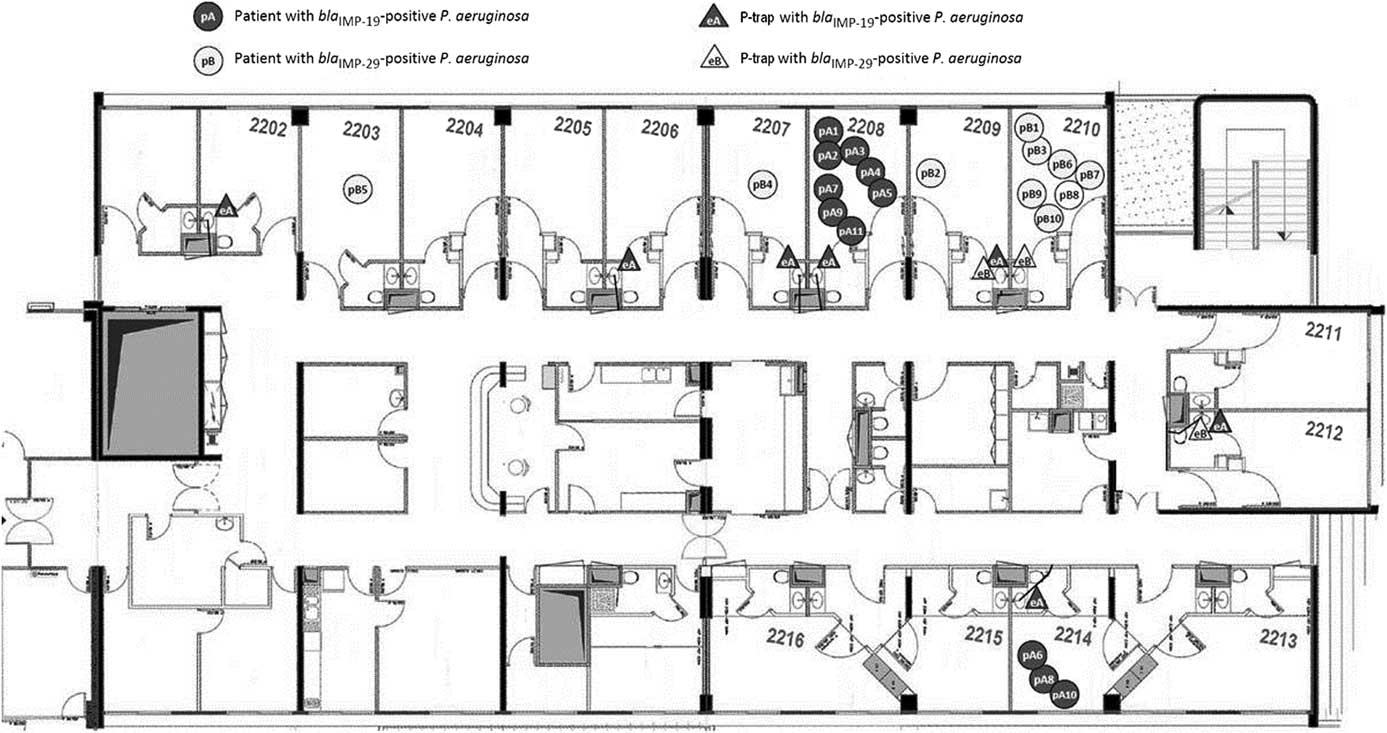
In May 2013, we implemented a bundle of infection control measures that included (1) a global clinical audit carried out by infection control nurses and practitioners and a reminder on recommendations of hand disinfection opportunities, (2) excreta management, (3) use of gloves, (4) recall of cleaning practices, (5) discontinuation of feces discharge in the toilets, and (6) removal of hand showers for rinsing the toilets. Considering the spatiotemporal distribution of acquisition of P. aeruginosa outbreak strains (Figure 2), rooms 2208 and 2210 were closed for 1 month, and a large microbiological surveillance program was implemented. After the first results of environmental sampling, we replaced all taps and all drains of sinks and toilets starting with rooms 2208 and 2210. These replacements took 1 year due to the maintenance of medical activity. New water outlets were equipped with lockable P-traps (Geberit, Avon, France) and disposable point-of-use water filters (Anios, Lille-Hellemmes, France) that were changed monthly. We recommended pouring a bleach solution (water with 2.6% active chlorine) twice weekly into the blocked P-traps to allow a contact time of 15 minutes before rinsing with water. An additional measure was implemented in April 2014: P-traps were changed at patient discharge whenever a patient stay exceeded 1 week.
RESULTS
Outbreak Description
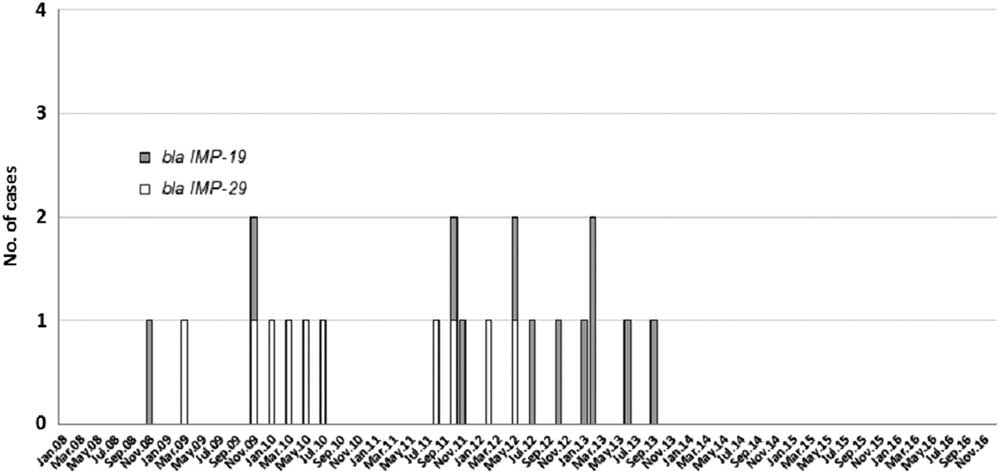
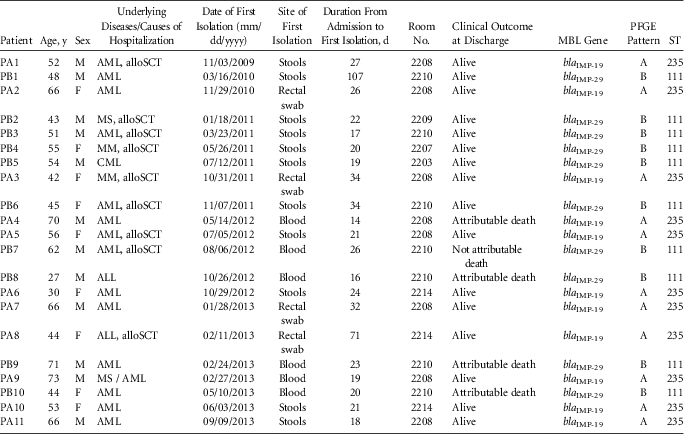
From November 2009 to September 2013, 21 patients were colonized or infected with an IMP-producing P. aeruginosa. Figure 1 shows the epidemic curve. We observed a biclonal outbreak with contemporary spread of IMP-19–producing ST235 (belonging to a unique PFGE pattern called A) and IMP-29–producing ST111 (belonging to a unique PFGE pattern called B). Overall, 11 patients were colonized or infected with ST235 and 10 patients were colonized or infected with ST111. Table 1 summarizes the main characteristics of these patients. The first infection occurred in May 2012, and 5 more patients were diagnosed between August 2012 and May 2013. Of these 6 patients, 5 died, and the deaths were considered attributable to P. aeruginosa infection in 4 cases.
Epidemic curve of the outbreak of IMP-producing P. aeruginosa in the hematology unit of the University Hospital of Besançon (2008–2016). The grey bars and white bars represent the number of patients positive with IMP-19– and IMP-29–producing P. aeruginosa, respectively.

Patients Infected or Colonized With IMP-Producing P. aeruginosa in the Hematology Unit

NOTE. MBL, metallo-beta-lactamase; PFGE, pulsed-field gel electrophoresis; ST, sequence type; AML, acute myeloid leukemia; alloSCT, allogeneic stem cell transplantation; MS, myelodysplastic syndromes; MM, multiple myeloma; CML, chronic myeloid leukemia; ALL, acute lymphoblastic leukemia.
Environmental Screening
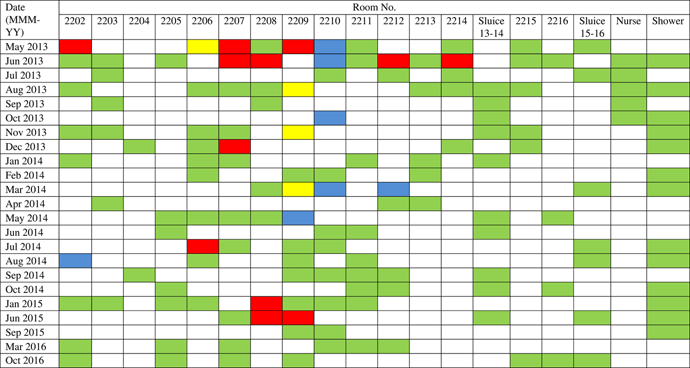
A total of 1,067 environmental samples were analyzed: 437 samples of P-traps, 414 water samples, and 216 toilets samples. All the water samples were negative for IMP-producing P. aeruginosa. However, 3 toilets sampled in May and June 2013 were positive for IMP-19–producing P. aeruginosa ST235 (rooms 2207, 2208, and 2212), and all toilets tested negative thereafter. The results of the search for P. aeruginosa in P-traps are summarized in Table 2. Broadly, P. aeruginosa was detected in 149 of 437 P-trap samples (34.1%) and IMP-like–producing P. aeruginosa were recovered in 19 samples (12 containing IMP-19–producing P. aeruginosa and 7 containing and IMP-29–producing P. aeruginosa). Additionally, 4 isolates producing the class A PER-1 ESBL were identified without being involved in the current outbreak. IMP-19–producing P. aeruginosa ST235 was identified in 7 rooms for a prolonged period (from May 2013 to June 2015). IMP-29–producing P. aeruginosa ST111 was recovered in only 4 rooms from May 2013 to August 2014.
Results of P-Trap Sampling for Presence of Pseudomonas aeruginosa in the Environment of Hematology Unit of the University Hospital of Besançon (2013–2016)

NOTE. Red, presence of IMP-19–producing P. aeruginosa; blue, presence of IMP-29–producing P. aeruginosa; yellow, presence of PER-1–producing P. aeruginosa; green, presence of P. aeruginosa not producing ESBLs or MBLs; white, absence of P. aeruginosa.
DISCUSSION
In the present study, we describe a 4-year-long outbreak of IMP-producing carbapenem-resistant P. aeruginosa where P-traps were the likely reservoir. Numerous studies have reported that water systems can act as a source of P. aeruginosa acquisition by patients in high-risk settings, but the route of transmission is often unclear and becomes a cause of chicken-and-egg debate.Reference Loveday, Wilson, Kerr, Pitchers, Walker and Browne 4 In this outbreak, the role of the environment was clear because the acquisition of the 2 outbreak strains was mainly associated with 2 specific rooms where the environment was contaminated. A recent in situ study using a handwashing sink laboratory gallery showed that transfer of bacteria from P-traps to patients is a multistage process: (1) the development of the biofilm up from the P-trap, (2) the contamination of the strainer, and (3) the subsequent droplet dispersion when the water flow hits the strainer. This process leads to the contamination of the sink and the surrounding environment.Reference Kotay, Chai, Guilford, Barry and Mathers 10 Therefore, patients can be contaminated when grooming, brushing their teeth, or after contact with the environment. Healthcare workers are also at risk for hand contamination and further patient contamination during care.Reference Stjarne Aspelund, Sjostrom, Olsson Liljequist, Morgelin, Melander and Pahlman 11 , Reference Hota, Hirji and Stockton 12
The comprehensive review by Oliver et alReference Oliver, Mulet, Lopez-Causape and Juan 5 gathered the evidence of the existence of multidrug-resistant global clones, denominated high-risk clones and disseminated worldwide. Our outbreak involved the 2 most successful high-risk clones, ST235 and ST111. Unexpectedly, both epidemic strains produced an IMP-like enzyme, which was not the most common MBL hosted by P. aeruginosa worldwide.Reference Potron, Poirel and Nordmann 13 The PFGE pattern A-ST235 produced an IMP-19 (an IMP-2 variant) that was described in 2007 at Dijon University Hospital. This pattern was first hosted by Aeromonas caviae Reference Neuwirth, Siebor, Robin and Bonnet 14 and subsequently by 8 other species of gram-negative bacilli, including P. aeruginosa. Reference Amoureux, Riedweg and Chapuis 15 Stem-cell transplantation of patients from the Dijon hospital was performed in our Besançon hospital. Considering these facts, IMP-19–producing P. aeruginosa was very likely introduced in our hospital via colonized patients from the Dijon hospital. The MBL IMP-29 was described for the first time in our hospital during this outbreak.Reference Jeannot, Poirel, Robert-Nicoud, Cholley, Nordmann and Plesiat 16 Since then, IMP-29–producing P. aeruginosa has been recovered in the wastewater network of our town but has not been described in another region or country.Reference Slekovec, Plantin and Cholley 9 bla IMP-19 and bla IMP-29 nucleotide sequences share only 88.8% identity, ruling out the possibility of a direct filiation between the 2 genes.
A bundle of measures was implemented progressively starting in May 2013, and it appears to be efficient to prevent transmission of epidemic strains to newly admitted patients. Indeed, 1 new patient become colonized in September 2013, but no patients were positive for P. aeruginosa producing IMP-like enzymes from this date to November 2016, and all patients were screened weekly for P. aeruginosa carriage during that period. Importantly, the outbreak was controlled while the epidemic strains were still present in the environment and were sporadically detected in P-traps in 2013, 2014, and 2015 (Figure 2). In other words, we witnessed a recolonization of the new P-traps in rooms hosting patients who were not colonized by the epidemic strains. This finding suggests, as shown by Kotay et al,Reference Kotay, Chai, Guilford, Barry and Mathers 10 that P. aeruginosa producing IMP-like enzymes stayed in the main pipe and recontaminated the P-traps.Reference Kotay, Chai, Guilford, Barry and Mathers 10 This explains how the pathogen contaminated new P-traps and drains of rooms hosting patients negative for IMP-like–producing P. aeruginosa.
Location of patients and P-traps positive for P. aeruginosa isolates carrying bla IMP-19 or bla IMP-29 genes in the hematology unit of the University Hospital of Besançon.

The use of bleach solution and changing the of P-traps (ie, at patient discharge whenever a patient stayed >7 days) may have reduced the microbial load in this environment. However, we did not assess the bacterial load of epidemic strains before and after implementation of the measures. Finally, it is quite difficult to identify measures that are most important in the bundle implemented in a crisis.
In summary, we report a prolonged outbreak in a hematology unit due to 2 IMP-producing high-risk clones of P. aeruginosa, for which the environment, particularly P-traps, played a major role in cross-transmission. Our infection control measures efficiently controlled the outbreak. However, our extensive microbiological investigation indicated that the eradication of P. aeruginosa from the wastewater network is unrealistic. Hence, a reservoir can persist even after full replacement of the equipment at the water point of use. In that context, it appears critical to implement proactive measures reducing the bacterial load in water fittings of high-risk units to limit the transmission of nosocomial pathogens to fragile patients.
ACKNOWLEDGMENTS
Financial support: The authors acknowledge funding support from the University Hospital of Besançon, France.
Potential conflicts of interest: All authors report no conflicts of interest related to this article.