

Bullying is a global issue for students (Due et al., Reference Due, Holstein, Lynch, Diderichsen, Gabhain and Scheidt2005; Molcho et al., Reference Molcho, Craig, Due, Pickett, Harel-Fisch and Overpeck2009). Characterised by three fundamental pillars, intention, repetition, and power imbalance (Olweus, Reference Olweus1993), bullying takes various forms: physical, verbal, and social (sometimes called relational or exclusionary). These forms of bullying are called traditional. Another form of bullying is bullying through technology or cyberbullying (Gladden, Vivolo-Kantor, Hamburger, & Lumpkin, Reference Gladden, Vivolo-Kantor, Hamburger and Lumpkin2014). Although prevalence rates have been found to vary depending upon the age of the children and youth sampled, the definitions used, the methodology employed, and the time frame queried (Ybarra, Boyd, Korchmaros, & Oppenheim, Reference Ybarra, Boyd, Korchmaros and Oppenheim2012), recent Australian studies have reported traditional victimisation prevalence rates of between 16.1 and 40% (Campbell, Spears, Slee, Butler, & Kift, Reference Campbell, Spears, Slee, Butler and Kift2012; Cross et al., Reference Cross, Shaw, Hearn, Epstein, Monks, Lester and Thomas2009; Hemphill et al., Reference Hemphill, Kotevski, Herrenkohl, Bond, Kim, Toumbourou and Catalano2011), with bullying perpetration between 11 and 17.1% (Cross et al., Reference Cross, Shaw, Hearn, Epstein, Monks, Lester and Thomas2009; Hemphill, Tollit, & Kotevski Reference Hemphill, Tollit and Kotevski2012).
Cyberbullying victimisation appears to be half the prevalence of traditional bullying, with 14% of 3,119 students aged 10–18 years reporting being cyberbullied and 7.4% reporting cyberbullying perpetration (Campbell, Spears, Slee, Kift, & Butler, Reference Campbell, Spears, Slee, Kift and Butler2011). This is lower than conservative estimates of cyberbullying presented by Spears, Keeley, Bates, and Katz (Reference Spears, Keeley, Bates and Katz2014), who suggest that 20% of children aged 8–17 years experience cyberbullying within a 12-month period.
Students in special populations, such as those with a disability, have been found to have even higher rates of both bullying victimisation and perpetration, compared to those without disabilities (i.e., typically developing students; Rose, Espelage, & Monda-Amaya, Reference Rose, Espelage and Monda-Amaya2009). Students with autism spectrum disorder (ASD) are at even higher risk of involvement in bullying, not only compared with typically developing students but also with other students with special needs (Kloosterman, Kelley, Craig, Parker, & Javier, Reference Kloosterman, Kelley, Craig, Parker and Javier2013). With the rise in prevalence of students diagnosed with ASD (Saracino, Noseworthy, Steiman, Reisinger, & Fombonne, Reference Saracino, Nosewothy, Steiman, Reisinger and Fombonne2010) the increased risk for bullying does not bode well for these students. Additionally, the increased inclusion of students with ASD in mainstream classrooms may place them at greater risk for involvement in bullying (Haq & Le Couteur, Reference Haq and Le Couteur2004; Hebron & Humphrey, Reference Hebron and Humphrey2014; Humphrey & Symes, Reference Humphrey and Symes2011). Current studies of bullying and students with ASD, however, have had extremely small samples and have mainly relied on others’ reports and not the reports of the students with ASD themselves. Furthermore, there appears to be limited prevalence studies of cyberbullying victimisation and perpetration in this population. We therefore examined the prevalence of victimisation and perpetration of both traditional and cyber forms of bullying in a larger sample of students with ASD from their own self-reports.
Consequences of Bullying
With the aforementioned high rates of traditional and cyberbullying, consequences of bullying are of concern. We know that there are many negative consequences of traditional bullying victimisation, such as long-term psychological problems, including increased levels of anxiety, depressive symptoms, social isolation and loneliness, poor self-worth, psychosomatic complaints, suicidal ideation, and suicide attempts (Bowes et al., Reference Bowes, Maughan, Ball, Shakoor, Ouellet-Morin, Caspi and Arseneault2013; Brunstein Klomek, Marrocco, Kleinman, Schonfeld, & Gould, Reference Brunstein Klomek, Marrocco, Kleinman, Schonfeld and Gould2007; Polanin, Espelage, & Pigott, Reference Polanin, Espelage and Pigott2012; Wang, Nansel, & Iannotti, Reference Wang, Nansel and Iannotti2011). Perpetrators of traditional bullying have also been found to be at a heightened risk of experiencing problems such as anxiety, depression, psychosomatic symptoms, and eating disorders (Cook-Cottone et al., Reference Cook-Cottone, Serwacki, Guyker, Sodano, Nickerson, Keddie-Olka and Anderson2016; Duarte & Pinto-Gouveia, Reference Duarte and Pinto-Gouveia2017). They may also experience difficulties with school, psychosocial adjustment, externalising behaviours, and delinquency in late adolescence and early adulthood (Perren & Hornung, Reference Perren and Hornung2005), substance abuse (Houbre, Tarquinio, Thuillier, & Hergott, Reference Houbre, Tarquinio, Thuillier and Hergott2006), and psychiatric problems (Espelage, Van Ryzin, & Holt, Reference Espelage, Van Ryzin and Holt2017). Bully-victims are at the greatest risk for adversity, experiencing both internalising and externalising difficulties (Isolan, Salum, Osowski, Zottis, & Manfro, Reference Isolan, Salum, Osowski, Zottis and Manfro2013; Swearer, Reference Swearer, Koocher, Norcross and Greene2013; Zablotsky, Bradshaw, Anderson, & Law, Reference Zablotsky, Bradshaw, Anderson and Law2013).
It has been shown that students who were cyber-victimised reported more social difficulties and higher levels of depression and anxiety than those students who were victims of traditional bullying (Campbell et al., Reference Campbell, Spears, Slee, Butler and Kift2012). Although these are serious sequelae for students who are victims of cyberbullying, those students who are perpetrators also reported more social difficulties and obtained higher scores on stress, depression, and anxiety scales than those not involved in bullying (Campbell, Slee, Spears, Butler & Kift, Reference Campbell, Slee, Spears, Butler and Kift2013). Even though the consequences for students with ASD who are bullied are similar to their typically developing peers, a further difficulty bullying may cause is an increase in their ASD symptomatology (Sreckovic, Brunsting, & Able, Reference Sreckovic, Brunsting and Able2014).
Students With an ASD and Bullying
ASD, as used in the present study, includes autistic disorder, Asperger's disorder, and pervasive developmental disorder not otherwise specified (PDD-NOS) as diagnostic criteria used at the time of the data collection according to the Diagnostic and Statistical Manual of Mental Disorders (4th ed., text rev.; American Psychiatric Association, 2000). Students with a diagnosis of ASD often have unusual mannerisms (Horowitz et al., Reference Horowitz, Vessey, Carlson, Bradley, Montoya, McCullough and David2004), may engage in restricted interests (Gazelle & Ladd, Reference Gazelle and Ladd2003), lack a social network or a group of close friends (Bauminger & Kasari, Reference Bauminger and Karasi2000), and experience difficulties in communication and specifically the social aspects of communication (Kelley, Paul, Fein, & Naigles, Reference Kelley, Paul, Fein and Naigles2006). They may also experience challenges in understanding their own and others’ behaviour (Frith & Hill, Reference Frith and Hill2004), have difficulties with self-regulation of their behaviour and emotions (Howlin, Reference Howlin2004; Matson & Nebel-Schwalm, Reference Matson and Nebel-Schwalm2007), and have comorbid mental health disorders (Rosenberg, Kaufman, Law, & Law, Reference Rosenberg, Kaufmann, Law and Law2011). These difficulties have been identified in the bullying literature as risk factors for both victimisation and perpetration in typically developing students. As Rose and Espelage (Reference Rose and Espelage2012) have argued, it is not the disability itself that is a risk factor but the characteristics associated with the disability.
Methodological Issues in Studying Bullying and Students With ASD
There are some methodological problems with existing prevalence studies reporting bullying involvement of students with ASD. For example, approximately 80% of research on the prevalence of bullying in typically developing young people uses methods involving self-report (Owens, Skrzypiec, & Wadham, Reference Owens, Skrzypiec, Wadham, Shute, Slee, Murray-Harvey and Dix2011), yet studies of bullying involvement in students with ASD tend to utilise parent reports (Cappadocia, Weiss, & Pepler, Reference Cappadocia, Weiss and Pepler2012; Little, Reference Little2002) or parent and teacher reports (Rowley et al., Reference Rowley, Chandler, Baird, Simonoff, Pickles, Loucas and Charman2012). This reflects the belief that young people with ASD might not be capable of accurately answering questions about bullying as they may fail to understand complex social situations (Loveland, Pearson, Tunali-Kotoski, Ortegon, & Cullen Gibbs, Reference Loveland, Pearson, Tunali-Kotoski, Ortegon and Cullen Gibbs2001) and therefore not understand bullying.
Parent and teacher reports, however, can be perceived as unreliable, as parents and teachers have been shown to be unaware of the nature and frequency of their children's involvement in bullying and consequently report it incorrectly (Beaty & Alexeyev, Reference Beaty and Alexeyev2008; Rieffe, Camodeca, Pouw, Lange, & Stockmann, Reference Rieffe, Camodeca, Pouw, Lange and Stockmann2012; Stassen Berger, Reference Stassen Berger2007). This could create unreliable comparisons with typically developing students given that there was only fair-to-moderate agreement between adolescents with ASD and their mothers on whether or not bullying victimisation had occurred, and poor agreement on the types of bullying (Zeedyk, Rodriguez, Tipton, Baker, & Blacher, Reference Zeedyk, Rodriguez, Tipton, Baker and Blacher2014).
Other studies have tried to triangulate data on bullying prevalence in populations of students with ASD using data from parents, teachers, and the students themselves (Chen & Schwartz, Reference Chen and Schwartz2012; van Roekel, Scholte, & Didden, Reference van Roekel, Scholte and Didden2010). These studies have found different prevalence rates according to the informant source. For example, in three autism-specific special schools, van Roekel et al. (Reference van Roekel, Scholte and Didden2010) found that teachers estimated student victimisation at 46%. This was significantly higher than peer report of 15% and the student self-report of 19%, and Rowley et al. (Reference Rowley, Chandler, Baird, Simonoff, Pickles, Loucas and Charman2012) found teachers’ ratings were lower for student victimisation than parents’ reports.
There are also some studies that have specifically asked students with ASD about their involvement in bullying, despite the belief that these students might not understand bullying. Wainscot, Naylor, Sutcliffe, Tantam, and Williams (Reference Wainscot, Naylor, Sutcliffe, Tantam and Williams2008) interviewed 57 students with Asperger syndrome in secondary schools and explored conceptions about bullying. However, the students were asked if there was anyone in their class they thought did not like them, which may not be interpreted by students with ASD as bullying behaviour. In contrast, Twyman et al. (Reference Twyman, Saylor, Saia, Macias, Taylor and Spratt2010) conducted a self-report survey on bullying with 294 students, but only 11% of these were diagnosed with an ASD. The results of this study found that with students on the spectrum, bullying victimisation was experienced at the same level as the group of students with attention-deficit/hyperactivity disorder (ADHD). Similarly, Storch et al. (Reference Storch, Larson, Ehrenreich-May, Arnold, Jones, Renno and Wood2012) used a survey administered to 60 students with ASD. In this study, compared to norms of typically developing youth, the students with ASD were one standard deviation above the mean for victimisation. However, all participants in this study also had a diagnosis of an anxiety disorder.
An interesting finding in two recent studies has shown that students with ASD were as accurate in identifying bullying behaviour as adolescents from the general population: van Roekel et al. (Reference van Roekel, Scholte and Didden2010), using videos, and Bitsika and Sharpley (Reference Bitsika and Sharpley2014), using open-ended definitions of bullying. These findings have been supported by Hwang et al.’s (under review) finding that students with ASD correctly identified scenarios of traditional bullying and cyberbullying with a better degree of accuracy than typically developing students. This study used the same participants with ASD as the present study, so we are confident that these students have at least the same understanding of what constitutes bullying as their typically developing peers.
Additionally, most studies have only considered traditional bullying and have not included cyberbullying. This is a concern, as students with ASD are often prolific users of the internet (Kuo, Orsmond, Coster, & Cohn, Reference Kuo, Orsmond, Coster and Cohn2014), and this is a risk factor for cyberbullying involvement (Didden et al., Reference Didden, Scholte, Korzilius, de Moor, Vermeulen and Lancioni2009). Studies investigating cyberbullying in the population of students with ASD have also found a discrepancy between parent reports and students’ self-reports. Kowalski and Fedina (Reference Kowalski and Fedina2011), for example, found 15% of parents reported that their child with ADHD and/or ASD had been cyberbullied, and 3% said their child had cyberbullied someone else. In contrast, 38% of the students with ADHD and/or ASD reported being cyber-victimised, and 5.8% said they had bullied someone else. For cyberbullying involvement, perhaps even more than for traditional bullying, it would seem more accurate to ask young people about their experiences rather than their parents, teachers, or peers.
Most studies have also not examined the roles of bully, victim, and bully-victim in the population of students with ASD, with many studies examining only victimisation (e.g., Cappadocia et al., Reference Cappadocia, Weiss and Pepler2012), or not separating victim and perpetrator roles (e.g., van Roekel et al., Reference van Roekel, Scholte and Didden2010). It is important, however, for intervention to distinguish whether students with ASD are either being victimised or are perpetrators of bullying. Moreover, in many studies, there has been no comparison group in the study of typically developing students and students with ASD (e.g., Bitsika & Sharpley, Reference Bitsika and Sharpley2014; Cappadocia et al., Reference Cappadocia, Weiss and Pepler2012; Carter, Reference Carter2009; Little, Reference Little2002). Additionally, studies have involved extremely small samples of children with ASD (e.g., 24 students [Kloosterman et al., Reference Kloosterman, Kelley, Craig, Parker and Javier2013]; 30 students [Wainscot et al., Reference Wainscot, Naylor, Sutcliffe, Tantam and Williams2008]; and 48 students [Bitsika & Sharpley, Reference Bitsika and Sharpley2014]).
Current Study
The purpose of the present study was therefore to investigate the prevalence of both traditional bullying and cyberbullying in students with ASD as either victims or perpetrators. To address the methodological issues identified from the review of existing studies, we sought self-reports from students with ASD and compared their responses to those of a typically developing matched sample of students to ascertain whether students with ASD were victimised more than typically developing students or were more likely to be perpetrators of bullying than their peers. Traditionally, self-report questionnaires have not been used with students with ASD primarily because of their difficulties with communication. As the students with ASD in this sample were found to understand the concept of both traditional and cyberbullying in real-life scenarios (Hwang et al., under review) with the same accuracy as typically developing students, we provided students in both groups with the same questions and compared the types of bullying and roles of bullying in each group. The research question, therefore, was as follows: What is the prevalence of traditional and cyber forms of bullying in students with ASD as either victims or perpetrators?
Method
Participants
Participants in this study were 104 children who were previously diagnosed with ASD (American Psychiatric Association, 2000) and 104 typically developing children. The typically developing students were matched with the students with ASD based on age and gender by random selection from a pool of 2,116 typically developing students. The ages of the children ranged from 11 to 16 years (M = 12.69, SD = 1.42). There were 91 males and 13 females in each group. This reflects the diagnostic gender imbalance characteristic of ASD, which stands at a ratio of 4 boys to 1 girl (Taylor, Jick, & MacLaughlin, Reference Taylor, Jick and MacLaughlin2013).
All children with ASD had received a diagnosis of autism spectrum disorder or pervasive developmental disorder. The criteria for inclusion was (a) a diagnosis provided by a registered paediatrician, psychiatrist, or neurologist specifying the diagnostic criteria provided in the Diagnostic and Statistical Manual of Mental Disorders (4th ed., text rev.; American Psychiatric Association, 2000); (b) activity limitations and participation restrictions for the student at school requiring significant education adjustments. Of the 104 children, 98 (94.2%) were in mainstream settings; 60 children (57.7%) attended state schools, and 26 (25%) and 12 (11.5%) children attended Catholic Education schools and independent schools, respectively, in Queensland, an Australian state. The typically developing children were drawn from three different Australian states and attended both government and nongovernment schools, similar to the students with ASD.
Measures
An anonymous, self-report, paper-based survey was conducted. This has been used successfully in previous studies (Campbell & Morgan, in press; Hooijer & Campbell, under review). For the typically developing students, there were 85 questions covering demographics, types of bullying (i.e., cyberbullying and traditional bullying), and bullying-related experience (i.e., victimisation, perpetration, and victimisation–perpetration). These students completed the questionnaire in class time. For the students with ASD, the survey was shortened to 21 questions in three sections (see Appendix). Self-report understanding has been found to be the same in children with ASD as well as those who are typically developing (Bitsika & Sharpley, Reference Bitsika and Sharpley2014; Hwang et al., under review; van Roekel et al., Reference van Roekel, Scholte and Didden2010). The first section of the questionnaire consisted of demographic questions, including gender, grade, and age. The second section began with a definition of cyberbullying, following the recommendation to improve the validity of the responses made in Ybarra et al.’s (Reference Ybarra, Boyd, Korchmaros and Oppenheim2012) study:
Cyberbullying is when one person or a group of people repeatedly try to hurt or embarrass another person, using their computer or mobile phone to use power over them. With cyberbullying the person bullying usually has some advantage over the person targeted and it is done on purpose to hurt them, not like an accident or when friends tease each other.
The section consisted of six questions concerning being cyberbullied in the current year; for example, were they a target of cyberbullying (yes, no); how often they were cyberbullied (every day, most days, one or two times a week, once a week, less than once a week); who cyberbullied them (1 person, 1 group, 2 different people, 2 different groups, 3 or more different people, 3 or more different groups); if they had cyberbullied someone else (yes, no). If they indicated that they had not been involved in cyberbullying, they were asked to skip to the next section. This skip pattern was also repeated for the other sections in the questionnaire. The third section began with a definition of face-to-face bullying:
There are lots of different ways to bully someone. A bully wants to hurt the other person (it's not an accident) and does it repeatedly and unfairly (the bully has some advantage over the victim). Sometimes a group of students will bully another student.
There were eight questions on face-to-face bullying, and these included how frequently they were bullied, how they were bullied (physically, verbally, socially) and whether they had face-to-face bullied someone, how often they had face-to-face bullied someone, and who they had face-to-face bullied.
Procedure
Ethical clearance was obtained from Queensland University of Technology (1100000186) and the educational systems involved (Queensland, South Australia, and Western Australia). It was also sought from the participating schools for the typically developing students and Autism Queensland for the students with ASD. Autism Queensland is a community-based not-for-profit, peak provider of services to children with ASD and their families in Queensland. Participation was voluntary. Return of the survey indicated consent from both parents and the student with ASD. Typically developing students had obtained written parental consent and provided their own assent. Schools were approached in three different Australian states by research assistants in the capital cities. For the typically developing students, a research assistant administered the survey in their classrooms during class time by reading standardised instructions out loud. There were between 15 and 25 students per testing session, and each session took 30–45 minutes. The anonymity of the survey responses was emphasised verbally and in writing to the students. The survey was conducted between August and September (Term 3) when students had spent the previous 6–7 months of the school year together in 2010.
As students with ASD attend their local school there are few students per school. To maximise our sample it was decided that more participants would be available if the participants were recruited through the autism association. For the students with ASD, Autism Queensland posted 614 surveys to the families of their clients with a reply paid envelope in August 2012. Parents were instructed to give the sealed envelope containing the survey to their child with ASD, and ask him or her to fill it in privately, and put it into the provided envelope. A total of 104 completed student surveys were returned, giving a response rate of 17%. Although considered a low response rate, the sample size was larger than that of previous research with bullying and students with ASD, adding strength to the findings.
Data Analysis
A matched case control analysis was conducted. Students with ASD (n = 104) were matched on age and gender from a random selection of 2,116 typically developing students. It is acknowledged that matched case control is not without its problems. In particular, if too many matching variables are utilised, the two matched variables will become increasingly similar with respect to the variable of interest. To minimise this happening, only two matching variables of age and gender were utilised. The reason for matching was to improve statistical efficiency through a balanced design and balanced number of cases across the levels of the variables of interest. This reduces the variance of the variables of interest, which drives efficiency (Kupper, Karon, Kleinbaum, Morgenstern, & Lewis, Reference Kupper, Karon, Kleinbaum, Morgenstern and Lewis1981; Rothman & Greenland, Reference Rothman and Greenland1998).
Data were analysed using SPSS Version 23. A bivariate analysis was conducted to examine relationships between groups of students with and without an ASD, and bullying variables. This process allowed the testing of hypotheses about the relationships between students with an ASD and bullying variables. In particular, this study used chi-square tests, allowing for examination as to whether the relationship/association between two variables was considered large enough to rule out random chance or error. The phi coefficient was explored in order to provide effect size (Field, Reference Field2009).
Results
Frequency of Traditional Bullying Victims, Perpetrators, and Bully-Victims
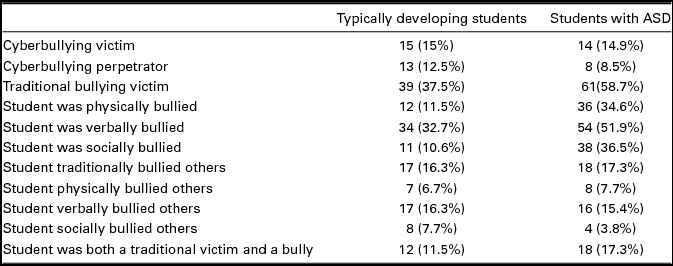
Significantly more students from the ASD group reported that they had experienced traditional bullying during the current year than students from the typically developing (TD) group, TD, 37.5%, n = 39; ASD, 64.9%, n = 61; χ2(1) = 14.82, p < .001, ϕ = .27. A significantly higher number of students from the ASD group also reported experiencing traditional bullying more frequently, more than the TD group, TD, 43.9%, n = 18; ASD, 70.5%, n = 43. A chi-square test showed this difference in frequency between the two groups to be significant, χ2(1) = 7.21, p < .05, ϕ = .27.
Significantly more students in the ASD group (34.6%, n = 36) indicated they had been physically bullied than students in the TD group (11.5%, n = 12), χ2(1) = 15.60, p < .001, ϕ = .27. This was the case also for students with ASD being verbally bullied, TD, 32.7%, n = 34; ASD, 51.9%, n = 54; χ2(1) = 7.88, p < .05, ϕ = .2, and socially bullied, TD, 10.6%, n = 11; ASD, 36.5%, n = 38; χ2(1) = 19.46, p < .001, ϕ = .31.
There were no significant differences between the TD and ASD groups in the frequency with which they traditionally bullied someone else that year. There were no statistically significant differences between the groups of students reporting that they had physically bullied someone (TD, 6.7%, n = 7; ASD, 7.7%, n = 8), verbally bullied someone (TD, 16.3%, n = 17; ASD, 15.4%, n = 16), or socially bullied someone (TD, 7.7%, n = 8; ASD, 3.8%, n = 4). Although more students in the ASD group reported that they were both a victim and a perpetrator of traditional bullying than those in the TD group, the difference was not statistically significant (TD, 11.5%, n = 12; ASD, 19.1%, n = 18).
Frequency of Cyberbullying Victims, Perpetrators, and Bully-Victims
A similar number of students from the TD group and ASD group reported experiencing cyberbullying victimisation (TD, 15%, n = 15; ASD, 14%, n = 14). Of these cyberbullied students, most reported that the bullying was on an infrequent basis (TD, 90%, n = 13; ASD, 85.7%, n = 12). There were no significant differences between groups based upon how many people or groups cyberbullied them.
More students from the TD group indicated that they had cyberbullied someone else during the year than students from the ASD group (TD, 12.5%, n = 13; ASD, 7.7%, n = 8); however, a chi-square test showed there was no significant difference between the two groups, χ2(1) = .83, p = .363. The majority of these perpetrators reported that they infrequently cyberbullied someone else less than once a week (TD, 85.7%, n = 12; ASD, 87.5%, n = 7). A small percentage of the respondents in each group reported they were both perpetrators and victims of cyberbullying (TD, 6.7%, n = 7; ASD, 6.7%, n = 7).
Frequency of Being Involved in Both Cyberbullying and Traditional Bullying
Similar rates of students with ASD and typically developing students were victimised by both traditional bullying and cyberbullying (TD, 9.6%, n = 10; ASD, 12.8%, n = 12). Similar rates were also noted for students in both groups regarding being perpetrators of both (TD, 4.8%; n = 5; ASD, 4.3%, n = 4).
Comparison of Typically Developing Students and Students With Autism Spectrum Disorder (ASD) on Victimisation and Perpetration of Bullying

Discussion
Previous research suggests that students with ASD are at higher risk of involvement in bullying than typically developing students. Findings from this study go part way to supporting previous research, with significantly more students with ASD reporting they had been victimised by traditional means (58.7%) than typically developing students (37.5%). The findings of this prevalence for traditional bullying victimisation are in line with other research on both typically developing students (Campbell et al., Reference Campbell, Spears, Slee, Butler and Kift2012) and also students with ASD (Cappadocia, Craig, & Pepler, Reference Cappadocia, Craig and Pepler2013).
We found that students with ASD were physically, verbally, and socially bullied more than the typically developing students, with social bullying the most prevalent. This is a similar result to that of Kloosterman et al. (Reference Kloosterman, Kelley, Craig, Parker and Javier2013) where students with ASD reported more social bullying than students with special needs or typically developing students, and more physical bullying than typically developing students. This is not surprising given that it has been shown that students with Asperger syndrome are socially vulnerable, and social vulnerability was found to be strongly and positively correlated with victimisation in students with Asperger syndrome (Sofronoff, Dark, & Stone, Reference Sofronoff, Dark and Stone2011).
There were no differences between the groups in traditional bullying perpetration. Kloosterman et al. (Reference Kloosterman, Kelley, Craig, Parker and Javier2013) and Twyman et al. (Reference Twyman, Saylor, Saia, Macias, Taylor and Spratt2010) also found there was no difference between students with ASD and typically developing students in traditional bullying perpetration. It is interesting to note the same result with a self-report study with 64 adolescents with ASD where no difference in bullying perpetration was found compared to typically developing students (Rieffe et al., Reference Rieffe, Camodeca, Pouw, Lange and Stockmann2012). These authors also found that the students with ASD who self-reported bullying others showed the same pattern of fewer feelings of guilt and more anger than students who were victimised. It was hypothesised, however, that the anger displayed by students with ASD was related more to the frustration of, and misunderstanding, the experience, their emotional dysregulation, rather than the controlled anger expressions for dominance in typically developing adolescents.
This result is different from Rowley et al. (Reference Rowley, Chandler, Baird, Simonoff, Pickles, Loucas and Charman2012), who found parents of students with ASD reported higher levels of bullying perpetration compared with United Kingdom norms. However, the question used to ascertain bullying, ‘often fights with other children or bullies them’, was from the Strengths and Difficulties Questionnaire (Goodman, Reference Goodman1997). This question therefore confounds fighting and bullying. Our results are also different from van Roekel et al.’s (Reference van Roekel, Scholte and Didden2010) study where teachers reported more bullying perpetration by students with ASD than did their typically developing peers or the adolescents themselves. However, many of these students with ASD had a comorbid diagnosis of ADHD, which has been shown to be a risk factor for bullying perpetration (Montes & Halterman, Reference Montes and Halterman2007). It is interesting to note also that although students with ASD have been shown to have deficits in empathy (Baron-Cohen & Wheelwright, Reference Baron-Cohen and Wheelwright2003), there could be a question of social desirability bias in their responses to perpetration. However, this would be similar for typically developing students in that not many students like to admit they bully others.
Furthermore, there were no differences between the groups in the percentage of traditional bully-victims. This is in contrast to the study by Chen and Schwartz (Reference Chen and Schwartz2012) where the most numerous category was bully-victims, with 24% of parents of students with ASD, 36% of students with ASD, and 52% of teachers placing students with ASD in this category. However, there are very few studies that have examined the role of students with ASD as a bully-victim, and none that we could find that compared students with ASD and typically developing students in this bullying role. This is surprising given that students with ASD have risk factors for both victimisation and perpetration. In addition, there are anecdotal accounts of how students with ASD are victimised and then retaliate. As suggested by Arseneault, Bowes, and Shakoor (Reference Arseneault, Bowes and Shakoor2010), some students with ASD may bully others as a response to being bullied. This response of a victim to become a bully-victim may occur when victims have mental health problems, lack the resources to deal with stress, and show poor emotional regulation (Wolke, Copeland, Angold, & Costello, Reference Wolke, Copeland, Angold and Costello2013).
The differences found in the present study between typically developing students and students with ASD in being traditionally bullied was not the case with cyberbullying where low numbers of both groups reported that they had been victimised in the past year. This finding that students with ASD were not more victimised by technological means seems surprising, as students with ASD are online more than twice that of typically developing students and are therefore more at risk (Kuo et al., Reference Kuo, Orsmond, Coster and Cohn2014). Cappadocia et al. (Reference Cappadocia, Craig and Pepler2013) found that only 1% of students with ASD were cyberbullied, but this was reported by parents who might not have been aware of the phenomenon. Parents also seemed unaware of their children's involvement in cyberbullying in Kowalski and Fedina's (Reference Kowalski and Fedina2011) study, with parents reporting significantly less cyberbullying victimisation and perpetration than their children with ADHD and/or ASD.
In the present study, typically developing students self-reported that they perpetrated more cyberbullying than students with ASD. Again, this is surprising given that students with ASD spend double the time on computers than typically developing students (Kuo et al., Reference Kuo, Orsmond, Coster and Cohn2014). However, it is unknown how the students with ASD spend their time on computers. It may be that they are following their special interests rather than being on social media sites.
Limitations
The researchers acknowledge several limitations of this work. Although the study could be criticised methodologically for sending the two sealed envelopes together, it is unlikely the parents filled in the student questionnaires as there were significant differences between parent and student responses (Hwang et al., under review). Another limitation of this study was the comparatively small sample size of students with ASD, even if larger than most other bullying studies in this population. An additional limitation could be the ability of these young people with ASD to accurately report on their own bullying behaviour. Even though they demonstrated a good understanding of bullying on paper (Hwang et al., under review) perhaps in real life they might not be as capable. Taking into account severity of ASD, additionally, may strengthen future research. A potential limitation was the decision to match solely on age and gender. Further research should take into account other confounding factors. Despite these limitations, the study contributes to the literature by including a control group of typically developing students using the same questionnaire and examined both victim and perpetrator status across all four forms of bullying.
Implications
It is concerning that students with ASD in mainstream settings, as in this study, are victimised more than typically developing students. With the increase in the diagnosis of ASD (Saracino et al., Reference Saracino, Nosewothy, Steiman, Reisinger and Fombonne2010) and inclusive education, prevention and intervention strategies, especially tailored to this population, are urgently required. There are a few evidenced-based programs for bullying reduction, such as Friendly Schools (Cross et al., Reference Cross, Waters, Pearce, Shaw, Hall, Erceg and Hamilton2012), KiVa (Yang & Salmivalli, Reference Yang and Salmivalli2015), and school-wide positive behavioural programs (Waasdorp, Bradshaw, & Leaf, Reference Waasdorp, Bradshaw and Leaf2012; see Rigby & Griffiths, in press, for a comprehensive review), but none as yet specifically targeting students with ASD. Thus future research should investigate programs that are especially written for students ASD to assist them to avoid victimisation and what to do should it happen.
Conclusion
Bullying is prevalent worldwide. Research suggests particular groups are more at risk of being victims of all forms of bullying, including those with ASD. Through surveying 104 students with ASD on their bullying experiences, we found that students with ASD, in line with most of the literature, reported more traditional victimisation than their typically developing peers, with social victimisation being the most common form of bullying victimisation. There was no difference, however, in cyberbullying victimisation for the two groups. Contrary to some research, we found no differences in traditional bullying perpetration, whereas typically developing students reported more cyberbullying perpetration. This work has practical implications for schools and policymakers. Schools and policymakers need to understand that students with ASD are victimised more than typically developing students, but they do not bully others more because of their lack of social skills. It is incumbent on schools, therefore, not to victimise students with ASD by insisting they have reduced school hours or miss break times to attend social skills lessons. It is imperative that prevention and intervention strategies especially tailored to this population are developed and implemented in schools to reduce bullying of students with ASD, which should mainly target those perpetrating the bullying and the bystanders who do nothing.
Acknowledgement
The overall project was funded by The Trust Philanthropic Company.
Questionnaire for Students With ASD