Introduction
Nasal polyposis is one of the most common inflammatory pathologies of the nasal cavity and paranasal sinuses. Its prevalence is estimated to be 2.7 per cent across Europe.Reference Johansonn, Akerlund, Holmberg, Melen and Bende1 Clinically, the term nasal polyposis comprises all types of nasal polyps, which emerge as blue-grey protuberances in the area of the ethmoid bone, middle meatus and middle turbinate. The aetiopathogenetic mechanisms of nasal polyposis formation are still unclear. The role of allergy in the aetiopathogenesis of nasal polyposis is controversial.Reference Settipane2 Nasal polyposis results from an extensive network of cellular interactions triggered by an overwhelming presence of chronic inflammatory cells.
Various inflammatory mediators have been identified in the pathogenesis of nasal polyposis, including: cytokines (interleukins (ILs) 2, 3, 4, 5, 6 and 8, interferon (IFN)-γ, etc); chemokines (eotaxins and regulated upon activation, normal T-cell expressed and secreted protein); growth factors (basic fibroblast growth factor, epidermal growth factor, vascular endothelial growth factor and insulin-like growth factor one); adhesion molecules (Vascular cell adhesion molecule-1 (VCAM-1), selectins); and acute-phase reactants.Reference Bernstein3
Leptin is a proteohormone produced by adipocytes and is thought to act primarily through specific receptors at the hypothalamus.Reference Camplified, Smith, Guisez, Devos and Burn4 It decreases appetite and increases energy expenditure.Reference Flier5 Leptin receptors are found in adipose tissue as well as in many other parts of the human body.Reference Masuzaki, Ogawa, Sagawa, Hosoda, Matsumoto and Mise6 Recent studies have demonstrated that leptin also acts as a pro-inflammatory mediator, and is a member of the IL-6 family of cytokines.Reference Loffreda, Yang, Lin, Karp, Brengman and Wang7 For example, leptin stimulates the release of pro-inflammatory cytokines such as IL-6 and tumour necrosis factor α from adipose tissue.Reference Loffreda, Yang, Lin, Karp, Brengman and Wang7 Leptin also promotes T helper 1 (Th1) immune responses with secretion of interferon-γ.Reference Matarese, La Cava, Sanna, Lord, Lechler and Fontana8 Leptin may provide a link between inflammation and T-cell function in nasal polyposis.
Leptin is an important cytokine in the adverse influence of obesity on chronic inflammatory disorders, such as cardiovascular disease and asthma bronchiale.Reference Mai, Böttcher and Leijon9 Nasal polyposis is recognised as a chronic inflammatory disease of the airways, but the role of leptin in nasal polyposis development has not yet been studied. In this preliminary study, we aimed to investigate the serum leptin levels in patients with nasal polyposis.
Materials and methods
This prospective, controlled study involved a consecutive series of 28 patients with nasal polyposis undergoing endoscopic sinus surgery at the department of otorhinolaryngology – head and neck surgery of the Gaziosmanpaşa University medical faculty, between February 2002 and April 2006. Exclusion criteria were pregnancy, acute sinusitis, serious systemic disease, morbid obesity, cystic fibrosis, and treatment with oral or topical corticosteroids within the last three months. Control subjects (n = 22) were selected from patients undergoing septoplasty within our clinic who had no acute infection or inflammation, systemic disease or obesity. The body mass index (BMI; defined as weight in kilograms divided by the square of height in metres) was calculated for all participants. All participants gave their informed consent, and the study was approved by the relevant local ethical committee.
Venous blood samples were taken and stored at −70°C until leptin analysis. Plasma leptin levels were measured using an enzyme-linked immunosorbent assay kit (Biosource Leptin Easia kit, KAP 2281, Biosource Europe, Nivelles, Belgium). The assay range was 0.5 to 100 ng/ml.
Statistical analysis
Data were analysed using the Statistical Package for the Social Sciences version 12.0 for Windows software (SPPS Inc, Chicago, Illinois, USA). Data are given as means ± standard deviation. Distribution of the groups was assessed by the one-sample Kolmogrov–Smirnov test for all parameters. All groups showed a normal distribution; therefore, parametrical statistical methods were used to analyse the data. Two independent sample t-tests were performed for statistical analysis. A p value of <0.05 was regarded as statistically significant.
Results
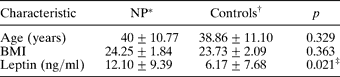
The clinical characteristics of the nasal polyposis patients and the control subjects are summarised in Table I. The patient group comprised 14 men and 14 women (mean age, 40 years; range, 20–64 years) and the control group 10 men and 12 women (mean age, 38.86 years; range, 22–61 years). The mean BMI was 24.25 ± 1.84 in the patient group and 23.73 ± 2.09 in the control group. The study groups were matched in terms of age and BMI, and there was no significant difference between the groups with respect to age and BMI (p = 0.363).
Clinical Characteristics of Nasal Polyposis Patients and Controls

* n = 28, female/male = 14/14;
† n = 22, female/male = 12/10.
‡ Statistically significant difference. Data are given as means ± standard deviations, using the student t-test. NP = nasal polyposis
The leptin levels were 12.10 ± 9.39 ng/ml in nasal polyposis patients and 6.17 ± 7.68 ng/ml in controls. A significant difference (p = 0.021) was observed in the mean levels of serum leptin between nasal polyposis patients and control subjects. No significant difference in serum leptin levels was detected between male and female nasal polyposis patients.
Discussion
Nasal polyposis is considered to result from local upheaval of the sinus mucosa, with mucous membrane hyperplasia secondary to chronic inflammation. However, the initial or persisting stimulus for the chronic inflammation is not known.
Although some associations exist with other respiratory tract conditions (such as aspirin sensitivity and asthma bronchiale), the pathogenesis of nasal polyposis is largely unknown thus far. Many factors have been proposed to play a role in the aetiopathogenesis of nasal polyposis, including allergy, vasomotor disorders, mechanical factors and immunological diseases. However, published studies have mainly investigated the role of inflammation. Histopathological studies have shown the importance of eosinophils, cytokines and extracellular matrix proteins in the pathogenesis of nasal polyposis.
Both the structure of leptin and that of its receptor suggest that leptin should be classified as a cytokine.Reference Visser, Bouter, McOuillan, Wener and Harris10 In fact, leptin and its receptor share structural and functional similarities with members of the long-chain helical cytokines, which include interleukins (ILs) 6, 11 and 12, leukaemia inhibitory factor, granulocyte-colony stimulating factor, ciliary neutrophic factor, and oncostatin.Reference Mai, Böttcher and Leijon9 Therefore, we believe that raised serum leptin levels might play a pro-inflammatory role in nasal polyposis.
• Leptin is a proteohormone produced by adipocytes and is thought to act primarily through specific receptors at the hypothalamus
• Recent studies have demonstrated that leptin also acts as a pro-inflammatory mediator, and that it is a member of the interleukin 6 family of cytokines
• The aim of this study was to investigate the serum leptin levels of patients with nasal polyposis
• Serum leptin levels were found to be significantly higher in nasal polyposis patients
• Leptin, apart from its primary role in the regulation of body weight and energy expenditure, may have a role in the inflammatory response of nasal polyposis
Our results showed that serum leptin levels were significantly higher in nasal polyposis patients compared with control subjects. Furthermore, this result was independent of BMI. The primary role of leptin is to regulate body weight and energy expenditure, and circulating concentrations of leptin are positively correlated with body fat mass.Reference Camplified, Smith, Guisez, Devos and Burn4 Recent evidence shows that leptin acts as a pro-inflammatory cytokine.Reference Loffreda, Yang, Lin, Karp, Brengman and Wang7 Previous studies have investigated the association between inflammation and nasal polyposis, but the results are still controversial. In the present study, we aimed to assess the association between serum leptin levels, independent of BMI. To our knowledge, this is the first study in the English literature to investigate the association between serum leptin level and nasal polyposis.
Ünal et al. Reference Ünal, Eskandari, Muşlu, Pata and Akbaş11 investigated the serum leptin levels of patients with allergic rhinitis and healthy controls, and found significantly higher levels in the allergic rhinitis patients. Güler et al. Reference Güler, Kirerleri, Ones, Tamay, Salmayenli and Darendeliler12 investigated serum leptin levels in asthmatic children and healthy controls, and found significantly higher leptin levels in children with atopic asthma. It seems that leptin may have some effect on the regulation of inflammation in chronic inflammatory diseases such as nasal polyposis.
Leptin modulates cytokine production from monocytes and macrophages. Indeed, leptin regulates several cytokine secretion patterns. It has been shown that different inflammatory stimuli, including IL-1, IL-6 and lipopolysaccharide, regulate leptin messenger ribonucleic acid expression as well as circulating leptin levels.Reference Faggioni, Feingold and Grunfeld13 Furthermore, leptin is produced by inflammatory regulatory cells, suggesting that leptin expression could trigger or participate in the inflammatory process through direct para- or autocrine actions.Reference Sanna, Di Giacomo, La Cava, Lechler, Fontana and Zappacosta14 Indeed, circulating leptin levels are greatly raised in experimental models of inflammation.Reference Otero, Lago, Lago, Casanueva, Dieguez and Gomez-Reino15 It has been demonstrated that leptin-deficient mice showed resistance or reduced susceptibility to the development of both innate and adaptive immune-mediated inflammatory diseases, including experimentally induced colitis, experimental autoimmune encephalomyelitis, type one diabetes and experimentally induced hepatitis.Reference Otero, Lago, Lago, Casanueva, Dieguez and Gomez-Reino15 The mechanism of the leptin-dependent resistance to the development of innate immune-mediated inflammation remains unknown, but an imbalance between pro- and anti-inflammatory cytokines has been reported.Reference Faggioni, Fantuzzi, Gabay, Moser, Dinarello and Feingold16
In animal models, exogenous leptin has been shown to increase phagocytosis by macrophages, as well as to upregulate the production of tumour necrosis factor (TNF) α, IL-6 and IL-12.Reference Bastard, Jardel, Delattre, Hainque, Bruckert and Oberlin17 Circulating levels of TNF-α and IL-6 are increased in nasal polyposis,Reference Bernstein3 and it is suggested that IL-6 may be a key modulator of airway remodelling. Circulating IL-6 further stimulates the production of acute-phase proteins, such as C-reactive protein from the liver, leading to an inflammatory state.Reference Bastard, Jardel, Delattre, Hainque, Bruckert and Oberlin17 Leptin also promotes Th1 immune responses with secretion of interferon-γ, a strong pro-inflammatory cytokine. Enhanced secretion of interferon-γ induced inflammatory markers, such as nitric oxide and prostaglandin E2, has been observed after leptin stimulation in murine macrophages.Reference Raso, Pacilio, Esposito, Coppola, Di Carlo and Meli18
In the light of this preliminary result, we suggest that leptin may have a role in the inflammatory pathway of nasal polyposis. Raised serum leptin levels may be related to the general activation of acute-phase reactants and/or the inflammatory cytokine cascade. However, further studies are needed to determine leptin's exact role in the pathogenesis of nasal polyposis.