[F]eymania [con artistry], maraboutage [sorcery] and internet scams can be interpreted as Africa's contribution to the global economy of the occult world. (Ndjio Reference Ndjio2012: 294)Footnote 1
In Côte d'Ivoire, a brouteur is an online scammer, a transformation of the infamous Nigerian 419er, only here the ploy does not rely on stereotypes of African political turmoil and wealthy corrupt politicians, but rather on the production of virtual intimacy. The brouteur relies on the capacity of the internet to transfer affective connection, but augments this possibility by shapeshifting; using false social media profiles that often cross racial, gender, class and geographic boundaries, they enter into long-distance romances with their targets which they build and maintain for months, even years, waiting for opportunities to invent emergencies that require money to be wired, or sometimes twisting the relationship into one of blackmail.Footnote 2 For this kind of operation to function properly, it is necessary to produce genuine relationships of intimacy and trust that require regular and reciprocal communication, often on multiple media platforms. To provide an example of how the scammers operate, I offer the testimony of a French victim of brouteurs who complained about their case on the website Arnacoeurs:
I was scammed for four months by a woman claiming to be a Brazilian living in Abidjan. Out of work after the accidental death of [her] companion, [she] asked me to send her money to repatriate her to France. There followed four false attempts, blocked first by a lack of traveller's cheques, then a stolen Ivoirian souvenir mask with a value of €3,500 that she bought from a merchant. I had to pay €4,500 to keep her out of prison and her return fare to Abidjan, then her traveller's cheques worth €2,500 were stolen, plus her plane ticket and hotel. Total: €11,000 and the woman is still in Abidjan. What do I have to do to get my money back?
I am interested in the entanglement between digital technology, the art of the con and witchcraftFootnote 3 in contemporary Ivoirian culture – for like the feyman of Cameroon (Ndjio Reference Ndjio2012), the brouteurs are often accused of being sorcerers – or, more often, of hiring marabouts and other occult artisans to give them the power of persuasion over their mougous (targets). Such witchcraft cosmologies are also theories for understanding the viral and sometimes virulent socialities built around new technologies, in Africa and beyond. Geschiere writes: ‘a profound ambivalence about intimacy – as desirable yet at the same time frightening – haunts human forms of sociality all over the world’ (Reference Geschiere2013: xxii). As Archambault (Reference Archambault2017) has so aptly demonstrated with the mobile phone, new communication technologies have deeply disrupted established barriers between public and private, between the intimate and the broadcast. Ivoirian scams and occult practices around the internet provide us with a virtual guide with which to plumb these forms of ambivalence, intimacy and deception in global cyberspace, since that is the platform on which both sociality and sorcery increasingly take place.
In Abidjan, the internet was not merely a zone of luxury entertainment and conspicuous consumption; it was much more – the space of the imaginary, the space for economic gain, the space of self-transformation, a portal for spatial, temporal and socio-economic mobility. Simultaneously, such positive visions were underpinned by dark stories of blood sacrifice, madness and fatal car accidents brought about by the internet, as well as the capacity to use zamou – a new form of sorcery – to reach through the internet and control people's actions, through the smartphones people carried with them everywhere they went. These dark discourses around cyberspace led me to think about what the emergence of digital sorcery might mean, not only as a social fact within West African cities, but also as an ethnographic theory of the internet.
These characteristics of digital social space respond rather seamlessly to the plasticity, interconnectedness and multiplicity of Ivoirian (and many other African) cosmologies of a second world that coexists with the first. The second world is best understood as a double of the everyday world, but it is here that spirits, witches, ancestors, djinn and other paranormal entities are present and visible in the flesh, as it were. It is here that witches are said to consume the flesh of their prey in feasts hosted by covens who demand that their members sacrifice their own kin. Mbembe has argued that ‘the plasticity of digital forms speaks powerfully to the plasticity of African … cultures and to ancient ways of working with representation and mediation, of folding reality’ (Reference Mbembe2016). Above all, as Katrien Pype and I have argued elsewhere (Newell and Pype Reference Newell and Pype2021), the second world of African cosmologies seems to uncannily parallel many aspects of virtual social space. As De Boeck has suggested of Kinshasa, the second world often seems to eclipse the first in importance (Reference De Boeck2000). As I understand it, the deuxième monde is the hidden infrastructure motivating the social, the potencies and causal connections that shape visible social action from the sidelines. Indeed, Koenig's recent ethnography of Abidjan argues for a concept of ‘occult infrastructure’ underpinning how social relationships are structured and negotiated (Reference Koenig2020). Dozon describes how Dobé, a village in western Côte d'Ivoire, turned into an invisible city at night in the deuxième monde. This doubled city was the causal source of unusual events in the everyday world, interpreted as ‘the result of a combat fought elsewhere’ (Reference Dozon1981: 394). Thus, the visible social world becomes interpreted as the theatre stage being orchestrated from behind the scenes by invisible operators. This is what Evans-Pritchard (Reference Evans-Pritchard1937) was after in his ground-breaking work on Azande occult concepts, when he suggested that witchcraft is the ‘second spear’, the social cause that supplements natural (scientific) causality, originating in a virtual double of social space.
The idea that sorcery now travels through the internet is just another ‘deadly fashion’ (Geschiere Reference Geschiere2013) in the ongoing African investigation of the invisible world – one marked by its association with colonial, neo-colonial and neoliberal entanglements with the North Atlantic, but nonetheless one whose miraculous efficacy and transformative wonder are rooted in long-standing cosmologies of the occult or ‘second world’. It is the importance of this mutual plasticity and the potential that popular theories of witchcraft contain for thinking about virtual technological worlds that I want to focus on here. As Whitehead and Finnström wrote in their book Virtual War and Magical Death, the ‘“techno-modern” and “magico-primitive” in fact blend into each other and thus need to be addressed through a symmetrical anthropology’ (Reference Whitehead and Finnström2013: 2). Perhaps the most important site of such blending is the internet, especially in its geo-localized smartphone incarnation, which increases the fabrication and circulation of images at an unprecedented rate. The smartphone's omnipresence and logged locality allow for a reproduction and instantaneous circulation of live events in a way that grants them apparent authenticity. At the same time, digital images can be manipulated and edited in new ways that are harder and harder to decipher for consumers. Magic has always been about the intersection of semiosis with the real – the capacity of signs to produce actual ‘perlocutionary’ effects on the world (Austin Reference Austin1962). The shaman's sleight of hand to produce a stone or a bloody worm apparently snatched from the belly of their sick client may be a trick, but the patient often recovers when they see the material source of their pain removed. Digital technologies allow for new ways to make magic visible and to share evidence of its effects, as well as new ways to produce and transfer semiotic efficacy.
This overlap between digital technology and sorcery is not unrelated to the role each plays in mediating intimacy. The internet allows us to both publicize intimate experience and experience publicity in private spaces of domestic intimacy, transgressively breaking down the boundaries of private and public in ways that resemble the ability of the witch to be at once alien outsider and intimate familiar. Both the ability to fabricate reality through semiotic representation and the ability to use the trust of intimacy to harm others for personal gain are capacities shared by the brouteur, the bluffeur, the hacker and the witch, all of which tend to collapse together in contemporary Ivoirian popular discourse.
Abidjan behind screens
Returning to Abidjan in 2015 after many years away, I encountered a generational shift around digital technologies, as the smartphone had brought widespread access to the internet and social media.Footnote 4 This rapid change in access to the internet is verified by Le Monde, which reports that from barely 200,000 Ivoirian ‘internauts’ in 2012, there were more than 10 million in 2019 (Ciyow Reference Ciyow2019). In a televised debate about the influence of music on Ivoirian youth, the middle-aged adults complained that now there was no way to control what entered public media. ‘In the village there is no internet,’ one claimed, but ‘the youth are all within the internet. They get internet through their phones now and “l'internet ne s'arrete pas”.’ This expression, ‘the internet doesn't stop’, resonates with the technological potentiality of virality and its capacity to breach all boundaries. Such capacities come with a sense of moral and spiritual unease. When I asked my old friend Christophe (in his mid-thirties) whether he had an email address, he looked at me in scandalized shock, shaking his head. ‘Nor would I want one,’ he said. His outraged tone puzzled me, until I realized that it matched the moralizing discourse of those who associated the internet with the brouteurs and the rash of missing children that year. But despite anxieties around the dangers of the internet, for many it was also an irresistible new space for the circulation of images of success.
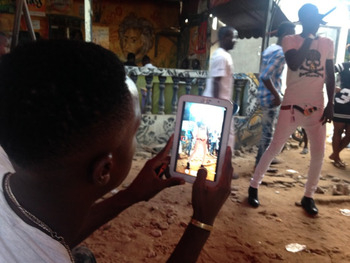
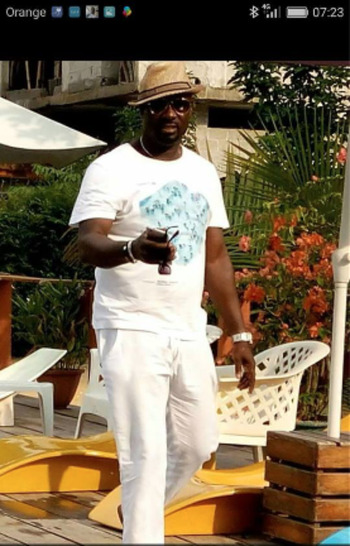
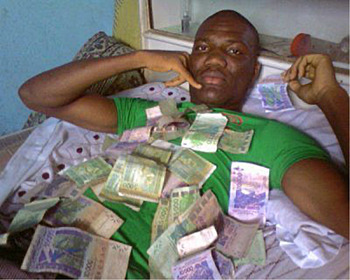
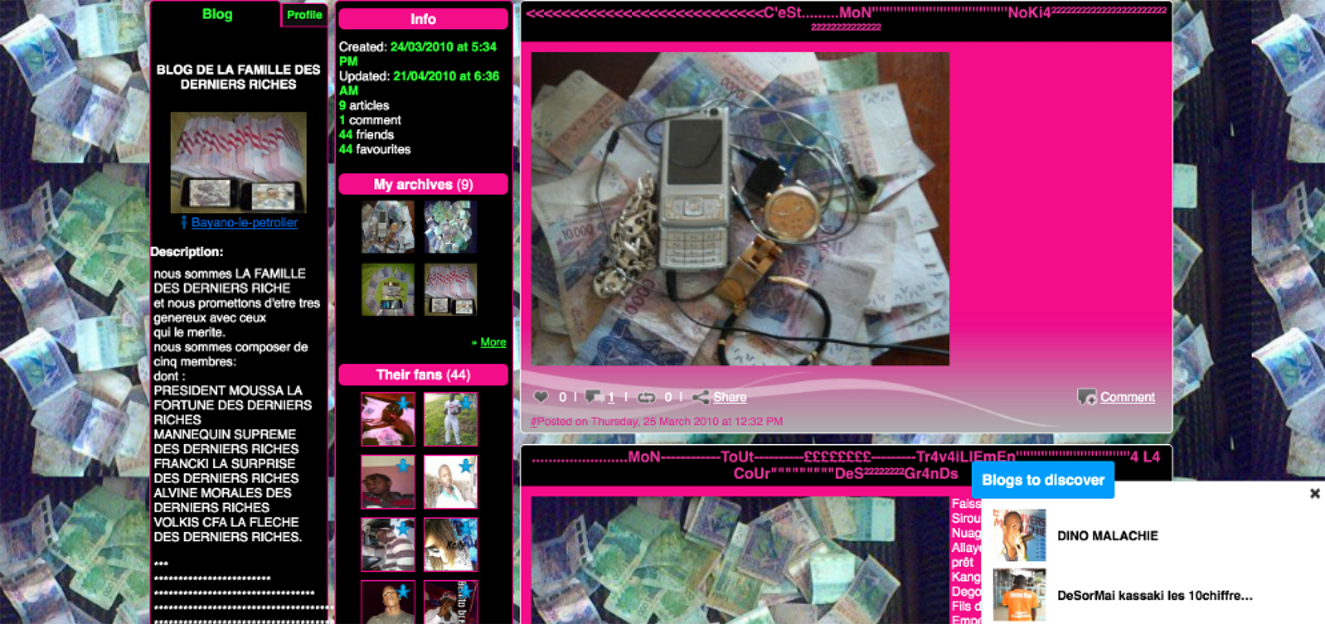
If Archambault (Reference Archambault2017) demonstrated the embeddedness of pretence in how mobile phones are used to negotiate visibility and invisibility, smartphones extend and archive such pretence onto social media platforms that become virtual doubles of analogue social networks through which gossip moves (Figure 1). Indeed, Abidjan's online life had become so rich that when I got home I was able to continue to pursue social connections and ethnographic foci, tracking not only public discourse about the brouteurs in newspapers, blogs and other online media, but also following the active self-performances of brouteurs in their social media feeds. I am now privy to the selfies from some of my old contacts in Abidjan on Facebook (Figure 2) and can check in on the feeds of some of Abidjan's boucantier celebrities.Footnote 5 Although my awareness of brouteurs and my richest interviews about both witchcraft and the internet were carried out in person in Abidjan, making use of my pre-existing social networks, I also gathered much of the data presented in this article to contextualize those findings through digital ethnography. Importantly, the perspectives I offer here are based more in the popular discourse surrounding brouteurs than from in-depth work with brouteurs themselves.Footnote 6 Nevertheless, to a significant extent, it is precisely in this virtual sphere that the action is taking place, as brouteurs use social media to present themselves and their money, uploading selfie after selfie of young men surrounded by packets of cash, portrayed as spilling out of their mouth and ears, or bursting from their underwear, spread out over the mattress they are rolling on, as though the money was somehow produced by their own body (Figure 3). These images of financial abundance are so common that they constitute a new genre of Ivoirian popular culture.
A young man films his friend's impromptu performance in a maquis on his tablet.

Screenshot shared by a friend on his Facebook page.

A brouteur rolling in money. Source: Photographer unknown, published at <http://www.arnacoeurs.com/2018/09/le-courrier-des-brouteurs-52.html>.

During my fieldwork in 2001 (Newell Reference Newell2012), I focused on bluffeurs (young men devoted to bluffing their way to success by appearing to have limitless resources). At the time, migration to the North Atlantic (or what they referred to as Bengue) had been the central dream of social mobility and self-transformation. Digital navigation now offered a novel, virtual route to real financial abundance and prestige, its material results both more secure and more immediate. While pickpockets, armed robbery, purse snatching, paper forging and petty scams had once offered a means of day-to-day survival for many urban Ivoirian youth, the streets had become noticeably safer as the primary site for criminal pursuits had shifted online and now targeted the world at large rather than those present on Ivoirian soil. Just as consumption of European goods can be considered a partial migration (Newell Reference Newell2012), the internet provided a means to pass virtually into a shared space of participation and mutuality with Bengue – the lands of modernity.
In the years following 2001, bluffing did not come to a stop – it even intensified. The boucantiers, who by 2015 were considered synonymous with brouteurs, made bluff even more theatrical, involving dramatic group arrivals, move-by-move narrations of their accomplishments over loudspeakers, using low tables as fashion runways, and drinking champagne. They developed a symbiotic relationship with the DJ, another emergent figure, whose job it was to narrate their every move over the blaring loudspeakers, frequently interrupting the music with their staccato chants. The DJs were digital entrepreneurs, marked by the USB drive they typically wore about their neck on a chain and that contained their music collection, especially their own greatest hits, their very music itself a pastiche of cut-and-paste electronic loops. The central act of the boucantier involved travailler (working), giving money away and even throwing it into the air while dancing, an inversion of the widespread African practice of sticking money to the body of an appreciated performer.
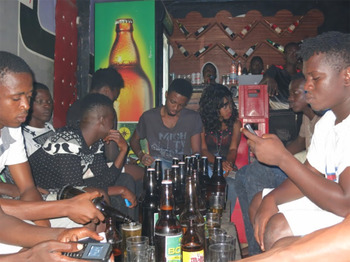
However, while the maquis (semi-outdoor social spaces where drink and food could be consumed; see Figure 4) remained an important social location and there were still groups of young people engaged in ‘faire le show’ during my fieldwork in 2015, I never witnessed anyone performing this famous act of ‘travailler’. Although confirmed by eyewitness descriptions, my observations of this are mostly drawn from online videos shot in maquis by onlookers, probably circulations of the most extravagant social performances rather than reflections of the everyday. The bluff, already a form of virtual wealth, has apparently moved towards the digital virtual world as its primary public. Indeed, Koenig's more recent fieldwork in Abidjan (Reference Koenig2020) indicates an important generational shift as the brouteurs he has known for years have moved increasingly away from bluffing in practice and towards more practical investments: establishing local businesses, maintaining the demands of romantic relationships, and supporting their families. Nevertheless, Ivoirians continued to appreciate the spectacle of boucan (the public acts of boucantiers) through mediated images, even if they did not engage in it themselves. One might say that the circulation of images of wealth online is a virtual bluff of tangible wealth, rather than the corporeal bluff of virtual wealth I focused on in my earlier work. In this sense, social media partially replaced the street public of the maquis, and by circulating images of money layered over the body it was possible to have one's wealth and ‘eat’ it at the same time (see Figure 5).
Ivoirian screen sociality in a maquis.

A brouteur blog from 2010. Source: <https://bayano-le-petrolier.skyrock.com/>, accessed 19 April 2019.

The new social figure of the brouteur epitomized the transformative power of the internet, and there was an appeal to the Afro-futuristic prestige of outsmarting the former colonists at their own technology. They claimed that their vast and highly visible wealth was repayment for the ‘colonial debt’, a claim that Jovan Lewis has supported in the parallel case of lottery scammers in Jamaica, where scams are acts of ‘counterdevelopment’ against structural adjustment policies (Lewis Reference Lewis2018). Brouteurs drove flashy cars too fast and enough of them died in car accidents to produce stories about occult debts being cashed in. Scammers living off their internet-driven profits displayed their newfound wealth and expanded fame in the same virtual domain, through social media, selfies, blogs and video clips.Footnote 7 Consumption and production were digitized reflections of each other. Their fame circulated in media and radio trottoir by street name, which typically indicates some combination of renowned power, force, wealth and style. Authentic pseudonyms I found listed online included the following:

The more famous brouteurs, such as Wapia de Paris, Le President Extractor and Diamant Noir, have taken on the status of culture heroes, fitting into a lineage of historical criminal figures who have taken on key roles in Ivoirian popular culture since at least the 1980s, often becoming singers or performers in their own right (Newell Reference Newell, Jaffe and Oosterbaan2019a). One of the most spectacular is Commissaire 5500 Voltes.Footnote 8 A darling of the press, he told a journalist he never travelled with less than 10 million FCFA (€15,000) in his car, and when held up at a stop sign he would give each child who approached a 10,000 FCFA bill. In one of his most famous performances, he spent thirty minutes on stage at a concert at the Palais de la Culture throwing bills into the air, around 7 million FCFA in total, in front of thousands of people. This kind of publicity eventually drew the attention of his victims, and he was imprisoned in May 2016. He was released after one year in 2017 and has since quickly returned to grand displays of his wealth,Footnote 9 announced his debut in Ivoirian film,Footnote 10 and was promptly arrested again in 2019 for conning €180,000 from someone in Europe.Footnote 11
The attention attracted by these extravagant characters as well as the increasing concern from the global North have made brouteurs the targets of local police (eighty-nine were arrested in 2018),Footnote 12 and wire transfer companies have created more security features on transactions directed to Côte d'Ivoire to protect customers. All of the brouteurs I interviewed said that they no longer engaged in the activity, and many indicated that broutage (the act of online scamming) was so difficult now that only those with occult assistance could succeed.
Avatars and white masks: performative efficacy and the digital con
Returning to the operation of the scam itself, we must consider the relationship between the establishment of intimacy and the performative arts of the con (see also Newell Reference Newell2019b). Unlike 419 scams, which rely on the greed of the mark, brouteurs rely on generosity and emotional attachment. These are mostly romantic relationships established with wealthy strangers seeking virtual companionship. Burrell's study (Reference Burrell2012) of the parallel case of Ghanaian Sakawa provides the most ethnographic detail of these scams, detailing the accommodation to racial stereotypes, the common choice to perform as female, and pioneering forays into chatrooms attempting to hook unknown invisible strangers. Brouteurs must successfully perform and pass as someone from another culture, another race, another gender for months of emails, text messages, social media posts and occasional live chats, silent codes they pick up through months of immersion (Koenig Reference Koenig2014). Burrell points out that, despite emic representations of the internet as disembodied, internet chatroom conversations almost always begin with a series of questions that quickly emplace the speakers in a specific gender, age, race and geographic location. Even if embodiment under these conditions is imaginary, it remains somehow essential to the development of ‘knowing’ someone, to the establishment of intimacy.
It is also worth thinking about the technical skills necessary to make these scams work. The brouteurs were reported to have nearly supernatural typing skills. Olivier reminisced:
I remember the first time I saw you type I was so impressed that you didn't need to look at your hands. But these guys didn't even look at the screen. They would be turned around having a conversation and typing with their hands behind their back. And while the brouteurs love to have a big fat mobile phone to show off, they have to have another phone with a normal keypad, because that way they can text with one hand without looking and they keep up their online relationships that way as they go about their everyday life.
Being a brouteur required a degree of professional training, and although during my fieldwork I heard quite a bit of scorn levelled at their criminality, the income they could produce sometimes earned them respect as professionals within their family as well as among their peers. Ivoirian blogger William Akire wrote that:
The phenomenon of brouteurs, these delinquents and scammers of the net, are today a corps de métier [profession] like all the others … One finds little kids dreaming of becoming brouteurs. Students in their khaki uniforms pass the school day in the cybercafé to hold on to ‘their whites’. Some parents offer their office to these students as ‘new workers’ … The fruit of this ‘work’ is shared by all and serves as the way to advance within the family.Footnote 13
More important to this ‘professional’ formation, however, is the art of mimesis.
The art of the bluff, so appreciated as social performance for local audiences in an earlier generation, is now vindicated as holding serious income-earning potential. But there remain technical mysteries. In order to become someone else online, one must have access to a steady stream of photographs of one's virtual identity, and there are apparently websites on the dark web that sell access to troves of such material. In reaction, there are websites such as Arnacoeurs – a pun that mixes arnaqueurs (scammers) with coeur (heart) – that collect and present the images used in these false identities as well as the stories of victims, in order to help people detect when they are themselves being scammed. In some cases, brouteurs have used pre-recorded video feeds during live Skype sessions, exchanging chat messages under the video in order to provide the appearance of being live (Koenig Reference Koenig2014). Another trick is to try to use video chats to get the mark to engage in some form of cybersex and record them, using the material to blackmail them later on.Footnote 14
These performances constitute a twist on Fanon's ‘white masks’, as actors digitally migrate and temporarily shed their Africanity in order to siphon wealth from the global North into African pockets. As in the epigraph, Ndjio (Reference Ndjio2012) writes of the Cameroonian version of such scams as an Africanization of global capitalism – rather than considering criminal economies in Africa as an effect of neoliberal policies and state corruption on African economies, brouteurs are an exportation of the trickster ‘spirit of sagacité’ from urban Africa to the global North.
Occulted intimacies: the intimation of relation
When a journalist asked a brouteur if he ever had a crisis of conscience, the latter responded that he saw himself as a kind of therapist: ‘People want to read what we write to them. They refuse to see that this is certainly a swindle. Europeans feel lonely and need to be comforted.’Footnote 15 A key aspect of how these scams work is the successful production of intimacy. Boellstorff (Reference Boellstorff2008) demonstrates the power of virtual worlds to produce actual intimacy, in some cases even enhanced forms of intimacy much more difficult to achieve in the physical world. The messages exchanged by brouteurs and their interlocutors must produce an affective state of trust and even love in the recipient; in order to convince them to send someone so much money, they must feel that this image on the other side of the screen is not a stranger but an intimate whom they have come to know, perhaps even depend on emotionally, and they sense a mutual affection flowing between the screens. Indeed, Burrell's account (Reference Burrell2012) of internet scamming opens with an example of a marriage produced by an internet encounter between a Ghanaian woman and a Canadian man, so sometimes the performance of intimacy can produce the real thing.
‘To intimate is to communicate with the sparest of signs and gestures,’ Berlant tells us in the introduction to her special issue on intimacy.
Conventionally, in its expression through language, intimacy relies heavily on the shifting registers of unspoken ambivalence. It is interfered with by metadiscourse (relationship talk) and prefers the calm of internal pressure, the taken-for-grantedness of the feeling that there would be a flowing reiteration where the intimate is. (Berlant Reference Berlant1998: 286)
I think this helps to understand the success of the brouteur in exploiting intimacy, for the target expects that intimacy to be intimated, not spelled out, and assumes the reciprocal mirroring of their own genuine affect. Indeed, the most effective communications here are the most affective – those that ‘say’ the least but imply the most. The ambiguous potential of the unsaid is akin to magic's exploitation of the unseen, where masking and secrecy are essential for the affective potency of the imaginary (Newell Reference Newell2018; Taussig Reference Taussig1999), short-circuiting rational logics and enervating the flesh, like the creepy chords of a horror film (Massumi Reference Massumi, Gregg and Seigworth2010).
Beek (Reference Beek and Mühlfried2018) makes a critical point about the relationship between trust and mistrust in his ethnography of Ghanaian Sakawa, arguing that the victims of fraud temporarily suspend mistrust just as they suspend disbelief in the narratives contained in the email. We might say that it is the habitus of a reader of fiction to allay disbelief during their engagement with it; and just as one's relationship to fictional realities is temporary, Beek argues that scam victims move in and out of mistrust, but often continue to send money anyway, presumably because they prefer to maintain the possibilities that continued trust allows.
Geschiere (Reference Geschiere1997) has long argued that ‘witchcraft is the dark side of kinship’. Whenever family relationships are transformed by new patterns of sociality, whenever the sphere of intimacy is stretched or pierced, we are likely to see new forms of witchcraft exploring and articulating the potential threats to which familial intimacy has been exposed.
Witches may hide inside, but they are oriented towards the outside world. Flying off to betray kin to outsiders, the witch makes a hidden breach in the enclosed space of the family or the community, through which its very life force can be drained, siphoned off to the outside world. This ambiguous position at the interface of the in and outside is vital for understanding the continuing resilience of these ideas. (Geschiere Reference Geschiere2013: xviii)
New communication technologies produce rifts in the enclosure that protects intimate space, while producing new deterritorialized platforms for intimacy to be created. The internet – precisely because it confounds the public–private divide in ways that are not yet reconciled with contemporary social norms – explodes our understanding of the boundaries around intimacy, highlighting the discomforts of both too much intimacy (the real meaning of TMI)Footnote 16 and not enough, now that our every movement, every transaction and click is being recorded, monetized, transacted and hoarded. Thus, the internet's ability to transfer, produce, dissimulate and breach the boundaries around intimacy is key to both its fascination and its menace, and the stories surrounding witchcraft thus constitute an archive for thinking about the (im)moralities and management of such forces.
Zamou: digital sorcery
As the anthropology of intersections between capitalism and the occult has led us to expect (Comaroff and Comaroff Reference Comaroff and Comaroff1993; Geschiere Reference Geschiere1997; Ndjio Reference Ndjio2012; Taussig Reference Taussig1980), the vast sums of ill-begotten money the brouteurs displayed in public as well as online instigated a wave of rumours about brouteurs and magical practices. According to public rumour as well as brouteur confessions, to succeed in earning all this money, brouteurs were forced to turn to occult techniques, typically by hiring occult specialists, often féticheurs or ‘marabouts’ (Burrell Reference Burrell2012: 121–8; Koenig Reference Koenig2020). I initially interpreted these stories as idiomatic moral critique, collective scorn at the rampant immorality and ‘undomesticated agency’ of urban youth (Nyamnjoh Reference Nyamnjoh and Werbner2002). But the brouteurs often admit to their use of occult assistance in interviews, and some even make their occult capabilities a part of their identity, like the social media star Chinape Chinapa (Figure 6), who makes videos of his ability to magically produce money out of his sneakers or his bedou magique, a wallet that never runs out of money.
A public post from Chinape Chinapa on Facebook.

During my original fieldwork in Côte d'Ivoire in 2001, there were many stories about canaris (clay pots) full of blood being buried and later dug up full of money, often associated with politicians. Such stories have been amplified by the public (and online) personas of the more famous brouteurs and their habits of displaying gaspillage (wasting) of large sums of money.
Douk Saga, the same figure who invented coupé-décalé, transformed the look of the bluffeur, and brought the act of boucan to Côte d'Ivoire, is also cited today as the originator of broutage. Although his wealth was always rumoured to have illicit origins, broutage was never part of his story as I learned it during his emergence in the early 2000s, and I suspect that this is a retrospective explanation for his dramatic rise to fame and wealth.Footnote 17 A group of my old friends from Treichville argued about whether or not his money was magical:
We didn't know where his money came from at first. It was only later, after he was dead, that we learned it was through broutage. The strangest thing about him was that his pockets always looked completely flat, as though he had nothing in them, but then the money never seemed to stop coming out of them. That has to have been magic.
Akim told me what he considered to be the real story, a story confirmed in Kehi's account (Reference Kehi2016):
It's money magic that killed Douk Saga. Lots of people died that way. There is a kind of magic in which you get a marabout to create a rooster out of the earth. It's not normal – roosters normally come from eggs – but this rooster they dig up from the ground. They don't allow it to drink any water. Before they dig it up, they scatter rice around the ground. The number of rice kernels it eats, that is how many years you will have in which you are rich, but when the time is up, you will die – at that exact hour, that day. Douk Saga's rooster must have eaten three grains, because that is how long he had. Three years. That magic is called zamou – a pact with the devil.
Indeed, Douk Saga died mysteriously only three years after emerging as one of the most important celebrities in Ivoirian popular culture and even as an international figure. The intensity of his fame and the extravagance of his fortune came at a cost, according to rumour.
Akim continued to talk about other forms of money magic, imitating how practitioners tear off the label of a beer bottle and chew it up, and then money streams out of their mouths – or they take a bottle cap and eat it and then coins pop out of their eyes:
But they can't eat from that money. They can make a deal, and say you give me 50,000 and I'll give you 100,000. But if you buy something with that 100,000, they cannot eat it. That's what happened to Sans-Monnaie. Sans-Monnaie's fetish was that he had as much money as he wanted, but he could never accept change. That's how he got his name. If he was buying something for 500 and he had a bill for 10,000, he wouldn't accept any change. Keep the change! One day he was in a maquis and the girl next to him accepted the change from the server without telling him. She used the money to buy some food and he ate from that plate, and now he has transformed into a dog.
Like Shipton's ‘bitter money’ (Reference Shipton1989), such ill-begotten cash was dangerous and unproductive. According to popular wisdom, it could be spent in useless excess, but it was impossible to invest it productively in family and futures. Ndjio (Reference Ndjio2012) suggests a similar interpretation for those engaged in money magic in Cameroon – those who do not distribute their money within their personal networks are believed to have gathered cursed money that will cause harm to anyone or anything it comes in contact with. Indeed, money magic seemed to be closely tied to the self-presentation of brouteurs, who sometimes perform such money magic in the maquis or posted on social media, presumably using sleight of hand (or camera tricks) to make money pour out of empty bowls or plastic buckets, thus drawing attention to their relationship to the occult.Footnote 18
These pre-existing relationships between magic, money and morality circulated with increasing intensity with the arrival of the internet in the popular sphere. A new form of digital sorcery called zamou emerged, specifically aimed at bewitching people with whom one is in contact on the internet to provide as much money as one asks for. In Koenig's fieldwork, they most often speak of ‘unblocking’ or ‘binding’ mougous (targets) who are not financially forthcoming (Reference Koenig2020: 154); he also depicts brouteurs who sometimes place a fetish over the screen of their computer to activate its effects upon their target.
A fascinating mini-ethnography of zamou is available from the unaffiliated Ivoirian scholar Franck Donald Kehi on the website Informations Sans Frontières (Reference Kehi2016). Kehi argues that the word zamou originated in the urban argot nouchi in around 2002 (at the same time as the emergence of Douk Saga and coupé-décalé) and combines the word zamlanhmlan (referring to a menial immigrant worker stereotypically from the Zarma ethnicity, who often employed gris-gris to enforce their physical strength) and samou (a Zarma term for herd animals). ‘Brouteurs’ in French literally means ‘grazers’ or herbivorous animals: ‘Thus, originally, zamou is the brouteur and the brouteur the zamou’ (Kehi Reference Kehi2016). To make zamou effective, a sacrifice was required – practitioners might give up their ability to sleep, or their fertility, the second half of their own life, or sometimes they collected the sexual fluids from relations with their sister or a ‘crazy’ person.Footnote 19 By doing these things, the brouteurs were said to make themselves irresistible to their online victims, gain control of the computers of others, and attain endless wealth.
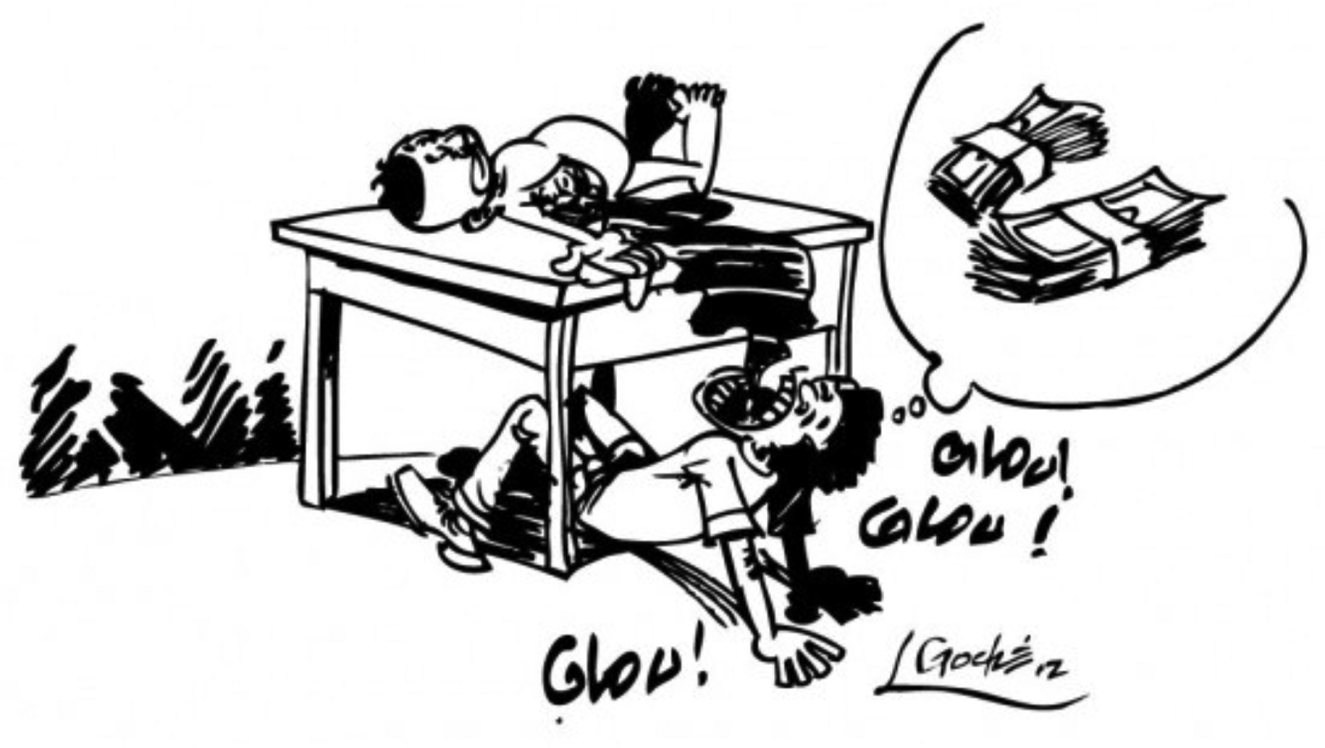
In the winter of 2015, a national panic ensued over the reported disappearance of twenty-five children over a period of three months, causing parents to pull their children out of school and the first lady to call for national action. Most speculation attributed the cause of the disappearances to occult practices. While some drew on long-standing rumours about the reliance of the political elite on ‘marabouts’ for power, many pointed their fingers at the brouteurs, who were said to be directed by their féticheurs to kill children and harvest their organs for blood sacrifice (Figure 7). Suspicions circulated not only through radio trottoir and newspaper reports, but virally through online news stories, social media, and horrific falsified memes depicting dismembered children.Footnote 20 The stories of child mutilations and disturbing rituals not only caused deep social malaise but were the direct cause of deaths, including several mob lynchings of brouteurs and one sad and terrifying case of a copycat killing by a youth caught trying to reproduce these stories using a real child. In other words, the internet was a modality for learning about and reproducing occult practices, and digital technology allowed for both the representation of occult violence and its rapid circulation, producing a collective representation powerful enough to produce actual violence.
Gbich! Cartoon depicting child sacrifice for financial gain.

I interviewed a couple of Treichville brouteurs who I had met in one of my neighbourhood haunts at the table football late one night. Both in their twenties, they said they had given up the brouteur profession but were willing to share stories from their experience. When I dared to bring up the rumours about sorcery, one of them spoke with shocking forthrightness:
When the white starts to stall and doesn't want to send money, you go to the marabout with a photo and a name. Then they say, ‘Give me human organs.’ And there is a market where you can buy blood, lungs, etc. Whatever you ask of the white after that, he will send it. The markets are secret, but there is one right near here in the IVOSEP building [a large funeral home near Treichville catering to VIP deceased people, including heads of state]. You go in, you talk to the guardian, pay [an entry fee of] 200,000–300,000 CFA – you enter, and you choose whatever body parts you want. Organs cost like 400,000 or 500,000 CFA [€600–750].
I assumed he was repeating hearsay, but he said it all in a deadpan voice, employing the ambiguously impersonal third person afforded by French (and perhaps especially prevalent in Ivoirian French, where ‘On dit quoi?’ [What does one say?] is the most frequent greeting) – I suspect he was deliberately leaving the origins of his insights ambiguous.
Some young musicians in Yopougon told me the following story when the subject of brouteurs came up, pointing out a young woman not far from us selling food on the street.
Baby blood is extra powerful. That woman went to take a bath and left her new baby in a basket. A young guy crept into her house and grabbed it. He gave the baby scotch (rubbed it over its mouth) to keep it calm. Then he put it in one of the [large wooden mortar and pestles to make foutou] and was about to smash it up, but someone saw him before he could deliver it to his marabout.
In an interview for Akody News, a marabout implied that these were the demands of the genies they serve – not their own choices: ‘What they demand from the youths does not come from us. In our work, we ourselves have to make sacrifices. If we could find a way we wouldn't ask anything of the youths.’Footnote 21 Thus, the motivation for such horror is always deferred. Like the rumours themselves, the origin point of witchcraft is always obscured (Siegel Reference Siegel2005).
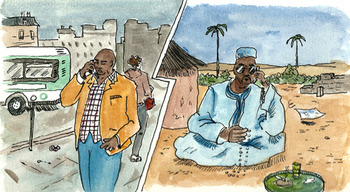
But it is not just that online scamming is thought to be dependent on sorcery and blood sacrifice: the modalities of magic have come to be increasingly imbricated with digital technology in general. The connection between the brouteur and the marabout has also been transformed into a virtual connection, and newspapers have carried cartoons of brouteurs chatting by phone with their hyper-connected marabout (Figure 8).
‘Un marabout et son client au telephone. D'un pays a l'autre. Crédits: Tommy.’ Source: <http://visavis.mondoblog.org/maraboutage-les-brouteurs-ivoiriens-sont-passes-maitres-dans-larnaque/>. The image found in the article cited in the caption was taken from the website <https://www.streetpress.com/sujet/1423829346-salle-d-attente-marabouts-chateau-rouge>, where it is also credited to ‘Tommy’.

More and more marabouts offer their services over the internet, often transnationally (since powerful magic always comes from far away), and this itself affords new opportunities for broutage – or marabroutage? – as the marabout to whom you send money in exchange for magical services might just be another brouteur posing as a magical practitioner. In a YouTube video circulating in 2020, an Ivoirian woman complains about the efforts of her Congolese friend to bewitch her in order to steal her husband. She found out when a marabout in Benin called her and confessed that he had been hired to kill her, sending her his entire chat history with her friend as proof.Footnote 22
Magical semiosis: the imbrication of digital and occult virtualities
There is an uncanny resonance in brouteur stories between the technical capacities of hackers and the language of Ivoirian occult practices. I was told to be careful who I gave my phone number to, as it could be used magically: ‘They can send you a text message, and you'll end up giving them all your money – you need to delete it right away’ or ‘They can get your mobile number just by sitting near you in a maquis. All of a sudden you get a text from them and you are like, how did they get my number. Ils sont trop forts.’ Brouteurs are increasingly technically proficient in manipulating virtual environments, as evidenced by stories of planting false videos in Skype chats to make them look like live chats. Thus, it is worth reflecting on how the viruses and worms of hacking culture resemble sorcery as they penetrate the walls of security with which we enclose our spaces of intimacy, taking over control and manipulating our worlds from the inside. Witches, like alien body snatchers, have the horrifying capacity to profit from our most trusted relations, working from the very belly of their human hosts, much like a hacked Facebook account used to ask their contact list for financial help, or the ability of a computer virus to turn our electronic appendages into weapons against ourselves.
Computers allow for the instantaneous reproduction of technically perfect copies, including digital doppelgangers of human beings, and armies of bots multiply the will of their creators across virtual space. And then there is the shapeshifting ability to transform one's own appearance – almost without limits – by producing animated avatars that act for you in the virtual space (new filters available on TikTok, for example, allow your live face to be transformed into a Disney animation or an anime character, or hyper-realistic ‘makeover’ filters automatically beautify live videos, including subtle shifts to facial structure).
Ivoirian witches are also said to be able to cross vast distances nearly instantly (flying on their magical aeroplanes), to meet in large late-night gatherings and participate in feasts without leaving their bedrooms, all characteristics of the space-collapsing effects of social media and video chat that have become so banal during the pandemic of 2020–21. Cybercriminals have also invented new ways to drain our bank account and hijack our computing power for their own schemes without our ever being aware of their aggressions, a vitality-draining effect that echoes the stories of jealous kin and neighbours draining financial resources, luck and health in the dark of the night without their victims ever realizing they are being attacked. And the dark web itself, that part of the internet that lives unregistered and inaccessible to the uninitiated, has allowed entities such as the ‘Silk Road’ to proliferate, exchange networks where all forms of illicit material and information can be bought, sold and traded with little fear of detection – this resembles all too keenly the invisible architectures of the second world (De Boeck Reference De Boeck2000).
But where the relationship between sorcery and the internet is especially fascinating is in the enhanced powers of circulation and rumour to transform and modulate reality. Just as the imaginary of the second world is a collective product forged through entwining pathways of the radio trottoir, and just as deadly witchcraft accusations initiate in the slipstream of gossip, we have witnessed the viral capacity of the internet to transform and fracture social reality (Lee et al. Reference Lee, Graan, Hodges and Stalcup2020). As in the electoral dalliance with fake news in 2016 and the emergence of QAnon as a mass distribution conspiracy theory during the pandemic, there is a self-confirming recursiveness to representation on the web that works very much like the closed loop of witchcraft cosmology first analysed by Evans-Pritchard (Reference Evans-Pritchard1937). Internet representations of brouteurs, their powers and their relationship to the occult become evidence for the reality of all these things. One particularly upsetting image depicted children's heads on spikes as the work of brouteurs. Unable to believe this, I tracked down the origins of the image to discover that it was an example of war photography from Sierra Leone; I later found an Ivoirian blog complaining about the dangers of precisely this kind of image forgery.Footnote 23 Likewise, the disturbing image of a brouteuse who had been turned half-dog by a jilted marabout turned out to be an appropriation of an image of a sculpture by the artist Patricia Piccinini.Footnote 24
But the point is not the falsity of these images, but that their fakery is irrelevant to their social power. In Bubandt's (Reference Bubandt2009) ethnography of a fake letter that inspired a massacre in Indonesia, the fact that many people identified the letter as a forgery did not stop them from believing that what it represented was true. Taussig's Mimesis and Alterity (Reference Taussig1993) spotlights the ability of mimesis to mean both the simple act of copying (the mimeograph) and the more sensuous act of magical mimesis in which the copy re-presents – calls into being – the original. If we use a neutral understanding of magic as the ability to transform the world through semiosis, the performative employment of signs with transformative efficacy, then it is very difficult to distinguish these capacities of the internet from magic. If we can believe ‘the Russians’ can shift US elections using troll factories, why are we incapable of believing in the transformative capacity of signs to alter reality itself? And isn't such a world-altering ability what people mean when they speak of magic? In this way, too, my own representations become a part of what I am discussing – they constitute what Harry West (Reference West2007) calls ‘ethnographic sorcery’, a discursive construction that projects itself into reality in the same way that circulations of witchcraft accusation produce witches, or even the semiotic conjuring that sorcerers use to heal or hurt by affectively tangling their audience in a new discursive definition of their own experience (Newell Reference Newell2018).
Conclusion
Taking a cue from African cosmologies of the second world that do not clearly differentiate between technology and sorcery, perhaps anthropologists should take seriously Arthur C. Clarke's famous third law of science fiction: ‘any sufficiently advanced technology is indistinguishable from magic’. Not the way it is usually read as an instance of what Larkin (Reference Larkin2008) calls the ‘colonial sublime’ – the use of technological prowess to wow the ‘natives’ into submission – but rather to accept that there may not always be a clear ontological gap between performative magic and technological wizardry. Pype (Reference Pype, Rio, MacCarthy and Blanes2017: 103–4) has carefully laid out the overlap in Kinshasa practice between kindoki ya biso and kindoki ya mindele (perhaps best translated as ‘our hidden knowledge’ versus the ‘hidden knowledge of the whites’), where electronic technologies such as television and radio have often been incorporated in healing and spiritual practices in the city. The ethnographic record is full of this kind of blending throughout Africa in witch-finding rituals that appropriate colonial bureaucracy (Richards Reference Richards1935), mirrors (Willis Reference Willis and Douglas1970), medical devices (Auslander Reference Auslander, Comaroff and Comaroff1993) and ‘radar’ (Smith Reference Smith2008). Evidence points towards contemporary digital technology having the capacity to delve into affective or non-conscious cognitive realms (Hayles Reference Hayles2017) where its effects are still more resonant with the probing, invisible ‘tentacles’ of witchcraft (Pype Reference Pype, Rio, MacCarthy and Blanes2017: 117). The smartphone has become a cyber appendage that gives distant and powerful corporate entities access to the most intimate and private moments, and since the technology is designed with cognitive efficacies rather than mechanical ones in mind, its technological agency actively encourages our voluntary participation and continued engagement. The mimetic capacity of digital technology to both duplicate and transform has affective resonances with non-conscious cognitive processes and unavoidable social imperatives, effectively hacking into the neurological infrastructures of sociality itself and producing both psychological and practical dependencies as simple acts of navigation and communication become difficult without digital mediation. The success of the brouteurs may well be explained by this neurological dependence on digital intimacy.
Just as the Maka of Cameroon (Geschiere Reference Geschiere1997) and the Nyakyusa of South Africa (Wilson Reference Wilson1951) describe witchcraft as a parasitic creature that lives in one's belly and manipulates the host's behaviour, the mobile phone latches onto our pocket and installs itself at the centre of our social networks, where it vampirically sucks information and financial transactions from us, feeding ever expanding corporate monsters already wealthier than any existing state. Even though many of us are increasingly aware of the dangers of the digital trails we are leaving and the profits and power we are ceding to data corporations, it has become nearly impossible to resist participation in social media and smartphone technology. For, like witches who lodge themselves within our most beloved relations of trust, new digital media is embedded within our private affective cognitive assemblages and in the phatic communicative infrastructures that make up society itself.
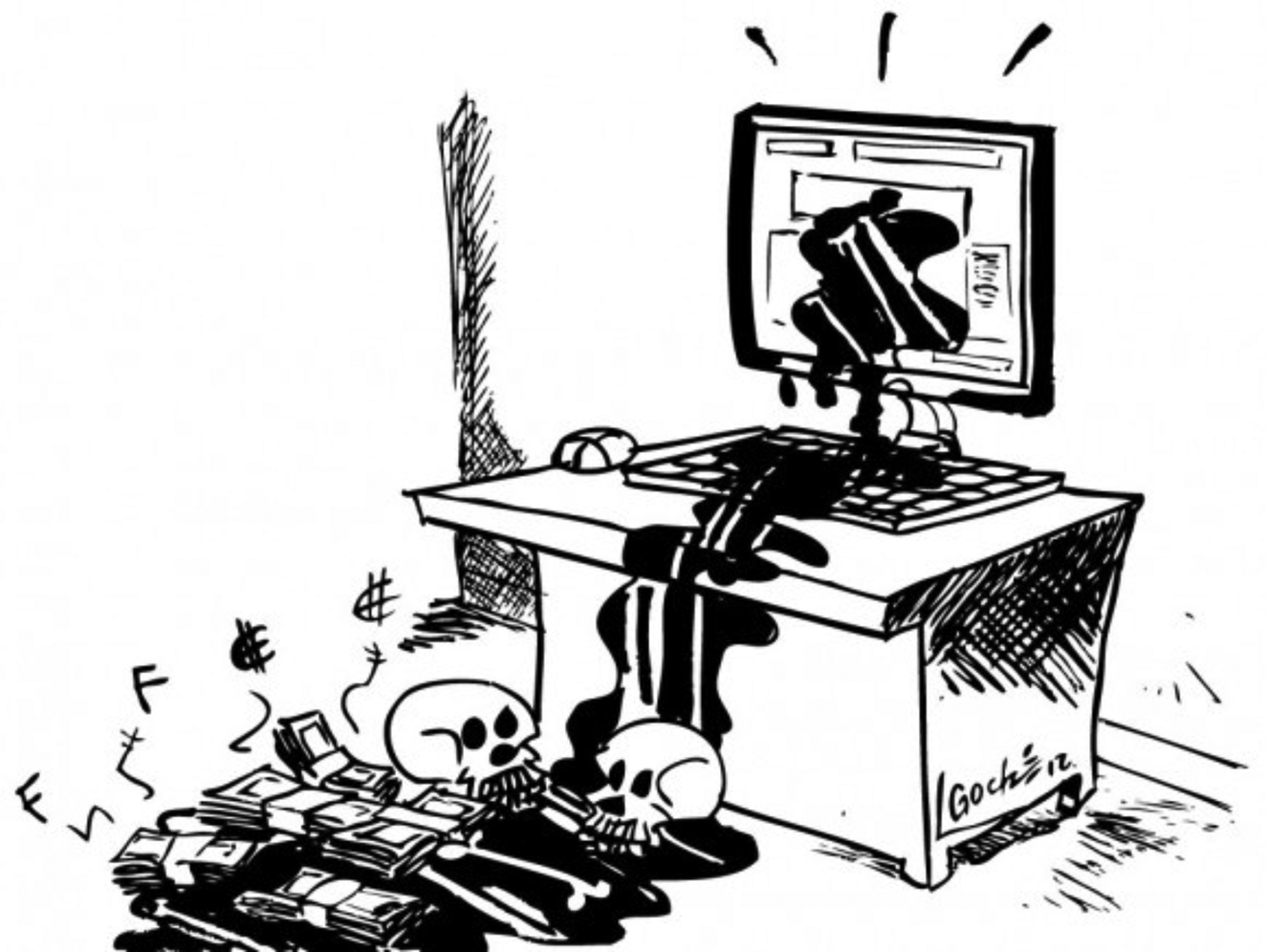
Perhaps a pause is warranted. What are the limits of the comparison I offer here? Certainly, as Frazer (Reference Frazer2002 [1890]) would have been quick to point out, the transformative capacities of the internet can be explained in step-by-step technological guides – the knowledge is transferrable. As much as they may appear as such to the lay person, hackers are not wizards. Magical expertise tends to involve impenetrable mystery and non-human forces that defer authority to spaces outside the social. However, the most important efficacies of both forms of virtuality depend on semiotic reception from the audience, and from this perspective the divergent forms of technical mastery are largely unimportant, as it is the invisibility of the technical infrastructure of enchantment that makes both compelling to the non-expert. My analysis here is based on the affective entanglements of semiotic communication in virtual spaces, where the intimacies of trust imply vulnerability to the betrayal of deceptive signals, whether across screens, in magical performances, or in the hectic circulation of rumour. I suggest that the stories of brouteur sorcery (see Figure 9) and cyber marabouts offer us a ‘theory from the south’ (Comaroff and Comaroff Reference Comaroff and Comaroff2012) of digital virtual space, which like the deuxième monde has now become the invisible causal source of transformation in the global economy, in the archiving and accessibility of cultural production (wherever there is internet), in the very infrastructures of sociality (especially post-Covid). Perhaps we can read cosmologies of the occult in Africa against the grain – not as cultural differences to be explained but as theories with which to conceive of the invisible and ethereal infrastructures of sociality that increasingly dominate our shared planetary space.
Gbich! Cartoon depicting the rewards and dangers of the internet.

Acknowledgements
I would like to thank the Wenner Gren Foundation for funding my initial fieldwork in Côte d'Ivoire and North Carolina State University for funding the subsequent fieldwork on which this article is based. Many thanks to Katrien Pype and Peter Geschiere for their comments and enthusiasm, and I am grateful as well for the work of the reviewers at Africa in improving the manuscript.