Introduction
The almond seed wasp, Eurytoma amygdali Enderlein (Hymenoptera: Eurytomidae), is a key pest of almonds in a number of European countries and in the Middle East (Avidov & Harpaz, Reference Avidov and Harpaz1969; Mentzelos & Atjemis, Reference Mentzelos and Atjemis1970; Plaut, Reference Plaut1971, Reference Plaut1972; Talhouk, Reference Talhouk1977; Arambourg et al., Reference Arambourg, Fauvel and Chevin1983; Zerova & Fursov, Reference Zerova and Fursov1991). E. amygdali has one generation per year and the larvae overwinter inside the infested almonds that remain mummified on the trees.
Control measures for this pest are based on cultural practices, such as collection and destruction of the infested almonds, and on chemical applications against the young larvae. The effectiveness of the insecticide treatments depends heavily on the time of insecticide application; newly hatched larvae bore inside the nucleus and feed on the fruit embryo where they are protected from insecticides (Mentzelos & Atjemis, Reference Mentzelos and Atjemis1970; Plaut, Reference Plaut1972; Talhouk, Reference Talhouk1977).
The use of pheromones in monitoring and controlling insect populations has become an important tool in pest management. The presence of a sex pheromone emitted by the adult female E. amygdali was demonstrated by Pittara & Katsoyannos (Reference Pittara and Katsoyannos1985) and Katsoyannos et al. (Reference Katsoyannos, Kouloussis and Bassiliou1992) who observed mating behaviour of captured males in traps baited with virgin females. The female-produced sex pheromone of E. amygdali was identified as a blend of (Z,Z)-6,9-tricosadiene [(Z,Z)-6,9-C23:2] and (Z,Z)-6,9-pentacosadiene [(Z,Z)-6,9-C25:2] (Krokos et al., Reference Krokos, Konstantopoulou and Mazomenos2001). Attraction of males to pheromone traps baited with 10 mg of the 7:3 blend in the field (Mazomenos et al., Reference Mazomenos, Athanassiou, Kavallieratos and Milonas2004) suggested that a pheromone-based monitoring system could be developed to detect the presence of male wasps and time the application of control measures. However, successful development of a monitoring system based on pheromone traps requires an understanding of various parameters that influence the trap performance, such as: ratio of the pheromone blend, trap type and trap height. In this paper, we report the results of experiments conducted in four almond growing sites in central Greece, aiming to test the efficacy of trap design and trap height and to explore the effect of blend ratio on traps efficacy in order to develop an effective pheromone-based trapping system for monitoring the seasonal occurrence of E. amygdali or for controlling its population by employing the mass trapping method.
Materials and methods
Chemicals
The synthetic alkadienes used in this study were kindly provided by Prof. Wittko Francke (University of Hamburg Germany). The alkadienes were 95–97% pure when analyzed on a 60 m×0.25 mm×0.1 μm film thickness DB-5 column (J & W Scientific Inc., Folsom, CA, USA).
Bait dispensers
The pheromone was dispensed from red rubber septa (Aldrich Chemical Co. Ltd, Gillingham, Dorset, UK; catalogue number 100722-100EA). For loading, 200 μl hexane solutions containing 10 mg of the blend [(Z,Z)-6,9-C23:2] and [(Z,Z)-6,9-C25:2] at the ratio of 7:3 or 1:1, respectively, were administered to the rubber septa. After evaporation of the solvent, the rubber septa were enclosed in aluminum bags and stored at −20°C until use.
Experimental sites
Trapping experiments were carried out in four commercial almond orchards (var. Ferragnes) in Microthivae (39° 15′ N, 22° 44′ E), Latomia (39° 24′ N, 22° 51′ E) and Kanalia (39° 30′ N, 22° 52′ E) (Magnesia province), and in Sykourion (39° 45′ N, 22° 34′ E) (Larissa province), all major almond producing areas in Thessaly, Central Greece. The three sites at Magnesia are 10–25 km apart and 68–83 km from Skourion. Kanalia, Microthivae, Latomia and Sykourion are 20, 35, 210 and 530 m above sea level, respectively. Kanalia is located at the bottom of a dried out lake (Karla) with unusual microclimatic conditions (cold winters and humid summers). The orchards were conventionally cultivated and 1–2 chemical treatments against E. amygdali were applied every year.
Adult emergence
The emergence rate of E. amygdali was monitored at the four experimental sites. At each site, two screen cages containing 300 infested almonds were placed on a 40 cm-high bench. The infested almonds were collected prior to trap placement from almond trees at the same site. On each trap-check date, emerged wasps (males and females) were counted and removed from the cage between March 10, 2004 and May 30, 2004.
Trap types
Four trap types were evaluated during the course of these experiments. These were: (i) white cardboard rectangular adhesive traps (28 cm in length, 7 cm in width), also known as Lasiotraps (Buchelos & Levinson, Reference Buchelos and Levinson1993); (ii) yellow plastic Rebel adhesive traps (30×10 cm); (iii) delta white adhesive traps (28×20 cm floor, 14 cm high Agrisense-BCS, Pontypridd, UK); and (iv) green plastic funnel type traps (22 cm high×15 cm external diameter) (Agrisense-BCS, Pontypridd, UK). In the white and yellow adhesive traps (Lasiotrap and Rebel), both surfaces were covered with Tanglefoot (The Tanglefoot Co., Grand Rapids, MI, USA); while, in the delta trap, sticky card inserts served to trap the wasps. Funnel traps included strips containing 0.5 g of dichlorvos (DDVP) as a killing agent for the captured individuals. Tanglefoot and sticky strips were renewed as necessary.
Experiment 1: Trap type and pheromone blend ratio
The effects of trap type and the pheromone blend ratio were tested in Latomia, Microthivae, Kanalia and Sykourion. The four trap types were loaded with 10 mg of (Z, Z)-6,9-C23:2 and (Z, Z)-6,9-C25:2 at either of two blend ratios, 7:1 or 1:1. There were four blocks, each with eight traps (four trap types×two blend ratios) placed randomly in the block. Traps within a block were placed every ten trees (80 m) and blocks were >100 m apart from each other. Traps were hung from almond trees 1.3 m above ground in March 10, 2004, and checked every three days until May 30, 2004, when captures were zero. In every check-date, traps were rotated to the next position.
Experiment 2: Trap type and trap height
The test was carried out in Latomia and Microthivae by using the same experimental design as above (four blocks for each location, eight traps totally within each block, two traps of each trap type within each block). Within each block, the two traps of the same type were suspended at different heights, 1.3 and 2.3 m above the ground. All traps were baited with rubber septa loaded with 10 mg of the pheromone blend at the ratio of 7:3, while the distance among blocks and traps were set as above. The traps were suspended in March 10, 2004 and checked for captured individuals at three-day intervals until May 30, 2004, as in experiment 1.
Experiment 3: Captures per hour
The daily attraction of males to pheromone traps was studied in Microthivae, in an almond field in which previous observations indicated high infestation and wasp activity (Mazomenos et al., Reference Mazomenos, Athanassiou, Kavallieratos and Milonas2004). Two traps of each trap type (Rebel and Lasiotraps), baited with rubber septa loaded with 10 mg of the pheromone blend at the 7:3 ratio, were hung at 1.3 and 2.3 m above ground in three blocks of four traps each. Hence, within each block, there were two traps of each type, one at 1.3 m and the other at 2.3 m above the ground. Traps within a block were placed every ten trees, or 80 m apart. Blocks were >100 m apart from each other. Trap captures were recorded on April 12, 15, 18, 21, 24 and 27, 2004, at the time of population peak. For each of these dates, the observations started at 06:00 and ended at 18:00, by counting and removing the captured E. amygdali males every hour (11 hours in total for each date).
Statistical analyses
Before the analyses, the number of captured males was transformed (log [x+1]) scale. In the case of experiment 1 (trap type and pheromone blend), the data were subjected to a three-way ANOVA for trap type, pheromone blend and experimental location. Similarly, for experiment 2 (trap type and trap height), the data were analyzed by using a three-way ANOVA for trap type, trap height and location. The data from experiment 3 (captures per hour) were subjected to a three-way ANOVA, for hour, trap type and height. In cases of significant interactions, the data were further analysed using the SLICE analyses of SAS Institute (1995). In all cases, means were separated by using the Tukey-Kramer (HSD) test at P=0.05 (Sokal & Rohlf, Reference Sokal and Rohlf1995). Finally, in order to examine the ‘synchronisation’ between trap catches and male emergence from the cages, the correlation coefficients of trap-cage pairs were examined separately for each region. The coefficient's were tested for the departure from zero using the two-tailed t-test, at P=0.01 (Snedecor & Cochran, Reference Snedecor and Cochran1989).
Results
Adult emergence
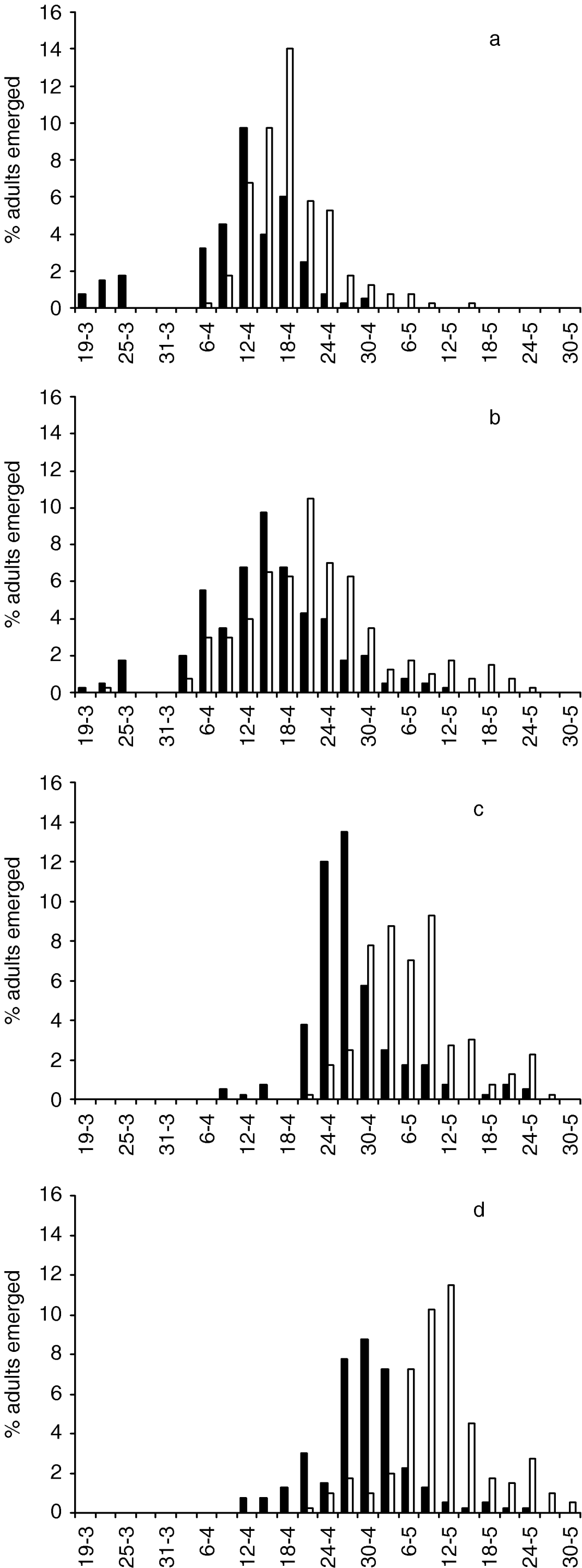
Adult emergence from the infested almonds kept in the cages differed among the experimental locations. Hence, in Latomia, the first male adults were recorded during mid-March, but the highest male number was recorded one month later (fig. 1a). Similar trends were noted in the case of Microthivae (fig. 1b). In contrast, in Kanalia and Sykourion, the majority of males and females emerged considerably later (late April-early May) (fig. 1c,d). Generally, in all cases, males emerged before females.
Percentage of Eurytoma amygdali adults emerged from infested almonds collected in early spring (day-month) in 2004 and placed in screen cages in four regions: (a) Latomia, (b) Microthivae, (c) Kanalia and (d) Sykourion (■, males; □, females).

Experiment 1: Trap type and pheromone blend ratio
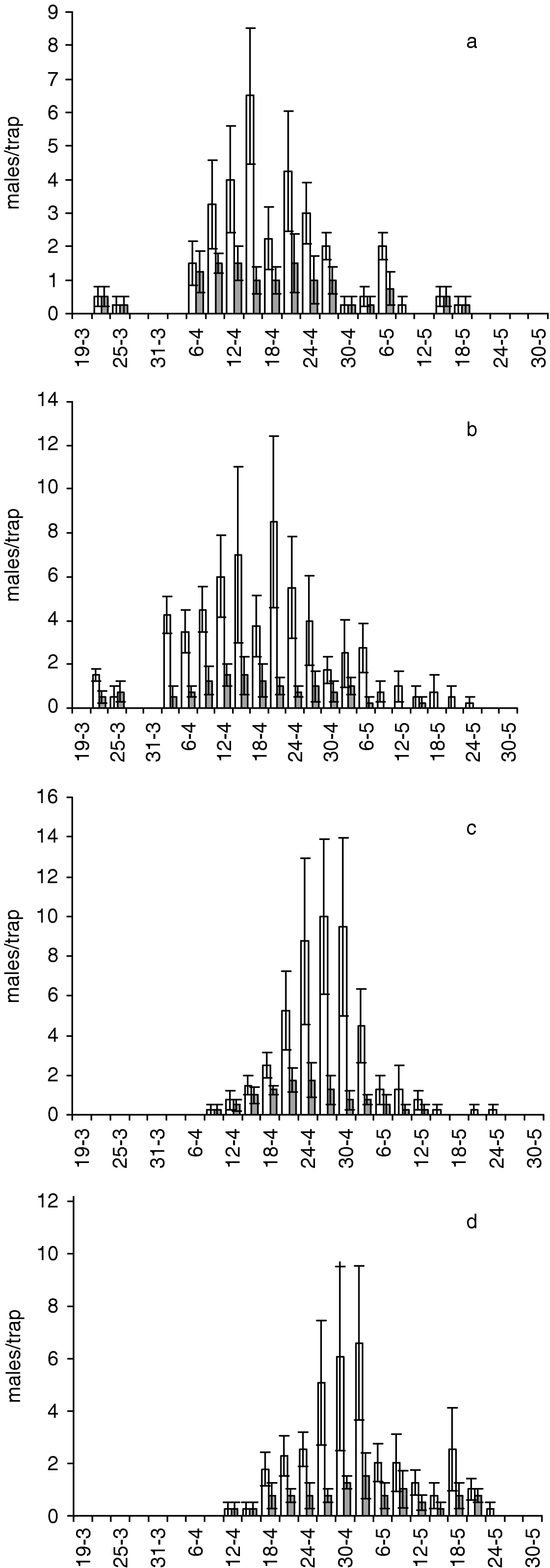
In the case of pheromone-baited traps, males were captured in all experimental locations and in all trap types. In Latomia and Microthivae, in traps baited with the 7:3 ratio, the highest number of adults was recorded during April (fig. 2a,b). In Kanalia and Sykourion, peak male capture was in late April and early May, respectively (fig. 2b,c). Generally, the seasonal occurrence, based on male captures for each location in the pheromone-baited traps, was similar to the seasonal emergence of males from the infested almonds of each location. Concerning the correlation coefficient values between male emergence and male captures in traps baited with the 7:3 pheromone ratio, in all cases, they were positive and significant (R=0.62, 0.78, 0.91 and 0.94 for Latomia, Microthivae, Kanalia and Sykourion, respectively, in all cases P<0.01).
Mean number of Eurytoma amygdali males/trap (±SE) on traps baited with 7:3 or 1:1 blend ratios during the monitoring period (day-month) in four regions: (a) Latomia, (b) Microthivae, (c) Kanalia and (d) Sykourion (□, 7 to 3 ratio;
 , 1 to 1 ratio).

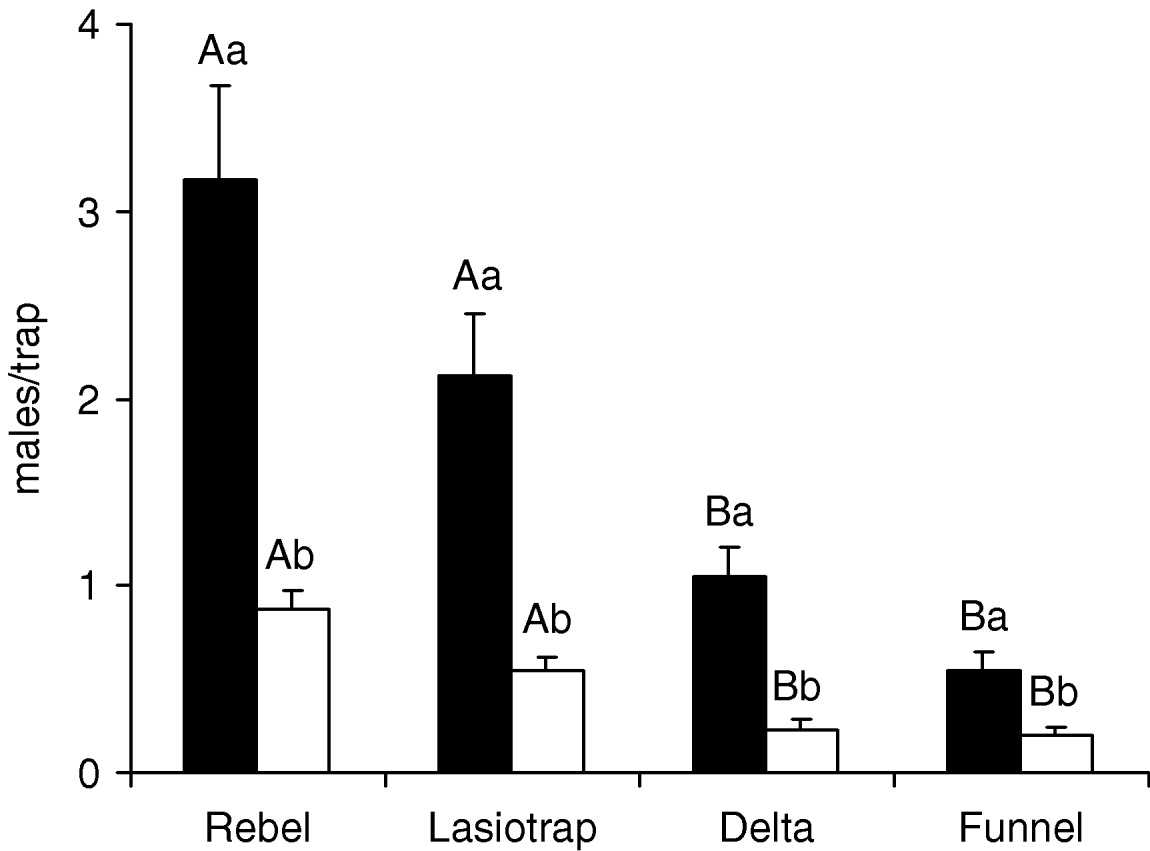
The following main effects and associated interactions were significant: (i) location: F3, 799=2.89, P=0.04; (ii) trap type: F3, 799=21.22, P<0.01; (iii) pheromone blend ratio: F1, 799=62.01, P<0.01; and (iv) trap type×pheromone blend ratio: F9, 799=7.15, P<0.01. The following interactions were not significant: (i) location×trap type: F9, 799=0.70, P=0.71; and (ii) location×pheromone blend ratio F3, 799=2.50, P=0.06. With the exception of Funnel, the 7:3 pheromone ratio was significantly more attractive than the 1:1 ratio, while no significant differences were noted among traps bated with the 1:1 ratio (SLICE analyses: Delta: F1, 768=6.54, P=0.01; Funnel: F1, 768=1.19, P=0.28; Lasiotrap: F1, 768=24.28, P<0.01; Rebel: F1, 768=51.45, P<0.01; 1:1 ratio: F3, 768=1.91, P=0.13; 7:3 ratio: F3, 768=26.46, P<0.01). Significantly more males were captured in Microthivae than in Latomia, while no significant differences were noted in the case of the other locations (mean males/trap/three days±SE were 1.46±0.19 in Microthivae, 0.88±0.12 in Latomia, 1.15±0.22 in Kanalia and 0.89±0.15 in Sykourion, respectively). Moreover, in all trap-check dates, more adults were found in traps that were baited with 7:3 ratio than the 1:1 ratio (fig. 2), and this trend was evident in all trap types. Also, significantly more males were recorded in Rebel and Lasiotraps than in the other two trap types (fig. 3).
Mean number of Eurytoma amygdali males/trap (+SE) in four trap types baited with 7:3 ratio or 1:1 blend ratios (within the same ratio, means followed by the same uppercase letter are not significantly different; within each trap, means followed by the same lowercase letter are not significantly different; Tukey-Kramer HSD test at P=0.05) (■, 7 to 3 ratio; □, 1 to 1 ratio).

Experiment 2: Trap type and trap height
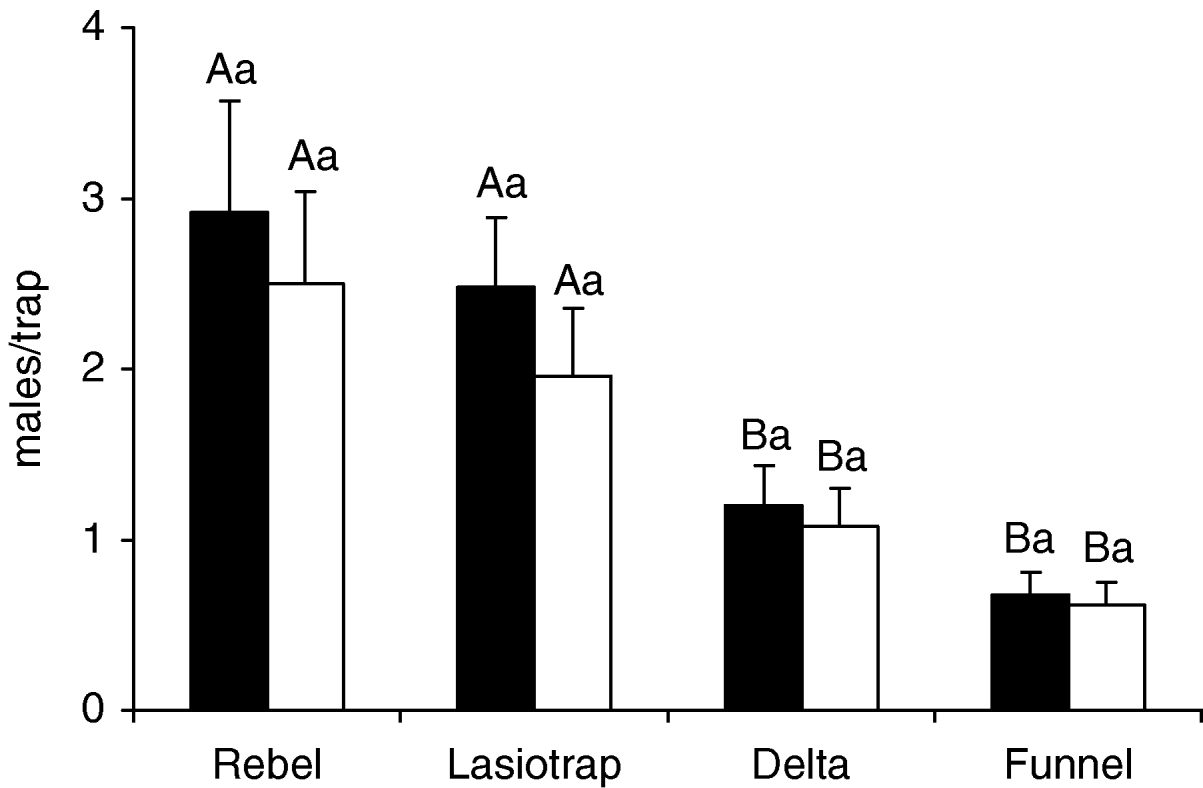
All main effects were significant at the level of P<0.01 (location: F1, 399=17.10; trap type: F3, 399=12.74) with the exception of height (F1, 399=1.11, P=0.29). All associated interactions were not significant (location×trap type: F3, 399=2.28, P=0.08; location×height: F1, 399=0.02, P=0.88; trap type×height: F3, 399=0.18, P=0.91). As in the case of experiment 1, significantly more males were found on Rebel and Lasiotraps than in Delta and Funnel traps (fig. 4).
Mean number of Eurytoma amygdali males/trap (+SE) in four different pheromone-baited trap types, suspended at different heights (within the same height, means followed by the same uppercase letter are not significantly different; within each trap, means followed by the same lowercase letter are not significantly different; Tukey-Kramer HSD test at P=0.05) (■, 1.3 m; □, 2.3 m).

Experiment 3: Captures per hour
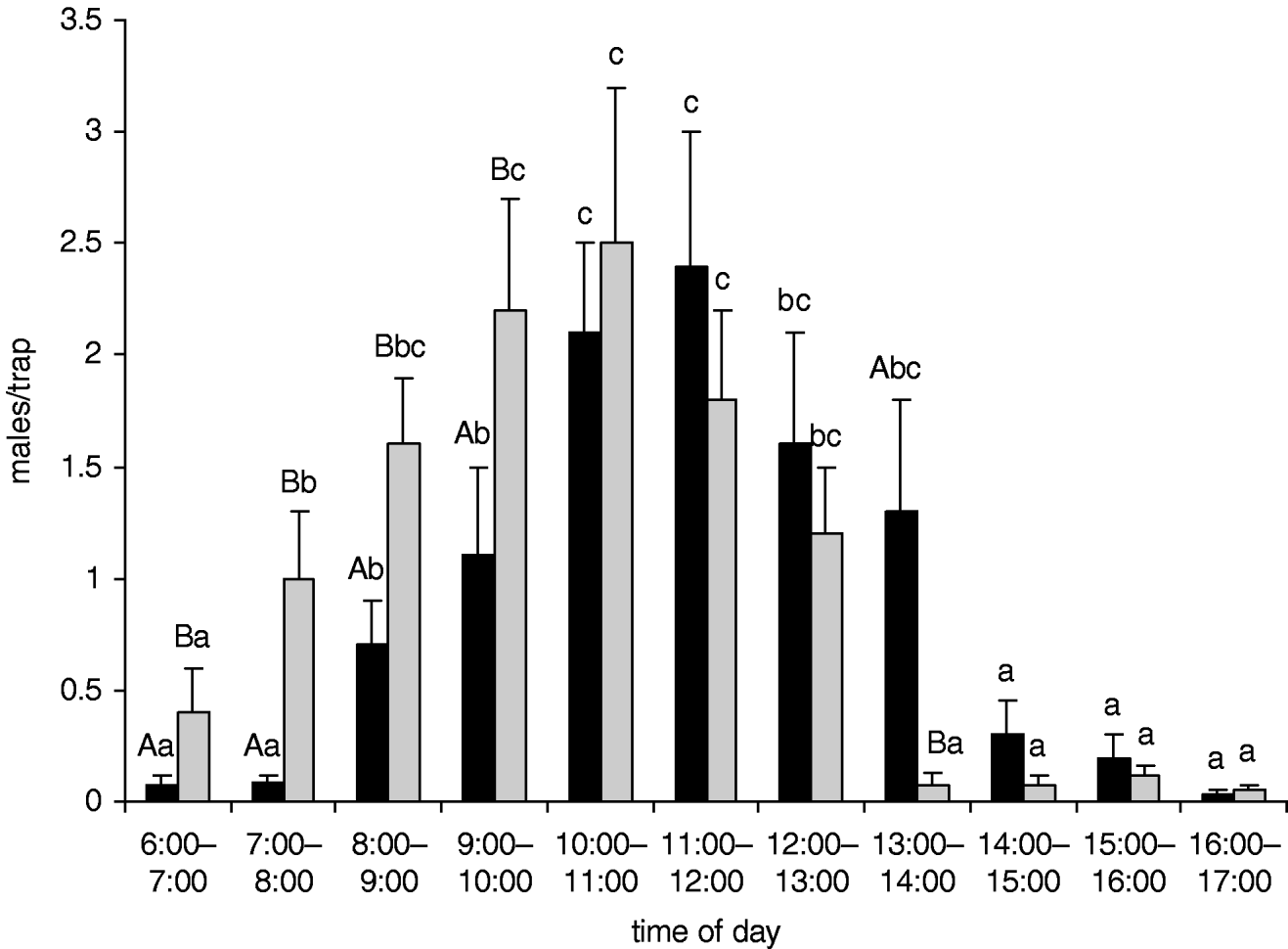
All main effects and associated interactions were significant at the level of P<0.01 (trap type: F1, 791=7.34; hour: F10, 791=30.31; height×hour F10, 791=6.09) with the exception of height (F1, 791=1.29, P=0.26), trap type×height (F1, 791=0.92, P=0.34) and trap type×hour (F10, 791=1.16, P=0.32), which were not significant. Significant differences were noted among hours for both heights examined; however, trap height was significant only in the case of five of the total number of hourly intervals examined (SLICE analyses: 1.3 m: F10, 748=16.92, P<0.01; 2.3 m: F10, 748=19.48, P<0.01; 6:00–7:00: F1, 748=0.76, P=0.39; 7:00–8:00: F1, 748=10.16, P<0.01; 8:00–9:00: F1, 748=10.16, P<0.01; 9:00–10:00: F1, 748=16.44, P<0.01; 10:00–11:00: F1, 748=2.10, P=0.15; 11:00–12:00: F1, 748=5.37, P=0.02; 12:00–13:00: F1, 748=2.10, P=0.15; 13:00–14:00: F1, 748=14.19, P<0.01; 14:00–15:00: F1, 748=0.76, P=0.39; 15:00–16:00: F1, 748=0.08, P=0.77; 16:00–17:00: F1, 748=0.09, P=0.75). From fig. 5, it becomes evident that, in traps that were suspended at 1.3 m height, the majority of the males were captured between 10:00 am and 12:00 noon; while, in the traps that were suspended at 2.3 m, the maximum number of captures was recorded earlier. However, in most cases, no significant differences were noted between traps that were suspended at different heights. Generally, males were recorded at both heights during the entire monitoring interval, but the capture rate was lowest before 8:00 am and after 13:00 pm.
Mean number of captured males (+SE) in pheromone-baited traps, at hourly intervals between 6:00 and 17:00, in traps suspended at two heights (within each hour, different uppercase letters indicate differences between the two heights, where no letters exist, no significant differences were noted; within each height, means followed by the same lowercase letter are not significantly different; Tukey-Kramer HSD test at P=0.05) (■, 1.3 m;  , 2.3 m).

Discussion
Previous studies successfully monitored E. amygdali adult emergence by the use of cages containing previously infested almonds (Mentzelos & Atjemis, Reference Mentzelos and Atjemis1970; Katsoyannos et al., Reference Katsoyannos, Kouloussis and Bassiliou1992). In those studies, it was confirmed that males appear first; and, in some cases, there is a considerable interval between the peaks of emergence of males and females (Talhouk, Reference Talhouk1977; Katsoyannos et al., Reference Katsoyannos, Kouloussis and Bassiliou1992). Hence, insecticidal applications that are based on the emergence of the first adults may not be effective for a satisfactory level of control of E. amygdali. Our results on the emergence of wasps from infested almonds in the four experimental locations stand in accordance with the above reports. Moreover, the cage data clearly indicate that, for a considerable proportion of the population, emergence does not occur within the same year. Similar observations have been recorded in previous studies (Mentzelos & Atjemis, Reference Mentzelos and Atjemis1970; Tzanakakis et al., Reference Tzanakakis, Karakassis, Tsaklidis, Karabina, Argalavini and Arabatzis1991; Mazomenos et al., Reference Mazomenos, Athanassiou, Kavallieratos and Milonas2004). For instance, in the same experimental area during early spring 2003, Mazomenos et al. (Reference Mazomenos, Athanassiou, Kavallieratos and Milonas2004) found, in the infested almonds, a noticeable number of E. amygdali individuals that were still in diapause. According to Tzanakakis et al. (Reference Tzanakakis, Karakassis, Tsaklidis, Karabina, Argalavini and Arabatzis1991), a part of the population of E. amygdali complete its life cycle in two or more years due to prolonged diapause, which requires certain thermal optima for its termination.
Despite the fact that cages can be effective as monitoring tools, this is a much more laborious method than the use of trapping devices, which capture E. amygdali adults. Mazomenos et al. (Reference Mazomenos, Athanassiou, Kavallieratos and Milonas2004) proved that the male attractant of this species can be used with success in trapping devices; however, the present study is the first report in which pheromone-baited traps are used to monitor E. amygdali populations during its entire flight period. In light of our findings, pheromone-baited traps can be used with success for monitoring purposes and can accurately present the seasonal flight activity of E. amygdali males. Moreover, male captures are good indicators of male emergence from infested almonds into the cages. It should be noted that R values were higher in the regions of Kanalia and Sykourionn, where the E. amygdali adults emerge later than in the other two regions. In warmer regions, such as Latomia and Microthivae, the lack of uniformity in temperatures prevailing early in the season (March, April) might have caused irregular and often intermittent emergence. On the other hand, more regular temperatures force the majority of adults to emerge in a shorter interval.
Trap design is one of the key elements in a pheromone-based monitoring protocol. Pittara & Katsoyannos (Reference Pittara and Katsoyannos1985) found that E. amygdali males responded to Delta traps containing 5–20 virgin females, while no response was recorded in traps containing mated females or empty cages. Similar observations have also been recorded by Katsoyannos et al. (Reference Katsoyannos, Kouloussis and Bassiliou1992). This is the first study on the influence of trap type on the capture of E. amygdali. The superiority of Rebel and Lasiotraps could result from the exposed sticky surfaces of these traps where simply a contact captures the wasp, whereas in Delta traps the adhesive surface is not exposed, and in the Funnel traps there is no glue. The relatively high numbers of males captured in Rebel traps than in Lasiotraps is likely to be a direct consequence of the highest total adhesive surface of Rebel traps. Moreover, since adults are active during daylight, yellow traps may be more attractive than white ones. In addition, in the traps with exposed sticky surfaces, the pheromonic lure is external, and this may play a certain role in pheromone dissemination.
Although traps baited with lures containing the pheromone blend at the 1:1 ratio captured males, these were less effective than those bated with the 7:3 ratio. This confirms the preliminary observations pointed out by Krokos et al. (Reference Krokos, Konstantopoulou and Mazomenos2001) and Mazomenos et al. (Reference Mazomenos, Athanassiou, Kavallieratos and Milonas2004) that (Z,Z)-6,9-tricosadiene is the major component of the male attractant for E. amygdali. On the other hand, the height at which the traps are suspended does not affect the overall capture performance, at least in the height range examined in the present study. Consequently, traps can be practically suspended at any height between this range (1.3–2.3 m) without a change in capture performance. However, trap height seems to play an important role in daily trap performance. In light of the present findings, the traps that had been placed at a height of 2.3 m captured males earlier in the day than those that were placed at 1.3 m. In fact, during the first three hours of the observations, the former traps captured 2–8 times more adults than the latter ones. The higher external branches are heated and lighted earlier in the morning and this may increase the captures of the higher traps. Further experimental work is needed to examine the factors that affect the daily activity of the E. amygdali male adults.
Kouloussis & Katsoyannos (Reference Kouloussis and Katsoyannos1994, Reference Kouloussis and Katsoyannos1995), using adhesive traps baited with virgin females, found that most adult activity occurs in the morning and that the flight activity continues until 19:00. Our results are in accordance with the above observations. However, Kouloussis & Katsoyannos (Reference Kouloussis and Katsoyannos1994) recorded that the peak in flight activity was between 9:00 and 13:00; while, in the present work, this interval was shorter, between 10:00 and 12:00. Since different regions were examined in the two studies, it is likely that different microclimates may be responsible for these variations in daily attraction. Moreover, response to virgin-female-baited traps may be different in comparison with the response to synthetic pheromone-baited traps.
In summary, traps with exposed sticky surfaces, baited with a 7:3 ratio of (Z,Z)-6,9-tricosadiene and (Z,Z)-6,9-pentacosadiene, can be used as a tool for monitoring the flight activity of E. amygdali males. The development of a pheromone-based protocol will provide the inferences necessary for a judicious control of this species, based on the accurate estimation of insecticidal applications. Further experimental work is required to evaluate if this pheromone can be used not only for monitoring but also for the control of E. amygdali (through mass trapping, mating disruption, etc.) under an IPM-based strategy.
Acknowledgements
We are grateful to Prof. Dr Wittko Francke and his group (University of Hamburg Germany) for providing the pheromone blend.