Introduction
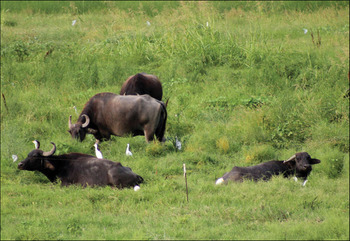
In the lowlands of the modern republic of Azerbaijan, small herds of water buffalo (Bubalus bubalis) are often seen wallowing in natural or human-modified wetlands inundated by the Kura River (Figure 1). Modern Azerbaijan and north-eastern Iran are major locations for water-buffalo husbandry, with their combined average annual livestock populations numbering almost 300 000 (Food and Agriculture Organization of the United Nations 2018). Although not always considered as one of the major domesticated species, these animals are particularly important for the economies of South and South-east Asia, contributing 6 per cent of all bovid meat and 17 per cent of all bovid milk produced annually, worldwide (Food and Agriculture Organization of the United Nations 2018). Notwithstanding this modern global importance, the history of how domestic water buffalo spread across Eurasia remains poorly understood. The recent identification of water buffalo remains in eleventh- to fourteenth-century AD layers from the excavations at the urban archaeological site of Bardhaʿa (in modern Azerbaijan) provides an opportunity to review what is currently known of the spread of this animal, particularly from the seventh century AD onwards. Historical accounts offer direct glimpses of this process, and, taken in parallel with the new zooarchaeological evidence presented here, not only elucidate the dispersal of these animals, but also provide a perspective on the social change that accompanied them.
Water buffalo (Bubalus bubalis) wallowing in artificially inundated fields near the modern city of Bərdə (photograph by A. Haruda).

By the late medieval period (thirteenth to fifteenth centuries AD), buffalo husbandry was practised across the Near East and Europe, but opinions are divided on when this spread occurred (McCormick Adams, Jr. & Nissen Reference McCormick Adams and Nissen1972: 25; Uerpmann Reference Uerpmann1987: 142; Potts Reference Potts, Valentini and Guarducci2019: 345–47). Late antique and medieval authors referring to the animal only contribute confusion regarding the early dates for its introduction into the Mediterranean, as the Latin moniker bubalus (from Greek βούβαλος) is applied across different categories of wild and domesticated cattle (Kitchell Reference Kitchell2014: 19). The missing piece of this puzzle is the accurate identification of buffalo in the archaeological record in the Near East. As these animals are often a similar size to oxen (castrated Bos taurus), their remains may be overlooked, particularly in fragmented assemblages, in which bones often lack the criteria necessary for identification to taxon level.
It is important to note that there are two subspecies of water buffalo (Bubalus bubalis) that are genetically distinct: the swamp buffalo, which is found in Southeast Asia and China, and the river buffalo that originates in the Indian subcontinent (Kumar et al. Reference Kumar, Nagarajan, Sandhu, Kumar and Behl2007; Hassan et al. Reference Hassan, El Nahas, Kumar, Godithala and Roushdy2009). Here, we focus on the river type and refer to it henceforth as water buffalo.
To understand the spread of water buffalo across the Near East and Europe, the animal's commercial potential for traction, food and also hide production must be weighed against the landscape prerequisites for raising these animals successfully—namely a consistent supply of shallow, standing water. The practice of wallowing in periods of hot weather is necessary to regulate body temperature, as they have less ability to lose heat through sweating, compared with other cattle (National Research Council 1981). Such prerequisites therefore restrict the adoption of buffalo herding to the often fragile wetland ecologies in which they thrive, providing an important case study for understanding human-animal adaptations in the face of environmental change.
Here, we document new evidence for the earliest water buffalo from the Caucasus, retrieved from the archaeological site of Bardhaʿa. This includes samples identified using ZooMS analysis from the early fourteenth century AD, alongside morphologically identified examples from stratigraphic layers dating to as early as the eleventh century AD. In order to contextualise these finds and illustrate their significance, we review current archaeological and textual evidence for the introduction of buffalo across the Middle East, before presenting the landscape of Bardhaʿa and the water buffalo remains found in the medieval urban centre. We conclude by evaluating socio-political models for this process: deliberate movements of people and animals vs the gradual diffusion of new agricultural practices into marginal lands.
Archaeological traces of water buffalo in Western Asia
The genetic and archaeological evidence suggest that the water buffalo was domesticated in the Indian subcontinent by c. 3000 BC from the wild progenitor Bubalus bubalis carabensis (Kumar et al. Reference Kumar, Nagarajan, Sandhu, Kumar and Behl2007; Mishra et al. Reference Mishra2015; Nagarajan et al. Reference Nagarajan, Nimisha and Kumar2015). The archaeological evidence for this taxon, however, remains limited, particularly outside of this region. There is a preponderance of large bovid remains in the Indus Valley, and some authors argue that domestication may have taken place there between the fourth and third millennia BC, as demonstrated by a reduction in the average size of individual animals during this period (e.g. Patel & Meadow Reference Patel, Meadow, Albarella, Rizzetto, Russ, Vickers and Viner-Daniels2017). Large quantities of bovid remains recovered from multiple Harappan-period (c. mid-third to second millennia BC) settlements in the Indus Valley, alongside frequent finds of zoomorphic seals and figurines of buffalo and cattle, underscore the central economic role of these animals in the prehistory of this region.
Beyond the Indus Valley, Bubalus sp. remains have been found in Neolithic contexts at Mehrgarh (seventh to sixth millennia BC) in Balochistan (modern day Pakistan), but have been identified as being wild, rather than domesticated forms (Uerpmann Reference Uerpmann1987: 78; Patel & Meadow Reference Patel, Meadow, Albarella, Rizzetto, Russ, Vickers and Viner-Daniels2017: 294). Meanwhile, two bones, unattributed to species, found in c. sixth-millennium BC contexts in Syria (Uerpmann Reference Uerpmann1982), probably represent wild Bubalus arnee, which was not subsequently domesticated in that region (Uerpmann Reference Uerpmann1987).
The tenacity of claims for archaeological evidence of domestic water buffalo in the Middle East before the late antique period (c. third to seventh centuries AD) is partly explained by extensive art-historical discourses on the iconography of ‘buffaloes’ in ancient Mesopotamia (Boehmer Reference Boehmer1975) and the interpretation of ambiguous historical descriptions (Casabonne Reference Casabonne, Peker and Ergin2006; a problem also observed by Potts (Reference Potts, Valentini and Guarducci2019)). The regular citation of Iron Age remains from second-millennium AD Bogazköy in central Anatolia (e.g. Hongo Reference Hongo1996: 65; Arbuckle Reference Arbuckle and Potts2012: 216) is based on a passing comment by Vogel (Reference Vogel, Bittel and Naumann1952: 152). Subsequent detailed zooarchaeological assessment of the site, however, has established definitively the absence of water buffalo in the assemblage (von den Driesch & Boessneck Reference von den Driesch and Boessneck1981: 24). This situation is identical for remains cited from the settlement of Korucutepe, also in Anatolia, from which water buffalo remains are, in fact, absent (Boessneck & von den Driesch Reference Boessneck, von den Driesch and von Loon1975: 37).
Domestic water buffalo bones have been recovered from contexts at Kamen-Kalehöyük in central Anatolia that were initially also believed to be Iron Age. In this case, however, Hongo (Reference Hongo1997: 279–81) stresses that the bones are almost certainly intrusive from subsequent, late medieval Ottoman layers (sixteenth to seventeenth centuries AD), in which Bubalus bubalis bones are also present. There are possible suggestions of buffalo in Iron Age contexts in Iran (specifically at Hasanlu Tepe), but metrics from this site do not currently support this conclusion (Davoudi & Mashkour Reference Davoudi, Mashkour, Hassanzadeh, Vahdati and Karimi2019: 496–98).
The earliest securely identified water buffalo remains from the region of Iran were recently found at the Gorgan Wall in the north-east of the country, and confirmed by genetic analysis. These remains have been directly radiocarbon-dated to the sixth to seventh centuries AD (Mashkour Reference Mashkour and Sauer2013: 555–58). Meanwhile, the faunal remains published from the site of Bastam (north-western Iran) and dated to between the ninth and fourteenth centuries AD, include six specimens identified morphologically as domesticated water buffalo (Boessneck & Kokabi Reference Boessneck, Kokabi and Kleiss1988: 226).
On current archaeological evidence, therefore, the story of water buffalo in Iran, and the Middle East more generally, begins at the earliest on the cusp of the arrival of Islam (c. seventh century). Even so, few archaeological examples are available to investigate the speed and the mechanisms by which the domesticated species was introduced into these new landscapes. For the time being, our knowledge of water buffalo during these early periods of introduction still relies on historical sources.
Water buffalo in early Islamic historical sources
The first mentions of buffaloes in Arabic historical sources relate to the movement of a people known as ‘al-Zuṭṭ’, originally from the region of al-Sind (roughly, modern Pakistan). According to the ninth-century historian al-Balādhurī, a group of buffalo and herdsmen were brought to the area of Antakya (ancient Antioch) from the marshes of southern Iraq at the time of Walīd ibn ʿAbd al-Malik (reigned AD 705–715) (al-Balādhurī; de Goeje Reference de Goeje1866: 167–68; Hitti Reference Hitti1916: 259). Al-Balādhurī states that the herdsmen and their animals were relocated to the Syrian frontier to deal with lions that had been plaguing the roads between Antakya and al-Maṣṣīṣah (a town roughly 25km to the west of modern Adana in Turkey), although he does not specify how herds of water buffalo would drive away predators. The technique seemingly worked, however, given that there are no further reports of such attacks. An earlier translocation of the Zuṭṭ to Antakya occurred under the Caliph Muʿāwiya in 49–50 AH/AD 669–670 (al-Balādhurī; de Goeje Reference de Goeje1866: 162), although it is unclear whether they were accompanied by their animals. Either way, it appears that by the close of the seventh century AD, buffaloes and their herdsmen were present in southern Iraq and north-eastern Syria. That these two specific locations should be the first loci of buffalo introduction into the Islamic world is unsurprising: they represent some of the most substantial areas of marshland in central Islamic lands (Wilkinson et al. Reference Wilkinson, Friedman, Alp, Stampfl and Fortin2001; Eger Reference Eger2011). These migrations were targeted specifically at the marginal wetland zones required for successful water-buffalo husbandry; they were also directly linked with one group of people: the Zuṭṭ.
The Zuṭṭ are generally associated with nomadic pastoralism, even in terms of their first encounters with the medieval Islamic world. Al-Balādhurī mentions that they “follow the pasture”, but also that they live on “the margins” (ṭufūf) (de Goeje Reference de Goeje1866: 373). The derogatory references to these people underline the degree to which they were perceived as outsiders. Al-Ṭabarī (d. 923 AD), for instance, mentions one incident in which the Zuṭṭ are referred to as ‘frogs’ (ḍifdiʿ/ḍafādiʿ), presumably on account of their somewhat ‘amphibious’ lifestyle in the marshes of southern Iraq (Guyard & de Goeje Reference Guyard and de Goeje1881: 1069; Bosworth Reference Bosworth1987: 140). Sources are unclear regarding possible earlier migrations of the Zuṭṭ into these wetland regions of Iraq and Syria; some medieval Islamic accounts mention migrations beginning under the Sasanians (third to seventh centuries AD), with conscription from al-Sind into the armies of pre-Islamic Iran, or as courtly musicians (de Goeje Reference de Goeje1866: 373, Reference de Goeje1903: 1–2; Daudpota Reference Daudpota1932: 100–101; Gottwald Reference Gottwald1961: 49). These pre-Islamic references do not mention buffalo specifically. As with the early Caliphal accounts of the Zuṭṭ moving with their animals, however, it is a central authority who encourages an outside group to come and settle the lands of Iraq, Iran and Syria, granting them specific ecological zones to inhabit.
Historical texts give few indications of the uses made of buffalo, although buffalo milk is associated with the region of Antakya and other parts of the Levant in the mid-ninth century. Elsewhere in the Middle East buffalo hides were used and there is some evidence that these animals were employed in transportation (de Goeje Reference de Goeje1866: 375, Reference de Goeje1877: 174, Reference de Goeje1890: 2019; Fields Reference Fields1987: 73; Collins Reference Collins2001: 146; Savage-Smith et al. Reference Savage-Smith, Swain, van Gelder and Sánchez Rojo2020: 14.3). Further textual investigation may eventually reveal other examples of how these animals were exploited in different contexts, but for now it can be assumed that their value lay in their adaptation to wetland environments and the variety of uses to which they could be put—very much akin to the present day.
The introduction of water buffalo into the Islamic world is thus an important indicator of both social and economic change. Our archaeological knowledge of these processes, however, is currently restricted to the few case studies that have definitively identified water buffalo in the early Islamic world. The site of Bardhaʿa in Azerbaijan offers a new archaeological example not specifically documented in the historical sources. The identification of water buffalo remains at this site attests to the spread of novel taxa across the medieval world through centralised political intervention.
Water buffalo in the historical landscape of Bardhaʿa
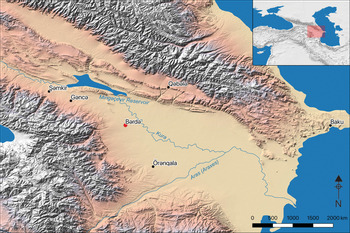
As the administrative centre of the modern Azerbaijani rayon (district), the town of Bərdə bears little resemblance to its historical eponym (Bardhaʿa), having been extensively redeveloped in the twentieth century on the same location as the historical site (Figure 2). A fourteenth-century monumental tower and a poorly preserved bridge are among the only vestiges of the town's historical architecture. Since the mid-twentieth century, the landscape surrounding Bərdə has been characterised by arable agriculture, which has transformed the ecology of the Kura River plain, substantially altering the historical hydrological landscape (Wordsworth Reference Wordsworth2018a).
Map of the Kura plain, showing the location of Bardha‘a and other major medieval cities in the context of the south-east Caucasus. Site names are given using the modern Azerbaijani orthography as opposed to the medieval historical toponyms. Topography: SRTM 30m (courtesy of the United States Geological Survey).

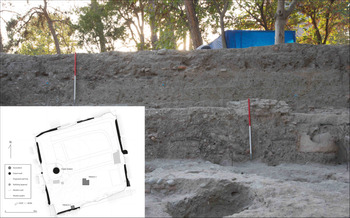
In 2015, the Archaeological Exploration of Bərdə project (AEB) began a series of excavations, accompanied by regional survey, to investigate this medieval provincial capital and its surrounding landscape (Wordsworth Reference Wordsworth2018a, Reference Wordsworth, Anderson and Hopper2018b). Excavations adjacent to the fourteenth-century tower have provided insights into urban life from the tenth to fifteenth centuries AD, revealing deeply stratified archaeological remains that were predominantly domestic in nature (excavation site AEB01; Figure 3). The approximately 300kg of animal bone recovered from 4.5m of deposits attests to the intensity of occupation in the form of food and butchery waste, deposited in thick layers during periods of intermittent remodelling of the area. The animal bone assemblage from this site is unique, as systematic retrieval and analysis of faunal assemblages from stratigraphic contexts is almost entirely unknown for medieval-period sites in this region; zooarchaeological material from comparable sites has rarely been quantified and archived. As well as revealing diachronic changes in human-animal relationships at the site, the zooarchaeological analysis has revealed the presence of water buffalo, which, in particular, warranted further exploration of the environmental context in which these animals were raised and used.
View of the stratigraphy of AEB01 trench one, which yielded the samples discussed in the text; inset) plan of the urban trenches in the modern city of Bərdə, site AEB01, showing the location of the nearby fourteenth-century monumental (tomb) tower (figure by A. Pantos).

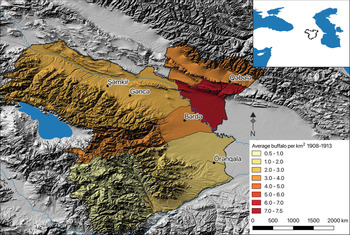
A combination of satellite imagery, historical maps and regional survey has been used to reconstruct the pre-modern landscape around Bərdə (Wordsworth Reference Wordsworth, Anderson and Hopper2018b). Maps and census data from the early twentieth century not only confirm that this region featured substantial areas of lowland marshes, but also that water buffalo were a crucial component of local livestock during recent centuries (Figure 4; Segal’ Reference Segal’1902: 212; Elisavetpol'skago gubernskago statisticheskago komiteta 1909: appendix 11, 1915: appendix 12; Generalstab des Heeres 1941). In 1913, Elisavetpol' Governorate alone raised 162 254 head of buffalo, equivalent to more than 90 per cent of the modern Azerbaijani national stock (Food and Agriculture Organization of the United Nations 2018).
Map showing the average number of water buffalo per km2 across three censuses (1902, 1908, 1913) of the Elizavetpol’ Governorate, based on totals per uezd (district). The modern Mingechevir Reservoir has been omitted to more accurately represent the early twentieth-century landscape (data from Segal’ Reference Segal’1902: 212; Elisavetpol'skago gubernskago statisticheskago komiteta 1909: appendix 11, 1915: appendix 12).

Zooarchaeological evidence for water buffalo at Bardhaʿa
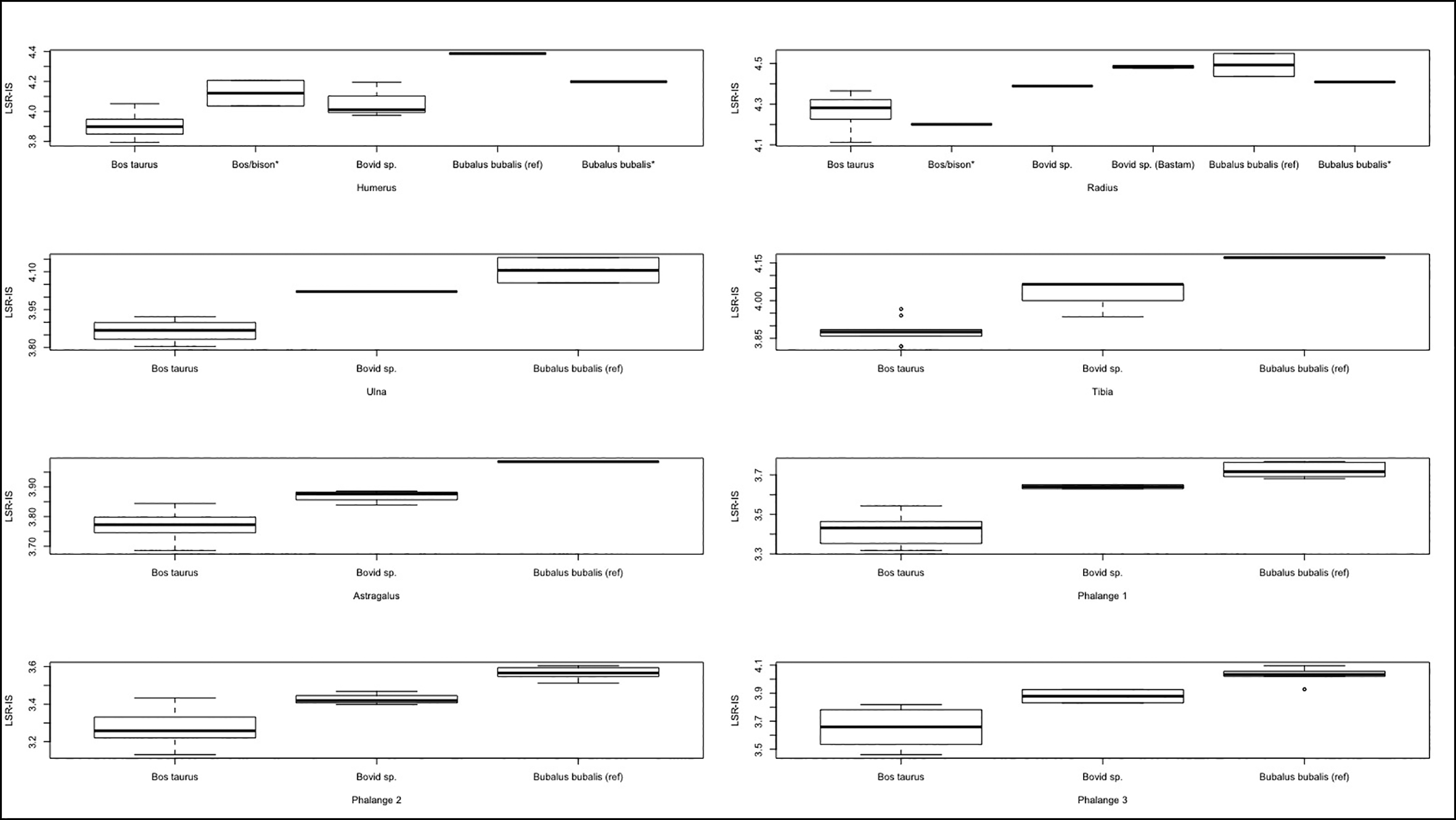
The remains of water buffalo from the excavations at Bardhaʿa were identified with reference to morphological guides (Joglekar et al. Reference Joglekar, Thomas, Matsushima and Pawankar1994; Haraniya et al. Reference Haraniya, Joglekar and Goyal2016) and a purpose-built reference collection including comparative archaeological Bos taurus specimens from Bardhaʿa. Skeletal measurements were taken according to von den Driesch (Reference von den Driesch1976) (see Table S2 in the online supplementary material (OSM)). Specimens were identified to Bos taurus when both morphological comparison with extant modern reference material and metrical data strongly suggested this identification. Specimens that exhibited Bubalus bubalis morphological criteria and were larger than the archaeological Bos taurus from Bardhaʿa were initially identified as Bovid sp. (Tables S2–3). Metrical results from the bovids (Bos taurus, Bovid sp. and Bubalus bubalis) were compared with extant reference metrics for modern buffalo originating from Iran and European zoos (Staatsammlung für Anthropologie und Paläoanatomie München), as well as other regional archaeological data from Bastam (Boessneck & Kokabi Reference Boessneck, Kokabi and Kleiss1988) and Shams Al-Din Tannira (Uerpmann Reference Uerpmann1982); Table S2). Due to the generally fragmented nature of zooarchaeological assemblages, a limited set of metrics that are consistently found across zooarchaeological remains were compared employing a Mosimann Log Shape Ratio (LSR) technique, using R to explore species discrimination in a more detailed manner, and to support taxonomic identification (Mosimann Reference Mosimann1970; R Core Team 2017) (Figure 5 & Table S2).
Boxplot of Log Shape Ratio (LSR) measurements from selected postcranial elements. All elements are from the site of Bardhaʿa, except for Bovid sp. from the archaeological site of Bastam, and reference Bubalus bubalis measurements, which are pooled from specimens originating from the reference collection housed at the Staatssammlung für Anthropologie und Paläoanatomie München, and published measurements from the archaeological sites of Bastam and Shams Al-Din Tannira. Bubalus bubalis and Bos taurus measurements noted with an asterisk were identified using ZooMS (created by A. Haruda using R (R Core Team 2017)).

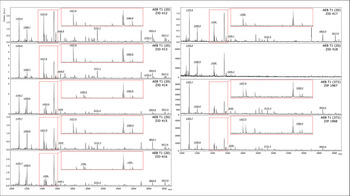
Eleven samples from the Bardhaʿa zooarchaeological assemblage were selected for ZooMS analysis, and ~20mg of bone was removed from each and analysed following established protocols (Buckley et al. Reference Buckley, Collins, Thomas-Oates and Wilson2009; Welker et al. Reference Welker2016; see Table S1 and the OSM). Seven samples were identified as Bos/bison and two samples as Bubalus bubalis (Figure 6). Two samples failed to produce sufficient collagen for taxonomic identification (Table S1 and the OSM).
Spectrum images for samples identified to taxa through ZooMS analysis; the two failed samples are not shown (figure prepared by S. Brown).

Remains identified definitively as water buffalo using ZooMS were associated with phase three, dating to the beginning of the fourteenth century AD (Table S3). Water buffalo elements that were not subject to ZooMS testing but that did meet morphological criteria and were larger than archaeological bovids are noted here as Bovid sp. These were associated with phases ten through to four (spanning the beginning of the eleventh to the end of the thirteenth centuries AD, based on a combination of radiocarbon- and ceramic typological dating (data to be published separately) (Table S3). In total, the assemblage contains 47 bone elements that are probably from water buffalo; the minimum number of individuals (MNI) calculated by phase is 10 individual animals. The overall contribution of this species to the local economy was relatively low, as they comprised only 1.3 per cent of identifiable remains from trench one and between 1 and 3 per cent of taxa throughout all phases (research ongoing). There are slightly more water buffalo remains in comparison to domestic cattle in the earlier phases eight to ten (between 11 and 21 per cent of all bovids recovered), but their prevalence decreases in later phases three to seven (between 7 and 4 per cent of all bovids recovered).
Although few in number (NISP), the very presence of water buffalo is surprising, especially as the collection includes both meaty (upper limb) and non-meaty (lower limb bones) elements, with evidence for butchery on 22 per cent of the bones, as well as pathologies affecting 15 per cent of the remains, concentrated on the phalanges and distal tibiae. These pathologies include calcified entheses, enthesophytes around the synovial borders of both proximal and distal articulations of the first phalanx, as well as arthritic polishing and grooving (eburnation) on the distal articulation of these elements (Table S3). The presence of such pathologies on these specimens may suggest that these animals were used for traction, although the aetiologies could also be traced to infections in the feet, which are often caused by prolonged contact with damp or wet ground (Cockrill Reference Cockrill1981).
Buffalo, landscapes and people
A positive identification of water buffalo in the Caucasus in the eleventh to fourteenth centuries in many ways should not come as a surprise, given the historical narratives outlined above. This discovery, however, reveals more than simply the appearance of a new taxon. We suggest that our results illustrate three concurrent changes in socio-economic organisation.
First, the adoption of these animals demonstrates a deliberate shift towards livestock management in wetland areas. Prior to recent land transformations, the annual flooding of the Kura River would have replenished seasonal lowland pastures, making them suitable for grazing sheep, but only at certain times of year. The vertical transhumance practised in the modern period emphasises the general need for most ruminant species in this region to migrate to higher ground during the summer months (Smith Reference Smith1833: 287; Mogilevskiǐ & Ermolov Reference Mogilevskiǐ and Ermolov1866). Buffalo, however, can thrive in this landscape year-round, countering the oppressive summer heat through the practice of wallowing. Furthermore, long-distance migration is specifically not a practice associated with water buffalo, who are generally managed in one discrete region (National Research Council 1981). More evidence, particularly in terms of isotopic analysis, is now required to elucidate patterns of seasonal movement in the region, but it is likely that the adoption of these animals necessitated social reorganisation.
Second, the historically attested association between water buffalo and the Zuṭṭ suggests that the introduction of water buffalo was accompanied by the movement of new people into this region. The social effect may therefore not simply be a case of reorganisation, but rather the introduction of entirely new groups of people with pre-existing specialised knowledge of buffalo husbandry. The social ramifications of such a process are as yet unclear archaeologically. If demonstrable, this conclusion would provide a valuable example of the demic spread of domestic animals—that is, accompanied by human migration, as opposed to the spread of these animals and the knowledge of how to farm them, through trade and other communication routes. The idea of a centralised authority, in this case, the Caliphal office, deliberately relocating people raises the possibility that this practice was driven by the opportunity to exploit and manage previously marginal wetlands.
Third, the introduction of new species raises the question of how these animals were integrated into the existing economy and into local customs of food production and consumption norms. While some historical sources suggest that they were clearly assimilated with other types of domestic cattle under the rubric al-baqar al-ahlī, elsewhere they are differentiated from cows, including in the context of food (Jayakar Reference Jayakar1908: 316–17, 399–401). While the consumption of cattle milk and meat is generally considered acceptable under Islamic law, understanding more about the specific and local traditions and taboos associated with consuming buffalo milk and meat requires further research. That around 25 per cent of all the buffalo bones identified at Bardhaʿa exhibit traces of butchery demonstrates that, regardless of any taboos surrounding the consumption of water buffalo meat, they were indeed being consumed in this context. Meanwhile, noting the modern use of buffalo for traction in wetland zones (Food and Agriculture Organization of the United Nations 2018), another trend we might expect to see at Bardhaʿa is an associated increase in the cultivation of crops in a marsh environment—the most obvious of which would be rice.
Conclusions
The difficulties of identifying water buffalo in zooarchaeological assemblages has led to its general exclusion from archaeological discussions of animal-based economies at sites in the medieval Islamic world. Our presentation of the earliest evidence for these animals in the Caucasus outlines the story of water buffalo and their spread across the Islamic world and into Europe. We have shown it is possible to isolate archaeological examples of Bubalus bubalis using ZooMS, in combination with standard zooarchaeological techniques. As well as providing a certain identification for individual samples, this combined process facilitates the establishment of definitive regional collections that can then be used as a comparative reference for morphological classification. Furthermore, recent success with using ZooMS on minute traces from bone with non-destructive techniques may herald the use of this technique for larger datasets (McGrath et al. Reference McGrath, Rowsell, St-Pierre, Tedder, Foody, Roberts, Speller and Collins2019). As demonstrated by the material analysed from excavations of the Gorgan Wall in Iran, aDNA analysis offers another option for the accurate identification of water buffalo in archaeological assemblages, albeit dependent on the preservation of the samples and the cost of analysis (Mashkour et al. Reference Mashkour and Sauer2017: 78).
Additional finds from other archaeological sites will allow us to examine further the spread of water buffalo. The existing combination of archaeological and historical data on buffalo presented here reveals their importance as proxies to indicate past ecologies, changing economies and centralised social reorganisation. For the prehistoric and historic periods in Eurasia, current archaeological narratives focus predominantly on continental trade networks as the major engine of such change—vis-à-vis the ‘Silk Roads’ (Taylor et al. Reference Taylor2018; Hu et al. Reference Hu, Hu, Yang, Yang, Wei, Hou and Marshall2020: 456; Spengler Reference Spengler2020). In contrast, populations of buffalo and their herders appear to have been deliberately implanted into marginal landscapes by centralised authorities, illustrating an important alternative mechanism through which animals and people move.
Acknowledgements
We would like to thank the Baku Branch of the Moscow State University and the rector of MGU Baku, Nargiz Pashayeva, for their partnership and assistance in organising archaeological fieldwork. We are grateful to the excavators of this material, in particular Katie Campbell and Davit Naskidashvili and the staff of the AEB Project (2015–2019). The authors also thank Nadja Pöllath, who provided metrics from the Staatssammlung für Anthropologie und Paläoanatomie München, and Renate Schafberg, who provided background literature.
Funding statement
This research was undertaken as part of the Archaeological Exploration of Bərdə project (2015–2019), funded by the Nizami Ganjavi Programme, University of Oxford.
Supplementary material
To view supplementary material for this article, please visit https://doi.org/10.15184/aqy.2021.108. ZooMS spectra has been uploaded to Zenodo and is accessible via https://doi.org/10.5281/zenodo.4967313