1. INTRODUCTION
The stimulated Brillouin scattering (SBS) is very attractive in optical research. On one hand, efforts have been reported to mitigate the SBS effect in order to overcome its obstacle on high peak power approach (Hao et al., Reference Hao, Liu, Hu and Zheng2013; Omatsu et al., Reference Omatsu, Kong, Park, Cha, Yoshida, Tsubakimoto, Fujita, Miyanaga, Nakatsuka and Wang2012; Jang & Murdoch, Reference Jang and Murdoch2012; Sharma et al., Reference Sharma, Sharma, Rajput and Bhardwaj2009). On the other hand, the SBS has been implemented in many fields such as laser systems (Kong et al., Reference Kong, Yoon, Beak, Shin, Lee and Lee2007), sensors (Dong et al., Reference Dong, Chen and Bao2011), optical-delays (Okawachi et al., Reference Okawachi, Bigelow, Sharping, Zhu, Schweinsberg, Gauthier, Boyd and Gaeta2005), pulse compressors (Yoshida et al., Reference Yoshida, Fujita, Nakatsuka, Ueda and Fujinoki2007), and beam combinatory (Kong et al., Reference Kong, Shin, Yoon and Beak2009). Moreover, an interesting effect observed in multimode (MM) fibers called SBS beam cleanup shows promising application prospect since it can transform a poor quality beam into a good one.
The beam cleanup effect induced by SBS process was first observed in an optical fiber in 1993 (Bruesselbach, Reference Bruesselbach1993) but was paid little attention at that time. Several years later, Rodgers et al. (Reference Rodgers, Russell and Roh1999) applied this effect to combine laser beams that showed great applications potential. In 2006, researchers from Thales Research and Technology first modeled the beam cleanup effect and realized a good quality SBS beam cleanup with a pump conversion efficiency of 31% by using a Brillouin cavity (Lombard et al., Reference Lombard, Brignon, Huignard, Lallier and Georges2006). In the next year, they improved the scheme and transformed a MM beam into a fundamental mode with an M 2 factor of 1.6 and an efficiency up to 50% (Steinhausser et al., Reference Steinhausser, Brignon, Lallier, Huignard and Georges2007). Afterward, investigations on beam cleanup in optical fibers were also reported by other researchers (Massey et al., Reference Massey, Spring and Russell2009; Massey & Russell, Reference Massey and Russell2008; Brown et al., Reference Brown, Russell, Alley and Roh2007), however, there is no publication showing more efficient cleanup by SBS to our best knowledge, which therefore limits its application on improving the laser beam quality.
In this paper, we demonstrate a scheme for the beam cleanup induced by SBS in a graded-index (GI) fiber, which achieves a pump conversion efficiency of 90% and predicts an applicable capability of improving the laser beam quality. A fusion splice scheme from a single-mode (SM) fiber to a MM fiber is first employed in SBS to steadily excite the fundamental mode of the Stokes beam in the present work. A very large core fiber (105 µm) is introduced in experiment to enhance the pump capacity and subsequently improving the efficiency. The MM pump beam has been transformed into the fundamental mode beam with an M 2 measured to be about 1.3.
2. EXPERIMENTAL SETUP
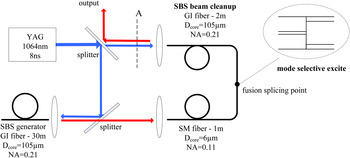
The experimental setup is shown in Figure 1. The source beam generated by an Nd: YAG laser (1064 nm wavelength, 8 ns pulse at 1 Hz) is divided into two parts: a pump beam and a seed beam. The pump beam is coupled into a 2 m long large core GI fiber (105 µm core, 0.21 NA) for the SBS process. The seed beam is coupled into a 30 m long GI fiber with the same parameters mentioned above to make a Brillouin shift and then the reflected Stokes beam is coupled into a SM (6 µm core, 0.11 NA) fiber, which is used as the signal beam of the SBS beam cleanup. The SM fiber is spliced to 2 m large core GI fiber. So the Stokes (signal) beam can encounter the pump beam in the GI fiber while the SBS beam cleanup take place. The output beam is observed after the beam splitter, and the far field beam profiles of the output Stokes beam are recorded by a CCD camera.
Experimental setup of the SBS beam cleanup.

In order to only excite the fundamental mode of the Stokes beam in the large core fiber, we employed a fusion splice scheme as shown in the inset in Figure 1. Due to the principles of the selective exciting effect in GI fibers, the excited modes depend on the position of the incident beam (Jeunhomme & Pocholle, Reference Jeunhomme and Pocholle1978). Especially, when the incident beam is accurately focused on the central of the GI fiber, only the fundamental mode would be excited. In most experiments, careful couplings should be engaged to excite the fundamental mode in a large core fiber. Here we used a fusion method to splice a SM fiber and a MM fiber together in which the two fibers are center-to-center aimed. This arrangement could steadily excite the fundamental seed mode (Jung et al., Reference Jung, Jeong, Brambilla and Richardson2009) while ensuring a good quality beam cleanup in the experiment.
3. RESULTS AND DISCUSSION
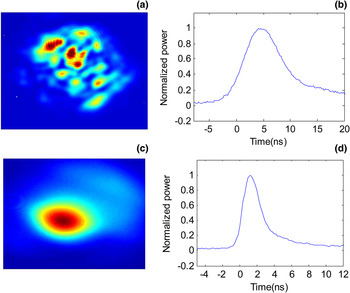
To investigate the beam cleanup shown in Figure 1, we focused on the beam profile and the beam quality of the pump beam and the Stokes beam. It should be noted that the pump beam of the SBS process is not the incident beam from the YAG laser, but the excited beam in the GI fiber. In order to ensure that a MM pump beam is excited in the GI fiber, we have adjusted the focal point to completely cover the fiber cross section. The profile of the pump beam excited by the YAG laser is recorded after a transmission for 10 cm in the GI fiber. It is shown in Figure 2a that the profile exhibits as a highly-multimode beam. As a result of the beam cleanup, this MM pump beam has been transformed into the fundamental mode output beam (shown in Fig. 2c). The output beam is measured to be ellipse polarized, which is because of the depolarization effect of the MM fiber while the signal beam is linearly polarized. And the pulse width of the output beam is slightly shorter than that of the pump beam, which is due to the pulse compression effect by the SBS process (as shown in Figs. 2b and 2d).
Investigation on the SBS beam cleanup: (a) spatial distribution of the pump beam that excited in the 105 µm GI fiber after a transmission for 10 cm length; (b) temporal shape of the pump beam; (c) spatial distribution of the output beam; (d) temporal shape of the output beam.

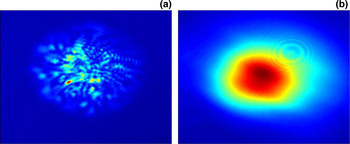
Let us try to understand how the beam cleanup effect in our experiment took place. As the conditions leading to the result of beam cleanup or phase conjugation in MM fibers have been discussed by many researchers from different perspectives, we prefer that the Stokes beam would preserve the fundamental mode of the seed beam if it is excited. It has been theoretically indicated by Ward and Mermelstein (Reference Ward and Mermelstein2010) that every mode can have a Brillouin gain on the fundamental mode. Song et al. (Reference Song, Kim and Kim2013) also experimentally proved that in the two-mode fibers, the Stokes beam would preserves the excited mode of the seed beam. So we believe that in the SBS amplification process, the Stokes beam would also absorb the power of different modes of the pump beam and preserve the excited modes of the seed beam. Actually in our experiments, we have validated that the output beam would preserve the fundamental mode of the seed beam if it is steadily excited by the fusion splicing method. Even when the incident energies or the incident angles of the pump beam have been changed, the output beam has always maintained the fundamental mode. We also inserted an aberrator at point A in Figure 1 to transform the incident beam into a highly-multimode beam (as shown in Fig. 3a). In this case, the output beam still preserves the fundamental form (Fig. 3b), which predicts an actually beam cleanup effect of the incident beam. But if the aiming position from the SM fiber to the MM fiber has been changed, the output profile would be significantly different. In addition, the engagement of the seed beam also helped us to reduce the SBS threshold. As reported, the large core fibers have the ability to mitigate the SBS effect because the large mode area would reduce the pump intensity. It is necessary to use a high pump power in order to achieve the SBS effect. In our experiment, the threshold of the SBS was measured to be about 80 µJ without any seed beam. However, if the seed beam was engaged in the work, the SBS process would take place while the pump power is comparable to the seed power.
Investigation of SBS beam cleanup when an aberrator engaged: (a) spatial distribution of the incident beam; (b) spatial distribution of the output beam.

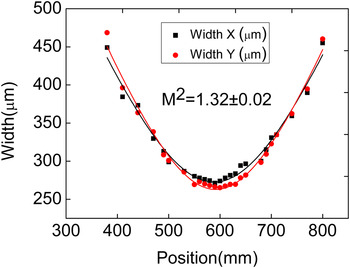
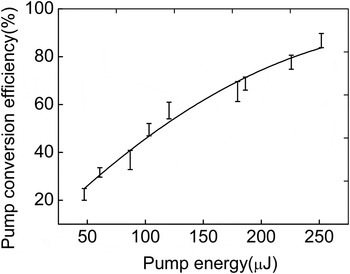
As an important parameter in the beam cleanup process, the M 2 of the output beam is measured to be 1.32 ± 0.02 as shown in Figure 4, with the pump beam energy of 233 µJ, seed beam energy of 1 µJ, and output beam energy of 212 µJ. The pump corresponding conversion efficiency is up to 90%. Let us try to find out how the efficiency has been achieved. From the theory of the SBS process, the pump conversion efficiency increases with the increase of the pump energy. Bennai et al. (Reference Bennaï, Lombard, Jolivet, Delezoide, Pourtal, Bourdon, Canat, Vasseur and Jaouën2008) also predicted an efficiency of nearly 100% in the GI fibers if a high peak power of the pump beam could be received. Nevertheless, the energies that could be received by the optical fiber are limited because of the low damage threshold that lies on its diameter. Therefore, we employed a very large core fiber with a diameter of 105 µm in the experiment to bear more pump energy and subsequently achieved a high efficiency of 90%. We also investigated the variation of the pump conversion efficiency with the energy of the incident beam. It is shown in Figure 5 that the efficiency is significantly enhanced when the energy of the incident beam is increased.
M2 measurement of the output beam.

Pump conversion efficiency is growing up with the pump energy (note the pump energies illustrated here is of the incident beam before it is coupled into the fiber).

As described above, we proposed a high efficient beam cleanup induced by the SBS process while the output beam exhibits a near diffraction-limited beam quality. Compared to other schemes on beam cleanup, the present work exhibits very good performance on pump conversion efficiency and output beam quality which deals with a simple arrangement. As the conventional pinhole beam cleanup technique results in a significant loss of power, the improved methods like using orientational stimulated scattering in nematic liquid crystals (Sarkissian et al., Reference Sarkissian, Tsai, Zeldovich and Tabirian2005; Tabiryan et al., Reference Tabiryan, Sukhov and Zel'Dovich2001), stimulated Raman scattering in MM fibers (Flusche et al., Reference Flusche, Alley, Russell and Roh2006; Roh, Reference Roh2004) and two-wave mixing in photorefractive polymeric composite (Winiarz & Ghebremichael, Reference Winiarz and Ghebremichael2004; Chiou & Yeh, Reference Chiou and Yeh1985) are still difficult to obtain a high efficiency. The adaptive optics system with a key element, e.g., a multi-actuator deformable mirror has been widely studied in recent years for beam cleanup of multiform incident beams and showed high efficiency (84% was reported in Lei et al. (Reference Lei, Wang, Yan, Liu, Dong, Yang and Xu2012a; Reference Lei, Xu, Yang, Dong, Liu and Yan2012b), Sheldakova et al. (Reference Sheldakova, Kudryashov, Samarkin and Zavalova2008), and Yang et al. (Reference Yang, Liu, Yang, Ao, Hu, Xu and Jiang2007)). However, the system control and the mirror design is complex, and it is difficult to achieve an outstanding beam quality of the output laser so far (typically with a M 2 about 2–8 in the reference). In this paper, we provide an alternative avenue of beam cleanup that realized a high pump conversion efficiency and a near diffraction-limited beam quality with a simple experimental arrangement. It is fair to point out a disadvantage of the present scheme that the incident power of the present work is limited to less than 1 mJ because of the finite cross-section area of the fiber. Nevertheless, as we discussed above, the profile of the output beam is only dependent on the excitation of the seed beam and is independent of the status of the pump beam. Owing to this conclusion, the GI fiber in our scheme could be replaced by a fiber with a larger core size to receive more pump energies. Moreover, a tapered fiber with a fiber end (Jung et al., Reference Jung, Jeong, Brambilla and Richardson2009) of several millimeters core is scalable to afford very large pump energies. As an envelope estimate, a 3 mm diameter fiber end could bear more than 1 J energy with a nanosecond pulse if it is needed in the scheme (Smith et al., Reference Smith, Do, Hadley and Farrow2009).
4. CONCLUSIONS
In conclusion, we proposed a scheme on the beam cleanup induced by SBS in a 105 µm GI fiber. The pump conversion efficiency is up to 90% which shows a good capability of improving the laser beam quality. A fusion splice scheme from a SM fiber to a MM fiber is firstly employed in SBS to steadily excite the fundamental mode of the seed beam and subsequently achieved a near diffraction-limited output beam with an M 2 of about 1.3. This setup is also scalable for larger fiber core sizes to receive higher pump energies if it is needed.
ACKNOWLEDGEMENTS
This work is supported by the National Natural Science Foundation of China (Grant No. 61138005 and No. 61008004) and China Postdoctoral Science Foundation funded project (Grant No. 201104397).