1. Introduction
The political consequences of corruption have been well-documented. Corruption undermines political trust and legitimacy in a variety of institutional settings.Footnote 1 It also typically depresses electoral turnoutFootnote 2 and reduces electoral support for the incumbent.Footnote 3 However, little is known about the channels through which corruption may affect citizens’ political behavior. In this article, we seek to further advance the literature by explicitly positing and investigating potential channels of influence. We focus on the relationship between corruption and vote choice, and introduce a framework for analyzing corruption voting. Our argument has two parts. First, we argue that corruption-sensitive voters may respond both to the direct effects of corruption in their lives, such as requests to pay bribes, and to indirect effects, such as increased awareness of high-level corruption scandals among politicians. While we are not the first to investigate either channel, to the best of our knowledge we are the first to posit them explicitly and jointly. Drawing on previous studies on corruption measurement and our own analysis, we hypothesize that these two domains are different – and largely separate – and can plausibly serve as distinct platforms for the influence of corruption on voting behavior. For simplicity, we adopt the nomenclature commonly used in the economic voting literature to distinguish between pocketbook corruption voting and sociotropic corruption voting, respectively; in both cases, we expect more corruption to make voters less likely to support the incumbent government.Footnote 4
The second component of our argument relates to the relative prevalence of pocketbook and sociotropic corruption voting. We introduce a salience-based argument. More specifically, we propose that the personal experience of corruption immediately makes it a salient issue, and that we should expect evidence of pocketbook corruption voting will persist as long as the corruption behavior continues. In contrast, we expect the salience of corruption as a national (sociotropic) problem to be a function of elite action that raises the salience of corruption as an important concern among the mass public; we consider in particular the role of corruption scandals and the emergence of new anti-corruption parties with an incentive to highlight corrupt behavior on the part of existing parties. Thus we expect sociotropic corruption voting to vary over time, but to do so in predictable ways following events that raise the salience of corruption as a political issue. We contrast the empirical support for our salience-based hypotheses with the predictions from three alternative sets of hypotheses (laid out in Section 2.3) for the conditions under which we should expect to observe corruption voting.
We test these predictions using data from Slovakia between 2004 and 2011, primarily drawn from the 2006–10 governing cycle. We utilize a number of individual-level surveys, a large volume of aggregate polls, and an original dataset of media coverage of corruption in Slovakia to test our arguments. As we document below and in the first two sections of the Web Appendix, post-communist Eastern Europe – of which Slovakia is representative – offers rich grounds for testing our theory. On the one hand, corruption has had a very prominent role both in the lives of individual citizens and in the conversation and perception surrounding political elites. On the other hand, the region has fully democratic elections, thus allowing for a meaningful study of voting behavior.Footnote 5
Our primary conclusion is that we find evidence of both pocketbook and sociotropic corruption, and the relative prevalence of these two forms of corruption voting is consistent with the salience model of corruption voting. Increased personal exposure to corruption and increased perception of the prevalence of corruption in politics drive voters away from the incumbents. Pocketbook voting is present and stable throughout our period of study. Sociotropic corruption voting, however, increases in prominence only after the emergence of a new anti-corruption party.
In addition, we are able to provide insight into the mechanisms underlying these two different forms of corruption voting. Pocketbook corruption voting – which at first glance may seem counter-intuitive as it involves voters punishing national incumbents for interactions with what are by and large local officials – is much more prevalent in localities where the local authorities are co-partisans of the national government.Footnote 6 For the sociotropic effects, we demonstrate that it is not simply the emergence of a new anti-corruption party that coincides with the appearance of sociotropic corruption voting, but rather that the emergence of such a party may contribute to a notable shift in the intensity of the coverage of corruption in the media. Interestingly – and somewhat surprisingly – we find that individual corruption scandals themselves do not have a similar effect. We suspect that this may in part be a function of the fact that in countries where corruption is prevalent, another corruption scandal is not always enough to capture the public's attention; instead, sustained attention from elites committed to politicizing corruption may be necessary.
Our results highlight the importance of distinguishing between the two channels. Since the two types of voting may operate separately and simultaneously, previous studies focusing only on sociotropic or pocketbook corruption voting may have underestimated the overall effect of corruption on voting behavior by ignoring the other component. This is particularly likely in developing countries, where bribe victimization is considerably higher than it is in wealthy democracies.
2. THEORIES OF CORRUPTION VOTING
2.1. Pocketbook Corruption vs. Sociotropic Corruption
For the purpose of this article, we adopt a conventional definition of corruption: the misuse of public office for private gain. Corruption that directly impacts the lives of individual citizens, therefore, could include being asked to pay a bribe by a police inspector to avoid a ticket for a fictional offense or by a doctor to be seen at what is supposed to be a free public medical clinic. Corruption among politicians could include politicians taking bribes to award public contracts or simply stealing money from the state directly.Footnote 7
How might the presence of corruption in a society affect voting behavior? Some studies suggest that corruption matters for political preferences by way of perception, either through general attitudes about the level of elite corruption,Footnote 8 or through awareness of specific corrupt activities.Footnote 9 In addition, many studies that use indirect measures of corruption such as media coverage or court cases assume that the effect of corruption runs through voters’ corruption perception.Footnote 10 Other studies – though fewer in number – claim that corruption matters through personal exposure (victimization).Footnote 11
However, little is known about the relationship between these different channels. The focus of previous studies on the consequences of corruption perception or experience have been often driven more by the kind of data available than by explicit theoretical considerations. The effect of corruption on political behavior may run concurrently through perception and exposure. High-level political corruption, which is typically assumed to drive voter perceptions and is more frequently the subject of information campaigns, differs in many ways from the types of corruption that voters may be exposed to in their daily lives, such as the solicitation of bribes. Voters, therefore, may be reacting differently – and separately – to these two aspects of corruption. Moreover, we do not know the relative prevalence and importance of each channel, what conditions may favor one channel over another, and whether they have different implications for electoral outcomes. Studies before this one have examined the effects of each form of influence, but only separately, and without explicitly positing the nature of the influence. To the extent that the two channels may be substitutes, previous studies may potentially have misattributed the effect of one channel to the other. To the extent that the two channels are complements, previous studies may have underestimated the influence of corruption on voting behavior.
To distinguish between the two channels, we mimic the economic voting literature and label the vote choice influenced by personal exposure to corruption as pocketbook corruption voting, and we label vote choice influenced by perception of corruption in society as sociotropic corruption voting.Footnote 12 While we adopt the nomenclature of economic voting, we want to be clear that we are not adopting identical concepts. Instead, our conceptualization of pocketbook and sociotropic corruption voting as separate processes is motivated by the findings from studies on the methodology of corruption measurement, which have repeatedly shown that the relationship between personal experience with corruption and corruption perception is quite tenuous. Personal experience is a poor predictor of both perception of administrative corruption and ‘grand’ corruption, even though survey respondents are much more likely to be exposed to administrative than to grand corruption.Footnote 13 The direction of change in perception does not relate systematically to the direction of change in reported exposure.Footnote 14 Respondents’ attitudes towards bribery do not relate to perceptions of corruption, even though they are related to exposure to corruption.Footnote 15 Corruption perception is more strongly correlated with other general perceptions and government evaluations, such as those of government's record on human rights or fairness of public services, as well as with certain country characteristics, such as gross domestic product (GDP) per capita.Footnote 16 This is perhaps not so surprising: exposure typically relates to ‘petty’ bureaucratic corruption, while perceptions are more likely to be directed towards corrupt politicians.
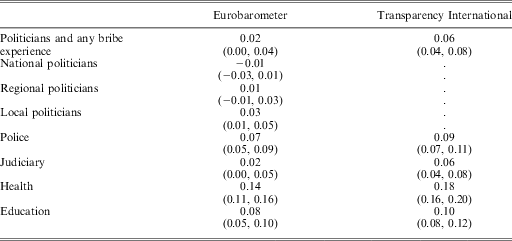
Our estimates for the context we are studying in this manuscript – post-communist Eastern European countries – conform with these findings. We estimate partial correlation coefficients between reported perceptions and experiences for a number of public domains (politicians at different levels of government, judiciary, police, health and education), taking into account demographic, socio-economic and geographic characteristics of respondents and country fixed effects.Footnote 17 The estimated correlations are rather low (see Table 1). While the signs of the coefficients accord with our prior of positive reinforcement – that increased exposure is associated with increased perception – none of the coefficients exceeds 0.2. In particular, the correlation between overall exposure to bribes and corruption perception of politicians, which are the measures we rely on in the analysis in the following sections, is nearly zero.Footnote 18 This is particularly striking considering that there is likely some priming in our data, as survey questions probing experiences and perceptions are invariably clustered together and asked consecutively.Footnote 19 Conceptualizing the two forms of corruption voting as separate, therefore, appears to be meaningful. Below, we find further support for this assumption by observing little change in the estimates of the sociotropic channel after omitting the measure of the pocketbook channel, and by finding virtually no interaction effects between experience and perception.Footnote 20
Partial Correlations between Corruption Experience and Perception in Eastern Europe

Note: The main entries represent the Pearson correlation coefficients between the residuals of the linear regression model of the reported bribe experience and perception on a set of demographic, socio-economic, and geographic covariates, and country fixed effects. All regressions are weighted by respondent-level weights, recalculated to the restricted sample of post-communist East European countries. The Eurobarometer data consist of the surveys 64.3, 68.2, and 72.2. The Transparency International (TI) data consist of the Global Corruption Barometer (GCB) surveys in 2003–07, 2009, and 2010. The estimates from different data differ partly because of differences in question wording and country samples. Entries in parentheses represent the 95 percent confidence intervals. The first row presents the partial correlation between bribe experience with any of the sectors examined in the Eurobarometer and Transparency International data and the perception of corruption among national-level politicians and political parties, respectively. The remaining rows give estimates of the partial correlation between bribe experience and the perception of corruption in the specified sector. All corruption variables in the Eurobarometer data are binary. Bribe variables in the GCB data are also binary, and perception variables are ordered-categorical. Results obtained using a logit model are qualitatively similar and are available upon request.
2.2. Relative Prevalence of Pocketbook vs. Sociotropic Corruption Voting: A Salience Approach
Assuming that pocketbook and sociotropic mechanisms are largely distinct phenomena, we can hypothesize about conditions that determine the relative weight the voter may place on each form of corruption voting.Footnote 21 In this section, we present hypotheses based on thinking about the relative salience of corruption in the minds of voters, and identify the patterns of variation in the prevalence of pocketbook and sociotropic corruption voting that would provide empirical support for salience-based hypotheses. In the following section, we then present three alternative sets of hypotheses that – while not drawing specifically on the distinctions across pocketbook and sociotropic corruption voting – predict different patterns of corruption voting than our salience-based approach.
One way to generate different predictions about the prevalence of pocketbook and sociotropic corruption voting is by drawing on the literature on the role of issue salience in evaluations of politicians’ performance and policy output. Researchers have shown that greater exposure to an issue increases its weight when evaluating politicians.Footnote 22 For example, the increase in the salience of European integration in Britain in the 1990s considerably strengthened its importance for vote choice among British voters between the 1992 and 1997 elections.Footnote 23
Being asked to pay a bribe imposes a direct cost on the citizen, and provides a highly precise signal about this aspect of performance of the political system. Personal experience with corruption may, therefore, increase the importance of corruption in voting behavior. To the extent that regularized contacts with public officials are characterized by a sufficiently high likelihood of bribe victimization, we may expect to see consistent evidence of pocketbook corruption voting.Footnote 24 If pocketbook corruption voting is prominent, we may also expect it to be stable in the short run, since bribe-extortion is decentralized and difficult to monitor and change in the short term.Footnote 25
Extending the insights of the priming literature to sociotropic voting is straightforward. In line with the argument that the salience of the issue determines the weight it plays in voting behavior, we expect that the prevalence of sociotropic corruption voting depends on the perceived salience of societal corruption. Several developments may increase the salience of societal corruption. First, we would expect public corruption scandals to increase the salience of corruption for self-evident reasons. Second, election campaigns may increase the salience of corruption in countries where corruption is a non-trivial issue because opposition parties may have a political incentive to raise the issue of corruption as a means of winning votes away from incumbent parties. Note, however, that since the societal level of corruption is fundamentally unobservable, salience may depend on the strength or credibility of the signal. Corruption revelations vary in seriousness and verifiability. Also, the politicization of corruption may trivialize scandal material, potentially resulting in ‘scandal fatigue.’Footnote 26 Similarly, raising corruption in an election campaign may be a less effective tactic when opposition parties have previously been in office themselves and accused of corruption, a far-too-frequent occurrence in post-communist Eastern Europe.Footnote 27 Thus, we also expect that the emergence of new, anti-corruption parties ought to increase the salience of corruption as a political issue.
Therefore, when the salience of corruption is high (e.g., corruption scandals, during an election campaign where parties are highlighting problems with corruption, following the emergence of anti-corruption political parties), we expect to find evidence of sociotropic corruption voting. However, since salience varies (at least according to the electoral cycle), we expect sociotropic corruption voting to be volatile.
2.3. Alternative Hypotheses
2.3.1. Corruption as a valence issue
Alternatively, we could eschew the question of salience and instead craft a very basic model where we simply consider corruption as a valence issue.Footnote 28 In this state of the world incumbents are always rewarded for less corruption and punished for more corruption. Of course, such an approach gives us no leverage to distinguish between pocketbook and sociotropic corruption voting; nor should we see any variation over time. We would simply expect to always find evidence of sociotropic and pocketbook corruption voting.
This is, of course, a naïve sort of hypothesis. But it is similar to the basic hypothesis underlying much of the economic voting literature: voters are expected to punish incumbent governments for bad economic conditions, be it their own personal economic circumstances (pocketbook economic voting), or the economy of the country as a whole (sociotropic economic voting). Thus we can consider this idea of corruption as a valence issue to anchor one end of the spectrum of possible findings regarding corruption voting: it is always present, and we ought to see effects through both sociotropic and pocketbook channels.
2.3.2. Corruption voting as a function of available alternatives
In the previous section, we noted that corruption voting could potentially be forestalled if voters lack a credible ‘non-corrupt’ alternative to the current incumbent governments.Footnote 29 For reasons previously identified, we suspect this type of context to be particularly likely in Eastern Europe, but we can apply it more generally to ‘high corruption’ countries. Importantly from the perspective of the current endeavor, such a framework would not predict any distinction between pocketbook and sociotropic corruption voting: both channels require an available alternative party to voters disgruntled over either type of corruption.
Thus, we should see both pocketbook and sociotropic corruption voting when there is an alternative ‘anti-corruption’ party for whom citizens can vote. When there is no such available alternative, we should not see evidence of either type of corruption voting. Note that this hypothesis is similar to the ‘corruption as valence’ argument insofar as it does not distinguish between pocketbook and sociotropic corruption voting, but different to the extent that it does not predict that both types of corruption voting will always be present.
2.3.3. Corruption as preferred by voters
Finally, it is possible that the basic valence assumption underlying all of the previous hypotheses – that voters will want to turn against incumbent governments in the face of corrupt behavior by governing officials – is fundamentally flawed. Instead, perhaps voters will seek to reward corrupt behavior. Two such reasons have previously been suggested. First, voters may hope to directly profit from corrupt behavior in the form of vote buying.Footnote 30 As we have previously noted, vote buying is not very prevalent in Eastern Europe, so this is one reason to suspect we may not find evidence of voters rewarding politicians for corrupt behavior in our data.Footnote 31 However, it is also possible that corruption – particularly petty corruption – could induce the government and bureaucrats to deliver more prompt and/or higher-quality services,Footnote 32 or that higher corruption is perceived to be correlated with higher professional or bureaucratic ability.Footnote 33
The link between this sort of argument and our pocketbook and sociotropic corruption voting hypotheses is clear: in no instances should we find evidence of voters who either experience corruption first-hand or think it is a problem among politicians generally punishing the incumbent government. Indeed, for the hypothesis to be fully supported, we should actually see the government being rewarded by these individuals. Nor, according to this argument, is there any need for distinct hypotheses regarding pocketbook and sociotropic corruption voting.
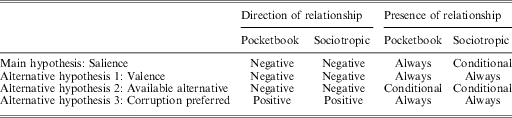
Table 2 concisely summarizes the different hypotheses from the four different approaches. The first and second columns of the table list the predicted effects (positive or negative) for pocketbook or sociotropic corruption, respectively, on the vote for the incumbent government. The third and fourth columns then list whether the effect is expected to be present always or whether it is a conditional effect.Footnote 34
Summary of Hypotheses: Relationship between Corruption Experience, Corruption Perception and Support for Incumbent Government

Note: ‘Negative (positive)’ direction of relationship indicates a negative (positive) effect on the probability of voting for the incumbent parties; ‘Always’ indicates a stable presence of an effect over time; ‘Conditional’ indicates a varying presence and absence of an effect over time, conditional on the actions of elites.
2.4. Mechanisms
Before proceeding to our data analysis, it is worth pausing briefly to consider as well the mechanisms by which we might expect pocketbook and sociotropic corruption voting to occur. Turning first to pocketbook voting, it is a legitimate question to ask why a personal experience with a local official might make one more likely to vote against the national incumbent parties. We suggest two mechanisms that could facilitate such an effect. First, it may be the case that being forced to pay a bribe sends the voter a signal about the overall level of corruption in society. We begin with a bit of suspicion about this mechanism given the cross-country findings presented earlier in Table 1, but we can still test for the prevalence of such effects in the specific data we employ in our analyses. Second, it may be the case that voters, when voting in national elections, ascribe responsibility for the behavior of their local officials to national politicians of the same national party or coalition. Should this be the mechanism, then we would expect to find much stronger evidence of pocketbook corruption voting in localities that are run by the same parties as those found in the national government.
The search for a mechanism underlying sociotropic corruption voting pushes us in a different direction. Here, we need to know how citizens come to believe that corruption is a problem in society. The usual suspect in this regard would be the media, so we should be able to gain added confirmation of the validity of the sociotropic corruption voting hypothesis if we can demonstrate that sociotropic effects are related to media coverage of corruption. This is perhaps most important for the salience argument, where support for this hypothesis increases if the events hypothesized to increase the salience of corruption as a political issue (e.g., scandals, entrance of new anti-corruption party) likewise lead to an increase in media coverage of corruption.Footnote 35
3. FOCUS AND DATA
It is difficult to find reliable data to test our hypotheses. Most available data fail on one of two accounts: they do not contain all essential variables, or they are not available in sufficient frequency.Footnote 36 Fortunately, we found an exception to this rule across a number of surveys that took place in Slovakia. Slovakia is an appealing initial case on which to test our theoretical arguments. Numerous scholars of post-communist politics in Eastern Europe have noted the potential role of political corruption in the region's chronic anti-incumbency bias.Footnote 37 Over the course of the transition from communism, corruption has emerged as one of the most pressing developmental and political issues.
A casual look at the data supports this notion. An examination of the election summaries in Electoral Studies reveals that of the forty elections in the region between 2000 and 2010, in twenty-eight, or 70 percent, corruption was a major issue, by way of allegations, scandals, and revelations of serious wrongdoings.Footnote 38 Part of this ‘apparent epidemic’ can be explained by the low level of economic development and limited experience with democracy.Footnote 39 However, despite the many developments of the past twenty years – including rapid economic development, the entrenchment of democratic government, and even accession to the European Union for many countries – concern with corruption still seems much more pronounced among East European citizens than those of Western Europe. In the Web Appendix, we show that typical East European citizens are significantly more likely to perceive their politicians as corrupt and to report having been asked for a bribe (Table A1 in the Web Appendix). East Europeans also report spending significantly more of their income on bribes than typical citizens of Western Europe (Table A2 in the Web Appendix).
Post-communist Eastern Europe therefore offers rich grounds for empirical tests of corruption voting. And Slovakia is quite representative of the region. While it is slightly smaller than the average country in the region and somewhat richer, it does not stand at a regional extreme on any major demographic or economic index. Like all of the EU accession countries, it has a functioning democracy with relatively high levels of civil liberties, and like most countries in the region it has a parliamentary form of government using a proportional electoral system with a moderate threshold (5 percent). Most importantly, Slovakia is also relatively typical in terms of its corruption experience and perception. We show in Figure A1 in the Web Appendix that Slovakia is close to the median for the region with respect to citizens’ bribe victimization and citizens’ perception of corruption.
We utilize nine cross-sectional individual-level surveys in the period between May 2004 and December 2011.Footnote 40 We mainly focus on the 2006–10 electoral cycle within which we have six surveys. Focusing mostly on one electoral cycle allows us to hold a number of political factors constant, most importantly the parties in the governing coalition. We also use the three surveys falling outside of the 2006–10 government cycle to cross-validate some of our results.Footnote 41 Five of the nine surveys contain all crucial variables of interest simultaneously: items probing corruption perception and experience, as well as vote choice and important control variables. The remaining surveys contain questions probing corruption perception, vote choice and controls, but not corruption exposure. We use these surveys to test our expectations about sociotropic corruption voting, while adjusting the estimates for the omission of a measure of corruption exposure.
To supplement our individual-level data, we utilize 116 aggregate polls of Slovak public opinion conducted by four Slovak polling firms in the period between July 2006 and July 2010. These polls, conducted almost every month, contain aggregate estimates of intended vote choice, which we use to construct the monthly vote share of the incumbent coalition and the senior incumbent party. We use these time series to examine the temporal patterns of sociotropic corruption voting and cross-validate results from individual-level surveys. Finally, we collect original data on the coverage of corruption by the Slovak media to examine the variation in the salience of societal corruption over time. The Web Appendix contains details on the individual and aggregate-level surveys (Web Appendix Tables A3 and A4) and media sources (Web Appendix Section 6).
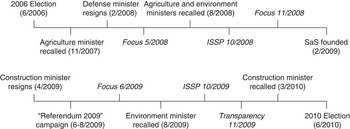
Aside from data availability and the general prominence of corruption in Eastern Europe, Slovakia provides fertile ground for testing our hypotheses for two other reasons. First, the 2006–10 electoral cycle was marked by several relatively high-profile corruption scandals within the governing coalition. The minister of defense (February 2008), two ministers of agriculture (November 2007 and August 2008), two ministers of construction and regional development (April 2009 and March 2010), and two ministers of environment (August 2008 and August 2009) were recalled or resigned due to various allegations of improper financial conduct.Footnote 42 All of the scandals were of a financial nature, and thus directly linked to the issue of corruption. Second, a new party, Freedom and Solidarity (Sloboda a Solidarita, abbreviated as SaS), with a technocratic leader, entered the political scene in February 2009, and in the summer of the same year launched a campaign for a referendum with a pronounced anti-corruption agenda.Footnote 43 The scandals and the emergence of a new anti-corruption party provide good conditions to test our predictions about sociotropic corruption voting.Footnote 44 Figure 1 shows a timeline of relevant events and individual-level survey dates during the period representing the main focus of our study.
Data and timeline of events in Slovakia, 2006–2010
Notes: Surveys are indicated in italic. Details about the events and the variables available in each survey are given in Sections 3 and 4 of the Web Appendix.

4. RESULTS
We begin by presenting results based on individual-level survey data. In the surveys, respondents are asked whether they would vote, and if so, for which party, if the election were held in the week following the survey (the Sunday question). We focus on whether a respondent intends to vote for any incumbent party.Footnote 45 The binary vote is modeled with a standard logit model.Footnote 46 The key independent variables are measures of corruption exposure and corruption perception. For exposure, respondents were asked whether they or someone from their immediate family had to give a bribe in some previous period of time.Footnote 47 In four of the five surveys containing an exposure item, the response was binary, with one denoting that a respondent has given a bribe and zero otherwise. We recode the variable in the remaining survey into a binary response as well.Footnote 48 For perception, respondents were asked several questions about the importance of corruption as a national problem and how widespread they thought corruption was among politicians, and sometimes among public officials (police, education, customs, etc.). The precise wording and subject of corruption-probing questions differ between surveys, particularly for the perceptual questions. To make the results as comparable across the surveys as possible, we build a composite sociotropic evaluation by applying factor analysis on all relevant perceptual questions available in each survey, and then standardizing the scale by its mean and standard deviation.Footnote 49 There are two added benefits from this strategy. First, a composite measure reduces measurement error compared to a single variable.Footnote 50 Second, this composite measure likely reduces the concerns about endogeneity of perceptions to partisanship.Footnote 51
Where available, we include as a control variable only the report of the vote choice in the last actual election in 2006. Previous vote choice, also coded as a binary variable, is a powerful control, as it should essentially subsume the effect of all time-invariant determinants of vote, such as demographic, geographic, and probably any slow-changing socio-economic characteristics (such as income or social class) of the respondents.Footnote 52 Indeed, in Table A7 in the Web Appendix, we show that saturating the specification containing previous vote choice with other standard predictors adds very little, if any, explanatory power. Previous vote choice should also include the effect of previous levels of corruption exposure, perception, and other changing attitudinal characteristics that determine vote choice. Our preferred specification therefore contains relatively few variables. However, not all surveys contain previous vote choice, in which case we saturate the model with (weakly) exogenous variables: demographic, socio-economic and geographical variables, as well as voters' positions on various policy issues. Since the logit model is non-linear, we present marginal effects of a meaningful change in the key variable when holding the other variables at their mean.Footnote 53
We proceed as follows. We first present our pocketbook results, followed by the discussion of the tests of the mechanisms we proposed in Section 2.4. We then turn to evidence of sociotropic corruption voting, again followed by the examination of the mechanism that may account for our findings. As we will demonstrate, our overall results are consistent with the salience hypothesis, as opposed to the other three hypotheses (i.e, the valence, available anti-corruption alternatives, or corruption preferred hypotheses). Throughout, we also briefly discuss the robustness of our findings for both channels, although we relegate most of the detailed discussion of robustness tests to the Web Appendix.
4.1. Pocketbook Results
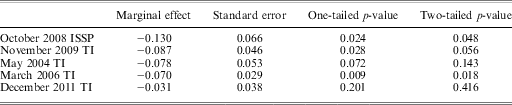
We first focus on our estimates of pocketbook corruption voting, while controlling for corruption perception and the remaining covariates. Only two of our surveys during the 2006–10 electoral cycle, in October 2008 and November 2009, contain corruption exposure items. Results from these two surveys are given in the first two rows of Table 3. The first column shows the marginal effect on incumbent vote probability of the change from reporting not having given a bribe to having given a bribe in the previous period for a typical respondent. The second column gives the robust standard errors, the third column shows the p-value on the one-tailed test of the hypothesis in line with previous research and three of the four hypotheses from Table 2, that increased corruption exposure reduces support for the incumbent. Since one-tailed tests are less conservative and presuppose an effect of a particular sign, we also report the p-value on a two-tailed test of the hypothesis that the effect of bribe victimization is different from zero in either a positive or negative direction in the last column.
Marginal Effect of Corruption Experience

Note: The dependent variable is the incumbent vote choice. The entries in the first column represent the marginal effect on incumbent vote probability of the change from reporting not having given a bribe to having given a bribe in the previous period when all other variables in the model are fixed at the mean. Full results are given in Web Appendix Table A5. Robust standard errors are given in the second column.
The results in the first two rows suggest that ceteris paribus the experience of giving a bribe decreases the probability of voting for the incumbent by around 13 percentage points based on the October 2008 data, and around 9 percentage points based on the November 2009 data. Both results are statistically significant at conventional levels. The estimated effects are not trivial. Around 58 and 51 percent of respondents reported an intention to vote for the incumbent coalition in October 2008 and November 2009, respectively.Footnote 54 Thus, the estimated effect of bribe victimization represents an approximately 22 and 17 percent decrease in the incumbent vote probability in October 2008 and November 2009, respectively.Footnote 55
Evidence from October 2008 and November 2009 suggests that pocketbook corruption voting exists. However, evidence from only two surveys is insufficient to address our hypothesis about its stability over time. As explained above, because bribe-taking is slow-changing we expect that any evidence of pocketbook corruption voting be persistent.Footnote 56 We use the three remaining surveys outside of the 2006–10 cycle that contain the exposure question to examine the persistence of pocketbook corruption voting.Footnote 57 Rows 3–5 in Table 3 display the results. All three specifications control for corruption perception and other relevant predictors of vote choice (see Table A5 in the Web Appendix for details). The results largely confirm that pocketbook corruption voting is persistent. The marginal effects based on the May 2004 and March 2006 data are of similar size to the estimates from the 2006–10 electoral cycle: a reduction of approximately 8 percentage points (25 percent) and 7 percentage points (30 percent) in the probability of voting for the incumbent government. The marginal effect in December 2011 is smaller, and imprecisely estimated, but still negative. One potential reason why the pocketbook channel is weaker and less precise in 2004 and 2011 is that the exposure question extends into the previous electoral cycle, necessarily inducing measurement error. The measurement error is likely larger in 2011 because the party composition of the government changed entirely, whereas in 2004 this was not the case.Footnote 58
4.1.1. Potential mechanisms
Even if we find persistent pocketbook corruption voting, the question remains as to the mechanism behind our finding. Why are voters who have been asked for a bribe by a local public official inclined to punish a national-level incumbent? As mentioned above, one potential explanation is that corruption exposure acts as a signal about how corrupt the government is more generally. In that case, despite the low correlations we report between corruption experience and corruption perception in Section 2.1, the effect of personal experience would be mediated by perception. This would invalidate our distinction between pocketbook and sociotropic corruption voting as largely separate channels. To check for this possibility, we perform two tests. First, we add to our model available measures reflecting perceptions related to corruption experience: perception of prevalence of bribe giving (2004, 2006, 2009, and 2011), or of fairness of civil servants and trust in them (2008).Footnote 59 If the effect of exposure runs through exposure-elicited perception, inclusion of these measures should weaken or eliminate the pocketbook effects presented in Table 3. However, we do not find such evidence: the pocketbook effects based on all five surveys are unchanged.Footnote 60
Second, we examine whether there is an interaction effect between the two channels. Intuitively, respondents with a higher perception of corruption may be more willing to sanction any corruption experience; and vice versa, respondents with greater exposure to corruption may be more likely to exhibit sociotropic corruption voting. However, we do not find any such effects, as the inclusion of the interaction term does not change the marginal effects of either channel noticeably.Footnote 61 These results suggest that the effect of experience is not mediated by perception, and further support our claim from Table 1 that perception and experience are weakly related.
Next, we examine whether the connection between the local authorities under which a respondent is victimized and the national government affects the strength of the pocketbook channel. Intuitively, we expect that respondents who were victimized in a town run by a local government formed by the same parties as the national government should be more likely to punish the national incumbent than if they had to pay a bribe in a town run by the opposition. We call this tendency co-partisan pocketbook corruption voting. This may be because the performance evaluation of the local government translates into the performance evaluation of the national government.Footnote 62
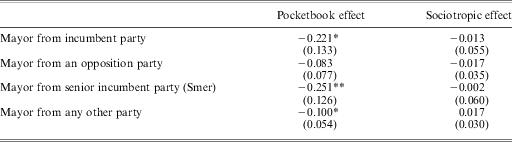
Table 4 shows evidence in favor of co-partisan pocketbook corruption voting. We combine the October 2008 survey, where we have information on respondents’ place of residence, with the data on the party affiliation of town mayors. The first two rows of the first column show that pocketbook corruption voting is more than twice as strong in towns run by a mayor from any of the parties constituting the national incumbent government (the first row) than in opposition towns (the second row). Results in the second column represent a form of a placebo test. If the mechanism indeed runs through bribe victimization under a co-partisan government, and if corruption perception and experience are indeed largely unrelated, we should not see a different pattern in sociotropic corruption voting based on societal perception under co-partisan and opposition governments. This is what we find: the sociotropic effect is similar (and insignificant – more on this below) across the two types of towns.Footnote 63 In rows 3–4, we show that much of the co-partisan pocketbook effect is drawn by the senior incumbent party, ‘Smer.’ The evidence is consistent with the hypothesis that a more prominent member of the government will be punished more severely for bad performance than junior coalition members.Footnote 64 We also find similar evidence for this hypothesis in the context of sociotropic corruption voting further below.
Co-partisanship of Local and Central Government and Pocketbook Corruption Voting

*p < 0.1, **p < 0.05, ***p < 0.01. Robust standard errors in parentheses.
Note: The dependent variable is the intended vote for the national-level incumbent government (first two rows) or the senior incumbent party, Smer, in the bottom two rows. The results are based on the October 2008 survey. The model consists of variables for corruption experience, corruption perception, reported vote choice in the previous election, party of the mayor in the respondent's municipality, and the interactions between party of the mayor and corruption experience and corruption perception. The main entries in the table are the marginal effects of a change from not giving a bribe to giving a bribe, or a one-standard deviation increase in corruption perception, while holding other covariates fixed at their mean.
4.2. Sociotropic Results
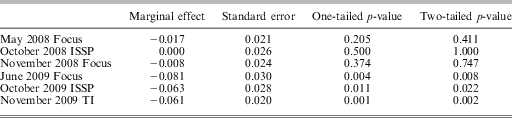
Next we turn to the sociotropic results. The first column of Table 5 gives the marginal effects on incumbent vote probability of a one-standard deviation increase in corruption perception on a standardized scale by a typical respondent. The results are from the six surveys during the 2006–10 electoral cycle. The remaining columns give the same quantities as for pocketbook effects in Table 3.
Marginal Effect of Corruption Perception

Note: The dependent variable is the incumbent vote choice. The entries in the first column represent the marginal effect on incumbent vote probability of a one-standard deviation increase in corruption perception on a standardized scale while all other variables in the model are fixed at the mean. Full results are given in Web Appendix Table A5. Robust standard errors are given in the second column.
The results suggest that sociotropic corruption voting was not present in 2008, as the estimates of the marginal effects based on the May, October, and November 2008 surveys are both substantively and statistically very close to zero. In 2009, however, sociotropic voting seems to be prominent.Footnote 65 The marginal effect of a one-standard-deviation increase in the perception of societal corruption is associated with a drop in the probability of incumbent vote of between 6 and 8 percentage points, or between 12 and 14 percent. The results based on all three surveys are statistically significant at conventional levels. The sociotropic effect, therefore, seems to have been activated between November 2008 and June 2009.Footnote 66
4.2.1. Potential mechanisms
We next turn to an examination of the mechanism behind the apparent shift in the prominence of the sociotropic channel between 2008 and 2009. The lack of a sociotropic effect in 2008 was amidst no less than four scandals in which government ministers were recalled or resigned because of alleged improprieties (November 2007, February 2008, and two in August 2008; see Figure 1). Between our surveys in October 2008 and June 2009, one other corruption scandal took place (April 2009). But in addition, a new anti-corruption party called Freedom and Solidarity (SaS) entered the party system (February 2009) and led a referendum campaign (launched in June 2009) with a strong anti-corruption agenda. The evidence presented in Table 5 thus suggests that the scandals in and of themselves seem to have been insufficient in raising the salience of societal corruption and that an entrance and a campaign of a new anti-corruption party were needed to activate sociotropic corruption voting. Here, we examine this conjecture more directly.
We turn to a wealth of aggregate polls conducted between the 2006 election and the 2010 election to estimate how the aggregate vote share of the governing coalition and the senior incumbent party react to our critical events.Footnote 67 We have 116 polls conducted by four different survey firms almost every month. These polls provide only aggregate vote shares for the major parties, and so we cannot perform the individual-level analysis we did above. Instead, we combine these polls to estimate a monthly vote share time-series.Footnote 68 We then estimate a time-series auto-distributed lag model of the monthly vote share as a function of our key events, as well as controls for economic activity and several other important political events – the European Parliament election (June 2006), local elections (December 2006), presidential election (March 2010), and the beginning of the general election campaign (May 2010).Footnote 69
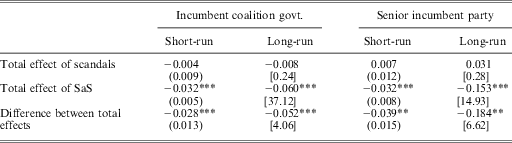
Based on this model, we calculate the short-term and long-term effects of all scandals combined, and of the new anti-corruption party (SaS) and its referendum campaign.Footnote 70 The results, shown in Table 6, give a clear picture: the total effect of the five scandals, whether short-run or long-run, is indistinguishable from zero, whereas the effect of the new anti-corruption party is noticeable. The entry of SaS and its referendum campaign produce a combined contemporaneous (within-month) reduction in the coalition vote share of around 3 percent (second row of the first column), and a longer-term (until the end of the electoral cycle) reduction of around 6 percent (second row of the second column). The difference between the two sets of events is highly statistically significant (third row). Columns 3–4 show that most of the effect of the new party is borne by the senior incumbent party.Footnote 71
Short-run and Long-run Effects of Scandals and New Party Entry

*p < 0.1, **p < 0.05, ***p < 0.01. Robust standard errors in parentheses.
Note: The dependent variable is the monthly vote share for the incumbent government (the first two columns) or the senior coalition party (columns 3–4) estimated from 116 aggregate polls. For more details on the estimation procedure and the poll data, see the Web Appendix Section 7.2. The short-run effect of an event represents the coefficient on each variable (when only the level is included) or the sum of the level and the lags. Full results are given in Web Appendix Table A6. The long-run effect equals the short-run effect divided by (1−sum of lags of Y) (De De Boef and Keele, Reference De Boef and Keele2008). Numbers in square brackets represent the F-statistic for the nonlinear null hypothesis test that the long-run effect is equal to zero.
In Section 2.2, we hypothesized that the prevalence of sociotropic corruption voting depends on the salience of societal corruption. The results from Tables 5 and 6 suggest that the salience of corruption may have been raised by the entry of the new party rather than, or at least in concert with, the corruption scandals, which do not seem to have been sufficient alone. To examine this claim more closely, we collected data on the coverage of corruption by the Slovak print and internet media during the 2006–10 cycle.Footnote 72 We then test whether it was the entry of the new party that induced a shift in the media coverage of corruption.Footnote 73
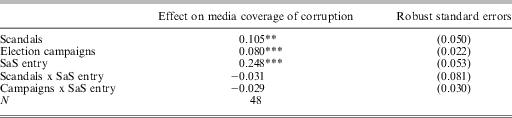
The results, given in Table 7, support the notion that the entry of SaS generally raises the salience of corruption through an increased coverage of corruption in the media. Entry of the new party increases the average media coverage by 25 percent compared to the period prior to the entry. The scandals and within-cycle second-order elections (local, presidential and European Parliament elections) also increase media focus on corruption, but to a considerably smaller extent. Moreover, we find no evidence that the effect of scandals or elections changes after the entry of SaS, given that the interaction terms in Table 7 are essentially zero. In other words, the entry of the new party increased the average salience of corruption, but did not make subsequent scandals or election campaigns more effective at raising the salience of corruption in the media.
New Party Entry as a Structural Break in Media Coverage of Corruption

*p < 0.1, **p < 0.05, ***p < 0.01.
Note: The dependent variable is the share of articles about corruption, whether scandal-related or about corruption more generally, as a proportion of all articles mentioning the government and Prime Minister Robert Fico appearing in any of the Slovak-language or English-language sources covering Slovakia on Factiva and Lexis-Nexis in the period July 2006–June 2010. Sources are listed in Section 6 of the Web Appendix. ‘Scandals’ is a dummy variable equal to 1 when a scandal happens. ‘Election campaigns’ is a dummy variable equal to 1 during the month an election took place (local election, European parliament election, and the presidential election). The model also includes a cubic polynomial in time to control for any time trends in the media coverage of corruption.
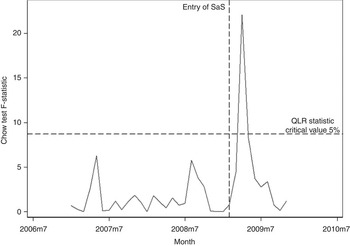
While the estimates from Table 7 clearly point to a break occurring shortly after the entry of SaS, this may not be the only structural break during the 2006–10 electoral cycle. To check for other structural breaks, we rerun the specification from Table 7 with SaS entry replaced with a variable denoting a structural break in any month between January 2007 and November 2009.Footnote 74 In other words, we assume that the breaks are ex-ante unknown and let the data tell us where the break is most likely to be. The date at which the value of the test statistic is at the maximum and is higher than an appropriate critical value represents the estimate of the structural break.Footnote 75 The results of this test are given in Figure 2, which strongly confirms our earlier results: the only structural break in the media coverage of corruption during the 2006–10 election seems to occur shortly after the entry of SaS, and not in the wake of any of the corruption scandals or second-order elections.Footnote 76
Testing for other structural breaks in media coverage of corruption
Notes: The y-axis plots the value of the Chow-test F-statistic, which in this case is the square of the t-statistic for the null hypothesis that the coefficient for a structural break in month t plotted on the x-axis is not different from zero. The horizontal dashed line represents the critical value of the Quandt Likelihood Ratio (QLR) statistic at 5 percent (Andrews, Reference Andrews1993). The QLR statistic is a modified Chow test where the structural break is treated as unknown ex ante. Every point on the line thus represents a test for a break in that month. The date at which the Chow-test F-statistic is at its maximum represents an estimate of the structural break. When this maximum is above the QLR critical value, the test rejects the null at α = 5 percent. The vertical dashed line represents the month of entry of the new party (SaS).

4.3. Alternative Hypotheses
Taken together, the evidence presented throughout this section suggests strong support for the salience approach to understanding the relative prevalence of pocketbook and sociotropic corruption voting. On one hand, we find consistent evidence of pocketbook corruption voting. Moreover, this phenomenon is largely driven by pocketbook corruption voting in localities where the mayor is a co-partisan of the incumbent national government. On the other hand, we find evidence of sociotropic corruption voting only after the emergence of a new anti-corruption party that leads to an increase in media coverage of corruption.
What of our alternative hypotheses regarding the prevalence of corruption voting? The valence hypothesis predicts that we should find evidence of both pocketbook and sociotropic and corruption voting at all times; this prediction is undermined by the lack of sociotropic corruption voting before the emergence of the anti-corruption SaS. The available alternatives hypothesis predicts that we should find corruption voting only when there is a viable alternative anti-corruption party present; this prediction is undermined by the repeated evidence of pocketbook corruption voting in the years before the emergence of SaS in February 2009. Finally, while the phenomenon may occur elsewhere, there is no evidence in Slovakia of voters rewarding incumbent political parties because of corruption.
5. THE WAY FORWARD
Our hope is that this article will help invigorate the study of the impact of corruption (and perceptions of corruption) on political behavior. Much like the effort to chart the impact of economic considerations on voting in established democracies, we believe that a thorough understanding of the ways in which corruption affects voting will prove valuable in the long run generally, but especially in countries in which corruption is persistent and politically relevant, such as the post-communist countries of East-Central Europe.
In that vein, this article offers several important contributions. Theoretically, we have introduced a framework for thinking explicitly about the channels through which corruption may affect voting behavior: pocketbook corruption voting is defined as the effect of personal experiences with corruption on voting behavior; while sociotropic corruption voting is defined as the effect of perceptions about corruption in one's society on voting behavior. Our taxonomy is motivated by the somewhat surprising yet empirically well-founded observation that experiences with and perceptions of corruption are only tenuously correlated. Moreover, we argued that the relative weight individuals put on these two mechanisms depends on the salience of each form of corruption. Since the importance of paying a bribe – for those who have had to do so – is inherently high, and exposure in the aggregate is slow to change, pocketbook corruption voting is expected to be stable when bribe victimization in the society is considerable. In contrast, the salience of societal corruption is variable and depends on the actions of elites, such as corruption scandals, campaigns, or the entry of new parties with anti-corruption platforms. Taken together, therefore, we provide a theoretical framework that both identifies two distinct channels by which corruption may affect voting behavior, as well as makes predictions about when these channels are likely to be activated. For countries in which corruption is prevalent, this may turn out to be an important development in furthering our understanding of voting behavior.
Empirically, to our knowledge we have provided the first evidence that the two channels can co-exist, suggesting that studies that do not account for both channels may have underestimated the effect of corruption on voting. In particular, the effect of personal exposure to corruption has been largely overlooked in the previous literature on voting behavior. Moreover, we confirm that the effect of corruption perception on voting varies based on context, and that it does so in predictable ways. We believe that another contribution lies in the evidence that sociotropic corruption voting may require credible or very strong signals. We do not find that the myriad scandals present in Slovakia lead to protest votes based on the perception of corruption. This is not to say that other scandals in Slovakia or elsewhere could not trigger sociotropic corruption voting, but rather that the threshold for doing so – especially in countries where corruption scandals are not isolated occurrences – may be higher than we have previously thought.
Moving beyond corruption, our findings can contribute to a larger debate about the relative importance of personal experience as opposed to perceptions of conditions in society writ large. Most commentary on this subject has come out of the economic voting literature, which has primarily concluded that evidence on pocketbook economic voting is considerably weaker than evidence on sociotropic economic voting.Footnote 77 However, two recent studies have showed that personal experiences such as being eligible for a military draft,Footnote 78 or living through extreme weather conditions,Footnote 79 have effects on political preferences, thus building on earlier research showing that being a victim of a crimeFootnote 80 could affect political preferences. In finding consistent effects for pocketbook corruption – and indeed more consistent than the sociotropic corruption effects – this article joins the other studies in pointing to the importance of personal experience in affecting vote choice.Footnote 81 While we cannot hope to resolve the discrepancies with the economic voting literature here – which as we earlier noted is now wrestling with the question of how independent sociotropic and pocketbook economic voting channels may actually be – perhaps experiences where the individual has little or no control, such as being asked for a bribe, crime victimization, or extreme weather patterns, have a more well-defined effect than experiences such as changes in income or unemployment spells, where the individual may have more control and thus assume more personal responsibility.
While there are obviously many ways in which we can proceed, we wish to highlight two which we think are particularly pertinent. Theoretically, it seems prudent to try to understand the relationship between corruption experience and corruption perception better. While our analysis suggests that bribe victimization may be largely independent of corruption perception, it is certainly possible that experiences with corruption will lead to a different view of corruption. Similarly, it is interesting to consider whether changes in the governing status of political parties might shape the attitudes of the party faithful about corruption and whether those changes could alter the relative weight of experience and perception. It is also possible that bribe victimization is not the only form of corruption experience we should be measuring: perhaps it is somehow possible to experience ‘grand corruption’ as well.
Another interesting area for theoretical progress concerns the extent to which our findings here can help to solve the puzzle of why so many countries seem to find themselves caught in ‘low corruption’ or ‘high corruption’ equilibria, also known as ‘corruption traps.’ Exisiting models designed to explain these patterns tend to focus on interactions among bureaucrats,Footnote 82 or between bureaucrats and citizens.Footnote 83 Our finding here and elsewhereFootnote 84 suggest that perhaps the way in which voters react to corrupt behavior on the part of politicians ought to be incorporated into such models as well.Footnote 85
Empirically, the next step forward seems obvious, which is to extend the research we have done in Slovakia into other countries, especially but not limited to other post-communist countries. The challenge in doing so, unfortunately – and indeed the reason we focus on the Slovak case in the first place – is that for now we have only been able to find all of the variables we need to carry out all the analyses contained in this article in Slovakia. Thus our hope is that one consequence of this article will be to encourage those studying corruption to add questions about political behavior (especially regarding both future and prior vote choices) to their surveys, and for election studies to include both pocketbook and sociotropic corruption questions. Either way, replicating the findings in this article outside of Slovakia remains an important future task. Moving beyond the data from a single country will also allow us to further test the ‘supply-side’ part of the equation to see whether the presence of new parties and parties with strong anti-corruption appeals is indeed primarily responsible for the sociotropic effects.