


Introduction
Do egalitarians strive for equalising policies, or is their commitment to equality predominantly cheap talk? We argue that parties’ equality rhetoric may not always translate into comprehensive equalising policies, particularly when faced with (perceived) political constraints. We refer to this as selective egalitarianism, and seek to shed light on it in an effort to better understand the parallel existence of remarkably egalitarian political rhetoric in many Organisation for Economic Co-operation and Development (OECD) countries alongside the equally remarkable persistence of (rising) inequality.
Selective egalitarianism refers to a political strategy where government parties choose less risky but also less redistributive policies, and even the implementation of these redistributive policies hinges on the party’s electorate not being too affluent or educated. We use this concept to answer the call of excellent recent studies showing that there is no lack of popular demand for redistribution per se (Hillen and Steiner Reference Hillen and Steiner2025; Wiesner Reference Wiesner2025) by providing an assessment of government parties, positions, and policies, thereby explaining why more is not done to counter high inequality levels politically. We argue that the source of this disconnect is perceived electoral risk by government parties (in line with Fastenrath and Marx Reference Fastenrath and Marx2025).
Our analysis is facilitated by new data we introduce on the economic equality positions of political parties. This data makes it possible to study the link between party positions and redistributive policy making in a large-N time-series framework. So far, no dedicated data on economic equality positions have been available.
We test the hypothesis that parties exert equality-enhancing policy effects by using party position data that directly measures their support of economic equality and redistribution. Specifically, we measure the share of positive references to economic equality that government parties make in their election manifestos. This contrasts with even the most recent and comprehensive assessments of the politics of inequality (see, for example, Lupu and Pontusson Reference Lupu, Pontusson, Lupu and Pontusson2023), which rely on party family labels or position data derived from political communication, including vague and undefined egalitarian lip service. Across polities, feel-good statements such as ‘for the many, not the few’, ‘a place for everyone’, or ‘no one left behind’ (three recent slogans from left parties in the United Kingdom, Denmark, and Germany) abound. Our measurement, by contrast, relies on less ambiguous statements such as ‘tax the rich and lower rates for the poor’, which facilitates a credible test of partisan effects on policy.
When it comes to policy choices, egalitarian parties have three main options to pursue equality (see Atkinson Reference Atkinson2015 for an authoritative review). As we will discuss, equality-enhancing policies can affect market incomes through pre-distribution (for example, via minimum wages), provide a buffer against the temporary or permanent loss of market incomes (for example, via unemployment insurance), or redistribute income via progressive taxation of those with the highest incomes (and fortunes).Footnote 1 For reasons of data availability, we focus on the marginal taxation of the highest incomes, but we can show that the same logic and results apply to similar measures. Of course, we are not suggesting that these different policy options have the same redistributive impact. It is precisely part of the problem of entrenched inequality that the levelling effects of these policies apply at different ends of the income distribution – with those that apply at the top end of the distribution being underused, as this paper demonstrates.
While the theoretical workhorses in political science such as partisan theory and the mandate model (Budge Reference Budge1994; Hibbs Reference Hibbs1977) suggest that governments mostly do what they say and signal pre-election, we discuss political (dis)incentives which may mean that such optimism does not apply regarding inequality-reducing and/or inequality-buffering policies. We build on three arguments that help to explain why the equality positions of cabinet parties may at best very selectively translate into egalitarian policy outputs and greater societal equality.Footnote 2
Building on a concentrated costs framework, we first argue that party egalitarianism primarily translates into equalising policies when the costs associated with policies are dispersed. This is because concentrated costs are unpopular among voters and avoided by parties (Pierson Reference Pierson1994; Weaver Reference Weaver1986; Zacher Reference Zacher2024). Specifically, there are more diffuse costs associated with social insurance and for pre-distribution via minimum wages and highly concentrated costs in the case of taxes on the rich. Accordingly, we expect that egalitarianism translates into pre-distribution and into welfare state insurance policies. In contrast, it should rarely translate into the type of progressive taxation that has been the focus of the debate since the ‘Occupy’ protests (with slogans such as ‘We stand with the 99 per cent’ and ‘Tax the 1 per cent’) and books by Piketty (Reference Piketty2014) and Atkinson (Reference Atkinson2015).
A related second political challenge that policy makers are well aware of (Fastenrath and Marx Reference Fastenrath and Marx2025) is the complexity of taxation compared to minimum wage rules or the generosity of replacement rates. This complexity compounds the concentrated costs problem and increases political risks for backlash because the limited and often erroneous information voters have in combination with the inherent complexity of fiscal debates makes them susceptible to political counter-mobilisation against the taxation of the most well-off. Such counter-mobilisation often comes in the form of meritocratic arguments about fairness and incentives that resonate with voters and pose a credible threat for parties (Fastenrath and Marx Reference Fastenrath and Marx2025; Trump Reference Trump2018).
Finally, our expectation is that there is a constituency-specific component; namely, that voter bases with higher education and income levels further constrain risk-averse government parties. Arguing from the perspective of government parties, we expect that parties with particularly well-educated and affluent electorates are less concerned with the generosity of unemployment insurance or the adequacy of minimum wage levels because these educated and affluent groups do not benefit from such policies to the same extent as lower-status groups.
In line with these sceptical expectations, we show that the egalitarian positions of cabinets yield equality-enhancing policies by different means than the focus on taxation in the literature would suggest. Egalitarians take the path of least electoral resistance. Instead of taxing the rich, they push for more generous welfare state insurance for the middle classes and pre-distribution for the poor. This is important because these channels are by no means functionally equivalent, as they have different distributional consequences. The policy channels for which we do find consistent egalitarian effects are also the ones that leave the most affluent the least affected.Footnote 3 Parties often evoke equality while evading riskier and more substantial redistribution. Even for policies for which we do find an effect of egalitarianism, this effect is dependent upon how bourgeois the party’s electorate is.
In sum, following recent calls to study the actual policy responses of governments (Hillen and Steiner Reference Hillen and Steiner2025; Wiesner Reference Wiesner2025), these results contribute to an emerging literature on what kinds of redistribution are perceived to be politically feasible (Hacker et al. Reference Hacker, Malpas, Pierson and Zacher2024; Haselmayer and Horn Reference Haselmayer and Horn2025; Jensen and van Kersbergen Reference Jensen and van Kersbergen2017). Conceiving of cabinet parties as selective egalitarians helps to understand the contemporary rise in (top-end) inequality and why more is not done to alleviate it politically. It explains the continued gulf between egalitarian rhetoric and the unwillingness to impose concentrated fiscal losses on the upper (middle) classes in the United States by the Democrats, for example, or the reluctance of the Social Democrats in Germany to implement more egalitarian fiscal policy.
Egalitarianism and Equalising Policies According to the Standard View
Classical political science theory argues that parties with more left-leaning policy positions should implement more redistributive policies in government. The literature often invokes partisan theory (Hibbs Reference Hibbs1977; Schmidt Reference Schmidt1996), which expects that parties from different political camps have distinct policy preferences that they implement once in government. Accordingly, more left-leaning parties such as social democrats should implement more equalising policies. There are two reasons for this. First, politicians may be policy-oriented and have distinct egalitarian goals that they implement in government. Secondly, parties hope to attract votes – and potentially political offices – by implementing their egalitarian positions (Adams et al. Reference Adams, Clark, Ezrow and Glasgow2004; Huber and Stephens Reference Huber and Stephens2014; Korpi Reference Korpi1983; Romeijn Reference Romeijn2020; Stephens Reference Stephens1979; Stimson et al. Reference Stimson, Mackuen and Erikson1995). Egalitarian parties attract egalitarian voters, and these voters may reward actual equality-enhancing policy at the next election in an act of policy-based retrospective voting. Likewise, successfully implementing one’s policy platform projects competence and trustworthiness, which can be retrospectively rewarded.
The problem with the perspective of classic partisan theory is an (often unwarranted) leap of faith from the historical roots of a certain party family to more contemporary policy positions and outputs. For example, it is assumed that left parties such as social democrats want more redistribution compared to other parties and will implement egalitarian policies once in government. While we consider this to be true historically, we can show that parties with a certain partisan colouring have varying egalitarian positions over time. For example, the new data we gathered on economic equality emphasis indicates that social democratic government parties used to embrace economic equality, then de-emphasised the issue beginning in the 1990s (in line with the ‘third way’ literature; see Green-Pedersen and van Kersbergen Reference Green-Pedersen and van Kersbergen2002) before a re-emphasis of economic equality again in the 2010s. The observed variation suggests that social democrats’ commitment to economic equality is not stable, but fluctuates with broader ideological and strategic shifts.
To underscore this point and provide a first impression of the data we introduce below, Figure 1 plots the share of positive references to economic equality for the old left, post-material green parties, the centre-right, and the nationalist right. In line with our research question, the plotted data only consider government parties, which is why a more fine-grained disaggregation into party families is not instructive. The figure shows that old left parties (mainly social democrats) display a U-shaped trajectory. Initially, they place greater emphasis on economic equality, followed by a marked decrease, and ending with an increasing equality emphasis after the financial crisis of 2007–8. As can be seen in Figure 1, centre-right parties (Conservatives, Liberals, Christian Democrats) in government allocated a relatively stable share of 2 per cent of their manifestos to economic equality. While the emphasis for old left parties is on average twice as high as for centre-right parties, this is only a valid description before and after the height of the third way of social democracy. Around the 2000s, emphasis was similarly modest.Footnote 4
Evolution of equality positions of government parties. Note: percentage share of statements in party manifestos devoted to economic equality by party family (see Data and Methods). The scatter points are binned. The available data years are split into seventeen bins with equal year-spacing and the scatter points represent means within these bins.

In light of such variation – which could not be accounted for in previous studies – it is unsurprising that extant studies are split on whether left and right parties affect inequality differently (Haselmayer and Horn Reference Haselmayer and Horn2025; Jensen and van Kersbergen Reference Jensen and van Kersbergen2017). The variation may also explain partial reversals of traditional patterns, for example when left parties implemented policies such as welfare cuts or workfare (O’Grady Reference O’Grady2022). As an interim conclusion, given these inconsistencies in parties’ historical and contemporary emphases on economic equality, it seems essential to move beyond static assumptions about the link between left–right dichotomies or party families on the one hand and support for equality on the other hand.
This need for a more nuanced perspective is further reinforced by another foundational theory in political science: mandate theory, which posits that parties in government implement policies in line with their pre-election rhetoric (Budge and Klingemann Reference Budge, Klingemann, Budge, Robertson and Hearl1994). If parties indeed follow through on their stated priorities, then fine-grained policy positions, rather than broad ideological labels, should be the primary predictor of policy outputs. Related research on pledge fulfilment similarly finds that, despite some variation, parties tend to honour their campaign promises when in government (Matthieß Reference Matthieß2020; Thomson et al. Reference Thomson, Royed, Naurin, Artés, Costello, Ennser‐Jedenastik, Ferguson, Kostadinova, Moury, Pétry and Praprotnik2017). Both lines of work suggest that the historical and general ideological placement of a party may be less relevant than its concrete commitments to economic equality in a given campaign. Thus, rather than assuming that left parties automatically pursue egalitarian policies, we argue that parties’ actual positions on economic equality serve as a more direct and instructive predictor of their policy choices in government. This leads to a clear empirical expectation: parties that place stronger emphasis on economic equality in their manifestos should also implement more egalitarian policies once in office.
Naïve mandate theory hypothesis: Cabinets with a stronger [weaker] emphasis on economic equality on their party manifestos implement more [less] egalitarian policies in government.
Selective Egalitarianism: Why Egalitarianism and Policy Outputs May Be Unrelated
In this section, we challenge the supposed relationship between egalitarian positions and equality-enhancing policies. We argue that government parties are selective in their egalitarianism. We thereby follow an established strand of comparative political economy research that seeks to identify constraints imposed on redistributive policy making. Notably, tax competition and capital mobility created concerns about the feasibility of imposing redistributive taxes as a means of financing the welfare state (Genschel Reference Genschel2002, Reference Genschel2004). While the doomsday scenarios did not materialise, social democrats have increasingly relied on regressive consumption taxes to fund a redistributive welfare state (Angelopoulos et al. Reference Angelopoulos, Economides and Kammas2012), especially in corporatist settings (Beramendi and Rueda Reference Beramendi and Rueda2007). The constrained partisanship model expanded this thinking by characterising redistributive policy choices as constrained by contextual factors, such as capital mobility and growth, as well as the necessity to build electoral coalitions of voters with diverse policy preferences (Beramendi et al. Reference Beramendi, Häusermann, Kitschelt, Kriesi, Beramendi, Häusermann, Kitschelt and Kriesi2015). We add a perceptual dimension on how constrained parties select and deselect policies to this electoral perspective.
We argue that equality policies are often avoided because of perceived electoral risks rather than objective risks and structural infeasibility. We still assume government parties to be guided by vote seeking, among other motivations. Yet, for the evaluation of the risks of particular policies, what counts is not the electoral threat per se (how voters are) but the perceived costs and risks (what politicians and parties believe to be true regarding voters). This distinction is crucial because recent research convincingly shows two key insights: first, parties and even party leaders do not know the preferences of (their) voters (Walgrave et al. Reference Walgrave, Sevenans, Varone, Sheffer and Breunig2025; Walgrave et al. Reference Walgrave, Soontjens and Sevaans2022). Secondly, and more specific to the politics of inequality and the debate about why parties shy away from taxing the rich, they fear that voters’ preferences for redistribution are only superficial and therefore susceptible to counter-mobilisation (Fastenrath and Marx Reference Fastenrath and Marx2025). We will argue in the next section that the risk evaluation varies significantly between different types of equality policies and according to parties’ specific voter structure.
Redistributive Instrument Choice
The electoral cost–benefit evaluation of government parties differs between the three redistributive instruments: pre-distribution, in particular minimum wages; social benefits, in particular unemployment insurance; and taxing the rich, in particular top-income taxation. Specifically, we expect politicians to avoid high-income taxation because they associate it with low electoral benefits and high electoral risks. We will first argue that this results from the high cost concentration of high-income taxation in the electorate and secondly from the complexity of tax policies.
Regarding cost concentration, Pierson’s (Reference Pierson1994) seminal work addressed the pushback of vested interest groups that would experience concentrated losses as a result of retrenchment.Footnote 5 It is electorally risky to allocate concentrated costs with diffuse benefits. Accordingly, empirical evidence from welfare state reforms confirms that politicians shy away from doing so (Green-Pedersen Reference Green-Pedersen2002; Hacker Reference Hacker2004). We expect concentrated costs to be perceived as especially risky when they fall on a party’s own constituency. But concentrated costs can also be perceived as risky when costs are incurred by outgroups. This is because the party’s own constituency may be influenced in their voting behaviour by organised interests representing the affected outgroups. Organised interest organisations such as business lobbies do so by shaping public discourse, thereby creating electoral risks for the party. We will return to this in our discussion of policy complexity below. Overall, the extent to which economic egalitarianism translates into equality policies is conditional on how concentrated the costs of such reforms are.
We expect that cost concentration especially hinders the translation of egalitarianism into high-income taxation. Higher taxation of top incomes creates concentrated costs for a precisely defined group of affluent voters. These voters are politically informed and active, and they are likely to countermobilise and inflict retrospective electoral punishment (Ahrens and Bandau Reference Ahrens and Bandau2024). Unemployment benefits and the minimum wage, on the other hand, have dispersed costs that are less likely to trigger class-based counter-mobilisation.
Cost concentration is moderate regarding minimum wages, implying a limited constraint on translating egalitarian positions into policy. It may appear that concentrated costs fall on the owners of businesses who incur increased labour costs, such as McDonald’s and Amazon. This is true to an extent, but research shows that firms pass a significant portion of increased labour costs on to consumers in the form of price hikes (Harasztosi and Lindner Reference Harasztosi and Lindner2019; Lemos Reference Lemos2008), thereby diffusing costs. Furthermore, research shows that the effect of minimum wages on low-wage employment is negligible, thus creating no concentrated costs for low-wage workers (Cengiz et al. Reference Cengiz, Dube, Lindner and Zipperer2019; Cengiz et al. Reference Cengiz, Dube, Lindner and Zentler-Munro2022; Dustmann et al. Reference Dustmann, Lindner, Schönberg, Umkehrer and vom Berge2021).
Lastly, cost concentration is low regarding unemployment insurance benefits. The required funds are drawn from revenues raised from a wide range of employees, employers, and general taxpayers.
A second explanation for differences in egalitarianism’s impact on redistributive policy instruments is complexity. Vote-seeking politicians rely on being able to claim credit for their egalitarian policy choices from voters. This becomes more difficult as a policy becomes more complex, as voters have trouble gauging whether the policy aligns with their interests. The less voters understand the functioning and consequences of a particular policy choice, the smaller the expected electoral benefits of actually implementing that policy.
Furthermore, politicians must expect greater influence on public sentiment by political adversaries as a policy becomes more complex. This is because voters rely on cues from political elites such as party leaders, journalists, and interest groups in their attitude formation. They adopt interpretations from public debate more readily when policies are complex, as limited policy knowledge makes independent evaluation difficult (Ahrens Reference Ahrens2024; Zaller Reference Zaller1992). Implementing complex egalitarian policies therefore bears significant electoral risks for cabinet parties, who must stay attuned to the risk that adversaries will sway voters with competing policy evaluations.
Complexity especially limits the impact of party egalitarianism on high-income taxation because politicians know that tax policies and their functioning are arcane to voters (Fastenrath and Marx Reference Fastenrath and Marx2025; Fastenrath et al. Reference Fastenrath, Marx, Truger and Vitt2022). Tax brackets, with their separate marginal rates and their effects on income distribution, are difficult to grasp. The benefits of high-income taxes are also complex. In theory, stronger high-income taxation not only reduces inequality that may be perceived as undesirable, it also raises additional tax revenues that may benefit the wider population. However, these benefits are intangible in the sense that it is uncertain how resources are allocated, and equating additional tax revenues with additional beneficial spending requires logical thinking steps that many will unconsciously skip. In contrast, unemployment benefits and minimum wages provide beneficiaries with tangible gains in the form of money in their pockets. These policies’ functioning and their benefits are clear to voters, which is why it is easier for parties to claim credit for these policies.
The complexity of high-income taxation not only implies that it will be more difficult for politicians to reap electoral rewards from credit claiming; complex policies also carry electoral risks as it is easier for the affluent and their lobbies to launch successful counter-campaigns against them. Indeed, public misinformation regarding taxes makes it susceptible to such influences (Ahrens Reference Ahrens2024). Pro-business lobbies in particular have proven to be highly influential in public campaigns against progressive taxation. For example, Emmenegger and Marx (Reference Emmenegger and Marx2019) show that Swiss citizens were persuaded by a conservative campaign against an inheritance tax, primarily on the grounds of its supposed danger to the economy (see Hilmar and Sachweh Reference Hilmar and Sachweh2022 for evidence from Germany). Another common tactic is to deliberately confuse marginal and effective tax rates, for example by claiming that a proposed 50 per cent top marginal tax rate would apply to all income, which voters tend to see as outrageous.
Fastenrath and Marx (Reference Fastenrath and Marx2025) confirm our perspective in elite interviews with German politicians (see also Fastenrath et al. Reference Fastenrath, Marx, Truger and Vitt2022). They show that left politicians have a ‘strong motivation to tax the rich’ (Fastenrath and Marx Reference Fastenrath and Marx2025, 440) and consider it economically feasible. At the same time, they perceive the public to pose a barrier to the implementation of progressive taxes because they consider the public to be tax illiterate. ‘[F]or many people, the tax issue is too complex’, one of their interviewees opines (441). Issues such as confusing effective and marginal tax rates offer a case in point. The interviewees also confirm the power of the anti-tax lobby in public discourse, whose frames are readily adopted by the general public (442–3, see also Elsässer et al. Reference Elsässer, Fastenrath and Rehm2023, 209–10).
In sum, only top-income taxation has high complexity and cost concentration. While the minimum wage does create concentrated costs among owners of businesses employing low-wage workers, this concentration is moderate, and policy complexity remains low. We therefore expect to find effects on minimum wages and welfare policies but not for top (marginal) income tax rates.
No top taxation hypothesis: Cabinet parties’ emphasis on economic equality in their party manifestos is related to unemployment benefits and minimum wages but not to high-income taxation.
Class Structure of Parties’ Electorates
Government parties’ electoral cost–benefit evaluations differ not only between redistributive policy instruments, but also according to the class structure of parties’ electorates. We expect that parties are more reluctant to translate their emphasis on economic equality into redistributive policies when their electorate consists of voters with higher income and education levels. This is because party officials expect higher-class voters to engage in pocketbook voting; that is, to favour party platforms with less redistribution (Tilley et al. Reference Tilley, Neundorf and Hobolt2018). These parties thus consider electoral rewards for redistributive policies to be less likely, or even perceive a greater risk for electoral punishment at the next election.
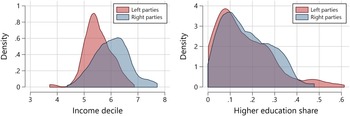
Our theory is timely because the electorates of left parties have become more affluent and educated as part of a broader embourgeoisement (Kitschelt Reference Kitschelt1994; Piketty Reference Piketty2020). A parallel stream of literature that is less strongly linked to the European cleavage literature points to the growing affluence of the centre-left coalition in the United States (Hacker et al. Reference Hacker, Malpas, Pierson and Zacher2024; Zacher Reference Zacher2024). Figure 2 shows that the actual class structure of parties’ electorates cannot be reliably approximated via partisanship. In our dataset, there is virtually no difference in the proportion of voters with higher education levels between left and right parties, and a considerable overlap in the mean voter income decile. Figure SI3 in Supplementary Information B breaks this down over time and shows that the gap between left and right parties has been closing. This matters because the cost–benefit calculation for equality-enhancing policies should become more negative the more affluent and educated the electorate of a party becomes, up to the point where such embourgeoisement eventually deters risk-averse parties from anything but the most cautious and selective egalitarian policies (Fastenrath and Marx Reference Fastenrath and Marx2025).
Parties and voter class. Note: distribution of mean voter income decile and proportion of voters with higher education levels among government parties’ voters. Data sourced from Gethin et al. (Reference Gethin, Martínez-Toledano and Piketty2022).

Sceptics may consider such class-focused cost–benefit analyses by politicians unlikely, as public opinion research shows remarkably high support for redistribution among high-class voters. This applies to voters with higher incomes and especially to those with higher education levels (Armingeon and Weisstanner Reference Armingeon and Weisstanner2021; Gingrich and Häusermann Reference Gingrich and Häusermann2015; Jacques Reference Jacques2023). According to this perspective, a higher-class constituency does not significantly constrain egalitarian parties.
We have two responses to this objection. First, it is sufficient for our theory that politicians doubt the prevalence of affluent egalitarians. Empirical evidence is scarce but supports this assumption. Lucas et al. (Reference Lucas, Sheffer, Loewen, Walgrave, Soontjens, Amsalem, Bailer, Brack, Breunig, Bundi, Coufal, Dumont, Lachance, Pereira, Persson, Pilet, Rasmussen, Sterba and Varone2025) report that politicians tend to consider voters to be egotropic pocketbook voters, which contrasts with voters’ own more sociotropic self-assessments. Fastenrath and Marx (Reference Fastenrath and Marx2025) find left politicians to describe voters as a major barrier in implementing progressive taxation, partly because they are so easily influenced by organised interests (see also Fastenrath et al. Reference Fastenrath, Marx, Truger and Vitt2022). Furthermore, politicians in both the United States and Europe consistently estimate their constituency to be more right-leaning – that is, anti-egalitarian – in their policy-related attitudes compared to constituents’ self-assessments (Broockman and Skovron Reference Broockman and Skovron2018; Pilet et al. Reference Pilet, Sheffer, Helfer, Varone, Vliegenthart and Walgrave2024).
Secondly, there are reasons to believe that the politicians are correct. The supposedly egalitarian affluent may engage in class-based economic voting to a larger degree than public opinion research suggests. We cannot settle this debate here, but we can provide some supporting theory and evidence. The affluent might support redistribution when pressed on the matter but assign low importance to the issue compared to poorer citizens. In effect, their redistribution preferences may be electorally inconsequential (Zacher Reference Zacher2024). In support of this theory, a Pew Research Center survey shows that more affluent US citizens consider inequality to be a much less important issue compared to less affluent citizens (Horowitz et al. Reference Horowitz, Igielnik and Kochhar2020). Furthermore, the high abstract support for redistribution among the affluent may be performative and wane substantially when they are faced with specific egalitarian policy proposals that hurt their bottom line (Zacher Reference Zacher2024). People are more likely to act upon their self-interest when they think about the personal costs and benefits of a policy, which is what happens when one moves from abstract goals to specific policies (Chong et al. Reference Chong, Citrin and Conley2001). For instance, the major electoral setback experienced by the German Greens in 2013 was blamed on the launch of the most fiscally progressive platform in their history (Blätte Reference Blätte2013).
In sum, shifts in the composition of party electorates have implications for policy making, as parties with affluent and highly educated voters have weaker incentives to actually pursue broad-based redistribution. While their voters may not oppose egalitarian policies outright, their reduced direct stake in redistribution can lower the salience of economic levelling. This may constrain governments from fully translating their egalitarian positions into policy outputs. Therefore, we expect that the explanatory power of government positions on economic equality diminishes as the affluence and education levels of their electorate increase.
High-class constituency hypothesis: The extent to which the cabinets’ emphasis on economic equality explains their policy outputs decreases with rising affluence and education of their electorate.
Data and Method
We use a panel-of-countries dataset with yearly values that links twelve countries’ policy outputs with the equality positions of their federal governments: Australia, Austria, Canada, Denmark, France, Germany, Ireland, New Zealand, Sweden, Switzerland, the United Kingdom, and the United States. We first introduce the new crowd-coded party position data before describing how we link this data to governments and our three subtypes of equality-enhancing policies.Footnote 6
A New Dataset on the Economic Equality Positions of Parties
Economic equality: We shall introduce an annual Wealth Tax on the rich. (UK Labour Party Manifesto 1974)
Equal rights: Labour is the only party to consistently stand with […] people from ethnic minority backgrounds. (UK Labour Party Manifesto 2019)
The two real-world statements above illustrate why it is crucial to measure economic equality emphasis. While economic equality statements include positive references to economic levelling or criticise material inequality, statements like the second one on equal rights pertain to the extension of rights to and equal treatment of minority groups. These minority groups are primarily ethnic minorities, and to a lesser extent disabled people and LGBTQI groups. In the few works that try to approximate the equality preferences of parties, these dimensions are conflated (as shown in Horn et al. Reference Horn, Haselmayer and Klüser2026), despite not being empirically related or even negatively related in some contexts (Pontusson and Rueda Reference Pontusson and Rueda2010; Tavits and Potter Reference Tavits and Potter2015). We argue that it undermines a fair test of the partisan hypothesis to consider the second example in a measure that is used to explain redistribution and redistributive policies – especially because critics (such as Piketty Reference Piketty2020 or Fraser Reference Fraser2017) argue precisely that equal rights issues are crowding out economic egalitarianism.
We use parties’ election manifestos to obtain information on party preferences. Such manifestos have frequently been used to measure parties’ issue emphasis (see, for example, Green-Pedersen Reference Green-Pedersen, Clasen and Siegel2007, Reference Green-Pedersen2019; Wagner and Meyer Reference Wagner and Meyer2014). However, existing datasets – notably the Manifesto Project (MARPOR) and Comparative Agendas Project – do not code whether parties emphasise economic equality or equal rights. We therefore coded the relevant party manifestos ourselves. We used crowd-coding to do so in a reliable and replicable way, a solution that is proven to scale expertise for semantically complex tasks that are still difficult to automate (Benoit et al. Reference Benoit, Conway, Lauderdale, Laver and Mikhaylov2016; Gielens et al. Reference Gielens, Sowula and Leifeld2025; Haselmayer and Jenny Reference Haselmayer and Jenny2017; Horn Reference Horn2019; Lehmann and Zobel Reference Lehmann and Zobel2018).
The digitised manifestos were retrieved from the MARPOR database or collected manually from different sources such as (online) archives and libraries. We used a sequential binary classifier trained on MARPOR data to splice the manifestos’ raw text into quasi-sentences. We then used regular expressions to identify sentences that might have been misallocated, which were forwarded to research assistants to check and – if necessary – revise the segmented quasi-sentences. This process segmented all party manifestos into quasi-sentences.
Secondly, we used another binary classifier to identify statements that likely concern (in)equality broadly conceived. The classifier was trained on MARPOR data to detect statements referencing positive mentions of equality (category 503 in the MARPOR data). The classifier was fine-tuned to reliably identify most relevant statements at the expense of false positives, thereby trading off precision for recall. This extensively validated reduction process left us with about 55,451 quasi-sentences (out of 850,000 in the text corpus overall) that speak to equality and social justice, which considerably decreases the workload for and costs of human coders.
Thirdly, we forwarded the retained statements to crowd-coders on Amazon Mechanical Turk between February and June 2022, a platform that has been successfully used for collecting data (Berinsky et al. Reference Berinsky, Huber and Lenz2012; Skytte Reference Skytte2022; Sumner et al. Reference Sumner, Farris and Holman2020). After reading brief instructions and having passed a qualification test, coders were presented individual statements and some context and were asked to judge whether they included a positive reference to equality and, if so, which of the specific categories applied. The qualification test used 2,904 unanimous coding decisions by three experts (post-doctoral researchers familiar with the topic) as reference (‘gold standard’). Based on previous research (Horn Reference Horn2019) and our pre-tests, we collected five codings per unit. This ensured that aggregated results align with expert ratings while enabling fast data collection at low cost. To warrant fair remuneration, we ensured that our workers were able to attain local minimum wages. The coding scheme is listed in Supplementary Information A, which describes the crowd-coding pipeline.
Fourthly, we aggregated individual codes based on majority vote. This approach reflects the notion of the ‘wisdom of the crowd’ and is anchored in social choice theory (Condorcet Reference de Condorcet2014 [Reference de Condorcet1785]). We obtain very high agreement between the crowd’s judgement and the unanimous expert coding: a Krippendorff’s alpha of 0.72 exhibits good agreement even by conventional standards of content analysis. Details are provided in Supplementary Information A.3, which shows reasonably high levels of validity across countries. This means that the crowd can match – and scale – expert judgements of complex tasks, even at the sentence (that is, below-manifesto) level.
For each party at each election, this gives us the share of economic equality statements relative to the overall party manifesto, along with data for other equality concepts and above-mentioned vague references. There is substantial variation across parties and within parties over time. Face validity is high. Consider the oft-debated cases of the US Democrats under Clinton in 2016 and the Danish Social Democrats under Frederiksen in 2019. While the Danish Social Democrats focused on material levelling (8 per cent) and neglected equal rights (1.9 per cent), the US Democrats campaigned with a focus on equal rights (7 per cent) rather than levelling (4 per cent). Two less-prominent cases that underscore the face validity of our measure, precisely because they capture a programmatic adjustment, are the uptick in egalitarianism of the Swiss Social Democratic Party after the financial crisis (in a programme entitled ‘For all, not the few’, with many clear economic equality stances), and the peak in economic egalitarianism of the German Greens in 2013 (Blätte Reference Blätte2013).
To give a more extensive idea of what we measure with our statements and what variation we capture, we provide additional examples at the statement level (Supplementary Information A.5). These fifty randomly drawn examples illustrate how the statements vary over policy contents, output v. outcome focus, and concreteness. Going beyond examples, we also show that our economic egalitarianism measure varies over the three policy fields, and includes outputs and outcomes (though the latter are less frequent) and positional statements as well as hard pledges (Supplementary Information A.6). Perhaps most importantly, as the correlation matrix and the distribution of the policy statements over programmes show, it is not the case that fiscal progressivity is already missing at the level of the economic equality statements. We emphasise this because it shows that, while our statements are specific, the economic equality indicator reflects a broad mix of equality policies and outcomes.
Measuring Policies
We require several measures for redistribution to cover the wide range of policies governments may use to level inequality. ‘Redistribution’ is a broad term that, in the loosest sense, refers to policies that make the income or wealth distribution more equal than it would have been without the policy (Atkinson Reference Atkinson2015). A helpful categorisation for types of equalising policies first distinguishes between pre- and redistributive policies. Pre-distributional policies act via equalising the income distribution on the market (Gornick and Smeeding Reference Gornick and Smeeding2018). In contrast, redistributive policies ‘correct’ market outcomes by changing the distribution post-market allocation. These can be further categorised into social policies that distribute transferred income and tax policies that raise taxes from citizens (Guillaud et al. Reference Guillaud, Olckers and Zemmour2019). This leaves us with a classification into pre-distributive policies, social policies, and tax/fiscal policies.
To measure pre-distributive policies, we use the Kaitz index, which quantifies the strength of minimum wages, sourced from the OECD. It quantifies the ratio between the federal minimum wage and the median wage in a country. Minimum wages are an ideal measure for pre-distribution because econometric evidence reliably shows that they reduce inequality while having mostly negligible employment effects (Autor et al. Reference Autor, Manning and Smith2016; Cengiz et al. Reference Cengiz, Dube, Lindner and Zipperer2019; Dustmann et al. Reference Dustmann, Lindner, Schönberg, Umkehrer and vom Berge2021). They function via boosting the wages of workers below and even somewhat above the minimum wage threshold. However, the downside is that the measure is only available for eight (of our twelve) countries with a minimum wage in effect, which excludes countries such as Denmark, which instead rely on strong union bargaining power to set sector wage floors; and for a limited and country-specific range of years in which a minimum wage was in effect in the respective countries.
To capture welfare state/social policies, we rely on the standard measure of unemployment insurance generosity, using the Comparative Welfare Entitlements Project dataset (CWEP) by Scruggs (Reference Scruggs2022). We chose unemployment benefits because this is in line with a large proportion of previous studies on partisan effects on the welfare state (Bandau and Ahrens Reference Bandau and Ahrens2020). Korpi’s (Reference Korpi1983) classic work on power resources highlights the decommodification and equalisation fostered by unemployment insurance, which is thus often seen as a pars pro toto for the welfare state at large (Horn Reference Horn2017). Unemployment benefits are inherently redistributive, distributing from those with labour market attachment to those without in the short term, and from those in more stable employment to those with riskier employment in the long term. They also tend to set a wage floor (reservation wage) and exert upward pressure on medium wage levels. Unemployment benefits are therefore a likely case for party effects that derive from different equality profiles. Despite their role as a neuralgic point in welfare states, generous unemployment schemes primarily serve an insurance purpose and are not a radical Robin Hood policy, as is the case with many welfare policies.
As for progressive taxation, we use top marginal income tax rates, which proxies taxation of the rich (Hope and Limberg Reference Hope and Limberg2022). We source the indicator from OECD data supplemented with data from Genovese et al. (Reference Genovese, Scheve and Stasavage2016). We focus on the personal income tax because it is highly redistributive while raising large revenues – implying that personal income taxes are the most quantitatively important redistributive tax. Alternative redistributive taxes such as wealth or inheritance taxes are used by few countries and/or raise comparatively little revenue. Regarding our use of top marginal rates, we are aware that marginal rates do not directly correspond to what the rich pay. One could argue that we should rather focus on effective rates, such as the comprehensive dataset by Egger et al. (Reference Egger, Nigai and Strecker2019) or the OECD’s Taxing Wages data. We prefer top marginal rates, however, because they are a politically salient policy output that is independent from the development of income levels. Another concern is that available effective taxation indicators would require us to drop a large proportion of our country–year observations due to data unavailability. However, we qualify our results regarding taxation with robustness tests using such alternative indicators.
Constituency Profiles
We use measures of mean voter income deciles and the mean share of voters with higher education to capture the socio-demographic profiles of parties’ voter bases. We source the data from Gethin et al. (Reference Gethin, Martínez-Toledano and Piketty2022), who harmonised post-election surveys for all countries in our sample. Occasional missing values are imputed using spline interpolation.
Control Variables
We include several control variables to account for possible confounders in our regression models: log GDP per capita, GDP growth, inflation, unemployment, the share of industry employment, the share of elderly citizens above working age, log population, union density, and union bargaining coverage. We source these data from the Comparative Political Data Set (Armingeon et al. Reference Armingeon, Engler, Leemann and Weisstanner2024) and Penn World Table (Feenstra et al. Reference Feenstra, Inklaar and Timmer2015). At the end of the analysis, we also assess whether historical party labels matter. For all countries, we linearly interpolate and extrapolate the few missing data points to avoid losing the observations to listwise deletion.
The main motivation of our variable choice is to control for economic problem pressure experienced by policy makers. GDP growth and unemployment in particular may induce them to adjust minimum wages, unemployment insurance, or income tax rates due to their complex interrelationships with employment levels and growth opportunities. Furthermore, union density and bargaining coverage control for political pressure from the labour movement.
Empirical Set-up
We use a panel-of-countries dataset with yearly values. The party position data is available on a party–election level. We restrict the data to government parties and convert them into a country–year structure using the Parties, Institutions, and Preferences (PiP) code infrastructure by Jahn (Reference Jahn2022). The resulting dataset records government parties’ positive mentions of economic equality for each country and year. Values are weighted according to the number of cabinet seats within coalition governments. If multiple governments served within the same year, the values are weighted according to their time in office. To test our hypotheses, we use a fixed effects (FE) regression model of the following form, estimated via ordinary least squares (OLS):
 $polic{y_c}_t = \beta \;egalitarianis{m_{ct - 1}} + \delta cntr{l_{ct - 1}} + {\alpha _c} + {\gamma _p} + {\varepsilon _{ct}}$
That is, we regress a policy measure (for example, level of minimum wage) of country c in year t on the equality position of their government in the preceding year, as well as several controls, country dummies, and five-year period dummies (1970–4, 1975–9, and so on).
We perform several variable transformations. The policy variables are always standardised to a mean of 0 and a standard deviation of 1 to make results comparable across the policies. Furthermore, some variables in our models have unusual values that may have an outsized influence on the results because OLS regressions are strongly influenced by outliers. We use the natural logarithms of governments’ equality positions, GDP per capita, and population due to their right-skewed distributions. We additionally winsoriseFootnote 7 several variables to bring outliers closer to what would be expected under a normal distribution: the logged equality positions and the generosity of the unemployment insurance are winsorised at the 1st percentile; economic growth and inflation are winsorised at both the 1st and 99th percentiles; and the mean share of voters with higher education is winsorised at the 95th percentile.Footnote 8
We use wild cluster bootstrap, clustered by countries, to estimate the standard errors (10,000 repetitions with Rademacher weights). This approach effectively deals with the problems associated with the data set-up, namely a clustered dataset with few clusters (Cameron et al. Reference Cameron, Gelbach and Miller2008). We require clustered standard errors because of serial autocorrelation within countries. However, usual cluster-robust standard errors require a large number of countries (at least thirty) and optionally a large number of observations within these clusters. Violations of these assumptions typically lead to underestimation of uncertainty. Wild cluster bootstrap is an alternative that remains valid with a small number of clusters, as in our case. That notwithstanding, using conventional clustered errors yields essentially the same findings.
Results
The Effect of Egalitarian Positions
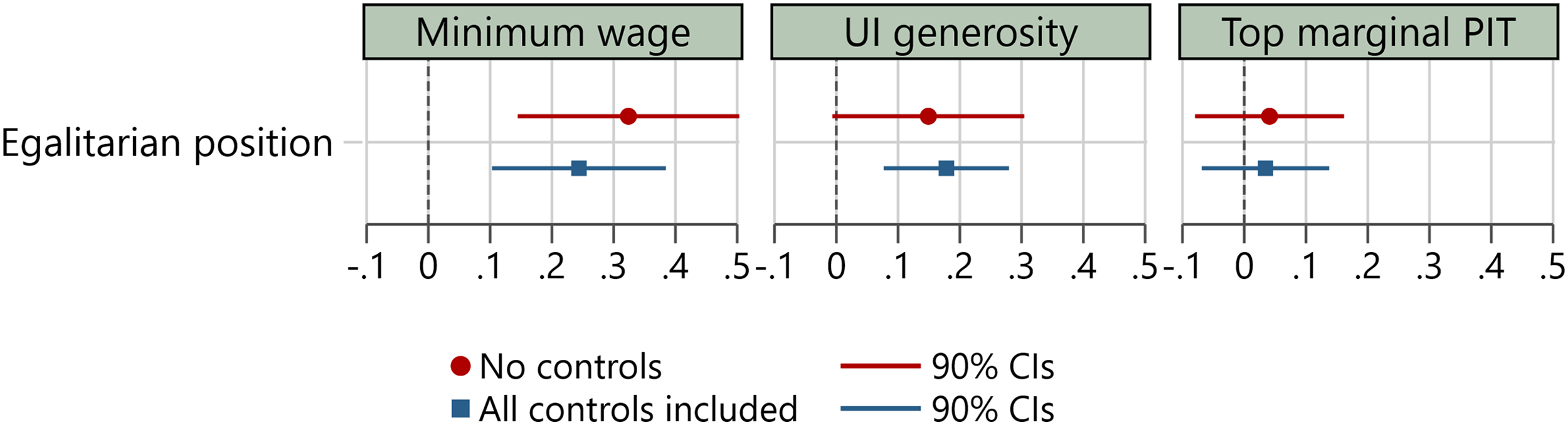
We begin the empirical analysis with the headline results before turning to subgroup analyses and robustness analyses. Figure 3 shows the results across the whole analysis sample. Overall, the naïve mandate theory hypothesis finds only partial support. In line with expectations, parties with a more egalitarian platform correspond with higher minimum wages (in countries and years where a minimum wage is in effect). The effect size is considerable. Going from the 25th to the 75th percentile of a government’s economic equality emphasis (1.6 per cent to 3.2 per cent equality statements in their manifestos) is associated with a minimum wage increase of 1.7 percentage points of the country’s median wage.Footnote 9 Furthermore, the effect on unemployment insurance generosity is significant when controls are included. Going from the 25th to the 75th percentile in equality emphasis is associated with a 0.3 increase in unemployment insurance generosity, which corresponds to a 0.3 standard deviation increase.Footnote 10 Results for top marginal income taxation, meanwhile, are neither statistically nor substantially significant, which is in line with our no top taxation hypothesis.
Main regression results. Note: the control variables are gross domestic product (GDP) growth, log GDP per capita, unemployment, inflation, the proportion of the workforce working in industry, the proportion of elderly, union density, bargaining coverage, and log population size. All models include country and time fixed effects (five-year intervals). Standard errors are estimated via wild bootstrap clustered by countries. Full regression models in Supplementary Information C. UI: unemployment insurance. PIT: personal income tax.

Classical Partisanship
We now turn to the role of partisanship. Our aim is to show that our results persist when including party family variables in our models. It is not our intention to thereby brush aside the role of partisanship and party families; we still consider partisanship to be important. For example, being a social democratic party incentivises party leaders to care about workers and social policy, which may lead to stronger egalitarianism under social democratic rule. Our expectation is merely that party positions derived from manifestos are a better predictor of policies than party labels.
We first analyse whether our results hold when including the share of left parties in governments as an additional variable. Figure SI4 in Supplementary Information D shows that our main results remain intact for all three policy variables. As can be expected, the left party share coefficients are positive for minimum wages and unemployment insurance benefits, but they are insignificant in both cases. This suggests that our egalitarianism indicator is a better predictor of policies than historical party labels.
We then turn to interaction models that analyse the effect of egalitarianism separately for governments with a right majority, left majority, and mixed cabinets.Footnote 11 Table SI8 and Figure SI5 in Supplementary Information D show that our results are relatively consistent across left, right, and mixed governments, although the confidence intervals are bound to be broader due to the lower number of observations. The egalitarian position is a good predictor of minimum wage and unemployment insurance benefit strength even among right cabinets. This offers further support for our expectation that party positions – rather than party labels – are good predictors of policies.
One result stands out from the separate analysis of left-majority, right-majority, and mixed cabinets. Mixed cabinets are estimated to have null effects on unemployment insurance generosity, while the estimates for both right and left majority cabinets are positive and significant. That is, the egalitarian position of government parties is not a good predictor of policies when left and right parties govern together. We interpret this finding as a result of issue ownership. It is exactly when left and right parties share government responsibility that party labels matter most. Traditionally, the left has owned issues revolving around welfare state expansion and equality. Although welfare and workfare reforms have led to a partial loss of this (issue) advantage (Horn Reference Horn2021), it is still the norm that, in comparison with right parties, left parties are associated by voters with pro-equality stances (Green-Pedersen Reference Green-Pedersen2019). Thus, if right parties find themselves in mixed government coalitions, this could make them cautious regarding egalitarian reforms. Due to the relatively stable issue ownership advantage of the left when it comes to issues of social justice, welfare, and equality (Seeberg Reference Seeberg2017), there is a palpable risk that it is easier for left coalition partners to take credit for equality-enhancing reform than for right parties.
The Conditioning Role of Constituency Constraints
We continue our analysis with interaction regression models that assess how conditional our main findings are on constituency composition (calculated at the party level, aggregated for the cabinet). We estimate similar models as before but now gauge the interaction of egalitarianism with the income and education levels of the cabinets’ electorates. Figure 4 plots marginal effects of cabinet egalitarianism conditional on voter structure derived from these interaction models.
Interaction results. Note: the control variables are gross domestic product (GDP) growth, log GDP per capita, unemployment, inflation, the proportion of the workforce working in industry, the proportion of elderly, union density, bargaining coverage, and log population size. All models include country and time fixed effects (five-year intervals). Standard errors are estimated via wild bootstrap clustered by countries. Regression tables in Supplementary Information C. UI: unemployment insurance. PIT: personal income tax.

Figure 4 offers partial support for our high-class constituency hypothesis, which expects the effect of party egalitarianism to decrease under a higher-class constituency. As a constituency has higher income, the effect of egalitarianism on unemployment insurance generosity decreases from positive and significant to a null effect. Likewise, the effect of egalitarianism on minimum wages decreases from positive and significant to insignificant as the share of voters with higher education increases.
The conditional effect sizes range from considerable to indistinguishable from zero. At a mean voter income at the fifth decile, going from the 25th to the 75th percentile in party egalitarianism is associated with a 0.5 increase in unemployment insurance generosity, which corresponds to a 0.4 standard deviation increase. The effect becomes insignificant when the party’s voters are on average in the 6th income decile or even higher (that is, if the party is mostly supported by the upper middle class).
Furthermore, at a 10 per cent share of voters with higher education, going from the 25th to the 75th percentile in equality emphasis is associated with a minimum wage increase of 2.8 percentage points of the country’s median wage. This effect becomes insignificant if the share of voters with higher education exceeds 18 per cent.
None of the other models suggest the existence of further interaction effects. Crucially, the effect on high-income taxation is estimated to be near zero and insignificant for all levels of constituency income and education. In other words, while a party’s class profile constrains egalitarian governments regarding pre-distribution and welfare, it does not condition the effect regarding top income tax rates. This offers further support for our no top taxation hypothesis and thereby further constrains the naïve mandate hypothesis.
Sensitivity Tests
As we briefly summarise in this section, our results are not only robust for left and right cabinets but also hold for alternative dependent variables and different econometric specifications, and irrespective of the exclusion of specific countries.
A first concern we want to address is that the top marginal income tax rate indicator may appear cherrypicked, as there are viable alternatives. We therefore re-estimate our main models with alternative tax measures to show that our null results hold. We use three alternative tax measures (see Table SI9 in Supplementary Information D), all of which are available for fewer countries and/or years compared to our main analyses. First is the share of income tax revenue paid by the top 20 per cent of income owners, which is an effective taxation measure. Second is the effective taxation of wage income averaged over two affluent household profiles (single earner with 200 per cent of average earnings and dual earners with 150–150 per cent of average earnings). And third, we use the top marginal inheritance tax rate (see Table SI9 for data sources). All indicators yield similar non-effect patterns as top marginal income taxation.
We conduct further analyses of our main specifications to ensure that our results are robust to alternative model set-ups (see Supplementary Information D). First, we stand by our modelling choices, but it is reassuring that popular approaches (PCSE/panel-corrected standard errors and conventional country-clustered standard errors) yield substantially identical results (Figures SI6–SI7). Secondly, we test the sensitivity of our results to the exclusion of specific countries using jackknife methods, which replicate our main findings dropping one country at a time (Figure SI8). No individual country seems to exert an outsized influence on the results we present, and our results hold across the jackknife models.
The Broader Policy Process: Selective Egalitarianism Already at Programme Level?
We analyse the translation of egalitarian positions coded into programmes but neglect programmatic selection, that is, how these programmes emerge. In our model of the policy formulation, we assume that ‘speech is sincere’, meaning that we see the economic egalitarianism indicator derived from party manifestos as a measure of real, sincere equality positions by these parties. The puzzle therefore concerns ‘a lack of action’ regarding actual redistributive policies.
Here, we address programmatic selection, as it would undermine our argument if the constraints in egalitarian action are already baked into programmes in the previous step. Supplementary Information E reports additional evidence showing that parties do not simply adjust their pre-election egalitarian position over time to the structure of their voter bases in terms of income and education. This holds if we lag by one election. Furthermore, the broad distribution of policies found in party programmes (as discussed in the data section; see also Supplementary Information A.6) is in line with our ‘lack of action’ perspective. At a given level of economic egalitarianism, voters cannot infer (future) neglect of tax reform pre-election. Taken together, this provides evidence for the notion that egalitarian positions are not hyper-strategic in the sense that parties adjust their positions in the short term to the supposed preferences of certain strata. However, we are careful to note that this view is compatible with the long-term adjustment to societal change that work on cleavages shows. Likewise, these results do not imply that there is no short-term targeting at all when formulating manifestos or that parties would not respond selectively to how inequality indicators change. Nevertheless, it is not the case that the equality rhetoric of parties is determined by short-term changes in voter profiles.
Selective Egalitarianism – Evoking Equality while Evading Redistribution
Egalitarianism leads to pro-equality policies, but even economically egalitarian cabinets exhibit reluctance and remain cautious when it comes to taxing the rich. Instead, they focus on addressing market inequalities by lifting the wage floor through (wage) pre-distribution and mitigating labour market risks via welfare policies. While pre-distribution is a crucial yet oft-neglected pathway, its impact is primarily concentrated on reducing low-end inequality. Similarly, although egalitarian governments tend to strengthen insurance schemes with at least partly equalising effects, these measures predominantly benefit the middle class.
Taken together, our findings – especially the robust non-findings – reveal a policy approach to combating inequality that avoids addressing top-end inequality directly. Instead, it seeks to insure the middle class against economic risks while cushioning the most visible downsides of low-end inequality through pre-distribution and targeted welfare measures. It rhetorically embraces equality for all, softens market shocks, and avoids imposing fiscal costs on influential groups. We label this pattern selective egalitarianism. To what extent this reflects a conscious strategy or mere adaptation to perceived electoral constraints remains an open question.
We concede that our approach has limitations pertaining to the empirical analysis. First, we cannot ascertain via a direct statistical test to what extent cost concentration and policy complexity explain the non-effect of party egalitarianism on top-income taxation. However, we note that our evidence is in line with previous research showing that politicians themselves consider policy complexity to be an important barrier to implementing progressive taxation (Fastenrath and Marx Reference Fastenrath and Marx2025). Secondly, we do not conduct design-based causal effect identification. Our estimates rely on the assumption that unobserved confounders are dealt with via our selection of control variables and fixed effects. While we have confidence in our empirical approach, the presence of additional unobserved confounders cannot be ruled out. Both limitations offer avenues for future research.
These limitations notwithstanding, our findings illuminate a central puzzle of contemporary politics: why economic inequality continues to rise despite strong rhetorical commitments to equality and widespread public support for redistribution. Our analysis shows that governments tend to pursue politically safer forms of inequality reduction that avoid imposing costs on affluent constituencies. As a result, they often insure the middle class and support the (working) poor while leaving top-end inequality largely untouched. This helps to explain why inequality endures: not because political elites lack egalitarian goals but because they perceive key redistributive tools – such as taxing the rich – to be electorally risky. Addressing entrenched inequality, therefore, may require more than ideological alignment or voter demand. It also requires altering the political calculus surrounding redistribution – either by changing the class structure of party constituencies or by shifting elite perceptions of voter preferences.
Supplementary material
The supplementary material for this article can be found at https://doi.org/10.1017/S0007123426101562.
Data availability statement
The replication data are available at the BJPolS Harvard Dataverse at https://doi.org/10.7910/DVN/GDYXDT.
Acknowledgements
Owing to its importance for our project and to Leo’s illness, no paper from the Varieties of Egalitarianism project has been presented as frequently or benefited from as much feedback. We are deeply grateful to many colleagues for insightful comments and suggestions, among them Jane Gingrich, David Rueda, Marius Busemeyer, Paul Marx, Florian Fastenrath, Julian Limberg, Julian Garritzmann, Bastian Becker, Matthias Haslberger, Lea Elsässer, Silja Häusermann, Matt Polacko, Julius Kölzer, Fabian Mushövel, Mads Elkjær, David Brady, and Kris-Stella Trump. Lukas Hofmann provided excellent research assistance. The broader framework underlying this paper benefited from earlier input by Carsten Jensen, Kees van Kersbergen, Peter Hall, Jonas Pontusson, Kenneth Benoit, Henrik Seeberg, and Christoffer Green-Pedersen, as well as former project members Martin Haselmayer, Jonathan Klüser, and Simon Rittershaus. This paper was a labour of love. Sadly, its enthusiastic acceptance by three thoughtful reviewers is something Leo, who passed away on 23 December 2025, did not live to see. His exceptional kindness, uncompromising honesty, and sharp wit will be deeply missed. We will not forget you, Leo.
Financial support
This work was supported by the German Research Foundation with an Emmy Noether Research Group Grant (grant number 428250727, PI Alexander Horn).
Competing interests
The authors declare none.



 Open access

