Brain-derived neurotrophic factor (BDNF) is a member of the neurotrophin family of growth factors, particularly involved in the growth and differentiation of neurons and the formation and elimination of synapses (Barde, Reference Barde1990). BDNF exists in the central nervous system and, with a high correlation, in the periphery (Karege, Schwald, & Cisse, Reference Karege, Schwald and Cisse2002). Several animal studies have examined prenatal risk factors that are associated with BDNF levels in newborns. For example, in rats, exposure to nicotine during gestation elevated BDNF levels in the striatum, frontal cortex, and the hippocampus of the offspring (Harrod et al., Reference Harrod, Lacy, Zhu, Hughes, Perna and Brown2011). In a study with mice, exposure to cigarette smoke during pregnancy decreased BDNF levels in the striatal structures of the offspring's brain (Yochum et al., Reference Yochum, Doherty-Lyon, Hoffman, Hossain, Zelikoff and Richardson2014). Compared to mice with a normal diet, mice fed a diet to induce maternal obesity had offspring with lower BDNF levels in the hippocampus that resulted in impairments in dendritic arborization of the hippocampal neurons (Tozuka et al., Reference Tozuka, Kumon, Wada, Onodera, Mochizuki and Wada2010). In addition, rats exposed to prenatal stress had reduced BDNF in the olfactory bulbs and the hippocampus 1 to 5 days after birth (Van den Hove et al., Reference Van den Hove, Steinbusch, Scheepens, Van de Berg, Kooiman, Boosten and Blanco2006). In humans, evidence on maternal lifestyle and environmental factors that could potentially influence neonatal BDNF is sparse. In a cohort study of 395 term singletons, maternal self-report of smoking during pregnancy was associated with higher cord serum levels of BDNF but only among girls (Spulber et al., Reference Spulber, Rantamaki, Nikkila, Castren, Weihe, Grandjean and Ceccatelli2010). In 120 mother–child pairs, it was reported that maternal mental disorders were associated with lower BDNF levels in umbilical cord blood (Flock et al., Reference Flock, Weber, Ferrari, Fietz, Graf, Fimmers and Merz2015). Despite a growing body of literature suggesting the impact of maternal adiposity and weight on children's neurodevelopment (Jo et al., Reference Jo, Schieve, Sharma, Hinkle, Li and Lind2015; Van Lieshout, Reference Van Lieshout2013), the effect of maternal obesity on children's BDNF has not been investigated in humans.
As BDNF has been implicated in several neuropsychiatric disorders such as depression (Molendijk et al., Reference Molendijk, Spinhoven, Polak, Bus, Penninx and Elzinga2014), autism spectrum disorder (ASD; Nickl-Jockschat & Michel, Reference Nickl-Jockschat and Michel2011), epilepsy (Connolly et al., Reference Connolly, Chez, Streif, Keeling, Golumbek, Kwon and Deuel2006), and schizophrenia (Weickert et al., Reference Weickert, Hyde, Lipska, Herman, Weinberger and Kleinman2003), the longitudinal association of neonatal BDNF levels and children's neurodevelopmental outcomes is of interest. For example, children with ASD are consistently shown to have higher levels of BDNF compared to typically developing children (Qin et al., Reference Qin, Feng, Cao, Wu, Loh and Cheng2016). However, studies of children with diagnosed psychopathology cannot provide insights on the stage of development; therefore, longitudinal studies linking BDNF, development, and psychopathology are warranted. Among the few studies that investigated the longitudinal relationship between neonatal BDNF and ASD, results remained inconsistent (Abdallah et al., Reference Abdallah, Mortensen, Greaves-Lord, Larsen, Bonefeld-Jørgensen, Nørgaard-Pedersen and Grove2013; Croen et al., Reference Croen, Goines, Braunschweig, Yolken, Yoshida, Grether and Van de Water2008; Nelson et al., Reference Nelson, Grether, Croen, Dambrosia, Dickens, Jelliffe and Phillips2001, Reference Nelson, Kuddo, Song, Dambrosia, Kohler, Satyanarayana and Nelson2006). In a retrospective analysis of neonatal dried blood spots (DBSs), Nelson et al. (Reference Nelson, Grether, Croen, Dambrosia, Dickens, Jelliffe and Phillips2001) showed an overexpression of BDNF in children with diagnosis of ASD compared to typically developing children. Contradicting their previous findings after using a different laboratory method of detection, Nelson et al. (Reference Nelson, Kuddo, Song, Dambrosia, Kohler, Satyanarayana and Nelson2006) reported no differences in BDNF levels measured in newborn blood spots between children with ASD and healthy controls. Croen et al. (Reference Croen, Goines, Braunschweig, Yolken, Yoshida, Grether and Van de Water2008) also showed no association between neonatal BDNF and ASD diagnosis. In a case-control study using a National Biobank in Denmark, serum blood samples from neonates later diagnosed with ASD were reported to have lower levels of BDNF than those of controls (Abdallah et al., Reference Abdallah, Mortensen, Greaves-Lord, Larsen, Bonefeld-Jørgensen, Nørgaard-Pedersen and Grove2013). High levels of heterogeneity in the previous studies, different methodology for assessment of BDNF, and differences in trajectories of BDNF levels among children with psychopathology and typically developing children are suggested to explain the inconsistencies in previous research (Nickl-Jockschat & Michel, Reference Nickl-Jockschat and Michel2011). Considering this heterogeneity, a recent meta-analysis found no prospective association between neonatal BDNF and ASD among four existing studies on neonatal BDNF and ASD (Qin et al., Reference Qin, Feng, Cao, Wu, Loh and Cheng2016).
Whether BDNF levels in infancy predict children's normal trajectory of development is also less clear. A handful of studies that investigated cord blood or neonatal BDNF with child development showed a positive association with personal–social skills in children (Yu et al., Reference Yu, Chen, Wang, Yang, Gao and Tian2016), no association with cerebral palsy, and a positive association with Down syndrome (Nelson et al., Reference Nelson, Grether, Croen, Dambrosia, Dickens, Jelliffe and Phillips2001). Impairments in several domains of development are shown to precede psychopathology in childhood (Skovgaard et al., Reference Skovgaard, Olsen, Christiansen, Houmann, Landorph and Jorgensen2008). For example, retrospective assessment of children with ASD and prospective follow-up of children at risk confirms that children with ASD diagnosis showed symptoms of delays in motor development, expressive language, and social development already in the “prodrome” phase (Landa, Stuart, Gross, & Faherty, Reference Landa, Stuart, Gross and Faherty2013; Yirmiya & Charman, Reference Yirmiya and Charman2010). Therefore, it is possible that neonatal BDNF levels are associated with broad developmental outcomes in young children before the emergence of psychopathology.
As such, in a large population-based US cohort, we examined socioeconomic and maternal lifestyle determinants of neonatal BDNF levels as measured using DBSs. Based on evidence from animal models, we hypothesized that prenatal exposures would be associated with lower neonatal BDNF levels. We also explored whether neonatal BDNF was associated with children's development through age 3 years in a large population-based sample, specifically with the domains of fine and gross motor, communication, personal–social functioning, and problem-solving ability. Because of its role in the growth and differentiation of neurons and the formation and elimination of synapses, lower neonatal BDNF levels were hypothesized to be associated with delays in these five domains of development through age 3 years. DBSs (five drops of whole blood collected on filter paper from a heel prick) are a rich resource with the potential to measure circulating biomarkers and early exposures of neonates (McDade, Williams, & Snodgrass, Reference McDade, Williams and Snodgrass2007). Previously, it has been shown that DBSs provide a robust and convenient sample for immunoassay analysis of inflammatory markers (including BDNF) in whole blood, especially if the DBSs are stored at low temperature (Skogstrand et al., Reference Skogstrand, Ekelund, Thorsen, Vogel, Jacobsson, Nørgaard-Pedersen and Hougaard2008).
Methods
Participants
This study used data from the Upstate KIDS Study, a population-based birth cohort that was originally designed to evaluate the long-term impact of infertility treatment on child development (Buck Louis et al., Reference Buck Louis, Hediger, Bell, Kus, Sundaram, McLain and Druschel2014). Recruitment, which was based on birth certificate indication of infertility treatment and plurality, occurred in New York State (excluding New York City) from 2008 to 2010. Infertility treatments included two broad categories: (a) assisted reproductive technology-specific treatment including in vitro fertilization (with or without intracytoplasmic sperm injection), and (b) ovulation induction via oral or injectable medications with or without intrauterine insemination (Buck Louis et al., Reference Buck Louis, Hediger, Bell, Kus, Sundaram, McLain and Druschel2014). All live births conceived with infertility treatment and all multiple gestations (regardless of mode of conception) were recruited. Singletons conceived by treatment were also recruited at a 1:3 ratio to those not conceived by treatment, while also frequency matching on region of birth. There were 3,905 mothers of singletons and 1,084 mothers of twins who were enrolled in Upstate KIDS. We previously showed that infertility treatment was not associated with children's development after accounting for plurality (Yeung, Sundaram, Bell, et al., Reference Yeung, Sundaram, Bell, Druschel, Kus, Ghassabian and Buck Louis2016). In these analyses, mother–child pairs with consent on the use of residual newborn DBSs and information on BDNF were included (n = 3,145, 2,095 singletons and 1,050 twins). Among them, characteristics between parents, who consented for DBS use and those who did not, were found to be very similar (Yeung, Buck Louis, et al., Reference Yeung, Buck Louis, Lawrence, Kannan, McLain, Caggana and Bell2016).
The New York State Department of Health (NYSDOH) and the University at Albany Institutional Review Board (IRB) approved the study (NYSDOH IRB 07-097; UAlbany 08-179) and served as the IRB designated by the National Institutes of Health for this study under a reliance agreement. Parents provided written informed consent on behalf of their children.
Measurements
BDNF levels
In the state of New York, DBSs are collected as part of the Newborn Screening Program. Parental consent for using residual DBSs (minus one reserved for future NYSDOH needs) was requested when the children were 8 months old. DBS cards of those with consent were retrieved from cold storage (4 °C). Punches of the residual spots were extracted in a similar manner as previously described for other analytes (Yeung, Buck Louis, et al., Reference Yeung, Buck Louis, Lawrence, Kannan, McLain, Caggana and Bell2016). Eluants from the extraction of each 3.2 mm punch were frozen at −80 °C until analysis. The BDNF levels (ng/ml) were measured as part of Millipore's Neurodegenerative Panel III (EMD Millipore, Billerica, MA) using a Luminex100 analyzer with xPONENT 3.1 software (Luminex System, Austin, TX). Based on 3,658 replicate measurements, the intraassay coefficient of variation was 12.5%. Instrument-reported values for those below the limit of detection (including samples where the instrument could not detect the presence of the analyte) were used without censoring to prevent potential bias (Schisterman, Vexler, Whitcomb, & Liu, Reference Schisterman, Vexler, Whitcomb and Liu2006). Batch effects in the BDNF values were removed using COMBAT, a statistical program that is commonly used to remove batch to batch measurement error (Johnson, Li, & Rabinovic, Reference Johnson, Li and Rabinovic2007; Leek, Johnson, Parker, Jaffe, & Storey, Reference Leek, Johnson, Parker, Jaffe and Storey2012).
Children's development
Using the Ages & Stages Questionnaires (ASQ), mothers reported on their children's development at ages 4–6, 8, 12, 18, 24, 30, and 36 months of age (corrected for gestational age). The ASQ is a validated screening instrument designed for the early detection of developmental delays (Guevara et al., Reference Guevara, Gerdes, Localio, Huang, Pinto-Martin, Minkovitz and Pati2013). The ASQ encourages parents to participate in activities with their children to obtain an accurate developmental assessment and then respond to questions assessing five developmental domains (i.e., fine motor, gross motor, communication, personal–social functioning, and problem-solving ability; Squires & Bricker, Reference Squires and Bricker2009). In Upstate KIDS, we first implemented the ASQ second edition for screening at ages 4 to 12 months and the third edition from ages 18 months onward as it became available in 2009 after recruitment began. Each questionnaire item was scored (yes = 10 points, sometimes = 5 points, not yet = 0 points) and summed for each domain (0–60 points; Squires, Potter, & Bricker, Reference Squires, Potter and Bricker1999).
Study personnel called parents to follow up when the child failed any of the five domains or parental concern was noted. Trained specialists implemented an age-appropriate follow-up ASQ for children failing any of the domains or for children whose parent reported concerns. We defined age at failing as the time of the initial screen fail (regardless of the time of the follow-up call). When follow-up was incomplete, the child remained as having failed for that age-appropriate ASQ. Screening instruments were considered valid only if they were completed in the specified age windows. We previously used data from the New York State Early Intervention Program to confirm findings from ASQ screening (Yeung, Sundaram, Bell, et al., Reference Yeung, Sundaram, Bell, Druschel, Kus, Ghassabian and Buck Louis2016).
The ASQ is a validated instrument that has been shown to identify early developmental delays in children between 0 and 5 years of age (Squires & Bricker, Reference Squires and Bricker2009). As a screener, the ASQ has adequate psychometric properties (75% sensitivity and 81% specificity) and modest agreement with other instruments (Gollenberg, Lynch, Jackson, McGuinness, & Msall, Reference Gollenberg, Lynch, Jackson, McGuinness and Msall2010; Schonhaut, Armijo, Schonstedt, Alvarez, & Cordero, Reference Schonhaut, Armijo, Schonstedt, Alvarez and Cordero2013). Due to the instrument's properties and a continuous raw score with a very skewed distribution, we used ASQ as a binary outcome (fail/pass status) in all analyses. Domain-specific fails were defined as scores below 2 SD of the mean for the child's age based on normative data (Squires & Bricker, Reference Squires and Bricker2009).
Covariates
Information on maternal age, parity, plurality, infant's gender, gestational age, and birth size was obtained from vital records. Mothers reported at 4 months postpartum on sociodemographic characteristics, such as highest acquired education level and race/ethnicity, and history of smoking (never, stopped when pregnancy was known, and continued in pregnancy) and pregnancy alcohol consumption (yes/no), prepregnancy weight and height, infertility treatment of any type, and use of fish oil or multivitamin supplement. We used the International Code for Disease—Ninth Revision codes to identify maternal history of depressive disorders in pregnancy as registered in hospital discharge data in the Statewide Planning and Research Cooperative System, a comprehensive reporting system capturing longitudinal inpatient and outpatient hospital discharge data from New York State including details on patient characteristics, diagnoses, treatments, services, and charges. Maternal body mass index (BMI) was calculated using prepregnancy weight and height as provided in the vital records and in the maternal questionnaire at 4 months postpartum (if missing in vital record) and categorized as thin or normal weight (<25 kg/m2), overweight (25–29.99 kg/m2), or obese (>30 kg/m2).
Statistical analyses
Analyses were performed in the primary cohort of the study, which included all singletons and a random twin from each pair (n = 2,637). We used multivariable linear regression models to investigate the associations of maternal age, maternal race, maternal educational levels, parity, infertility treatment, having private insurance, maternal categories of BMI, maternal history of drinking and smoking in pregnancy, maternal history of depressive disorders in pregnancy, preterm delivery, and plurality with neonatal BDNF levels. Models were run univariately for each of these variables. A parsimonious model including factors that were statistically significant (p < .1) from these analyses was built to estimate the association of examined socioeconomic and maternal lifestyle determinants with neonatal BDNF (Rothman, Greenland, & Lash, Reference Rothman, Greenland and Lash2008). BDNF levels were log transformed for normality.
Next, we used generalized linear mixed models with logit function and random effect to estimate the odds ratios and 95% confidence intervals (CIs) of the association between BDNF levels and failing the five ASQ domains over time (up to age 3 years). We also examined the same association with any ASQ fail, defined as failing any of the five domains at each assessment, up to seven times. All models included an infant-level random intercept to account for repeated measures for each infant and to model the child-specific variable effect. These models utilize children's repeated ASQ pass/fail information over time. The random intercept variance and Bayesian information criterion for these models were reported. We examined interactions between preterm birth and BDNF as well as plurality and BDNF in relation to overall ASQ failure. In the presence of an interaction, stratified analyses were performed. We also categorized BDNF levels in quartiles to examine a nonlinear association between BDNF and odds of ASQ failure. To examine whether effects may have been more subtle and independent of cutoff choice, we ran the analyses using a lower cutoff (1.5 SD of the scores in the study population).
We selected confounders on the basis of the associations between maternal lifestyle factors, neonatal BDNF levels, and children's neurodevelopment in previous literature (Abdallah et al., Reference Abdallah, Mortensen, Greaves-Lord, Larsen, Bonefeld-Jørgensen, Nørgaard-Pedersen and Grove2013; Spulber et al., Reference Spulber, Rantamaki, Nikkila, Castren, Weihe, Grandjean and Ceccatelli2010). We also included the socioeconomic and maternal lifestyle factors that were associated with neonatal BDNF in our analyses. All models were adjusted for child gender, preterm birth, plurality, parity, infertility treatment, maternal age, race, education, history of smoking and drinking, prepregnancy BMI, and having private insurance. We did not adjust the models for a child's age, because ASQ fails were age specific. Models included the discrete “time” variable indicating the wave of ASQ assessment. In all analyses, sampling weights were used to account for the study's design of oversampling infants conceived with infertility treatment and twins as well as having consent to use DBS for assessment of BDNF (Buck Louis et al., Reference Buck Louis, Hediger, Bell, Kus, Sundaram, McLain and Druschel2014). Weights were derived using New York State birth certificate data on infertility treatment, plurality, and region of birth for all infants born during the period of recruitment (Buck Louis et al., Reference Buck Louis, Hediger, Bell, Kus, Sundaram, McLain and Druschel2014). Missing covariate data were less than 5%, and therefore, imputation was not conducted. All analyses were performed using SAS version 9.3 (SAS Institute Inc., Cary, NC).
Results
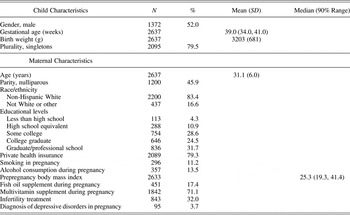
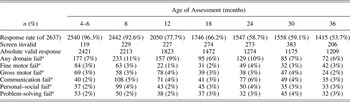
Characteristics of study participants are summarized in Table 1. Given that the cohort was originally designed to track children conceived by infertility treatment, 32% of the current analytic sample was conceived by treatment. As such, the cohort was highly educated (with 31% having graduate-level education) and predominantly non-Hispanic White (83%). In addition, 45% of mothers were nulliparous, 79% had private insurance, 11% smoked in pregnancy, and 13% reported history of any alcohol drinking in pregnancy. |In 2,637 children included in the study, 820 children (31%) had ASQ assessments at all seven time points and 525 children (20%) had data on six ASQ assessments. Only 50 children (1.9%) had one ASQ from all seven assessment waves. From ages 4 to 36 months, 2%–4% of children failed the screen in each of the five domains of fine motor, gross motor, communication, personal–social, and problem solving (Appendix A, Table A.1). The percentage of children failing in at least one of the five developmental domains (any ASQ fail) when viewed altogether were 7% at ages 4–6 months, 11% at age 8 months, 9% at 12 months, 6% at 18 months, 10% at 24 months, 7% at 30 months, and 6% at 36 months.
Baseline characteristics of participants (n = 2637)

Note: The values are mean (standard deviation) for continuous normally distributed variables, median (90% range) for continuous variables with skewed distribution, and percentage for categorical variables. Observations counted from singletons and one randomly selected twin of each pair (primary cohort, n = 2637). Information on maternal age, parity, plurality, infant's gender, gestational age, and birth size was obtained from vital records. Mothers reported at 4 months postpartum on sociodemographic characteristics, such as highest acquired education level and race/ethnicity, and history of smoking (never, stopped when pregnancy was known, and continued in pregnancy) and pregnancy alcohol consumption (yes/no), prepregnancy weight and height, infertility treatment of any type, and use of fish oil or multivitamin supplement. International Code for Disease Ninth Revision. Codes was used to identify maternal history of depressive disorders in pregnancy as registered in hospital discharge data in the Statewide Planning and Research Cooperative System.
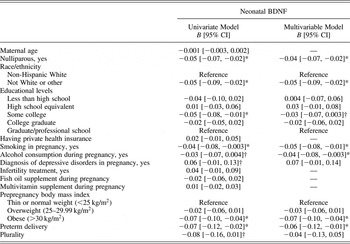
Table 2 shows the associations between prenatal determinants and neonatal BDNF. When we examined the relationship between prenatal factors and neonatal BDNF levels in a multivariate model, we observed that nulliparity (p < .001), maternal non-White ethnicity/race (p = .004), maternal smoking in pregnancy (p = .02), maternal alcohol consumption in pregnancy (p = .05), and prepregnancy obesity (p < .001) were associated with lower BDNF levels in neonates. Education and depressive disorders did not remain significant in the multivariate model.
Prenatal determinants of BDNF in neonates
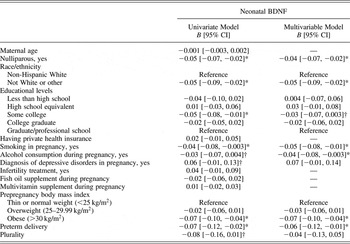
Note: Analyses were performed in the primary cohort including singletons and one randomly selected twin of each pair (n = 2637). First, maternal age, maternal race, maternal educational levels, parity, infertility treatment, having private insurance, maternal categories of body mass index, maternal history of drinking and smoking in pregnancy, and maternal history of depressive disorders in pregnancy were included in the model of association with brain-dervied neurotrophic factor (BDNF) separately (univariate model). Second, a parsimonious model including factors that were statistically significant (p < .1) from these analyses was built to estimate the association of determinants with neonatal BDNF (multivariable model). BDNF had a skewed distribution and therefore was log transformed. The BDNF levels are log nanograms/milliliter (ng/ml).
†p < .1. *p < .05.
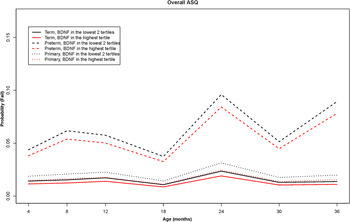
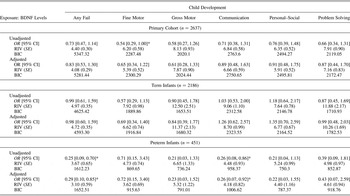
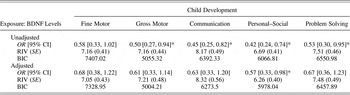
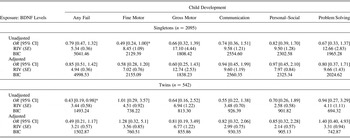
The unadjusted longitudinal trajectories of any ASQ failure (in five domains) were similar between children with neonatal BDNF in the lowest tertile and the rest of children (in the primary cohort, term infants, and preterm infants; Figure 1). In longitudinal analyses of neonatal BDNF and children's development up to age 36 months, we found no association between neonatal BDNF and any ASQ failure or domain specific fail in the primary cohort (Table 3). When the alternative cutoff was used (1.5 SD of the scores in the study population), the results remained essentially unchanged, except that there was a significant association between neonatal BDNF and failure in the domain of personal–social skills. (Table A.2 shows the results in the primary cohort and with five ASQ domains.) There was no interaction between plurality and BDNF in relation to ASQ failure; however, further testing suggested an interaction between preterm birth and BDNF (interaction p = .06). When we stratified analyses for preterm birth, we found that among preterm infants, a higher neonatal BDNF was associated with lower odds of failing in any of the five ASQ domains, per log unit increase in BDNF, odds ratio (OR) = 0.29, 95% CI [0.10–0.79]. Post hoc analyses on domain specific failure revealed that this association was significant for failure in communication, OR = 0.23, 95% CI [0.07–0.76]. (Table A.3 presents the results in singletons and twins separately.) The results of the analyses with BDNF levels categorized in quartiles confirmed a linear association between BDNF levels and odds of any ASQ failure (data not shown).
(Color online) The longitudinal probabilities of failing the Ages & Stages Questionnaire (ASQ) by neonatal brain-derived neurotrophic factor for children in the primary cohort (singletons and one randomly select of twin pairs) and nonstratified and stratified by gestational age (term vs. preterm) were estimated by generalized linear mixed-effects models using ASQ data from 4 to 36 months in the Upstate KIDS Study. Overall failure indicated failure in any one of the five domains that include fine motor, gross motor, communication, personal–social, and problem solving.

BDNF in infancy and children's developmental delay

Note: BDNF, Brain-derived neurotrophic factor; BIC, Bayesian information criterion; OR, odds ratio; RIV, random intercept variability (standard error); CI, confidence interval. The primary cohort contained singletons and one randomly selected twin of each pair. Developmental delay was assessed up to age 3 years using the Ages and Stages Questionnaires. BDNF had a skewed distribution and therefore was log transformed. Models were adjusted for child gender, preterm birth (in not-stratified models), plurality, parity, infertility treatment, maternal age, race, education, history of smoking and drinking, prepregnancy body mass index, and having private insurance.
*p < .05.
Discussion
In our population-based cohort, we identified several determinants of BDNF among which three potentially modifiable factors (i.e., maternal cigarette smoking, history of drinking alcohol in pregnancy, and prepregnancy obesity) were associated with lower BDNF levels in neonates. No association was observed between neonatal BDNF and child development, except that when we used an alternative cutoff to define delay, higher neonatal BDNF was associated with lower odds of delay in personal–social skills. Nevertheless, when the sample was limited to preterm infants only, we observed that preterm infants with higher DBS BDNF levels were less likely to fail developmental screening up to age 3 years. This association was particularly present for failure in the communication domain.
Determinants of BDNF
Several studies have investigated the role of BDNF as a regulator of neuronal development and plasticity throughout the life span (Primiani et al., Reference Primiani, Ryan, Rao, Cam, Ahn, Modi and Rapoport2014). Due to high correlation between BDNF levels in the central nervous system and serum, neonatal BDNF has been used as a marker of plasticity to evaluate the effect of prenatal exposures on fetal brain development in both animal and human studies (Prickaerts, Gieling, Bruder, van der Staay, & Vanmierlo, Reference Prickaerts, Gieling, Bruder, van der Staay and Vanmierlo2014; Spulber et al., Reference Spulber, Rantamaki, Nikkila, Castren, Weihe, Grandjean and Ceccatelli2010; Uguz et al., Reference Uguz, Sonmez, Sahingoz, Gokmen, Basaran, Gezginc and Tasyurek2013). In the present study, we examined a range of socioeconomic and lifestyle factors simultaneously and found that exposures during the prenatal period, including cigarette smoking in pregnancy and history of drinking alcohol, were associated with lower BDNF levels in neonates. Two other factors that were associated with lower neonatal BDNF were parity and maternal ethnicity/race. We found no association between maternal depressive symptoms and neonatal BDNF, likely due to a small number of women with depressive symptoms in this sample. The observation that neonates born to mothers who smoked during pregnancy averaged lower levels of BDNF than neonates of nonsmoking mothers agrees with previous studies (Harrod et al., Reference Harrod, Lacy, Zhu, Hughes, Perna and Brown2011; Spulber et al., Reference Spulber, Rantamaki, Nikkila, Castren, Weihe, Grandjean and Ceccatelli2010). Whether BDNF expression in the brain (and correlated peripheral levels) might be a possible neurobiological mechanism underlying the association of cigarette smoking during pregnancy and adverse neurodevelopment outcomes in the offspring, as investigated by others (Wiebe et al., Reference Wiebe, Clark, De Jong, Chevalier, Espy and Wakschlag2015), requires further research.
The results on the association between prenatal alcohol exposure and neonatal BDNF levels are less conclusive. Animal studies show an overexpression of BDNF genes and upregulation of the BDNF protein in the hippocampus in rats exposed to third-trimester equivalent binge drinking and suggest a reactive BDNF response and neuroprotective mechanism in the central nervous system as a result of acute exposure to alcohol (Boschen, Criss, Palamarchouk, Roth, & Klintsova, Reference Boschen, Criss, Palamarchouk, Roth and Klintsova2015; Heaton, Mitchell, Paiva, & Walker, Reference Heaton, Mitchell, Paiva and Walker2000). In this study, we did not use any measure of excessive alcohol exposure or binge drinking; rather, we defined any alcohol intake during pregnancy. Therefore, comparison with studies on excessive alcohol exposure or binge drinking in pregnancy should be done with caution.
We also observed that children born to women with prepregnancy obesity had lower BDNF levels shortly after birth. Due to the increase in the number of obese women in reproductive age, concerns regarding the impact of obesity in children of these women have increased considerably. In a study with mice, Tozuka et al. (Reference Tozuka, Kumon, Wada, Onodera, Mochizuki and Wada2010) showed that maternal obesity resulted in a significant decrease in the hippocampal BDNF levels during the early postnatal period of the offspring. In addition, offspring of obese mice had fewer neuronal branches in the hippocampus and subsequently had impaired hippocampus-dependent cognitive function (i.e., spatial learning). The hippocampus is one of the brain regions with high expression of BDNF (Ward & Hagg, Reference Ward and Hagg2000), and factors affecting BDNF expression in the hippocampus may influence not only learning and memory but also cognitive information necessary to control food intake (Kanoski & Grill, Reference Kanoski and Grill2015). Our findings of an association between maternal obesity and lower DBS BDNF, and separately of maternal obesity with childhood development (Yeung, Sundaram, Ghassabian, Xie, & Buck Louis, Reference Yeung, Sundaram, Ghassabian, Xie and Buck Louisin press), seem to follow the above findings from experimental studies. However, it remains premature evidence, as we admittedly also did not find an association (except among preterm infants) between BDNF and development, suggesting other explanatory mechanisms may be at play. Future studies are suggested to examine whether the effect of maternal socioeconomic and lifestyle characteristics on BDNF expression is through methylation processes on the BDNF polymorphism or otherwise (Braithwaite, Kundakovic, Ramchandani, Murphy, & Champagne, Reference Braithwaite, Kundakovic, Ramchandani, Murphy and Champagne2015; Roth, Matt, Chen, & Blaze, Reference Roth, Matt, Chen and Blaze2014).
Longitudinal association of BDNF and neurodevelopment
BDNF is implicated in several psychiatric disorders (Lee & Kim, Reference Lee and Kim2010; Mueller et al., Reference Mueller, Aouidad, Gorodetsky, Goldman, Pine and Ernst2013; Wang et al., Reference Wang, Chen, Yu, Cui, Jiao and Liang2015) and epilepsy (Connolly et al., Reference Connolly, Chez, Streif, Keeling, Golumbek, Kwon and Deuel2006), has a role in the pathogenesis of obesity (Mou et al., Reference Mou, Hyde, Lipska, Martinowich, Wei, Ong and Han2015), and is involved in immunological reaction and asthma (Lommatzsch et al., Reference Lommatzsch, Schloetcke, Klotz, Schuhbaeck, Zingler, Zingler and Virchow2005). BDNF plays a crucial role in antenatal and postnatal brain developmental processes, including neurogenesis, neural migration, and synapse formation. Neurotrophins such as BDNF may contribute to the pathogenesis of the neurodevelopmental delays as suggested by animal models (Janke, Cominski, Kuzhikandathil, Servatius, & Pang, Reference Janke, Cominski, Kuzhikandathil, Servatius and Pang2015) or postmortem studies (Weickert et al., Reference Weickert, Hyde, Lipska, Herman, Weinberger and Kleinman2003), or may be an early biomarker in children who later develop brain abnormalities. For this reason, several studies to date examined the prospective association of neonatal BDNF and children's neurodevelopment (Abdallah et al., Reference Abdallah, Mortensen, Greaves-Lord, Larsen, Bonefeld-Jørgensen, Nørgaard-Pedersen and Grove2013; Nelson et al., Reference Nelson, Kuddo, Song, Dambrosia, Kohler, Satyanarayana and Nelson2006) but have yielded inconsistent results. In this study, there were no associations between neonatal BDNF levels and failure of developmental screening in children. This finding is consistent with a study by Nelson et al. (Reference Nelson, Kuddo, Song, Dambrosia, Kohler, Satyanarayana and Nelson2006) that showed BDNF did not differ in children with developmental disabilities such as autism or Down syndrome and controls. We observed an effect modification by preterm birth such that in children born before Week 37, BDNF levels shortly after birth were associated with failing the developmental screening and, in particular, communication skills. Neonatal BDNF may reflect the degree of neuronal maturity in preterm infants, as BDNF is shown to play a significant role in cortical maturation and synaptic plasticity in the perinatal and early postnatal period (Ward & Hagg, Reference Ward and Hagg2000). During neuronal migration in human cortex between Weeks 12 and 24, the “inside-out” pattern of neuronal layering happens under the influence of reelin, an extracellular matrix protein secreted by Cajal-Retzius cells. In the late prenatal and early postnatal period, reelin expression is downregulated by the BDNF to initiate developmental maturation and synaptogenesis in the human brain (Ringstedt et al., Reference Ringstedt, Linnarsson, Wagner, Lendahl, Kokaia, Arenas and Ibanez1998). As BDNF increases with gestational age, the levels are lower in preterm infants (Chouthai, Sampers, Desai, & Smith, Reference Chouthai, Sampers, Desai and Smith2003), and therefore, the regulatory effect on developmental processes in the cortex of the preterm infants might be limited. This may explain the association observed between neonatal BDNF levels in preterm infants and not the children born at term. Furthermore, disruption in the reelin signaling system is suggested as the underlying pathophysiology in autism (Reiner, Karzburn, Kshirsagar, & Kaibuchi, Reference Reiner, Karzburn, Kshirsagar and Kaibuchi2016) and may explain the possible link between neonatal BDNF and communication problems or ASD diagnosis.
The strengths of this study include having a large sample of singletons and twins that allowed us to test interactions and longitudinal and repeated assessment of children's development up to age 36 months. We considered many socioeconomic and lifestyle factors as determinants of BDNF and potential confounders in the analyses. Previous studies suggested that the length of sample storage affects BDNF measurement (Bus et al., Reference Bus, Molendijk, Penninx, Buitelaar, Kenis, Prickaerts and Voshaar2011); in this prospective study, BDNF was assessed in samples stored for less than a year. However, we faced limitations. First, not all Upstate KIDS participants gave consent for the use of DBS for BDNF assessment. Although there were small absolute differences in sociodemographic characteristics of parents who gave consent for DBS use, these differences should be random with respect to BDNF levels and were not related to ASQ fails. Such random misclassification might have reduced our ability to detect small associations but should not introduce any bias to our results. In addition, the children with BDNF data did not differ in ASQ failure compared to children without BDNF data. Second, similar to other follow-up studies of children's development, there was attrition over time in response to ASQ screening. Nevertheless, we used generalized linear mixed effect models that are robust to loss to follow-up under the missing at random assumption (Fitzmaurice, Laird, & Ware; Molenberghs & Verbeke, Reference Molenberghs and Verbeke2006). Third, even though a large number of factors were considered as determinants of BDNF, information on important determinants of BDNF levels such as physical activity during pregnancy (Vega et al., Reference Vega, Kleinert, Sulprizio, Hollmann, Bloch and Struder2011) was not available.
The results of this large population-based study support the evidence from animal models that have shown BDNF levels in offspring are influenced by various prenatal factors. Therefore, neonatal BDNF might be used as a marker of plasticity to evaluate the effect of prenatal exposures on fetal brain development. Furthermore, in line with studies in children with neuropsychiatric disorders, we did not find a longitudinal association between neonatal BDNF and developmental delays in children born at term. Our findings cautiously suggest that lower neonatal BDNF levels might be an early marker of aberrant neurodevelopment in preterm infants. Identification of a biomarker that is present prior to abnormal behavior may allow for earlier recognition of children at risk and earlier interventions. We used a double-antibody immunoaffinity assay (Luminex) to measure BDNF in the residual DBSs. Others have discussed the advantage of this method over immunoaffinity chromatography for measurement of BDNF (Nelson et al., Reference Nelson, Kuddo, Song, Dambrosia, Kohler, Satyanarayana and Nelson2006). Evidence suggests that methods of assessment and biological sample could be the source of heterogeneity in existing studies on neonatal BDNF and child development (Nelson et al., Reference Nelson, Kuddo, Song, Dambrosia, Kohler, Satyanarayana and Nelson2006; Qin et al., Reference Qin, Feng, Cao, Wu, Loh and Cheng2016). Future studies are suggested to consider this methodological issue in assessment of BDNF in dried blood spots, plasma or serum.
Appendix A
Ages & Stages Questionnaire responses up to age 3 years

BDNF in infancy and children's developmental delay in the primary cohort (alternative cutoff)

BDNF in infancy and children's developmental delay in twins and singletons