Introduction
Sparganosis is a serious food-borne parasitic zoonosis caused by infection with spargana, the plerocercoid larvae of some diphyllobothroid tapeworms belonging to the genus Spirometra (Nithiuthai et al., Reference Nithiuthai, Anantaphruti, Waikagul and Gajadhar2004). The most important species of the genus Spirometra tapeworms with plerocercoids that can produce sparganosis in humans include S. erinaceieuropaei (syn. S. erinacei or S. mansoni) which is the most common in Asia, and S. mansonoides which is mainly distributed in North America (Bogitsch et al., Reference Bogitsch, Carter and Oeltmann2005; Roberts et al., Reference Roberts, Janovy and Gerald2009). Human infection results mainly from ingesting the raw flesh of frogs and snakes infected with plerocercoids, drinking raw water contaminated with cyclops harbouring procercoids, or placing frog or snake flesh on an open wound (Fukushima & Yamane, Reference Fukushima and Yamane1999; Magnino et al., Reference Magnino, Colin, Dei-Cas, Madsen, McLauchlin, Nöckler, Maradona, Tsigarida, Vanopdenbosch and Van Peteghem2009). Sparganosis is sporadically distributed worldwide, but most cases occur in South-East Asia, Japan, Korea and Thailand (Anantaphruti et al., Reference Anantaphruti, Nawa and Vanvanitchai2011), and less commonly in the United States and Europe. Sparganosis poses a serious threat to human health. Larvae usually lodge in subcutaneous tissues and sometimes invade the abdominal cavity, eye and central nervous system, causing blindness, epilepsy, paralysis and even death (Shirakawa et al., Reference Shirakawa, Yamasaki, Ito and Miyajima2010; Cui et al., Reference Cui, Li, Wang, Jiang and Lin2011a).
In China, sparganosis is an important food-borne parasitic zoonosis, with more than 1000 human cases reported in 27 out of 34 provinces, autonomous regions or municipal districts during 1927–2009 (Qiu & Qiu, Reference Qiu and Qiu2009). In Henan Province of central China, only three imported cases had been reported before 2006; however, since 2006, more than 20 autochthonous cases, caused by ingestion of live tadpoles, have emerged (Cui et al., Reference Cui, Lin, Zhang, Xu and Wang2011b). Many people in Henan Province habitually eat frog meat and some inhabitants in rural villages believe that eating frogs or tadpoles has a medicinal role for skin diseases and eye inflammations. Therefore an investigation of sparganum infection in frogs of Henan Province is important for food safety and the prevention and control of human sparganosis.
Traditionally, the species identification of Spirometra is by morphological observation, but the absence of distinguishing morphological characteristics in the larval stage does not allow the species to be identified easily. However, an accurate identification of parasites and their characterization at different taxonomic levels has important implications for the prevention and control of parasitic diseases (G.H. Liu et al., Reference Liu, Li, Li, Zhou, Xiong, Lin, Zou and Zhu2012). Over the past few decades, the molecular taxonomic method based on suitable markers, such as cytochrome c oxidase subunit 1 and 3 genes (cox1 and cox3) and NADH dehydrogenase subunit 4 gene (nad4), has become a well-established approach in simplifying the identification of a group of parasites (Gasser et al., Reference Gasser, Zhu and McManus1999; Nakao et al., Reference Nakao, Sako, Yokoyama, Fukunaga and Ito2000; Zarowiecki et al., Reference Zarowiecki, Huyse and Littlewood2007; Li et al., Reference Li, Lin, Song, Sani, Wu and Zhu2008; Liu et al., Reference Liu, Zhao, Tan, Zeng, Wang, Yuan, Lin, Zhu and Liu2010; Dai et al., Reference Dai, Liu, Song, Lin, Yuan, Li, Huang, Liu and Zhu2012). Sequence variation is widespread in the molecular taxonomy of parasite populations. Information about the genetic variation in parasite populations is important for genetic structure and molecular epidemiological surveys of parasites of significance for human and animal health.
The aim of the present study was to determine the prevalence of Spirometra sparganum infection in wild frogs from Henan Province, to identify the species and investigate the phylogenetic position of Spirometra sparganum isolates with three molecular markers (cox1, cox3 and a portion of the nad4 gene).
Materials and methods
Collection and examination of frogs
All frogs were collected from Henan Province, which is situated in the central part of mainland China, between the northern latitudes of 31–36° and eastern longitudes of 110–116°. Henan Province shares borders with Shanxi Province and Hebei Province in the north, Shandong Province and Anhui Province in the east, Hubei Province in the south and Shaanxi Province in the west. This province has an area of approximately 167,000 km2, with a population of approximately 100 million. Wild frogs were caught from field sites in six geographical locations (Kaifeng, Tongxu county of Kaifeng, Zhengzhou, Luohe, Xinxiang and Fugou county of Zhoukou) in Henan Province from July 2008 to July 2012.
The presence of spargana was examined according to the methods of Ooi et al. (Reference Ooi, Chang, Huang, Kawakami and Uchida2000). Briefly, frogs were euthanized using ethyl-ether anaesthesia, weighed and skinned. Skeletal muscles and subcutaneous tissues were carefully and visually observed for the presence of spargana. These were removed from muscles or subcutaneous tissues and placed in a Petri dish containing physiological saline to observe their movement. The number of spargana collected from infected frogs was recorded.
Experimental infections
Six 3-month-old specific-pathogen-free domestic cats were orally inoculated with ten plerocercoids from six locations in Henan Province. Faecal samples were microscopically examined after sedimentation during days 10–25 post infection (dpi), and cats were euthanized and examined for adult worms in the small intestine.
DNA extraction, amplification and sequencing
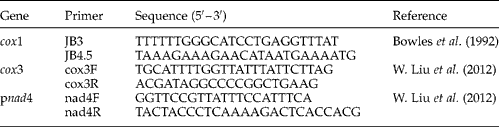
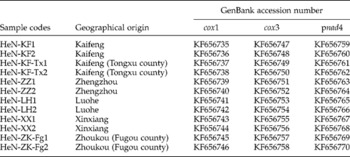
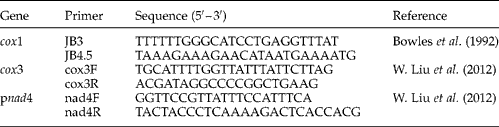
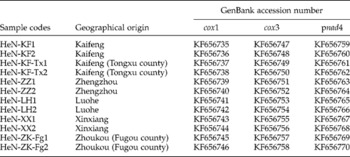
Total genomic DNA was extracted from individual plerocercoid samples using the Tiangen DNeasy Blood and Tissue Kit (Tiangen, China) following the manufacturer's protocol. Three target genes (i.e. cox1, cox3 and pnad4) were amplified by polymerase chain reaction (PCR) using the primer combinations listed in table 1. The PCR mixture (25 μl) contained 2 mm MgCl2, 2.5 μm of each primer, 2.5 μl 10 × rTaq buffer, 0.5 mm of each deoxyribonucleoside triphosphate (dNTP), 1.25 U of rTaq DNA polymerase (Takara, China) and 1 μl of DNA sample, and the reaction was performed in a thermocycler under the following conditions: an initial denaturation at 94°C for 5 min; then 94°C for 30 s (denaturation), 50°C (for cox3), 54°C (for pnad4) or 55°C (for cox1) for 30 s (annealing), 72°C for 1 min (extension) for 36 cycles; followed by a final extension at 72°C for 5 min. These optimized amplification conditions for the specific and efficient amplification of individual DNA fragments were obtained after varying annealing and extension temperatures. One microlitre (5–10 ng) of genomic DNA was added to each PCR reaction. Samples without genomic DNA (no-DNA controls) were included in each amplification run, and in no cases were amplicons detected in the no-DNA controls (not shown). PCR products were purified using the High Pure PCR Product Purification Kit (Takara, China) and sequenced in both directions using an automated sequencer (ABI Prism 3730 XL DNA Analyzer; ABI Prism, Foster City, California, USA) at the Genwiz Company (Beijing, China). Sequences of cox1, cox3 and pnad4 were submitted to the GenBankTM database under the accession numbers shown in table 2.
Primers used to amplify the sequences of S. erinaceieuropaei sparganum isolates.
Isolates of S. erinaceieuropaei sparganum from geographical origins in Henan Province together with GenBank accession numbers for sequences of mitochondrial cytochrome c oxidase subunit 1 and 3 genes (cox1 and cox3), and partial NADH dehydrogenase subunit 4 gene (pnad4).
To study the genetic relationships within Spirometra and among diphyllobothroid cestodes, other isolates of Spirometra from Hunan Province of China (S. erinaceieuropaei of Yiyang isolates GQ999951, HM475018, HM475083; Yueyang isolates GQ999956, HM475019, HM475084; Zhuzhou isolates GQ999957, HM475021, HM475086; Loudi isolates GQ999946, HM475014, HM475079; Xupu isolates GQ999953, HM475016, HM475081; Changsha isolates GQ999954, HM475011, HM475076 and Shaoyang isolates GQ999950, HM475015, HM475080) and two mtDNA sequences of Diphyllobothrium species (Diphyllobothrium nihonkaiense NC_009463; D. latum AB269325) were considered in the present study, with Taenia solium (GenBank accession number NC_004022) as the outgroup to root the resulting trees.
Sequence analysis
Sequences of the three genes were initially aligned using the default settings in Clustal X version 2.0 (Higgins et al., Reference Higgins, Larkin, Blackshields, Brown, Chenna, McGettigan, McWilliam, Valentin, Wallace, Wilm, Lopez, Thompson and Gibson2007) and adjusted in Se-Al v2.0a11 (Rambaut, Reference Rambaut2002). The program DAMBE 5.0 (Xia & Xie, Reference Xia and Xie2001) was used to measure the nucleotide substitution saturation, using the method of (Xia et al., Reference Xia, Xie, Salemi, Chen and Wang2003) as the substitution saturation masked the phylogenetic signal (Lopez et al., Reference Lopez, Forterre and Philippe1999). Uncorrected pairwise divergence was estimated by program MEGA 5.0 (Tamura et al., Reference Tamura, Peterson, Peterson, Stecher, Nei and Kumar2011).
Phylogenetic and data analyses
The concatenated sequence of cox1, cox3 and pnad4 was analysed using the three methods of maximum parsimony (MP), maximum likelihood (ML) and Bayesian inference (BI), respectively. MP analyses were performed in PAUP*4b10 (Swofford, Reference Swofford2003) using heuristic searches with tree bisection and reconnection (TBR) branch swapping and 10,000 random addition sequences. Confidence in each node was assessed by boot-strapping (2000 pseudo-replicates, heuristic search of 20 random addition replicates with TBR option). ML analyses were performed in PhyML v3.0 (Guindon & Gascuel, Reference Guindon and Gascuel2003) using the sequence evolution model selected by Modeltest 3.7 (Posada & Crandall, Reference Posada and Crandall1998) under the Akaike information criterion (AIC). The Ts/Tv ratio, proportion of invariable sites and gamma distribution parameter were estimated by the software. The support of the data for each internal branch of the phylogeny was estimated using non-parametric bootstrap (1000 replicates). BI analyses were performed in MrBayes v3.1 (Ronquist & Huelsenbeck, Reference Ronquist and Huelsenbeck2003) with 5 million generations, sampling trees every 100 generations. Sequence evolution models were selected by Modeltest 3.7 (Posada & Crandall, Reference Posada and Crandall1998). Likelihood values were observed with Tracer v1.5 (Rambaut & Drummond, Reference Rambaut and Drummond2007). Stationarity was also reassessed using a convergence diagnostic. An average standard deviation of the split frequencies (ASDSF) < 0.03 was used as criterion of convergence between both runs.
Data analysis was performed using SPSS version 17.0 (SPSS Inc., Chicago, Illinois, USA). Prevalences of S. erinaceieuropaei sparganum infections in the different species were compared using the chi square test, with significant differences considered when P < 0.05.
Results and discussion
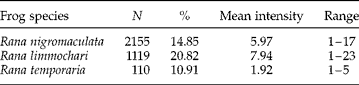
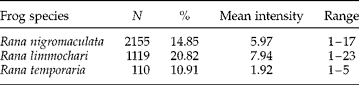
During 2008–2012, a total of 3482 wild frogs (including R. nigromaculata, R. limmochari, R. temporaria and Bufo gargarizans) were collected from six locations in Henan Province. Most spargana were located in muscles and subcutaneous tissues of hind legs and backside, and some parasitized the muscles of the abdominal wall and forelegs of frogs. These spargana were 1–13 cm long and 1–2.5 mm wide. Spargana were found in 16.23% (565/3482) of the examined frogs. By frog species, spargana were found in 14.85% (320/2155) of R. nigromaculata and 20.82% (233/1119) of R. limmochari, each significantly (P < 0.05) more numerous in these species than the 10.91% (12/110) in R. temporaria frogs (table 3). However, no sparganum was found in B. gargarizans. Therefore, R. nigromaculata, R. limmochari and R. temporaria are susceptible to sparganum, and R. nigromaculata and R. limmochari frogs are the main intermediate hosts of Spirometra tapeworms in Henan Province. Additionally, wildlife in China is protected by the law and selling wild frogs is prohibited. Those killed by poachers were often sold clandestinely at markets without parasitological inspection. Therefore, the unacceptable habit of eating frog flesh and tadpoles poses a high risk for sparganum infection and must be discouraged.
The prevalence (%) of S. erinaceieuropaei sparganum infections in frogs from Henan Province during 2008–2012; N=number of frogs examined. Of 98 Bufo gargarizans examined, none were infected.
Spirometra tapeworm eggs were found in the faeces of cats experimentally infected with spargana during days 12–25 post infection, and adult worms, 26–45 cm long, were recovered from the small intestine at 25 dpi. However, no spargana were seen in tissues. Adult worms were identified morphologically as S. erinaceieuropaei according to the following features: scolex with two longitudinal grooves, mature and gravid proglottids with conspicuous uterus at the centre of segments, spiral-shaped uterus (unlike the rosette-shaped uterus of Diphyllobothrium latum), and cirrus and vaginal pore with separate openings (Wardle & McLeod, Reference Wardle and McLeod1952; Chen, Reference Chen1965).
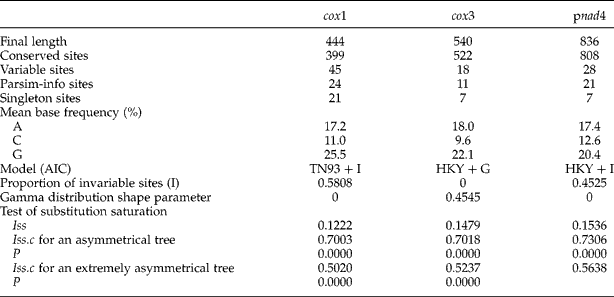
All amplifications were successful, with fragments 417 bp, 390 bp and 578 bp for cox1, cox3 and pnad4, respectively. The concatenated sequence alignment contained 16 sequences and 1820 positions after trimming (table 4). The base composition of cox1, cox3 and pnad4 was generally AT rich with means of 63.5%, 68.3% and 67%, respectively, consistent with the results of other studies (Dai et al., Reference Dai, Liu, Song, Lin, Yuan, Li, Huang, Liu and Zhu2012; W. Liu et al., Reference Liu, Li, Li, Zhou, Xiong, Lin, Zou and Zhu2012). The test of substitution saturation showed that the observed index of substitution saturation (Iss) for cox1-alignments, cox3-alignments or for pnad4-alignments was significantly lower than the corresponding critical index substitution saturation (Iss.c), indicating that there was little saturation in the present sequences (table 4). The genetic divergence of cox1 sequences of species within the Spirometra group ranged from 0 to 7.4%; however, when only Henan sparganum isolates were taken into account, the upper limits declined to 4.4%. The genetic divergence of cox3 sequences ranged from 0 to 2.4%; when only Henan sparganum isolates were taken into account, the upper limits declined to 0.8%. The genetic divergence of pnad4 sequences ranged from 0 to 1.4%; when only Henan sparganum isolates were taken into account, the upper limits declined to 0.5%.
Isolates of Spirometra erinaceieuropaei sparganum to show data from concatenated alignments, model selection and tests of substitution saturation.
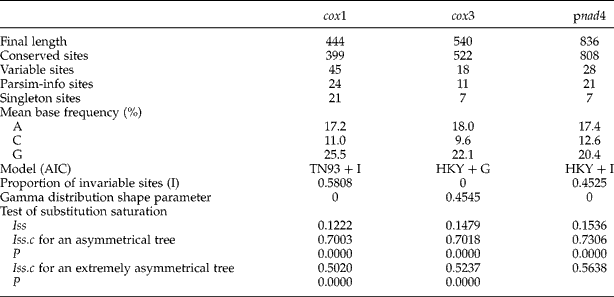
AIC, Akaike information criteria; Iss, index of substitution saturation; Iss.c, critical index substitution saturation.
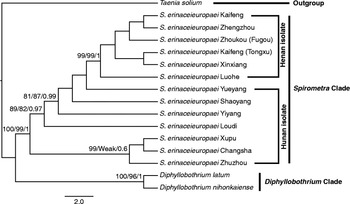
The substitution models were TN93+I for cox1, HKY+G for cox3 and HKY+I for pnad4 following model selection by Modeltest 3.7 (Posada & Crandall, Reference Posada and Crandall1998). For the BI analysis, the first 12,500 trees were discarded as ‘burn in’, and the ASDSF value was 0.0036. The MP analysis yielded 72 equally parsimonious trees with tree length = 925, consistency index (CI) = 0.9222, retention index (RI) = 0.8808, respectively. The log-likelihood and unconstrained likelihood values of the concatenated sequence were − 6036.44 955 and − 6472.05 840, respectively. The combined analyses of cox1+cox3+pnad4 generated two main clades (fig. 1). One clade, including all Spirometra isolates, was supported by all three phylogenetic inference methods (MP, ML and BI) with high support values (100/99/1.0). The other clade, containing all Diphyllobothrium species, was also supported by MP, ML and BI with bootstrap values of 100, 96 and posterior probability value of 1.0, respectively. Within the Spirometra clade, isolates from Henan Province (Kaifeng, Tongxu, Zhengzhou, Xinxiang, Luohe and Fugou) were recovered as a monophyletic group with high support values (99/99/1.0) of all inference methods; isolates from Xupu, Changsha and Zhuzhou of Hunan Province formed a single group that was supported by the maximum parsimony and Bayesian methods (99/0.6). Other isolates of Hunan Province (Yueyang, Shaoyang, Yiyang and Loudi) plus the Henan isolates made up a single group with moderate support values (89/82/0.97). These results indicate that all the sparganum isolates in Henan Province represent S. erinaceieuropaei, and genera Spirometra and Diphyllobothrium were sister groups.
Phylogenetic relationships of isolates of S. erinaceieuropaei sparganum from Henan Province inferred by maximum parsimony (MP), Bayesian inference (BI) and maximum likelihood (ML) analyses based on combined mitochondrial dataset (cox1+cox3+pnad4) sequences, using one Taenia species (Taenia solium) as outgroup. Numbers along branches indicate posterior probabilities and bootstrap values resulting from different analyses in the order: MP/BI/ML. The posterior probabilities lower than 0.6 and the bootstrap values lower than 60 are given as ‘Weak’.

In conclusion, the present survey showed that the prevalence of sparganum infection in wild frogs was 16.23% in Henan Province, R. nigromaculata and R. limmochari being the main intermediate hosts of S. erinaceieuropaei. Phylogenetic analysis showed that all the sparganum isolates in Henan Province represented S. erinaceieuropaei and were a well-supported clade. The genetic variability among Spirometra sparganum isolates could be revealed by sequences of three mitochondrial DNA genes. For the three mtDNA genes, genetic variation of cox1 was higher than cox3 and pnad4, and cox3 was higher than pnad4. Results of this study are also of value for the molecular diagnosis and control of Spirometra sparganum infections in humans and animals.
Financial support
This work was supported by the National Natural Science Foundation of China (No. 81172612).
Conflict of interest
None.
Ethical procedures
The authors assert that all procedures contributing to this work comply with the Guidelines and Recommendations for the Care and Use of Animals of the Ministry of Health of the People's Republic of China. The protocols of the animal experiments reported herein were approved by The Life Science Ethics Committee of Zhengzhou University. All efforts were made to minimize animal suffering during the course of these studies.