


Introduction
The appropriation of Persian literary themes, forms, and models by Ottoman poets is one of the controversial issues in the study and interpretation of Ottoman literature. Beginning with the critical writings of nineteenth-century Ottoman poet-intellectuals, the controversy particularly revolved around the Ottoman “imitation” (taḳlīd) of Persian poetry and generated a constellation of discussions over a long history that extended from the late Ottoman era into Republican Turkey.Footnote 1 Inspired by French literary models, most Ottoman poet-intellectuals of the nineteenth century found the work of their “predecessor poets” (şuʿarā-yı eslāf) obsolete and inauthentic, arguing that it is simply an imitation of Persian poetic tradition. In the words of Namık Kemal (1840‒88), the pioneer poet who called for a new creative literature, Ottoman poets “did nothing but imitate Persia until around the year 1100 A.H. [1688‒89 CE].”Footnote 2 The late nineteenth- and early twentieth-century Ottoman discourse of imitation flowed into the Republican period primarily through the writings of Mehmed Fuad Köprülü (1890–1966), a leading nationalist literary historian whose oeuvre has left a lasting legacy on modern Turkish literary scholarship especially in terms of the ways in which Turkish literary history is framed and interpreted. Beginning with his 1913 article proposing a methodological framework for the study of Turkish literary history, Köprülü’s discussion of the Ottoman literary past mostly focused on the Ottoman dependence on Persian literary culture, presenting the Ottoman literary world as a world that simply mirrored the literary practices and conventions in Persia:
While Turkish (court) literature shows a Persian veneer in all of its manifestations—in meter, subject matter, genre of stories, descriptive quality and prose—its creators and admirers also reveal the same veneer in their distinctive and shared way of life, with respect to ways of living, feeling and reflecting.Footnote 3
One can find echoes of the Ottoman/Turkish discourse of imitation in the ways in which Ottoman poetry has been approached in the history of the western scholarship on Oriental/Middle Eastern literatures, which can be traced back to the writings of Sir William Jones (1746–94), one of the pioneers of Oriental studies in Britain. Written in 1772, Jones’ “An Essay on the Poetry of the Eastern Nations” is an early example of approaching Ottoman/Turkish poetry through the paradigm of imitation. Drawing on the premise that “in the same manner as the Greek compositions were the models of all the Roman writers, so were those of Persia imitated by the Turks,” Jones interpreted Ottoman/Turkish poetry as an imitative continuation of the Persian literary tradition.Footnote 4 As one can understand from his correspondence with Charles Reviczki (1737–93), Jones’ interpretation seems to have been influenced by his fellow orientalist who, in one of his letters to Jones, dated 24 February 1768, wrote that “the Turkish poets in general are no better than slavish imitators of the Persians, and often deficient in taste and harmony.”Footnote 5 In another letter, now dated 7 March 1768, Reviczki wrote to Jones as follows:
I do not mean to apply my censures on the servile imitations of Turkish authors to every species of imitation; for in some instances the imitation, as in the case of Virgil with respect to Hesiod, has surpassed the original … But I am disgusted with the flat and perpetual imitation of the many Turkish poets, to whom we may aptly apply the words of Horace: “O servile herd of imitators!”Footnote 6
The discursive tendency to juxtapose Ottoman/Turkish poetry with “imitation” and “Persia/Persian(s)” was not confined to Jones and Reviczki but was shared by later scholars of Oriental studies as well. One significant example is the Austrian orientalist Joseph Freiherr von Hammer-Purgstall (1774‒1856), who explained the relation between Ottoman and Persian poetry with the following metaphor: “Persian poetry is the sun, Turkish the sun-flower; the last naturally turns towards the first, and is indebted to it for its hues and growth.”Footnote 7 Perhaps the most prominent orientalist in this regard is Elias John Wilkinson Gibb (1857–1901), the author of the six-volume A History of Ottoman Poetry.Footnote 8 Gibb’s work is the first comprehensive account of Ottoman poetry, which not only mirrors the orientalist narrative but is also informed by the nineteenth-century Ottoman discourse of imitation.Footnote 9 Published in 1900, the first volume of Gibb’s History attracts particular attention as it features an introductory chapter entitled “The Origin, Character and Scope of Ottoman Poetry,” where Gibb coins the term “Persianism” to portray the way Ottoman literati appropriated Persian literary culture: “By the term ‘Persianism’ I mean here and elsewhere, not a Persian idiom, but Persian culture as adopted by the Ottomans, and more especially, as applied by them to matters connected with literature.”Footnote 10 Gibb concludes the chapter by summing up the impact of “Persianism” in the Ottoman poetic world as follows: “So the first Ottoman poets—and their successors through many a generation—strove with all their strength to write what is little else than Persian poetry in Turkish words.”Footnote 11 Gibb’s History stood for a long time as the only available work in English on the literary world of the Ottomans, and as such has not only contributed to the crystallization of the discourse of imitation but also shaped the reception and perception of Ottoman poetry in modern scholarship.Footnote 12
What is particularly striking about the prevailing discourse of imitation is that it not only places a negative connotation on the concept of imitation but also obscures any discussion of imitation as a practice associated with literary production and creativity. Whether perpetuated and reinforced by scholarly ideology or tradition, the discourse seems to be conceptually driven by what can be called Persocentrism, a way of thinking that holds Persian literature as the literary standard and views Ottoman literature as replication. In Persocentric thinking, therefore, Ottoman literary production is defined and interpreted in terms of the manner and extent to which it imitates, or is influenced by, the literary models of Persia. Seen in this light, Hammer-Purgstall’s metaphor of sun and sunflower, or Gibb’s term “Persianism,” can be interpreted as examples of the Persocentric approach, an approach that reserves almost no space for literary creativity, innovation, or individuality on the part of Ottoman poets. Perhaps one of the most problematic consequences of this approach is that it has precluded any comparative reading or analysis that can help us identify, contextualize, and interpret the intertextual affinities and divergences between Ottoman and Persian poetic traditions.Footnote 13
This article steps aside from the dominant discourse to explore the Ottoman reception of Persian poetry through an example. My example is an Ottoman Turkish gazel (lyric poem) by Süleyman I (1494–1566), the Ottoman sultan known as Süleyman the Magnificent, which is written imitating the opening poem in the dīvān (poetry collection) of Hafiz of Shiraz (ca. 1315‒90), the celebrated lyric poet of Persian whose poems enjoyed wide circulation among the Ottomans. As a naẓīre (parallel/response poem), the gazel presents us with couplets in which Süleyman, writing under the pen name Muhibbi (the One Who Loves), puts creative twists on the model poem’s structure, theme, and imagery. In analyzing and discussing Süleyman’s poem, I pay particular attention to the way in which he reworks and challenges a Persian model, and thus aim to highlight how his interaction with Hafiz’s text goes beyond a passive reception.
The Ottomans and the World of Persian Poetry: Muhibbi on Hafiz’s Opening Poem
As an avid reader and aspiring student of Persian poetry, Süleyman seems to have followed in the footsteps of his father Selim I (1466‒1520), the Ottoman sultan who was deeply interested and well versed in Persian language and literature. Like Selimi, the pen name of his father, Muhibbi regularly composed poems in Turkish and Persian and was particularly attracted to the work of the master poets of Persia such as Nizami Ganjavi (1141‒1209), Salman Savaji (ca. 1309‒76), Hafiz, Kamal Khujandi (ca. 1320‒1401), ‘Abd al-Rahman Jami (1414‒92), and ‘Ali Shir Nava’i (1441‒1501).Footnote 14 Among these poets, Hafiz appears not as a poet whom Muhibbi refers to frequently, but rather as a muse who left his fingerprints on many of Muhibbi’s poems, whether in Turkish or Persian.Footnote 15 In Muhibbi’s words, Hafiz, together with Jami, is an intoxicating wine that arouses his poetic imagination and invests his poetry with layers of meaning:
As the couplet suggests, Muhibbi saw Hafiz as a literary role model and emulated his poetic style. Also telling in this regard is that Muhibbi’s contemporaries found his style reminiscent particularly of that of Hafiz.Footnote 17 Perhaps the reason why Muhibbi turned to Hafiz for inspiration can be explained by his abiding interest in the gazel as a poetic form and genre, especially if we keep in mind that the Persian bard enjoyed a reputation among the Ottomans as one of the most acclaimed love poets while his poems were celebrated as epitomes of the Persian gazel.Footnote 18 It is not hard to imagine, therefore, that as a poet who often wrote in the gazel form and frequently pondered on the intricacies of love, Muhibbi remained under the spell of Hafiz and kept on his desk a copy of his dīvān as a source of inspiration.
Though we generally find Muhibbi gratefully acknowledging the stimulating influence of Persian master poets on his creativity, we also notice, on the other hand, that he often assumes a self-assertive tone especially when he speaks of his poetry and positions it in relation to the Persian poetic canon. A particularly revealing example is the following couplet, where Muhibbi speaks boastfully of his dīvān and presents his work as comparable to that of celebrated love poets, alluding presumably to Hafiz:
It would hardly be surprising, therefore, if a boldly assertive poet like Muhibbi objected to being labeled as a plagiarist poet debilitatingly dependent on Hafiz. In fact, we do come across such a case in one of Muhibbi’s gazels, in which he expresses his anxiety about the way his poetry is criticized by fellow poets:
The anxiety Muhibbi voices in closing his poem is not an anxiety of influence, but rather an anxiety that has much to do with the accusation of poetic plagiarism or dependence. The poet in a sense responds to a Persocentric criticism of his poetry, which views his gazels not as poems produced by the individual talent of a hardworking poet inspired by divine grace but simply as plagiarisms from, or replications of, those of Hafiz.Footnote 21 Muhibbi’s words also throw some light on discussions of imitation in Ottoman poetic circles. It appears that creativity and originality were issues of prime concern in these circles where plagiaristic or pallid imitations of Persian models were deemed unacceptable. A 1546 biographical dictionary of poets by Abdüllatif Latifi (1491–1582), for instance, exemplifies the critical attitude of a contemporary Ottoman poet and literary critic toward an imitation devoid of innovation or inventiveness. As Latifi makes it clear, a poet who simply follows or copies from the works of established poets is a “pallid imitator” (muḳallid) or “poetaster” (müteşāʿir), whom he places in opposition to an “innovator” (mübdiʿ), a poet who creates poetry either by the power of his resourceful imagination or by carefully studying the dīvāns of master poets and elaborating on their poetry in new and transformative ways.Footnote 22 Creativity, Latifi warns, is not, however, easy to achieve, particularly at a time like the mid-sixteenth century, when audiences had a refined and subtle literary taste and, as Latifi puts it, “looked for a poetry that displayed a variety of poetic and rhetoric devices and encapsulated multiple meanings.”Footnote 23 Latifi’s words suggest that in Ottoman circles the standards of poetic production were high, as were the pressures and expectations placed upon poets like Muhibbi who were inspired but also challenged by Persian models in their quest for creativity and innovation, which, I think, also underpins Muhibbi’s anxiety in the couplet above.
Before turning to Muhibbi’s gazel, finally, I would like to highlight one of its aspects that, I think, can shed more light on its significance as a response poem. The gazel I will analyze is the first poem in the fifth and last volume of Muhibbi’s dīvān. Titled Dīvān-ı Hāmis (the fifth dīvān), the volume was copied in 1564, two years before Süleyman’s passing, by the imperial calligrapher Muzaffer Ali Şirvani and illuminated by Kara Memi, the head illuminator at the court of Süleyman. We do not know for sure whether the last volume was a work Muhibbi held in particularly high regard or thought of as his magnum opus.Footnote 24 But still, his decision to open his last volume with a poem modeled on the opening poem of the dīvān of Hafiz seems not to be a random choice. Even more interesting, the second poem in the same volume, too, is a poem modeled after Hafiz’s opening poem. Beyond showing the extent of Hafiz’s influence on Muhibbi, these two strategically located poems also testify to the Ottoman poet’s ambitious attempt at designing a dīvān comparable to Hafiz’s. By correlating Muhibbi’s assertive tone in praising his dīvān in the couplet quoted earlier with his choice to open his fifth volume with a Hafizian poem, his attempt can be further interpreted not simply as an emulation of a canonical text like Hafiz’s but perhaps rather as a poetic drive to create a dīvān that seeks to surpass his predecessor’s work.
Below are transliterations and translations of Hafiz’s and Muhibbi’s opening poems, which are placed side by side for purposes of comparison:Footnote 25
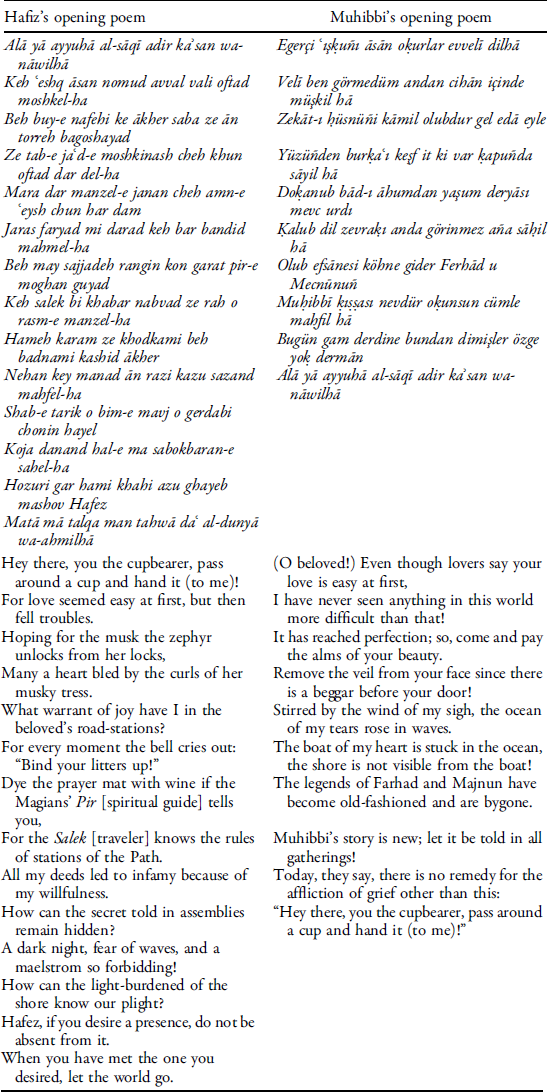
As a naẓīre, Muhibbi’s poem provides a good venue through which one can discuss the way an Ottoman poet engaged with Persian poetry, for a response poem is the one in which processes of poetic intertextuality are vividly observed as the poet oscillates between convention and invention. In Paul Losensky’s words, “[b]ecause it requires the poet both to follow and to diverge from a specific model, the response poem—the explicit imitation of an earlier work—is one of the best forums for studying how the poet interprets and recreates the literary tradition.”Footnote 26 Seen in this light, we can better analyze Muhibbi’s poem by identifying and reflecting on those points where the Ottoman poet follows and diverges from the Hafizian model in terms of form and content.
To begin with the form, it is clear that though Muhibbi turns Hafiz’s seven-verse poem into a five-verse poem, he follows the formal structure of the model. By convention, he writes his poem in the same rhyme and meter. What is uncommon, however, is that Muhibbi makes copious use of Hafiz’s lexical repertoire. He freely adopts some of the vocabulary of the model poem, including its rhyme words. Out of the fourteen words of the first couplet, for instance, six are borrowed from Hafiz’s poem, and, except for the second couplet, Muhibbi uses the same rhyme words as Hafiz. In addition to lexical borrowings, Muhibbi also quotes Hafiz’s opening line to incorporate it into his own poem. In choosing to conclude his poem with an Arabic line, Muhibbi seems to be shaping his poem in such a way that it should parallel that of Hafiz, which also concludes with an Arabic line. Taken together, Muhibbi’s formal choices reflect his decision to shape the texture of his poem according to the model set by his predecessor. From a cursory perspective, the rhyme and meter scheme of Muhibbi’s poem as well as his lexical borrowing and quotation from Hafiz can easily lead one to think that the Ottoman poem is an inauthentic imitation of an authentic Persian poem. That way of thinking, in turn, can and in fact does result in an assumption that Ottoman poets wrote, as Gibb would say, “what is little else than Persian poetry in Turkish words.”Footnote 27
But a closer look at Muhibbi’s poem reveals some significant aspects of its formal texture that would go unnoticed otherwise. Perhaps the most significant is the way Muhibbi turns the Persian plural suffix (-ha) in Hafiz’s rhyming pattern into a Turkish expression of exclamation (hā) in the second hemistiches of each of his couplets except for the last one. Muhibbi’s reframing of the Persian suffix can be interpreted as a rhetorical move to achieve a poetic voice that would resonate as powerfully as Hafiz’s. This is especially the case with the first couplet in which Muhibbi addresses his beloved. As a rhetorical device, the exclamation Muhibbi uses at the end of the second hemistich serves as the Turkish counterpart of the Arabic exclamation of address (Alā yā ayyuhā) that comes at the beginning of Hafiz’s opening line where he invokes the cupbearer (al-sāqī). One other, less visible aspect regarding the intricacies involved in Muhibbi’s remaking of the formal design of Hafiz’s poem involves the manner in which the poet uses the words he borrows from Hafiz. As a Turkish naẓīre to a Persian poem, Muhibbi’s text presents us with an interlingual transmission from Persian to Turkish. And in this transmission we see that the Ottoman poet does not appropriate Hafiz’s vocabulary in a “cut and paste” manner, but rather transfers his words into a vernacular by giving them a new turn. For instance, Muhibbi takes Hafiz’s rhyme word del-ha (hearts/minds/souls) and places it at the end of his opening line. In doing that the poet puts a twist on the meaning of the Persian word del-ha, rendering it into Ottoman Turkish not as “hearts” but rather as “lovers.” And sometimes we see the poet employing Hafiz’s words by placing them in a new linguistic context. This is particularly the case in Muhibbi’s adaptation of Hafiz’s words to Ottoman Turkish by using them in idiomatic phrases. To cite some examples, the phrase āsān oḳurlar (they speak of it as easy) in Muhibbi’s opening couplet combines Hafiz’s word āsan (easy) and the Turkish verb oḳumak (to say, to tell). In the same couplet, the Persian word moshkel (difficult or difficulty) is rendered not as a noun (which is the case in Hafiz’s use of the word) but as an adjective and coupled with the Turkish verb görmek (to see), the two constituting the idiom müşkil görmek (to find something difficult). Similarly, in his third couplet Muhibbi joins the word mavj (wave) and the Turkish verb urmaḳ (to hit) in the Ottoman Turkish expression mevc urmaḳ (to rise in waves).
When we move beyond the formal aspects of Muhibbi’s poem to consider its thematic and imagistic texture, we find a more complex picture of imitation, which, I think, better illustrates Muhibbi’s inventiveness in appropriating Hafiz. In what follows, I will analyze Muhibbi’s poem verse by verse to unearth the complexity involved in the way the Ottoman poet fashions the imagery and theme of Hafiz’s text into a distinctive poetic composition.
Like Hafiz, Muhibbi opens his poem with a couplet on the nature of love:
Emulating the manner in which Hafiz comes to the cupbearer with a complaint, Muhibbi speaks to his beloved with a complaining tone in his voice. Though both poets complain about love’s difficulties, the reasons behind their complaints seem to be quite different from each other. Hafiz describes the beginnings of love as easy and appealing but complains about the later stages in which the lover is faced with a variety of difficulties. But from Muhibbi’s perspective, what is insurmountably difficult is the very beginning of love, since he cries out about how impossible it is to evoke love from his indifferent beloved. What is especially interesting here is the way Muhibbi alludes to Hafiz’s opening couplet in departing from his approach to the theme of love. Muhibbi does so not by quoting what Hafiz says about the difficulties of love but by referring to what “lovers” say about love, which is obviously an echo of Hafiz’s formulation of love. In this regard, close attention to the way Muhibbi frames the word dilhā invites us to interpret this word not exclusively as “lovers” but also in the sense of “fellow love poets.” From this semantic perspective, it seems that the implied binary is between Muhibbi and his fellow love poets who follow Hafiz’s formula, according to which love seems to be easy at the beginning but becomes difficult as one moves beyond the initial stage. Seen in this light, the contrast Muhibbi makes between himself and other love poets—which can be sensed in Muhibbi’s contrasting use of the words ben (I, myself) and dilhā—not only signals his diverging perspective on love but also seems to reflect his disagreement with the Persian bard himself. By positioning himself as a love poet who, unlike his fellow poets, does not agree with Hafiz’s canonical statement on love, Muhibbi subtly attempts to make a case for his own statement, namely that the beginning of love is actually the most difficult to achieve. Thematically, the rest of Muhibbi’s poem is structured around this poetic statement voiced in the opening couplet. The poet supports his counter-statement to the Hafizian understanding of love by bringing to the fore his experiences as a lover who has very much suffered the pains of love for an indifferent beloved, as can be seen especially in the second and third couplets. Though a quick comparison of the two opening couplets makes clear that Muhibbi radically diverges from the way Hafiz takes on the theme of love, the question that still remains is what might account for such divergence between the two poets. This, I argue, has much to do with the manner in which the two poets approach love from different angles. In the case of Hafiz, the poet treats love as an abstract concept that is difficult to grasp and tries to describe that concept through metaphorical images and associations. In this abstract and more mystically oriented representation and depiction of love, Hafiz conceptualizes love as a formidable journey undertaken to achieve spiritual enlightenment and ultimate wisdom, and uses a series of metaphors to give a glimpse of the difficulties encountered on the path of love as he passes from one step to another. Muhibbi, on the other hand, transforms that poetic abstraction into the concrete experience of a lover wooing an unresponsive beloved and portrays the difficulty of initiating love from his beloved by using vivid imagery that conveys the plight of the lover. This suggests that the thematic framework of Muhibbi’s poem is based on a binarism between the dying lover and the indifferent beloved. It is through this framework that the poet-lover opposes the Hafizian conception of love and articulates his own love experience.Footnote 28
The second couplet well illustrates the binarism that characterizes the poem’s thematic framework:
On the one hand, Muhibbi tries to court his indifferent beloved by praising her perfect beauty, but on the other hand the veil covering his beloved’s face leads him to hopelessness and frustration as he likens his condition to the situation of a beggar who is despairingly waiting for alms. In terms of vocabulary, the second couplet attracts particular attention not only because it is the one in which Muhibbi does not draw on Hafiz’s poem, but also because he comes up with a new word (sāyil, the beggar) to form the rhyme. The other notable thing about the couplet is the way Muhibbi expresses his pursuit of an inaccessible beloved through a symbol that refers to the difficulty of the very first step of love. As the poet begs his beloved to uncover her face, the veil becomes a symbol signifying an obstacle for the lover who seeks to get the attention of the aloof and unresponsive beloved to initiate a love affair. This not only brings us back to the main theme of the poem expressed in the opening couplet but also shows how the poet ties his couplets together beyond the formal unity created by the rhyme and refrain. In terms of imagery, the second couplet seems to be an invention, because here Muhibbi does not look to the Persian bard for poetic imagination, but rather brings a new dimension to a conventional image—the image of the beggar. He places the image against the backdrop of the Islamic practice of paying alms (zekāt), which is practiced during the month of Ramadan, the fasting month that comes only once a year. Because it is a blessed time to help and care for the poor, the poet assumes the role of a beggar, knocks at the door of his beloved, and asks for alms, not of money but of beauty, thereby reminding her of the significance of the month and of her religious duty. Seen in this context, Muhibbi’s bringing the religious backdrop into play in structuring his image can be interpreted as a hint at the difficulty of his situation as a lover who, after a year of waiting, implores his beloved to show her face for the sake of Ramadan.
When we move on to the third couplet, we see that it bears similarities with the sixth couplet in Hafiz’s poem, which invites us to think about the intertextuality between the two:
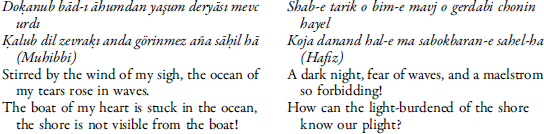
The intertextuality at play in Muhibbi’s imitation of Hafiz’s couplet seems to go beyond borrowing of words to a molding of an image invented by the Persian bard into a new form. While Hafiz paints a mysteriously opaque scene in which a helpless lover is caught up in the waves of a turbulent ocean, Muhibbi catches the lover’s despair by revivifying conventional similes. In this hyperbolically metaphorical representation of love’s difficulty, the suffering lover sighs and sheds tears over his misery, to such an extent that his eyes turn into a wavy ocean in the midst of which the boat of his heart, drifting far from the shore, swirls in a vortex. When we reflect on the intention behind Muhibbi’s preference for a graphic depiction of the lover’s plight, it can be said that such a description allows the poet to shed more light on what Hafiz aptly encapsulates in the expression ḥal-e ma (our plight). In a sense, Muhibbi’s picturing of the lover’s plight comes to elucidate what Hafiz leaves obscure. Seen in this way, the third couplet can be read as a poetic gloss on Hafiz’s sixth couplet.
The penultimate couplet presents Muhibbi as a true lover who ranks with Farhad and Majnun, the two legendary lovers featuring in Persian and Arabic poetry respectively:
By identifying with Farhad and Majnun, Muhibbi obviously seeks to carve a niche for himself in the pantheon of lover-heroes. But though Muhibbi associates himself with these two famous lovers, he finds their legends “old-fashioned” and instead calls attention to his own “story,” which can refer to Muhibbi’s poem, where he narrates his experience with love and hence his story, or to his poetry in general. The poet argues that his story, unlike those of his predecessors, is a “new” one. The way Muhibbi differentiates himself from Farhad and Majnun by constructing a dichotomy of “old-fashioned” versus “new” is intriguing and brings us to the question of whether the poet’s evocation of the two figures has a function other than that of allowing him to fashion himself as a lover who truly experienced love’s difficulties. At the risk of reading too much into the couplet, it is worth arguing that the names Farhad and Majnun can stand as a metonymy for Persian and Arabic poetic traditions respectively. Seen in this light, the dichotomous language Muhibbi employs in describing his story can be interpreted as a departure from the preceding poetic traditions as well as a declaration of a “new” poetry which, as he implies, would be more appealing to contemporary literary taste than the now “old-fashioned” poetry of the past. Interpreted this way, the couplet affords a glimpse into how an Ottoman poet writing in the sixteenth century views his work in relation to the Arabic and Persian schools of poetry, especially when read alongside other examples from the mid-to-late sixteenth century. The following couplet by the Ottoman poet Nevi (1533–99), for instance, offers a compelling illustration of the contemporaneous poetic discourse characterized by the binarism of “old” and “new”:
It is also worth noting before turning to the next couplet that the tone in which Muhibbi speaks of his story echoes somewhat that of an imperial edict. As Muhibbi wants his story to be circulated in “all gatherings,” he sounds less like a romantic poet and more like an ambitious sultan. Here we hear not so much the desperate voice of the afflicting lover Muhibbi but rather the bold voice of Süleyman, who seems dedicated to moving the poetic heritage in a new direction and leading the world of poetry in the same manner he rules over an empire. Seen this way, Muhibbi’s couplet stands in sharp contrast to Hafiz’s fifth couplet, which reads as a warning that a lover’s experience is an inner experience that should be kept like a secret:
Hafiz uses the rhyme word mahfel (gathering) with a negative connotation, suggesting that sharing the love experience with others in the gatherings of lovers brings a mystical lover not fame but infamy. Muhibbi, on the other hand, reverses this mystical theme by foregrounding his desire for worldly fame. In reversing the theme, Muhibbi places the same rhyme word in a completely different context, and uses it with an opposite connotation: while Hafiz views the “gatherings” as a potential threat to his state of seclusion, Muhibbi takes the same “gatherings” as an opportunity to publicize himself and his poetry.
The concluding couplet strikes the reader in three ways, all related to Muhibbi’s citing of Hafiz’s opening line:
To begin with, the manner in which Muhibbi uses the device of tażmīn, inserting a line of another poet into one’s own poem, presents an interesting case. Unlike the conventional use of tażmīn, the poet does not employ this poetic device as a springboard for his poem. Rather, he quotes Hafiz’s opening line to conclude his poem. This leads us to the question of why the poet made such a choice. Muhibbi’s choice to place Hafiz’s line at the end seems to be related to the thematic order in which he organizes his poem. The reason for thinking so is that the poet frames his poem such that it unfolds in three interlacing thematic structures. In this three-part structure, the poet-lover begins the poem by offering his perspective on the difficulty of love and continues with a description and comparison of his love experience before concluding with what the remedy is for a despairing lover who seeks to find a way out of the impasse of love. In light of this thematic arrangement, Muhibbi’s choice to transpose Hafiz’s opening line to the end of his poem seems to be a witty choice, for the line serves as a fitting conclusion to his poem, particularly given that it is a line in which the wine cup in the hands of the cupbearer is presented as an antidote to the pains of love. Thus it is not surprising that Muhibbi concludes his poem by appealing to the cupbearer for a cup of wine to find relief from the pain of his love for an indifferent beloved. As such, Muhibbi’s citing of Hafiz at the end of his poem hardly seems a coincidence, but rather stands as a well-calculated poetic move made in accordance with the overall thematic structure of his poem.
Another interesting feature of Muhibbi’s concluding couplet is the poetic tone which now echoes that of the figure of the rend, a libertine poet-lover who forsakes the world and drinks wine to free himself from its conventions. As Muhibbi cultivates the idea that there is no “remedy” for the “affliction of grief” other than a sip of wine, the tone of his couplet comes closer to the libertine language in Hafiz’s concluding words:
Muhibbi follows the typical libertine rhetoric in concluding his poem and he does so by incorporating Hafiz, the epitome of poetic libertinism. Thus as a rhetorical device the tażmīn enables Muhibbi to give his concluding couplet a Hafizian tone, which can be taken as an indication of the poet’s rhetorical attempt to capture and express the libertine voice commonly associated with Hafiz. In this regard, the tażmīn also marks Muhibbi’s transition from one poetic role to another, from the lamenting lover to the libertine. Muhibbi’s shifting between the two roles seems by no means accidental, but is made by the poet’s choice to emulate the way Hafiz alternates between his two poetic personae—the desperate lover and the libertine lover.
The third and final point relates to the manner in which the quotation is introduced. Contrary to what is expected, Muhibbi introduces the quoted line from Hafiz not with a third-person singular verb, but instead with the third-person plural verb dimişler (they say/have said). The poet’s use of the plural marker (-ler) makes the concluding line less a citation of the individual words of a poet and more a quotation of a popular saying. As such, Muhibbi’s grammatical choice hints that the line is a famous and oft-quoted one, widely known to poets and audiences alike.Footnote 30 By presenting Hafiz’s words as a popular and wise saying, Muhibbi in a sense subtly alludes in closing his poem to the Persian bard’s legacy and wide popularity in the poetic culture of the time and thus pays tribute to a poet whom he finds particularly inspirational.
Conclusion
The analysis above illuminates how Muhibbi’s poem relates to and differs from Hafiz’s, thereby leading us to some conclusions as well as inviting us to rethink the Persocentric discourse on Ottoman poetry. Muhibbi’s poem stands as a text in which a poet builds on and reframes the formal and thematic threads of a model poem to interweave them into a distinct composition. As Muhibbi experiments with Hafiz’s text, he presents us with linguistic, stylistic, and imagistic inventions and adaptations, which, I think, highlight and account for the way he moves from imitation to innovation—or, in the words of Latifi, from being a “pallid imitator” to being an “innovator.” Through such poetic maneuvers, the Ottoman poet differentiates his work from that of the Persian bard while he draws upon him as a touchstone for inspiration. This can be seen especially in the way Muhibbi presents and develops his perspective on the theme of love and defines his poetry through the binary of old and new.
A discourse like Persocentrism, however, sweeps aside almost all of the intricate reworkings that mark Muhibbi’s creativity and reduces his poem to a text permeated with Persian borrowings, without paying attention to how these borrowings are recast in a new poetic setting. As evident from the way Muhibbi remakes Hafiz’s opening poem, the Ottoman imitation of Persian poetry often involves intertwined and multifaceted literary motivations and practices that cannot be treated simply from a Persocentric perspective. But it is not only Muhibbi’s textual gestures that are ignored. The Persocentric approach also obscures the contextual clues that provide us with insights into the literary environment in which Muhibbi composed his poem, such as the one regarding the ways in which Hafiz’s poetry was respected and admired, or into those aspects underpinning Muhibbi’s poetic enterprise, such as his anxiety about being labeled as a plagiarist or his concern for originality and creativity.
Obviously, it would be misleading to extend the conclusions drawn from the analysis of a single poem to other, if not all, Ottoman poems patterned on those of Persian masters. It would not be inaccurate, however, to say that Ottoman poems like Muhibbi’s may be better approached through intertextual reading that opens a window onto the formal, semantic, and rhetorical transmissions and transformations involved in an Ottoman poet’s relation with Persian poetry.
Accompanied by literary historical insights, such reading can lead us to see these poems as products of a poetic tradition where Persian models were appropriated in different ways and for different reasons and molded by the literary tastes and conventions of the time. Another benefit of placing the work of Ottoman poets like Muhibbi within an intertextual framework is that it enables us to see their poetry as deeply rooted in and yet markedly distinct from the preceding traditions. Seen through this framework, we find that intertextual concepts like appropriation, imitation, or adaptation operated in the Ottoman world as mechanisms of literary productivity and creativity and significantly contributed to the flourishing of poetry.


