Over time, the Rey Auditory-Verbal Learning Test (RAVLT) has undergone several modifications from its original version published in France (Ivnik et al., Reference Ivnik, Malec, Smith, Tangalos, Petersen, Kokmen and Kurland1992; Rey, Reference Rey1964; Vakil & Blachstein, Reference Vakil and Blachstein1997). To date, one of the major limitations of this test has been the lack of appropriate regulations. Many of the studies that were conducted to date using this test, have presented a series of limitations, some of them by excluding women (Query & Megran, Reference Query and Megran1983) and others by not including elderly people (Bleecker, Bolla-Wilson, Agnew, & Meyers, Reference Bleecker, Bolla-Wilson, Agnew and Meyers1988; Wiens, McMinn, & Crossen, Reference Wiens, McMinn and Crossen1988) or by using small samples (Geffen, Moar, O’Hanlon, Clark, & Geffen, Reference Geffen, Moar, O’Hanlon, Clark and Geffen1990).
This test has been used in the evaluation of many disorders in which memory can be affected such as Alzheimer’s disease, Huntington’s disease, Korsakoff syndrome, cerebral damage, learning difficulties, dysfunction of the temporal lobe, adult anxiety disorders or lapses of memory associated to age and schizophrenia (Bierman, Comijs, Rijmen, Jonker, & Beekman, Reference Bierman, Comijs, Rijmen, Jonker and Beekman2008; Bierman et al., Reference Bierman, Comijs, Gundy, Sonnenberg, Jonker and Beekman2007; Butters, Wolfe, Martone, Granholm, & Cermak, Reference Butters, Wolfe, Martone, Granholm and Cermak1985; Calero-Garcia et al., Reference Calero-García, Navarro-González, Gómez-Ceballos, López, Torres-Carbonell and Calero-García2008; Draper & Ponsford, Reference Draper and Ponsford2008; Maeda et al., Reference Maeda, Kasai, Watanabe, Henomatsu, Rogers and Kato2006). Other authors such as Kurylo, Temple, Elliott, and Crawford (Reference Kurylo, Temple, Elliott and Crawford2001), have presented normative data from this test for people with medullary lesions (SCI).
In addition, this test is of great use in distinguishing between the typical learning or encoding associated with Alzheimer’s disease and the characteristic memory retrieval deficit found in Parkinson’s disease (Tierney et al., Reference Tierney, Nores, Snow, Fisher, Zorzitto and Reid1994). In another study, Tierney et al. (Reference Tierney, Black, Szalai, Snow, Fisher, Nadon and Chui2001) also showed that this test is useful in differentiating Parkinson’s-type dementia, Alzheimer’s-type dementia and normal ageing. Some studies have confirmed the sensitivity of this test in memory impairment (Mungas, Reference Mungas1983; Query & Megran, Reference Query and Megran1983).
The Spanish-Complutense Verbal Learning Test (TAVEC) by Benedet and Alejandre (Reference Benedet and Alejandre1998) has been widely used to evaluate encoding processes in patients suffering from multiple sclerosis (Introzzi, Urquijo, & López, Reference Introzzi, Urquijo and López2010). The test has also been used recently in a study analyzing the differences between cognitive functions in normal ageing and mild cognitive impairment (Rodríguez, Juncos-Rabadan, & Facal, Reference Rodríguez, Juncos-Rabadan and Facal2008). Lastly, the Spanish version of this test has also been used in studies on schizophrenia and substance abuse (Vargas, López, del Brio, Fernández, & Franco, Reference Vargas, López, del Brío, Fernández and Franco2009).
Nowadays, a wide range of tests using word lists is available; however, the RAVLT (Rey, Reference Rey1964) has played a major role over time and has undergone several variations. There are versions of the RAVLT and other verbal learning tests for Spanish speakers, but for people over 60 in Spain and particularly in the Basque Country, there are no specific tests available. Perri, Naplin, and Carpenter (Reference Perri, Naplin and Carpenter1995) presented normative data for Spanish speaking people; however they did not use the RAVLT but rather another verbal learning test. Recently, Burin, Ramenzoni, and Arizaga (2003) presented percentile norms for Rey verbal learning test indicators with a sample of the population in Buenos Aires, Argentina. However, nothing has been published to date on people over 60 in Spain.
Finally, memory evaluation is interesting, especially in older people, since many neuropsychological tests do not have adequate norms for their age.
The purpose of this study is to establish normative data for people over 60 years of age using a Spanish version of the Rey Auditory-Verbal Learning Test (Ponton, Reference Ponton, Ponton and León-Carrión2001). The normative data extracted in this study are based on a large sample of men and women over 60 years of age.
Method
Participants
This paper represents an effort to approach a sample representing the population over 60 years of age in the province of Biscay (Basque country, Spain). The people included in the study voluntarily agreed to participate after informing them of the purpose of this research. The sample was comprised of people who attend the senior citizen’s clubs in Biscay and people living in special care facilities for the elderly in the same province. This normative sample was entirely Caucasian.
The psychologists at the care facilities and the psychologist in charge of the project were responsible for checking that all the people included in the study fulfilled the inclusion and exclusion criteria. People of both sexes, over 60 years of age who, as reported by their family or reliable sources, did not present subjective complaints were included in the sample. To corroborate this, each participant was assessed using a cognitive screening test, the MMSE (Folstein, Folstein, & McHugh, Reference Folstein, Folstein and McHugh1975). In addition, eligible participants should not present dementia according to the “Diagnostic and Statistical Manual of Mental Disorders Fourth Edition” (DSM-IV). The criteria for exclusion from the group were lack of formal schooling, serious pulmonary, cardiac, hepatic or renal disease that incapacitates them in their daily lives, drug addiction or consumption of illegal substances, active psychiatric disease (they were asked if they had been diagnosed or treated for any illnesses such as depression or anxiety), prior psychomotor impairment, cranioencephalic disorders, prior history of stroke, degenerative cerebral, cerebellar or medullary disease, sensorial problems or of any other type that may incapacitate them to carry out neuropsychological tests.
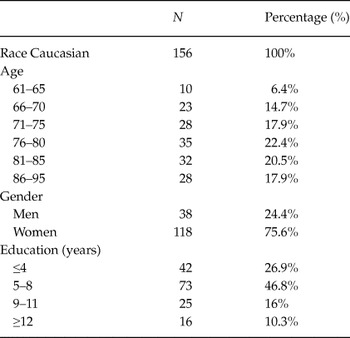
The initial participant sample comprised 170 individuals. Of this total, 14 (8.2%) of them were not included in the study: 6 (3.5%) did not fulfill the inclusion and exclusion criteria because of different diseases (previous strokes) and 8 (4.7%) cases obtained a score below the 25th percentile for their age and years of education (Crum, Anthony, Bassett, & Folstein, Reference Crum, Anthony, Bassett and Folstein1993) in the MMSE (MMSE; Folstein, Folstein, & McHugh, Reference Folstein, Folstein and McHugh1975). Therefore, the sample was comprised of 156 persons, of which 38 (24.4%) were men and 118 (75.6%) were women.
Table 1 shows the demographic characteristics related to age, gender and years of education of the sample. The participant’s ages range from 61 to 95. From these data, six age groups and four groups based on the level of education were created according to the methodology used by Lucas et al. (Reference Lucas, Ivnik, Willis, Ferman, Smith, Parfitt and Graff-Radford2005). The groups comprised of 10 participants (between 61–65 years of age) in group 1, 23 participants (66–70) in group 2, 28 participants (71–75) in group 3, 35 participants (76–80) in group 4, 32 participants (81–85) in group 5 and 28 participants (86–95) in group 6.
Demographic data of the study sample

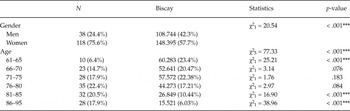
Once the demographic data of the sample were known, Biscay’s census data for the year the data was compiled were accessed. This data was used to observe if the sample was representative and if it digressed from the Biscay population in relation to sex and age. In general, women were over-represented (Table 2), χ2(1) = 20.54, p < .001. More specifically, the first age group was under-represented χ2(1 = 25.21, p < .001; the second, χ2(1) = 3.14, p = .076, third, χ2(1) = 1.76, p = .183 and forth, χ2 (1) = 2.97, p = .084 groups were well represented; and, in contrast, the fifth, χ2(1) = 16.90, p > .001 and sixth, χ2(1) = 38.96, p <.001 groups were over-represented.
Comparison of the sample with the general population of Biscay

Note:
*p < .05 **p < .01 ***p < .001
χ2 test for frequencies (percentage)
The data on Biscay have been taken from EUSTAT (Instituto Vasco de Estadística)
Assuming normality in the education variable, p = .22, a variance analysis (ANOVA) was conducted taking it as a continuous variable, and no statistically significant differences in the years of education in relation to the different age groups F(5, 150) = 1.21, p = .307 were observed. Even if the categorized education variable was considered, no statistically significant differences were observed F(5, 150) = 1.38, p = .232.
With respect to gender, a variance analysis (ANOVA) was also conducted to observe whether significant differences were found in the test variables according to gender (trial 1) F(1, 154) = 1.90, p = .16; (trial 2) F(1, 154) = 0.51, p = .47; (trial 3) F(1, 154) = 0.42, p = .51; (trial 4) F(1, 154) = 0.028, p = .86; (trial 5) F(1, 154) = .19, p = .66; (List B) F(1, 154) = 1.94, p = .16; (trial 6) F(1, 154) = .016, p = .90; (R) F(1, 154) = 1.02, p = .31; (REC) F(1, 154) = .14, p = .70. In this case, there were no statistically significant differences in any of the variables; therefore, it was not necessary to draw up tables and normative data according to gender.
The WAIS vocabulary subtest (Wechsler, Reference Wechsler2001) was used as a premorbid intelligence measure. It was assumed that the vocabulary variable fulfils the normality criteria of p = .47 A variance analysis (ANOVA) yielded no statistically significant differences F(5, 104) = 2.01, p = .08.
Procedure
The test was administered as part of a broader neuropsychological battery. The task lasted approximately 15 minutes and consisted of a list of 15 words (List A) read aloud, with an interval of one second between them. Then, a free recall trial of the words read aloud by the evaluator immediately followed. Four more trials were repeated in the same way. Once the five trials had been completed, a new list of different words (List B) was presented, in the same way as before, and likewise, a free recall trial would immediately follow for all the words in List B. Immediately after the free recall of List B, the subject was asked to freely recall the first list of words, that is, List A. Twenty minutes later the subject was again asked to freely recall the words on List A. The evaluator then read aloud a list of 30 words, 15 from List A and 15 new words, after which the participant was asked to recognize the words from List A.
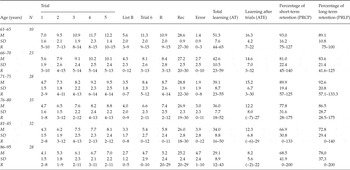
Even though this test can be analyzed trial by trial (Table 3), it is recommended to establish four measures for its clinical use (Ivnik et al., Reference Ivnik, Malec, Tangalos, Petersen, Kokmen and Kurland1990). The first measure of learning is the total learning (AT), which results from the sum of the five consecutive learning trials AT = (trial1 + trial2 + trial3 + trial4 + trial5). This measure represents the capacity to recall and to accumulate words through the learning trials. However, the individual’s ability to improve his memory after the five trials is not perceived. For this reason, a second measurement was calculated, that is, the learning through trials (ATE). The formula used is as follows: ATE = AT-(5 × trial 1). This index represents the total learning corrected by the immediate recall score; it is a summary score. This measurement index better estimates the improvement across trials than other indexes, such as estimating the learning curve slope and subtracting the correct words (trial 5 – trial 1).
Means, standard deviations and ranges for the correct answers in the learning, recall, recognition trials and for the summary of the 4 scores

In addition to these two measurements, there are two others. The first corresponds to the percentage of short-term retention or retroactive interference index PRCP = 100 × (trial 6 / trial l5). This score expresses as a percentage the retention of information between trial 6 and 5, after the List B interference trial; that is, it reflects the effect of interference of new learning on the previous learning. The last measurement is the percentage of long-term retention PRLP = 100 × (R/trial5). It expresses as a percentage the retention between the best learning and delayed recall.
Statistical analysis
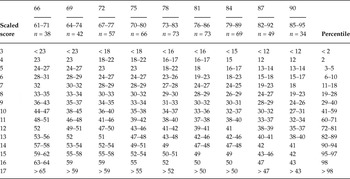
A descriptive analysis of ranges, means and standard deviations was conducted on the 10 measurements in the six age groups. From these measurements, four composite scores were calculated on which the same procedure was carried out as with the first 10 measurements. The percentiles were calculated on these four composite scores, following the Pauker (Reference Pauker1988) methodology. Once the percentile tables were obtained, the scaled scores were calculated (M = 10, SD = 3) corrected by age. For the differences between percentages, the “chi-square” test was used and for the differences in means, the variance analysis (ANOVA) was used.
Results
Table 3 presents the means, standard deviations and ranges and the direct raw scores. For the purpose of evaluating the effect of age on test performance, a variance analysis was conducted by age groups with all the scores that appear in Table 3. The results show that all are significant: (trial 1) F(5, 150) = 5.87, p <.001; (trial 2) F(5, 150) = 8.59, p < .001; (trial 3) F(5, 150) = 8.09, p < .001; (trial 4) F(5, 150) = 10.31, p < .001; (trial5) F(5, 150) = 9.85, p < .001; (List B) F(5, 150) = 4.44, p = .001; (trial6) F(5, 150) = 14.68, p < .001; (R) F(5, 150) = 12.42, p < .001; (Rec) F(5, 150) = 6.05, p < .001. This analysis confirms the need to establish specific norms by age.
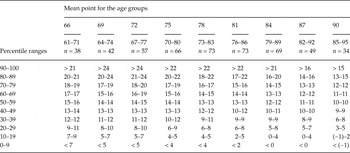
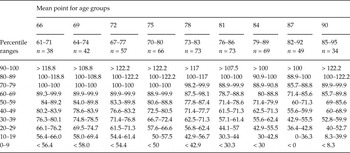
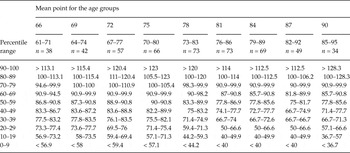
The results of the variance analysis conducted with the four composite scores (Table 4) on the test were also all significant. (AT) F(5, 150) = 12.69, p < .001; (ATE) F(5, 150) = 4.09, p < .05; (PRCP) F(5, 150) = 2.87, p < .05; (PRLP) F(5, 150) = 1.93, p < .05.
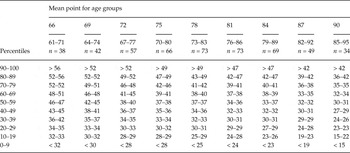
Percentiles for the Total Learning (AT) scores with mean point, in age groups

Calculating the mean scores, standard deviations and ranges is admissible when there is clear and convincing evidence that the characteristics of the study, such as age and gender, are well distributed throughout the population. Due to the lack of this evidence, the use of the percentiles, derived from distribution of the sample, is much more advisable. Table 5 to Table 8, both inclusive, describe the percentiles, having used adjacent intervals, specifying the mean age point proposed by Pauker (Reference Pauker1988) and used on other occasions (Ivnik et al., Reference Ivnik, Malec, Tangalos, Petersen, Kokmen and Kurland1990; Lucas et al., Reference Lucas, Ivnik, Willis, Ferman, Smith, Parfitt and Graff-Radford2005; Sierra, Reference Sierra2001), and in this way the clinical use is maximized and more information is obtained from the previous and subsequent values, since the score of each individual is taken into account in various age groups, increasing the sample and making it more robust.
Percentiles for the Learning scores through the trials (ATE) with mean point, in age groups

Percentiles for the scores of percentage of short-term retention (PRCP) with mean point, in age groups

Percentiles for the scores of percentage of long-term retention (PRLP) with mean point, in age groups

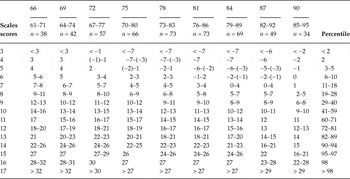
Scaled scores corrected for the influence of age on the total learning score (AT)

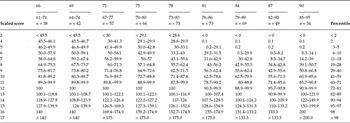
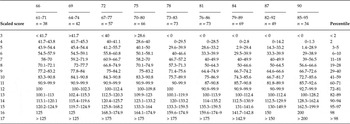
In each of the columns the mean age point is different, but the same subject can appear in more than one column. For a 71-year-old person, his mean point of reference would be the column of the 67–77 interval because is the closest to his actual age.
Once the percentiles were obtained, the tables of normative data corrected by age were created (Lucas et al., Reference Lucas, Ivnik, Willis, Ferman, Smith, Parfitt and Graff-Radford2005). The raw scores were standardized into scaled scores with a mean of 10 and standard deviation of 3. The percentiles created with the raw scores from the test were transformed in scaled scores; in this way, the scores are now corrected by age (Ivnik et al., Reference Ivnik, Malec, Smith, Tangalos, Petersen, Kokmen and Kurland1992) (Table 9–11).
Scaled scores corrected for the influence of age on the learning scores across trials (ATE)

Scaled scores corrected for the influence of age in the short-term retention percentage score (PRCP)

Scaled scores corrected for the influence of age on the long-term retention percentage score (PRLP)

Discussion
The main objective of this study has been to establish specific normative age data in the Rey Auditory-Verbal Learning Test in a population over 60 years of age. The results contribute to corroborate the idea of the need to establish norms for each age group, since it was found that the performance on this test depends, to a great extent, on age (Bleecker et al., Reference Bleecker, Bolla-Wilson, Agnew and Meyers1988; Ivnik et al., Reference Ivnik, Malec, Tangalos, Petersen, Kokmen and Kurland1990; Kurylo et al., Reference Kurylo, Temple, Elliott and Crawford2001; Mitrushina, Satz, Chevinsky, & D’Elia, Reference Mitrushina, Satz, Chervinsky and D’Elia1991; Query & Megran, Reference Query and Megran1983; Wiens et al., Reference Wiens, McMinn and Crossen1988). The use of these data principally depends on two factors: on the one hand, the sample obtained corresponds to the population of interest and, on the other hand, persons evaluated are motivated and involved in taking the test, so the data could be interpreted as more reliable.
The normative values established in this study according to age are generally quite similar, although with some variations, to the normative values generated in other reviewed studies that used this test (Geffen et al., Reference Geffen, Moar, O’Hanlon, Clark and Geffen1990; Ivnik et al., Reference Ivnik, Malec, Tangalos, Petersen, Kokmen and Kurland1990; Mitrushina et al., Reference Mitrushina, Satz, Chervinsky and D’Elia1991). This may be due to the fact that memory skills are quite stable among cultures; however, this datum requires empirical confirmation.
In contrast to the findings in some studies (Bleecker et al., Reference Bleecker, Bolla-Wilson, Agnew and Meyers1988; Bolla-Wilson & Bleecker, Reference Bolla-Wilson and Bleecker1986; Geffen et al., Reference Geffen, Moar, O’Hanlon, Clark and Geffen1990) regarding the effect that gender has on this test, this study did not show significant differences in any of the test scores, coinciding with the results of Sierra (Reference Sierra2001) and Wiens et al. (Reference Wiens, McMinn and Crossen1988).
One of the limitations of this study is that, despite not being a small sample, it is not sufficiently representative, especially for the first age group. However, this limitation occurs in several studies (Bleecker et al., Reference Bleecker, Bolla-Wilson, Agnew and Meyers1988; Ivnik et al., Reference Ivnik, Malec, Tangalos, Petersen, Kokmen and Kurland1990; Kurylo et al., Reference Kurylo, Temple, Elliott and Crawford2001; Mitrushina et al., Reference Mitrushina, Satz, Chervinsky and D’Elia1991; Wiens et al., Reference Wiens, McMinn and Crossen1988). Another limitation is that women are over-represented, as occurs in other papers (Ivnik et al., Reference Ivnik, Malec, Tangalos, Petersen, Kokmen and Kurland1990). In other studies, however, the women are under-represented (Wiens et al., Reference Wiens, McMinn and Crossen1988). This fact is quite usual when one works with people who agree to participate voluntarily. Another possible explanation for the higher number of women in the sample could be the higher life expectancy for women (84.93) in Spain, in comparison to men (78.92) (Instituto Nacional de Estadística, 2011).
Nowadays, among the older population, women participate more actively. In future research, one must try to increase the sample and aim for a better gender distribution. The best option is to randomize the sample, but in this case it is difficult, since the bias is due to the fact that the sample is comprised of voluntary participants in exchange for no personal benefit. It is difficult to attain an ideal situation. In any case, working with randomized samples is not always the best option, since we may find that one person in the sample has not shown his best performance when carrying out the test.
The volunteers in this study are considered normal at the time of evaluation; however, the incidence of the degenerative disorders increases with age, so that these persons may develop a type of pathology in the future and at present be in a preclinical stage. In order to corroborate this idea, it would be ideal to be able to follow up these patients as it has been done in some studies (Lucas et al., Reference Lucas, Ivnik, Willis, Ferman, Smith, Parfitt and Graff-Radford2005). There are studies that suggest that persons that progress towards dementia during the follow-up of a longitudinal study must be excluded from the normative study in order to avoid, in this way, the potential influence of preclinical cognitive impairment (Sliwinski, Lipton, Buschke, & Stewart, Reference Sliwinski, Lipton, Buschke and Stewart1996).
The classification made with regard to the age groups and their 5-year ranges is the most appropriate, since it is the type of classification that is usually done in research related with the standardization of tests (Ferman et al., Reference Ferman, Lucas, Ivnik, Smith, Willis, Petersen and Graff-Radford2005; Harris, Ivnik, & Smith, Reference Harris, Ivnik and Smith2002; Ivnik et al., Reference Ivnik, Malec, Tangalos, Petersen, Kokmen and Kurland1990; Ivnik et al., Reference Ivnik, Malec, Smith, Tangalos, Petersen, Kokmen and Kurland1992; Lucas et al., Reference Lucas, Ivnik, Willis, Ferman, Smith, Parfitt and Graff-Radford2005, Steinberg, Bieliauskas, Smith, Ivnik, & Malec, Reference Steinberg, Bieliauskas, Smith, Ivnik and Malec2005), in other cases the age ranges are of 10 years (Vakil & Blachstein, Reference Vakil and Blachstein1997; Wiens et al., Reference Wiens, McMinn and Crossen1988).
It would be ideal for the normative data to be based on groups with a sample number of persons paired in age, gender, education level and premorbid intelligence. In general, it is suggested that should be a minimum of 50 people in each age group. However, the age groups are usually smaller (Ferman et al., Reference Ferman, Lucas, Ivnik, Smith, Willis, Petersen and Graff-Radford2005; Ivnik et al., Reference Ivnik, Malec, Tangalos, Petersen, Kokmen and Kurland1990; Sierra, Reference Sierra2001; Vakil & Blachstein, Reference Vakil and Blachstein1997). As a consequence of the number of participants in each group, if it is less than 50, the means and standard deviations of each normative study differ considerably and the variations with respect to age fluctuate a great deal, hence the necessity of establishing percentiles by age groups and scaled scores (Crawford & Howell, Reference Crawford and Howell1998; Geffen et al., Reference Geffen, Moar, O’Hanlon, Clark and Geffen1990).
The effect of gender in this neuropsychological test has never been studied rigorously. In this case, since no significant differences were observed in the gender variable, it was not considered necessary to make separate tables for men and women.
In relation to the composite scores, in other research (such as Ferman et al., Reference Ferman, Lucas, Ivnik, Smith, Willis, Petersen and Graff-Radford2005) the calculated composite scores differed with this study. In the case of Ferman et al.’s study, the same scores were obtained as in our work except for a composite score. In our study, the total learning was calculated and the aforementioned study did not calculate it. Nevertheless, they calculated other scores, since the methodology used was different. Sierra (Reference Sierra2001) also used another composite score, but this paper used the scores that were used in Ivnik et al. (Reference Ivnik, Malec, Tangalos, Petersen, Kokmen and Kurland1990).
Lastly, we would like to add the importance of continuing to advance in standardization research of neuropsychological tests, especially for the elderly population. Memory problems increase with age, so that the increase in life expectancy makes it increasingly important to advance further with this type of research.