Introduction
New parties have appeared and disappeared on Japan's political scene over the past twenty yearsFootnote 1 during a period of party system re-alignment triggered by the defection of Liberal Democratic Party (LDP) members from the ruling party in 1993. Most of the new parties formed in this period emerged from defections of national-level politicians and the splintering and merging of pre-existing parties. Once born, these parties actively sought to establish party organizations, capture local political offices, and attract membership across Japan to expand party strength. Despite their efforts, all have largely failed in creating robust local party organizations based on a network of local politicians to rival that held by the LDP (for example, Weiner, Reference Weiner, Martin and Steel2008; Uekami and Tsutumi, Reference Uekami and Tsutsumi2011; Reed, Reference Reed, Kushida and Lipscy2013).
The weakness of local party organizations has been blamed for the failure of opposition parties, especially the Democratic Party of Japan (DPJ), to compete successfully at the national level (Scheiner, Reference Scheiner2006). It has also been identified as the reason for the survival failure of several new parties that have emerged since the 1990s (Reed, Reference Reed, Kushida and Lipscy2013). In contrast, a strong organizational base in civil society and local politics enabled other older third parties, such as the Japanese Communist Party (JCP) and New Komeitō (NCP), to survive under Japan's more majoritarian electoral system (Reed, Reference Reed, Kushida and Lipscy2013). Party insiders and executives have pointed to the DPJ's weak local organizations and dearth of local office holders as a critical weakness, making it overly dependent on the support of labor unions and the volatile support of unaffiliated voters in national elections (Ito, Reference Itō2008: 194–6). Some scholars have even questioned whether the new parties, especially the DPJ, have adequate incentives under the current electoral system to commit to building their local party organizations (Ohmura and Machidori, Reference Ohmura, Machidori and Tatebayashi2013: 177–8; Tsutumi and Mori, Reference Tsustumi, Mori and Tatebayashi2013: 253–4).
Comparative literature on new parties in other established democracies argues that the strength of local organizations beyond its parliamentary representation is a critical variable in the organizational survival and electoral sustainability of smaller new parties (Kestel and Godmer, Reference Kestel and Godmer2003; Bolleyer, Reference Bolleyer2013; Poguntke, Reference Poguntke2002). Success in sub-national-level elections has helped Green and Right parties, as well as other smaller parties, in Europe to establish a foothold and eventually break through into the national electoral arena (Poguntke, Reference Poguntke2002; Art, Reference Art2007). Such empirical studies make it clear that local party organizations – in the form of ordinary party members and activists, locally elected officials, as well as various social groups affiliated to the party at the local level – are important for new challenger parties seeking organizational stability and national electoral success.
At first glance, the failure of new parties in Japan to expand locally is puzzling. The first puzzle is that new parties are failing to stand candidates and gain local seats despite competing in an electoral system favorable to smaller parties. Unlike the mixed member majoritarian system adopted at the national level which has strong Duvergerian pressures discouraging smaller parties from emerging, Japan's local electoral system (single non-transferable vote in multi-member districts = SNTV MMD) is more ‘permissive’ to the entry of candidates from newer and smaller parties. Comparative studies have shown that smaller parties should receive higher votes in more proportional systems with larger district magnitudes (such as SNTV MMD) and lower thresholds (Golder, Reference Golder2003). Despite this ‘permissive’ environment, new parties in Japan are having greater difficulty establishing a foothold at the local level compared to the national level.
The second puzzle is that recent opposition parties and third parties are not succeeding in building local organizations despite a decade or so in which traditional LDP-controlled pork-barrel politics have weakened. Until recently, the most powerful and referenced explanatory model proposed by Scheiner (Reference Scheiner2006) for the failure of opposition parties to make ground in local politics pointed to the country's fiscal centralization and clientelistic politics. This dynamic encouraged local politicians and voters to affiliate with the ruling party at the national level to secure centrally controlled resources (Scheiner, Reference Scheiner2006). Since the late 1990s, however, central government-funded clientelistic spending has declined (Noble, Reference Noble2010), while moderate fiscal and administrative decentralization has also occurred (Nishio, Reference Nishio2007). In 2009, the LDP was ousted from power, losing control of both houses of the Diet to the DPJ. These recent trends, however, seem not to have affected the LDP's dominance at the local level, particularly in rural areas; nor does it seem to have aided new parties, especially the DPJ, to significantly expand their local organization.
These puzzles point to three questions. Have Japan's new parties genuinely made an effort and invested resources in building their parties locally? If so, what sort of strategies have they taken? And, most importantly, why have these strategies failed? This article seeks to answer the first two descriptive questions to help answer the third analytical question of why Japan's new parties face such difficulty in establishing a foothold locally.
Answering these questions will hopefully contribute to the political science literature on new parties in two ways. In terms of the study of Japanese politics, the article seeks to expand on Scheiner's explanatory model, by identifying reasons other than LDP dominance as to why new parties have failed in winning local seats. In terms of comparative politics, although extensive literature exists on party members and their role in party organizations (see Dalton and Wattenburg, Reference Dalton and Wattenberg2002), little exists on party building in terms of locally elected officials. Compared to recruiting ordinary members, securing representation in local government is a different, but equally important, dynamic that requires both empirical observation and theoretical development. Japan's case may provide insight for new parties facing similar electoral environments, such as those with a heritage of a one-party dominant system.
Substantially, the continued strength of the LDP and the endemic weakness of opposition parties in local politics are significant on several accounts. Opposition parties which do not have local party organizations will lack a stable source of candidates for national-level elections; they will lack a base to retreat to following an electoral defeat at the national level; and they will lack a stable channel to mobilize voters and generate party legitimacy. In certain instances, such as matters of nuclear energy or military base policy, a strong presence in local politics will be instrumental in implementing or blocking central government policies which require the consent of local governments. All of these local-level disadvantages will hamper the creation of a stable opposition party, while giving the LDP a continued edge in national elections.
This article focuses on three facets of local party building for the new parties: the recruiting, nominating, and securing of locally elected officials. It limits its empirical scope to four new parties that emerged since the 1990s: the DPJ, the New Frontier Party (Shinshintō ‒ NFP), Your Party (Minna no Tō ‒ YP), and Japan Restoration Party (Nihon Ishin no Kai ‒ JRP). The four are so-called ‘entrepreneurial’ parties (Bolleyer, Reference Bolleyer2013: 40) without pre-existing social roots in society, such as the JCP or NCP, and as such they have sought to build their organizations mostly from scratch. Unlike the other smaller new third parties that emerged during the period, these four parties have sought to build nation-wide party organizations with particular emphasis on winning local elections. One of them is defunct (NFP). Two others are newish and their future uncertain (YP and JRP). The last one (DPJ) is a crucial case in that it has experienced four major local elections nationwide, including one during which it was the party in government at the national level.
The first section of the article asks if these four party organizations, both at the level of the party leadership and individual Diet members, had incentives to try and build local organizations, especially in terms of increasing local representation in prefectural assemblies. It then observes what kind of efforts the parties expended to recruit, nominate, and secure prefectural assembly seats. The second section of the article looks at the perceptions from below by asking what kinds of incentives exist at the local level for local candidates to join the new parties. Considering these incentives, certain conditions are deduced in which new parties would be better able to attract candidates and votes locally. These conditions are stated as hypotheses of the types of geographic areas in which new parties will tend to succeed in local elections. The article then observes the four parties in terms of the regions in which they were more successful in local elections against those that they were not, to find evidence for these hypotheses.
The article finds evidence that the new parties indeed recognized the importance of party building and made considerable efforts to expand their local party organizations. Despite some variation in strategy, all focused on trying to recruit and stand prefectural assembly members. However, the new parties – as already observed – largely failed to achieve this goal, only maintaining relatively strong organizations in areas in which they inherited pre-existing party organizations, controlled local governments, or in more ‘permissive’ electoral districts. In the majority of regions where new parties did not enjoy these conditions, party building was largely unsuccessful.
In Japan, new parties are often described as having proliferated like ‘bamboo shoots after spring rain’; the article demonstrates why it is so difficult for these ‘shoots'to grow deep ‘roots’.
1. Context and strategies for local party building
Context for local party building
To analyze the new parties’ strategies of recruiting, nominating, and securing locally elected officials, it is necessary to identify the electoral environment in which these parties compete. The article highlights three institutional and structural features in Japan which shape the behavior of politicians and voters in local elections. These are: (1) the role of local-level office holders for national electoral competition; (2) the tendency of local politicians to affiliate with the party in government at the national level; and (3) the effects of multi-member districts on local electoral competition.
The first feature of local party organizations in Japan is the critical role played by local politicians in supporting national-level candidates. Under the stringent electoral campaigning rules in Japan, which limit broad appeals to the electorate through mass media and limit official campaigning periods, local politicians have acted as a channel in linking national-level politicians to local voters in districts. Local politicians mobilize local voters, provide knowledge of their own districts, and offer their own personal supporters (kōenkai) for Diet members in their district (Park, Reference Park2000; Scheiner, Reference Scheiner2006). Although greater ‘nationalization’ of national-level politics (McElwain, Reference McElwain2012) has lessened the importance of local, district-level campaign activity for Diet candidates, Japanese parties continue to perceive of and depend on local politicians as an electoral resource (e.g. Akiyoshi, Reference Akiyoshi and Shiratori2013; Yamaguchi, Reference Yamaguchi and Shiratori2013). This means that there is a strong incentive for new parties seeking to contest national elections to secure local representatives, either through standing their own local candidates and winning seats or encouraging incumbents to defect to their party.
The second feature of Japanese local politics in the post-war period has been the tendency of local politicians and voters to affiliate with the ruling party at the national level in order to access particularistic goods from the central government (Scheiner, Reference Scheiner2006). Opposition parties, such as the DPJ, which do not have access to central government resources have struggled to attract local candidates and failed to capture local political offices. As local politicians are an important pool of quality politicians for competing at the national level, the weakness of opposition parties locally has meant a shortage of candidates in national races (Scheiner, Reference Scheiner2006). New parties without links to the ruling party will therefore be unable to attract voters and candidates through appeals of channeling pork from the centre to their regions.
Since the late 1990s, however, central government-funded clientelistic spending has declined (Noble, Reference Noble2010), moderate fiscal and administrative decentralization has occurred (Nishio, Reference Nishio2007), and the LDP has ceded control of central government to the opposition for three years between 2009 and 2012. These recent trends should imply that the incentives for local candidates and voters to affiliate with the LDP locally has declined, levelling the playing field for smaller and newer party candidates.
The third feature of Japan's local electoral environment that may both encourage and constrain new parties locally is the structure of the local electoral system.Footnote 2 Under SNTV MMD, partisan candidates are forced to compete with candidates of the same party in the same electoral district, thereby encouraging the cultivation of the personal vote and less emphasis on partisan labels or reputation (Carey and Shugart, Reference Carey and Shugart1995). Rather than emphasize partisan ideologies or policy platforms, local candidates have tended to emphasize their role as representatives of the narrow interests of their electoral base in the district. This is particularly pronounced in municipal-level elections with larger electoral districts. New parties with a strong programmatic emphasis are therefore likely to face difficulty in capturing votes simply by pushing programmatic national, or even local, policies.
Although the strength of the personal vote in SNTV MMD may discourage programmatic competition, it is also a relatively proportional system which lowers the barriers of entry for newer and smaller parties. The consistent strength of the JCP and NCP in MMDs in local elections, compared to their inability to capture seats in SMDs at the national level, shows how the proportionality of the local electoral system can help smaller parties win seats. Comparative literature also suggests that more ‘permissive’ electoral systems with high district magnitudes allow smaller parties to emerge (Golder, Reference Golder2003). New party local candidates will therefore likely seek to compete in local electoral districts with higher magnitudes which offer better chances to win seats.
Under SNTV MMD, however, candidates and parties will face the challenges of intra-party competition and vote coordination among multiple co-partisan candidates. Without a way of accurately predicting the total votes that a party will receive in a district and allocating them effectively among co-partisan candidates, a party in the same district may see co-partisan candidates fail to gain seats together (tomodaore). Or one candidate may win an excess of votes at the cost of another co-partisan candidate's chance to win a seat (Reed, Reference Reed2009). From the perspective of individual candidates, standing multiple co-partisan candidates in MMDs is problematic. Local incumbents will have few incentives to help the party organization recruit and nominate new candidates for the same party in his/her own district, as they may threaten their vote share and re/election chances in the district.Footnote 3 Such reluctance among local-level partisan candidates is expected to be an obstacle to the expansion of the party as a whole.
Strategies for local party building
Under these conditions, how did the four parties perceive of the need and seek to build their local party organizations? The section observes the efforts of the NFP, DPJ, YP, and JRP in this regard.
NFP
The New Frontier Party was formed in December 1994 as an umbrella party to unite the Japan Renewal Party, the Democratic Socialist Party (DSP), Japan New Party, and the Social Democratic League against the LDP. Its origins as an amalgamation of rival parties led to difficulties in integrating local organizations and local party building (Kataoka, Reference Kataoka1997: 211).
In the 1995 Unified Local Elections, the NFP nominated 206 candidates (only 5% of total candidates) in 31 of the 44 prefectural assembly elections contested. It was able to stand the most candidates in the Aomori, Iwate, Chiba, Kanagawa, Aichi, and Osaka prefectures. These were areas where the NFP had numerous defectors at the national level, a strong Democratic Socialist Party inheritance (such as in Aichi and Osaka), or was the home prefecture of a leading NFP politician with a strong kōenkai – such as Ozawa Ichiro (Iwate) and Kaifu Toshiyuki (Aichi). The NFP failed to stand candidates in most rural areas and strongholds of the LDP, where it had few defectors at the national level (such as Akita, Yamagata, Gunma, Fukui, Wakayama, Tottori, Shimane, Okayama, Hiroshima, and Saga). A majority of those that won seats were incumbents (61%), reflecting the importance of inherited local resources for the party. The party also supported candidates in ten gubernatorial elections (four against an LDP candidate, winning threeFootnote 4 of these contests).
From the onset, the NFP faced a succession of internal crises that led it to unravel and disband by 1997, leaving it with little time to focus on building its local party organization. During its three years of existence, there is little evidence that the NFP headquarters made systematic efforts in local party building (Scheiner, Reference Scheiner2006: 188; Kataoka, Reference Kataoka1997: 211‒12). Local politicians switched to the NFP label in some prefectures, but these were not lasting switches, with many returning to the LDP (Kataoka, Reference Kataoka1997: 212). No evidence was found of the party making official targets and strategies for recruiting, nominating, and securing local political offices or providing funds to encourage local candidacies.
Although NFP leadership was aware of the need to build a strong local organization, they have admitted to the challenges of ensuring local politicians affiliated with Diet members that had joined the new party switch to the NFP.Footnote 5 Local-level Komeitō kept its party-organization separate from the NFP, even though the national Komeitō joined the NFP. (Katoaka, Reference Kataoka1997: 211) Local branches of other amalgamated parties, such as the DSP, also resisted adopting the NFP label in prefectural elections. In numerous prefectures, LDP prefectural assembly politicians affiliated to an LDP patron failed to switch to the NFP despite their patron doing so.Footnote 6 As Diet members defected from the NFP in later stages, prefectural politicians complained of the parties’ negative image and also defected.Footnote 7 The NFP was disbanded in 1997 along with most of its local branches, although some continued to exist as local NFP groups, such as in Iwate and Mie prefectures.
DPJ
The DPJ was founded in 1996 as an amalgamation of defectors from the LDP and socialist parties to become a ‘third pole’ in competition against the LDP and the NFP. The party gradually established itself as the main opposition party after absorbing splinter parties of the NFP from 1997, completing the process by merging with the Liberal Party in 2003.
Recognizing that the NFP had failed at building its local party organization, the DPJ sought to avoid this mistake and consciously strove to develop well-structured, unified party organizations in each of the prefectures. Incumbent Diet members drove the creation of local party organizations initially, together with the DPJ's central office in Tokyo (Scheiner, Reference Scheiner2006: 177).
In the first Unified Local Elections the DPJ contested in 1999, the party was able to stand candidates in almost all contested prefectural assembly elections, aside from Ehime and Wakayama prefectures. More than half of the candidates the DPJ stood were incumbents (139 incumbents out of 254 candidates, winning 177 seats) and the majority of winners were incumbents (66.4%), reflecting the importance of its inherited resources. In the second major local elections that it contested in 2003, the DPJ was unable to stand candidates in four rural prefectures: Aomori, Fukui, Mie, and Wakayama. Overall, the number of candidates remained flat and once again the majority of them were incumbents (156 incumbents out of 263 candidates, winning 205 seats), reflecting the weakness of its expansion pace.
The DPJ has periodically voiced concern over its weakness in local elections and called for measures to improve its local election performance. In its 2004 statement,Footnote 8 the party headquarters called for prefectural branches to stand DPJ candidates in all prefectural assemblies and largest cities as well as to stand multiple candidates in districts of three seats or greater. Various prefectural branches recruited through kōbo – open recruitment drives with formal selection procedures including essay submission and interviews. The party called for doubling the number of prefectural candidates for the local elections in 2007, but the target was not achieved, with only a 60% increase from the previous Unified Local Election.Footnote 9 In 2011, the party headquarters stated its goals of eliminating prefectural electoral districts without DPJ candidates, standing multiple candidates in districts of three seats or greater, and increasing the number of female candidates (Yamaguchi, Reference Yamaguchi and Shiratori2013: 127).
Reflecting its amalgamation origins, the DPJ is seen to have developed three types of prefectural organizations (todōfuken sōshibu rengōkai) reflecting the party's pre-existing parties and their supporting organizations. These are: DPJ prefectural branches dominated by the former members of the Japan Socialist Party; those dominated by former Democratic Socialist Party; and those in urban areas controlled by the new generation of politicians without backgrounds from other parties (Ito, Reference Itō2008).
There is evidence from various case studies of DPJ prefectural organizations that local party building strategies differ across these types. In prefectures with a strong inheritance of socialist party organizations – such as Hokkaido – the party has tended to recruit local candidates internally from local civil servants, local public sector employees, or labour union officials (Ohmura and Machidori, Reference Ohmura, Machidori and Tatebayashi2013). Whereas in other regions without a strong legacy organization, such as in Okayama and Kumamoto prefectures (Yamaguchi, Reference Yamaguchi and Shiratori2013; Akiyoshi, Reference Akiyoshi and Shiratori2013) as well as Kagawa prefecture (Tsustumi and Mori, Reference Tsustumi, Mori and Tatebayashi2013), the DPJ has resorted to open recruitment drives for local candidates. The above cases studies also point to difficulties for the DPJ in recruiting local-level candidates, tensions between local DPJ politicians from pre-existing organizations and national-level DPJ politicians, and coordination problems of nominating candidates in MMDs.
To encourage more candidacies, the DPJ party headquarters provided limited amounts of campaign funding to new and incumbent candidates in local elections in its early years. After capturing national government in 2010 and receiving substantial party subventions, the party promised to pay 1 million yen in campaign funding to new candidates for prefectural and designated city elections, 600,000 yen to incumbents, as well as a smaller fee for ‘recommended’ candidates.Footnote 10 Following its poor performance in the 2011 local elections, party headquarters begun providing funds (a total of 120 million yen in four years) to local organizations. The measures include funds to hire support staff for local branches, campaigning funds for municipal and prefectural branches, and expansion of funds distributed according to the number of local politicians in the prefecture.
YP
Your Party was founded by Watanabe Yoshimi, a LDP House of Representatives (HoR) Diet member (Tochigi 3rd district) who had defected from the ruling party in January 2009. Two other HoR LDP Diet members, one DPJ Diet member, and one independent joined Watanabe that year. With five sitting Diet members, Watanabe was able to register his group as a new party in August 2009, one month prior to the 2009 HoR elections. In its early phase, the party outlined a three-stage ‘Hop, Step, and Jump’ expansion strategy centering around three key elections: House of Councilor elections in 2010, Unified Local Elections in 2011, and the 2012 HoR elections. The party has made clear that local elections are a critical preparatory stage for national elections and important in publicizing the party's message to the greater public.
The party has primarily used kōbo for securing local candidates, advertising its candidate recruitment on its homepage and local newspapers.Footnote 11 Some of these potential candidates apply directly while others have been recommended to apply by sitting politicians in the district.Footnote 12 Local candidates are screened by sitting national politicians in the region or by the party headquarters if there are none. During interviews they are asked about their position on key policies (in 2011, consumption tax and public sector reform). Unique to YP, all local candidates must sign a pledge (seiyakusho) agreeing ‘to obey party directives’ (tō no hōshin ni shitagau). The YP has also been running a political academy (minna no seijijuku) – a series of lectures and discussion sessions on politics – in order to find and train suitable candidates.Footnote 13
The party leadership has stated that it aims to win enough seats in each local legislature so the party can become a kōsho kaiha: a legislative group with rights to join legislative committees and participate in the executive's interpellations (daihyōsha shitsumon). The party also sees securing one-twelfth of the local legislature's seats as another goal, since this enables a local legislative group to propose bylaws, further publicizing the image of the party nationally.Footnote 14
In order to achieve this expansion, the party has consciously targeted urban areas by standing single candidates in large electoral districts which are perceived to be ‘winnable’ districts.Footnote 15 Geographically, the party has focused on urban areas, but also nominated candidates in and around Tochigi, close to the party leader's HoR electoral district, and Kanagawa, where two of its founding members have HoR districts.
YP stood multiple candidates in multi-member districts only in very exceptional cases (e.g. the Utsunomiya district in Tochigi prefectural elections or in the very large Tokyo metropolitan ward elections where district sizes tend to be over 30). Although it is the second largest party in the prefectural legislature of Tochigi and the third largest party in Kanagawa following the 2011 elections, the party does not have majorities anywhere nor has it nominated enough candidates to capture majorities at the local level. Even in regions where the party has greatest support (Tochigi and Kanagawa, Utsunomiya and Yokohama) YP has not been able to stand multiple candidates in MMDs. Your Party has supported some mayoral candidates, winning a single mayoralty in Nasu Shiobara, but has not managed to stand their own gubernatorial candidates, including in Tochigi prefecture.
YP does not provide funds to individual local candidates which it has nominated, and only after four years since founding has it promised to provide funds for local party building. In 2013, the party secretary general promised one to ten million yen to prefectural branches, depending on the number of local politicians in the prefecture.Footnote 16
JRP
The Japan Restoration Party was founded by Hashimoto Toru, mayor of Osaka, along with Tokyo governor Ishihara Shintaro in 2012. The JRP was primarily a vehicle for Hashimoto who had earlier developed a powerful regional party in Osaka prefecture. As the JRP has not competed in any Unified Local Election yet, the article focuses on the strategies of its earlier, regional organization in local elections.
In April of 2010, Hashimoto (then governor of Osaka) and his supporters in the Osaka prefectural assembly established a new local party – One Osaka or Osaka Restoration Association (ORA) – with the central goal of merging Osaka city and prefecture into one jurisdiction. Thirty Osaka prefectural members – mostly from the LDP, including several veterans and prefectural-level LDP executives – formed ORA with Hashimoto as party leader. Their ranks expanded through absorbing further defectors and standing candidates in local by-elections.
In the Unified Local Elections of April 2011, ORA nominated a large number of candidates (119 candidates in total, a little less than half of them defectors from the LDP) in a bid to capture the majorities of Osaka prefecture, Osaka city, and Sakai city legislatures. The party relied on kōbo for recruiting candidates for its Osaka prefectural and city legislature elections. After landslide victories,Footnote 17 ORA held control of both Osaka gubernatorial and mayoral seats, took single-party majority of Osaka prefecture and became the largest party in Osaka and Sakai cities. Throughout this period and later, the party nominated official candidates for mayoral posts in surrounding areas of Osaka, winning a majority of these elections.Footnote 18
In February 2012, Hashimoto announced intentions to enter national politics and to recruit and stand candidates at the national level. The decision followed his victories in the 2011 local elections and continued frustration in getting national politicians to commit to further decentralization. Hashimoto announced the formation of the Japan Restoration Party (JRP) in September and by the start of the general election in December 2012, 12 incumbent Diet members had joined the JRP.
In the ten months before the general election, the JRP sought to expand its support beyond its home base of Osaka to compete in national-level elections through a combination of fielding their own candidates as well as absorbing pre-existing local political forces. First, the party established a political academy (ishin juku) to train and recruit candidates for national and local-level elections;Footnote 19 second, the JRP pursued alliances with local parties and groups which had emerged in various prefectural assemblies across Japan. In its early stages of formation, the JRP signed various co-operation agreements with incumbent local politicians in Ehime, Kyoto, Shizuoka, Tokyo, Nara, and Okayama prefectures that had established local party groups distinct from the national parties. In the co-operation agreements, these local party groups were requested to commit to the JRP's key policy platform (Ishin Hassaku), push for the local public sector, education and legislature reforms, and agree to support any national-level candidate chosen by the JRP headquarters for the region.Footnote 20
After the 2012 HoR elections, the JRP decided to create top-down, homogeneous local prefectural branches whose executive officers were to be selected by party headquarters.Footnote 21 This, in effect, absorbed pre-existing local parties into the JRP. Party headquarters were given ultimate control over the branches’ key decisions of nominating local and national-level candidates. In its first party conference in March 2013, the JRP announced the establishment of 22 prefectural branches to be led by sitting Diet members or official JRP candidates for upcoming national elections. It also announced plans to stand candidates in all future prefectural and designated city elections, selecting them through open recruitment at party headquarters.
Despite these targets, in the two major municipal elections which the JRP has contested – Kitakyūshū and Shizuoka city elections – the party was only able to stand six candidates in total. For the Tokyo metropolitan assembly election in 2013, the JRP initially announced a target of standing 60 candidates, but was only able to stand 34 candidates, winning three seats.
The JRP does not provide campaign funding to individual local candidates, although it has provided funds to national-level candidates and former national-level candidates that have lost elections.
Summary for the four cases
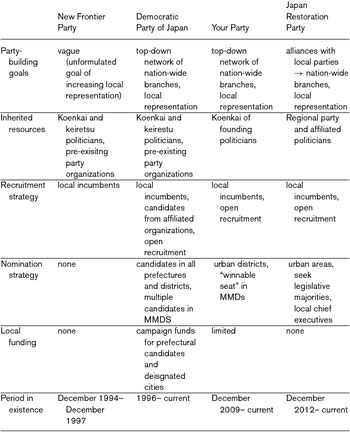
In summary (Table 1), the four parties all recognized the importance of building local party organizations, particularly focusing on recruiting, nominating, and securing prefectural-level politicians. Aside from the NFP, the parties all had explicit targets and strategies of establishing a network of national branches and increasing local representation.
New party strategies in local party building

The DPJ leadership, reflecting their success at the national level as the main opposition and eventual ruling party, set the most ambitious targets of building a nation-wide base of local politicians. They also provided the greatest levels of funding to local candidates, reflecting in part the DPJ's income from party subventions at the national level. YP and JRP, although still in their early stages, have committed to recruiting and nominating local politicians for prefectural seats. Among the new parties, the JRP was the most ambitious in seeking to gain control of the local governments it targeted, by standing enough candidates to win legislative majorities and nominating official partisan candidates for local chief executive elections. Despite their efforts, all new parties generally faced a shortage of local-level candidates, being unable to reach self-stated goals of fielding candidates at the prefectural level.
2. Success and failure in local elections for new parties
Hypotheses concerning conditions in which local candidates will join new parties
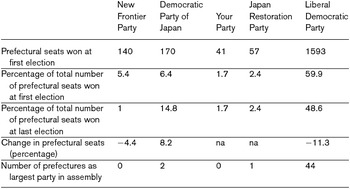
Although the new parties have been committed to party building, this does not mean that their efforts will necessarily be rewarded. As stated in the introduction and indicated quantitatively in Table 2, the four parties’ success in gaining local representation has been limited.
New party success in local elections

For new parties to be able to expand locally, potential local candidates have to be convinced of the benefits of joining the newcomer party and local voters convinced of the benefits of supporting these new party candidates. Under what conditions would this occur?
The article assumes that local candidates are driven, like national candidates, by the three key motivational factors of (re)election, power, and policy, with (re)election being necessary to achieving the others (Fenno, Reference Fenno1973). Local candidates will likely perceive their chances of securing (re)election by affiliating with a particular party if certain conditions encourage voters to support that particular party.
Reflecting the earlier discussion on the context of local politics in Japan, the article postulates four conditions that will affect a new party's ability to expand locally: the party controlling the national-level government, the party controlling the local-level government, the party having inherited resources, and the ‘permissiveness’ of the local electoral environment. The first two conditions relates to the ability of the candidate to promise and deliver material benefits to the electorate and attract supporters. The second two conditions relate to whether the local election environment is favorable for the entry of new parties, regardless of whether they are able to promise and deliver material benefits to the electorate.
These conditions can be stated as hypotheses of conditions/areas in which new parties will be more successful at standing candidates and winning seats in local elections:
1. When the party controls central government, it can deliver national-level policy and material goods to local supporters, making is easier to attract candidates and voters locally.
2. When the party controls local government through the chief executive, it can deliver local-level policy and material goods to local supporters, making it easier to attract candidates and voters locally.
3. In areas where the new party inherited resources (such as kōenkai and pre-existing party organizations), the new party will be able to expand faster than in areas where it did not inherit such resources.
4. In areas where the local electoral environment is more permissive for smaller parties, the new party will be able to expand faster than less permissive areas.
4a. Urban areas have a higher level of unaffiliated voters and less traditional campaigns, and thus are more permissive, making it easier for the new party to attract candidates and voters locally.
4b. Electoral districts with larger magnitude are more permissive for new and smaller parties, making it easier for the new party to attract candidates and voters locally.
The next section observes how the four parties, when applicable, have fared under these different conditions in terms of securing local representation.
Observations concerning conditions in which candidates will join new parties
Hypothesis 1: control of national government
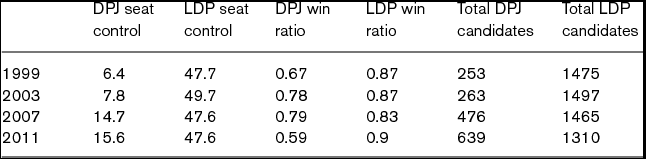
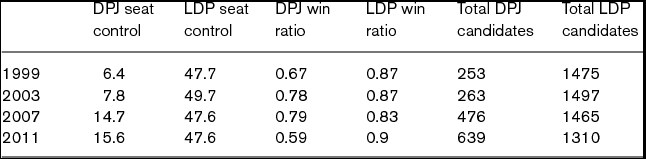
As discussed already, local politicians in Japan are expected to affiliate with the party which controls central government (Scheiner, Reference Scheiner2006). Among the four new parties, only the DPJ held control of the national government (September 2009 to December 2013). During this period, the DPJ experienced one Unified Local Election in 2011,Footnote 22 where it stood 639 candidates and won 376 seats, gaining 15.6% of all seats. Compared to the previous local election, the DPJ was able to field about 50% more candidates, but remained virtually flat in terms of seats won. In addition, the DPJ's win ratio (seats won over candidates fielded) deteriorated sharply from 2007 to 2011, whereas the LDP's ratio improved (Table 3). It is clear that the DPJ was not able to benefit from control of the national-level government in the 2011 local elections compared to previous elections.
DPJ vs LDP control of seats, candidacies and wins for prefectural assembly elections (1991‒2011)
To control for the other variables, especially urbanization and inheritance of resources, the electoral success of the DPJ in rural prefectures in 2011, where the DPJ had few resources, are observed. These rural regions should be most sensitive to changes in the partisan control at the national level, as they depend most on fiscal redistribution from the central government.
There were 23 prefecturesFootnote 23 where the DPJ had less than five seats after the 2007 Unified Local Elections. In these predominantly rural regions, the party had 65 prefectural seats (after standing 86 candidates) out of a total of 1,058 seats in 2007. In 2011, the DPJ won 83 seats (after standing 145 candidates) out of 1,032 seats. As with the national trend, the DPJ was able to increase its local representation only marginally in these rural districts, although increasing the number of candidates by more than 50%. The feeble gains of the DPJ during local elections in these regions, despite the party controlling the central government, weakens the hypothesis that partisan control of the central government leads to improvements in local representation.
The failure of the DPJ in 2011 locally reflected the unpopularity of the party at the national level as well as record low voter turnout following the Great East Japan Earthquake the previous month (Akiyoshi, Reference Akiyoshi and Shiratori2013: 160‒2). Case studies of the DPJ's election campaigns in specific prefectures such as Okayama (Yamaguchi, Reference Yamaguchi and Shiratori2013) and Kumamoto (Akiyoshi, Reference Akiyoshi and Shiratori2013) have analyzed why the DPJ failed in the 2011 election campaign, despite the party controlling the national-level government and winning most of the HoR seats in these prefectures. Both studies point to a failure of securing enough candidates and coordination failure between incumbent national and local politicians, local unions, and new candidates. These local (prefectural and district-level) issues provide evidence of why becoming the ruling party is not a sufficient condition for a new party to increase candidacies and win in local elections.
Hypothesis 2: control of local government
As chief executives in Japan's local government system are predominant in both agenda-setting and budget formation, it is expected that local legislators will seek to maintain good relations with the governor/mayor to achieve their own local policy goals (Sunahara, Reference Sunahara2010, Hijino, Reference Hijino2014). If the executive branch is backed primarily by a particular party, incumbents and potential candidates in the legislative branch are likely to affiliate with that particular party. To test for whether new party control of the chief executive post has helped new parties expand in a particular region, the article compares new party candidacies and wins prior to and after the new party controlling the local executive branch.
There have been very few instances in which new parties have backed their own gubernatorial candidate against another supported by the LDP at the prefectural level, and even fewer instances in which such candidates have won. Instead, new parties have tended to join a grand coalition, including the LDP, in support of chief executive candidates. Table 4 shows the nine cases in which the new parties won a gubernatorial post (backing the candidate alone or together with other opposition groups against an LDP candidate). Of the DPJ cases, all five prefectures (Iwate, Mie, Shizuoka, Tokushima, and Nagano) saw moderate to strong increases in candidacies and seat wins after the arrival of a DPJ-backed governor in the region. The NFP party won three chief executive posts and secured strong local representation in these prefectures initially. Moreover NFP local groups in two of these prefectures (Iwate and Mie) continued to exist even after the NFP disbanded in 1997, suggesting that the existence of a partisan governor exerts a strong influence on partisan affiliation of local candidates. Finally, the rapid expansion of the Osaka Restoration Association in the Osaka prefecture (and city) assemblies as a result of its party leader being governor (and later mayor) of these regions provides evidence for the hypothesis that controlling local government chief executives facilitates new party expansion locally.
Change in new party candidacies and wins after new party-backed gubernatorial candidate wins (1995‒2011 for DPJ, NFP, and JRP)

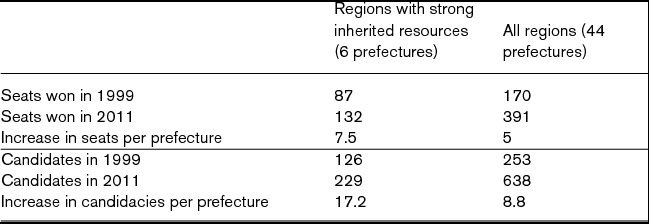
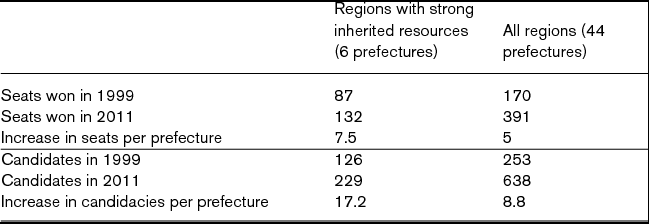
DPJ growth in prefectural assemblies with strong inherited resources vs national average
As a caveat, the qualitative analysis provided here is a simple one that does not control for other variables that may affect new party candidate success, while the cases are too few to make strong inferences. Yet at least within the specific regions, there is evidence of a positive impact on local party building when a new party controls the local executive branch.Footnote 24
Hypothesis 3: inherited resources
One would expect a party to be able to expand faster where it has already inherited a strong local party organization as opposed to where it must start from scratch. As a proxy to indicate inheritance of resources, the number of candidates and wins of the new party in its first contested local election is used. Since only the DPJ substantially contested more than one Unified Local Election, the DPJ is analyzed. DPJ had more than ten candidates in its first major local elections in 1999 in the following six prefectures: Hokkaido, Chiba, Kanagawa, Aichi, Osaka, and Hyogo. These are areas where the DPJ has successfully integrated the local JSP and DSP branches and inherited their organizational bases in terms of local unions. They have been referred to in popular parlance as ‘DPJ kingdoms’ (Minshutō ōkoku). The speed in which the DPJ expanded in terms of candidacies and wins in these six ‘kingdoms’ are compared with the average speed of growth across all other prefectures contested during the Unified Local Elections.
The above tables illustrate that the DPJ increased the average number of candidates and seats in these six prefectures where it had inherited resources faster than the national average.
Despite these gains, the DPJ has not been able to win more seats than the LDP in any of these ‘kingdoms’ at the local level (the DPJ has only experienced being the largest party in prefectural assemblies in Iwate after 2011 and Tokyo after 2009. Moreover, as most of these regions are urban or primarily urban prefectures, it is unclear whether the faster expansion here is a result of inherited resources or a function of urban-ness (a hypothesis tested below.)
Although cross-temporal comparisons are not possible for the NFP, YP, and JRP, which have contested only one Unified Local Elections, these parties also expanded fastest in regions where it had a pre-existing foothold in its first election. As discussed earlier, the NFP and YP stood most candidates in the home districts of its founders (Iwate, Tochigi, and Kanagawa), while the JRP's only significant prefectural presence is in Osaka, where the party was originally founded.
Hypothesis 4: electorally permissive areas
New parties are more likely to stand and win candidates where the electoral environment is more ‘permissive’. Such permissiveness can be determined by two district-level conditions: urban-ness and electoral magnitude.
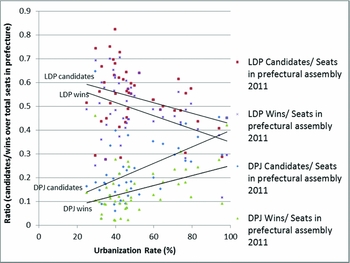
First, the degree of urban-ness of a district is expected to affect the chances of newer and smaller parties to win seats. Urban voters tend to be younger, better educated, and more likely to hold anti-clientelist attitudes than their rural counterparts, and, as a result, urban areas are more competitive electorally than rural areas (Schiener, Reference Scheiner2006: 174). To observe the impact of urban-ness on new party expansion, the article compares the success of the DPJ in local elections in rural and urban areas. A scatter chart for the prefectural election results of 2011 was created from which linear trend-lines were generated (see Figure 1). The vertical axis measures the ratio of candidates/seats won to total number of seats in the prefectural assembly (the higher, the more aggressive in standing candidates and successful in winning seats) and the horizontal axis measures degree of urbanization of the prefecture (the higher the more urbanized the prefecture as measured by the proportion of those living in Densely Inhabited Districts = DID).
DPJ and LDP candidacies and wins by level of urbanization

The linear trend-lines from the data show that the DPJ has tended to stand more candidates and win more seats in more urban prefectures. In contrast, the LDP has stood more candidates and won more seats than the DPJ in all prefectures, but the party has been even more successful in standing candidates and winning seats in more rural prefectures. Although the article does not do a similar analysis on the other new parties, the regions in which the YP and JRP have stood most candidates and won prefectural seats have also primarily been urban (Osaka, Kanagawa, Chiba).
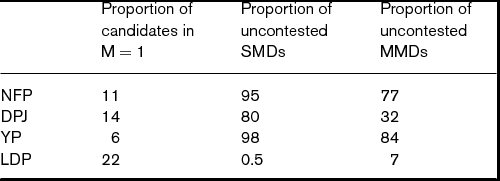
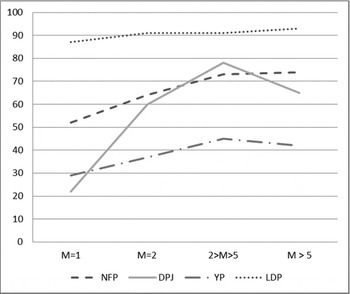
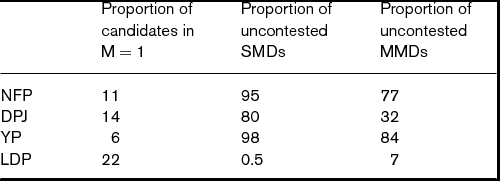
Second, district magnitude should affect the chances of new parties standing and winning seats. As discussed already, electoral districts with larger magnitudes have lower thresholds and provide a lower barrier for the entry of candidates of new and smaller parties. To observe the impact of district magnitudes in prefectural elections on new party candidacies and wins, the article compared data on candidacies and wins according to electoral district size for the 2011 Unified Local Election. Table 6 and Figure 2 shows that new parties have tended to stand more of their candidates and win more of their seats in districts with larger magnitudes. In contrast, LDP candidates have been equally successful in standing candidates and winning seats in SMDs and MMDs.
Proportion of prefectural assembly candidates by district magnitude (M) in 2011
Percentage of winning candidates by district magnitude (M) in prefectural assembly elections for parties in 2011

Despite the ‘permissiveness’ of MMDs, the new parties have largely been only able to field single candidates, not multiple candidates, in MMDs. The DPJ was able to field multiple candidates in only a quarter (24%) of all electoral districts with a magnitude larger than two seats, compared to the LDP's 64%. In 2011, the DPJ failed to stand candidates in roughly half of all prefectural electoral districts (80% of all SMDs and a third of all MMDs). These data imply that despite the existence of permissive electoral districts, the new parties are not able to recruit and field enough candidates to take advantage of these conditions. They have failed, in other words, to effectively challenge the LDP in both SMDs and the electorally more permissive MMDs.
Discussion
The above observations provide evidence for the hypotheses that new parties expand more successfully where they control local chief executive posts, have inherited pre-existing organizational resources in urban areas and in electoral districts with larger magnitudes. The DPJ's failure in the 2011 election fails to confirm the hypothesis that a new party would be able to expand faster so long as it controls the central government. Despite being relatively more successful in these regions with certain circumstances, the new parties have not been able to expand their local organizations to rival that of the LDP in absolute terms. Only in a handful of regions have the new parties become the largest party in the prefectural assembly,Footnote 25 while candidacy rates and win ratios are worse than the LDP even where new parties have been successful.
Although barriers for entry are lower in urban areas or the many MMDs of Japan's local prefectural districts, this ‘permissiveness’ in itself is not adequate for new parties to stand candidates and win seats. The failure of the DPJ, even after more than a decade of contesting local elections and becoming the ruling party, to contest over four-fifths of SMDs and a third of MMDs at the local level is significant. The immediate reason for this failure is that the DPJ – along with the other new parties –could not recruit enough candidates.
The difficulty of finding local candidates reflects the lack of ‘material benefits’ that the parties could offer to potential candidates. Lacking a strong party organization, providing only limited financial backing, not controlling the local government either in the executive or legislative branch, the new parties, unlike the LDP, had few incentives to offer potential candidates. As a result, local voters and candidates have, only in exceptional circumstances, distanced themselves from the LDP at the local level, despite the party facing volatility and falling out of power at the national level.
The article so far has not investigated incentives other than material benefits that the new parties can offer to attract voters and candidates: ideological and programmatic distinctiveness. The section ends by examining the two briefly.
The first variable refers to whether the new party can attract party members and potential candidates with a distinct ideological program. Socially rooted parties have succeeded in maintaining a local presence largely based on being able to provide a distinct ideological program that attracts and keeps followers and candidates regardless of their actual political power. The JCP has only had marginal influence at national-level politics and in most local governments, but the party has consistently been able to stand more candidates than new parties in many prefectural, municipal, and chief executive elections. The NCP has enjoyed similar strength and stability in local elections thanks to the support of its affiliated religious organization, even before entering government through coalition with the LDP in the mid-1990s.
The existence of an extra-party support organization has meant the recruiting, nominating, and campaigning strategies of these socially rooted parties differ considerably from the new entrepreneurial parties. Both the JCP and NCP parties recruit internally from members of their supporting organizations and rely on members to vote according to instruction, obviating the difficulties of voter coordination in local MMDs (Lam, Reference Lam1996; Brett, Reference Brett1979). Candidates of the JCP are salaried members of the party organization and do not risk their livelihoods from losing an election, unlike other party candidates. As salaried members of a centralized party organization, they are more tractable to the directives of the party headquarters. As such, the parties face less risk of defecting incumbents or a shortage in the supply of candidates. In contrast to these socially rooted parties, none of the new parties could offer a distinct ideological program to attract the sustained commitment of activists and the members necessary to generate a reliable pool of candidates.
The second question is whether the new parties were able to offer a distinct policy program (as opposed to an ideology) to ordinary voters to attract support away from incumbent parties. Although it is difficult to judge the policy distinctiveness of the various local branches of the NFP, DPJ, YP, or JRP against other parties competing at the local level, the YP and JRP arguably had the strongest focus on programmatic campaigning (Reed, Reference Reed, Kushida and Lipscy2013; HIjino, Reference Hijino2013). Both the YP and JRP pushed for administrative reforms, including reduction of local assembly sizes and salaries, as well as a strong emphasis on drastic decentralization reform.
Policy distinctiveness in local elections, however, is arguably only effective if the new party can control local governments through the chief executive and thereby actually deliver the program. This was the case for the JRP, which was highly successful in Osaka by campaigning on a distinct programmatic platform together with its party leader who was also mayor/governor of the region. New party candidates from other regional parties led by chief executives in Shiga and Aichi prefectures were also successful at campaigning on broader policy issues, rather than appealing to the personal vote (Hijino, Reference Hijino2013). There is evidence, however, that where the new party did not control the local government, campaigning on broader programs for the local community as a whole or on national-level issues proved counter-active (Akiyoshi, Reference Akiyoshi and Shiratori2013, 166). Under local MMD SNTV rules which encourage personal voting, a candidate's ability to appeal on partisan reputation and programs is strongly limited.Footnote 26 Only by linking together with a partisan chief executive can new party candidates use programmatic distinctiveness as an effective tool. Unfortunately, new parties have not managed to capture enough local chief executive posts to expand across Japan in this way.
Conclusion
According to Ohmura and Machidori, the DPJ made the ‘rational choice’ of ‘consciously not seeking to build’ a local party organization since the ‘party developed primarily to win at national level’ (Reference Ohmura, Machidori and Tatebayashi2013: 178). Moreover, the authors argue that a strong party organization costs time and money to both develop and maintain, while providing only disproportionally direct benefits to its success at the national level. As such, it was an ‘irrational’ entity for the DPJ to invest in. Despite such claims, this article demonstrated that the DPJ and other entrepreneurial parties that had formed with the aim of winning power nationally devoted considerable energy to standing candidates and winning seats locally. Party headquarters were conscious of the need to develop a strong local presence, primarily through the recruiting, standing, and winning of local representation. Regardless of its actual efficacy, to party leaders founding new parties, the goal of local party building was perceived not as ‘irrational’ but necessary for party success at the national level.
Despite this awareness and commitment to party building, the new parties all largely failed in this endeavor. Why? The article postulated that the parties would expand faster when able to provide material benefits (through the control of national and local governments), to utilize inherited pre-existing organizations, and when in electorally less demanding areas (such as urban areas or MMDs). The data provided evidence that when these conditions were met, new parties succeeded in expanding their local organizations.
The problem, however, is that these conditions which enable organization building are limited to only a handful of regions for the new parties. In rural areas without inherited resources and little chance for winning governorships – that is, in local strongholds of the LDP – new parties face a very difficult time in breaking through. The only potential ways to break LDP dominance – investing in social roots to develop a party organization like the JCP or NCP or winning numerous chief executive elections across the country – are perceived as too time-consuming and/or unrealistic.
A final reflection is one on the continuing constraints of historical inertia. The LDP did not build its local base from scratch. It inherited local incumbent politicians from pre-merger parties and won an astounding 60% of local prefectural seats in its first major local election in 1959. This legacy represents the most significant of what Reed has called the powerful path dependence of initial endowments for Japanese party organizations (Reed, Reference Reed, Kushida and Lipscy2013: 123). Ultimately, the LDP has continued to benefit from the inertia of its local predominance, established early on at the party's formation in the 1950s. Opposition parties continue to fight an uphill battle against this legacy more than half a century later. We wonder what exogenous shocks or internal drifts will be necessary for LDP dominance at the local level to be disrupted. So far, new party attempts at expansion have largely failed to dislodge this historical trajectory in Japanese local politics.
About the author
Ken Victor Leonard Hijino is currently associate professor at the Graduate School of Law, Kyoto University. He completed his PhD on decentralization in Japan at Cambridge University in 2009. During 2010, he spent a year at Osaka City University as a guest researcher on a JSPS grant. He has published an article on Japanese chief executives and party organizations in Party Politics, an analysis of independent candidates in Social Science Japan Journal, and a study of local parties in Journal of East Asian Studies. He is currently researching political party responses to regional inequality and rural depopulation in Japan and elsewhere.