Introduction
About 75% of patients with dementia experience behavioral and psychological symptoms of dementia (BPSD) such as delusions, hallucinations, agitation/aggression, depression, anxiety, apathy, and sleep disturbance (Lyketsos et al., Reference Lyketsos, Lopez, Jones, Fitzpatrick, Breitner and DeKosky2002). Although psychotropic medications have been extensively prescribed for the treatment of BPSD (Martinez et al., Reference Martinez, Jones and Rietbrock2013), there is a need for more evidence on the risks and benefits of the use of psychotropic medications.
A number of previous studies have revealed that antipsychotics are associated with increased mortality in patients with dementia (Schneider et al., Reference Schneider, Dagerman and Insel2005; Gill et al., Reference Gill2007). Banerjee (Reference Banerjee2009) estimated that the administration of a second-generation antipsychotic to 1,000 patients with BPSD for around 12 weeks would result in death in an additional 10 patients, cerebrovascular adverse events in an additional 18 patients, and gait disturbances in an additional 58–94 patients. Thus, some clinical practice guidelines recommend that non-pharmacological approaches should be the first line of treatment for BPSD (National Institute for Health and Clinical Excellence, 2006; Rabins et al., Reference Rabins2007). Notwithstanding the safety issues of antipsychotics, it would be unrealistic to treat “all” patients with BPSD via a strictly non-pharmacological approach, especially when severe aggression and agitation are present (Gareri et al., Reference Gareri, De Fazio, Manfredi and De Sarro2014). A recent clinical practice guideline and a systematic review recommended aripiprazole, olanzapine, and risperidone for severe agitation, aggression, and psychosis associated with dementia when a patient is believed to be at risk of harm to self or others (Maglione et al., Reference Maglione2011; Herrmann et al., Reference Herrmann, Lanctot and Hogan2013). However, with the exception of carbamazepine (Yeh and Ouyang, Reference Yeh and Ouyang2012), there is insufficient evidence to recommend the use of alternative psychotropic medications for BPSD such as quetiapine (Herrmann et al., Reference Herrmann, Lanctot and Hogan2013), antidepressants (including selective serotonin reuptake inhibitors and trazodone) (Herrmann et al., Reference Herrmann, Lanctot and Hogan2013), benzodiazepines (BZDs) (Tampi and Tampi, Reference Tampi and Tampi2014), and anticonvulsant mood-stabilizers (including gabapentin, lamotrigine, lithium, topiramate, and valproate) (Yeh and Ouyang, Reference Yeh and Ouyang2012; Herrmann et al., Reference Herrmann, Lanctot and Hogan2013).
Several regulatory agencies have issued warnings and regulations regarding the prescription of antipsychotics for BPSD in patients with dementia. In 2005, the United States Food and Drug Administration (FDA) gave the strongest warning (i.e. black box warning) against the use of SGAs in patients with dementia (U.S. Food and Drug Administration, 2005). In 2008, the FDA added a similar warning for FGAs (U.S. Food and Drug Administration, 2008). Thus, there are currently no FDA-approved medications for BPSD treatment. In the United Kingdom, short-term (i.e. up to 6 weeks) treatment with risperidone is the only pharmacotherapy licensed for the treatment of persistent aggression in patients with dementia (Medicines and Healthcare Products Regulatory Agency, 2009). In addition, healthcare professionals have been asked to report all suspected risperidone related adverse effects during the treatment period. In Italy, physicians are subordinated to rules regarding the prescription of antipsychotics for patients with dementia (Agenzia Italiana del Farmaco, 2005). More specifically, patients who have been prescribed antipsychotics for BPSD are registered into a clinical database and monitored for adverse reactions every 2 months (Agenzia Italiana del Farmaco, 2005).
In Japan, there is no approved medication for BPSD treatment. However, off-label psychotropic medications are commonly prescribed for BPSD. Moreover, trends in the use of psychotropic medications might remain stable because the regulatory agency in Japan has not issued strong warnings and/or regulations regarding the prescription of psychotropic medications for BPSD. To date, there are no nationwide studies on the utilization of psychotropic medications for patients with dementia in Japan. Therefore, in the current study, we aimed to examine trends in psychotropic medications use for elderly patients with dementia in nationwide ambulatory care settings between 2002 and 2010.
Methods
Data source and setting
We used data from the Survey of Medical Care Activities in Public Health Insurance, a nationally representative cross-sectional survey of claims data, conducted annually by the Ministry of Health, Labor and Welfare (MHLW) (Statistics and Information Department, 2011). A detailed description of the SMCA-PHI has been reported elsewhere (Statistics and Information Department, 2011). The SMCA-PHI comprises of claims data for the month of June in every year. The study employed a two-stage stratified random sampling procedure with a first-selection of medical or pharmacy facilities and a second-stage sample of claims from the sampled facilities. In the present study, we obtained permission of the MHLW to use nine consecutive years of data from the SMCA-PHI between 2002 and 2010. We limited the sample to ambulatory care visits by patients aged 65 years or older who received a prescription of donepezil, which was the only approved cholinesterase inhibitor during the survey years. The only indication for the use of donepezil is Alzheimer's disease in Japan.
Since 1961, Japan has a universal healthcare system (National Institute of Population and Social Security Research, 2014). The Japan's public insurance system is composed of three types of health insurances: occupation-based, municipality-based, and a separate system for persons aged 75 years or older. All Japanese citizens are required to be enrolled in one of these insurances. A patient can pay maximum of 30% of medical and pharmacy fees, while the rest is paid thorough the public insurance. Because majority of psychotropic medications are prescription drugs rather than over-the-counter drugs, almost all patients who use psychotropic medications are reimbursed by the public insurance.
Psychotropic medications
We defined use of psychotropic medications as having at least one prescription of antipsychotics, antidepressants, mood-stabilizers, and/or sedatives-hypnotics during the survey month. We classified 101 substances into four major psychotropic classes according to one of the most popular prescription handbooks in the Japanese clinical setting (Mizushima, Reference Mizushima2002). A complete list of included medications is available as supplementary material (online publications only, see supplementary tables available as supplementary material attached to the electronic version of this paper at www.journals.cambridge.org/jid_IPG). Antipsychotics included both SGAs and FGAs. Antidepressants included new-generation antidepressants (NGAs) as defined in the previous study (Cipriani et al., Reference Cipriani2009), tricyclic antidepressants (TCAs), and others antidepressants. Mood-stabilizers included carbamazepine, gabapentin, lamotrigine, lithium, topiramate, and valproate similar to the previous study (Yeh and Ouyang, Reference Yeh and Ouyang2012). Sedatives-hypnotics included BZDs that were subdivided into sedative BZDs and hypnotic BZDs, z-drugs (i.e. zolpidem and zopiclone), and other sedatives-hypnotics. Etizolam was double-counted as both a sedative and hypnotic BZD because this substance has been used for both purposes.
Statistical analyses
We combined data from contiguous survey years into groups (2002–2004, 2005–2007, and 2008–2010) to derive more stable estimates. First, we estimated the proportion of visits where psychotropic medications had been prescribed by survey year group for psychotropic classes and individual psychotropic medications. Second, we conducted logistic regression analyses to examine trends in psychotropic medications. The outcome variable was whether a patient received psychotropic medications. The primary explanatory variable was survey year group. The potential confounding variables included in the models were selected based on previous literature (Carrasco-Garrido et al., Reference Carrasco-Garrido, Lopez de Andres, Hernandez Barrera, Jimenez-Trujillo and Jimenez-Garcia2013; Ruths et al., Reference Ruths2013) and data availability as follows: sex, age (65–74, 75–84, and 85 years or older), provider type (clinic and hospital), and pharmacy type (out-hospital and in-hospital pharmacy). We estimated odds ratios (ORs) and their 95% confidence intervals (CIs) for visits in which psychotropic medications had been prescribed (2002–2004 compared to 2005–2007, and 2002–2004 compared to 2008–2010) after simultaneously controlling for potential confounders. To increase interpretability, we changed the reference year as 2005–2008 and re-calculated ORs for psychotropic visits (2005–2008 compared to 2008–2010). Separate regressions were constructed for each level of psychotropic visit. Data were analyzed using R version 3.0.3.
Results
Between 2002 and 2010, the sample sizes of ambulatory visits ranged between 205,191 and 268,872, yielding a total of 2,191,098 visits. The prevalence of patients aged 65 years or older ranged 49.8% and 53.2%. The prevalence of donepezil use increased from 0.5% in 2002 to 2.3% in 2010 among patients age 65 years or older. There were 1.9-, 4.0-, and 6.2-fold increases in the prevalence of donepezil use among patients aged 65–74, 75–84, and 85 years or older, respectively.
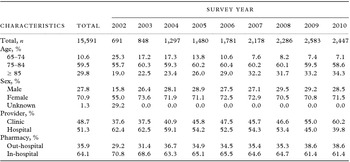
The eligible study population included 15,591 patients aged 65 years or older with dementia from 2002 to 2010 (Table 1). We observed changes over time in age- and provider-composition in our study population. The proportion of patients aged 85 years or older ranged between 19.0% and 34.3%. In addition, the proportion of patients receiving treatment in a clinic ranged between 37.5% and 60.2%.
Characteristics of study population

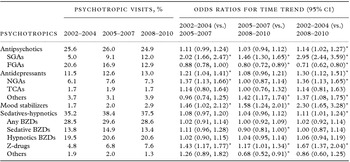
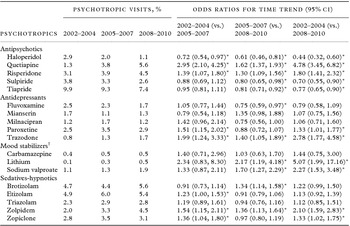
Table 2 depicts percentages and trends in outpatients with dementia with psychotropic prescriptions. Table 3 shows percentages and trends of the five psychotropic medications most prescribed broken into four major psychotropic classes.
Trends in psychotropic visits by psychotropic classes

Note. BZDs = benzodiazepines; CI = confidence interval; FGAs = first-generation antipsychotics; NGAs = new-generation antidepressants; SGAs = second-generation antipsychotics; TCAs = tricyclic antidepressants.
*p < 0.05.
Trends in psychotropic visits by individual psychotropic medications

Note. BZDs = benzodiazepines; CI = confidence interval; FGAs = first-generation antipsychotics; NGAs = new-generation antidepressants; SGAs = second-generation antipsychotics; TCAs = tricyclic antidepressants.
*p < 0.05.
†Gabapentin and topiramate were prescribed for only one patient, respectively. Lamotrigine was not prescribed.
In 2008–2010, the most prescribed psychotropic classes were sedatives-hypnotics (37.5%), antipsychotics (24.9%), antidepressants (13.0%), and mood-stabilizers (2.9%). Between 2002–2004 and 2008–2010, significant increases were evident among dementia visits with prescriptions for mood-stabilizers (OR 2.30, 95% CI 1.65–3.28), antidepressants (OR 1.30, 95% CI 1.12–1.51), antipsychotics (OR 1.14, 95% CI 1.02–1.27), and sedatives-hypnotics (OR 1.11, 95% CI 1.01–1.24).
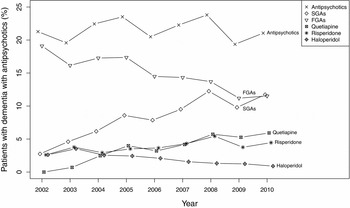
Figure 1 shows major results of trends in antipsychotics use between 2002 and 2010. Amongst the antipsychotics, prevalent utilization of SGAs markedly increased from 5.0% to 12.0% (OR 2.95, 95% CI 2.44–3.59), while the use of FGAs declined from 20.6% to 12.9% (OR 0.71, 95% CI 0.62–0.88) between 2002–2004 and 2008–2010. In terms of individual antipsychotics, the five most prescribed antipsychotics were haloperidol, quetiapine, risperidone, sulpiride, and tiapride. The use of quetiapine dramatically increased from 1.3% in 2002–2004 to 3.8% in 2005–2007 (OR 2.95, 95% CI 2.10–4.25), and from 3.8% in 2005–2007 to 5.6% in 2008–2010 (OR 1.62, 95% CI 1.37–1.93), which resulted in a 4.8-fold increase between 2002–2004 and 2008–2010 (OR 4.78, 95% CI 3.45–6.82). In addition, the use of risperidone increased from 3.1% to 4.5% (OR 1.80, 95% CI 1.41–2.32) between 2002–2004 and 2008–2010. On the other, the use of haloperidol showed a 2.3-fold decrease from 2.9% to 1.1% (OR 0.44, 95% CI 0.32–0.60) between 2002–2004 and 2008–2010.
Trends in antipsychotics use between 2002 and 2010.

Amongst the antidepressants, prevalent utilization of NGAs slightly increased from 6.1% to 7.3% (OR 1.36, 95% CI 1.13–1.65), and other antidepressants increased from 3.7% to 3.9% (OR 1.37, 95% CI 1.08–1.75) between 2002–2004 and 2008–2010. The five most prescribed antidepressants were fluvoxamine, mianserin, milnacipran, paroxetine, and trazodone. The use of trazodone markedly increased from 0.8% in 2002–2004 to 1.7% in 2008–2010 (OR 2.78, 95% CI 1.77–4.58). The use of paroxetine significantly increased from 2.5% in 2002–2004 to 3.5% in 2005–2007 (OR 1.51, 95% CI 1.15–2.02), and non-significantly decreased from 3.5% in 2005–2007 to 2.9% in 2008–2010, which resulted in a 1.3-fold increase between 2002–2004 and 2008–2010 (OR 1.33, 95% CI 1.01–1.77).
Amongst the mood-stabilizers, the use of lithium dramatically increased from 0.1% in 2002–2004 to 0.5% in 2008–2010 (OR 5.07, 95% CI 1.99–17.16). The use of valproate also markedly increased from 1.1% in 2002–2004 to 1.9% (OR 2.27, 95% CI 1.53–3.48).
Amongst the sedatives-hypnotics, the most prescribed subclasses were hypnotic BZDs (20.6%), Sedative BZDs (13.4%), z-drugs (7.6%), and other sedatives-hypnotics (1.3%) in 2008–2010. Between 2002–2004 and 2008–2010, the prevalent utilization of z-drugs increased from 4.8% to 7.6% (OR 1.67, 95% CI 1.37–2.04) although use of any BZDs, sedative BZDs, hypnotic BZDs, and other sedatives-hypnotics remained stable. The use of zolpidem and zopiclone increased, respectively, from 2.0% to 4.5% (OR 2.10, 95% CI 1.59–2.83), and from 2.8% to 3.1% (OR 1.33, 95% CI 1.02–1.75) between 2002–2004 and 2008–2010.
Discussion
Our study yielded six major findings using data collected from outpatients with dementia. First, we observed a 1.1-fold increase in the extensive use of antipsychotics (about 25%) over time. Our findings are inconsistent with those of several previous studies that found decreasing trends in overall antipsychotic use in patients with dementia, although direct comparison is difficult because of differences in study designs and outcomes. These prior studies reported a 69% reduction from 1995 to 2011 in the United Kingdom (Martinez et al., Reference Martinez, Jones and Rietbrock2013), a 41% reduction from 1999 to 2007 in the United States of America (Kales et al., Reference Kales2011), a 40% reduction from 2003 to 2011 in France (Gallini et al., Reference Gallini, Andrieu, Donohue, Oumouhou, Lapeyre-Mestre and Gardette2014), a 34% reduction from 2002 to 2008 in Italy (Franchi et al., Reference Franchi2012), and a non-significant 9% reduction from 2004 to 2009 in Germany (Schulze et al., Reference Schulze, van den Bussche, Glaeske, Kaduszkiewicz, Wiese and Hoffmann2013). This discrepancy may be because the regulatory agency in Japan has not yet issued strong warnings and regulations regarding the prescription of psychotropic medications for BPSD. Our results might prompt the regulatory agency to issue safety warnings. The contents of such warnings would be optimal only if they provide physicians with guidelines and alternative treatment strategies for the management of BPSD (Gallini et al., Reference Gallini, Andrieu, Donohue, Oumouhou, Lapeyre-Mestre and Gardette2014). However, some nursing home facilities have reported their inability to provide alternative treatment strategies for residents with BPSD (Nakanishi et al., Reference Nakanishi, Hattori, Nakashima and Sawamura2012). To reduce the overall use of antipsychotics, systematic efforts should be made to ensure that physicians and nursing staff can incorporate evidence-based approaches such as antipsychotic withdrawal strategies (Declercq et al., Reference Declercq2013) and psychosocial interventions (Richter et al., Reference Richter, Meyer, Mohler and Kopke2012) into their routine clinical practices.
Second, there was a significant shift in the prevalence of prescriptions from FGAs to SGAs. Among the various types of antipsychotics, use of quetiapine and risperidone increased, while that of haloperidol decreased. This shift is likely desirable because FGAs have been associated with a greater mortality rate than SGAs (Gill et al., Reference Gill2007). However, based on the available evidence, the strength of recommendations varies amongst individual SGAs. A recent clinical practice guideline and systematic review suggested that there is insufficient evidence for or against the use of quetiapine (Herrmann et al., Reference Herrmann, Lanctot and Hogan2013); on the other hand, several previous studies have provided sufficient evidence to recommend the use of aripiprazole, olanzapine, and risperidone (Maglione et al., Reference Maglione2011; Herrmann et al., Reference Herrmann, Lanctot and Hogan2013). In Japan, these SGAs are approved only for the treatment of patients with schizophrenia and bipolar disorders. In addition, no randomized placebo-controlled trials have been conducted to examine the efficacy of antipsychotics for BPSD in Japan. These results suggest the urgent need to evaluate the efficacy of antipsychotics for the approved treatment of severe BPSD.
Third, we observed a stable non-negligible use of sedative BZDs (13%) over time. A systematic review showed that there is inadequate data for recommending the routine use of sedative BZDs for BPSD (Tampi and Tampi, Reference Tampi and Tampi2014). A clinical practice guideline indicated that the side effects associated with sedative BZDs outweighed the benefits when compared to antipsychotic medications (Rabins et al., Reference Rabins2007). The common side effects of BZDs include over-sedation, ataxia, amnesia, confusion (even delirium), and possibly paradoxical anxiety, which lead to worsening cognition and behavior and increasing risk of falls (Rabins et al., Reference Rabins2007). In addition, the guideline stated that sedative BZDs could be useful on an occasional (as-needed) basis for patients who only have rare episodes of agitation or for those needing to be sedated for a particular procedure such as a tooth extraction (Rabins et al., Reference Rabins2007). This suggests that physicians should be judicious in their prescription of sedative BZDs for BPSD. Direct-to-consumer education about the risks of BZDs use and a stepwise tapering protocol might be a promising strategy to discontinue the use of BZDs (Tannenbaum et al., Reference Tannenbaum, Martin, Tamblyn, Benedetti and Ahmed2014).
Fourth, we found significant increases in the use of lithium and valproate over time. The prevalent utilization of lithium is relatively low (0.5%), while the prevalent utilization of valproate is non-negligible (1.9%). Especially, the latter prescribing practice might be incongruent with recommendations from the current available evidence. More specifically, strong evidence indicates that valproate should not be used for BPSD due to its lack of efficacy and risk of mortality (Yeh and Ouyang, Reference Yeh and Ouyang2012; Herrmann et al., Reference Herrmann, Lanctot and Hogan2013). Thus, our results should raise caution to frequent prescribers of valproate for patients with BPSD.
Fifth, we observed an increase in the use of antidepressants over time, especially trazodone and paroxetine. It is difficult to judge whether these prescription patterns are clinically questionable due to the lack of available data in the literature. It has been suggested that there is sufficient evidence to recommend the use of these antidepressants to manage major depressive disorders; however, there is insufficient evidence for or against the use of trazodone or selective serotonin reuptake inhibitors in the management of agitated patients (Herrmann et al., Reference Herrmann, Lanctot and Hogan2013). A meta-analysis of seven randomized controlled trials concluded that few high-quality studies have examined the efficacy and acceptability of antidepressants for BPSD treatment, although antidepressants may have the potential to improve symptoms of agitations and psychosis in patients with dementia (Seitz et al., Reference Seitz, Adunuri, Gill, Gruneir, Herrmann and Rochon2011). Therefore, large randomized controlled trials are needed to determine the efficacy and acceptability of antidepressants for BPSD management.
Sixth, the use of z-drugs showed a 1.7-fold increase over time, while the use of hypnotic BZDs remained stable. The possible reason for the increasing trend in z-drug use is that physicians might perceive z-drugs as being more effective and safer compared to BZDs (Hoffmann, Reference Hoffmann2013); however, there is no evidence to support this assumption (Levy, Reference Levy2014). Moreover, a recent systematic review showed that there is very little data regarding appropriate medication selection for sleep disturbances in patients with dementia (McCleery et al., Reference McCleery, Cohen and Sharpley2014). These results indicate an urgent need for evaluating the efficacy and safety of medications commonly used for sleep disturbances in patients with dementia.
Limitations
Our study had four important limitations. First, the data available to us did not include information on diagnosis, duration of treatments, dosage, or adherence. As a result, we were unable to determine the reasons why physicians prescribed psychotropic medications. More specifically, we were unable to exclude patients who had severe and enduring mental illness such as schizophrenia or severe bipolar disorders and were likely to receive psychotropic medications for indications other than BPSD. Second, our study population did not represent the whole population of patients with dementia, because our criterion for identifying patients with dementia was limited to a prescription of cholinesterase inhibitors. Third, we were unable to investigate the possibility of change in the eligible study population over time, although we adjusted for potential cofounding variables such as sex, age, provider type, and pharmacy type. For example, we observed a marked increase in the use of donepezil over time. One possible explanation for the increase is that physicians become more familiar with the use of donepezil that have been approved for the treatment of Alzheimer's disease since 1998. Another possible explanation is due to the increase in off-label use of donepezil for the treatment of other conditions such as vascular dementia and dementia with Lewy bodies. Fourth, the use of psychotropic medications may have been underestimated due to the nature of the data; we were unable to identify patients who received cholinesterase inhibitors and psychotropic medications from different pharmacies or from different departments within the same medical facility.
Conclusions
In conclusion, we found a slight increase in the extensive use of off-label antipsychotics over time. This study highlights the urgent need to evaluate the efficacy of antipsychotics for the approved treatment of severe BPSD. Moreover, our findings suggest the need to direct cares and resources toward psychosocial interventions and antipsychotic withdrawal strategies in order to reduce the overall prevalence of the use of antipsychotics.
Conflict of interest
None.
Description of authors’ roles
Y. Okumura participated in the study concept and design, analysis and interpretation of data, and drafting of the manuscript. T. Togo and J. Fujita participated in supervision of the study design, interpretation of data, and critical revision of the manuscript for important intellectual content. All authors contributed to and approved the final manuscript.
Acknowledgments
Funding for analyzing and writing this article was supported by Comprehensive Research on Disability Health and Welfare (Ministry of Health, Labor and Welfare, H26-SEISHIN-SHITEI-001). We are grateful to Dr. Miharu Nakanishi for her valuable comments on this manuscript. We would like to thank Dr. Helen Kales for providing us with unpublished data.
Supplementary material
To view supplementary material for this article, please visit http://dx.doi.org/10.1017/S1041610214001975