Introduction
The Information and communication technologies (ICT) that are transforming approaches to teaching in primary and secondary schools are part of a much larger social and cultural change driven by the arrival of these technologies (Savage, Reference SAVAGE2007). In contemporary society, the use of digital technology has become pervasive in a wide range of activities and in all segments of society, including many young people's lives (Macedo, Reference MACEDO2013). The use of digital technologyFootnote 1 as part of the resources used to support learning in a music classroom is accepted today in a number of countries around the world such as the United States, United Kingdom, New Zealand and Hong Kong, and is considered a necessary and desirable part of the teaching and learning environment (Beckstead, Reference BECKSTEAD2001; Ho, Reference HO2004; Mills & Murray, Reference MILLS and MURRAY2000; Wise, Reference WISE2010). These countries have spent considerable time and money implementing this technology in music education. Implementation has been accompanied by research into how this form of technology is being used in music lessons and how effective that use is in respect of students’ learning about and appreciation of music (Button, Reference BUTTON2006; Crow, Reference CROW2006; Hargreaves, Marshall & North, Reference HARGREAVES, MARSHALL and NORTH2003; Ho, Reference HO2004; Mills & Murray, Reference MILLS and MURRAY2000; Pitts & Kwami, Reference PITTS and KWAMI2002; Savage, Reference SAVAGE2007; Westerlund, Reference WESTERLUND2006). We know that technology is deeply embedded in the contemporary lexicon of many young people's musical lives and that the internet is their playground. Young people tend to have familiarised themselves with ICT innovations before their parents and teachers have; a reversal of the usual hierarchical roles. Various commentators (e.g., Prensky, Reference PRENSKY2001; Jonassen et al., Reference JONASSEN, HOWLAND, MOORE and MARRA2003; Prensky, Reference PRENSKY2009) stress that the students attending 21st century schools commonly live with computers, video games, digital music players and cellphones, and that this has changed how they and their peers engage with everyday life.
One particular challenge that technology brings music teachers is that of finding ways to bring into the school setting the knowledge that students develop outside of school about digital music composition and production. Further challenges, as identified by Wise (Reference WISE2010), Wise, Greenwood and Davis (Reference WISE, GREENWOOD and DAVIS2011), Webster (Reference WEBSTER2011) and McPhail (Reference MCPHAIL2012) include the moral imperative of including music from the western canon, plus an increased focus on explorative learning in creative music and on participative and student-centred individualised modes of learning.
This article examines the approaches to composition adopted by music teachers in four New Zealand secondary schools. In contrast with earlier reports of this research that provided a broad view including teachers’ perceptions (Wise, Reference WISE2010; Wise, Greenwood & Davis, Reference WISE, GREENWOOD and DAVIS2011), this paper focuses on the music teachers’ use of digital technology when teaching composition.
Literature review
Curriculum requirements referring to digital technology
The wide ranges of technological developments that have occurred in the last decade have had a considerable impact on what is taught as part of the music curriculum. The music industry in the 21st century uses digital technology in many applications including performance and composition, and in recording and publishing. This technology is transforming music and the way people approach many traditional music activities. Teachers may now be expected to incorporate some or a considerable amount of this new hardware and software into their teaching (Cain, Reference CAIN2004).
The adoption and implementation of digital technology may have challenged some of the basic conceptual frameworks that have underpinned many of the approaches to music teaching common throughout the world. Swanwick (Reference SWANWICK1999) classified the core musical activities as composing, performing and audience-listening (initially described as audition) with an exploration of music literature studies and development of skills in a supporting role. This classification had considerable impact on music teaching both in the United Kingdom and in New Zealand (NZ). It formed the basis of the music curriculum developed in New Zealand in the 1990s and was carried through to the various Music Achievement standards as part of the NZ National Certificate of Educational Achievement (NCEA), New Zealand's main secondary school qualification. In most schools in New Zealand, students begin work on NCEA in Year 11 (age 15–16) in their third year of high school study.
In the United Kingdom and in New Zealand the use of ICT is prescribed in the formal curriculum requirements in both primary and secondary schools. In the United Kingdom previous curriculum requirements have recommended the application of ICT to composition activities. More recent developments suggest an application to the teaching and practice of performance and other learning contexts as part of a ‘wider’ curriculum (Savage, Reference SAVAGE2010). McPhail (Reference MCPHAIL2012) writes about the development of the senior school music curriculum in New Zealand in the 20th century and argues that initially it mirrored the ‘parent structure’ of knowledge that was more highly valued of the university and he noted that, ‘practical elements were rendered secondary to the explicitly cognitive dimensions of analysis, history, harmony and counterpoint’ in that iteration of the curriculum (p. 319). In 2007 the new curriculum for New Zealand schools contained a major change in the Arts area moving from Music to the broader area of ‘Music – Sound Arts’ (Ministry of Education, 2007) including ICT for music creation:
Sound from natural, acoustic, and digital environments is the source material for expressive ideas in music. These ideas are manipulated and extended into forms, genres, and styles that are recognised as music. In music education, students work individually and collaboratively to explore the potential of sounds and technologies for creating, interpreting, and representing music ideas (Ministry of Education, 2007, p. 23).
Computer-based composition
The increasing impact of media and the technological development of a range of digital devices over the last decade have changed many young people's lives so that they often listen to and create music as part of their leisure activities. More students are included when the creation of music is viewed as something anyone can do and is not seen as reserved only for musical geniuses (Folkestad, Hargreaves & Lindstrom, Reference FOLKESTAD, HARGREAVES and LINDSTROM1998).
Digital technology allows students at all levels of musical experience and knowledge to compose (Crow, Reference CROW2006; Odam, Reference ODAM2000), because the process of creating music via available digital technologies no longer is dependent on notational literacy when using sequencing software such as GarageBand where students have access to pre-recorded loops. For tasks that require notated scores, dedicated notation software such as Sibelius is often used on a regular basis in music classrooms around the world.
Berkley (Reference BERKLEY2004) reports on a school-based research project into teaching composition at GCSE level. Berkley focused on some of the approaches taken by teachers and described how students were required to work through ‘an invariant series of stages chronologically when making a piece’ (Berkley, Reference BERKLEY2004: p. 241). She identifies the central role that the teacher plays in the student's development in learning to compose.
Digital technology has become part of the resources available to a music teacher. Mills and Murray (Reference MILLS and MURRAY2000), and Pitts and Kwami (Reference PITTS and KWAMI2002), found that many teachers’ pedagogical approaches were concerned with developing successful operation of the software by themselves and their students before any creative work took place. In addition, the role that behavioural objectives derived from the music curriculum provided by the government influenced the decisions that teachers made when teaching composition (Berkley, Reference BERKLEY2004).
Pedagogical change and ICT
Beckstead (Reference BECKSTEAD2001), when considering whether technology will transform music education, cited Keisler to clarify the use of technology as either ‘amplicative’ or ‘transformative’ (p. 47). The first term refers to technology in the classroom being used to do traditional tasks better or more efficiently. In contrast, a transformative impact is one that ‘shows a qualitative change in how people think, act and react’ (p. 47). However, the research literature surrounding pedagogical change with the implementation of ICT offers little support for the popular rhetoric about technology revolutionising teaching and learning or teachers fundamentally changing their pedagogical approaches and re-working their lesson plans (Hennessy, Ruthven & Brindley, Reference HENNESSY, RUTHVEN and BRINDLEY2005). Goodson and Managan (Reference GOODSON and MANAGAN1995) said they found ‘evidence of reshuffling the pack of cards but little evidence of anyone trying a new game’ (p. 119). Further studies in the UK and the U.S. show that relatively few teachers are integrating ICT into subject teaching in a way that motivates students and enriches learning or stimulates higher-level thinking with reasoning. Many classroom teachers are simply using the technology to do what they have always done, although they may claim that they have changed their practice (Cuban, Reference CUBAN2001; Hennessy, Ruthven & Brindley, Reference HENNESSY, RUTHVEN and BRINDLEY2005; Southcott & Crawford, Reference SOUTHCOTT and CRAWFORD2011). A key finding in Hennessy, Ruthven & Brindley's (Reference HENNESSY, RUTHVEN and BRINDLEY2005) research was that for many teachers subject pedagogy was dictated by the nature of external examinations students are required to sit and as a result the use of ICT (unless specifically mentioned in the examination requirements) had to take second place when guiding students to examination success.
Digital technology in music education
Savage (Reference SAVAGE2007) reported that despite widespread and significant cultural changes, music education in the classroom was still predominantly technologically conservative. Seven years on from Mills and Murray (Reference MILLS and MURRAY2000), it seems that ICT use in music education had not developed alongside performing artists working with similar technology and that much of the teachers’ work continued to be dominated by basic uses of ICT for sequencing and score notation. Savage suggested that the prescriptive nature of the curriculum and Attainment Targets at Key Stage 3 in England had tended to limit exploration of the potential of ICT so that teachers tend to do more interesting things at Key Stage 4 and post-16 where the curriculum was broader. He suggested that the inspection agency for education (OFSTED) appeared to judge success with music technology when it reinforces a traditional approach to music education. For example, OFSTED (2009) reported that ‘Sound pictures and collages’ are useful only as a precursor to ‘real’ compositional activities in developing melody, rhythm and harmony and variation as dictated in examination specifications.
Just what constitutes originality in any form of creative activity has become increasingly contestable. Vakeva (Reference VAKEVA2010) argued that digital technology can enable manipulation of previously recorded sounds by someone other than the original composer and, in many cases, this has become a form of creativity in its own right. Such an approach to creativity appears common in many more recent examples of contemporary music, particularly where fragments of existing songs have been sampled, re-arranged and included in a new piece, often in a very different style than the original.
Other research by Savage (Reference SAVAGE2010) undertaken through 2007–2008 also remains highly relevant to this article. He suggested that the connections between wider technological changes in musical production and consumption and their impact on educational practice have seldom been explored. Savage's key finding was that teachers were using technologies for teaching music from early school years but their practices were limited and often related to reinforcing traditional values associated with musical performance and composition (Savage, Reference SAVAGE2010). As technologies permeated more deeply, more radical pedagogical approaches needed to develop. Where a school had invested in a high level of technology, teachers had to develop their skills to be able to use it effectively and often this resulted in a significant change in their approach for them to be able to support their students.
Savage (Reference SAVAGE2010) suggested that there can be little doubt that the use of technology in music has had a profound impact on musicians and their conceptualisation of musical practice. However, he argues that this change in the wider musical world has not been reflected in classroom music. This study of music teachers in New Zealand indicates that some music teachers do make radical changes to their pedagogy in contexts where this is important to their students’ engagement and supported by their school.
Research design and methods
This paper reports on interview data gathered from nine secondary music teachers working in four secondary schools and adopts an interpretivist qualitative approach. The interpretive research paradigm can be described as an examination of the processes and the lived experience of participants in a particular environment such as a music classroom in a school. Interpreting the meaning of the process or the experience constitutes the knowledge to be gained from an inductive mode as opposed to a deductive or testing mode of inquiry (Merriam, Reference MERRIAM1998).
The nine music teachers who participated in this study were located in four local secondary schools. The schools were:
-
A. An independent boys’ school.
-
B. An independent girls’ school.
-
C. A large co-educational state school.
-
D. A smaller co-educational state school.
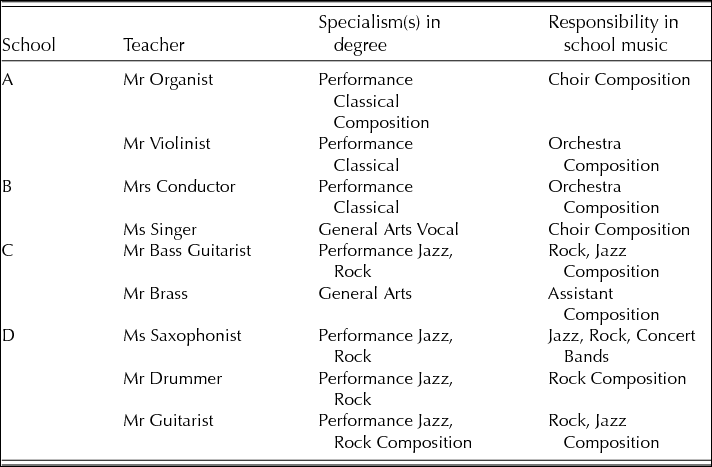
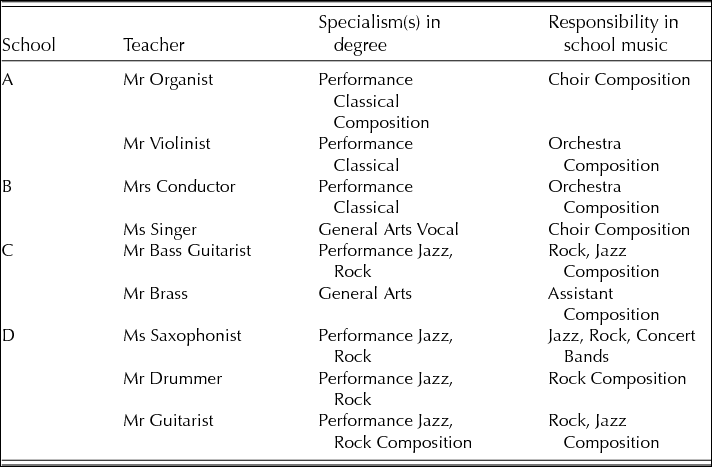
These schools were initially selected for the study because they were all considered by their school communities as having effective and successful music departments that incorporate a high level of ICT and associated digital technology in the courses offered to students. Details of the teachers’ music backgrounds and teaching specialisms are described in Table 1. Of the nine teachers involved in this study, three were female and six male. Two teachers were teaching at in each of schools A, B and C. The remaining three were teaching at School D. The research was guided by the key ethical principles of informed voluntary consent and protection of participants from risk or harm (Bogdan & Biklen, Reference BOGDAN and BIKLEN2007). Ethical approval was granted by the Educational Research Human Ethics Committee from the author's university. Pseudonyms are used for all participants to preserve anonymity.
Data collection and analysis
Initial data were gathered utilising a numerically descriptive and interpretivist qualitative approach. The main source of data for this paper was one semi-structured interview with each of the nine teachers that took approximately 30 minutes (a total of seven interviews). The teachers in School B and School C were interviewed together at their request.
The design of the interview questions was informed by an initial questionnaire completed in the final term of the school year, which in turn was informed by the literature review. The semi-structured interviews took place between one and three months after analysis of the questionnaire data. For example, the teachers were surveyed about their personal use of digital technologies at home and at school and their use of specific composition software, such as Sibelius and GarageBand. The questions developed for the semi-structured interviews were designed to probe deeper into the approaches the participants took to teaching composition with their students in junior music classes and at NCEA level 1.
The questions asked during the interviews focused on what software the teachers used for teaching composition and why they used it, what they thought of software that involves using pre-recorded loops, if the use of particular software had resulted in changes in their pedagogical approach, and what they might like to do in the future in terms of utilising developments in digital technologies. The interviews were recorded and transcribed. The teachers were asked to check the transcripts and any amendments were included in the analysis. This data was first analysed inductively to identify emergent themes, particularly around strategies utilised by participants when approaching teaching composition. A second analysis reviewed the data for themes that had emerged from the literature review.
Findings
The findings are presented focusing on the use of digital technology for composition activities in each schools following analysis of the interview data. The focus is placed on the use of specific software and the strategies employed by the teachers to teach composition predominantly in Year 9 (age 13) and Year 10 (age 14) classes. These are now discussed with examples coming from the semi-structured interviews with the teachers in each of the schools (A to D). The pseudonyms aim to communicate each teacher's gender and musical background.
School A
Mr Organist and Mr Violinist at School A are typical of many music teachers working in schools in New Zealand. They are both competent musicians with a strong background in Western art music. These teachers discussed the importance of students knowing how to use Sibelius; at School A, students in Year 9 are introduced to music notation using this software.
Mr Violinist described his use of Sibelius this way:
We use Sibelius in Year 9, just as an introduction. . . we give them a piece of music and they copy it in and later on they do some composing where they copy and paste and they have to put in their own version and add a free part for their own. . . that's three fanfares. With Sibelius, the benefit for me is that it actually gets them using traditional notation. That is the best one for me, because that is my aim in Year 9.
Mr Violinist's priority was learning to read and write music using traditional music notation. This was very important to him and he used Sibelius in order to achieve this. Once the students had learnt to use the software by copying and inputting notes from a pre-prepared task book, they progressed to a simple composition activity following a ‘compose by numbers’ approach. Mr Violinist felt that Sibelius was the more useful of the two pieces of digital technology used on a regular basis at School A although he did describe what he felt was some useful purpose for GarageBand for some students:
With GarageBand it is instant and they really can't go wrong and so they can get something up that sounds good to them and can see some structure to what they have done.
Whilst both teachers had come from a traditional classical background with qualifications at tertiary level in Western art music, Mr Organist was the only one to comment that he was starting to recognise that many of the traditional methods for assessing musical ability appeared to be inappropriate for a number of the students he worked with.
School B
School B was in the fortunate position of having two performance music classes in Year 9. This was an unusual situation; most schools in New Zealand would have a general music course at Year 9 with music available as an option from Year 10 on.
The students at School B were required to become familiar with Sibelius early in the year. Mrs Conductor described how both teachers introduced Sibelius to the Year 9 performance music classes because the students needed to be able to use it for composition work for all levels of NCEA. She was particularly enthusiastic about Sibelius and the immediacy it provided students to replay what they had written:
Sibelius, well, it is instant, they can hear what they are writing. So for me, it allows them to write far more complex pieces, no matter what the genre is, than they would otherwise because you can get instant feedback and they are not relying on having to find somebody to play it for you.
The students in junior classes at School B did not use sequencing software in their work in composition. The composition activities that they were required to complete were designed to introduce the students to Sibelius because the teachers believed an understanding of the functions of the software by the students was necessary to complete the composition achievement standards of the studied music in Year 11 and later classes.
School C
Students at School C were influenced by contemporary (popular) music practices in their first introduction to Sibelius in Year 10. In a similar fashion to Mr Violinist at School A and Mrs Conductor at School B, Mr Bass Guitarist had developed a Sibelius tutorial, which all students were required to complete to gain an understanding of how the software operated, including how notes were entered onto the staves on the screen. However Mr Bass Guitarist utilised fonts that were very different to the traditional music scores produced at the other schools. The scores the students produced were more similar to a jazz musician's lead sheet. Following the initial tutorial where basic skills related to note entry were taught, Mr Bass Guitarist had developed a composition task where students were required to complete parts in a 12-bar blues progression. As part of this tutorial, Mr Bass Guitarist had prepared one section that was an exemplar that the students were unable to modify followed by a second section containing little melodic riffs and phrases that the students could use in a composition of their own. Following completion of that task, the students were then required to write their own blues piece. This task is designed as a follow-up because students had had the opportunity to play a number of 12-bar blues pieces in their performance classes. As a result, the students were able to compose a complete piece in a contemporary style that sounded effective relatively quickly and easily.
Mr Bass Guitarist made this comment:
I think Sibelius is definitely a tool and everyone needs to learn how to use tools. There is no point in putting a carpenter on the site without knowing how to use a skill saw, they would chop their hands off! The Sibelius tutorials are really important, really important to do and complete and then move on to the blues composition.
He was insistent that senior students who were working on the composition achievement standards had to know how to use Sibelius in order to achieve well at that level. His views echoed those of the teachers at School A and School B in this regard.
One area of difference between Mr Bass Guitarist and Mr Brass was their perceptions of the usefulness of sequencing software that had pre-recorded loops available for users, such as GarageBand. Mr Brass said that using loops when creating a piece was ‘just cutting and pasting and that is not composing!’ He agreed that it might be useful for students who really struggled with Sibelius because of their lack of understanding of traditional notation saying,
I suppose that if they get fun out of it and they come up with something that they have enjoyed creating, then I suppose it is OK, but it will be a low priority for me if and when we use it. It is not original you see, that is what annoys me. For me, to compose, there has to be aspect of originality in it.
The two music teachers with quite different musical backgrounds reiterated the importance of students understanding music theory and being able to read and write music using traditional notation
School D
School D used only GarageBand to teach composition in junior classes. Ms Saxophonist, Mr Drummer and Mr Guitarist referred to accessibility as being the greatest advantage that GarageBand provided students when teaching composition. Ms Saxophonist said that she felt using GarageBand was fun for the students and they could quickly create something that they were pleased with without having to have a great deal of theoretical knowledge. Mr Drummer's perception was GarageBand allowed the students to create music without the requirements of a more traditional approach to composition using notation and music theory. Mr Guitarist's response to using GarageBand in his classes was:
. . . there are a whole lot of students who don't have necessarily great, strong musical theoretical backgrounds, can come in and start composing really cool stuff from day one.
Ms Saxophonist described how she taught song writing using a holistic approach where the students were able to make many of their choices before sitting down with the computer and starting to write their piece. She said that in many cases the students seemed to be able to write well-structured work almost instinctively:
They are so full of ideas and they can play their ideas in and then we can. . . it is almost like doing it in reverse, their ears are so good, that they naturally write things that have great form and good ideas and extension of ideas, but, they tend to do it by ear.
Mr Drummer expressed a similar view but commented about what he saw was the natural talent the students possessed, possibly because of experiences they had out of school:
I think that the greatest advantage is that, especially with these kids, we are talking about where they come from, their socio-economic background and all that kind of thing – music is in their blood. It just tends to be more natural for them and sometimes using this (GarageBand) tends to be a way of discovering a real natural talent.
The teachers at School D recognised that for these students, a traditional approach to teaching composition using music notation and music theory was difficult. Mr Guitarist made a series of comments about this too. He said that he was surprised at how skilfully many of the students could recreate different styles of music, particularly hip-hop:
I think the Pacific Island students here, have got a really good grasp of hip-hop and are working at a much higher level than what I thought they would. They seem to be able to work to a schedule. So for them, one example would be a student deciding to do a ‘Bollywood’ song and they will just nail it, and he will pull out every element in ‘Bollywood’.
Discussion
The data gathered in this small-scale study suggest that the digital technology available to the students has the potential to enhance their creativity, especially in composition. In particular, the study showed that sequencing software, such as GarageBand, has the potential to allow students with little or no formal understanding of traditional notation and theory, or with little or no experience of formal instrumental tuition, to create sophisticated and complex pieces of their own as described by Crow (Reference CROW2006).
As discussed earlier in this paper, an important consideration are the regulatory frameworks and the requirements of a national qualification as these can have a considerable impact on what teachers may or may not do with the digital technology available to them. In Schools A, B and C, the requirements of the national examination (NCEA) proved to be the most important factor influencing teacher decisions concerning the use of digital technology in the classroom. The requirements of the achievement standards in composition appeared to have the greatest influence on the range of activities teachers prepared for students in general and performance music classes. In three of the schools, the teachers had prepared a series of carefully structured exercises that students had to complete and these were used to teach the students how to use Sibelius. The participants did this to develop students’ skills and knowledge about the software so they are familiar with it when working on the composition achievement standard at Level 1 for NCEA music. Even though the participants acknowledged that they had many students in their music classes who played contemporary instruments such as electric guitars and drums, they were clear that all the students, irrespective of what instrument they played, needed to be able to use this specific software to prepare a notated score to meet the assessment requirements of that particular achievement standard.
The newer forms of composition using pre-recorded loops may be challenging for music educators as they may be considered either not original, as suggested by Mr Brass at School C, or as some form of plagiarism. It may be necessary for music educators to reassess their assumptions about originality and borrowing, as Crow (Reference CROW2006) suggests. However, if we conceive that the loops, samples and the like are part of the Cultural Commons as described by Goetz (Reference GOETZ2004), it may be that instead of viewing the use of these items in a negative light, a new role for the music educator could be to guide students to find interesting ways to employ the content available in the cultural commons and to find new approaches to them that might result in individual expressions (Vakeva, Reference VAKEVA2010). In other words, music educators may need to familiarise themselves with the nature of the musical input that their students make when working in this manner. They may need to work as enablers who accept that this is a new environment and one that is different to what they, as music educators are used to working in. Only by doing this will they be able to fully support their students. Music educators may need to be aware of the creative possibilities of such technologies, as described above, as well as developing an understanding of the traditions and contexts of genres of styles.
Conclusion
Students at School A, School B and School C were required to complete highly structured tasks that were designed to provide an understanding of the operation of the software and allowed some individual choices. It could be argued that all the exercises did was to prepare the students to be competent users of the software. Only in School D were students able to create their own pieces free from any particular procedural limitations designed to teach them how to use the software.
At the time that this research was conducted, the requirements of the relevant composition achievement standards was a key factor in informing the choices the teachers were making. The need to notate compositions and the descriptors included in standards for assessment were clear drivers for the teachers. While acknowledging that with the recent curriculum realignment this requirement perhaps will not influence teachers’ choice to the same extent, it remains to be seen if the teachers will choose to re-develop the current tasks to allow greater freedom of expression by the students.
Earlier in this paper, I described many of the issues identified some of the commentators (e.g., Dillon, Reference DILLON2004; Hennessy, Ruthven & Brindley, Reference HENNESSY, RUTHVEN and BRINDLEY2005; Way & Webb, Reference WAY and WEBB2007) surrounding the implementation and use of ICT by teachers in their classrooms. A common theme among these commentators was that despite the amount of digital technology available to teachers in schools, there remains some reluctance to use it. In this study, the evidence would suggest that the teacher participants do, in fact, use digital technologies on a regular basis but the activities the students engage in using these technologies remain fundamentally traditional and procedural in nature when connected with composition. In all of the schools apart from School D, the focus remained on procedural understandings and it appeared to lack a strong creative focus. Dillon (Reference DILLON2004) argues that teacher reluctance to explore potential affordances offered by digital technology is often connected with a preoccupation on developing procedural knowledge and skills of software with an emphasis on student proficiency when using them. Findings from this study could support this claim with most of the teacher participants developing carefully structured worksheets students that introduce students to this procedural knowledge in order to develop proficiency using one particular piece of software, Sibelius.
For teacher commitment to integrate ICT into subject practice, they need to recognise the educational value and believe in the transformative potential of the technology (Hennessy, Ruthven & Brindley, Reference HENNESSY, RUTHVEN and BRINDLEY2005). However, as Savage (Reference SAVAGE, Philpott and Spruce2012) says, there is the potential for significant rewards when we contextualise digital literacy and the associated skills and competencies including creativity within the field of music education. These skills in digital literacy need to be integrated alongside those specific skills that are accepted universally as a necessary part of music education.
Appendix
Teachers' music education and responsibilities at each school