Introduction
Group activity is an integral part of music-making and popular, classical and folk musicians play in groups for the larger part of their repertoires. In tertiary music institutions, group music-making can occur in improvisation, classical vocal and instrumental ensembles, and jazz and popular music groups (with or without a vocalist). The teaching and assessment of group music-making, and the learning that takes place, can be a significant element of a higher education music curriculum.
While literature has discussed issues that arise in solo and group performance, this has been predominantly about classical music and few studies focus on assessing group music-making. One recent exception is Pulman's (2009) study of the rehearsal process of tertiary-level popular music groups which finds that ‘personal attributes’ (p. 121) of individuals (such as punctuality, commitment, reliability, decision-making, organisational skills and feelings of artistic worth) and their impact on the dynamics of the group are emphasised when students contribute criteria as assessment parameters. Our study investigates what criteria tertiary music students choose for peer and self assessment of both the rehearsal process and performance outcome of their rock groups. In doing so, the study also works towards filling gaps in music education literature, where there has been an emphasis on (i) the performance of classical, rather than other types, of repertoire, (ii) solo, rather than group performance, (iii) the performance event, rather than the rehearsal process, and (iv) technical, or specifically musical skills over what the literature calls social or non-musical skills. While the research engaged students with peer and self assessment, this paper places its primary focus on student-chosen assessment criteria (and students’ explanations of these criteria) in their rehearsal process and performance outcome.
The study responds to two questions:
(i) what issues do tertiary student rock performers consider so important in the rehearsal process and performance outcome that they identify them as criteria for peer and self assessment?
(ii) what are the implications, for staff and students, of this knowledge?
Literature review
Davidson and King (Reference DAVIDSON, KING and Williamon2004) identify two levels of knowledge which must be worked out between players in ensemble rehearsals, to be communicated to the audience. The first is broad, encompassing ‘general musical and social knowledge that provides performance rules and regulations based on historical, social, and cultural factors’ (p. 105). The other involves ‘specific moment-by-moment information that must be processed and responded to in an ongoing manner’ (p. 105). Other writers perceive broad categories similar to musical and social and these are described as musical and non-musical factors (McPherson & Thompson, Reference MCPHERSON and THOMPSON1998); musical and social (Goodman, Reference GOODMAN and Rink2002); and musical and personal (Davidson & Good, 2002 in Davidson & King, Reference DAVIDSON, KING and Williamon2004).
Soft and hard skillsFootnote 1
The terms ‘hard’ and ‘soft’ skills have been used to describe technical/cognitive (hard) and behavioural (soft) skills (Coll and Zegwaard, Reference COLL and ZEGWAARD2006) which parallel these groupings of musical and non-musical/social factors. Coll and Zegwaard draw on Birkett's skills taxonomy (Birkett, 1993 in Coll and Zegwaard, Reference COLL and ZEGWAARD2006) to show that ‘hard’ skills comprise technical skills which ‘represent the ability to apply technical knowledge with some expertise’ (p. 31), analytical skills ‘and constructive skills [which] are concerned with problem identification and the development of solutions’ (p. 31), and appreciative skills which ‘refer to the ability to evaluate complicated situations, and make creative and complex judgements’ (p. 31). Soft skills ‘comprise personal skills, how one responds to, and handles, various situations; interpersonal skills, securing outcomes through interpersonal relationships; and organisational skills, securing outcomes through organisational networks’ (p. 31). The delineation of soft and hard skills, plus the descriptions drawn from Birkett's skills taxonomy, will be the organising principle in this paper that helps identify what is important to students. For our purposes, it will be seen that hard skills often map on to the ‘musical’, whereas soft skills are largely ‘non-musical’, though ultimately we found that a strict delineation between the two is neither desirable nor possible.
Music ensemble skills
Whether writers are discussing aspects of ensemble/group music performance (classical – Young and Colman, Reference YOUNG and COLMAN1979; Goodman, Reference GOODMAN and Rink2002; Davidson & King, Reference DAVIDSON, KING and Williamon2004; Kokotsaki, Reference KOKOTSAKI2007), assessing solo music performance (classical – Lockett, Reference LOCKETT, Nightingale, Te Wiata, Toohey, Ryan, Hughes and Magin1996; Searby & Ewers, Reference SEARBY and EWERS1997; Stanley et al., Reference STANLEY, BROOKER and GILBERT2002; classical and popular – Blom & Poole, Reference BLOM and POOLE2004; unidentified – Thomas & Millard, Reference THOMAS, MILLARD and Shortland-Jones2006) or group rehearsal (unidentified – Burrack, Reference BURRACK2002; popular – Green, Reference GREEN2002; Pulman, Reference PULMAN2009) with staff chosen (Lockett, Reference LOCKETT, Nightingale, Te Wiata, Toohey, Ryan, Hughes and Magin1996; Burrack, Reference BURRACK2002; Blom & Poole, Reference BLOM and POOLE2004), student chosen (Ryan, Reference RYAN2004; Pulman, Reference PULMAN2009), or negotiated (Searby & Ewers, Reference SEARBY and EWERS1997) criteria, all include soft and hard skills as part of their discussion, although they do not use this terminology. The skills below are drawn largely from instrumental music with idiomatically vocal aspects such as ‘purity of vowel’ (Stanley et al., Reference STANLEY, BROOKER and GILBERT2002, p. 46) not included. The exact meaning of some – for example, ‘professionalism’ – is not always clearly identified in the literature.
In the lists below, skills drawn from the literature are introduced in relation to hard and soft attributes, and combinations of both. However, we understand that many of the issues can arguably fit under one or more headings because ‘what are consequences of action/interaction at one point in time may become part of the conditions in another’ (Strauss & Corbin, 1990, p. 106 in Kokotsaki, Reference KOKOTSAKI2007, p. 656). Those which could be considered ‘hard’ musical skills are grouped into Birkett's sub-categories of technical, analytical and appreciative. All of these attributes are summed up by the catch-all of ‘musicianship’ (Lockett, Reference LOCKETT, Nightingale, Te Wiata, Toohey, Ryan, Hughes and Magin1996; Stanley et al., Reference STANLEY, BROOKER and GILBERT2002).
‘Technical skills’ include:
• playing technique (Hunter & Russ, Reference HUNTER and RUSS1996; Lockett, Reference LOCKETT, Nightingale, Te Wiata, Toohey, Ryan, Hughes and Magin1996; Searby & Ewers, Reference SEARBY and EWERS1997; Burrack, Reference BURRACK2002; Stanley et al., Reference STANLEY, BROOKER and GILBERT2002; Green, Reference GREEN2002; Blom & Poole, Reference BLOM and POOLE2004; Ryan, Reference RYAN2004);
• fluency of performers/performing ability/agility (Lockett, Reference LOCKETT, Nightingale, Te Wiata, Toohey, Ryan, Hughes and Magin1996; Ryan, Reference RYAN2004; Pulman, Reference PULMAN2009);
• accuracy of playing notation (Hunter & Russ, Reference HUNTER and RUSS1996; Lockett, Reference LOCKETT, Nightingale, Te Wiata, Toohey, Ryan, Hughes and Magin1996; Burrack, Reference BURRACK2002; Stanley et al., Reference STANLEY, BROOKER and GILBERT2002; Ryan, Reference RYAN2004);
• rhythmic accuracy (Lockett, Reference LOCKETT, Nightingale, Te Wiata, Toohey, Ryan, Hughes and Magin1996; Burrack, Reference BURRACK2002; Thomas & Millard, Reference THOMAS, MILLARD and Shortland-Jones2006);
• intonation (Lockett, Reference LOCKETT, Nightingale, Te Wiata, Toohey, Ryan, Hughes and Magin1996; Searby & Ewers, Reference SEARBY and EWERS1997; Burrack, Reference BURRACK2002; Stanley et al., Reference STANLEY, BROOKER and GILBERT2002; Price & Byo, Reference PRICE, BYO, Parncutt and McPherson2002 – especially for secondary school students; Thomas & Millard, Reference THOMAS, MILLARD and Shortland-Jones2006);
• playing in time (Hunter & Russ, Reference HUNTER and RUSS1996; Goodman, Reference GOODMAN and Rink2002);
• tempo (Searby & Ewers, Reference SEARBY and EWERS1997; Burrack, Reference BURRACK2002);
• articulation (Lockett, Reference LOCKETT, Nightingale, Te Wiata, Toohey, Ryan, Hughes and Magin1996; Searby & Ewers, Reference SEARBY and EWERS1997; Burrack, Reference BURRACK2002; Price & Byo, Reference PRICE, BYO, Parncutt and McPherson2002 – especially for secondary school students; Thomas & Millard, Reference THOMAS, MILLARD and Shortland-Jones2006);
• phrasing (Young & Colman, Reference YOUNG and COLMAN1979; Hunter & Russ, Reference HUNTER and RUSS1996; Lockett, Reference LOCKETT, Nightingale, Te Wiata, Toohey, Ryan, Hughes and Magin1996; Searby & Ewers, Reference SEARBY and EWERS1997; Burrack, Reference BURRACK2002; Price & Byo, Reference PRICE, BYO, Parncutt and McPherson2002 – especially for secondary school students; Stanley et al., 2002);
• sense of line and sensitivity to harmonic movement (Hunter & Russ, Reference HUNTER and RUSS1996; Lockett, Reference LOCKETT, Nightingale, Te Wiata, Toohey, Ryan, Hughes and Magin1996; Searby & Ewers, Reference SEARBY and EWERS1997);
• dynamic variation (Young & Colman, Reference YOUNG and COLMAN1979; Lockett, Reference LOCKETT, Nightingale, Te Wiata, Toohey, Ryan, Hughes and Magin1996; Searby & Ewers, Reference SEARBY and EWERS1997; Stanley et al., Reference STANLEY, BROOKER and GILBERT2002; Ryan, Reference RYAN2004; Thomas & Millard, Reference THOMAS, MILLARD and Shortland-Jones2006);
• tone quality (Lockett, Reference LOCKETT, Nightingale, Te Wiata, Toohey, Ryan, Hughes and Magin1996; Searby & Ewers, Reference SEARBY and EWERS1997; Burrack, Reference BURRACK2002; Stanley et al., Reference STANLEY, BROOKER and GILBERT2002; Thomas & Millard, Reference THOMAS, MILLARD and Shortland-Jones2006);
• timbral variation (Lockett, Reference LOCKETT, Nightingale, Te Wiata, Toohey, Ryan, Hughes and Magin1996; Ryan, Reference RYAN2004) and complementarity (Davidson & King, Reference DAVIDSON, KING and Williamon2004);
• breathing/posture (Lockett, Reference LOCKETT, Nightingale, Te Wiata, Toohey, Ryan, Hughes and Magin1996; Stanley et al., Reference STANLEY, BROOKER and GILBERT2002);
• projection (Stanley et al., Reference STANLEY, BROOKER and GILBERT2002);
• balance/blend (Hunter & Russ, Reference HUNTER and RUSS1996; Lockett, Reference LOCKETT, Nightingale, Te Wiata, Toohey, Ryan, Hughes and Magin1996; Burrack, Reference BURRACK2002; Kokotsaki, Reference KOKOTSAKI2007);
• expressive qualities, creativity, imagination, artistic individuality (Hunter & Russ, Reference HUNTER and RUSS1996; Stanley et al., Reference STANLEY, BROOKER and GILBERT2002; Thomas & Millard, Reference THOMAS, MILLARD and Shortland-Jones2006);
• emotional impact (Lockett, Reference LOCKETT, Nightingale, Te Wiata, Toohey, Ryan, Hughes and Magin1996; Stanley et al., Reference STANLEY, BROOKER and GILBERT2002; Thomas & Millard, Reference THOMAS, MILLARD and Shortland-Jones2006).
‘Analytical skills’ include:
• awareness of style/performance practice (Hunter & Russ, Reference HUNTER and RUSS1996; Lockett, Reference LOCKETT, Nightingale, Te Wiata, Toohey, Ryan, Hughes and Magin1996; Searby & Ewers, Reference SEARBY and EWERS1997; Burrack, Reference BURRACK2002; Stanley et al., Reference STANLEY, BROOKER and GILBERT2002; Blom & Poole, Reference BLOM and POOLE2004; Ryan, Reference RYAN2004; Thomas & Millard, Reference THOMAS, MILLARD and Shortland-Jones2006);
• an understanding of the work (Hunter & Russ Reference HUNTER and RUSS1996; Stanley et al., Reference STANLEY, BROOKER and GILBERT2002; Thomas & Millard, Reference THOMAS, MILLARD and Shortland-Jones2006 – structure);
• interpretative qualities (Young & Colman, Reference YOUNG and COLMAN1979; Lockett, Reference LOCKETT, Nightingale, Te Wiata, Toohey, Ryan, Hughes and Magin1996; Thomas & Millard, Reference THOMAS, MILLARD and Shortland-Jones2006).
‘Appreciative skills’ include:
• repertoire (choice, negotiation of) (Searby & Ewers, Reference SEARBY and EWERS1997; Blom & Poole, Reference BLOM and POOLE2004);
• cohesion of ensemble playing (Stanley et al., Reference STANLEY, BROOKER and GILBERT2002);
• balance of technical progress and musical fluency in rehearsal (Davidson & King, Reference DAVIDSON, KING and Williamon2004).
The soft/non-musical skill-set is strongly represented by issues particular to general group interaction. However, Young and Colman (Reference YOUNG and COLMAN1979) argue for a music group (they are discussing the string quartet) as ‘a special kind of small group which . . . might reasonably be assumed to manifest some of the established social psychological processes of small groups in a particularly striking way’ (p. 17). Soft skills were found to be criteria often favoured in peer assessment of group music-making, especially when students have chosen the criteria (Pulman, Reference PULMAN2009). Like ‘musicianship’ in relation to hard skills, much of the soft skill-set is summed up by the catch-all ‘professionalism’ (Ryan, Reference RYAN2004).
‘Personal skills’ include:
• reliability, punctuality, commitment (Pulman, Reference PULMAN2009),
• attendance (Hunter & Russ, Reference HUNTER and RUSS1996);
• remembering equipment (Pulman, Reference PULMAN2009);
• sense of involvement (Lockett, Reference LOCKETT, Nightingale, Te Wiata, Toohey, Ryan, Hughes and Magin1996);
• sense of individual personality (Lockett, Reference LOCKETT, Nightingale, Te Wiata, Toohey, Ryan, Hughes and Magin1996).
‘Interpersonal skills’ include:
• sharing of decision-making (Pulman, Reference PULMAN2009);
• achieving integration (Kokotsaki, Reference KOKOTSAKI2007);
• social factors (Goodman, Reference GOODMAN and Rink2002), incorporating cooperative skills (Pulman, Reference PULMAN2009), equal involvement (Davidson & King, Reference DAVIDSON, KING and Williamon2004);
• negotiation of shared musical goals (Davidson & King, Reference DAVIDSON, KING and Williamon2004);
• verbal interaction (Young & Colman, Reference YOUNG and COLMAN1979);
• interpersonal skills (Pulman, Reference PULMAN2009), trust and respect (Davidson & King, Reference DAVIDSON, KING and Williamon2004);
• confrontation and compromise (Goodman, Reference GOODMAN and Rink2002; Davidson & King, Reference DAVIDSON, KING and Williamon2004);
• each individual feels he or she is contributing artistically (Goodman, Reference GOODMAN and Rink2002; Davidson & King, Reference DAVIDSON, KING and Williamon2004; Pulman, Reference PULMAN2009).
And ‘organisational skills’ include:
• allocation of time for practising and rehearsing (Davidson & King, Reference DAVIDSON, KING and Williamon2004);
• regulating the ensemble (Kokotsaki, Reference KOKOTSAKI2007), organisation skills (Pulman, Reference PULMAN2009), operational principles of the ensemble (Davidson & King, Reference DAVIDSON, KING and Williamon2004);
• leadership/roles (Young & Colman, Reference YOUNG and COLMAN1979; Goodman, Reference GOODMAN and Rink2002; Pulman, Reference PULMAN2009).
There are criteria which blur the distinction between hard and soft skill-sets. Particularly hard to measure, on-stage criteria include:
• confidence/stage presence (Lockett, Reference LOCKETT, Nightingale, Te Wiata, Toohey, Ryan, Hughes and Magin1996; Searby & Ewers, Reference SEARBY and EWERS1997; Blom & Poole, Reference BLOM and POOLE2004; Ryan, Reference RYAN2004; Thomas & Millard, Reference THOMAS, MILLARD and Shortland-Jones2006; Pulman, Reference PULMAN2009) tends towards the soft skill-set, in particular, ‘personal skills’;
• musical communication to the audience (Searby & Ewers, Reference SEARBY and EWERS1997; Stanley et al., Reference STANLEY, BROOKER and GILBERT2002; Blom & Poole, Reference BLOM and POOLE2004);
• musical effectiveness (Thomas & Millard, Reference THOMAS, MILLARD and Shortland-Jones2006);
• musical communication within the group (Stanley et al., Reference STANLEY, BROOKER and GILBERT2002) including aural (Goodman, Reference GOODMAN and Rink2002; Davidson & King, Reference DAVIDSON, KING and Williamon2004; Kokotsaki, Reference KOKOTSAKI2007), visual (Goodman, Reference GOODMAN and Rink2002; Blom & Poole, Reference BLOM and POOLE2004; Davidson & King, Reference DAVIDSON, KING and Williamon2004; Kokotsaki, Reference KOKOTSAKI2007), and movement for musical coherence and social unity (Davidson & King, Reference DAVIDSON, KING and Williamon2004).
Criteria considered particular to the rehearsal process which blur the line between hard/musical and the soft/non-musical skill-sets include:
• warming up together (Davidson & King, Reference DAVIDSON, KING and Williamon2004);
• approaches to individual pieces – identifying structural boundaries in the music (Hunter & Russ, Reference HUNTER and RUSS1996; Davidson & King, Reference DAVIDSON, KING and Williamon2004);
• balance rehearsal focus between long and short segments of the piece; integrate run-throughs; working sequentially and nonsequentially (Davidson & King, Reference DAVIDSON, KING and Williamon2004);
• practice (and its effect in rehearsal) (Green, Reference GREEN2002);
• time for practising and rehearsing (Davidson & King, Reference DAVIDSON, KING and Williamon2004; Kokotsaki, Reference KOKOTSAKI2007).
The broader issue of individual skills and the need to ‘think beyond them’ (Davidson & King Reference DAVIDSON, KING and Williamon2004, p. 105) to achieve the group's musical and interpersonal cohesion also combines hard and soft skills.
Methodology
Participants were 15 second-year performance students in four rock groups (Gold – 5 participants; Red – 3 participants; Silver – 4 participants; and Black – 3 participants) studying in a three-year music programme where performance is not taught on a one-to-one basis but adopts a ‘broader class-based approach’ (Blom, Reference BLOM, Bennett and Hannan2008, p. 101). As part of a written task for a semester of group performance, students were asked to identify three criteria with which to peer and self assess their own and their group's rehearsal process and three criteria with which peers from other rock groups could evaluate their final performance. They were also asked to explain the meaning of their nominated criteria. Students had nine weeks of lectures, rehearsal and trial performance within which to select criteria they considered important to their rehearsal and performance and the peer and self assessment took place during the last four weeks of the semester. Two more criteria were designed by performance staff, the authors of the paper, for each part of the task making a total of five criteria for assessment of each group's rehearsal process and five for each group's performance outcome. The staff-chosen rehearsal process criteria were the soft skill, participation and soft/hard combination, preparation; and for the performance outcome the hard skill, musical quality (i.e. technique; pitch accuracy/attention to tuning; groove/rhythmic accuracy and precision; timbre; balance) plus the hard/soft combination, presentation (i.e. presence, confidence, communication and staging/stagecraft). While each group collectively agreed on criteria chosen, each student submitted her or his definitions of these criteria individually.
Student assessment of self and peers was not included in the final mark for the unit but was designed as an exercise in the understanding of group music-making and assessment. Lectures on group dynamics, stagecraft, peer assessment and concert production were given by performance staff. These lectures, the criteria given in the subject outline, plus the range of staff-chosen soft and hard skill criteria, introduced students to what we hoped was a balanced range of terms and possible issues to begin their own thinking and criteria selection.
Analysis
Three layers of data analysis were undertaken. Firstly, the criteria chosen by each of the four groups were categorised in relation to Birkett's definition of ‘soft’ and ‘hard’ skills; secondly, each individual student participant's explanation of all criteria nominated by their group, plus those given by staff, were coded; and thirdly, both data sets were categorised in relation to Birkett's definition of ‘soft’ and ‘hard’ skills and his sub-groupings. Codings were compared ‘over and over again with codings and classifications that have already been made’ (Flick, Reference FLICK2002, p. 231) and which appeared in the literature, in order to identify existing and new issues. Written consent was sought from students participating in the data collection for this paper.
Findings
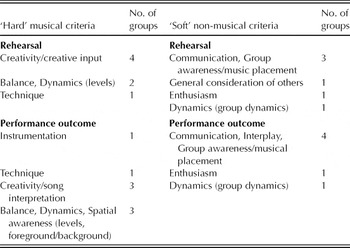
While the four groups each chose three criteria, there are more than 12 criteria in Table 1 for both rehearsal process and performance outcome. This is because, firstly, one student brought ‘balance’ across from the rehearsal process into the performance outcome criteria making four not three; and, secondly, because ‘dynamics’ had several meanings including sound levels but also group dynamics, these are treated separately. When the meaning of a named criterion was unclear, such as ‘special awareness’, the explanations given by students in the group were used to clarify – in this case a misspelling of ‘spatial awareness’.
Criteria chosen for assessing rock group rehearsal and performance

Criteria chosen for assessing rock group rehearsal and performance
In the rehearsal process, the criteria ‘creativity’, and in the performance outcome ‘communication’ were chosen by all groups. ‘Communication’ was also important in the rehearsal process, and ‘creativity’ and issues of dynamic ‘balance’ were important in the performance outcome for three groups. Two groups chose the same criteria for assessment of rehearsal process and performance outcome. One group chose ‘enthusiasm’ for both assessment tasks and named other criteria which often covered similar issues. Overall, the criteria chosen for both rehearsal and performance were fairly evenly grouped as soft and hard (see Table 1).
Student explanations of the criteria chosen and given – rehearsal process
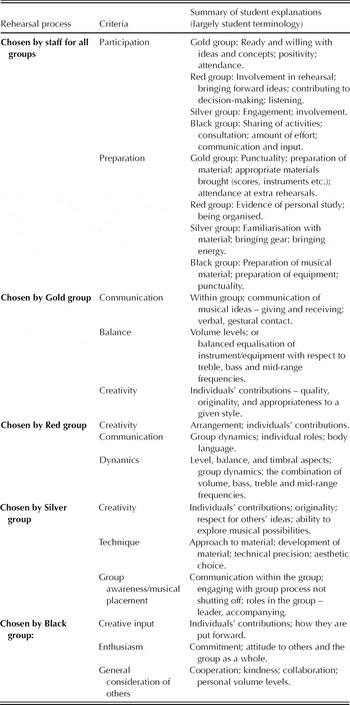
From the participants’ individual explanations of all criteria chosen (by students and staff), several different interpretations of such terms as ‘participation’ emerged revealing many other aspects valued for the assessment process (see Tables 2 and 3). In the rehearsal process the staff-designated ‘participation’ embraced attitude (‘positive input’ M2GoldFootnote 2) and effort, contribution of ideas, attendance, decision-making, listening and sharing. Explanations of ‘preparation’ included the familiar list of practical expectations – ‘knowing your “part” in the piece and displaying out-of-class practice’ (F1Red), but also bringing energy to the rehearsal. ‘Communication’ in the rehearsal embraced attitude (‘do they engage with the group process or shut themselves off?’ M3Silver), and group roles – leadership, accompanying, musical communication through words, gestures, body language, and communication of musical ideas. ‘Creativity’ included each individual's contribution, issues of quality and originality and appropriateness to style, how ideas were put forward plus attitude to the creativity of others. ‘Dynamics’ drew on four meanings – group dynamics, a social psychology term introduced in lectures; the dynamics of the balanced instrument/equipment with respect to treble, bass and mid-range frequencies of the sound being produced; balance between players; and also timbral balance. Within criteria which did and did not overtly indicate personal attributes, several personal issues emerged including kindness, respect and cooperation.
Student explanations of given and chosen assessment criteria – rehearsal process

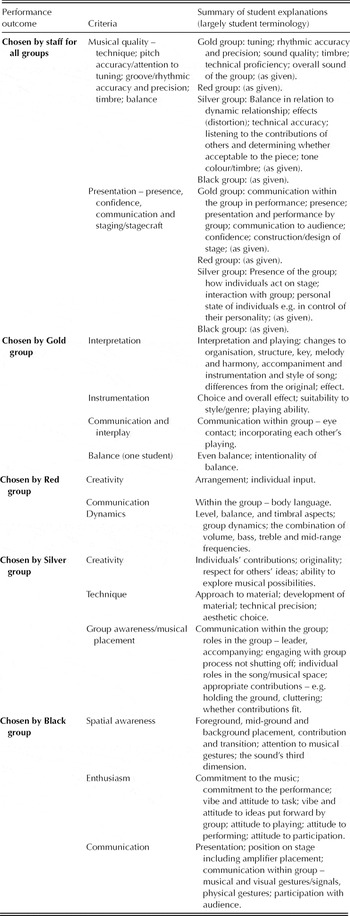
Student explanations of given and chosen assessment criteria – performance outcome

Student explanations of the criteria chosen and given – performance outcome
In the performance outcome (Table 3), the staff-designated criteria of ‘musical quality’ came loaded with skills issues. In each group these were accepted ‘as is’ by some students, but for others issues of sound quality, effects (‘distortion could phase out an acoustic guitar’ F1Silver), listening to the contributions of others and making judgements were included. ‘Presentation’ drew out some issues raised in the rehearsal process under ‘communication’, but focused on communication within the group. ‘Communication’ was also focused largely within the group with stage design and placement of gear a practical addition. Communicating to the audience was raised once each under these last two criteria. ‘Balance’ covered ‘how well players place themselves in the foreground, mid-ground and background’ (M1Black), and when appropriate, ‘to contribute to and transition between [them]’ (M2Black). This is an appreciative skill which requires a fine listening and playing combination to achieve an effective ‘spectrum and the sound[’]s third dimension’ (M3Black).
Categorising the assessment issues
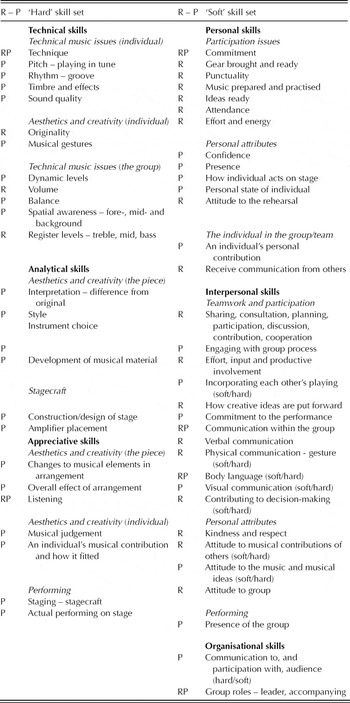
Assessment issues drawn from named criteria and individual student explanations of the given and chosen criteria were then categorised as hard or soft in relation to Birkett's taxonomy, plus his sub-groupings within these two categories (see Table 4). In doing this, however, readers are reminded of the quote from Strauss and Corbin given earlier in the paper, regarding how changing circumstances and actions mean that many of the issues could be listed under one or more headings. The table also sorts the issues into areas of focus such as technical, personal attributes, aesthetics and creativity within Birkett's taxonomy categories.
Assessment issues in rehearsal (R) and performance (P) drawn from named criteria and individual participants’ explanations of the given and chosen criteria categorised according to Birkett's taxonomy

When choosing criteria for performance, a greater emphasis was placed on hard skill issues, with only ‘technique’ and ‘listening’ considered important for both rehearsal and performance assessment. In the hard skill-set, three areas of focus were identified: technical skills of the individual, technical skills of the group, plus two aesthetic and creativity issues. ‘Technical skills’ of the individual focused on the expected technical music issues of the individual's playing ability, playing in tune and in time, plus their sound quality, timbre and use of effects. For the group's technical music skills, several balance dimensions including dynamic level, electronic volume level, register balance and foreground/background balance were identified. Students had a strong sense of the individual's aesthetic judgement and creativity skills, in particular the ability to create musical gestures and originality. ‘Analytical skills’ identified the same three areas but with a different emphasis. Interpretation, style, instrument choice and development of musical material all involve aesthetic and creative choice by the group. Listening responds to all of the technical music issues but also the aesthetic and creative decisions. Construction and design of stage, and placement of equipment in performance has aesthetic and practical ramifications. ‘Appreciative skills’ focused on aesthetics and creativity of the individual. Listening holistically to the piece broadened the analytical skills of style, interpretation and choice of instrument and material into considerations of changes to musical elements in the arrangement, individual contributions, musical judgement and the overall effect. Similarly, the stage issues included a broader sense of staging and stagecraft, and performing itself.
Issues important in the rehearsal process drew heavily on the soft skill set. Again, three areas of focus were identified: participation, personal attributes, and the team or group. ‘Personal skills’ of participation included such basic issues as coming on time, bringing equipment and having musical ideas ready. How the individual behaves received much attention including attitude to the rehearsal, confidence, personal state, presence and how they behave on stage. The individual within the group needs to make a personal contribution and know how to receive communication from others. ‘Interpersonal skills’, referenced by all groups, emphasised the importance of teamwork and participation through sharing, discussing, contributing, engaging with the group process, putting in effort, and communicating well within the group on a person to person level. Through reference to interpersonal skills specific to the music group environment (soft/hard combinations), students noted how creative ideas were put forward, the level of commitment to the performance, and how musical communication occurred within the group, whether visual, body language or gesture. Controlling personal attributes within the group focused on attitude to the group, to musical contributions of others and the musical ideas themselves being put forward, another soft/hard combination, and in performance, the presence of the group as a whole was identified as an important issue. Being aware of roles in the group, and how the group communicated to the audience (a hard/soft combination), are ‘organisational skills’.
Conclusions and discussion
Issues students consider important
Issues tertiary student rock performers consider so important that they identify them as criteria for peer and self assessment, focused more on the soft skill set in the rehearsal process, an emphasis reflected in Pulman's (2009) findings, with ‘interpersonal’ skills receiving most attention. The focus was on the ‘hard’ skill set in the performance outcome, an emphasis noted in studies of classical music (Stanley et al., Reference STANLEY, BROOKER and GILBERT2002; Hunter & Russ, Reference HUNTER and RUSS1996), with ‘technical skills’ receiving the stronger emphasis. This was despite being given criteria, by staff, which addressed non-musical issues of participation and preparation in the rehearsal, and musical and non-musical issues of musical quality and presentation in the performance outcome. None of Davidson and King's (2004) rehearsal strategies, drawn from observations of classical musicians warming up together, such as ways of approaching individual pieces through long and short segments, or run-throughs, were raised by students probably because rock groups use different rehearsal strategies. All groups named criteria which drew from both hard and soft skills sets, emphasising ‘creativity’ and ‘communication’ in the rehearsal process, and ‘communication’, ‘creativity’ and issues of dynamic ‘balance’ in the performance outcome. In the student explanations of their chosen criteria a myriad of further issues emerged, and despite different terminology and wording, many of these reflected issues raised in the literature. Not mentioned in the literature were several issues more pertinent to rock than classical music. These included interpretation/difference from the original, instrument choice, stage construction and placement of equipment, several dimensions of ‘balance’ and attitude to others, to the group, the music and to self.
Emphases in the category sub-sets
The assessment issues which arose in rehearsal and performance (see Table 4), changed emphasis within each of Birkett's sub-sets. In the hard skill-set, ‘technical skills’ focused on technical music issues for the individual and the group, while ‘analytical skills’ focused on aesthetic and creativity issues, continuing in ‘appreciative skills’. In the soft skill-set, ‘personal skills’ focused most strongly on participation issues and personal attributes; ‘interpersonal skills’ on teamwork and participation issues.
Implications for students and staff
Whether criteria chosen and the explanations given of them constitute soft or hard skills, or combined soft/hard skills, the fact that they were chosen and described by students, and are therefore highly valued by them, has implications for both staff and students. Allowing tertiary students to choose criteria for peer group assessment is one of the horizontal rather than the more common vertical ‘feedback mechanisms’ (Lebler, Reference LEBLER2007, p. 218) which recognises ‘the students’ expertise’ (p. 218) and draws it into the assessment process. It encourages students to continually assess themselves against their own prior and future performance, their peers, the musical models they are drawing from, and also to ‘assess their peers, and . . . seek assessment from their peers’ (Green, Reference GREEN2002, p. 209). By choosing criteria, students gain an understanding of issues important to the rock group rehearsal process and performance outcome. These include the role of the individual within the group, what Bresler (Reference BRESLER and Espeland2002) describes as ‘a shift of perception . . . from the individual against the community, to a framework where the individual becomes enhanced by interactions with the society’ (p. 54); ways to identify and discuss non-musical issues of respect and teamwork; and the assessment process itself. For students, these understandings are valuable to take into their performing life within and outside the university. It also enables them to take this knowledge into their professional life after the university, enabling them ‘to function effectively in a competitive professional market’ (Blom & Poole, Reference BLOM and POOLE2004, p. 125).
For staff, it increases understanding of how important these issues are to students and raises the challenge of how soft skills can be fairly incorporated into the group music-making assessment process. Rock groups can flounder because of soft skill issues such as unresolvable personality differences or struggles for control; one is less likely to hear of professional rock groups breaking up because the lead guitarist's hard skills are not good enough.
A continuum of soft and hard skills
The range of responses in Table 4 shows staff that the integration of both skills sets in the assessment process produces what many student rock musicians consider something of an ideal. Students and the literature also identified criteria and issues which combine both hard and soft skill qualities and this suggests an expansion of Coll and Zegwaard's distinction of hard and soft-skills sets. A continuum of hard and soft skills presents an understanding for both staff and students of the two poles ranging from soft skills of ‘respect’ and ‘sharing’, through soft/hard combinations such as ‘incorporating each other's playing’ and hard/soft combinations such as ‘communication to the audience’, to hard skills of ‘technique’ and ‘balance’ (see Fig. 1).
A continuum of soft and hard skills

Clarifying multiple meanings
While all four groups chose ‘creativity’ (or ’creative input’) as a criterion, which we define as a hard skill, one member of the Silver group identified what could be seen as a soft skill component as part of this criterion in the form of respect for how ideas were put forward. This is one example of the multiple meanings terms can carry. Ensuring that terms such as ‘communication’, ‘balance’, ‘attitude’ and ‘dynamics’ are clearly understood by those being assessed and those undertaking the assessment makes a fairer assessment process; and defining technical terms also helps students ‘describe the concepts that they were trying to understand’ (Latukefu, Reference LATUKEFU2009).
Inside the rehearsal process
When students choose assessment criteria, staff gain a deeper understanding of what is going on in the privacy of the rehearsal process. Where members of one group have focused on issues of ‘attitude to group’ and ‘personal state of individual’ as assessment issues, members of another have focused on the finer points of ‘spatial awareness’ and the sound's third dimension; the first group may have a difficult member affecting the vibe of the team and holding up progress while for the other group, ‘attitude’ is not an issue, but a spectrum of nuances concerning sound in space is ready to be judged. Student-chosen criteria also indicate what stage each group has achieved during the teaching period. Because of the short time (one semester of 13 weeks) that the students are required to play together in groups, issues of respect and teamwork need to be overcome before a rehearsal strategy can be established. This stage of ‘forming’ (Tuckman, 1965 in Forgas, Reference FORGAS1985) moves onto ‘storming’ then to ‘norming’, before ‘performing’ within a stable pattern of personal relationships and task functions becomes established. Another indication that the groups were in the earlier stages of group formation is that the issue of ‘communication to audience’ was only raised by two students. Instead, ‘communication within the group’, both interpersonal and musical communication, was the primary focus, suggesting that ‘storming’ and ‘norming’ were taking place.
Suggestions for teaching and assessing ‘soft’ skills
There is an implied understanding by students that technical musical skills will only take a musician so far. In order for the rehearsal process of a group, and to a lesser extent, the performance outcome, to proceed productively, the utilisation of soft skills is imperative but these are seldom adequately accounted for when the assessment process is being undertaken. However, these issues are part of any group interaction and if not resolved or discussed, result in the group disbanding. Understanding the range of criteria considered important by tertiary students highlights how each is continually informing and enriching the other in the group rehearsal process and performance outcome. It also raises the issue, for staff, of how to fairly assess soft skills, issues of considerable importance to students, in the tertiary music environment. We suggest five possible stages of including this knowledge in the assessment process: firstly, informing students (through lectures) about the range of soft skills likely to be encountered and required; secondly, asking for student-chosen criteria which will invariably include soft skill issues, thereby raising awareness of their value; thirdly, formalising this valuing by asking students to address these issues through peer and/or self assessment using student- and/or staff-chosen criteria, which include soft, hard and soft/hard skill criteria; fourthly, asking students to allocate a mark for peer and self assessment of the rehearsal process and performance outcome; and finally, including the mark in the final assessment result. The popular music students in Karlsen's (Reference KARLSEN2010) BoomTown Music Education project wrote regular diary entries to investigate their own thinking and their learning and creative processes, another possible approach. We have adopted the first three stages at the University of Western Sydney and are interested in including the fourth and fifth in the future. These stages capitalise on the knowledge students have of the types of issues important to them in their rehearsal and performance process. It makes the assessment of the rehearsal process and performance outcome more directly relevant to them and they understand that assessing music groups is not just about the music.