INTRODUCTION
The common two-banded seabream, Diplodus vulgaris (Geoffroy Saint-Hilaire, 1817) is a demersal species distributed in the Mediterranean and Black Seas and along the eastern Atlantic coast from France to Senegal, including the Madeira, the Azores and the Canaries Archipelagos. It is also present from Angola to South Africa (Bauchot & Hureau, Reference Bauchot, Hureau, Whitehead, Bauchot, Hureau, Nielsen and Tortenese1986, Reference Bauchot, Hureau, Quero, Hureau, Karrer, Post and Saldanha1990). It can be found close to rocky and sandy bottoms to a maximum depth of 160 m. Juveniles often live in coastal lagoons and estuaries (Monteiro, Reference Monteiro1989) and it is considered a resident species in artificial reefs (Santos, Reference Santos1997).
The age, growth, mortality, sex-ratio, spawning season, feeding, size at maturity and fisheries aspects of common two-banded sea bream have been studied in some areas of its distribution: North Atlantic (Erzini et al., Reference Erzini, Gonçalves, Bentes, Lino and Ribeiro1998; Gonçalves & Erzini, 2000; Gonçalves et al., Reference Gonçalves, Bentes, Coelho, Correia, Lino, Monteiro, Ribeiro and Erzini2003; Pajuelo & Lorenzo, Reference Pajuelo and Lorenzo2003; Pajuelo et al., Reference Pajuelo, Lorenzo, Bilbao, Ayza and Ramos2006; Abecasis et al., Reference Abecasis, Bentes, Coelho, Correia, Lino, Monteiro, Gonçalves, Ribeiro and Erzini2008), eastern Atlantic (Dulčić et al., Reference Dulčić, Pallaoro, Matić-Skoko, Dragičević, Tutman, Grgičević, Stagličić, Bukvić, Pavličević, Glamuzina and Kraljević2010), north-western Mediterranean (Rosecchi, Reference Rosecchi1987; Gordoa & Moli, Reference Gordoa and Moli1997) and central Mediterranean (Bradai et al., Reference Bradai, Ghorbel, Jarboui and Bouain1998a, Reference Bradai, Ghorbel, Jarboui and Bouainb; Bradai, Reference Bradai2000; Hadj Taieb, Reference Hadj Taieb2007).
In the Gulf of Gabès, D. vulgaris is of a great commercial interest. It is commonly taken in the small-scale fisheries and is captured all year round with seasonal differences in the landings.
The present study provides more information on the reproductive biology, age structure and growth rates, and estimated natural mortality of this species in the area.
MATERIALS AND METHODS
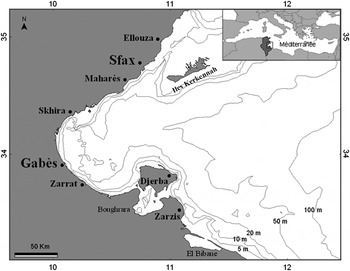
A total of 1097 specimens of D. vulgaris was obtained by a random stratified sampling from commercial catches at different fishing ports of the Gulf of Gabès between March 2008 and February 2010. The Gulf of Gabès is a large area situated on the south-east coastline of Tunisia, spreading over about 750 km from Cape Kapoudia (35th parallel) to the Tunisian–Libyan border (Figure 1). The species is caught currently in the area with lognlines, purse seines, trammel nets and traditional traps called locally “cherfias”: fixed fisheries known in the south of the country and particularly in the Kerkennah Islands where waters are shallow and the tidal range is important. They are formed by vertical V-shaped partitions built by palm leaves whose tip is directed seaward. At the apex of the V we find an entrance hall which leads into a capture chamber giving access to several traps in which fish are trapped by low tide.
Geographical position of the Gulf of Gabès (Tunisia).

For each specimen, the total length (TL) was measured to the nearest mm, total fish weight (TW) and eviscerated fish weight (EW) to the nearest 0.1 g and the weight of the gonads (GW) was recorded to the nearest 0.01 g. Sex and maturity stages were determined macroscopically. Examined specimens were divided following the method of Holden & Raitt (Reference Holden and Raitt1975) into immatures (I), resting (II), ripe (III), ripe and running (IV) and spent (V). Otoliths (sagittae) were removed from 955 specimens, cleaned and stored for reading.
Males ranged from 7 to 24 cm in length (4–200 g in weight) and females ranged from 10 to 25 cm (16–220 g in weight). Hermaphrodites ranged in size from 14 to 18 cm and weighed from 50 to 90 g.
The sex-ratio (number of males to each female; M:F) of the sample population was analysed by size-classes. The spawning period was determined following the monthly changes in the gonadosomatic index (GSI), which was calculated as follows (Anderson & Gutreuter, Reference Anderson, Gutreuter, Nielsen and Jonhnson1983):
 $$\hbox{GSI}=\hbox{GW}^{\ast}100/ \hbox{EW}$$
To estimate size at 50% maturity, a logistic function was fitted to the proportion of the mature individuals by size-class using a non-linear regression (Pauly, Reference Pauly1980).
 $$P=1/\left({1+e^{ - r\lpar L - L_{50} \rpar } } \right)$$
where P is the proportion of fish mature in each size-interval (L); L50 is the length at first maturity; and r the model parameter mean length of the interval.
The relation of total or gutted weight to total length was calculated applying the exponential regression equation (Ricker, Reference Ricker1973):
 $$\hbox{TW}=a\hbox{TL}^{b}$$
where a and b are the parameters to be estimated.
Age was determined by reading otoliths in whole, under a compound binocular microscope at 20× magnification using reflected light while immersed in a solution of glycerine and alcohol. Age estimates were obtained by counting the number of opaque bands from the nucleus to the margin of the otolith. The percentage of otoliths with an opaque margin was calculated for each month to determine the periodicity and timing of ring formation. This method allowed the annual formation of the rings to be determined; once the rings were confirmed to be annual, the age of each fish was determined and assigned to a year-class, taking into account the date of capture, the ring formation period, and the reproductive biology of the species in the area (Morales-Nin, Reference Morales-Nin1987).
The von Bertalanffy growth curve was fitted to the observed length at age data of the resulting age–length key by means of a Marquardt's algorithm for non-linear least-squares parameter estimation (Saila et al., Reference Saila, Recksiek and Prager1988). The form of the growth curve is (Beverton & Holt, Reference Beverton and Holt1957):
 $${\rm L}_{\rm t}=\hbox{L}_\infty \lpar 1-{\rm e}^{-{\rm k} \lpar {\rm t}-{\rm t}0\rpar }\rpar $$
where Lt is the fish length at age t (year), L∞ the theoretical asymptotic length, k the growth rate coefficient, and t0 the theoretical age when fish length is zero.
We have determined, through a direct calculation method (Jabeur, Reference Jabeur1999), the age for each fish length at the moment of capture. In this calculation, we considered the spawning period, the annual deposition period of the ring of growth cessation as well as the date of capture of the individual considered.
Natural mortality (M) was estimated using different classical methods:
 $$\hbox{M}=\lpar 2.996^{\ast} \hbox{K}\rpar / \lpar 2.996+\lpar \hbox{K}^{\ast} {\rm t}_{0}\rpar \rpar \ \lpar \hbox{Taylor }1959\rpar $$
 $$\hbox{Log M}=-0.0066 - 0.279\hbox{ log L}_{\infty}+0.6543\hbox{ log K}+0.4634\hbox{ log T }\lpar \hbox{Pauly }1980\rpar $$
 $$\hbox{Log M}=0.736 - 0.114\hbox{ log L}_{\infty}+0.522\hbox{ log K} - \!0.583\hbox{ log T }\lpar \hbox{Djbali }et \;al.,\hbox{1993}\rpar $$
where k, t0 and L∞ are the parameters of the Von Bertalanffy equation. T is the annual mean water temperature value, which was 22.86°C for the given sampling area (Hannachi, Reference Hannachi2010).
RESULTS
Of the fish examined, 628 were male, 378 were female and 14 were hermaphrodites. The sex of the remaining 77 fish could not be determined macroscopically.
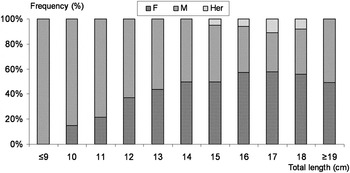
The overall female:male ratio (F:M = 1:1.66) was biased in favour of males; it is significantly different from a balanced ratio (1:1) (χ2 = 62.127 > χ2t 1,0.05 = 3.84). Sex-ratios between males and females by size-class were also significantly different from the 1:1 ratio (χ2 > χ2t 1,0.05 = 3.84) for most size-classes, except for 12–13 cm size groups. Males predominated in smaller size-classes and females in larger ones (Figure 2). Hermaphrodites, ranging in medium size-classes, represented 1.3 % of the specimens examined.
Sex-ratio by size of Diplodus vulgaris of the Gulf of Gabès.

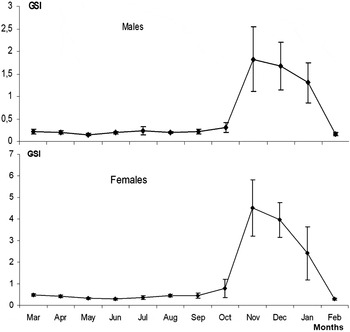
The GSI values were usually higher in females than in males, but they followed the same seasonal pattern (Figure 3). The active period of ovaries extended from September to February. The spawning period would be between November and February.
Monthly change in the gonadosomatic index (GSI) for males and females of Diplodus vulgaris of the Gulf of Gabès.

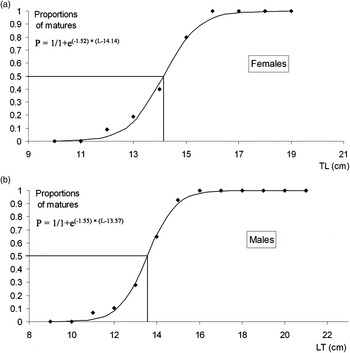
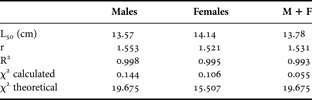
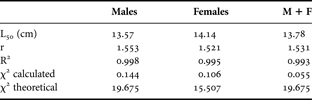
L50% was estimated to be 14.14 ± 0.16 for females and 13.57 ± 0.01 cm for males (Table 1; Figure 4). All parameters of the sexual maturity were given in Table 4.
Maturity ogive of females and males of Diplodus vulgaris in the Gulf of Gabès.

Parameters of the maturity ogive (P = 1/(1 + e −r(L–L 50))) for male, female and sex combined of Diplodus vulgaris from the Gulf of Gabès.
Length–weight relationship parameters for males, females and the two sexes considered together are presented in Table 2. Negative allometric growth was observed for males, females and sex combined (Table 2). Significant difference in the allometric coefficient was found between males and females (t-test, t = 5 > t 0.05,1006 = 1.962).
Length–weight relationship (TW = aTLb) for male, female and sex combined of Diplodus vulgaris from the Gulf of Gabès.

The growth rings on otolith were clear when the otoliths were covered with glycerine, and 54% were readable.
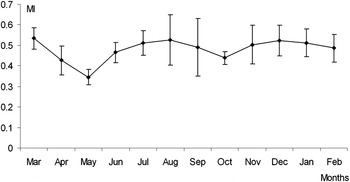
Marginal increment analysis showed that a single annulus was formed during May each year (Figure 5).
Monthly evolution of the marginal increment of otoliths of Diplodus vulgaris of the Gulf of Gabès.

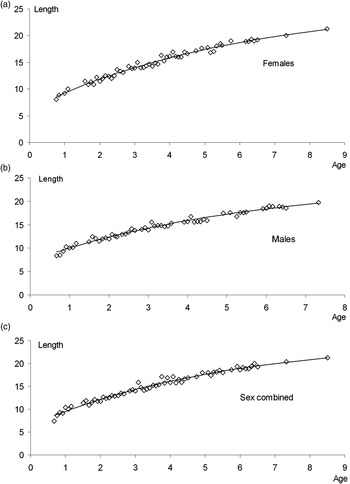
The estimated absolute age at length of the fish are reported in Figure 6.
Estimated absolute age at length for females, males and all individuals of the two banded seabream in the Gulf of Gabès, Tunisia, sampled between March 2008 and February 2010.

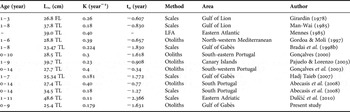
Males were aged from 0+ and 7+ years, and females from 0+ and 8+ years (Figure 6). The parameters of the Von Bertalanffy growth equation for males, females and all individuals are given in Table 3.
Estimated parameters of the Von Bertalanffy growth equation for Diplodus vulgaris in different areas.

LFA, length frequency analysis; FL, fork length; TL, total length.
The estimated natural mortality by the three methods (Taylor, Pauly and Djabali) were respectively 0.20, 0.55 and 0.25 year−1. The mean instantaneous rate of natural mortality was: M = 0.33 year−1.
DISCUSSION
Diplodus vulgaris is hermaphroditic (Gonçalves & Erzini, Reference Gonçalves and Erzini2000). This characteristic, which is common among sparids (Alekseev, Reference Alekseev1982; Buxton & Garratt, Reference Buxton and Garratt1990), has also been observed for this species in the Gulf of Gabès (present study) and in other areas (D'Ancona, 1950; El Maghraby, Reference El-Maghraby, Botoros, Hashem and Wassef1981).
The presence of individuals with well-formed ovaries and residues of degenerated testes and the predominance of males at smaller sizes confirms that it is a protandric hermaphrodite. This characteristic has been documented for this species in the Mediterranean (Man-Wai, Reference Man-Wai1985; Gordoa & Moli, Reference Gordoa and Moli1997). Sex reversal was accompanied by resorption and restructuring of the testicular tissue and subsequent resurgence of the ovarian tissue.
The size–sex structure is mainly determined by the nature of the sex change. The sex-ratio in the samples favoured males. The predominance of males has been observed in samples from elsewhere in the Mediterranean (Man-Wai, Reference Man-Wai1985).
Analysis of the GSI together with maturity stage data suggest that the spawning period took place from November to February, when the sea temperature is low. Our data showed a more prolonged spawning period than in other Mediterranean areas (Kentouri & Divanch, Reference Kentouri and Divanach1982; Quéro, Reference Quéro1984; Man-Wai, Reference Man-Wai1985; Bauchot & Hureau, Reference Bauchot, Hureau, Whitehead, Bauchot, Hureau, Nielsen and Tortenese1986; Ried, 1986; Fischer et al., 1987).
The differences observed in sexual maturity between the sexes may be explained adequately by protandry. Fish attain maturity between the second and the third years of life. Dulčić et al. (Reference Dulčić, Pallaoro, Matić-Skoko, Dragičević, Tutman, Grgičević, Stagličić, Bukvić, Pavličević, Glamuzina and Kraljević2010) pointed out that this species also attains sexual maturity at the age of 2–3 years in the eastern Adriatic Sea.
The length–weight relationship reveals that females are heavier than males at a given length. This may also be explained by protandry, because males predominated in smaller size-classes and females in larger ones. Also, weight increases negatively with length for the two sexes. Similar results have been reported from other areas (Gordoa & Moli, Reference Gordoa and Moli1997).
The monthly evolution of the marginal increment showed which was lower in May and which corresponded to the growth judgment.
The oldest fish was 9 years old in the Gulf of Gabès, 8 in Gulf of Lion (Man-Wai, Reference Man-Wai1985), 4 in Spain (Gordoa & Moli, Reference Gordoa and Moli1997) and 11 in Croatia (Dulčić et al., Reference Dulčić, Pallaoro, Matić-Skoko, Dragičević, Tutman, Grgičević, Stagličić, Bukvić, Pavličević, Glamuzina and Kraljević2010).
The observed difference in mean length at age between the sexes is characteristic of protandric species.
Therefore, differences in length between males and females of the same age cannot be considered as evidence of intersexual difference in growth rates because females and males are the same individuals at different phases of sexual succession and, possibly, the largest males in an age group are the first to change sex.
The theoretical maximal length value (L∞ = 25.4 cm) was close to the size of the largest fish examined. This parameter is similar to those reported by Bradai et al. (Reference Bradai, Ghorbel, Jarboui and Bouain1998b), Gonçalves (Reference Gonçalves2000), Gonçalves et al. (Reference Gonçalves, Bentes, Coelho, Correia, Lino, Monteiro, Ribeiro and Erzini2003), Hadj Taieb (Reference Hadj Taieb2007) and Abecasis et al. (Reference Abecasis, Bentes, Coelho, Correia, Lino, Monteiro, Gonçalves, Ribeiro and Erzini2008). However, it differs from those obtained by Man-Wai (Reference Man-Wai1985), Mennes (Reference Mennes1985), Pajuelo & Lorenzo (Reference Pajuelo and Lorenzo2003) and Dulčić et al. (Reference Dulčić, Pallaoro, Matić-Skoko, Dragičević, Tutman, Grgičević, Stagličić, Bukvić, Pavličević, Glamuzina and Kraljević2010) (Table 3). The growth coefficient value (k = 0.179 year-1) indicated that relatively low attainment of maximal size is similar to those reported by Bradai et al. (Reference Bradai, Ghorbel, Jarboui and Bouain1998b), Man-Wai (Reference Man-Wai1985), Hadj Taieb (Reference Hadj Taieb2007) and Abecasis et al. (Reference Abecasis, Bentes, Coelho, Correia, Lino, Monteiro, Gonçalves, Ribeiro and Erzini2008). But, it differs from those obtained by Girardin (Reference Girardin1978), Mennes (Reference Mennes1985), Gonçalves et al. (Reference Gonçalves, Bentes, Coelho, Correia, Lino, Monteiro, Ribeiro and Erzini2003) and Dulčić et al. (Reference Dulčić, Pallaoro, Matić-Skoko, Dragičević, Tutman, Grgičević, Stagličić, Bukvić, Pavličević, Glamuzina and Kraljević2010) (Table 3). The differences in growth between regions can be attributed to the difference in the size of the largest individual sampled in each area. The largest fish were found in the studies conducted by Mennes (Reference Mennes1985), Pajuelo & Lorenzo (Reference Pajuelo and Lorenzo2003) and Dulčić et al. (Reference Dulčić, Pallaoro, Matić-Skoko, Dragičević, Tutman, Grgičević, Stagličić, Bukvić, Pavličević, Glamuzina and Kraljević2010).
The natural mortality of D. vulgaris in the area of study varied between 0.20 and 0.55, indicating that values for the common two-banded seabream are within the reported range characterizing average natural mortality. Values of natural mortality (M = 0.753) obtained by Gonçalves et al. (Reference Gonçalves, Bentes, Coelho, Correia, Lino, Monteiro, Ribeiro and Erzini2003) and (M = 0.66, for the north-western African coast) obtained by Mennes (Reference Mennes1985) were greater the values obtained in this study, but two estimates (M = 0.36 and M = 0.26) by Erzini et al. (Reference Erzini, Bentes, Coelho, Correia, Lino, Monteiro, Ribeiro and Gonçalves2001) and Dulčić et al. (Reference Dulčić, Pallaoro, Matić-Skoko, Dragičević, Tutman, Grgičević, Stagličić, Bukvić, Pavličević, Glamuzina and Kraljević2010) successively were similar to ours. The estimated range of values of M obtained is very similar to that reported for other sparids off the Gulf of Gabès with similar life history characteristics to those of Pagellus erythrinus (Ghorbel et al., Reference Ghorbel, Jarboui and Bouain1997) and Diplodus annularis (Bradai, Reference Bradai2000).
ACKNOWLEDGEMENTS
Special thanks to the technical and supporting staff of INSTM (Centre de Sfax) for their practical assistance in laboratory analysis. We thank Nabil Kallel, an English teacher at the Faculty of Sciences (Sfax), for proofreading our manuscript.