Introduction
According to meta-analyses, memory is perhaps the most severely impaired cognitive function in schizophrenia (Heinrichs & Zakzanis, Reference Heinrichs and Zakzanis1998; Aleman et al. Reference Aleman, Hijman, de Haan and Kahn1999) that, in contrast to early claims by Bleuler (Reference Bleuler1911), is not fully accounted for by attentional difficulties (Moritz et al. Reference Moritz, Heeren, Andresen and Krausz2001). In addition to diminished memory accuracy, which is mainly associated with depression and negative symptomatology (Brébion et al. Reference Brébion, Amador, Smith, Sharif and Gorman2000), a number of metamemory dysfunctions have been described that relate to more qualitative aspects of recollection. Apart from poor vividness of recollection (Huron et al. Reference Huron, Danion, Giacomoni, Grengé, Robert and Rizzo1995; Danion et al. Reference Danion, Rizzo and Bruant1999, Reference Danion, Kazes, Huron and Karchouni2003), multiple studies have indicated that patients with schizophrenia display overconfidence in errors, while at the same time being less confident in correct responses (Moritz et al. Reference Moritz, Woodward and Ruff2003, Reference Moritz, Woodward, Whitman and Cuttler2005b, Reference Moritz, Woodward and Rodriguez-Raecke2006b; Moritz & Woodward, Reference Moritz and Woodward2006a). In a recent study this twofold response pattern, termed reduced ‘confidence gap’, discriminated schizophrenia patients from both healthy and psychiatric controls, whereas indices of memory accuracy failed to yield significant differences between psychiatric groups (Moritz & Woodward, Reference Moritz and Woodward2006a).
Memory confidence is a central aspect of metacognition, the latter encompassing various aspect of cognitive self-reflection (‘thinking about one's thinking’). Metacognitive skills are important for navigation in the social environment. To illustrate, false memories, or other forms of erroneous responses, may not be momentous when, as in the case of healthy subjects, these are tagged as ‘not trustworthy’. Under these circumstances, doubt will prevent decisive actions. However, overconfidence in false memories (or in any memory errors), as is displayed by schizophrenia patients, may produce dramatic consequences, particularly if valid memories that might mitigate the influence of false recollections are not as clearly recalled and/or do not have sufficient influence over current processing (Woodward et al. Reference Woodward, Moritz, Arnold, Cuttler, Whitman and Lindsay2006a). Importantly, overconfidence in errors has been repeatedly demonstrated in patients with schizophrenia in acute and remitted stages (for a review see Moritz & Woodward, Reference Moritz and Woodward2006b), with delusion-neutral scenarios, and thus represents a risk factor for delusions and other forms of positive symptoms rather than a consequence.
We have proposed (Moritz & Woodward, Reference Moritz and Woodward2004) that a decreased confidence gap may result from liberal acceptance (LA)Footnote †: patients with schizophrenia collect little evidence before arriving at strong judgements (i.e. considering options as valid response candidates). Put differently, patients are satisfied with incomplete information, which makes them prone to high-confident false judgements because incompatible information that may decrease confidence is more easily overlooked. Conversely, a more thorough search (such as that carried out by healthy subjects) largely increases the likelihood of (a) finding valid cues and thus arriving at correct judgements and (b) decreasing confidence when the decision-making process fails to accumulate sufficient supporting evidence. Hence, errors may still occur in healthy subjects, but high confidence in those errors is typically held in check, and behaviour based on those errors is less likely to occur. Importantly, LA is seen as a core deficit that is not only expressed in delusion-relevant scenarios (e.g. a look by a passing stranger on the street is misinterpreted as an indication of surveillance) but also has been confirmed in neutral settings such as interpretations of complex pictures (Moritz & Woodward, Reference Moritz and Woodward2004; Woodward et al. Reference Woodward, Moritz, Cuttler and Whitman2006b).
Further support for the LA account comes from a recent study involving a task similar to the ‘Who wants to be a millionaire?’ TV game show (Moritz et al. Reference Moritz, Woodward and Hausmann2006a). Healthy and schizophrenia participants were asked to rate the probability of each of four response alternatives to general knowledge questions: for example, ‘How many fingers does Mickey Mouse have?’ (10, 12, 8, 6); ‘What is the most frequent cause of death in Australia?’ (shark attacks, skin cancer, stroke, heart failure). Probability ratings were obligatory, but participants were free to decide on one of the response options, or to exclude one or more. This procedure allowed determination of subjective decision thresholds. In line with the LA account, patients arrived at decisions at much lower internal subjective probability ratings than healthy controls (Moritz & Woodward, Reference Moritz and Woodward2005). Healthy subjects made decisions at approximately 70% subjective probability whereas the corresponding rate in patients was 54%.
If patients are guided by rapidly accessed and superficial evidence, then differences between healthy controls and schizophrenia patients should be particularly pronounced for distractor items with weak to medium validity (e.g. weak resemblance to targets), such that patients would accept the distractors when controls would reject them. Thus, superficial relatedness may more easily lure patients into confidently accepting distracters as targets. By contrast, strong suggestive evidence (e.g. when distrators match the target on multiple aspects) may elicit a comparable degree of high-confident false memories in both schizophrenia patients and healthy subjects, as has been shown previously (Huron & Danion, Reference Huron and Danion2002; Elvevåg et al. Reference Elvevåg, Fisher, Weickert, Weinberger and Goldberg2004; Moritz et al. Reference Moritz, Woodward, Cuttler, Whitman and Watson2004). In this case the amount of evidence for accepting passes the more conservative acceptance threshold of healthy subjects.
To test this assumption directly, a visual memory test was developed with graded lure ‘temptingness’. The most pronounced group differences were expected for lure items where only one or two out of four visual attributes (i.e. shape, symbol, colour and position) matched the target. In the strong lure condition, the lure items matched the corresponding targets on three out of four visual attributes (e.g. the distractor and target matched on shape, colour and position but not symbol), while the mismatched attribute appeared (at encoding) in another target configuration (plausible lure). In another condition, the mismatched attribute was novel and thus would be more likely to be detected by a thorough analysis (i.e. a symbol, shape, position or colour not used for other targets). It was expected that the latter novel lure condition would elicit greater group differences than the strong lure condition because of the more thorough data gathering processes carried out by healthy participants.
Method
Subject recruitment
Sixty-eight patients who met criteria for either schizophrenia (ICD-10, F20) or schizo-affective disorder (ICD-10, F25), determined by the Neuropsychiatric Interview (Sheehan et al. Reference Sheehan, Lecrubier, Sheehan, Amorim, Janavs, Weiller, Hergueta, Baker and Dunbar1998) and chart review, were recruited from the University Medical Centre Hamburg-Eppendorf and the University Hospital of Heidelberg [age in years: mean=33.94, s.d.=10.45; gender: 39 male, 29 female; years of school: mean=11.66, s.d.=1.82; previous admissions: mean=3.42, s.d.=3.10; pre-morbid intelligence (IQ) as assessed with a vocabulary test (Lehrl, Reference Lehrl1995): mean=109, s.d.=14]. The Positive and Negative Syndrome Scale (PANSS; Kay et al. Reference Kay, Opler and Lindenmayer1989) was administered to assess the severity of schizophrenia symptoms (mean=62.24, s.d.=18.37). Exclusion criteria were as follows: a co-morbid substance dependency disorder, bipolar disorder, and macroscopic brain damage (e.g. stroke). Twenty-five participants recruited from the community served as healthy controls (age in years: mean=32.04, s.d.=10.23; gender: 10 male, 15 female; years of school: mean=12.04, s.d.=1.52; pre-morbid intelligence: meanIQ=115, s.d.=15). Absence of mental illness in healthy subjects was also verified with the Neuropsychiatric Interview.
Experiment
Participants were individually tested in a quiet room. A computerized memory task that was constructed with Superlab® Pro for Macintosh was administered. At encoding, participants were shown eight complex targets that represented a unique combination of the following four aspects: shape (attributes: circle, oval horizontal, oval vertical, D-shaped figure, square, diamond, triangle, hexagon), symbol (attributes: X, Z, Y, K, D, C, O, U), colour (attributes: red, green, blue, yellow, black, white, grey, brown), and position (i.e. locations corresponding to the digit positions on a conventional clock, excluding the 3, 6, 9 and 12 o'clock positions). None of the combinations of the eight target configurations overlapped; that is, no specific attribute was used on two targets. Prior to the experimental session, subjects were acquainted with the encoding and recognition task by means of a practice item that did not reappear over the course of the trial.
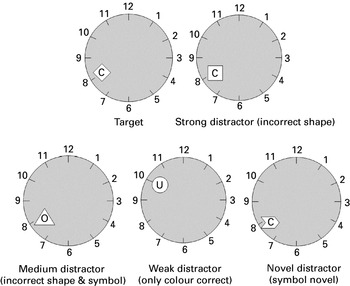
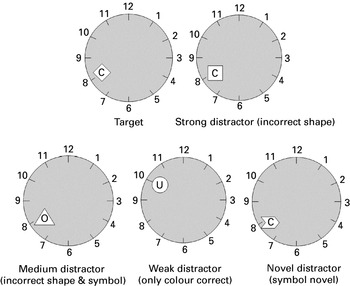
At encoding, each item was displayed, in random order, for 5 s. At recognition, which was initiated immediately after termination of the encoding phase, subjects were presented with 40 stimuli in random order that were of the following item types (an example for each item type is displayed in Fig. 1; each distractor item was medium, strong or novel relative to its corresponding target and did not share resemblance with other targets):
(1) targets: eight previously studied items (i.e. recognition item matched target on all four attributes);
(2) strong distractors: each of the eight new items matched one of the eight targets on three attributes, with the mismatched attribute appearing on another target (i.e. either colour, shape, symbol or position);
(3) medium distractors: each of the eight new items matched one of the eight targets on two attributes, with the two mismatched attributes appearing on any of the other targets (e.g. colour, position, shape or symbol);
(4) weak distractors: each of the eight new items shared only one attribute with each of the eight studied items (i.e. all attributes appeared uncombined in other targets)
(5) novel attribute distractor: same as item type 2 but the mismatched attribute was completely novel [e.g. new colour (e.g. light blue or orange), shape (e.g. flag- or arrow-shaped figures), symbol (e.g. M or N) or position (e.g. 3 or 9 o'clock positions)].
At recognition, participants were requested to indicate by button press on a six-point scale if they thought that an item was old or new, graded by confidence (button 1=100% old, 2=rather sure old, 3=unsure old, 4=unsure new, 5=rather sure new, 6=100% new). Labels on the computer screen (e.g. ‘1=100% old’) corresponded to computer buttons (1–6). Thus, subjects did not have to actively memorize any of the assignments. It was emphasized that subjects should rate a figure as new even if only one aspect differed from the target figures; that is, that the task was to rate equality between encoding and recognition items and not the degree of resemblance. The duration of the recognition session was between 10 and 15 min.
Stimulus samples for the five different conditions. For display purposes we chose non-coloured objects.
Results
Background variables
Groups did not differ on any major sociodemographic background variable (age, gender, years of school education, pre-morbid intelligence; p>0.1). Gender distribution was not fully balanced; therefore, we entered gender as an additional factor in subsequent analyses. This did not yield any significant differences, and is therefore not included in the analyses reported below.
Memory accuracy and metamemory
A two-way mixed ANOVA was conducted with group (schizophrenia, healthy) as the between-subject and resemblance-to-target (target, strong distractor, medium distractor, weak distractor) as the within-subject factor. Recognition responses (1=100% old – 6=100% new) served as the dependent variable.
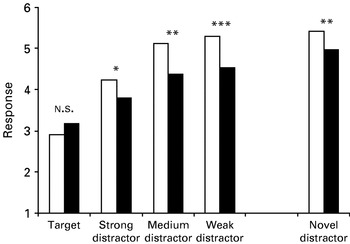
The group factor achieved significance [F(1, 91)=11.87, p=0.001], reflecting a higher rate of high-confident ‘old’ responses in patients. The resemblance-to-target factor [F(3, 271)=115.79, p<0.001] was highly significant. As expected, both groups gave higher ratings (i.e. more in the direction of 100% new) the less the recognition items resembled the targets. These significant group effects were qualified by a highly significant group×resemblance-to-target interaction [F(3, 273)=9.48, p<0.001]; the excess of high-confident false memories in patients versus controls was particularly strong for weak and medium-related items, as evidenced by a highly significant linear trend [F(1, 91)=17.69, p<0.001; see Fig. 2].
Responses across conditions. Responses ranged from 100% old (=1) to 100% new (=6) and are displayed on the y axis. The weaker the target–distractor resemblance the stronger the group differences, as evidenced by a significant interaction of group×condition (see text). As expected, group differences were stronger for the distractor condition with a novel lure aspect than for the strong distractor condition (see also Table 1). ■, Schizophrenia; □, healthy controls.
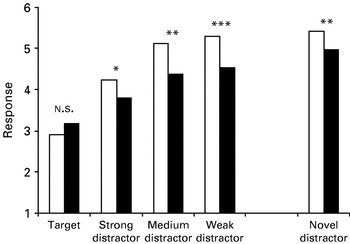
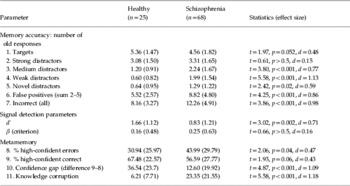
With respect to the number of false positives, in line with our prediction the novel attribute distractor condition was a more potent discriminator of groups than the strong distractor condition (see Table 1). Items from both the strong and novel conditions shared three attributes with the targets, but the novel lures were more easily detected by the healthy controls.
Group differences on recognition: memory accuracy and metamemory parameters
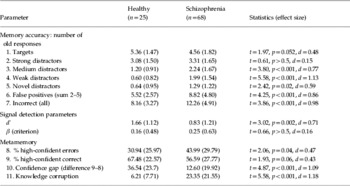
Ratings 1–3 are considered ‘old’, ratings 4–6 are considered ‘new’.
We computed the percentage of responses made with high confidence for correct and incorrect responses separately. The difference between the two scores, the confidence gap, differed significantly between groups, particularly because of significant overconfidence in errors (see Table 1). The knowledge corruption index (percentage of high-confident responses that were errors; that is, subjective but false knowledge) also demonstrated a significant difference between groups. The latter index yielded the highest effect size for the between-groups comparison for all measures in the study (see Table 1).
The signal detection parameter d′ differed significantly between the groups. However, β (criterion) was not significantly different between groups, suggesting that patients with schizophrenia did not display a generally enhanced overall tendency to respond ‘old’ versus ‘new’ (see Table 1).
To explore whether variance due to metamemory is independent from that due to memory accuracy, we correlated the confidence gap with false recognition and correct responses, but none of these reached significance (all r's <0.36, p>0.05).
Relationship of experimental parameters with psychopathology and medication
Few differences emerged when we split the schizophrenia sample into high and low scorers (cut-off: 3) for four cardinal symptoms [persecutory delusions, positive item 6 on the Positive and Negative Syndrome Scale (PANSS), present in n=34; hallucinations, PANSS positive item 3, present in n=17; formal thought disorder, PANSS positive item 2, present in n=24; flat affect, PANSS negative item 1, present in n=33]. Patients with flat affect and those with formal thought disorder recognized fewer target items correctly at trend level (p<0.1), while patients with flat affect committed fewer false-positive errors for medium-related items (p=0.04). Hallucinations and persecutory delusions did not differ on any of the memory accuracy and metamemory parameters (p>0.1; all parameters shown in Table 1 and Fig. 1 were entered). Correlations with PANSS negative and positive scores also yielded non-significant results. Chlorpromazine equivalent dosage (as determined by guidelines from Benkert & Hippius, Reference Benkert and Hippius2003) was inversely correlated with the number of high-confident responses (r=−0.27, p<0.05; neuroleptic dosage was documented for only 55 participants), which was marginally significant when PANSS positive symptoms were controlled for (p=0.06). Sociodemographic background variables as well as indexes of executive functioning (Trail-Making Test B), the latter being only available for patients, also did not correlate with metamemory indexes (p>0.1).
Discussion
The aim of the present study was to test a specific assumption of the LA theory of schizophrenia: patients are more prone than controls to accept and falsely recognize weak lures, but do not differ from controls in their tendency to accept strong lures. In other words, little evidence and a mere sense of familiarity justify acceptance, which has been discussed as a risk factor for the emergence of positive symptoms (Weiss et al. Reference Weiss, Dodson, Goff, Schacter and Heckers2002; Moritz & Woodward, Reference Moritz and Woodward2006b). LA explains not only enhanced false memories for weak lures but also deviances on metamemory, particularly memory confidence. As healthy people search the available evidence more thoroughly before making a judgement, higher confidence is associated with correct responses, and more doubt is imposed on incorrect responses, because in the latter situation, cues are insufficient for justifying a strong decision.
In line with our hypotheses, group differences yielded strong effect sizes for weak and medium lures, whereas healthy participants were as accepting as patients of strong distractors that contained a plausible lure aspect. The latter result accords with prior research that found no excess of false memories for schizophrenia patients using the Deese–Rodiger–McDermott paradigm (Huron & Danion, Reference Huron and Danion2002; Elvevåg et al. Reference Elvevåg, Fisher, Weickert, Weinberger and Goldberg2004; Moritz et al. Reference Moritz, Woodward, Cuttler, Whitman and Watson2004), which involves highly suggestive (strong) distractors. Thus, strong lure–target resemblance may mislead healthy subjects and patients alike, as demonstrated by the literature on illusions and false memories. However, when a novel attribute was displayed in the distractor, controls were apparently more able than patients to detect that cue and to reject the distractor. Because of the less stringent response criteria and more superficial search processes, schizophrenia patients were less effective in making use of the pop-out effect of the novel aspects of the distractors.
The present findings are in accordance with the LA account of schizophrenia. LA implies that patients with schizophrenia make strong inferences even when little evidence is available, its signature being the reported enhanced false recognition of weak lures and overconfidence in errors. In patients with LA, incompatible evidence is more easily overlooked, whereas healthy controls adopting more cautious decision-making processes will either detect that incompatible evidence or decrease confidence if the decision-making process does not arrive at an unequivocal result.
Despite resemblance in the labels, LA captures a different aspect of cognition than the signal detection parameter β, which refers to the tendency to respond ‘old’ to new or old items. As described, LA is a data-gathering bias, not a general tendency to respond old or new. Whereas a general tendency to respond old and LA may both predict overall increased false positives in the current study, only LA predicts a group difference on false positives in the least difficult condition (i.e. weak lures). For correct responses, the full power of a complete feature match is neglected by patients experiencing LA, resulting in decreased confidence in correct responses. This is one aspect of the decreased confidence gap, and the opposite of what would be expected with a liberal signal detection β. In addition, the observed metamemory dysfunctions cannot easily be explained by dysfunctions in memory accuracy because weak correlations emerged accuracy and confidence. Furthermore, there is evidence that metamemory problems persist when groups are equated for performance accuracy (Moritz & Woodward, Reference Moritz and Woodward2006a; Kircher et al. Reference Kircher, Koch, Stottmeister and Durst2007). Finally, parameters reflecting LA displayed stronger discriminatory power than measures of memory accuracy, such as total number of incorrect responses.
In accordance with a previous study (Moritz et al. Reference Moritz, Woodward and Ruff2003), we found a relationship between neuroleptic dosage and the quantity of high-confident ratings; patients under higher dosages of neuroleptic drugs were more cautious in their responses. However, the correlations were small, and controlling for symptoms as a primary moderator further attenuated this result. Longitudinal studies as well as research on patients on and off medication are required to determine whether one behavioural route of action in neuroleptics is through metacognition; neuroleptics may lead to an increase in cautiousness in accepting implausible interpretations of reality, which in turn may decrease conviction in false beliefs and/or the authenticity of acoustic hallucinations.
Although impairments in memory accuracy are among the strongest deficits in schizophrenia (Heinrichs & Zakzanis, Reference Heinrichs and Zakzanis1998; Aleman et al. Reference Aleman, Hijman, de Haan and Kahn1999; Fioravanti et al. Reference Fioravanti, Carlone, Vitale, Cinti and Clare2005), there is also evidence that these are not specific to schizophrenia. In addition, no conclusive model has been proposed to explain how problems with memory accuracy translate into core schizophrenia symptoms. LA allows metamemory and enhanced false recognition of weak lures supplement considerations of how memory impairments lead to the positive symptoms of schizophrenia. A low threshold of acceptance may lead to overacceptance of false hypotheses, which healthy people are more likely to reject. Once these false interpretations are contemplated (among other hypotheses surveillance is considered a possible explanation crackling on the telephone line), they might be further strengthened through new ‘evidence’, which may be attracted by means of a confirmation bias, or a bias against disconfirmatory evidence (Woodward et al. Reference Woodward, Moritz, Arnold, Cuttler, Whitman and Lindsay2006a, Reference Woodward, Moritz, Cuttler and Whitmanb) that seeks to consolidate the working hypotheses. Such an outcome becomes more likely as the difficulty for validating the correct hypothesis increases. Thus, the emphasis of the LA account is on lax criteria for making strong decisions, which, in conjunction with other biases, may lead to the acceptance of false hypothesis, and in that way may play a part in delusion formation. The development of Schneiderian first-rank symptoms from rather unspecific feelings (something is strange or different) to ‘as if’ feelings and eventual full-blown delusions was described by Klosterkotter (Reference Klosterkotter1992).
Some limitations of the present study need to be acknowledged. Although the putative specificity of knowledge corruption and a reduced confidence gap has been demonstrated previously (Moritz & Woodward, Reference Moritz and Woodward2006a), in the present study we did not recruit a psychiatric control group. In addition, the range of lure ‘temptingness’ was fairly narrow. We assume that with extreme degrees of unrelatedness, lures will fail to yield group differences, as such items are likely to be rejected even with a lowered threshold of acceptance. Thus, demonstration of an inverted U-shaped relationship (such that strong and extremely weak distractors will not elicit group differences) between the extent of group differences and lure temptingness would require a broader range of lures. Finally, the state–trait properties of LA can only be adequately determined by future longitudinal studies.
We are currently investigating whether liberal acceptance/jumping to conclusions, which many theorists consider central to our understanding of delusion formation and schizophrenia, can readily be changed by metacognitive training (MCT; Moritz et al. Reference Moritz, Woodward and Burlon2005a, Reference Moritz and Woodward2007; Moritz & Woodward, Reference Moritz and Woodward2007). The goal of MCT is thus to alter the metacognitive infrastructure by providing patients with knowledge on their thinking biases and correcting experiences by way of exercises and experience. One of the MCT modules is directly devoted to memory, whereby patients are acquainted with the false memory effect. By means of multiple visual false memory tasks (e.g. beach scene with towels missing) that commonly elicit a corresponding false memory for strong lure items (e.g. towels), it is demonstrated that memory does not work passively but that reality is instead reconstructed, making the underlying processes prone to distortions. Heuristics are provided on how to avoid the establishment of false memories (e.g. a judgement should not be fully trusted when it is not vivid and consensually experienced). It is hoped that this training may guard patients against LA, which, again, in this study has emerged as a core impairment in schizophrenia. To conclude, the study of decision-making and metamemory processes may deepen our understanding of the cognitive underpinnings of schizophrenia, and may be particularly important for our understanding of how false judgements may be transformed into reality misperception.
Acknowledgements
This work was supported by the National Alliance for Research in Schizophrenia and Depression (Young Investigator Award to S.M.) and the German Research Foundation (project MO 969/4-1) and the Michael Smith Foundation for Health Research (Scholar Award to T.W.).
Declaration of Interest
None.