INTRODUCTION
The use of gastropods as biomonitors of heavy metal pollution has been widely reported in the literature (Peerzada et al., Reference Peerzada, Eastbrook and Guinea1990; Walsh et al., Reference Walsh, Dunstan, Murdoch, Conroy, Robert and Lake1994; Leung & Furness, Reference Leung and Furness1999; Kang et al., Reference Kang, Choi, Oh, Wright and Koh1999, 2000; De Wolf et al., Reference De Wolf, Backeljau and Blust2000; Blackmore, Reference Blackmore2001; Cubadda et al., Reference Cubadda, Conti and Campanella2001; Gay & Maher, Reference Gay and Maher2003; Conti & Cecchetti, Reference Conti and Cecchetti2003; Foster & Cravo, Reference Foster and Cravo2003; Liang et al., Reference Liang, He, Jiang, Chen and Yao2004; Hamed & Emara, Reference Hamed and Emara2006). This is due to characteristics which are advantageous for biomonitoring from an ecological and biological point of view. The characteristics which fulfil the criteria for being a good biomonitor include being sedentary, abundant, of relative longevity, easy to collect and weigh (Hartley & Johnston, Reference Hartley and Johnston1983; Bu-Olayan & Subrahmanyam, Reference Bu-Olayan and Subrahmanyam1997).
Nerita lineata (Family: Neritidae) is not a well studied gastropod species. The species is usually found in the tropical intertidal area including mangrove trees, rocky shores and intertidal mudflats. Although abundant and usually distributed along the west intertidal area of Peninsular Malaysia, its potential as a biomonitor has not been reported in the literature. The objective of the present study was to determine the heavy metal concentrations of Cd, Cu, Pb, Zn, Ni and Fe in the soft tissues, opercula and shells of N. lineata along the west intertidal area of Peninsular Malaysia.
MATERIALS AND METHODS
The Nerita lineata snails were collected between December 2005 and April 2006 from 15 sampling sites along the west intertidal area of Peninsular Malaysia (Figure 1). The samples were taken randomly from bedrock or gravel substrates and mangrove trees at the mean high tide level of the intertidal zone. Samples were identified based on descriptions of the N. lineata by Lim et al. (Reference Lim, Murphy, Morgany, Sivasothi, Ng, Soong, Tan, Tan, Tan, Ng and Sivasothi2001). The samples were placed in an ice compartment (<10°C) during transportation to the laboratory. In this study, the N. lineata was not depurated from the content of their alimentary canal since the depuration might be subject to contamination (Rainbow & Blackmore, Reference Rainbow and Blackmore2001). Most importantly, it was found that there was no significant difference (P > 0.05) between metal levels before and after depuration based on our preliminary study.
Sampling map for Nerita lineata on the west intertidal area of Peninsular Malaysia.

In the laboratory, 15 snails of a relatively similar size from each sampling site were washed with distilled water and each individual was then dissected and separated into three parts (shell, operculum and total soft tissues). All the separated parts were pooled and dried for 72 hours at 60°C in an oven to provide constant dry weights.
The detailed processes for metal analysis were conducted by following the procedures outlined by Yap et al. (Reference Yap, Ismail, Tan and Rahim2003). The dried samples were digested in concentrated nitric acid (AnalaR grade, R&M Chemicals 65%). They were placed in a hot-block digester at low temperature (40°C) for one hour and were then fully digested at high temperature (140°C) for at least three hours. The digested samples were then diluted to a certain volume with milli-Q water (18.2 Ω). After filtration, heavy metals were determined for Cd, Cu, Fe, Ni, Pb and Zn by using an air–acetylene flame atomic absorption spectrophotometer (AAS) Perkin-Elmer Model AAnalyst 800 series. The data were presented in μg/g dry weight.
All glassware and equipment used were acid-washed with 10% HCl and then rinsed with double distilled water to avoid possible contamination. Multiple level calibration standards were analysed to generate calibration curves against which sample concentrations were calculated. The percentages (%) of recoveries for heavy metal analysis were between 96 and 103%. Procedural blanks and quality control samples were made from the standard solutions for Cd, Cu, Fe, Ni, Pb and Zn. They were prepared from 1000 mg/l stock solution (BDH SpectrosoL) of each metal, and they were analysed for every five to ten samples in order to check for sample accuracy. The quality of the method used was checked with Certified Reference Material (CRM) for dogfish liver-DOLT-3 (National Research Council Canada) and the recoveries of CRM were 103.07%, 102.59%, 72.13%, 140.61% and 95.61% for Cd, Cu, Fe, Ni and Zn, respectively.
Cluster analyses based on single linkage Euclidean were performed (based on log10(mean + 1) transformed data) on the six metal levels in the soft tissues, operculum and shells to determine the accumulation of metals in the snails. Statistical analyses were done by using Statistical software, SPSS software v. 15.0 for Windows.
RESULTS
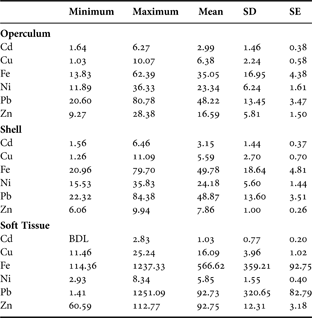
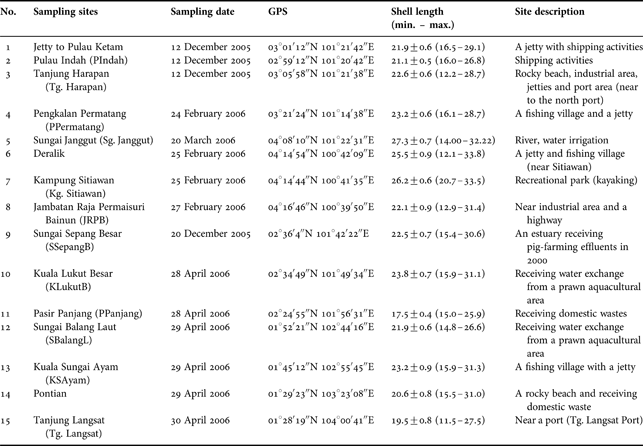
The average values for shell lengths of Nerita lineata collected at 15 sites along the intertidal area of Peninsular Malaysia ranged from 11.5 to 33.8 mm (Table 1). The mean concentrations of each metal varied for the shell, operculum and soft tissue of N. lineata collected from the 15 sites are shown in Table 2. The mean concentrations (μg/g dry weight) of Cd, Cu, Fe, Ni, Pb and Zn in the snails from 15 sites ranged from 1.64–6.27, 1.03–0.07, 13.83–62.39, 11.89–36.33, 20.60–80.78 and 9.27–27.85 in the operculum, 1.56–6.46, 1.26–11.09, 20.96–79.90, 15.53–35.83, 22.32–84.38 and 6.06–9.94 in the shells, below detection limit–2.83, 11.50–25.24, 189.80–1237.30, 2.93–8.34, 1.41–1251.00 and 60.59–112.77 in the soft tissues, respectively (Table 2).
Descriptions of sampling sites and mean of shell length (mm) of Nerita lineata in the west coast of Peninsular Malaysia. (N = 30 individuals for each population).

min., minimum; max., maximum.
Overall minimum, maximum, mean and standard errors of heavy metal concentrations in the operculum, shells and soft tissues of Nerita lineata collected from 15 sites from the west intertidal area of Peninsular Malaysia.

BDL, below detection limit; SD, standard deviation; SE, standard error.
Concentrations of Cd, Ni, and Pb were found to be highest in the shells, followed by the operculum and the lowest level was found in the soft tissues; Fe was recorded to be highest in soft tissues followed by shells and lowest in operculum; Cu and Zn were recorded to be highest in the soft tissues followed by the operculum and lowest in the shells. Higher concentrations of Cd and Ni in the operculum rather than in the shells might be due to the higher volume ratio of the operculum as compared to the shells which are related to growth rate. According to Hunt (Reference Hunt1970), the operculum of Buccinum undatum contained calcified tissue and might also consist of protein which could be similar to binding sites that occurred in the case of N. lineata operculum.
Concentrations of heavy metals in N. lineata from the 15 sites also varied among sampling sites (Figures 2–4). Based on the opercula (Figure 2), the highest concentrations of Cu, Pb and Zn are also found in the KSAyam population while the highest concentrations of Cd, Fe and Ni are found in the KLukutB population. Based on the shells (Figure 3), the highest concentrations of Cd are found in the JRPB population while the highest concentrations of Cu, Fe and Pb are also found in the Tg. Langsat, Tg. Harapan and KSAyam populations, respectively. The highest concentrations of Ni and Zn are found in KLukutB. The populations of KLukutB, SSepangB and Tg. Harapan are found to record Fe concentrations exceeding 70 µg/g dry weights. Based on the soft tissue (Figure 4), the highest concentrations of Cu, Ni, Pb and Zn are found in the JKetam, Sg. Janggut, KSAyam and Tg. Langsat populations respectively, while the highest concentrations of Cd and Fe are found in the SSepangB population. Most interestingly, the highest concentrations of Pb were consistently recorded in the shell, operculum and soft tissue of samples from KSAyam. This indicated that this population was contaminated by Pb when compared with others. Based on the observation in the sampling site, KSAyam is a fishing area with many boats berthed in the area. The sediment in this area was also visually darker than others, indicating some organic inputs from the surroundings. Heavy industries are not observed in the surrounding area; hence future studies are needed to identify the source by taking sediment and mollusc samples from along the river and further upstream.
Concentrations (µg/g dry weight) of heavy metals in the operculum of Nerita lineata collected from 15 sites from the west intertidal area of Peninsular Malaysia. Y-axis, numbers are sampling sites following those in Table 1; X-axis, concentrations in µg/g dry weight.

Concentrations (µg/g dry weight) of heavy metals in the shells of Nerita lineata collected from 15 sites from the west intertidal area of Peninsular Malaysia. Y-axis, numbers are sampling sites following those in Table 1; X-axis, concentrations in µg/g dry weight.

Concentrations (µg/g dry weight) of heavy metals in the soft tissues of Nerita lineata collected from 15 sites from the west intertidal area of Peninsular Malaysia. Y-axis, numbers are sampling sites following those in Table 1; X-axis, concentrations in µg/g dry weight.

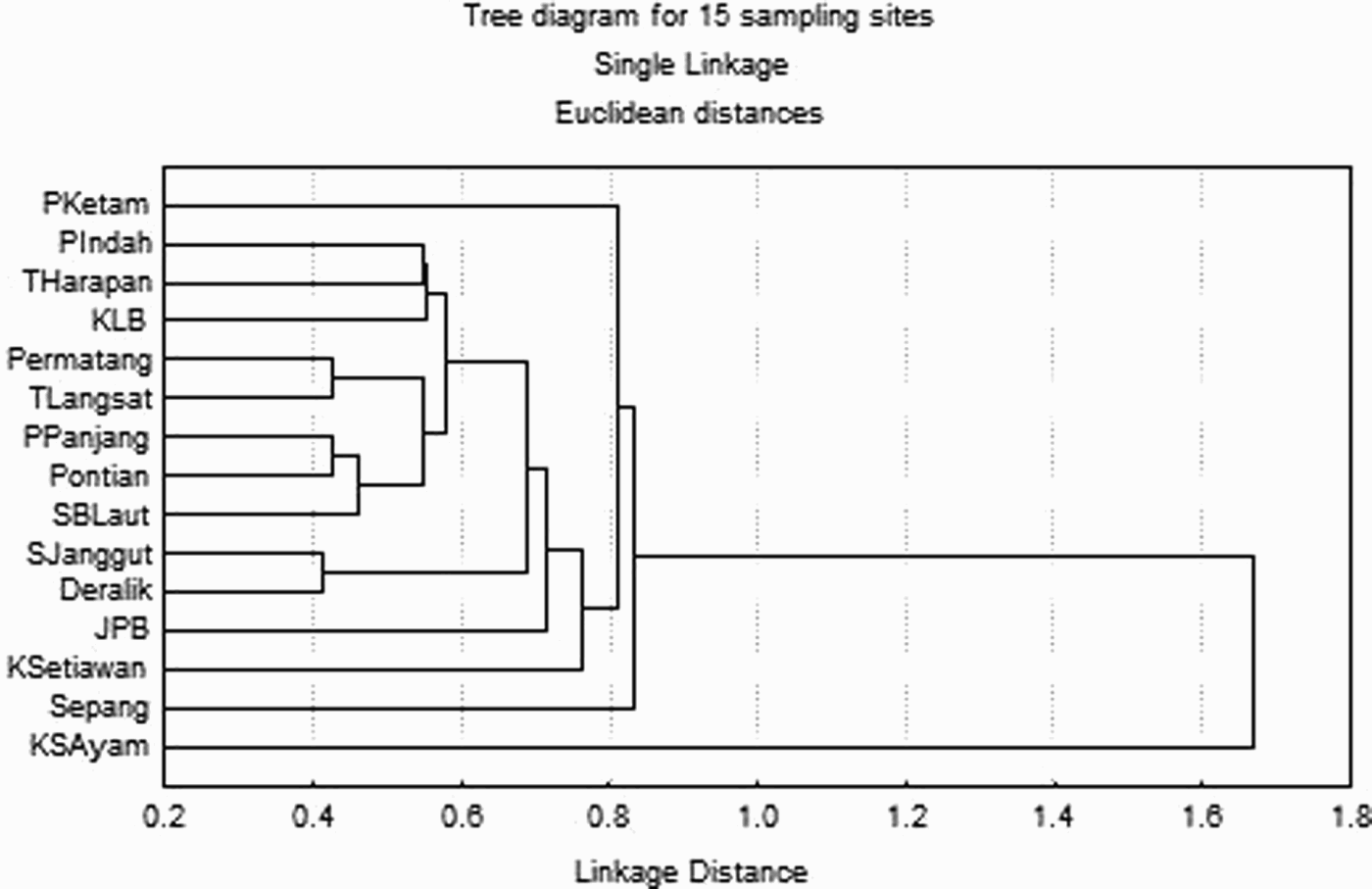
Based on the cluster analysis (Figure 5), the examined sampling sites were classified into two main groups according to their sources: KSAyam was clustered differently from the rest of the populations. This clustering pattern complemented the results based on Figures 2, 3 and 4. The application of cluster analysis combined with metal concentration analysis has been proven to be an effective tool for source identification of heavy metals in the different tissues of N. lineata populations.
Cluster analysis based on Single Linkage Euclidean distances, on the six heavy metals in the operculum, shells and soft tissues of Nerita lineata, based on log10(mean + 1) transformed data.

DISCUSSION
The results of the study showed that the shells, operculum and soft tissues of Nerita lineata are accumulative of Cd, Cu, Fe, Ni, Pb and Zn from the tropical intertidal area, although the metal concentrations varied spatially and among the different tissues. Shells recorded higher concentrations of Cd, Ni and Pb, whilst soft tissues recorded higher concentrations of Cu, Zn and Fe. The soft tissues of marine molluscs are generally recognized as more efficient accumulators of metals than the shells (Rainbow, Reference Rainbow, Furness and Rainbow1990; Brown & Depledge, Reference Brown, Depledge, Langston and Bebianno1998). However, the shells are also useful in studying metal accumulation since they can be used as a record of environmental pollution. The composition of a mollusc's shell is strongly related to the chemical mineralogy which includes metals accumulated from the environment, and therefore metal concentrations in the shells follow the metal concentrations in their environments (Carell et al., Reference Carell, Forberg, Grundelius, Henrikson, Johnels, Lindh, Mutvei, Olsson, Svardstro and Westermark1987). Shells also have some practical advantages over the use of soft tissue as they reveal less variability, integrate metal concentrations over the life of the organisms, are able to give an idea on the metal levels in the past and offer considerable advantages in easy preservation and storage (Al-Dabbas et al., Reference Al-Dabbas, Hubbard and McManus1984; Bourgoin, Reference Bourgoin1990; Cravo et al., Reference Cravo, Foster and Bebianno2002; Yap et al., Reference Yap, Ismail, Tan and Rahim2003).
The higher concentrations of Cd, Ni and Pb in the shells rather than the soft tissues indicated that the shells had higher affinities for Cd, Ni and Pb. Walsh et al. (Reference Walsh, Dunstan and Murdoch1995) also found that the marine gastropod Austrocochlea constricta recorded higher concentration of Cd in the shells as compared with the soft tissues. The higher concentrations of Cd, Ni and Pb found in the shell could probably be due to the fact that the crystalline structures of the shell matrix have a higher capacity for incorporation of Cd, Ni and Pb than the soft tissues (Koide et al., Reference Koide, Lee and Goldberg1982; Al-Dabbas et al., Reference Al-Dabbas, Hubbard and McManus1984). The incorporation of Cd, Ni and Pb in the shell matrices might take place at a faster rate than that for Cu, Zn and Fe. The Cd, Ni and Pb are assumed not to be affected by the physiological conditions of the Nerita snail and stored almost permanently in their hard tissues (Yap et al., Reference Yap, Ismail, Tan and Rahim2003). Bertine & Goldberg (Reference Bertine and Goldberg1972) suggested that the carbonate shells of bivalves may act as a biodeposition site for unwanted chemical species. Marigomez & Ireland (Reference Marigomez and Ireland1990) reported that the shell of the winkle, Littorina littorea, was a good indicator of the average environmental Cd concentration. Several previous studies also showed the fact that some trace metals are incorporated into the shells of molluscs and barnacles through substitution of the calcium ions in the crystalline phase of the shells or are associated with the organic matrix of the shells (Carriker et al., Reference Carriker, Palmer, Sick and Johnson1980, Reference Carriker, Swann and Ewart1982, Reference Carriker, Swann, Prezant and Counts1991; Koide et al., Reference Koide, Lee and Goldberg1982; Al-Dabbas et al., Reference Al-Dabbas, Hubbard and McManus1984; Watson et al., Reference Watson, Foster and Walker1995).
The soft tissues of Nerita lineata accumulated more Cu, Zn and Fe than the operculum and shells. This could be due to these metals being needed for metabolism in the soft tissues of N. lineata. The higher concentration of these metals being found in the soft tissues rather than in the shells was in agreement with the results reported by Cravo et al. (Reference Cravo, Bebianno and Foster2004) who found that Fe and Zn concentrations were consistently lower in the shells than in the soft tissues of the gastropod Patella aspera from the south coast of Portugal. The same results were also reported for the mussels Mytilus edulis (Segar et al., Reference Segar, Collins and Riley1971; Giusti et al., Reference Giusti, Williamson and Mistry1999) and Mytilus galloprovincialis (Puente et al., Reference Puente, Villares, Carral and Carballeira1996) and Perna viridis (Yap et al., Reference Yap, Ismail, Tan and Rahim2003) for Zn.
In general, higher concentrations of metals in Nerita lineata, whether in shells, the operculum or the soft tissues in the KSAyam population, might be related to the more anthropogenic activities in the sampling sites besides naturally originating metals. Yap et al. (Reference Yap, Ismail, Tan and Omar2002, Reference Yap, Ismail and Tan2004) reported that the west coast of Peninsular Malaysia is more developed than the east coast. Many activities such as petrochemical plants, land reclamation, urbanization, shipping and other industrial activities and some major ports are concentrated in this intertidal area. In fact, the determination of metal concentrations in the different tissues of molluscs can be a measure of metal contamination and bioavailability of the sampling sites (Yap et al., Reference Yap, Ismail, Cheng and Tan2006a, Reference Yap, Ismail, Edward, Tan and Sirajb).
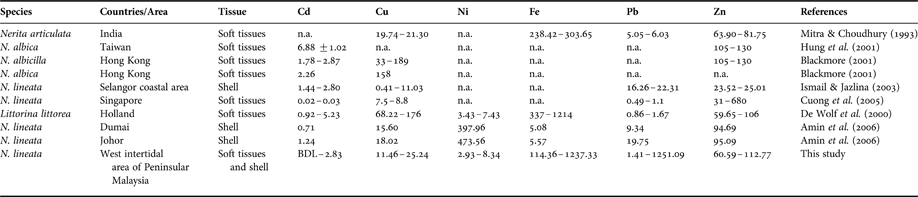
The results of the present study were still comparable to those previously reported studies in Nerita and other gastropods from several geographical regions as presented in Table 3. Concentrations of Cd and Pb in N. lineata were higher in the shells than in the soft tissues, whereas Cu and Zn were higher in the soft tissues than in the shells. This was in agreement with other previous studies in Nerita by Ismail & Jazlina (Reference Ismail, Jazlina and Bujang2003), Foster et al. (Reference Foster, Chacko and Badran1997), Foster & Cravo (Reference Foster and Cravo2003) and in other gastropods (Cravo, 2004 and Walsh et al., Reference Walsh, Dunstan and Murdoch1995). Concentrations of Cu were slightly higher, whilst Fe and Zn in shells were comparable to other species of Nerita in the previous studies (Foster et al., Reference Foster, Chacko and Badran1997; Foster & Cravo, Reference Foster and Cravo2003; Cravo et al., Reference Cravo, Bebianno and Foster2004). The concentrations of Fe and Zn in soft tissues, however, were lower than other gastropod species such as Littorina littorea (De Wolf, Reference De Wolf, Backeljau and Blust2000) and Patella aspera (Cravo et al., Reference Cravo, Bebianno and Foster2004). These differences in metal concentrations are attributed to the geographical factors and its environmental sources of contaminants.
Comparison of metal concentrations in soft tissue of Nerita lineata with other species reported in previous literature.

n.a., data not available; BDL, below detection limit.
The correlation between the tissues clearly showed that the shells and the operculum are significantly correlated (P < 0.05) for all metals. This could be due to some similarity in the structure of shell and the operculum as both consisted of calcified tissues (Hunt, Reference Hunt1970; Amin et al., Reference Amin, Ismail, Arshad, Yap and Kamarudin2006).
CONCLUSION
The present study indicated that the KSAyam population is heavily contaminated by Pb as indicated by the operculum, shells and soft tissues of Nerita lineata. From an ecological point of view, the snail N. lineata is widely distributed and abundant along the the west intertidal area of Peninsular Malaysia. From an ecotoxicological point of view, the accumulation of Cd, Cu, Ni, Fe, Pb and Zn, and consistently high levels of Pb in the three tissues of N. lineata population collected from KSAyam, indicate the snail species is a potential biomonitor of heavy metal pollution in general and especially for Pb. The potential as a biomonitoring material for Ni and Cd is shown in the shells while the operculum can always be a complementary organ for the soft tissues. Lastly, experimental (laboratory and field-based) studies are needed to verify its effective use as a biomonitor for heavy metals.
ACKNOWLEDGEMENTS
The authors wish to acknowledge the financial support provided through the Research University Grant Scheme (RUGS), [Vote no.: 91229], by Universiti Putra Malaysia and e-Science Fund [Vote no.: 5450338], and by the Ministry of Science, Technology and Innovation, Malaysia.