1. Introduction and geologic background
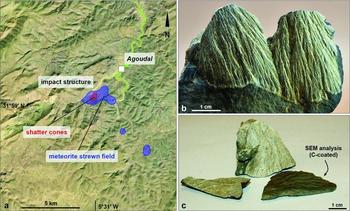
The newly discovered Agoudal impact site (31°59′N, 5°31′W) ~3 km SW of the village of Agoudal in the High Atlas Mountains of Morocco (Sadilenko et al. Reference Sadilenko, Lorenz, Ivanova, Roshina and Korochantsev2013; Lorenz et al. Reference Lorenz, Ivanova, Artemieva, Sadilenko, Chennaoui Aoudjehane, Roschina, Korochantsev and Humayun2014) is the latest addition to the list of impact structures recognized on Earth. Unambiguous evidence for meteorite impact is presented by well-developed auto- and allochthonous shatter cones in fine-grained Middle Jurassic lime- and marlstones (Sadilenko et al. Reference Sadilenko, Lorenz, Ivanova, Roshina and Korochantsev2013; Chennaoui Aoudjehane et al. Reference Chennaoui Aoudjehane, Reimold, Koeberl, Bouley, Aoudjehane, Aboulahris, El Kerni, Hutzler, Bourles and Rochette2014; red area in Fig. 1a; specimen shown in Fig. 1b) and is further supported by the occurrence of lithic breccias that contain iron meteorite fragments (Lorenz et al. Reference Lorenz, Ivanova, Artemieva, Sadilenko, Chennaoui Aoudjehane, Roschina, Korochantsev and Humayun2014). From the limited occurrence of impactites in the field, the Agoudal impact structure is thought to have been eroded down to the crater floor level. The original crater size is unknown, but according to the extent of shocked rocks it was probably a few hundred metres across (El Kerni et al. Reference El Kerni, Chennaoui Aoudjehane, Aboulahris, Reimold, Koeberl, Rochette, Quesnel, Uehara, Hutzler, Bourles, Bouley and Aoudjehane2014). Lorenz et al. (Reference Lorenz, Ivanova, Artemieva, Sadilenko, Chennaoui Aoudjehane, Roschina, Korochantsev and Humayun2014) suggested a diameter of at least 400 m for a single impact crater, but also discussed a potential field of several smaller craters. The age of the Agoudal impact is stratigraphically bracketed by the Middle Jurassic shocked target rock and Upper Pleistocene alluvial–fluvial sediments in which shatter cones occur as reworked clasts (Sadilenko et al. Reference Sadilenko, Lorenz, Ivanova, Roshina and Korochantsev2013). Calculations considering erosion rates suggest an age for the impact in the order of ~100 ka (Sadilenko et al. Reference Sadilenko, Lorenz, Ivanova, Roshina and Korochantsev2013; Rochette et al. Reference Rochette, Chennaoui Aoudjehane, El Kerni, Quesnel, Uehara, Aboulahris, Hutzler and Bourles2014).
Distribution and examples of shatter cones at the Agoudal impact structure, Morocco. (a) False-colour satellite image (Landsat-5) of the High Atlas region near Imilchil, central Morocco, and outline of the proposed strewn field of the Agoudal IIAB iron meteorite (area outlined in blue). The position of the recently discovered, small, eroded Agoudal impact structure evidenced by shatter cones (area outlined in red) is indicated. Image source: USGS. Distribution of shatter cones and meteorite fragments simplified after Chennaoui Aoudjehane et al. (Reference Chennaoui Aoudjehane, Reimold, Koeberl, Bouley, Aoudjehane, Aboulahris, El Kerni, Hutzler, Bourles and Rochette2014). (b) Well-developed shatter cones in limestone. Image courtesy: Marco Frigerio. (c) Smaller shatter cone specimen (dark) carbon-coated for SEM–EDS analysis.

Prior to the finding of shatter cones, an iron meteorite was discovered in the same area, classified as a IIAB iron, and named Agoudal (Chennaoui Aoudjehane et al. Reference Chennaoui Aoudjehane, Garvie, Herd, Chen and Aboulahris2013; Meteoritical Bulletin Database, 2014). The majority of the meteorite fragments were found in a strewn field roughly 6×2 km in extent (Lorenz et al. Reference Lorenz, Ivanova, Artemieva, Sadilenko, Chennaoui Aoudjehane, Roschina, Korochantsev and Humayun2014; blue area in Fig. 1a). Recent discoveries of bigger masses (up to 196 kg, along with many other pieces ranging from 78 kg to a few grams) suggest a total known weight of the meteorite in excess of 500 kg (Lorenz et al. Reference Lorenz, Ivanova, Artemieva, Sadilenko, Chennaoui Aoudjehane, Roschina, Korochantsev and Humayun2014). The Agoudal meteorite contains abundant coarse-grained kamacite and schreibersite, as well as microscopic rhabdite (prismatic schreibersite) and troilite, and has an average Ni content of ~5.5 wt% (Chennaoui Aoudjehane et al. Reference Chennaoui Aoudjehane, Garvie, Herd, Chen and Aboulahris2013; Garvie, 2013 in Meteoritical Bulletin Database, 2014). It has been speculated whether the iron meteorite represents the projectile that also created the Agoudal impact structure (e.g. Sadilenko et al. Reference Sadilenko, Lorenz, Ivanova, Roshina and Korochantsev2013); however, the genetic link between the two phenomena remained until now questionable (Chennaoui Aoudjehane et al. Reference Chennaoui Aoudjehane, Reimold, Koeberl, Bouley, Aoudjehane, Aboulahris, El Kerni, Hutzler, Bourles and Rochette2014; Lorenz et al. Reference Lorenz, Ivanova, Artemieva, Sadilenko, Chennaoui Aoudjehane, Roschina, Korochantsev and Humayun2014; Rochette et al. Reference Rochette, Chennaoui Aoudjehane, El Kerni, Quesnel, Uehara, Aboulahris, Hutzler and Bourles2014).
2. Analytical methods
This rapid communication presents a brief scanning electron microscopic investigation of a randomly selected shatter cone fragment from the Agoudal impact site, in search of possible meteorite-derived material associated with the shocked rock. A smaller limestone shatter cone specimen ~3 cm in size (Fig. 1c) was carbon-coated and its convex surface studied using a VEGA3 TESCAN scanning electron microscope (SEM) equipped with an X-Max 50 silicon drift detector and energy-dispersive X-ray spectroscopy (EDS) system at the Centre for Microscopy, Characterization and Analysis (CMCA) at the University of Western Australia. The AZtecEnergy 2.0 software was used to determine the EDS-determined major-element composition of the minerals (see Oxford Instruments, 2011 for technical details). Oxygen peaks allowed for the distinction between oxidized and reduced phases. Secondary and backscattered electron images were acquired using an acceleration voltage of 15 kV.
3. New observations
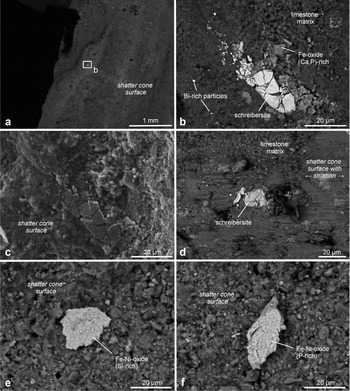
The SEM–EDS analysis of the Agoudal shatter cone (Figs 1c, 2a) revealed a number of exotic particles adherent to the shatter cone surface. A striking feature is a Fe–Ni phosphide of brecciated appearance, determined to be schreibersite (Patera & Berzelius, 1847 in Haidinger, Reference Haidinger1848; Reed, Reference Reed and Millman1969; Clarke & Goldstein, Reference Clarke and Goldstein1978), with its characteristic brittle fracturing pattern (e.g. Goldstein & Ogilvie, Reference Goldstein and Ogilvie1963; Hofmann et al. Reference Hofmann, Lorenzetti, Eugster, Krähenbühl, Herzog, Serefiddin, Gnos, Eggimann and Wasson2009; D'Orazio et al. Reference D'Orazio, Folco, Zeoli and Cordier2011). Over an area ~2 cm2 across, three schreibersite aggregates ≥10 µm in size were encountered; two of them are shown in Figure 2b–d. Schreibersite is locally associated with P- and Ca-rich Fe oxides and, rarely, bismuth-rich microparticles of uncertain origin. The schreibersite aggregates appear micro-tectonized and are elongated roughly in the direction of the shatter cone striation, locally at angles of ~45° relative to the main cone striation (Fig. 2b–d). In addition to schreibersite, several flakes of platy and locally P- and Si-bearing Fe–Ni oxides typically 10–20 µm across were detected (Fig. 2e, f). A smooth, thin coating of ‘glass-like’ appearance in SEM images marks the surface of the shatter cone fracture (Fig. 2c) and seems to serve as an adhesive for the exotic minerals. The shatter cone surface locally exhibits grooves and striae (Fig. 2d). The shatter-coned limestone, moreover, contains spheroidal and rod-shaped framboidal-microcrystalline iron oxides (likely microbial pellets), which may be primary constituents of the limestone.
Scanning electron microscope images of exotic particles adherent to the surface of a selected limestone shatter cone from the Agoudal impact site. (a) Low-magnification view of the shatter cone fragment (grey), with exotic particles (schreibersite in white box, magnified in (b)) already visible; backscattered electron image (BSE). (b) Aggregate of brecciated schreibersite with characteristic fracturing pattern and neighbouring phases; BSE. The sheared schreibersite aggregate is elongated at ~45° relative to the direction of the shatter cone's main striation. Pale grey flecks are Fe oxides. (c) Same scene as in (b); secondary electron image. A thin coating with a ‘glassy’ appearance covers the shocked limestone. (d) Schreibersite fragments in a striated shatter cone domain, roughly following the elongation of the shatter cone; BSE. (e) Flake of a Fe–Ni oxide, probably Ni-rich haematite or maghemite; BSE. (f) A second Fe–Ni oxide; BSE. All images taken at 15 kV.

The EDS analysis of two schreibersite aggregates, each one consisting of multiple individual mineral fragments, yielded the following major-element composition: Ni ~12–15 wt%; P ~10–16 wt%; and Fe ~65–71 wt% (Table 1). Figure 3a shows a typical EDS spectrum obtained from a schreibersite domain within the aggregate shown in Figure 2b, c. The average atomic ratio (Fe+Ni)/P is ~3, consistent with the schreibersite formula (Fe,Ni)3P. The analysis of seven Fe–Ni-oxide flakes yielded Ni contents of ~1.5–7 wt% at O concentrations of typically ~30 wt% and P concentrations of ~0.1–0.5 wt% (Fig. 3b; Table 1). The platy crystal shape (Fig. 2e, f) suggests that these minerals could represent an impure form of haematite or maghemite. Cobalt was below detection limit (i.e. <0.1 wt%) for all phosphides and oxides analysed.
Major-element composition (SEM–EDS) of multiple fragments of schreibersite, as well as Fe–Ni oxides adherent to the shatter cone surface

All values in wt%. Difference from 100% total represents other elements not specified here (compare Fig. 3); n.d. – ‘not detected’.
Compositional variation of schreibersite and Fe–Ni oxides adherent to the shatter cone (SEM–EDS, 15 kV). (a) Typical EDS X-ray spectrum for a beam spot in the schreibersite aggregate shown in the small SEM inset image. (b) Ni and P concentrations (main logarithmic diagram) for schreibersite (tilted squares), Fe–Ni oxides (triangles), and atomic ratio for Fe, Ni and P in the schreibersite (circles, small linear inset plot). Red dots indicate average values (compare Table 1).

4. Discussion
4.a. A new link between the Agoudal iron meteorite and impact structure?
The Agoudal impact structure counts among the smallest known impact sites on Earth with shatter cones, and is thus an interesting candidate for the study of the meteorite – target rock interaction during shatter cone formation. With some rare exceptions in the terrestrial impact cratering record, including extraterrestrial chromite grains in the Lockne impact structure, Sweden (Alwmark & Schmitz, Reference Alwmark and Schmitz2007), taenite particles in the impact breccia of the Obolon impact structure, Ukraine (Valter & Ryabenko, Reference Valter and Ryabenko1977), or a meteorite fragment preserved in the impact melt sheet of the large Morokweng impact structure, South Africa (Maier et al. Reference Maier, Andreoli, McDonald, Higgins, Boyce, Shukolyukov, Lugmair, Ashwal, Gräser, Ripley and Hart2006), most of the impacting projectile is vaporized during a larger impact event (e.g. French, Reference French1998). Therefore, impactor traces in terrestrial impact structures are usually investigated by the geochemical analysis of melt-bearing impactites (e.g. Goderis, Paquay & Claeys, Reference Goderis, Paquay, Claeys, Osinski and Pierazzo2012; Koeberl, Reference Koeberl, Turekian and Holland2014). In some cases, meteorite-derived elements have reacted with the target rock-derived impact melt to form neocrystallized siderophile-rich minerals that contain ‘redistributed’ impactor matter, such as Fe–Ni–Co sulfides in suevitic impact breccias at Steinheim, Germany (Buchner & Schmieder, Reference Buchner and Schmieder2010), millerite (NiS) needles in the impact melt sheet of the East Clearwater Lake impact structure, Canada (Grieve, Palme & Plant, Reference Grieve, Palme and Plant1981), or bravoite (Ni-rich pyrite) in melt rocks from the Rochechouart impact structure, France (Lambert, Reference Lambert1976).
The discovery of schreibersite from the Agoudal impact site represents the first reported evidence for primary meteoritic material preserved in direct association with terrestrial shatter cones. Only under strongly reducing conditions is schreibersite formed on Earth, e.g. in fulgurites (Essene & Fisher, Reference Essene and Fisher1986; Pasek & Block, Reference Pasek and Block2009) or in very rare crustal rocks that also contain native iron (e.g. Pauly, Reference Pauly1969). In contrast, schreibersite is a common accessory mineral in iron and stony-iron meteorites (Buchwald, Reference Buchwald1975, Reference Buchwald1977; Heide & Wlotzka, Reference Heide and Wlotzka1995) but comparatively rare in stone meteorites, although schreibersite and/or its Ni-rich analogue, nickelphosphide: (Ni,Fe)3P, have been found in Lunar rocks, enstatite chondrites, aubrites (enstatite achondrites) and carbonaceous chondrites (e.g. Keil et al. Reference Keil1968; Hunter & Taylor, Reference Hunter and Taylor1981; Easton, Reference Easton1986; Rubin, Reference Rubin2002; Yaroshevsky & Ivanov, Reference Yaroshevsky and Ivanov2010; McCoy, Reference McCoy2010).
Despite its reduced state, schreibersite is relatively resistant to corrosion compared to Fe–Ni metal (e.g. Hofmann et al. Reference Hofmann, Lorenzetti, Eugster, Krähenbühl, Herzog, Serefiddin, Gnos, Eggimann and Wasson2009; Langenhorst, Harries & Pack, Reference Langenhorst, Harries and Pack2012). While the discovery of schreibersite particles adherent to the Agoudal shatter cone is considered evidence for the survival of original, non-oxidized, meteorite detritus, the close association of Fe–Ni oxides suggests that post-impact oxidation and alteration processes were operative on some portion of the dispersed impactor material. One could argue that these oxide phases may represent terrestrial material. However, the low Ni concentrations in the Middle Jurassic sedimentary rocks and interspersed Mesozoic gabbroic, basaltic and syenitic intrusive rocks that dominate the High Atlas region in the wider surroundings of Imilchil and Agoudal (with Ni at the ppm level, e.g. B. Bougadir, unpub. Ph.D. thesis, Univ. Marrakech, 1998; Lhachmi, Lorand & Fabries, Reference Lhachmi, Lorand and Fabries2001; Fadile, Reference Fadile2003) render a terrestrial origin for the Fe–Ni oxides a remote possibility. Anthropogenic contamination seems also unlikely in this barely populated rural landscape. On the other hand, Ni concentrations of ~1.5–7 wt% and P concentrations of ≤0.4 wt% in the Fe–Ni-oxide flakes (Fig. 3b) are in agreement with the Ni content of the Agoudal IIAB iron meteorite (~5.5 wt%; Chennaoui Aoudjehane et al. Reference Chennaoui Aoudjehane, Garvie, Herd, Chen and Aboulahris2013) and most other IIAB irons (~5.2–6.0 wt% Ni, ~0.2–0.4 wt% P; Wasson, Huber & Malvin, Reference Wasson, Huber and Malvin2007). It is thus proposed that the Fe–Ni-oxide flakes probably formed via the oxidation of kamacite, one of the main constituents of the Agoudal iron meteorite (Chennaoui Aoudjehane et al. Reference Chennaoui Aoudjehane, Garvie, Herd, Chen and Aboulahris2013). Nickel-rich Fe oxides similar to those reported in this study are also known from a number of other smaller meteorite impact sites worldwide, such as the Sikhote Alin strewn field in far-east Russia (Krinov, Reference Krinov1964), Wolfe Creek crater in Western Australia (White, Henderson & Mason, Reference White, Henderson and Mason1967), Monturaqui crater in Chile (Bender Koch & Buchwald, Reference Bender Koch and Buchwald1994), Whitecourt crater in Alberta, Canada (Kofman, Herd & Froese, Reference Kofman, Herd and Froese2010) and Kamil crater in Egypt (Folco et al. Reference Folco, Di Martino, El Barkooky, D'Orazio, Lethy, Urbini, Nicolosi, Hafez, Cordier, van Ginneken, Zeoli, Radwan, El Khrepy, El Gabry, Gomaa, Barakat, Serra and El Sharkawi2011), all of which were produced by the falls of iron meteorites.
The schreibersite and Fe–Ni oxides preserved on the shatter cone surface strongly support the view that the Agoudal impact structure was formed by the impact of an iron meteorite – probably the Agoudal IIAB iron given its position within the meteorite strewn field. This interpretation is supported by the discovery of iron meteorite fragments in the lithic breccias at the impact site (Lorenz et al. Reference Lorenz, Ivanova, Artemieva, Sadilenko, Chennaoui Aoudjehane, Roschina, Korochantsev and Humayun2014). The survival of microscopic schreibersite grains (schreibersite is oxidized under the influence of water and atmospheric oxygen; Pasek & Pasek, Reference Pasek and Pasek2007) suggests that impact-triggered hydrothermal activity and/or groundwater steam influence were rather insignificant and, if present, short-lived. This is consistent with the estimated small original size of the Agoudal impact crater.
4.b. Agoudal and implications for the formation and significance of shatter cones
The identification of meteorite-derived material associated with the Agoudal shatter cones has wider implications for the formation of shatter cones on Earth and other planetary bodies. After the first discovery and description of shatter cones at Steinheim by Branco & Fraas Reference Branco and Fraas(1905; the so-called ‘Steinheimer Strahlenkalke’) and their first systematic investigation as macroscopic indicators for impact (Dietz Reference Dietz1947, Reference Dietz1959, Reference Dietz1960), theoretical considerations and numerical simulations have improved the general understanding of shatter cone formation. It is today widely accepted that shatter cones form as tensile fractures by shock wave interference, at comparatively low shock pressures of approximately 2 GPa and higher (G. P. Johnson & R. J. Talbot, unpub. M.Sc. thesis, M.Sc. thesis, GSF/Mech 64–35, Wright-Patterson Air Force Base, Ohio, 1964; Sagy, Reches & Fineberg, Reference Sagy, Reches and Fineberg2002; Baratoux & Melosh, Reference Baratoux and Melosh2003; Sagy, Fineberg & Reches, Reference Sagy, Fineberg and Reches2004). Earlier scanning electron microscopic studies of shatter cone surfaces revealed spherules and other melting features in rock samples from the two largest and oldest impact structures on Earth, Vredefort in South Africa (Gay, Reference Gay1976; Gay, Comins & Simpson, Reference Gay, Comins and Simpson1978) and Sudbury in Canada (Gibson & Spray, Reference Gibson and Spray1998). The formation of Si–Al-rich, Fe-rich and intermediate spherules adherent to the Vredefort shatter cones was suggested to be related to frictional melting (Gay, Reference Gay1976; Gay, Comins & Simpson, Reference Gay, Comins and Simpson1978), whereas silicate and Ni-rich spherules, as well as silicate melt-splats, -fibres and -smears on the shatter cone surfaces from Sudbury were interpreted as evidence for vaporization at the highest levels of shock metamorphism (Gibson & Spray, Reference Gibson and Spray1998). The finding of schreibersite and Fe–Ni oxides adherent to the shatter cone surface at the much smaller Agoudal impact structure seems to be in conflict with melting and vaporization processes and requires a formation mechanism for the shatter cones that allows for the rapid injection of particulate impactor matter into transient open fractures during the impact process. This is compatible with the models of Sagy, Reches & Fineberg (Reference Sagy, Reches and Fineberg2002), Baratoux & Melosh (Reference Baratoux and Melosh2003) and Sagy, Fineberg & Reches (Reference Sagy, Fineberg and Reches2004), who proposed that shatter cones are rapidly produced tensile fractures. The brecciated texture of the schreibersite aggregates suggests the influence of rather mild shock metamorphism (compare, e.g. Buchwald, Reference Buchwald1975; Dominik, Reference Dominik1977; Hofmann et al. Reference Hofmann, Lorenzetti, Eugster, Krähenbühl, Herzog, Serefiddin, Gnos, Eggimann and Wasson2009) followed by ‘cataclastic’ microdeformation after the injection of the meteoritic matter and the closure of transient open shatter cone fractures. We acknowledge that the meteorite – target rock interaction processes that operate on shatter cone surfaces during impact may greatly vary according to the magnitude of the impact event and as a function of the distance/depth of the newly produced shatter cones from the debouched projectile. Shatter cones produced from target rocks close to the crater centre and the land surface at the time of impact (compare Schmieder & Buchner, Reference Schmieder and Buchner2013 with examples from Steinheim) are probably more likely to carry a distinct impactor contamination compared to shatter cones that formed at greater depth within the crater basement or in the outer crater domains. Thus, the Agoudal shatter cones contaminated with schreibersite and Fe–Ni oxides were presumably formed within the shock zone near the impacted land surface; injection of the particulate projectile material into the deeper fractured target rock seems rather unlikely. This adds to the ongoing discussion about the uncertain structural nature, original size and level of erosion of the Agoudal impact structure (e.g. Lorenz et al. Reference Lorenz, Ivanova, Artemieva, Sadilenko, Chennaoui Aoudjehane, Roschina, Korochantsev and Humayun2014).
The discovery of meteorite matter seeding the shatter cones at Agoudal, finally, poses the question of whether similar exotic particles could occur on shatter cones from other similar-sized and larger terrestrial impact structures. In order to obtain a more reliable dataset for the potential impactor contamination of shatter cones, additional specimens from the Agoudal impact site, as well as shatter cones from a variety of settings in other terrestrial impact structures, ought to be screened for analogous effects. For deeply eroded impact structures where evidence for shock metamorphism is restricted to the field occurrence of shatter cones, such as at Île Rouleau in Québec, Canada (Grieve, Reference Grieve2006), fresh shatter cone surfaces might hold valuable information towards the nature of the impacting body.
5. Conclusions
Shatter cones found at the newly discovered Agoudal impact site in the High Atlas of central Morocco carry a distinct contamination of exotic mineral particles, so far unique to the terrestrial impact cratering record. The SEM–EDS study of a shatter cone surface revealed the presence of schreibersite and Fe–Ni oxides, interpreted to represent primary and oxidized meteoritic matter, respectively. The new findings suggest that the Agoudal impact structure and the Agoudal IIAB iron meteorite are most likely genetically linked. The presence of impactor material decorating the surface of shatter cones requires formation via the temporary opening of fractures, allowing for the injection of particulate projectile matter and volatilized material. In analogy to Agoudal, shatter cones at other impact sites may turn out to be of valuable use in the search for projectile signatures in eroded impact structures worldwide.
Acknowledgements
We thank Dr Carl Alwmark and an anonymous reviewer for their constructive reviews and Dr Phil Leat for editorial handling. M. S. and E. T. acknowledge the facilities, and the scientific and technical assistance of the Australian Microscopy & Microanalysis Research Facility at the Centre for Microscopy, Characterization & Analysis (CMCA), The University of Western Australia (UWA), a facility funded by the University, State and Commonwealth Governments. E. B. acknowledges a grant from the Stifterverband für die Deutsche Wissenschaft. Marco Frigerio is thanked for the shatter cone photograph used in Figure 1b.