Introduction
The flea-weevil Orchestes steppensis Korotyaev (Coleoptera: Curculionidae) is an eastern Palaearctic species common in southern East Siberia and southern Far East of Russia, Mongolia, and northeastern China (Korotyaev, Reference Korotyaev2015, Reference Korotyaev2016), who also reported it from Kazakhstan and some other regions of Russia such as northwestern Caucasus and southern Urals. In China, prior to that, only Yang et al. (Reference Yang, Yao, Che and Qi1996) reported O. steppensis (as O. mutabilis Boheman) from Harbin, Heilongjiang Province, on Ulmus sp. (Ulmaceae). Both the larval and adult stages of O. steppensis can cause serious, often severe damage to elms (Ulmus spp.) by feeding on the leaves (adults) or mining them heavily (larvae), thus making the trees incapable of vigorous growth and even causing defoliation and death of the lower, small branches.
Four species of Ulmus are distributed in Urumqi, the capital city and the largest urban area of Xinjiang (Xinjiang Uyghur Autonomous Region of China) including one native species, the Siberian elm U. pumila L. and its distinctive, cultivated pendula cultivar, and three cultivated species, U. laciniata (von Trautvetter) Mayr, U. laevis Pallas, and U. minor Miller. As a native and the main afforestation tree in Xinjiang, U. pumila is widely distributed, and also has been extensively planted, in many urban and rural areas of the region. It is drought resistant, cold tolerant, and easily adaptable, the characteristics that play a very important role in windbreak plantations and sand fixations in desert and semi-desert environments and urban landscapes. Some very valuable elm trees, which are older than 100 years, can be found in the parks and scenic forests in Urumqi, and these must be protected as part of the precious cultural heritage of China; they are regarded as ‘living relics of modern civilization’.
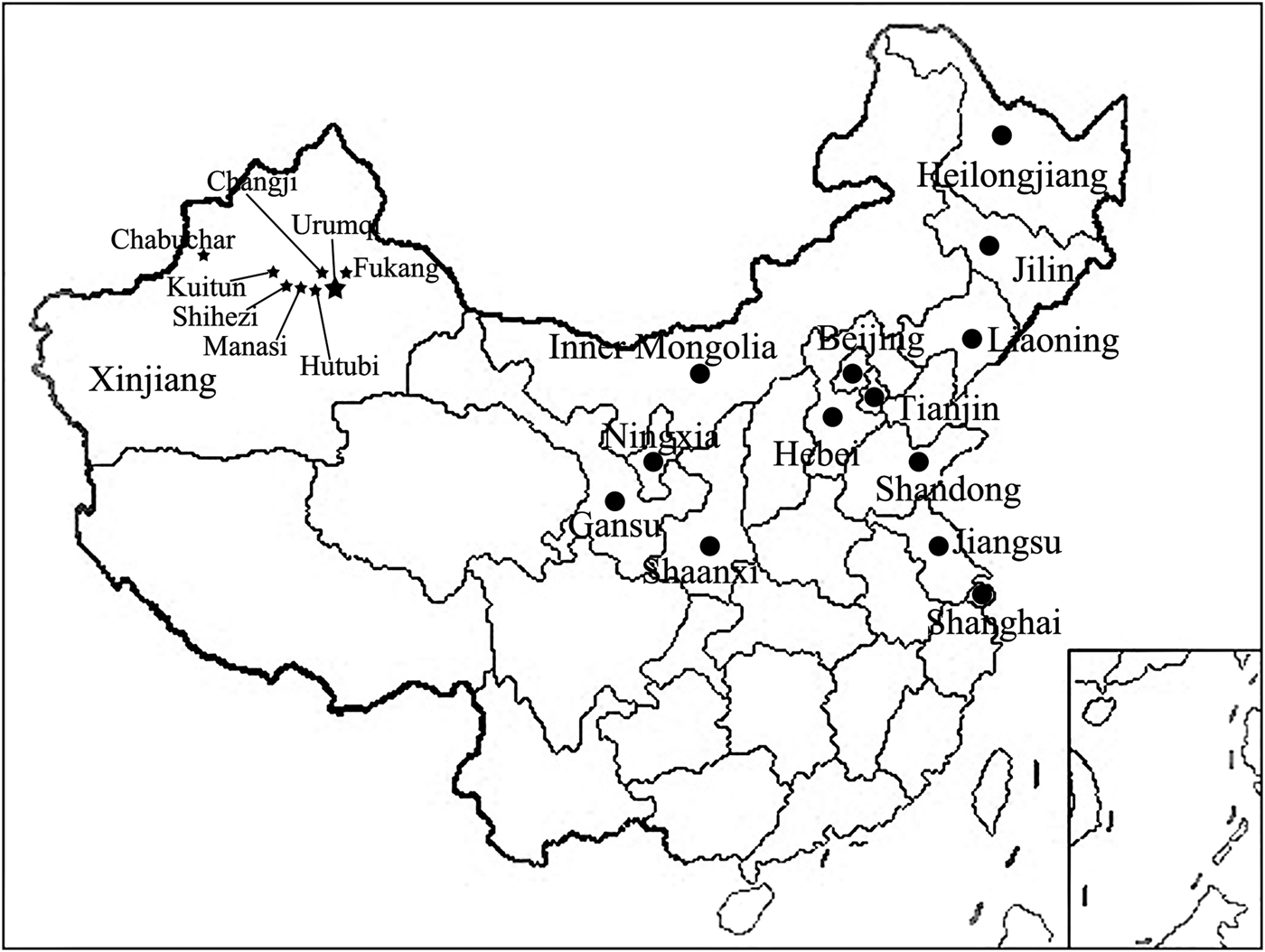
In China, the misidentified European Orchestes alni (L.) was reported as an elm pest in several provinces, as shown in fig. 1. It was first found in Jiangsu Province in 1976 by Wang & Chen (Reference Wang and Chen1981), reported for the first time from Changji, Xinjiang in 1994 (Zhao et al., Reference Zhao, Jin, Zhu, Bai, Zhao and Yang1996), and then detected in Ili Prefecture of Xinjiang since 1997 (Zhang et al., Reference Zhang, Xu and Shen2000). More recently, Ma (Reference Ma2015) mentioned that O. alni was possibly an invasive species in Xinjiang in his book on the forest insects of Xinjiang. However, as previous reports of O. alni from China seemed untrustworthy because of likely misidentifications, one of the primary goals of this study was to establish its true identity, in addition to the study of its bionomics in Xinjiang, as such data were largely lacking for this pest in China or elsewhere. Prior to our surveys throughout Xinjiang, the native Siberian elms had been heavily damaged by this very common weevil, especially in Urumqi.
Distribution of Orchestes steppensis in China (previously misidentified as O. alni except in Heilogjiang as O. mutabilis); that in the cities of Xinjiang is marked by stars and in other provinces by circles.

Current control methods of this weevil in Urumqi rely heavily on the use of various chemical pesticides, such as organophosphates, to kill adult O. steppensis (Li, Reference Li1999). However, repeated pesticide applications could increase chemical residues and insect resistance, as well as negatively affect other beneficial species. In addition, chemical control is restricted in many urban and rural areas in Xinjiang. In this context, developing of an area-wide integrated management program is crucial to control this highly mobile and widespread pest. Biological control, especially by means of managing native natural enemies or using specialized parasitoids, may help suppress source populations, particularly in urban areas, which need to provide a clean and beautiful environment for people to live. Thus, biological control of this pest would be undoubtedly the best alternate method but to assess its potential, critical data about the life history of O. steppensis and its natural enemies are needed (these are currently lacking), especially information on the parasitoid species in Xinjiang. Parasitoids are the most frequent natural enemies of leafminers whose larvae feed between the epidermis of leaves, consuming foliar mesophyllum and finding shelter against harsh environmental conditions but little protection against parasitoids (Askew & Shaw, Reference Askew and Shaw1974; Salvo & Valladares, Reference Salvo and Valladares1999). Actually, this guild of phytophagous insects supports rich parasitoid communities, seemingly due to the physical characteristics of leaf mines (Hawkins, Reference Hawkins1988).
In China, only two species of parasitoids, both in the family Eulophidae (Hymenoptera), were previously reported parasitizing O. steppensis (as O. alni) in Gansu Province by Li (Reference Li1999), but their biology were totally unknown. Therefore, we conducted a study in Urumqi during 2013–2016 to investigate phenology and biology of O. steppensis, the complex of its parasitoids, and their basic biological traits. An estimate of parasitism rates of this weevil by the local parasitoids was needed to provide necessary data for a potential biological control program against it, and also to make a recommendation whether an augmentative or a classical biocontrol approach should be implemented.
In North America, O. steppensis, misidentified as O. alni (Korotyaev, Reference Korotyaev2016) was first noted in the USA by Anderson et al. (Reference Anderson, O'Brien, Salsbury and Krauth2007) who found it at several locations in Wisconsin and Illinois beginning in 2003. The species appears to have undergone a rapid range expansion and experienced a surge of detections across the continent, with additional records from several eastern and mid-western states (Gibb et al., Reference Gibb, Pierce and Waltz2007). Korotyaev (Reference Korotyaev2016) reported that it has rapidly widened its range in North America in the recent decade, including Canada (British Columbia) and USA (Arizona, Colorado, Idaho, New Mexico, Oregon, Utah, Washington, and Wyoming). Its damage was distinctive; numerous efforts were made to detect O. steppensis attacking elms in 2011, including U. pumila, west of the Cascade Mountain range in British Columbia and Washington (Looney et al., Reference Looney, Humble and Cranshaw2012). They reported only one species of Pteromalidae (unidentified) and Eupelmus vesicularis (Retzius) from this weevil in North America, but any biological information about these parasitoids was totally lacking. So, our results may be of interest and also of potential importance for a perspective classical biological control program against O. steppensis in North America, where it is a highly damaging and rapidly spreading invasive species (Looney et al., Reference Looney, Humble and Cranshaw2012; Korotyaev, Reference Korotyaev2016).
Materials and methods
Study sites and sampling procedures
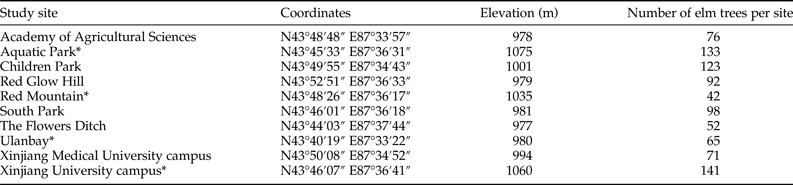
Ten collecting sites (table 1) with Ulmus trees naturally infested with O. steppensis were established to study biology of this weevil and complex of its parasitoids in Urumqi (fig. 1) during 2013–2016. Based on the study during 2013–2014, four collecting sites with different habitats, marked with an asterisk (*) in table 1, were chosen to investigate parasitism rates of O. steppensis during 2015–2016: Aquatic Park (a moist environment), Xinjiang University (a transition zone between moist and semi-arid environments), Red Mountain (a semi-arid), and Ulanbay (arid).
Survey sites of Orchestes steppensis and its parasitoids (*) in Urumqi from 2013 to 2016.

A random sampling method was used, as follows. A total of 50 elm leaves infested with mines of the weevil were randomly collected from all sides (north, south, east, and west) of one to three elm trees at heights of approximately 1–2 m from March to June and then taken to the laboratory for processing. Almost all elm trees were of about the same height, within about 10 m, but the number of trees varied in different sites (table 1). Adult weevils were collected by both sweeping and by hand directly into 100% ethanol, as well as by rearing them from the mines.
A preliminary investigation of development and damage of the weevil in the field, and of their parasitoids was conducted in 2013 and 2014. In 2014, only 88 parasitoid individuals belonging to Pteromalidae and Eulophidae (Hymenoptera: Chalcidoidea) were reared from elm leaves infested by O. steppensis, but biology of these parasitoids was then totally unknown. Then, during 2015 and 2016, further investigations of biology of the weevil were carried out along with rearing experiments of the parasitoids and studies on parasitism rates, on a total of 381 elm trees at four sites.
Photographs were taken using a Nikon Ni-E system. All images were stacked with Helicon Focus software (http://www.heliconsoft.com) and arranged in plates using Adobe Photoshop. The experimental scheme designed refers to, Mills (Reference Mills1993), Salvo & Valladares (Reference Salvo and Valladares1999), Kapaun et al. (Reference Kapaun, Nadel, Headrick and Vredevoe2010), and Gudrun et al. (Reference Gudrun, Harney, Neser, Joffe, Bush, Hurley, Wingfield and Slippers2014).
Rearing, life history studies, and identification of the weevil
Observations on development of the weevils were conducted in H.-Y. Hu laboratory at Xinjiang University at room temperature (20–32°C) and 22–60% RH, with natural and fluorescent lighting of approximately 13:11 L:D, during April to June 2015 and 2016. In 2014, only adults were reared while data on other developmental stages were not recorded.
To study phenology of O. steppensis in 2015 and 2016, 9708 its individuals, including eggs, first through third larval instars, pupae, and fully developed but not emerged adults in thousands of leaves were individually isolated inside glass vials (diameter 1.5 and length 6.0 cm) and capped with a moist cotton plug to keep them fresh. Then all the vials were assembled in four different groups according to their respective developmental stages: Group 1 contained the leaves with eggs only; Group 2 had all the larval stages (1–3 instars), Group 3 contained the pupae, and Group 4 had the unemerged adults. In the rare cases when more than one developmental stage of O. steppensis was found in a leaf, these were separated in two different vials by cutting the leaf. Daily observations on the development of the weevils were made and recorded thereafter until all the adults have emerged, and that provided data on the biological characteristics of O. steppensis. Criteria for confirmation of development of the host stages followed Oldham (Reference Oldham1928).
After making sure that all the collected adult weevils belong to the same morphospecies, some of them were air-dried from ethanol and point-mounted as voucher specimens. We first identified the weevil in 2013 as O. alni according to the same morphological characteristics reported by Li (Reference Li1999) and Zhang et al. (Reference Zhang, Xu and Shen2000), but when we compared our specimens with the description and illustrations of O. alni from England, given in Oldham (Reference Oldham1928), we suspected that they might not be the same species because they differed in the following: in the specimens from Xinjiang antennae are inserted at about one-third of rostrum and definitely before the middle of rostrum and elytrae with eight spots, whereas in O. alni from England the antennae are inserted behind the middle of rostrum and elytrae with four spots, which are very variable. So, to make sure whether it was the true O. alni, several specimens from Urumqi were then sent for identification to an expert in weevil taxonomy, Dr Boris A. Korotyaev (Zoological Institute of the Russian Academy of Sciences, Saint Petersburg, Russia), and also its photographs were sent to Dr Andrei A. Legalov (Siberian Zoological Museum, Institute of Animal Systematics and Ecology, Siberian Branch of the Russian Academy of Sciences, Novosibirsk, Russia). See Korotyaev (Reference Korotyaev2016) for the detailed history of misidentifications of O. alni and O. mutabilis, and the subsequent description of O. steppensis as a new species, the type series of which includes many paratypes from Xinjiang collected in the course of this study.
Rearing, development, and identification of parasitoids of O. steppensis
First rearing of the parasitoids of O. steppensis was conducted, on a limited basis, in 2014. Then, during April to June of 2015 and 2016, thousands of O. steppensis mines in Siberian elm leaves (in 2015, also from the pendula cultivar of U. pumila) were collected for rearing under laboratory conditions (at room temperature of 20–32°C, 22–60% RH, and 13:11 L: D) to reveal the complex of parasitoids of this weevil and to study their biological traits.
To determine the host stage attacked by the parasitoids, dissections and rearings of each stage of O. steppensis were conducted in the laboratory. In 2015 and 2016, altogether, 2823 eggs of this weevil were detected from 3341 elm leaves and these eggs were divided into 188 groups, each group with at most 15 eggs placed inside Petri dishes (6.6 or 10.0 cm diameter) when a leaf contained only one egg of the weevil; often, when two or more eggs were present in the same elm leaf, these were kept separate in the vial. A total of 1905 larvae representing first through third instars inside 953 elm leaves were divided into 127 groups, each group with 15 larvae inside a glass vial (diameter 1.5, length 6.0 cm). The number of 2685 pupae were arranged into 179 groups, each group with 15 pupae inside a glass vial. All eggs and first and second instar larvae were dissected under a microscope to find out if they were parasitized; these were destroyed by the procedure. All third instar larvae and pupae were checked for signs of parasitization (larva of parasitoid can be found on or beside the larva or pupa of weevil when parasitized) and then left inside the mines and allowed to develop to obtain parasitoids or adult beetles (when unparasitized). Also, 2563 adults (either reared from the pupae or collected in the field) were dissected from May to early June to find out whether any of them were parasitized.
Upon emergence, adult parasitoids were preserved in 100% ethanol and sorted to family and morphospecies. Selected specimens of each morphospecies were sent to the Entomology Research Museum, University of California, Riverside, California, USA (UCRC) where they were dried from ethanol using a critical point drier, mounted on points or slides, and identified first to family and then at least to genus using personal knowledge of the second author, who is an expert taxonomist on several families of Chalcidoidea, and available taxonomic literature (e.g., Bouček & Rasplus, Reference Bouček and Rasplus1991; Dzhanokmen, Reference Dzhanokmen1998); some were later sent to the leading taxonomists working on the respective groups (table 3). The bulk of voucher specimens were deposited at the Insect Collection of College of Life Science and Technology, Xinjiang University, Urumqi, Xinjiang, China (ICXU) either as point-mounted specimens or preserved in ethanol and kept in a refrigerator at −4°C. Some voucher specimens were also deposited at UCRC.
Parasitism rates
Field collections at four collection sites (Aquatic Park, Red Mountain, Ulanbay, and Xinjiang University campus, table 1) as well as rearing in the laboratory were conducted to monitor parasitism rates from 2015 to 2016. Elm leaves, of both U. pumila and its pendula cultivar, were collected in 2015. In 2016, only the leaves of U. pumila infested by this weevil were collected.
Elm leaves infested by O. steppensis were collected almost every two days in 2015 and 2016 from all sides (north, south, east, and west) of the trees at about 1–2 m height level, placed into 2 L sealed, transparent plastic bags, and brought back to the laboratory as soon as possible (or immediately when collected at the Xinjiang University campus). All the collected elm leaves were kept under laboratory room conditions (room temperature of 20–32°C, 22–60% RH, natural and fluorescent lighting of approximately 13:11 L:D). A total of 20 pieces of leaves with mines (each piece containing only one host) were put inside clear glass vials (3 cm diameter and 20 cm length) with mesh gauze as one sample. The emerged weevils and parasitoids were counted and removed daily; the parasitoids were then preserved and identified.
In order to calculate the rate of parasitism, the number of hosts per sample was estimated as the sum of the number of the adult weevils and parasitoids emerged in the samples. Average parasitism rate per year was calculated based on the total number of parasitoids divided the by the sum of O. steppensis and the parasitoids. Proportion parasitism was calculated based on the emerged insects as the number of parasitoids divided by the sum of O. steppensis and the parasitoids. Proportion parasitism by Pteromalidae was calculated from the emerged insects as the number of Pteromalidae divided by the sum of O. steppensis and Pteromalidae, and similarly for the Eulophidae.
Results
Identity of the weevil and its distribution and pest status in Xinjiang
Both Drs B.A. Korotyaev and A.A. Legalov, authorities on taxonomy of the Palaearctic Curculionidae, initially identified this weevil as O. mutabilis in 2015; later, however, Korotyaev (Reference Korotyaev2016) found that these O. mutabilis were actually misidentified and are in fact O. steppensis. That prompted us to re-assess all the previous records of O. alni in China (Wang & Chen, Reference Wang and Chen1981; Zhao et al., Reference Zhao, Jin, Zhu, Bai, Zhao and Yang1996; Si et al., Reference Si, Shao, Shi, Liu and Dong1997; Li, Reference Li1999; Zhang et al., Reference Zhang, Xu and Shen2000), as well as of O. mutabilis from Ulmus sp. in Heilongjiang by Yang et al. (Reference Yang, Yao, Che and Qi1996). As shown below, and in accordance with the recent changes in the taxonomy of Orchestes spp. (Korotyaev, Reference Korotyaev2016), indeed all the previous reports of O. alni and O. mutabilis from China were misidentifications of O. steppensis. In his previous publication (Korotyaev, Reference Korotyaev2015), the misidentified O. mutabilis, which now refers to O. steppensis (Korotyaev, Reference Korotyaev2016), was reported to be ‘a steppe eastern Palaearctic species, common in the south of the Transbaikalia, the Russian Far East, and eastern Mongolia’. Thus, only O. steppensis has been occurring in China since at least 1976; moreover, it is likely to be a native species in at least some northeastern provinces of the country that are adjacent to the areas indicated by Korotyaev (Reference Korotyaev2015) for ‘O. mutabilis’. Ma (Reference Ma2015) mentioned that ‘O. alni’ was an invasive species in Xinjiang; we agree that it is very likely that O. steppensis is indeed an inadvertently introduced invasive species, and is the species observed by these earlier authors.
In Xinjiang, besides Urumqi area, this weevil is also distributed in Chabuchar County, Changji Hui Autonomous Prefecture, Fukang, Hutubi County, Manasi, Kuitun and Shihezi (fig. 1). This pest was observed feeding on all four aforementioned species of Ulmus including the pendula cultivar of U. pumila. However, its damage to U. pumila is the most serious, followed by the pendula cultivar of U. pumila and then U. laevis; the other species of elms are damaged only occasionally.
Life history and phenology of O. steppensis in Xinjiang
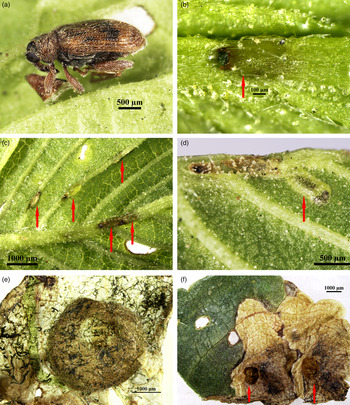
O. steppensis has only one generation per year in Urumqi and overwinters as adult stage. Generally, most overwintered adults come out from their shelters during 20–25 April, beginning to feed on the buds and expanding, tender elm leaves right away (fig. 2a). After the adults mate, female lays a single egg (fig. 2b) by biting out a suitable cavity in the mid-vein or in one of the secondary larger veins on the under surface of a leaf with her snout. One to three eggs were observed in a single leaf. In some cases, four or more eggs were occasionally found in a single leaf, up to five eggs (fig. 2c). Also, some females may abort laying eggs after biting out a cavity in the leaf.
Life habits of Orchestes steppensis. (a) adult weevil feeding on an elm leaf; (b) an egg in the vein of a leaf; (c) five eggs in the veins of a leaf; (d) larva feeding on the mesophyll; (e) pupal cell; (f) adult emergence hole.

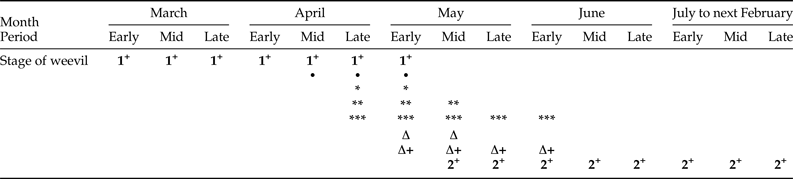
The larvae of O. steppensis have three instars and a short prepupal stage before pupation and subsequent adult emergence. Larvae devour the parenchyma in different directions, thus continuously enlarging the mine (fig. 2d). The third instar larvae spin silk to hold the upper and lower surfaces of a leaf together and to form a cell for pupation (fig. 2e). When a larva becomes a prepupa, it stops feeding and then develops into pupa. Generally, an adult will emerge from its pupa after chewing its way out of the cocoon (fig. 2f). Life history and phenology of O. steppensis in Urumqi are summarized in table 2.
Life history of Orchestes steppensis in Urumqi.

•, Egg; *, First instar larva; **, Second instar larva; ***, Third instar larva; ∆, Prepupa; ∆+, Pupa; 1+, Adult emerged in the previous year; 2+, Adult emerged in the current year.
Parasitoids of O. steppensis and notes on their biology
Seven parasitoid species of O. steppensis with a total number of 813 specimens were reared from the larval and pupal stages of the weevil during 2014–2016, including 616 individuals of Pteromalus spp. (372♀, 244♂) and 197 individuals of Eulophidae (146♀, 51♂). All the parasitoid species are reported here for the first time for this host weevil. The overall sex ratio of parasitoids was female biased (63.7%, n = 813). Adult sex ratio for Pteromalidae, expressed as a percentage of females reared in the laboratory, was 56.4% (n = 55) in 2014, 75.6% (n = 45) in 2015, and 59.5% (n = 516) in 2016, and was highly female-biased (60.4%) overall. Similarly, the percentage of females of Eulophidae reared in the laboratory was 66.7% (n = 33) in 2014, 69.4% (n = 62) in 2015, and 79.4% (n = 102) in 2016, and was also highly female-biased (74.1%) overall.
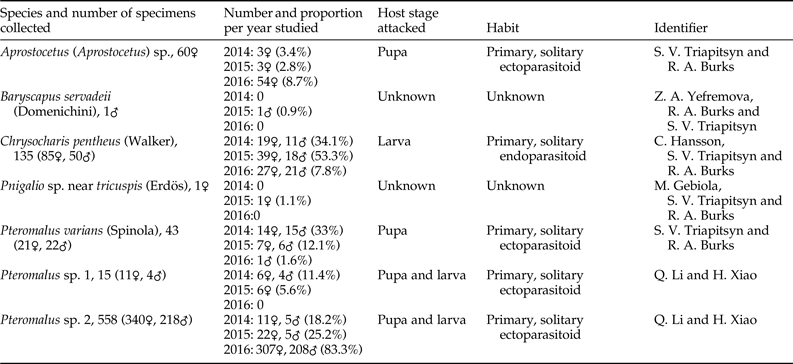
Composition of the parasitoid species and their number varied during the investigation (table 3). Five parasitoids species were reared in 2014, seven in 2015, and four in 2016. Chrysocharis pentheus (Walker) (Eulophidae) and Pteromalus varians (Spinola) (Pteromalidae) were the most abundant parasitoids in 2014 and 2015, while Pteromalus sp. 2 as the dominant parasitoid in 2016 when it comprised 83.3% among all the parasitoid specimens reared from O. steppensis.
Parasitoids of Orchestes steppensis and their habits in Urumqi from 2014 to 2016.

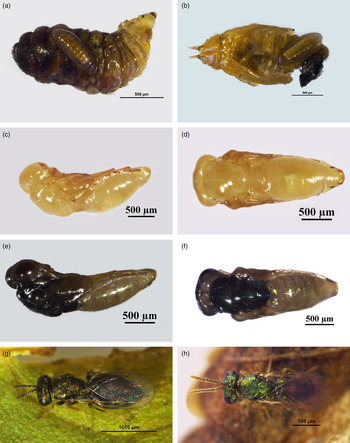
Among the parasitoids, Aprostocetus (Aprostocetus) sp. (Eulophidae), P. varians, and Pteromalus spp. 1 and 2 are solitary, idiobiont, primary ectoparasitoids of the pupae of O. steppensis, and the latter two species also can parasitize the third instar larvae of the same host. The developmental stages of Pteromalus sp. 2 are illustrated in fig. 3a–h. C. pentheus is a solitary, idiobiont, primary endoparasitoid of third instar larvae of this weevil. However, biology of both Baryscapus servadeii (Domenichini) and Pnigalio sp. near tricuspis (Erdös) (Eulophidae) is unknown due to the limited number of the individuals reared.
Development of Pteromalus sp. 2. (a) Larva feeding on a larva of Orchestes steppensis; (b) larva feeding on a pupa of the same host; (c–f): pupae; (g) adult female; (h) adult male.

Parasitism rates
The average parasitism rate of O. steppensis larvae and pupae at the Xinjiang University campus in Urumqi was about 7% in 2015, as calculated for both Ulmus pumila and its pendula cultivar together; in 2016, it was 36%, but recorded for U. pumila only. The parasitism rate was thus much higher on U. pumila than on the pendula cultivar of the same species of elm.
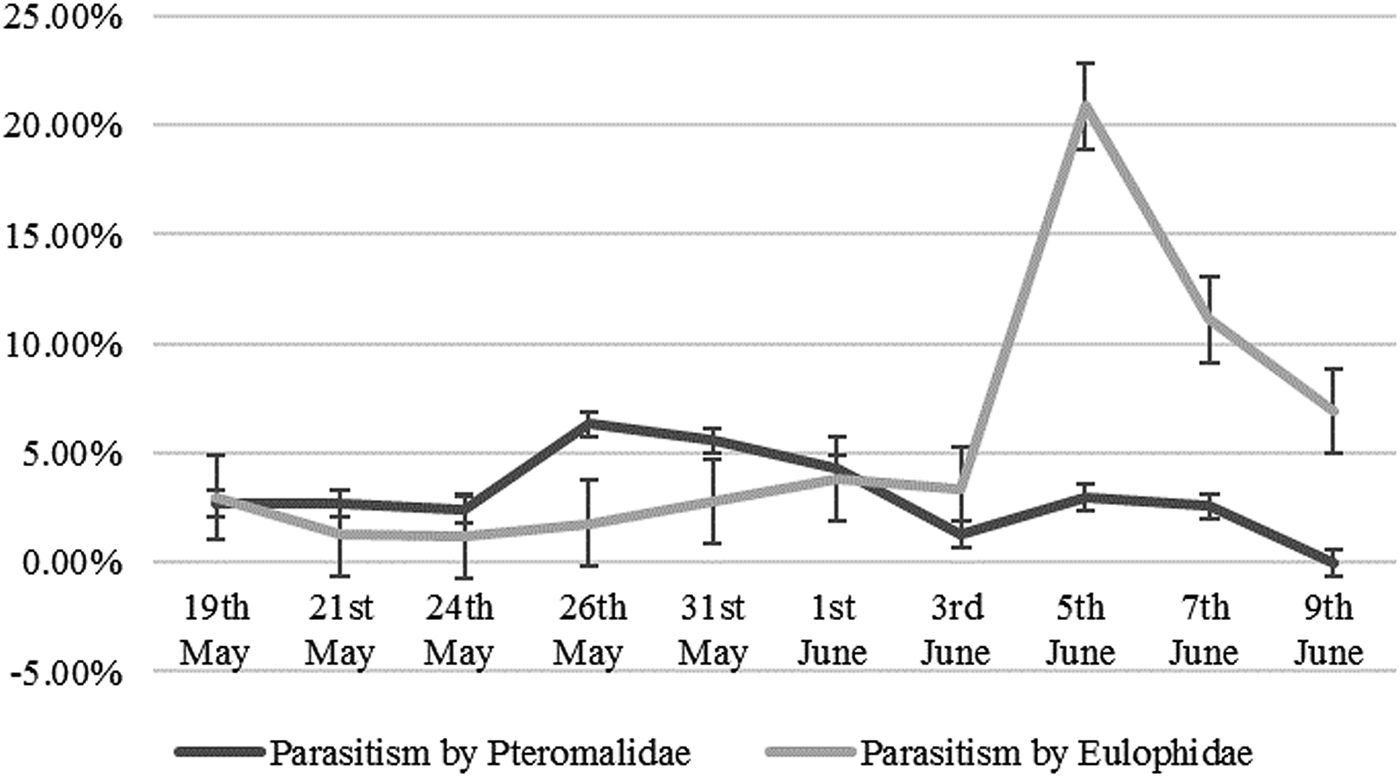
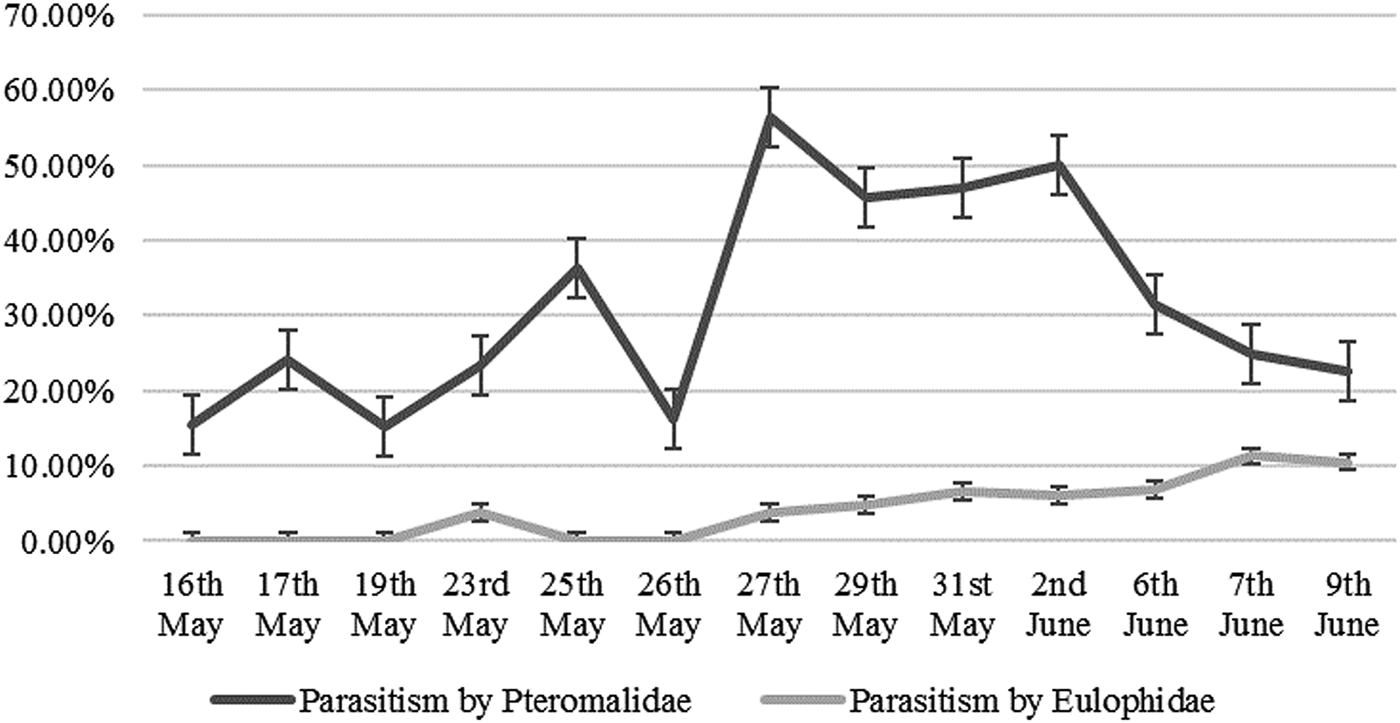
In 2015 and 2016, parasitism rates of O. steppensis were notably different between the Pteromalidae and Eulophidae (figs 4 and 5). In 2015, parasitism rate by Pteromalidae was much higher than that by Eulophidae from 19 May to 1 June (fig. 4). For the Pteromalidae species, the peak of parasitism (6%) was on 26 May and then it decreased. For the Eulophidae species, parasitism increased from 21 May to 5 June when its rate reached its peak (21%). In 2016, parasitism by Pteromalidae was much higher than that by Eulophidae all the time (fig. 5).
Parasitism rate of larvae and pupae of Orchestes steppensis in Urumqi by Pteromalidae and Eulophidae from 19 May to 9 June 2015.

Parasitism rate of larvae and pupae of Orchestes steppensis in Urumqi by Pteromalidae and Eulophidae from 16 May to 9 June 2016.

Discussion
Our results show that O. steppensis has only one generation per year in Xinjiang and that all the weevils in the ten collecting sites have the same life history (table 2) and damage elm leaves heavily.
We made a lot of efforts, as correct identification of the pest weevil was one of the primary goals of this study, to demonstrate that O. steppensis had been previously misidentified in China as either O. alni (Wang & Chen, Reference Wang and Chen1981; Zhao et al., Reference Zhao, Jin, Zhu, Bai, Zhao and Yang1996; Si et al., Reference Si, Shao, Shi, Liu and Dong1997; Li, Reference Li1999; Zhang et al., Reference Zhang, Xu and Shen2000) or O. mutabilis (Yang et al., Reference Yang, Yao, Che and Qi1996). In Xinjiang, voucher specimens of O. alni from the study by Zhao et al. (Reference Zhao, Jin, Zhu, Bai, Zhao and Yang1996) were reported to be deposited both in the collection of Xinjiang Agricultural University in Urumqi and at the Plant Protection Station in Changji. We have contacted the current researchers responsible for the insect collections in both these institutions, but unfortunately no voucher specimens of ‘O. alni’ could be located there. However, the first author of this communication has collected in the same locality in Xinjiang (North Park in Changji) that had been mentioned in the study by Zhao et al. (Reference Zhao, Jin, Zhu, Bai, Zhao and Yang1996), and only O. steppensis was found there. In addition, we also contacted Zhiliang Wang of the Institute of Zoology, Chinese Academy of Sciences, Beijing, China (CAS) and asked him to look for the specimens identified as O. alni from other parts of China. He compared these specimens with our positively identified adults of O. steppensis from Xinjiang, and they were identical. Later, Li Ren from the same institution provided us the following data on these specimens in CAS (one specimen from each locality): Gansu Province, Lanzhou, 27.vi.1955, Yong-lin Chen; Hebei Province, Wuling Mountain, 4.vi.1981, Pei-yu Yu; Inner Mongolia Autonomous Region, Huhhot, 18.v.1965, Hong-chang Li; Jilin Province, Lishu County, vi.1965, Wen-zhen Ma; Ningxia Hui Autonomous Region, Lingwu, 30.vi.1985; Shandong Province, Taishan, 6.vi.1979, Shu-yong Wang; Sichuan Province, Chengdu, 25.v.1984. Photographs of these weevil specimens were sent to Dr Boris A. Korotyaev who confirmed their identity as O. steppensis (Korotyaev, Reference Korotyaev2016).
For the voucher specimens of O. mutabilis, we have tried to contact Li-Ming Yang from the Northeast Forestry University in Harbin, Heilongjiang Province, who reported it from there (Yang et al., Reference Yang, Yao, Che and Qi1996), but he has been retired for almost twenty years. Then we contacted the current researcher responsible for the insect collection of Northeast Forestry University; however, unfortunately no voucher specimens of ‘O. mutabilis’ were found there. But we compared our specimens of O. steppensis from Xinjiang with the description of ‘O. mutabilis’ from Harbin given by Yang et al. (Reference Yang, Yao, Che and Qi1996) and found them to be identical. As mentioned above, it is actually unknown whether O. steppensis is native to northeastern China, but that is quite likely.
Seven parasitoid species were reared in Xinjiang from elm leaves infested with O. steppensis (table 3), all reported here for the first time for this host weevil. Among them, Pnigalio sp. near tricuspis is likely to be a new species; however, it is not described here as a new taxon because for the time being we cannot diagnose it properly, at least until the Palaearctic species of this genus are thoroughly revised, and also because only just one specimen is available. It is reported elsewhere that several other species of the genus Pnigalio Schrank are known to parasitize Orchestes spp., for instance P. mediterraneus Ferrière & Delucchi was reared from an Orchestes sp. in the UK (Noyes, Reference Noyes2016). P. varians and B. servadeii are newly recorded here from China, and C. pentheus is for the first time reported from Xinjiang.
Currently, taxonomy of the Palaearctic species of the genus Pteromalus Swederus is in flux, so both Pteromalus (Pteromalus) spp. 1 and 2 cannot be positively identified to species. We unsuccessfully tried to identify them using the key by Dzhanokmen (Reference Dzhanokmen1998), which we also used to identify P. (Habrocytus) varians. They are definitely not the same species that were recently reported by Yao & Yang (Reference Yao and Yang2008) from another weevil in China. To reveal their identity, a separate, thorough taxonomic investigation would be required but that is beyond the scope of this study, but one would be definitely facilitated by our voucher specimens.
So far, parasitism of O. steppensis is still low in Xinjiang, while proportion of each species responsible for it varied from 2014 to 2016; only that of Aprostocetus (Aprostocetus) sp. and Pteromalus sp. 2 increased from 3.4 to 8.7% and from 18.2 to 83.3%, respectively. Our results show that Pteromalus sp. 2 is the dominant and also the most competitive species among the seven parasitoids and therefore it can be considered to be a perspective biological control agent against O. steppensis.
Among the parasitoids, Pteromalus sp. 2 and C. pentheus were the most common species attacking larvae of O. steppensis in Urumqi, while all species of Pteromalus can attack its pupae. P. varians is also distributed in Europe and Kazakhstan, parasitizing six different other leafminer hosts (Todorov et al., Reference Todorov, Toshova and Tóth2014). It is likely to prefer mostly curculionid beetles as hosts, parasitizing at least four species of Anthonomus Germar (Noyes, Reference Noyes2016). O. steppensis is a new host record for this species. C. pentheus is widely distributed in the Holarctic region where it also known to attack eight other species of Curculionidae (Noyes, Reference Noyes2016).
Because control of this apparently invasive pest by the local natural enemies in Xinjiang is still currently inefficient (even though in 2016 parasitism was about 36% on U. pumila in Urumqi), the potential for a classical biological control program against it needs to be further investigated. Thus, we recommend that a survey of its parasitoids and other natural enemies be conducted in the presumptive native range of O. steppensis in southeastern Siberia (Russia), eastern Mongolia, and also northwestern China, to assess the possibility of introductions of parasitoids that co-evolved with this host to Xinjiang and potentially also North America.
Acknowledgements
Funding for research was supported by the National Natural Science Foundation of China (U1170305) and the Graduate Student Research Innovation Project in Xinjiang University (XJGRI2015022). We thank Drs Boris A. Korotyaev and Andrei A. Legalov for providing identifications of the weevil, which were critical for this study, and also Drs Roger A. Burks (UCRC), Christer Hansson (Museum of Biology (Entomology), Lund University, Lund, Sweden), Marco Gebiola (Department of Entomology, University of Arizona, Tucson, Arizona, USA), Zoya A. Yefremova (Department of Zoology, Tel-Aviv University, Ramat Aviv, Israel), and Hui Xiao (CAS) for their kind help in parasitoid identifications. We also thank Yong Han and Alimire Aibulikemu (Xinjiang University, Urumqi) for assistance in collecting and rearing, Zhi-liang Wang (CAS) and Li Ren (CAS) for help with locating specimens of the weevil, as well as Qing-song Zhou (CAS) for improving the tables and taking the photographs of the beetles from other parts of China. Dr Doug Yanega (UCRC) kindly reviewed the manuscript prior to its submission.