1. Introduction
Mandarin Chinese (henceforth MC) is a language that permits more than one modal in a sentence.Footnote 2 The examples in (1)–(4) illustrate.
(1) Zhangsan keneng lai.Zhangsan be.likely.to come‘Zhangsan is likely to come.’
(2) Zhangsan kenenghui lai.Zhangsan be.likely.to will come‘It is likely that Zhangsan will come.’
(3) Zhangsan kenenghuinenggou lai.Zhangsan be.likely.to will be.able.to come‘It is likely that Zhangsan will be able to come.’
(4) Zhangsan yinggaikenenghuinenggou lai.Zhangsan should be.likely.to will be.able.to come‘It should be the case that it is likely that Zhangsan will be able to come.’
In MC, sentences with two modals are very common. Sentences with three or more modals occur less commonly, and their acceptability decreases with an increase in the number of modals. Thus, though (3) is relatively fine to most native speakers of MC, (4) can be harder to accept.Footnote 3 But this does not necessarily mean that there is an upper bound to the number of modals permitted in an MC sentence; it is likely that (4) is grammatical but poses processing difficulties for speakers, resulting in relatively lower acceptability. At any rate, the examples in (1)–(4) show that multiple-modal sentences in MC are generally grammatical.
However, the modals in an MC sentence must be ordered in specific ways. For instance, if the order of the two modals in (2) is reversed, the resulting sentence is ungrammatical; likewise, a different ordering of the modals in (4) results in ungrammaticality.
(5) *Zhangsan huikeneng lai.Zhangsan will be.likely.to come
(6) *Zhangsan yinggaikenengnenggouhui lai.Zhangsan should be.likely.to be.able.to will come
Thus, multiple-modal constructions in MC are subject to ordering restrictions. What are those restrictions? This paper explores this question. Specifically, it is shown that in addition to common semantic factors, the well-formedness of multiple-modal constructions in MC has a direct bearing on the finiteness of the complement clauses of the modals. This paper makes the following two proposals. First, modals in MC take a clausal complement, which I assume is a TP; it can be finite or nonfinite. Second, the complementation relation between two modals in MC is sensitive to the finiteness of the TP complement of the higher modal. For instance, the possibility modal keneng ‘be likely to’ can only occur in a finite clause; in contrast, the future modal hui ‘will’ may occur in a finite or nonfinite clause. The sensitivity to finiteness accounts for some of the ordering restrictions on MC modals which do not seem to be amenable to other semantic explanations.
If these proposals are correct, then MC clauses exhibit the finite/nonfinite contrast. There have been debates on whether MC clauses have the syntactic projection TP, and whether they exhibit the finite/nonfinite contrast; see Huang Reference Huang1982; Li Reference Li1990; Tang Reference Tang1990; Tang Reference Tang2000; Hu, Pan & Xu Reference Hu, Pan and Xu2001; J.-W. Lin Reference Lin2003, Reference Lin2006, Reference Lin2010; Sybesma Reference Sybesma2007; among others. One may suppose that since TP is a member of the Core Functional Categories (CFC; Chomsky Reference Chomsky and Kenstowicz2001), the null hypothesis would be that it occurs in all languages (Fukui Reference Fukui, Shibatani and Bynon1995). But this is just a hypothesis, and it requires empirical validation. In this regard, MC offers an interesting test ground. Mandarin Chinese is a language without morphological tense. However, lack of morphological tense does not entail that the syntactic category TP does not exist in this language. This paper shows that the assumption that MC has TP and the hypothesis that TP in MC exhibits the finite/nonfinite contrast provide an explanation for some of the ordering restrictions on modals in MC sentences. The analysis of this paper, therefore, will contribute to the above-mentioned debate, and also to the understanding of functional categories, in particular the existence of a possibly uniform set of CFCs in natural languages.
The paper is organized as follows. Sections 2 and 3 examine modals in MC and their occurrence in multiple-modal constructions. Section 4 presents evidence to show that epistemic modals in MC, in particular the possibility modal keneng ‘be likely to’, are verbs rather than adverbs. Section 5 discusses the distribution and interpretations of the element yao ‘(lit.) want’. Section 6 introduces the theory of T.-H. J. Lin Reference Lin2011, which argues for the existence of TP and the finite/nonfinite contrast in MC. Sections 7 and 8 analyze the ordering restrictions of modals in MC sentences and the distribution and interpretations of the element yao. Section 9 is the conclusion. There are also two appendices: Appendix A presents evidence to show that the sentence-final particle le denotes the perfect aspect; Appendix B provides a brief discussion of the scope properties of the possibility modal keneng ‘be likely to’.
Types of modals in MC
Table 1 presents a summary of the different types of modals and aspectual auxiliaries in MC.Footnote 4 Following Palmer (Reference Palmer1990), I divide the modals in MC into three general types: the epistemic modals (possibility and necessity), the deontic modals (obligation), and the dynamic modals (ability, permission, and volition). The latter two are also called the ‘root modals’ (see von Fintel Reference von Fintel and Borchert2006). I separate the future modal hui ‘will’ and the aspectual auxiliaries yao ‘(lit.) want’ and zai ‘(lit.) at’ as independent types, because their distributions are different from the other modal verbs.
Types of modals and aspectual auxiliaries in Mandarin Chinese.

Two points should be noted at this stage. First, like many other languages, a modal in MC may assume more than one reading (see Butler Reference Butler2003 among many others). For instance, yinggai ‘should’ may assume an epistemic reading or a root (deontic) reading; this is also the case with keyi ‘be permitted to’, which can assume a root reading or an epistemic reading (Lin & Tang Reference Lin and Jane Tang1995). But the ambiguity of modals in MC appears to be more extensive. Hsieh (Reference Hsieh2004) observes that the modal hui ‘will’ has three different uses, and Hsieh & Lin (Reference Hsieh and Lin2003) observe that yao ‘(lit.) want’ has at least five different uses.Footnote 5 See the examples in (7)–(9) for the three uses of hui ‘will’, and (10)–(14) for the five uses of yao ‘(lit.) want’.
(7) Zhangsan hui youyong. (ability)Footnote 6Zhangsan will swim‘Zhangsan can swim.’
(8) Zhangsan mingtian hui lai. (future)Zhangsan tomorrow will come‘Zhangsan will come tomorrow.’
(9) Xiong hui dongmien. (generalization)Footnote 7bear will hibernate‘Bears hibernate.’
(10) Zhangsan yao qian. (main verb)Zhangsan want money‘Zhangsan wants money.’
(11) Zhangsan yao hui jia. (control verb)Zhangsan want return home‘Zhangsan wants to go home.’
(12) Zhangsan mingtian yao qu Taibei. (aspectual auxiliary)Zhangsan tomorrow want go Taipei‘Zhangsan is going to Taipei tomorrow.’
(13) Zhangsan yao lai, fouze ta hui you mafan. (obligation modal)Zhangsan want come otherwise he will have trouble ‘Zhangsan must come, otherwise he will be in trouble.’
(14) Yao ma ni lai, yao ma wo qu. (conditional marker)want prt you come want prt I go‘Either you come, or I go.’
We will not go into the question of why there is such extensive ambiguity with MC modals. However, the multiple readings of the element yao ‘(lit.) want’ will be an important topic in later discussion.
The second point to note is that, J.-W. Lin & Tang (Reference Lin and Jane Tang1995) argue convincingly that modals in MC are verbs, and they take a clausal complement, specifically a CP (in GB terms, S'). The authors also argue that epistemic modals are raising predicates, and root modals are control predicates. In current grammatical theory, raising predicates are assumed to take a TP complement; besides, Bošković (Reference Bošković1997) argues that control predicates also take a TP complement. I therefore assume that modals in MC, epistemic and root alike, take a TP complement.
3. Multiple modals in MC sentences
In the above discussion we saw that the linear order of modals in MC sentences is restricted. In this section we look at the restrictions in more detail.
Epistemic modals
Epistemic modals precede dynamic modals, as is shown in (15)–(16). Keneng ‘be likely to’ must precede keyi ‘be permitted to’; the reverse order is ungrammatical.
(15) Zhangsan kenengkeyi lai.Zhangsan be.likely.to be.permitted.to come‘It is likely that Zhangsan is permitted to come.’
(16) *Zhangsan keyikeneng lai.Zhangsan be.permitted.to be.likely.to come
3.2 The future modal
The future modal hui ‘will’ follows epistemic modals but precedes dynamic modals, as is shown in (17)–(20). As a result, hui ‘will’ may be sandwiched by an epistemic modal and a dynamic modal, as in (21).
(17) Zhangsan kenenghui lai.Zhangsan be.likely.to will come‘It is likely that Zhangsan will come.’
(18) *Zhangsan huikeneng lai.Zhangsan will be.likely.to come
(19) Zhangsan huinenggou lai.Zhangsan will be.able.to come‘Zhangsan will be able to come.’
(20) *Zhangsan nenggouhui lai.Zhangsan be.able.to will come
(21) Zhangsan kenenghuinenggou lai.Zhangsan be.likely.to will be.able.to come‘It is likely that Zhangsan will be able to come.’
3.3 The necessity modal
The necessity modal yinggai ‘should’ precedes the possibility modal keneng ‘be likely to’; the reverse order is ungrammatical:Footnote 8
(22) Zhangsan yinggaikeneng lai.Zhangsan should be.likely.to come‘It should be the case that Zhangsan is likely to come.’
(23) *Zhangsan kenengyinggai lai le.Zhangsan be.likely.to should come perf
3.4 The deontic modal and epistemic modals
The possibility modal keneng ‘be likely to’ may precede or follow the deontic modal bixu ‘must’; see (24)–(25). But the necessity modal yinggai ‘should’ must precede bixu ‘must’; see (26)–(27).
(24) Zhangsan kenengbixu lai.Zhangsan be.likely.to must come‘It is likely that Zhangsan must come.’
(25) Zhangsan bixukeneng lai (fouze jihua hui shibai).Zhangsan must be.likely.to come otherwise plan will fail‘It has to be the case that Zhangsan is likely to come (otherwise the plan will fail).’
(26) Zhangsan yinggaibixu lai.Zhangsan should must come‘It should be the case that Zhangsan must come.’
(27) *Zhangsan bixuyinggai lai le.Zhangsan must should come perf
3.5 The deontic modal and dynamic modals
The deontic modal bixu ‘must’ precedes the dynamic modals; the reverse order is ungrammatical, as (28)–(29) show.
(28) Zhangsan bixunenggou lai.Zhangsan must be.able.to come‘Zhangsan must be able to come.’
(29) *Zhangsan nenggoubixu lai.Zhangsan be.able.to must come
3.6 The deontic modal and the future modal
The order of the deontic modal bixu ‘must’ and the future modal hui ‘will’ is free; namely, either one may precede the other.
(30) Zhangsan bixuhui lai.Zhangsan must will come‘It has to be the case that Zhangsan will come.’
(31) (Zong you yi tian,) Zhangsan huibixu xiang wo daoqian.overall have one day Zhangsan will must toward me apologize‘(Some day in the future) Zhangsan will have to apologize to me.’
3.7 Dynamic modals
Co-occurrences of dynamic modals are ungrammatical, perhaps due to semantic conflicts (ability cannot be permitted, for example).
(32) *Zhangsan nenggoukeyi lai.Zhangsan be.able.to be.permitted.to come
(33) *Zhangsan keyinenggou lai.Zhangsan be.permitted.to be.able.to come
3.8 Summary
These ordering restrictions clearly indicate that there is a hierarchy of modals in the syntactic structure of MC sentences. The hierarchy is as follows:
(34)


This hierarchy gives rise to interesting questions. For instance: Why can the deontic modal precede the possibility modal, while all other root modals must follow it? Why can the future modal hui ‘will’ precede the deontic modal bixu ‘must’, but at the same time it has to follow the possibility modal keneng ‘be likely to’, when bixu ‘must’ actually can precede keneng ‘be likely to’? These questions are intriguing and need explanations. We will turn to them in Section 7.
4. Epistemic modals as verbs
In this section we digress to an important question: the categorial status of epistemic modals in MC. An anonymous JL referee reminds of the possibility that epistemic modals in MC could actually be adverbs when they occur in multiple-modal sentences. However, there are reasons to believe that they are verbs rather than adverbs, in single-modal and multiple-modal sentences alike. We will look at the possibility modal keneng ‘be likely to’ as an example. (The necessity modal yinggai ‘should’, as will be shown in Section 7.1, is a strong evidential element and thus is ‘extra-propositional’; see Drubig Reference Drubig2001 and von Fintel & Gillies Reference von Fintel and Gillies2006. Being a strong evidential element, it cannot fall under the scope of any other operator. As a result, it is very difficult to come up with reliable tests to show that it is a verb. But this does not undermine its status as a verb, because the necessity modal must in English behaves in the same way. See Section 7 for more details.)
First of all, keneng can be questioned, negated, and used as a short answer to a question. These are the criteria used by Lin & Tang (Reference Lin and Jane Tang1995) to show that modals in MC are verbs. In (35) keneng takes the A-not-A form, which is a disjunctive question construction in MC. In (36) keneng is negated. In (37) it is used as a short answer to the question (35).
(35) Zhangsan keneng- bu-keneng lai?Zhangsan be.likely.to- not-be.likely.to come‘Is it likely for Zhangsan to come?’
(36) Zhangsan bu keneng lai.Zhangsan not be.likely.to come‘It is not likely for Zhangsan to come.’
(37) Keneng.be.likely.to‘[Zhangsan] is likely to [come].’
Second, in marked contexts, e.g. when it is negated, keneng can fall inside the scope of the sentence-final perfect particle le and acquire a change-of-state meaning. (For a discussion of the particle le, see Appendix A.) This indicates that keneng is a verb, not an adverb, because only a verb gets the change-of-state meaning (see Appendix B).Footnote 9
(38) Women bukeneng zai jianmien le.we not be.likely.to again meet perf‘We cannot [=become not likely to] meet anymore.’
Third, keneng can fall within the scope of the focus adverb zhi ‘only’, as in (39). The adverb zhi ‘only’ is low in the structure and presumably adjoins to vP or VP.
(39) Zhangsan zhikeneng jie shu, bu keneng mai shu.Zhangsan only be.likely.to borrow book not be.likely.to buy book‘Zhangsan may only borrow a book; he is unlikely to buy a book.’
The evidence is the contrast between (40) and (41).
(40) Zhangsan zhiqingqing peng ta yi-xia, ta jiu ku le.Zhangsan only slightly touch him one-time he then cry perf‘Zhangsan only slightly touched him once, and then he cried.’
(41) *Zhangsan zhizuotian lai, mingtian bu hui lai.Zhangsan only yesterday come tomorrow not will comeIntended: ‘Zhangsan only came yesterday; he will not come tomorrow.’
In (40) zhi precedes the VP-level adverb qingqing ‘slightly’, and the sentence is grammatical; in (41) it precedes the TP-level time adverb zuotian ‘yesterday’, but the sentence is ungrammatical. As keneng can be preceded by zhi’, this indicates that keneng is low in the structure too. If it is an epistemic adverb, presumably it should be at least as high as T, because an epistemic adverb takes the whole proposition as its scope. The fact that keneng is low in the structure casts doubt on the hypothesis that it is an adverb. But if keneng is a verb, then its low structural position poses no problem.
Next we turn to keneng in multiple-modal sentences. Again, there are reasons to believe that it is still a verb. First, uniformity and parsimony considerations lead us to expect that keneng is still a verb in multiple-modal sentences. Second, it can be questioned, negated, and serve as a short answer, as in (42)–(44).Footnote 10 Third, it can fall under the scope of the adverb zhi ‘only’, as in (45).
(42) Zhangsan keneng-bu-kenenghui lai?Zhangsan be.likely.to-not-be.likely.to will come‘It is likely for Zhangsan to come?’
(43) Zhangsan bukenenghui lai.Zhangsan not be.likely.to will come‘It is not likely for Zhangsan to come.’
(44) Q: Zhangsan kenenghui lai ma?Zhangsan be.likely.to will come q‘It is likely for Zhangsan to come?’
A: Keneng.be.likely.to‘[Zhangsan] is likely to [come].’
(45) Zhangsan zhikenenghui jie shu, bu keneng hui mai shu.Zhangsan only be.likely.to will borrow book not be.likely.to will buy book‘Zhangsan may only borrow a book; he is unlikely to buy a book.’
Let us compare keneng with two epistemic adverbs, haoxiang ‘seemingly’ and dagai ‘probably’. These two adverbs can occur with the future modal hui ‘will’, just like keneng; but they cannot be questioned or negated, nor can they fall within the scope of the focus adverb zhi ‘only’; see (46)–(48).
(46) *Zhangsan haoxiang /dagai-bu-haoxiang / dagai hui lai?Zhangsan seemingly probably-not-seemingly probably will come
(47) *Zhangsan buhaoxiang / dagai hui lai.Zhangsan not seemingly probably will come
(48) *Zhangsan zhidagai / haoxiang hui jie shu.Zhangsan only probably seemingly will borrow book
One more reason to believe that keneng is a verb rather than an adverb is that the alleged counterarguments against keneng as a verb can usually be subject to alternative analyses, or are simply irrelevant. In what follows we look at two examples.
A JL referee suggests an argument against keneng as a verb. The sentence in (49) is an interrogative sentence, with haoxiang ‘seemingly’, dagai ‘probably’, and keneng preceding hui ‘will’. The first two elements are known to be adverbs. The referee points out that if the adverbs are used as the short answer to the question, the presence of the copula verb shi ‘be’ is obligatory, as in (50); on the other hand, if keneng is used as the short answer, then the copula shi is optional, as in (51). Why is the copula shi necessary for haoxiang ‘seemingly’ and dagai ‘probably’? According to the referee, this is because they are adverbs, and they need a verbal host for adjunction.Footnote 11 The fact that keneng can occur with the copula shi (as in (51)), the referee suggests, shows that it has a usage as an adverb. A true modal, according to the referee, does not occur with the copula shi, as in (52). Therefore, keneng in (49) can be an adverb.
(49) Ta haoxiang / dagai / keneng hui qu Taibei ma?he seemingly probably be.likely.to will go Taipei q‘Does it seem that he is going to Taipei?/Is he probably going to Taipei?/Is it likely that he is going to Taipei?’
(50) Haoxiang / Dagai *(shi).seemingly probably be‘It seems so./Probably so.’
(51) Keneng (shi).be.likely.to be‘It is likely so.’
(52) Q: Ni yao qu Taibei ma?you want go Taipei q‘Do you want to go to Taipei?’
A: Yao / *Yao shi.want want be‘[I] want [to go to Taipei].’
The problem with this argument is that it assumes that the occurrence of the copula shi in such sentences is only for the purpose of providing a verbal host for the adjunction of the adverb. But this is not necessarily the case. In fact, the copula shi can be a ‘pro-proposition’. Consider the following examples:
(53) Ta hui qu Taibei ma?he will go Taipei q‘Will he go to Taipei?’
(54) Zhangsan renwei shi.Zhangsan think be‘Zhangsan thinks so.’
The example in (54) is an answer to the question (53). In this example the embedded copula shi clearly represents the proposition ‘He will go to Taipei’ and thus behaves as a pro-form for the proposition. Note that this use of shi should not be confused with the affirmative word shi ‘yes’, as in (55), because embedding (55) into (54) results in unacceptability, as in (56).
(55) Shi, ta hui qu Taibei.yes he will go Taipei‘Yes, he will go to Taipei.’
(56) *Zhangsan renwei shi, ta hui qu Taibei.Zhangsan think yes he will go TaipeiIntended: ‘Zhangsan thinks yes, he will go to Taipei.’
The same pro-proposition use of shi is seen in the following example:
(57) (Zhangsan xihuan na-ben shu ma?) Ruguo shi dehua, wo jiu mai gei ta.Zhangsan like that-cl book q if be top I then buy give him‘(Does Zhangsan like that book?) If so, I will buy and give it to him.’
In this example shi is flanked by the conditional operator ruguo ‘if’ and the topic marker dehua. This is the position for the antecedent clause of the conditional construction. Thus, shi in this example must be a pro-form for a proposition.
Given the above considerations, it is likely that shi in (51) is a pro-proposition, and the expression keneng shi is to be analyzed as involving an empty subject followed by keneng as the main verb, which then is followed by shi as the pro-form of the complement clause. This alternative analysis is particularly attractive in view of potential problems that the ‘support for adjunction’ analysis would have to face. First, in English, an adverb can be used as a short answer, as in (58). Why is MC different? Second, though a single epistemic adverb in MC may not sound good as a short answer to a question, it does not really need to occur with a verb. A sentence-final mood particle can make it perfectly acceptable too, as in (59) (the particle ba represents mild agreement). It makes no sense to say that in this example the adverb adjoins to the mood particle, because, among other reasons, the mood particle itself also needs to encliticize to some other element.
(58) Q: Does John like Bill?A: Probably.
(59) Q: Zhangsan xihuan Lisi ma?Zhangsan like Lisi q‘Does Zhangsan like Lisi?’
A: Dagai ba.probabluy mood‘Probably[, I guess].’
Thus, the ‘support for adjunction’ analysis is clearly less favorable than the ‘pro-proposition’ analysis. The ‘pro-proposition’ analysis appears to be even more plausible if we consider the claim to be made in the next section – that epistemic modals in MC take a finite clause as complement, and root modals in MC take a nonfinite clause as complement. If shi represents a proposition, and if a finite clause denotes a proposition, then shi certainly can replace and represent the complement clause of keneng. On the other hand, a root modal, such as yao ‘want’ in (52), takes a nonfinite clause as complement. The nonfinite complement of the root modal in MC is a control clause denoting a propositional function (the empty subject PRO translates into an open place). Shi is a pro-form for a proposition, not for a propositional function. This is why the volitional modal yao ‘want’, and root modals in general, cannot occur with shi.
In conclusion, the co-occurrence with the copula shi does not provide evidence for the claim that keneng is an adverb.
The second counterargument has to do with the preposing of the complement of keneng.Footnote 12 Let us first look at (60), which is a sentence with two modals, keneng and hui ‘will’. In (61) hui ‘will’ is preposed along with its complement, leaving keneng in the original position. However, this example is ungrammatical. The argument goes like this: the ungrammaticality of (61) would be hard to explain if keneng is a verb, since a modal verb in MC generally permits preposing of its complement, as in (62)–(63). But if keneng is an adverb, then the ungrammaticality of (61) receives a natural explanation, because keneng has to adjoin to the modal verb hui ‘will’, and the preposing of hui ‘will’ makes the adjunction impossible.
(60) Zhangsan kenenghui qu Taibei.Zhangsan be.likely.to will go Taipei‘Zhangsan is likely to go to Taipei.’
(61) *Hui qu Taibei, Zhangsan keneng.will go Taipei Zhangsan be.likely.to
(62) Zhangsan keyi qu Taibei.Zhangsan be.permitted.to go Taipei‘Zhangsan is permitted to go toTaipei.’
(63) Qu Taibei, Zhangsan keyi.go Taipei Zhangsan be.permitted.to‘Go to Taipei, Zhangsan is permitted to.’
The problem with this argument is that the ungrammaticality of (61) is, in fact, irrelevant to whether or not keneng is an adverb. Consider (64)–(65), in which the modals are hui ‘will’ and nenggou ‘be able to’.
(64) Zhangsan (mingtian) hui nenggou qu Taibei.Zhangsan tomorrow will be.able.to go Taipei‘Zhangsan will be able to go to Taipei (tomorrow).’
(65) *Nenggou qu Taibei, Zhangsan (mingtian) hui.be.able.to go Taipei Zhangsan tomorrow will
Again, the preposing of the complement of hui ‘will’ results in ungrammaticality, even though hui ‘will’ and nenggou ‘be able to’ are generally assumed to be verbs. It seems that the real generalization is that modals in a sequence cannot be broken up by syntactic operations such as movement. It is not clear why such breaking up leads to ungrammaticality, but one thing is sure: it has nothing to do with whether the first modal is a verb or an adverb.
In conclusion, there is good reason to assume that epistemic modals in MC are verbs. The alleged counterarguments do not really provide sufficient evidence to refute this claim. Thus, in what follows, I will keep to this position and assume that epistemic modals in MC are verbs.
5. The distribution and interpretations of yao ‘want’
Let us now turn to a different set of phenomena: the multiple interpretations of the element yao ‘(lit.) want’. The literal meaning of yao is ‘want’, as illustrated in (10) above, but it can assume other readings, including the control reading, as in (11), the aspectual reading, in (12), the obligation reading, in (13), and the conditional reading, in (14). It should be noted, however, that yao cannot just assume any reading in any syntactic position; its interpretation is restricted by the context in which it occurs. In particular, the reading of yao is crucially affected by the modal(s) that it occurs with.
In the following discussion, we will only be concerned with the obligation, aspectual, and control readings of yao; we will not be concerned with the verbal and conditional readings.
In the remainder of this section, we consider the distribution and interpretations of yao as it interacts with different types of modals.
5.1 Interaction with epistemic modals
Yao may precede or follow the possibility modal keneng ‘be likely to’, but it can only follow the necessity modal yinggai ‘should’; see (66)–(68). When it precedes the possibility modal, yao assumes the obligation reading only, as in (67). But when it follows the possibility and necessity modals, it can assume the obligation reading, the aspectual reading, or the control reading, as in (66).
(66) Zhangsan keneng / yinggai yao lai.Zhangsan be.likely.to should want come‘It is likely/should be the case that Zhangsan has to/is going to/want to come.' (yao: obligation, aspectual, or control reading)
(67) Zhangsan yao keneng lai (cai xing), (fouze jihua hui shibai).Zhangsan want be.likely.to come only fine otherwise plan will fail‘It has to be the case that Zhangsan is likely to come, (otherwise the plan will fail.)’ (yao: obligation reading)
(68) *Zhangsan yao yinggai lai le.Zhangsan want should come perf
5.2 Interaction with the deontic modal
Yao may precede or follow the deontic modal bixu ‘must’. In the former case it assumes the obligation reading; in the latter it may assume the obligation, aspectual, or control reading.
(69) Si-zhong ren yao bixu jingchang he niunai. (www.eyny.com/thread-575748-1-1.html, 26 April 2009)four-kind people want must frequently drink milk‘Four kinds of people must drink milk frequently.’ (yao: obligation reading)
(70) Zhangsan bixu yao lai.Zhangsan must want come‘It has to be the case that Zhangsan has to/is going to/want to come.’ (yao: obligation, aspectual, or control reading)
5.3 Interaction with the future modal
Yao may precede or follow the future modal hui ‘will’. When it precedes hui, it assumes the obligation reading; see (71). When it follows hui, it can only assume the obligation reading or the control reading; see (72).Footnote 13
(71) Zhangsan yao hui lai.Zhangsan want will come‘It has to be the case that Zhangsan will come.’ (yao: obligation reading)
(72) (Zhong you yi tian,) Zhangsan hui yao xiang wo daoqian.overall have one.day Zhangsan will want to me apologize‘(Some day in the future) Zhangsan will have to apologize to me.’ (yao: obligation or control reading)
5.4 Interaction with dynamic modals
Yao may precede the ability, permission, and volition modals, assuming the obligation reading, as in (73). It may also follow them, assuming the control reading, as in (74).Footnote 14
(73) Zhangsan yao nenggou/keyi/yuanyi lai.Zhangsan want be.able.to/be.permitted.to/be.willing.to come‘Zhangsan has to be able/permitted/willing to come.’ (yao: obligation reading)
(74) Zhangsan nenggou/keyi/yuanyi yao hui jia (le)Zhangsan be.able.to/be.permitted.to/be.willing.to want return home perf‘Zhangsan (has become) able/permitted/willing to want to go home.’ (yao: control reading)
5.5 Summary
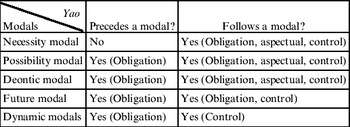
Table 2 summarizes the distribution and interpretations of yao as it interacts with different types of modals. At first sight, all this seems arbitrary, but in fact there are principles that govern the occurrences and meanings of yao. It will be shown in Section 8 that one of the principles involves the finiteness of the clause in which yao occurs.
The distribution and interpretations of yao with different modals.

6. Finiteness of the TP complements of modals
This section introduces the theory of T.-H. J. Lin (Reference Lin2011), which holds that MC has the syntactic category TP and that the TP in MC exhibits the finite/nonfinite contrast. This will lay the foundation for the discussions in the following sections.
A crucial piece of evidence for Lin's theory is the scope interaction between modals and the sentence-final perfect particle le, which roughly corresponds to the English aspectual auxiliary have, with a strong sense of change of state (see Appendix A). The phenomena are as follows. When le occurs in a sentence with an epistemic modal, it falls within the scope of the modal; when le occurs in a sentence with a root modal, the root modal falls within the scope of le; see (75)–(78) for illustration.Footnote 15
(75) Zhangsan [keneng [[qu Taibei] le]]. (keneng >le)Zhangsan be.likely.to go Taipei perf‘It is likely that Zhangsan has gone to Taipei.’
(76) *Zhangsan [[keneng [qu Taibei]] le]. (*le>keneng)Zhangsan be.likely.to go Taipei perf
(77) Zhangsan [[nenggou [qu Taibei]] le]. (le>nenggou)Zhangsan be.able.to go Taipei perf‘Zhangsan has [become] able to go to Taipei.’
(78) *Zhangsan [nenggou [[qu Taibei] le]]. (*nenggou >le)Zhangsan be.able.to go Taipei perf
T.-H. J. Lin (Reference Lin2011) follows Shen (Reference Shen2004) in assuming that MC has a functional projection AspP which hosts sentence-final aspectual particles. The particles come in two varieties: the dynamic aspectual particles, such as the perfect particle le and the progressive particle ne, and the static aspectual particle Ø, which is phonetically empty. Dynamic aspectual particles occur with dynamic predicates (activities, accomplishments, and achievements); the static aspectual particle Ø occurs with static predicates (states); see (79)–(81).
(79) Zhangsan [chi hanbao [Asp le]]. (the perfect le)Zhangsan eat burger perf‘Zhangsan has eaten the burger.’
(80) Zhangsan [chi hanbao [Asp ne]]. (the progressive ne)Zhangsan eat burger prog‘Zhangsan is eating the burger.’
(81) Zhangsan [xihuan Lisi [Asp Ø]]. (the static Ø)Zhangsan like Lisi‘Zhangsan likes Lisi.’
Lin suggests that AspP is the complement of TP. The sentence in (79), for example, has the structure in (82). (T.-H. J. Lin Reference Lin2006 argues that le triggers complement-to-specifier movement of the VP complement of AspP, and this is why it is sentence-final. See also Takida Reference Takida2009.)
(82)

Lin's argument goes as follows. The perfect particle le needs a reference time so as to fix the event time it denotes (see Reichenbach Reference Reichenbach1947, Hornstein Reference Hornstein1993). Presumably the reference time comes from T. If T does not have a value, that is, if it is nonfinite, then le is not licensed, as it does not get a reference time. On the other hand, if T has a value, that is, if it is finite, then le may occur, because it can obtain a reference time from T and therefore is licensed.Footnote 16 The contrast between epistemic modals and root modals pointed out above (in examples (75)–(78)) can be accounted for on this distinction. The diagrams in (83) and (84) illustrate the two different cases (TF=finite T; TNF=nonfinite T; stc=static aspect; arrows indicate reference time licensing):Footnote 17
(83)
(84)
In (83), the epistemic modal keneng ‘be likely to’ takes a finite TP complement. The head T of this TP complement has a value and thus le is licensed in this embedded TP. This is why le falls within the scope of keneng ‘be likely to’ (see Appendix B). On the other hand, in (84), the ability modal nenggou ‘be able to’ takes a nonfinite TP complement, whose head T does not have a value. The perfect particle le is not licensed in this embedded TP; therefore, if le is to occur in this sentence, it can only occur in the matrix Asp. This is why le has a wider scope than nenggou.
In summary, T.-H. J. Lin (Reference Lin2011) argues that epistemic modals in MC take a finite TP complement, and root modals take a nonfinite TP complement. Lin also examines the future modal hui ‘will’ and shows that it patterns with root modals; that is, it takes a nonfinite TP complement, even though it is a raising predicate on a par with epistemic modals. Consider (85), which shows that hui does not permit the perfect particle le in its complement clause.
(85) *Zhangsan hui [chi hanbao le].Zhangsan will eat burger perfIntended: ‘Zhangsan will have eaten the burger.’
Lin also observes that the deontic modal bixu ‘must’ can take either a finite TP or a nonfinite TP as complement. The examples in (86)–(87) illustrate this ambiguity: the perfect particle le can scope over bixu, as in (86), or be scoped over by it, as in (87). In (86) bixu takes a nonfinite TP complement and in (87) it takes a finite TP complement. Thus, bixu patterns with both epistemic modals and root modals.Footnote 18
(86) Zhangsan [[bixu likai] le].Zhangsan must leave perf‘It has become the case that Zhangsan must leave.’
(87) Zhangsan [bixu [likai le]].Zhangsan must leave perf‘It must be the case that Zhangsan has left.’
7. Accounting for the multiple-modal constructions in MC
In this section and next, we consider the following two questions: What factors cause the hierarchy of modals in (34)? How can the distribution and interpretations of yao ‘want’ be explained? We will see that the finiteness properties of the TP complements of the different kinds of modals play an important role in the answers to these questions.
7.1 Evidentiality of epistemic modals and finiteness generalizations
In Section 3 above, it was shown that modals in MC form a hierarchy ((34)), repeated here in (88).
(88)

At least some of the word orders in (88) are attested cross-linguistically and therefore may have a purely modal-semantic explanation. For instance, it appears to be the case across languages that epistemic modals are higher than root modals (see McDowell Reference McDowell1987, Brennan Reference Brennan1993, Butler Reference Butler2003, van Gelderen Reference van Gelderen2003, Barbiers Reference Barbiers, Everaert, Riemsdijk, Goedemans and Hollebrandse2006, among others). Besides, in (88), the necessity modal is higher than the possibility modal. Again, this appears to be universally true (see Butler Reference Butler2003, Barbiers Reference Barbiers, Everaert, Riemsdijk, Goedemans and Hollebrandse2006). This clearly has to do with the evidential nature of epistemic modals and their different evidential forces.
Drubig (Reference Drubig2001) and von Fintel & Gillies (Reference von Fintel and Gillies2006) propose that epistemic modals are evidentials. Drubig (Reference Drubig2001) specifically points out that, since evidentials express the speaker's certainty about the proposition, they are ‘extra-propositional’ and thus cannot be under the scope of any operator. Indeed, the necessity modal must in English cannot be negated (see (89)–(90)), cannot be under the scope of past tense ((91)), and cannot be embedded in a question ((92)–(93)).
(89) John must be rich.
(90) John must not be rich. (*necessity reading)
(91) Last night John must be here. (must >last night; *last night >must)
(92) John must like Bill.
(93) Must John like Bill? (*necessity reading)
The necessity modal yinggai ‘should’ in MC behaves in the same way – it cannot be negated, under the scope of past tense, or questioned; see (94)–(98).Footnote 19
(94) Zhangsan yinggai hen youqian.Zhangsan should very rich‘Zhangsan should be rich.’
(95) Zhangsan bu yinggai hen youqian. (*necessity reading)Zhangsan not should very rich‘Zhangsan should not be rich.’
(96) Zuo-wan Zhangsan yinggai zai zheli. (‘should’ >‘last night’; *‘last night’ >‘should’)last-night Zhangsan should at here ‘Last night Zhangsan should have been here.’
(97) Zhangsan yinggai xihuan Lisi.Zhangsan should like Lisi‘Zhangsan should like Lisi.’
(98) Zhangsan yinggai xihuan Lisi ma? (*necessity reading)Zhangsan should like Lisi q‘Should Zhangsan like Lisi?’
Drubig (Reference Drubig2001) also proposes that possibility modals are evidentials too, but von Fintel & Gillies (Reference von Fintel and Gillies2006: 11) point out that in English a possibility modal can be under the scope of some operators; see (99)–(101), which show that possibility modals in English can be negated, questioned, and embedded under the past tense.
(99) There can't have been a mistake. (negation >modal)
(100) Where might you have put the keys? (question >modal)
(101) The keys might have been in the drawer. (past >modal)
Again, the possibility modal keneng ‘be likely to’ in MC behaves in the same way; see (102)–(104).
(102) Zhangsan bu keneng lai. (negation>modal)Zhangsan not be.likely.to come‘Zhangsan is not likely to come.’
(103) Zhangsan keneng lai ma? (question >modal)Zhangsan be.likely.to come q‘Is Zhangsan likely to come?’
(104) Zhangsan qu-nian hai keneng mai fangzi, jin-nian shi bu keneng le. (past >modal)Zhangsan last-year still be.likely.to sell house this-year be not likely.to perf‘Last year it was still possible for Zhangsan to sell the house; this year it has become not possible.’
These examples indicate that, even though necessity modals and possibility modals may both be evidentials, their evidential force can differ: the former is stronger than the latter. In other words, the necessity modal is more ‘extra-propositional’ than the possibility modal. This results in the order Necessity>Possibility in (88).
However, such modal-semantic factors do not seem to provide explanations of some of the questions arising from the hierarchy in (88). For example, why are epistemic modals higher than hui ‘will’? This question arises because hui ‘will’ is epistemic-like (see Palmer Reference Palmer1990). Why can it not be higher than, say, the possibility modal keneng ‘be likely to’? This is all the more puzzling when we see that the deontic modal bixu ‘must’ can be higher than keneng ‘be likely to’. Hui ‘will’ can be higher than bixu ‘must’; as a result, one would expect that it could be higher than keneng ‘be likely to’ as well, contrary to fact. There are no obvious reasons for these phenomena.
To answer these questions, I make the following claim: in addition to the fact that an MC modal may take a finite or nonfinite TP complement, whether the modal itself can occur in a nonfinite clause is also a crucial factor. Specifically, I propose the following generalizations:
(105) The finiteness generalizations for MC modals
(a) A modal that takes a nonfinite TP complement can itself occur in a nonfinite context.
(b) A modal that takes a finite TP complement can only occur in a finite context.
These two generalizations can be deduced from more fundamental assumptions and generalizations. Let us first consider (105a), which covers dynamic modals and the future modal hui ‘will’. In a sense, the validity of (105a) is self-evident: a verb can be used in a nonfinite clause unless there are specific restrictions that ban it. This is the default option for any verb. What needs explanation is thus (105b). The generalization in (105b) covers epistemic modals. If it is the default option for a verb to be freely used in a nonfinite clause, why is it that epistemic modals cannot occur in nonfinite contexts? This restriction can be derived in the following way. The primary reason for epistemic modals to take a finite clause as complement, as opposed to root modals and hui ‘will’, is that they are evidentials and are ‘extra-propositional’. They must scope over the proposition, which syntactically is the clause that they take as complement. They cannot take a nonfinite clause as complement because a nonfinite clause does not express a proposition, only a propositional function. On the other hand, being evidentials, epistemic modals must have direct access to the speaker's coordinate. However, this would be impossible if they occur in a nonfinite clause. Giorgi (Reference Giorgi2009) proposes that in Italian, an indicative clause has a speaker's coordinate, but a subjunctive clause lacks it.Footnote 20 Suppose that such a contrast exists between a finite clause and a nonfinite clause in MC as well; that is, a finite clause in MC contains the speaker's coordinate, whereas a nonfinite clause does not. Thus, if an epistemic modal occurs in a nonfinite clause, it cannot have access to the speaker's coordinate, which results in semantic failure and hence unacceptability. In this way the finiteness of the complement clauses that epistemic modals take are linked to the finiteness of the clauses in which they occur, through their evidentiality.
Let us now examine the finiteness properties of the TP complements of different MC modals in the light of (105a–b). We first look at a summary of what has been established so far, presented in (106a–d).
(106) The finiteness properties of the TP complements of MC modals
(a) Epistemic modals, including the necessity modal yinggai ‘should’ and the possibility modal keneng ‘be likely to’ take a finite TP complement.
(b) Dynamic modals, including the ability modal nenggou ‘be able to’, the permission modal keyi ‘be permitted to’, and the volition modal yuanyi ‘be willing to’ take a nonfinite TP complement.
(c) The future modal hui ‘will’ takes a nonfinite TP complement, patterning with the dynamic modals.
(d) The deontic modal bixu ‘must’ is ambiguous – it can take a finite or nonfinite TP complement.
According to (106b) and (106c), dynamic modals and the future modal hui ‘will’ take a nonfinite TP complement; thus, they should occur in nonfinite contexts, as (105a) claims. On the other hand, according to (106a), epistemic modals take a finite TP complement. According to the generalization in (105b), they can only occur in finite contexts. These predictions are borne out. We find that dynamic modals and the future modal hui ‘will’ can appear in the complement clause of the verb xuyao ‘need’, which is subjunctive and takes a nonfinite complement. On the other hand, epistemic modals cannot appear in the complement clause of xuyao ‘need’, as is shown in the examples in (107)–(108).
(107) Wo xuyao [ni yuanyi/nenggou/keyi/hui lai].I need you be.willing.to/be.able.to/be.permitted.to/will come‘I need that you be willing to/be able to/be permitted to/would come.’
(108) *Wo xuyao [ni yinggai/keneng lai].I need you should/be.likely.to come
Note that dynamic modals can also occur in finite contexts. A dynamic modal such as nenggou ‘be able to’ can serve as the main predicate of a sentence or occur in an embedded finite clause, as (109)–(110) show. This indicates that root modals are compatible with either finite or nonfinite contexts.
(109) Zhangsan nenggou lai.Zhangsan be.able.to come‘Zhangsan is able to come.’
(110) Lisi shuo Zhangsan nenggou lai.Lisi say Zhangsan be.able.to come‘Lisi said that Zhangsan is able to come.’
According to (106d), the deontic modal bixu ‘must’ can take a finite or nonfinite TP complement, and according to (105a), it should be able to occur in nonfinite contexts, because it has the option of taking a nonfinite complement. This prediction is borne out; see (111)–(112):Footnote 21
(111) Wo yaoqiu [nimen dou bixu lai].I demand you all must come‘I demand that all of you must come.’
(112) Zhangsan mingling Lisi [Wangwu bixu lai].Zhagsan order Lisi Wangwu must come‘Zhangsan ordered Lisi that Wangwu must come.’
In the following subsections we will see that the generalizations (105a–b) help to account for the hierarchy of modals in (88) (in conjunction with the modal-semantic factors pointed out above).
7.2 Epistemic modals
Epistemic modals always precede dynamic modals. Epistemic modals take a finite TP complement. Dynamic modals can occur in finite contexts, so they can occur in the complement clauses of epistemic modals. The reverse word order is ungrammatical, because dynamic modals take a nonfinite TP complement. Epistemic modals cannot occur in nonfinite contexts.
7.3 The future modal
The future modal hui ‘will’ follows epistemic modals but precedes dynamic modals. Hui takes a nonfinite TP complement and therefore it cannot take an epistemic modal in its complement clause. Thus, hui has to follow epistemic modals but not precede them. On the other hand, it can take dynamic modals in its complement, because these modals can occur in nonfinite contexts. (But dynamic modals cannot take hui in their complement clauses; presumably this has to do with the fact that raising predicates tend to take wider scope than control predicates.Footnote 22)
7.4 The possibility modal and the deontic modal
The possibility modal keneng ‘be likely to’ may precede or follow the deontic modal bixu ‘must’. Keneng takes a finite TP complement and therefore can only occur in finite contexts. Bixu can take a finite TP complement, and thus can occur in finite contexts too. Consequently, the two modals may occur in each other's complement clause, resulting in free ordering of the two.
7.5 The deontic modal and the future modal
The order between the deontic modal bixu ‘must’ and the future modal hui ‘will’ is free. Recall that bixu can take either a finite TP complement or a nonfinite TP complement, that is, it has a ‘finite version’ and a ‘nonfinite version’. In the order bixu >hui, the complement clause of bixu can be finite or nonfinite; hui is compatible with either. In the order hui >bixu, because bixu can assume the ‘nonfinite version’, it can occur in the nonfinite TP complement of hui.
7.6 Word order puzzles resolved
Now, the word order puzzles of MC modals that cannot be readily accounted for by known modal-semantic factors can be explained by the generalizations in (105). Let us reiterate the questions from Section 7.1 above. Why do epistemic modals precede hui ‘will’? Why is it that hui, which is epistemic-like, cannot precede epistemic modals? In particular, why is it that hui cannot precede the possibility modal keneng ‘be likely to’, even though it can precede the deontic modal bixu ‘must’, and bixu ‘must’ can precede keneng ‘be likely to’? The answers to these questions are as follows. First, hui ‘will’ takes a nonfinite TP complement, yet epistemic modals cannot occur in nonfinite contexts. This is why the order has to be Epistemic >hui but not hui >Epistemic, even though hui is epistemic-like. Second, the two occurrences of the deontic modal (bixu ‘must’) in the hierarchy in (88) – the one that precedes hui ‘will’ (‘Future’) and the one that follows it – in fact arise from the ambiguity of bixu ‘must’. The one that precedes hui ‘will’ is the ‘finite version’, and the one that follows it is the ‘nonfinite version’. The finite bixu can take keneng ‘be likely to’ in its TP complement; the nonfinite bixu occurs in the TP complement of hui ‘will’. The two versions must be distinguished. Thus, the finiteness properties of the TP complements determine the word order of these modals.
The above discussion of the ordering of different MC modals provides supporting evidence for generalizations (105a–b). In the next section we will see that these generalizations, along with some ancillary assumptions, account for the distribution and interpretations of yao ‘want’. This will again provide supporting evidence for (105a–b).
8. The distribution and interpretations of yao ‘want’ again
8.1 Some ancillary assumptions
To account for the distribution and interpretations of yao ‘want’, I make the following ancillary assumptions. First, I assume that when yao ‘want’ functions as a control verb, it is essentially the same as the English counterpart want, namely it takes a complement clause with PRO subject. When yao functions as an obligation modal, it is no different from the deontic modal bixu ‘must’. That is, it is syntactically and semantically a deontic modal verb. When yao functions as an aspectual auxiliary, I assume that it is the head of AspP (see Section 6 above). In this use it is interpreted as ‘be going to’.
Second, when yao assumes the aspectual reading ‘be going to’, it must occur with an eventive predicate. Specifically, it cannot occur with a stative predicate. This is kind of self-evident, because the aspectual meaning ‘be going to’ is only compatible with action and change of state.
(113) Zhangsan yao lai.Zhangsan want come‘Zhangsan is going to come.’
(114) *Zhangsan yao gaoxing.Zhangsan want happyIntended: ‘Zhangsan is going to be happy.’
Third, when yao assumes the control reading, its complement TP must take an eventive predicate. See the contrast between (115) and (116) for illustration. It is not clear why this is the case, as the English control verb want clearly permits a stative predicate in its complement clause. No matter what the reason is, yao must have an eventive predicate in its complement clause when it functions as a control verb.
(1) Zhangsan yao hui jia/chi hanbao.Zhangsan want return home/eat burger‘Zhangsan wants to go home/eat a burger.’
(116) *Zhangsan yao gaoxing/youqian.Zhangsan want happy/richIntended: ‘Zhangsan wants to be happy/rich.’
With these assumptions, we are ready to account for the distribution and interpretations of yao as it interacts with the different types of modals.
8.2 Interaction with the possibility modal keneng ‘be likely to’
We start with the possibility modal keneng ‘be likely to’. According to Table 2 above, yao can precede keneng assuming the obligation reading, or follow it assuming the obligation, aspectual, or control reading.
First, we look at the case where yao precedes keneng. Because modals are stative predicates, yao cannot assume the aspectual reading, as the aspectual reading is only compatible with eventive predicates. Yao cannot assume the control reading either, because the embedded predicate of the control yao must be eventive, yet keneng is stative (in fact all modals are). As a consequence, the only permissible reading for yao is the obligation reading.
The second case to consider is one where yao follows keneng. Keneng takes a finite TP as complement; yao can freely assume the obligation reading, the aspectual reading, or the control reading in this finite TP. This is why all three readings are permissible.
8.3 Interaction with the necessity modal yinggai ‘should’
According to Table 2, yao cannot precede yinggai; it can only follow yinggai assuming the obligation, aspectual, or control reading.
When yao precedes yinggai, it cannot assume the aspectual reading, because yinggai is stative. Nor can it assume the control reading, because, again, yinggai is stative. Yao cannot assume the obligation reading either, because yinggai is a strong evidential element and cannot be scoped over by any other modal. Consequently, yao does not have any acceptable reading. This is why it cannot precede yinggai.
When yao follows yinggai, it occurs in a finite TP clause. In that TP yao can freely assume the obligation reading, the aspectual reading, or the control reading.
8.4 Interaction with the deontic modal bixu ‘must’
The situation of bixu ‘must’ is the same as keneng ‘be likely to’; namely yao can precede or follow it, assuming the obligation reading in the former case and the obligation, aspectual, or control reading in the latter case.
The account is the same too. First we look at the case when yao precedes bixu. Yao cannot assume the aspectual reading and the control reading, as bixu is stative. What is interesting is that yao can assume the obligation reading, even when it precedes the deontic modal bixu. MC permits multiple obligation modals in a row; see (117) for example. So there is no problem for yao to assume the obligation reading.
(1) Zhangsan bixu dei likai.Zhangsan must must leave‘Zhangsan must have to leave.’
When yao follows bixu, since bixu can take a finite TP complement, yao can freely assume the aspectual, control, or obligation reading in that finite TP.
Remember that bixu has a nonfinite version. We will not go into the possible readings of yao in the complement clause of the nonfinite bixu. We will come to the readings of yao in a nonfinite TP next.
8.5 Interaction with the future modal hui ‘will’
Next we consider the future modal hui ‘will’. According to Table 2, yao can precede hui assuming the obligation reading, or follow it assuming the obligation or control reading.
When yao precedes hui, it cannot assume the aspectual reading and the control reading, because hui is stative. The only permissible reading is the obligation reading. When yao follows hui, it can assume the obligation reading. This is possible because the deontic modal bixu ‘must’ has a nonfinite version, and presumably the obligation yao does too. This nonfinite obligation yao can occur in the nonfinite TP complement of hui. Yao can also assume the control reading, as nothing prevents yao from functioning as a control verb in a nonfinite TP complement. But it cannot assume the aspectual reading. I propose that this is because the aspectual reading requires support from a finite T, on a par with the perfect particle le (see Section 6 above). That is, the aspectual reading (‘be going to’) needs a reference time from T to fix the event time it denotes, which cannot be achieved in a nonfinite clause. Thus, yao cannot assume the aspectual reading in the nonfinite TP complement of hui.
8.6 Interaction with dynamic modals
According to Table 2, yao can precede dynamic modals assuming the obligation reading, or follow them assuming the control reading. When yao precedes these modals, for familiar reasons (i.e. those modals being stative) it can only assume the obligation reading. When it follows these modals, it cannot assume the aspectual reading, for the nonfinite TP complement of these modals does not support this reading. It cannot assume the obligation reading because MC does not permit the obligation modal to occur lower than these modals. (See the hierarchy in (88) – presumably this is because semantic conflicts result if a deontic modal occurs in the complement of a dynamic modal. First, dynamic modals typically take an eventive predicate in their complement; second, deontic obligation is not an ability, a volition, or a permitted thing.) The only possibility left is the control reading. This is why yao can only assume the control reading when it follows dynamic modals.
8.7 Summary
The above discussion shows clearly that the distribution and interpretations of yao are exactly as we expect. Modal semantics does not explain all the questions; the finiteness properties of modals and their TP complements are crucial too. This is particularly clear in the cases of hui ‘will’ and dynamic modals. For example, without the finiteness contrast, it would be difficult to explain why yao cannot assume the aspectual reading in the complement clauses of those modals, and why yao can assume the obligation reading both preceding and following hui. All this lends further support for the finite/nonfinite contrast in MC clauses and the generalizations in (105).
9. Conclusion
I have shown in this paper that Mandarin Chinese clauses exhibit the finite/nonfinite contrast, and that this contrast has a substantial impact on the multiple-modal constructions. The phenomena reported in this work shed a new light on the debate concerning the TP projection in MC and the finiteness of MC clauses. If the analyses presented in this work are correct, MC indeed has the category T, and it can be finite or nonfinite, even though there is no morphological tense in this language.
APPENDIX A
On the sentence-final perfect particle le
Mandarin Chinese has two aspectual elements with the phonetic form le: one is the sentence-final perfect particle le (glossed as perf), and the other is the perfective verbal suffix -le (glossed as pftv, usually represented with a hyphen). They can occur in the same sentence, as in (A1).
(A1) Zhangsan chi-le hanbao le.Zhangsan eat-pftv burger perf‘Zhangsan has eaten the burger.’
According to Klein, Li & Hendricks (Reference Klein, Li and Hendriks2000) and J.-W. Lin (Reference Lin2000), the verbal suffix -le is an assertion marker or a realization operator, and thus only exhibits an impoverished aspectual function. We have been concerned with the sentence-final perfect particle le only; verbal suffix -le does not concern us in this paper.
The nature of the particle le needs some clarification. I adopt the theory of Shen (Reference Shen2004) according to which the sentence-final particle le denotes the perfect aspect. This is different from the widely held view, according to which le is an inchoative marker, or a ‘new situation’ marker (Li & Thompson Reference Li and Thompson1981). Notably, le appears to trigger a change-of-state meaning; see (A2)–(A3).
(A2) Zhangsan hen gao.Zhangsan very tall‘Zhangsan is tall.’
(A3) Zhangsan gao le.Zhangsan tall perf‘Zhangsan has become tall.’
But in Shen's (Reference Shen2004) theory, the change-of-state meaning does not come from the meaning of le itself; it arises from the aspectual agreement between le and the predicate of the sentence. According to Shen, perfect aspect, which le denotes, is a dynamic aspect; as a result, the predicate of the sentence to which le is appended must be dynamic as well. If the predicate is static, a change-of-state light verb must be merged into the structure to make it dynamic, so as to agree with le. Thus, (A3) would have a structure in (A4), with the merger of a dynamic v denoting change of state. Le is a perfect aspect marker throughout. See Shen Reference Shen2004 for more details.
(A4) Zhangsan [v[+D] [gao[–D]]] le[+D]](v agrees with le, both being dynamic)
There is evidence that the particle le is a perfect aspect marker, rather than an inchoative marker. Consider the following examples (see Liao Reference Liao2004 for relevant discussion):
(A5) 1492 nian, Gelunbu faxian-le xin dalu.1492 year Columbus discover-pftv new continent‘In 1492, Columbus discovered the new world.’
(A6) 1492 nian, Gelunbu (zhongyu) faxian xin dalu le.1492 year Columbus finally discover new continent perf‘In 1492, Columbus (finally) discovered the new world.’
(A7) #1500 nian, Gelunbu faxian-le xin dalu.1500 year Columbus discover-pftv new continent‘In 1500, Columbus discovered the new world.’ (false proposition)
(A8) 1500 nian, Gelunbu (yijing) faxian xin dalu le.1500 year Columbus already discover new continent perf‘In 1500, Columbus had (already) discovered the new world.’ (true proposition)
The sentences in (A5) and (A7) on the one hand and in (A6) and (A8) on the other differ minimally in the aspect marker that is taken – in the former pair of examples, it is the verbal perfective suffix -le, but in the latter pair, it is the perfect particle le. The result is also different. In (A5) and (A6), the year given is 1492, and the two sentences are both acceptable; the suffix -le and final particle le make no difference. In (A7) and (A8), however, the year given is 1500, eight years after the discovery. It turns out that the suffix -le makes the sentence ((A7)) truth-conditionally false, but the particle le renders the sentence ((A8)) acceptable. In (A8) the particle le clearly associates the event time (the time of discovery) to a given reference time (the year 1500). This is precisely what perfect aspect does. Sentences such as (A8), therefore, provide strong evidence for le as a perfect aspect marker.
Note that even in (A6) the particle le is still a perfect aspect marker. In English the perfect aspect have obligatorily enforces a back-shifted reading of the event time relative to the reference time; as a result the perfect auxiliary have cannot be used in the same way as le in (A6), in which case the reference time is identical to the event time itself. But in some European languages, such as the Romance languages and the continental Germanic languages, this is permitted (see Hofmann Reference Hofmann and McCawley1976, Drubig Reference Drubig2001). Compare the following examples (from Drubig Reference Drubig2001: 16–17, examples (40)–(41)):
(A9) English
(a) He left last Tuesday.
(b) *He has left last Tuesday.
(c) He has already left.
(A10) German
(a) Sie ging gestern nach hause‘She went home yesterday.’
(b) Sie ist gestern nach hause gegangen‘She went home yesterday.’
(c) Sie ist schon nach hause gegangen‘She has already gone home.’
Thus, the particle le is the same as the perfect aspect in German and other European languages in permitting identification of the reference time with the event time. This may be the source of the mistaken impression that in examples such as (A3) and (A6) le is an inchoative marker. In fact it is not; in those sentences it still denotes the perfect aspect.
APPENDIX B
The scope of the possibility modal
Generally, epistemic modals in Mandarin Chinese resist being under the scope of other operators; this clearly is related to their evidential nature (see Section 7.1 above). This is why le does not occur in the matrix Asp in sentences like (83) in Section 6, where the main verb of the matrix clause is the possibility modal keneng ‘be likely to’. But in some marked contexts it is possible to force the possibility modal keneng under the scope of the perfect particle le. One example is when keneng is negated, as an anonymous JL referee pointed out; see (B1). Another example is when keneng is modified by the repetitive adverb you ‘again’, which forces a wide scope reading of le (T.-H. J. Lin & Liu Reference Lin and Louis Liu2009); see (B2).
(B1) Women bu keneng zai jianmien le.we not be.likely.to again meet perf‘We can't meet anymore.’ (=‘It has become the case that we are not likely to meet anymore.’)
(B2) Mingtian you keneng yao xia yu le.tomorrow again be.likely.to be.going.to fall rain perf‘It becomes the case again that it is likely to rain tomorrow.’
Even though keneng is within the scope of le in these examples, it can still be claimed that it takes a finite complement. Specifically, in MC, if the matrix clause takes le, then the embedded clause cannot take le. The perfect particle le cannot occur in both the matrix clause and in the embedded clause. See the following examples for demonstration.
(B3) Zhangsan zhidao na-ge xiaoxi le.Zhangsan know that-CL news perf‘Zhansgan has known the news.’
(B4) Zhangsan zhidao [Lisi dao Taibei le].Zhangsan know Lisi arrive Taipei perf‘Zhangsan knows that Lisi has arrived in Taipei.’
(B5) *Zhangsan zhidao [Lisi dao Taibei le] le.Zhangsan know Lisi arrive Taipei perfperfIntended: ‘Zhangsan has known that Lisi has arrived in Taipei.’
It is not clear why there is such a restriction, but in the case of (B1)–(B2) above, if the matrix clause has le, then naturally the embedded clause, namely the complement TP of keneng, cannot take le.