The detection and transmission of the novel 2009 influenza A (H1N1) virus (2009 H1N1) in the United States during the spring of 2009 rapidly emerged as a public health issue that required exceptional focus and resources. A national decision to manufacture a monovalent vaccine against the 2009 H1N1 strain (H1N1 vaccine) was made, and preparing the public health infrastructure for a nationwide vaccination campaign was a priority. To ensure accountability and monitor administration of the vaccine, a federal reporting requirement was established, requiring all states and projects to report the number of doses administered weekly in the state, by recipient age and dose number.Reference Tropper, Shimabukuro and Sapkota1 To assure that this information could be easily collected and reported in a timely manner, the Wisconsin Division of Public Health (DPH) relied heavily on the use of the Wisconsin Immunization Registry (WIR), a web-based immunization information system (IIS).
The WIR has been used in Wisconsin since 2000, and as of June 2010 had records for 7.3 million clients and 56 million immunizations, which were voluntarily provided by more than 1700 health care organizations. The WIR received data through direct data entry and electronic data exchange of batch files with public and private health care providers; health maintenance organizations; Medicaid; the Women, Infants and Children (WIC) program; and Wisconsin Vital Records.
For the purposes of this report, an organization is defined by how the entity referred to is organizationally structured in the WIR (ie, submitting data as one group or as several distinct entities) or how they chose to register as an H1N1 vaccine provider. Thus, organizations are not equal in size or number of locations; a solo practitioner or a large health maintenance network with multiple clinicians and locations could be one organization.
Of Wisconsin children aged younger than 6 years, 92% have records of 2 or more immunizations in the WIR. This percentage is close to the goal of 95%, which is the standard used by the Centers for Disease Control and Prevention (CDC) for an IIS being fully functional.2 In addition, based on 2009 data, 55% of Wisconsin adults aged 19 years or older and 79% of adults aged 50 years or older have a record in the WIR, indicating significant participation among all ages. Therefore, Wisconsin was well-poised to obtain H1N1 immunization information in a timely manner using the WIR. Also, the forthcoming requirements of the vaccination campaign were viewed as a good opportunity to promote the use of the registry and improve the quality and quantity of data in the WIR.
METHODS
The Wisconsin H1N1 influenza vaccine administration data came from 2 different reporting sources, the WIR and the aggregate survey. The majority of providers entered individual patient information into the WIR, while organizations that did not use the WIR reported aggregate data into a web survey. Age groups used for reporting the aggregate data were defined by the CDC (0-1, 2-4, 5-18, 19-24, 25-49, 50-64, and ≥65 years). Data from both sources were combined and reported to the CDC every Tuesday for the preceding week (Sunday through Saturday); previous weeks' data were also updated.
As of May 7, 2010, the total number of doses reported for a given week was finalized. To calculate the timeliness of reporting, the percentage of the total was calculated for a given week using the number of doses reported on the following Tuesday to determine the percentage of data reported within 7 days. On subsequent Tuesdays, any newly reported data for the week of interest was added to the previous totals, and a new percentage of the total was determined for that time period. An average of 3 consecutive weeks' data was used to calculate timeliness of reporting at 2 particular phases in the campaign. The beginning phase of the campaign was October 18, 2009, through November 7, 2009 (Morbidity and Mortality Weekly Reporting [MMWR] weeks 42-44), while December 20, 2009, through January 9, 2010 (MMWR weeks 51-1), was used as the later phase in the campaign, when vaccine was more widely available and reporting processes were well-established.
RESULTS
Meeting Federal Countermeasure Reporting Administration H1N1 Reporting Requirements
To meet federal reporting requirements to the Countermeasure Reporting Administration (CRA), providers agreed to report doses-administered data to the DPH within 7 days of administration, in accordance with the requirements to administer H1N1 vaccine in Wisconsin. The use of the WIR was not mandatory for the H1N1 vaccination campaign; therefore, there were 3 options to fulfill the reporting requirement: (1) use direct data entry of individual data into the WIR or an electronic medical record system that had an established interface with the WIR; (2) provide individual data to the WIR as part of an electronic batched submission; or (3) report aggregate age group and dose number data using a web-based survey on a weekly basis, a non-WIR option. For the few providers without Internet service, an allowance was made for them to fax the information to DPH, where it was manually entered into the aggregate database.
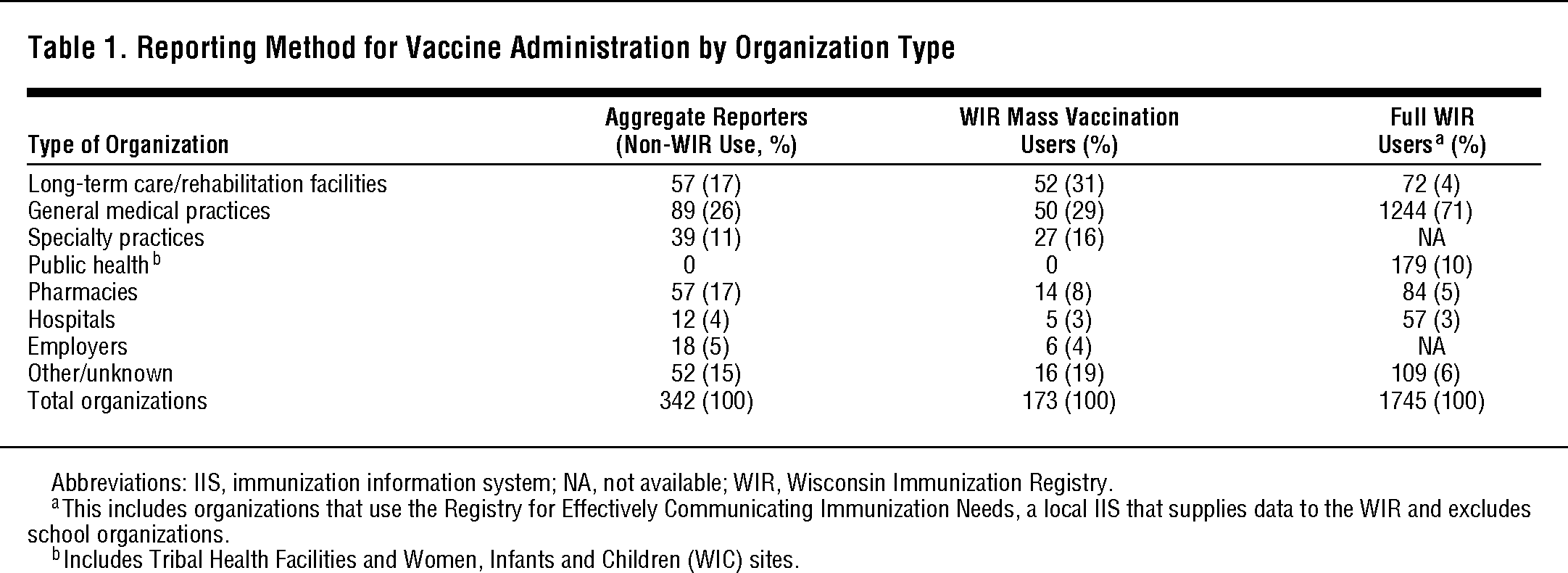
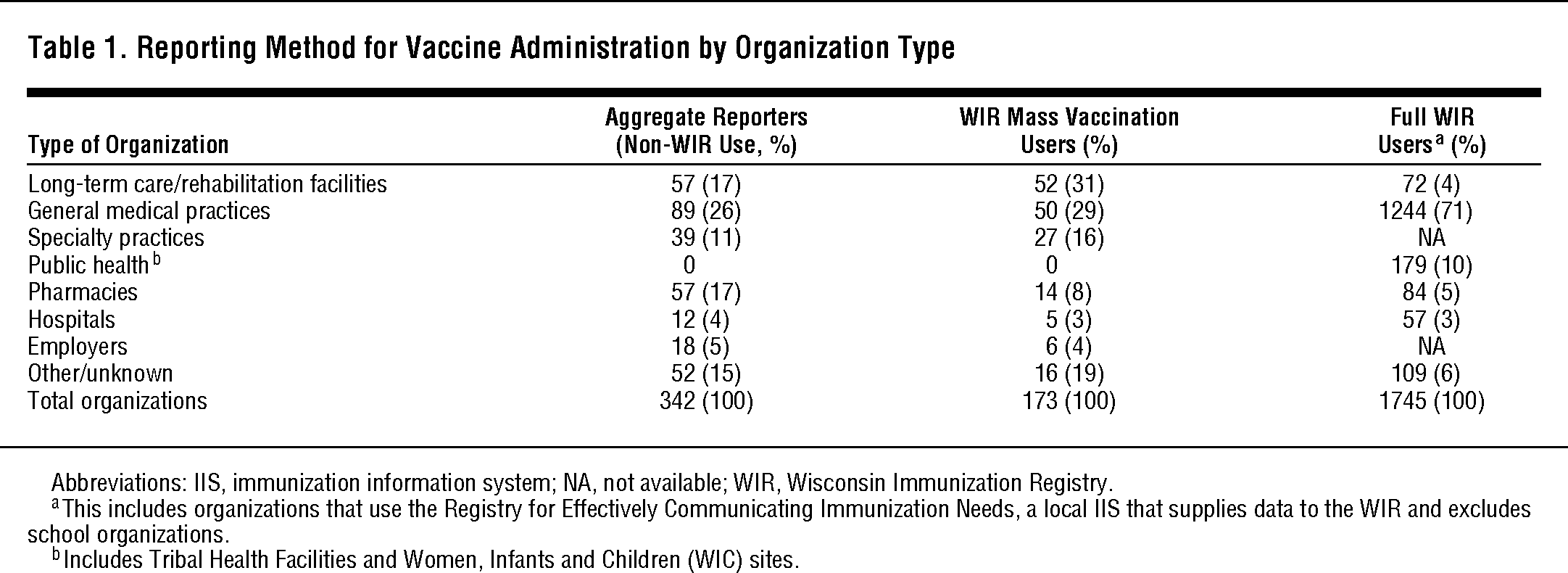
More than 1100 organizations that wished to provide H1N1 vaccine registered with the DPH, and 760 (69%) initially indicated they would report by submitting data to the WIR, although fewer actually reported in this manner. Table 1 lists the types of organizations that submitted data through the different reporting methods, including aggregate reporting. As a point of reference, the distribution of organization types for all WIR users, regardless of their participation in H1N1 vaccination, is presented.
Reporting Method for Vaccine Administration by Organization Type
The number of immunizations provided by organizations that chose aggregate reporting (option 3) was far less than the number of organizations that used the WIR; on average, 5465 doses were reported on a weekly basis using the aggregate system, while an average of 68 834 doses were administered by WIR users (options 1 and 2).
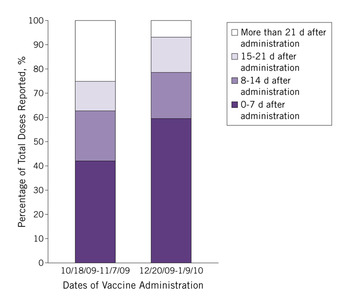
To comply with the federal reporting requirements, DPH staff compiled data from the WIR and the aggregate surveys and reported to the CDC using the secure CRA website each Tuesday. Previous weeks' data were updated, as many providers experienced difficulty in meeting the 7-day requirement and reported the data during subsequent days/weeks. Although the reporting time frame was not enforced, the reporting of doses to the WIR became timelier throughout the vaccination campaign. Initially, 41.9% of doses administered during October 18, 2009, to November 7, 2009 (MMWR weeks 42-44), were reported within 7 days, whereas 59.6% of doses administered during December 20, 2009, to January 9, 2010 (MMWR weeks 51-1), were reported within 7 days (Figure). In addition, the number of doses reported within 21 days increased from 75.1% during MMWR weeks 42 to 44 to 93.9% during MMWR weeks 51 to 1.
Timeliness of Reporting H1N1 Vaccine Doses to the Wisconsin Division of Public Health, by Time Period.

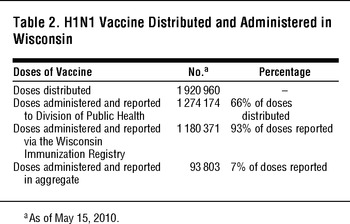
While the federal requirement was only in place through November 21, 2009, the DPH continued to require providers to report these data to track the number of doses being administered. These data were shared with key decision-makers within the Wisconsin Department of Health Services and reported weekly during H1N1 vaccine-planning meetings, where decisions regarding vaccine distribution were made. As of May 15, 2010, a total of 1 920 960 doses of H1N1 vaccine were distributed in Wisconsin and 1 274 174 doses were administered (Table 2). Of the administered doses, 93% were reported using the WIR and 7% were reported using the aggregate survey. Overall, approximately 646 000 doses that were distributed were not reported as administered; it is unclear how many of these doses were used but not reported and how many were not used. Unused expired thimerosal-free vaccine doses could be destroyed by the provider according to the protocols stipulated by the Wisconsin Department of Natural Resources; a reporting mechanism was not established for these destroyed doses.
H1N1 Vaccine Distributed and Administered in Wisconsin

Mass Vaccination Access
To achieve the goals of the H1N1 vaccination campaign and ensure adequate access to immunization among the entire Wisconsin population, nontraditional immunization providers, such as ophthalmologists, obstetricians, and gynecologists were encouraged to provide immunizations as well. It was anticipated that many of these new vaccinators, as well as those organizations currently providing immunizations but not using the registry, would need training to use the WIR. However, the current way of training providers by having each organization send at least 1 person to a day-long, hands-on, training would not be feasible because of the estimated increase in volume of training sessions needed to meet the demand, the short time frame, and the difficulty for organizations to commit staff for an entire day. Moreover, there was concern that while the WIR is an efficient way to record immunizations, data entry would still be a limiting factor during high-volume clinics, and a quicker method of entering data was needed.
To address these concerns, the DPH created a streamlined data entry access to the WIR, called mass vaccination access. This access was based on the same basic platform as the full WIR system, such as the client search function and de-duplication algorithms, but it used fewer data screens and mandatory fields, thereby increasing the speed of data entry. To ensure that the increased use of the WIR resulting from the mass vaccination access did not tax the WIR hardware and software capacities and result in slowing the entire system, it was decided that resource-heavy forecasting information would not be included on the mass vaccination screens. Instead, a list of the vaccines a patient previously received (including the date of administration) was included on the patient's mass vaccination record, leaving the determination of the correct interval to the clinician. Additional features of the mass vaccination access included the ability of the WIR staff to determine which vaccines could be added through this access by users (eg, influenza or measles, mumps, and rubella [MMR]), and access could be limited by user role, organization, or time period, thereby allowing flexibility for future mass vaccination needs. Training could be done at the user's own computer by viewing an 8-minute video training clip accessible through the WIR.
The mass vaccination module was introduced on October 4, 2009, just as the first doses of H1N1 vaccine were being received by providers. New users were given access within a day of completing the appropriate security and confidentiality paperwork, while organizations that already had full access to WIR could immediately give additional staff limited access to the WIR (using established protocols to ensure security and confidentiality of IIS data) to increase their capacity to enter data in a timely manner.
The vast majority of new organizations that reported via the WIR used the mass vaccination data entry, because, as expected, very few had the time to have staff trained to use the entire WIR system or had the technical skills readily available to establish electronic data exchange between their billing or medical system and the WIR. As a result, 173 new organizations entered data into the WIR through the mass vaccination module, with the majority providing services to adults, including those in long-term care or rehabilitation facilities (n = 52), adult specialty practices (n = 27), hospitals (n = 5), and employers (n = 6) (Table 1). In addition, 14 pharmacies/pharmacy chains submitted data to the WIR in this manner. Overall, approximately 350 individual users entered data through this module.
While the mass vaccination module met the need of the H1N1 campaign, its limitations for data collection rendered it less desirable as a permanent way to enter immunization data, and it was turned off on July 30, 2010. Mass vaccination organizations were encouraged to become full WIR users; however, many of these organizations were non-traditional immunizers, such as podiatrists, kidney specialists, oncologists, eye clinics, and dialysis centers, and did not continue administering immunizations. The 3 groups that were more likely to continue with WIR use were pharmacies, long-term care facilities, and employee health programs. As of April 30, 2011, 44 (25%) of the 173 became full-time users.
Data Completeness
A challenge faced by many with an IIS has been the balance of collecting complete, accurate information with the time needed to enter a new client record or an immunization. One factor affecting the speed of data entry has been the number of data fields collected by the system. To expedite data entry, the number of fields available through the mass vaccination access was reduced, as compared with full WIR access. Such omitted fields included those for race and ethnicity, as these fields are often not collected or are incomplete in many electronic systems. While these omissions increased the speed of data entry, they hampered the ability to perform some analyses.
Required fields for data directly entered into the WIR included the date of administration, the vaccine group (influenza or H1N1 influenza), manufacturer/trade name (created by the WIR, this was an amalgamation of the vaccine type [inactivated vs live attenuated] and the manufacturer—eg, H1N1 MED NASAL for the MedImmune Live Attenuated Influenza Vaccine [LAIV] product). However, the manufacturer/trade name was not required for batch data exchange, as these data were usually submitted using the single Current Procedural Terminology (CPT) code, 90663, created for all H1N1 vaccines, in accordance with the guidelines from the American Medical Association.3 As a result, because of the large amount of data the WIR received through batched data exchange, the type was not available for 39% of the H1N1 doses.
Increase in Immunization Data in the WIR
Because many H1N1 vaccine providers were also administering seasonal influenza, DPH allowed the addition of seasonal influenza data through the mass vaccination access. As of May 15, 2010, there were 1 440 096 doses of seasonal influenza vaccine entered into the WIR, a 14% increase compared to 1 160 734 doses during the 2008-2009 influenza season. Also, the percentage of individuals aged 50 years and older in Wisconsin who received 1 dose of seasonal influenza vaccine increased from 25% during the 2008 influenza season compared to 30% during the 2009 season (written data, Wisconsin Annual Report to CDC, 2009). Factors that may have influenced this trend include an increase in the number of providers submitting data to the WIR and an increase in the number of people being vaccinated.4 Several entities, including 2 large retail pharmacy chains, established routine batched data exchange with the WIR in 2009 as a result of the H1N1 vaccination efforts; this resulted in a large influx of data. Pharmacies submitted data for 43 869 doses of H1N1 vaccine (3.5% of the total amount administered within Wisconsin) and 97 469 doses of seasonal influenza vaccine, or 6.8% of the total reported in the WIR during the 2009-2010 season, a substantial increase compared to 3703 (0.3%) of the total doses reported in the WIR by pharmacies during the 2008 to 2009 season. Moreover, these entities have committed to continuing data exchange with the WIR, thereby ensuring more complete patient records.
Forecasting
The ability to forecast which immunizations a patient needs and when they should be administered is one of the strengths of a robust IIS, and is 1 of the 12 immunization information systems functional standards of the National Vaccine Advisory Committee.5 The WIR contains a forecasting module that can be changed by DPH staff with relative ease to forecast immunizations in accordance with the latest recommendations by the Advisory Committee on Immunization Practices (ACIP). However, during the vaccination campaign, the recommendations for the minimum and recommended intervals for the H1N1 vaccine evolved, presenting a challenge for health care providers to stay current with the latest recommendations. Ideally, by using the forecasting module in the WIR, providers could ensure that pediatric patients who required 2 doses of H1N1 vaccine, or those who received a dose of live attenuated vaccine (either seasonal or H1N1 vaccine) and needed another live attenuated vaccine, such as the MMR vaccine, received these vaccines with the correct spacing in accordance with the ACIP recommendations. In practice, however, this was only accurate if the information for the dose of H1N1 vaccine included the vaccine type.
Changes in the recommendations for vaccination (eg, age indications or acceptable minimal intervals) presented a problem for doses already administered according to previous guidelines. Because of the limitations of the WIR schedule ability, revising the “rules” that govern the schedule in WIR results in a re-evaluation of all the doses in the system, which could result in changing previously valid doses to invalid.
Use of the WIR for Vaccine Recalls
During the H1N1 vaccination campaign, several recalls of H1N1 vaccine occurred, primarily because of potency issues and shortened expiration dates. To supplement the traditional methods of notifying providers of the recall, such as general e-mails and notices on the departmental H1N1 website and the WIR home page, the WIR was used to identify all organizations (who use the WIR inventory module) with remaining doses of affected lots and send a direct email to the contact, indicating they currently had affected product and what the recommended course of action should be for their patients. In addition, WIR staff identified the affected lots and changed the expiration date accordingly, without any involvement by the providers themselves. Importantly, the registry would give an error message if a provider attempted to choose a vaccine in inventory that was past the expiration date.
Meeting Grant-Reporting Requirements for Local Health Departments
The federal Public Health Emergency Response (PHER) grant requirements for local health departments in Wisconsin included accountability for the number of 2009 H1N1 influenza doses administered. Since 2002, all local health departments have been using the WIR (or the Registry for Effectively Communicating Immunization Needs [RECIN], a local registry that supplies data to the WIR), and they routinely use the reporting functions to measure progress toward yearly childhood and adolescent immunization grant objectives. Therefore, local health departments already were familiar with entering data into the WIR and using the reporting tools. To supplement the ability to run H1N1 vaccine usage reports, additional fields were added to the ad hoc reporting options, and a live web-based training was held to explain these new additions and provide guidance on how to generate the information using the WIR to meet the grant deliverables.
DISCUSSION
The use of the WIR was integral to the DPH weekly reporting of data to the CRA and monitoring vaccine uptake by state and local public health agencies. Throughout this process, multiple challenges were identified and should be considered if a program of similar scope would be implemented in the future.
The use of the WIR has been optional for providers, and was not made mandatory during the H1N1 vaccination campaign. As a result, doses-administered data came from 2 sources and had to be merged and manually entered into the secure CRA website each week. Also, the data reported to DPH in aggregate were limited for data analysis because they were not individual patient level data; the data were by age group instead of discrete ages and by week rather than exact date of administration. Some analyses based on age groups were conducted, but they were hampered by significant data limitations, as mentioned, and the lag in reporting. Unfortunately, address data for geographic mapping or race/ethnicity data were not considered sufficiently complete to base changes in vaccine distribution or policy. In the future, consideration of making WIR use mandatory is warranted to address some of these issues. However, particular attention will need to be given to the organizations such as those that opted for aggregate reporting to determine significant barriers to WIR use.
The creation of the mass vaccination access within the existing structure of the IIS was of lasting benefit to the program. It relied on the existing client search functions and de-duplication algorithms in the WIR and avoided the pitfall of creating many duplicate entries of clients. Unfortunately, because of concerns about system capacity, this access did not include vaccine forecasting. Given the usefulness of forecasting, ensuring adequate capacity to accommodate the addition of this function to the mass vaccination screens should be a future consideration. Also, the mass vaccination access introduced new users to the benefits of the WIR and resulted in 44 new organizations becoming full users. The DPH has continued to work to address the needs of mass vaccination users, and has been exploring the possibility of providing specially tailored trainings for long-term care facilities and pharmacies.
Even with an expedited data entry mechanism, the reporting time frame of 7 days postadministration was difficult to meet and was not adhered to by the majority of the providers. Many providers used the mass vaccination for data entry, but it was done after, not during, the clinic. As a result, a lag of approximately 14 to 21 days postadministration was closer to the norm, rendering real-time analysis difficult.
Rapidly changing schedules were problematic for the WIR forecaster, which cannot apply different schedules for a particular vaccine depending on the date of vaccination (and therefore, the recommended schedule at that time); this deficit resulted in doses changing from “valid” to “invalid,” which caused concern on the part of clinicians and patients. To address this issue, the WIR is being updated to accommodate different schedules based on an inception date or for a particular birth cohort.
The use of the single, generic CPT code for a large number of the doses also posed difficulties for accurate forecasting and data analyses. While different CPT codes were assigned in the late spring, this action did not affect the data regarding the majority of the doses that had already been administered and submitted to the WIR. Because some organizations resubmitted data, records could be updated if they include the new codes, but many doses continued to have the “generic” CPT code. Moreover, the lack of vaccine type adversely affected data analysis. Efforts to ensure that data are as defined as possible will result in more meaningful, comprehensive analyses.
While the 2009 to 2010 H1N1 vaccination campaign presented multiple challenges to the WIR, it also provided a number of opportunities to improve the IIS. These improvements, along with noted future enhancements, will result in more comprehensive, accurate immunization records to help guide clinical immunization decisions, which, in turn, will lead to a healthier Wisconsin.
Funding and Support: This work was funded by the Centers for Disease Control and Prevention, National Immunization Program Grant (Grant ID H23/CCH522563).