Introduction
In freshwater environments, amphipods are frequently host to diverse parasite assemblages (Moore, Reference Moore2002). Amphipods are also a main food source for a variety of animals, with many trophically transmitted parasites utilizing this as a bridge to reach their definitive host. Co-infections of multiple parasite species in a single amphipod host are common (e.g. Dezfuli et al., Reference Dezfuli, Giari and Poulin2000; Rauque et al., Reference Rauque, Paterson, Poulin and Tompkins2011), making these crustaceans a good model system in which to test interactions between co-infecting parasites.
Parasites face several challenges in their hosts, for example sharing their hosts with specimens of the same or other parasite species. This may cause parasites to adopt various strategies to overcome such challenges (Lafferty, Reference Lafferty1999). Since larval parasites grow and develop in the intermediate host, they use resources that are limited. Therefore, co-infections of relatively large parasites or at high infection intensities could generate potential conflicts for resources between individual parasites. In contrast, when parasite species share their life cycles, using the same intermediate and definitive hosts, it could be beneficial to be associated with other parasite species. Evaluations of such associations between parasite species in shared hosts have been more frequently shown in definitive (Dezfuli et al., Reference Dezfuli, Giari, De Biaggi and Poulin2001) than in intermediate hosts, with both positive and negative associations being noted (Dezfuli et al., Reference Dezfuli, Giari and Poulin2000; Poulin et al., Reference Poulin, Steeper and Miller2000; Fauchier & Thomas, Reference Fauchier and Thomas2001; Outreman et al., Reference Outreman, Bollache, Plaistow and Cézilly2002).
In Patagonia, previous studies on the amphipod Hyalella patagonica have focused on population dynamics, in terms of the deleterious effects of infection by two acanthocephalan species, Acanthocephalus tumescens and Pseudocorynosoma sp., and the interactions between these acanthocephalan species (Rauque & Semenas, Reference Rauque and Semenas2007, Reference Rauque and Semenas2009, Reference Rauque and Semenas2011). In Lake Mascardi, a large and deep oligotrophic lake, these two acanthocephalans are sympatric in H. patagonica, although segregation of infection in time and space occurs to avoid competition, i.e. A. tumescens is a fish parasite that predominately infects small juvenile amphipods during winter, while Pseudocorynosoma sp. is a bird parasite that mainly occurs in intermediate to large male amphipods during spring and summer (Rauque & Semenas, Reference Rauque and Semenas2007).
In Pool Los Juncos (Patagonia, Argentina), amphipods are infected by four parasite species; the acanthocephalan Pseudocorynosoma sp., two species of cestodes of the order Cyclophyllidea and the microsporidian Thelohania sp. Pseudocorynosoma sp. and the two species of Cyclophyllidea are located in the haemocoel, and have a typical two-host life cycle, using birds as definitive hosts (Rauque, Reference Rauque2007). Thelohania sp. is located in the muscles of the telson (Rauque, Reference Rauque2007), and its life cycle is unknown. Microsporidians can infect almost all animal taxa, and generally their life cycles are monoxenous, ending in the host, with new recruitment only beginning after ingestion by a new host (Tanada & Kaya, Reference Tanada and Kaya1993). Transmission may be horizontal, through ingestion of contaminated material, or vertical, through the transfer of parasites from one generation of a host to the next (Shou-Chung Cheng, Reference Shou-Chung Cheng2004).
The aim of the present study was to describe, through field samples, interactions among the four parasite species in an amphipod population of H. patagonica.
Materials and methods
Collection and examination of amphipods
Pool Los Juncos (41°03′S; 71°00′W) is a small (4 ha surface area), shallow (1.8 m maximum depth), fish-less freshwater environment with a diverse bird community (Perotti et al., Reference Perotti, Diéguez and Jara2005). Specimens of the amphipod H. patagonica are found in the pool all year round. Amphipods were collected monthly with a sieve (1 mm mesh size) from the coastal vegetated zone between June 2002 and January 2004. Amphipods were fixed with 5% formalin in the field and transported to the laboratory to be assessed for total length (head to telson) and sex, being categorized as sexual (males and females) and asexual individuals (juveniles and undetermined). Asexual individuals were classified following Rauque & Semenas (Reference Rauque and Semenas2007), as juveniles (less than 5.68 mm) and undetermined (greater than 5.68 mm, but without secondary sex characters or developed gonads that allowed its determination). Amphipods were necropsied under a stereoscopic microscope to seek, determine and count parasite species. Determination was based on morphological criteria such as size, colour, body shape and the possession of relevant structures, such as hooks. Then prevalence, mean intensity and abundance of infection were assessed.
Additionally, to compare parasite relative sizes, a subsample of parasites was measured under a stereoscopic microscope. Parasite volume was calculated as an ovoid [V= (πLW 2)/6, where L= maximum length and W= maximum width].
Parasite identification
Larvae of Pseudocorynosoma sp. are bright orange, measuring 767 μm (L) by 514 μm (W), n= 23. Both cestode larvae are colourless with rostellar hooks (Rauque, Reference Rauque2007; Rauque & Semenas, Reference Rauque and Semenas2007), with Cyclophyllidea sp. 1 measuring 225 μm (L) by 179 μm (W), n= 20, and Cyclophyllidea sp. 2 measuring 697 μm (L) by 403 μm (W), n= 4. The microsporidian Thelohania sp. is found in groups of eight spores surrounded by an envelope measuring 3.3 μm (L) by 1.8 μm (W) (Rauque, Reference Rauque2007).
Data analysis
Standardized and adjusted residuals analysis was used to evaluate differences in infection levels among male, female, juvenile and undetermined amphipods. Generalized linear models (logistic regression), using a binomial error distribution, were used to test the influence of total amphipod length and sex on parasite infection, and the influence of other parasites on the infection of each parasite species separately. G-test post-hoc analysis was used to calculate expected mixed infections that indicated the kind of association between parasites (positive or negative). A Kruskal–Wallis test, and multiple comparisons of mean ranks test were used to evaluate differences in amphipod length among infected and uninfected amphipods. All tests were performed with a significance level of 5%.
Results
Of the 6201 amphipods collected, 3493 were female, 1783 male, 541 juveniles and 384 were undetermined. Mean length was 7.9 mm (SD = 1.8 mm) for females, 8.5 mm (SD = 2.2 mm) for males, 4.8 mm (SD = 0.6 mm) for juveniles and 5.6 mm (SD = 1.9 mm) for undetermined amphipods.
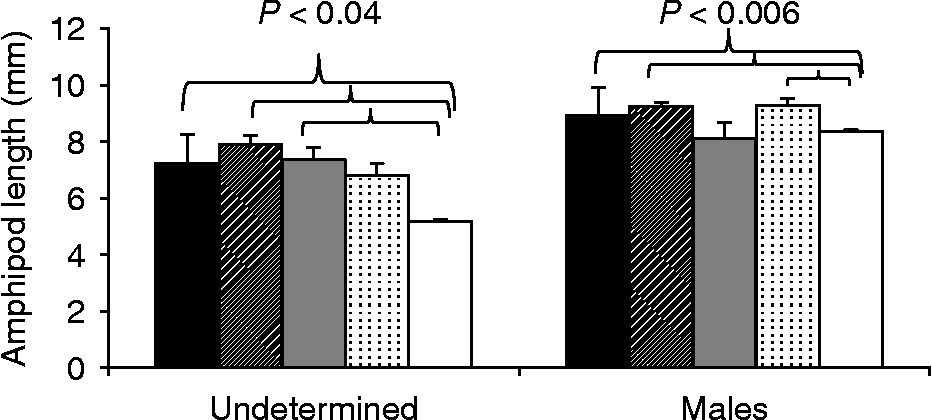
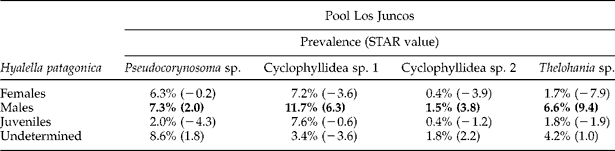
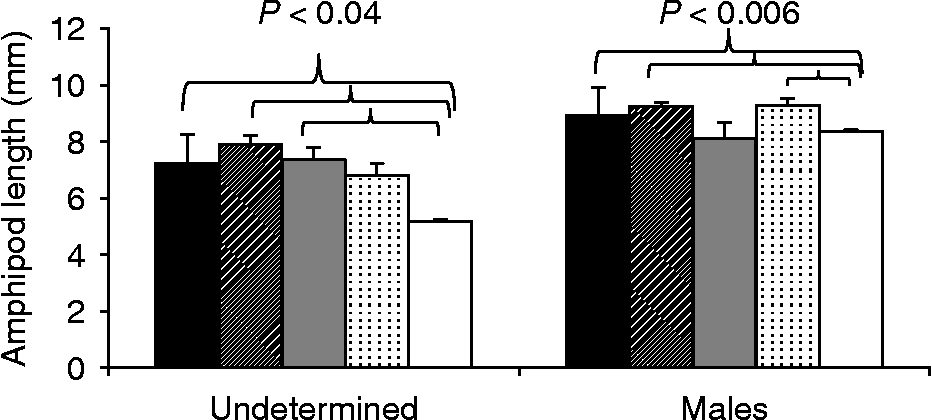
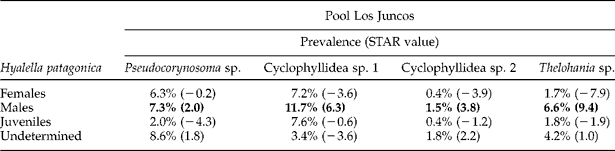
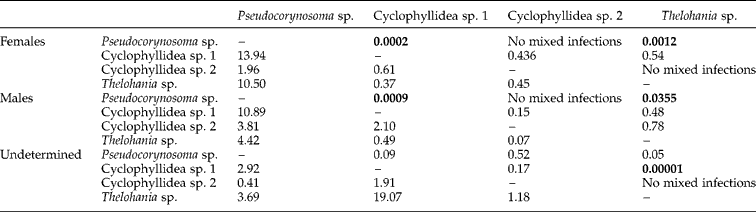
Prevalence and mean intensity of the four parasite species recorded was 6.4% and 1.0 for Pseudocorynosoma sp., 8.3% and 24.4 for Cyclophyllidea sp. 1, 0.8% and 1.3 for Cyclophyllidea sp. 2, and 3.3% for Thelohania sp. Only simultaneous infections by two species (mixed infections) were recorded. All parasites species were involved in mixed infections, with a total of 156 amphipods involved in them (prevalence = 2.5%). Parasite mean volume differed significantly between species (H= 35.4, n= 47, P< 0.001), ranging from 0.11 mm3 for Pseudocorynosoma sp., 0.07 mm3 for Cyclophyllidea sp. 2 and 0.004 mm3 for Cyclophyllidea sp. 1. In undetermined (H= 92.1, n= 358, P< 0.001) and male amphipods (H= 57.1, n= 1744, P< 0.001), infected individuals were significantly longer than uninfected individuals (fig. 1), with the exception of undetermined amphipods infected by Thelohania sp. and male amphipods infected by Cyclophyllidea sp. 2. No differences were found in host length between uninfected and infected individuals for juvenile or female amphipods (H= 11.1, n= 534, P>0.05; H= 13.5, n= 3463, P>0.05, respectively). Male amphipods showed significantly higher prevalence for all parasite species (table 1). Sex, length and their second-order interactions were significant for infection by Pseudocorynosoma sp., Cyclophyllidea sp. 1 and Thelohania sp. In contrast, both predictors were not significant for Cyclophyllidea sp. 2, although their second-order interactions were significant (table 2).
Mean length ± SE of male and undetermined amphipods in Pool Los Juncos, uninfected (white bars) and infected by Pseudocorynosoma sp. (black bars), Cyclophyllidea sp. 1 (hatched bars), Cyclophyllidea sp. 2 (shaded bars) and Thelohania sp. (dotted bars).
Prevalence and Standardized and Adjusted Residual (STAR) value, of parasites in sexes and developmental stages of Hyalella patagonica in Pool Los Juncos. STAR values higher than 1.96 are considered significant. The highest positive STAR values (observed − expected) are indicated in bold case.
Generalized linear models of single parasite infections controlling for sex and length effects in Pool Los Juncos. Significant differences are indicated in bold case.

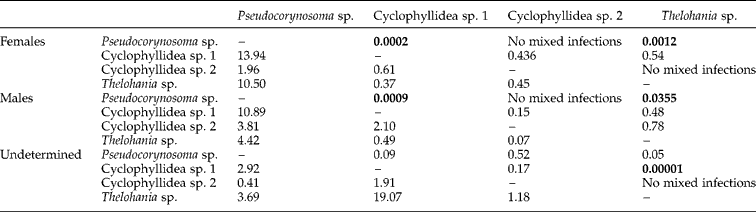
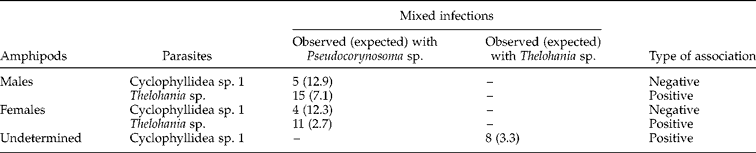
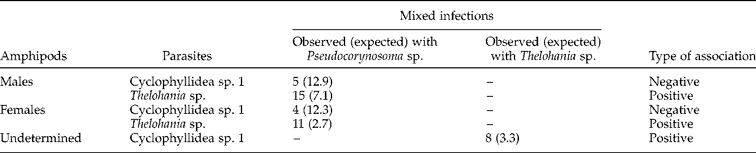
In male and female amphipods, two associations, Pseudocorynosoma sp. + Cyclophyllidea sp. 1 and Pseudocorynosoma sp. + Thelohania sp. were significant (table 3), with Pseudocorynosoma sp. infections being positively associated with Thelohania sp. infections and negatively associated with Cyclophyllidea sp. 1 infections (table 4). In undetermined amphipods, infection by Cyclophyllidea sp. 1 was positively associated with Thelohania sp. infections (tables 3 and 4). For juveniles, no models were performed because no mixed infections were recorded.
Generalized linear models to detect associations between the four parasite species in amphipods from Pool Los Juncos. Significant differences are indicated in bold case. P values are given in the upper diagonals, and chi-square values in the lower diagonals.
Observed and expected mixed infections (using G-test) in males, females and undetermined amphipods in Pool Los Juncos.
Discussion
Co-infecting parasites share resources from their hosts and, on some occasions, these parasites can be found in high infection intensities and in large sizes relative to their hosts, so some negative interactions could be predicted between such parasites. For example, in crabs, high infection intensities reduce the volume of Profilicollis sp. (Poulin et al., Reference Poulin, Nichol and Latham2003). When presence/absence of parasites or the number of parasites of one particular species in a host population is studied, association patterns between species are often seen. Associations may be positive (e.g. Pomphorhynchus laevis and Acanthocephalus clavula, or Meiogymnophallus sp. and Curtuteria australis), random (e.g. Polymorphus minutus and P. laevis), or negative (e.g. Gammarinema gammari and M. papillorobustus) (Dezfuli et al., Reference Dezfuli, Giari and Poulin2000; Poulin et al., Reference Poulin, Steeper and Miller2000, Fauchier & Thomas, Reference Fauchier and Thomas2001; Outreman et al., Reference Outreman, Bollache, Plaistow and Cézilly2002). Differences in associations between parasites are thought to be explained by their life cycles, with positive associations when parasite species have similar life cycles, and either random or negative associations when they differ (Outreman et al., Reference Outreman, Bollache, Plaistow and Cézilly2002; Poulin et al., Reference Poulin, Nichol and Latham2003; Lagrue & Poulin, Reference Lagrue and Poulin2008).
In Pool Los Juncos, Cyclophyllidea sp. 1 was the dominant species in terms of infection prevalence and intensity, while Pseudocorynosoma sp. and Thelohania sp. were less abundant, and Cyclophyllidea sp. 2 was rare. Pseudocorynosoma sp. showed a negative association with Cyclophyllidea sp. 1. Because both of these species have the same life cycle, this pattern could indicate that competition for resources may be occurring, and suggests that mixed infections of both parasite species could have high energy resource demands, since Pseudocorynosoma sp. is the larger of the two parasite species, while Cyclophyllidea sp. 1 tends to be found in higher infection intensities. A possible method to avoid co-infections could involve mechanisms preventing the establishment and growth of new parasites (Barger & Nickol, Reference Barger and Nickol1999), or to change the behaviour of the infected host. Acanthocephalans are known to be manipulators of host behaviour, therefore Pseudocorynosoma sp. may alter the behaviour of H. patagonica to reduced its chance of acquiring mixed infections, such as by causing infected amphipods to occupy habitats where there is less chance of ingesting eggs from other parasite species. Our data do not allow us to infer the mechanism of segregation, and experimental infections and behavioural studies are necessary. In our study, we also found a positive association between Thelohania sp. and both Pseudocorynosoma sp. and Cyclophyllidea sp. 1. As this microsporidian obtains resources from muscles, and not from the haemocoel like the other parasites, it may be assumed that this parasite uses a different ecological niche, thereby avoiding competition not only for space but also for resources. Alternatively, this positive association could be the side-effect of the microsporidian infection, since this parasite can potentially impair the function of the amphipod's telson muscles, which would alter normal swimming movements (Ryan & Kohler, Reference Ryan and Kohler2010) and may lead to microsporidian-infected hosts being located in habitats with higher risk of infection by other parasite species. This mechanism has been invoked for the association of the copepod Pseudomyicola spinosus with echinostome cercariae in the cockle Austrovenus stutchburyi (Leung & Poulin, Reference Leung and Poulin2007), for example. Here we have to be cautious, because a positive association between Thelohania sp. and Cyclophyllidea sp. 1. was only recorded in undetermined amphipods, so this pattern seems to be restricted only to a small fraction of the amphipod population. Why were no associations between Cyclophyllidea sp. 2 and any other parasites observed? This cestode is a relatively large parasite, and was uncommon in terms of prevalence and mean infection intensity. Interestingly, almost no mixed infections were found between this parasite and Pseudocorynosoma sp. or Thelohania sp. (see table 3). Therefore we suspect that selection to avoid infected hosts (negative association) may be acting between Cyclophyllidea sp. 2 and the other parasite species.
In Pool Los Juncos, sex and length of hosts were associated with parasite infections, and male amphipods, in particular, were more commonly infected by all parasite species. Many parasite species are commonly found infecting males; this pattern in mammals has been attributed to behavioural, genetic or immunity differences (mediated by immunosuppressant effects of testosterone) between sexes (Zuk & McKean, Reference Zuk and McKean1996; Klein, Reference Klein2004). However, because no testosterone is found in male invertebrates, sex-biased infection is an unusual finding (Sheridan et al., Reference Sheridan, Poulin, Ward and Zuk2000). So, differences between sexes recorded here can be attributed to genetics or behaviour of males. For example, it has been suggested that higher infections in males could be associated with an increased food intake, and accumulation of parasites in larger males (Outreman et al., Reference Outreman, Bollache, Plaistow and Cézilly2002; Rauque & Semenas, Reference Rauque and Semenas2007; Rauque et al., Reference Rauque, Paterson, Poulin and Tompkins2011). However, experimental infections have shown that male copepods are more susceptible to infection than females, and this is thought to be explained by the more intensive sexual selection pressures acting on males, which would result in less energy being available for an immune response against parasites (Wedekind & Jakobsen, Reference Wedekind and Jakobsen1998). Finally, in this study female amphipods were more abundant than males. Although this pattern has been recorded in other environments in Patagonia (Rauque, Reference Rauque2007; Rauque & Semenas, Reference Rauque and Semenas2007), no information is available for the possible feminizing effects of microsporidians, which are known to provoke such alterations (Rodgers-Gray et al., Reference Rodgers-Gray, Smith, Ashcroft, Isaac and Dunn2004).
In conclusion, in Pool Los Juncos we found a combination of positive and negative associations between mixed parasite infections in H. patagonica, and that infection patterns are likely to be attributed to competition for both food intake and space in the haemocoel of the amphipod.
Acknowledgements
We are very grateful to Gustavo Viozzi and Verónica Flores for useful comments on a previous version of this manuscript, and to Rachel Paterson for her careful revision of the style and grammar. Financial support was provided by the National University of Comahue B-165 and National Research Council of Argentina (CONICET) PIP 2010-1293.