Introduction
The traditional fabrication of micro resinous diamond grinding wheels presents several challenges [Reference Chen, Yin, Huang and Ohmori1, Reference Chen, Yin, Huang, Ohmori, Wang, Fan and Zhu2], such as significant waste of material, forming difficulty, and uneven distribution of diamond grains. To solve these problems, a novel resinous diamond composite (RDC) was prepared by using hot pressing molding. Acrylonitrile butadiene styrene (ABS) and polyvinyl chloride (PVC) exhibit excellent comprehensive physical and mechanical properties for fabricating thermoplastic engineering plastic materials with high strength and good fluidity [Reference Wu, Zhou, Lu and Zhao3]. Mohamed et al. established the relationships between the process conditions of fused deposition modeling (FDM) and time-dependent mechanical properties of the materials using definitive screening design [Reference Mohamed, Masood and Bhowmik4]. Sharma et al. found that a biocompatible FDM filament prepared using PVC can generate a porous structure that exhibits sufficient mechanical strength [Reference Sharma, Singh, Penna and Fraternali5].
While butadiene is uniformly distributed throughout the acrylonitrile–styrene matrix in ABS, its aging resistance is poor [Reference Dunne, Desai and Sadiku6]. The thermal decomposition of ABS directly affects the behavior of the polymer once exposed to flame, for example, ABS nitrile group starts to decrease its intensity from 350 °C [Reference Feng, Carpanese and Fina7]. N, N″-Ethylenebistearamide (EBS) and poly(ethylene-co-octene) (EN) were selected as internal lubricants for ABS to improve its friction characteristics [Reference Rojsatean, Larpsuriyakul, Prakymoramas, Thanomjitr, Kaewket, Singsom and Srinun8]. Furthermore, melamine–terephthaldehyde resin modified using graphene oxide can be synthesized as reinforcement for PVC [Reference Khaleghi, Didehban and Shabanian9]. When ABS/PVC mass ratio is 1/1, the Vicat softening temperature is 94 °C and increases with the increase in ABS content [Reference Zhang, Zhang, Guo and He10]. Thus, copolymerizing PVC into ABS is a feasible approach to achieve the desired aging resistance for RDCs.
Diamond represents the ideal grain for grinding due to its high hardness, good wear resistance, and higher grinding efficiency and precision compared with ordinary abrasives [Reference Duan, Yu, Wang and Xu11]. When dioctyl phthalate (DOP) is added to ABS/PVC system, the size of PVC particles of composite changes from 20–50 μm to 0.1–2 μm, which greatly increases the thermal fluidity of the blend system [Reference Wang, Zhang and Ren12]. To study the influence of DOP incorporation into RDCs, we added 1%, 2%, and 3% of mobilizers, and these formulations underwent radiation sterilization at doses higher than 25 kGy [Reference Ahmed, Mehmood and Iqbal13]. PC/ABS/MWCNT (multi-walled carbon nanotube) composite with the poly(styrene-co-acrylonitrile)-g-maleic anhydride as a compatibilizer was investigated by Han et al. [Reference Han, Lee, Lee, Yoon and Kim14]. Jyoti et al. studied the synergetic effect of graphene oxide–carbon nanotube acrylonitrile butadiene styrene hybrid composites on static and dynamic mechanical properties [Reference Jyoti, Babal, Sharma, Dhakate and Singh15].
In this work, five groups of RDCs with different mass ratios were fabricated and simulated to explore the changes in the mechanical properties and compatibility of RDCs. The systematic molecular dynamics (MD) simulations provided several ideas for designing RDCs. Detailed formulas of RDCs presenting different component mass ratios were designed and optimized. Moreover, Materials Studio (MS) simulations and formation experiments were conducted to analyze the performances of RDCs.
Computational models
Components and proportions
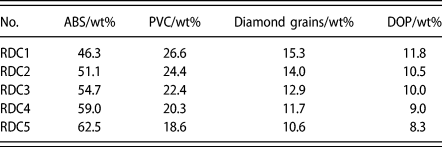
The RDC material used for fabricating grinding wheels was composed of 46.3–62.5 wt% ABS resin, 18.6–26.6 wt% PVC, 10.6–15.3 wt% diamond grains, and 8.3–11.8 wt% processing aid, as illustrated in Table I. The average diameter of the diamond grains was similar to that of the nano filler, and DOP was selected as a processing aid to reduce the viscosity and improve the fluidity of the melt. To determine the optimum mass ratio of components for the designed formula, we considered five groups of RDC materials, and simulation and experiments were carried out.
RDCs with different composition ratios.

Computational models
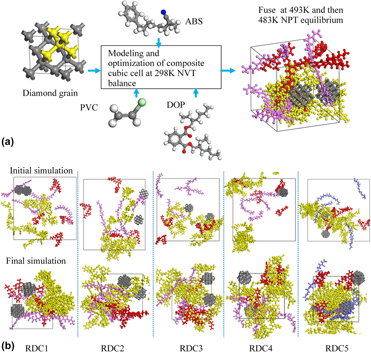
The RDC model was built by simulating the preparation process, as illustrated in Fig. 1. First, each RDC component was modeled using the MD simulation method. Various components were blended to obtain a cubic cell of this new composite, and a 298 K equilibration operation using an canonical (NVT) ensemble was performed [Reference Kindt16]. According to the mold and extrusion temperatures of the twin screw extruder, 483 and 493 K equilibration operations utilizing the isothermal-isobaric (NPT) ensemble were used for the blending system [Reference Hamilton, Mahjoub, Laws and Ferry17]. The Forcite module of the MS software was used to optimize the geometry of each molecular model and minimize its energy using the smart minimizer method, which switched from the steepest descent to the conjugate gradient and then to the Newton method as the energy derivatives decreased to accelerate the computation. The COMPASS force field was used throughout the simulation process [Reference Rigby18]. The ab initio method [Reference Esrafili, Asadollahi and Mousavian19, Reference Greenberg and Shkolnisky20] of this force field could accurately predict the molecular conformation, vibration, and thermodynamic properties of a series of isolated and condensed molecules. Additional details on the COMPASS force field can be found in the literature [Reference Martin21].
(a) Simulated modeling process of RDC and (b) initial and final simulation of RDC cells with different mass ratios.

Modeling and optimization of components
The decomposition temperature of ABS, which is a graft copolymer of acrylonitrile, 1,3-butadiene, and styrene, is approximately 533 K. The boiling point of DOP is 657 K. Given that the carbon atom of the C=O bonds presents sp 2 hybridization, the C–C=O and O–C=O angles are 120° each. Due to the internal rotation of the C–C bonds, the carbon chain cannot coexist in the same plane as the C=O bonds. Moreover, PVC is mostly a linear carbon chain polymer composed of vinyl chloride monomers exhibiting head–tail structure with a small branching degree, which starts to soften at 353–358 °C and becomes viscous at 433–453 °C. PVC presents a planar triangular structure and 15 repeating chain units. Diamond grains contain 87 carbon atoms in a face-centered cubic cell arrangement. The axial lengths of the cell are 3.57 Å, and the axial angles are 90°. Diamond belongs to the FD-3M space group, and its structure contains globular clusters with the radius of 5 Å.
Blending and melt extrusion
During the simulation process, the preparation temperature was determined using the Nosè–Hoover temperature control system [Reference Beckedahl, Obaga, Uken, Sergi and Ferrario22], and the preparation pressure was regulated using the Andersen regulator. The van der Waals [Reference Knoll and Nirschl23] and electrostatic forces were calculated based on the summation of atoms, and the time step was set to be 1 fs. To study the densities, cohesive energy densities, radial distribution functions (RDFs), physical properties, and binding energies of RDC materials with different composition ratios, each composition was embedded into a simulation cell. According to the periodic boundary condition, if one or several particles move out of the simulation cell, the same number of particles must return to the cell from the opposite interface. This process ensures a constant particle number in the simulation system, which is required to ensure the accuracy of the simulation. The construction parameters of all simulation cells are listed in Table II.
Construction parameters of simulation cells.

Energy minimization was employed to eliminate all unfavorable molecular interactions within the five simulation cells. Afterward, a 150 ps MD equilibration operation [Reference Chawla and Sharma24] was performed using the NVT ensemble at 298 K and 101.325 kPa to ensure that the RDC materials were uniformly mixed. The Forcite module of the MS software was used to run a 50,000 steps annealing treatment. The temperature increased from 298 to 598 K and then decreased from 598 to 298 K. The heating and cooling intervals were 50 K each, and five annealing cycles were carried out to optimize the structure of the cell and improve the mechanical properties of the RDCs. Subsequently, two successive 150 ps MD equilibration operations were performed using the NVT ensemble at 493 and 483 K/10 MPa to obtain compact composite structures. The atomic trajectory was recorded once per second. This setting was suitable for analyzing the thermodynamic properties and the structure of the RDCs. The initial and final simulation cells of the RDCs with different component ratios are presented in Fig. 1(b). For the RDC cells, the colors of ABS, PVC, diamond grains, and DOP are yellow, blue, gray, and red, respectively.
Simulation discussions
Conformation and density
The initial densities of the five RDC cells were set as 0.1 g/cm3, but their final densities were different because of the different component ratios. As shown in Fig. 2, the molecular dispersivity of the initial simulation cell was bigger than that of the final cell, given that the volume of the final cell decreased compared with that of the initial one. Given the tight coupling of the molecules, some specific characteristics could be revealed. The chains of the ABS and PVC polymers were intertwined, and the diamond grains were wrapped around the polymer chains. In addition, the DOP molecules were inserted into the ABS and PVC chains. The polar C≡N bond of ABS was attracted to the polar C–Cl bond of PVC in the RDC cells. Diamond grains were wrapped around the ABS and PVC chains under the constant pressure of the NPT ensemble.
(a) Final simulation cell of RDC1 and (b) densities of the five simulation cells. (c) CED and (d) RDF of various RDCs.

Figure 2(a) illustrates the simulation of the RDC1 cell. Diamond grain 1 was wrapped around ABS1 and PVC3, whereas diamond grain 2 was wrapped around ABS2 and PVC4. Furthermore, DOP molecules were inserted into the ABS and PVC chains using their polar ester –COO– groups. For example, DOP1 was inserted into PVC1, and DOP2 was inserted into ABS1, whereas both DOP3 and DOP4 were inserted into PVC4. Figure 2(b) shows that the simulation density of various RDC cells changed during the 483 K equilibration operation using the NPT ensemble. The densities of all RDCs increased rapidly during the first 10 ps and then continued to increase slowly in the 10–25 ps time interval. After 25 ps, the density fluctuated by 5–10%, which was regarded as a stable state. The final densities of the RDC samples were 1.36, 1.34, 1.33, 1.31, and 1.30 g/cm3. The final densities decreased as follows: RDC1 > RDC2 > RDC3 > RDC4 > RDC5. As the mass ratio of ABS increased, the attraction between the polar C–Cl bonds of PVC and ABS decreased relatively, so the entanglement rate between ABS and PVC decreased. The decrease in the percentage of the diamond grains led to a decrease in the density of the RDCs. While the percentage of ABS increased, the number of polar ester –COO– groups of DOP inserted into the polymer chains reached saturation, which further reduced the density of the RDCs.
Cohesive energy density
During MD simulation, cohesive energy density (CED) represents the amount of energy required to completely remove unit volumes of molecules from their neighbors to infinite separation. This parameter is used to evaluate the interaction forces between molecules [Reference Marcus25]. Figure 2(c) illustrates the CED values of the five RDC materials. The corresponding values were 1.39, 1.42, 1.45, 1.53, and 1.56 J/m3 × 109. All CEDs were higher than 400 J/cm3, which indicated that the intermolecular forces within RDCs were strong, whereas their mechanical strengths and the heat resistance values were good. The CED values increased as the percentage of ABS increased. This result occurred because ABS was conducive to form intermolecular hydrogen bonds (HD) and strengthen the interactions between the ABS chains, PVC chains, and DOP molecules. The electrostatic and van der Waals forces between the ABS chains, PVC chains, and DOP molecules represented the main causes of the tight binding between molecules.
Radial distribution function
RDF is the distribution probability of particle B with respect to a given particle A in a system of particles, and the function g AB(r) can be expressed as follows [Reference Yin, Zhang, Jiang, Yin and Du26]:
 $${g_{{\rm{AB}}}}\left( r \right) = {{\left\langle {{n_{{\rm{AB}}}}\left( r \right)} \right\rangle } / {4\pi {r^2}\Delta {\rho _{{\rm{AB}}}}}}\quad ,$$
where n AB(r) is the average number of atom pairs between r and r + ∆r and ρAB is the density of the atom pairs. The action ranges of the HD and van der Waals forces are 2.6–3.1 Å and 3.1–5.0, respectively. The range of the electrostatic force exceeds 5.0 Å. Using the Forcite module of the MS software, several carbon atoms of the diamond grains in RDC1-5 were labeled as C1, C2, C3, C4, and C5, respectively, whereas all other atoms in these RDCs were labeled as Other atoms1, Other atoms2, Other atoms3, Other atoms4, and Other atoms5. Figure 2(d) shows the RDF values of various RDCs. The value of g(r) increased as r increased, which indicated that diamond grains were attracted to other molecules mainly by electrostatic forces. The electrostatic forces became the strongest for RDC5, which revealed that ABS could enhance the holding power of the RDC material for diamond grains because of the increase in the electrostatic forces acting on the diamond grains. In addition, the winding of the chains reduced the gaps between molecules, which limited the movement of the diamond grains.
Mechanical properties
The work efficiency of grinding wheels prepared using RDC materials would be influenced by the working environment (temperature, humidity, and medium) and various external loads (tension, compression, bending, torsion, and shock). Therefore, studying the physical properties of RDCs to determine whether they meet the practical requirements is necessary [Reference Yang, Gong and Wang27]. The elastic stiffness matrices of the RDC cells were obtained, including the Young modulus (E), shear modulus (K), bulk modulus (G), Poisson’s ratio (ν), and K/G. For every elastic stiffness matrix, two independent coefficients λ and μ were calculated to determine E, ν, K, and G, which could be calculated as follows:
 $$E = \mu \left( {{{3\lambda + 2\mu } \over {\lambda + \mu }}} \right),\;\nu = {\lambda \over {2\left( {\lambda + \mu } \right)}},\;K = \lambda + {2 \over 3}\mu ,\;G = \mu \quad .$$
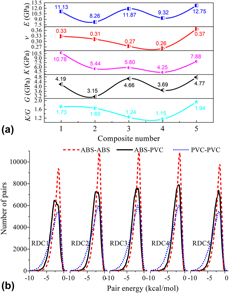
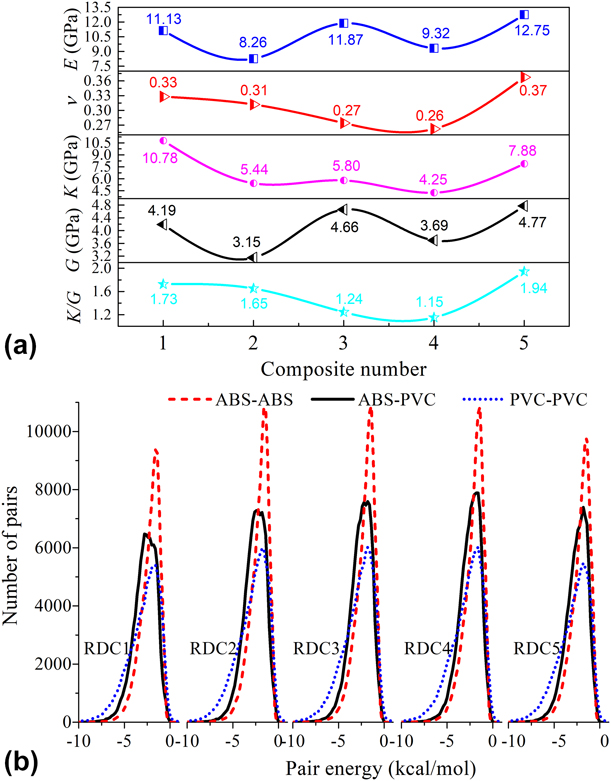
Figure 3(a) shows the mechanical properties of various RDCs. E improved from 8.26 to 12.75 GPa compared with pure ABS (approximately 2.2 GPa) and pure PVC (approximately 3.5 GPa). In addition, K, G, and K/G improved accordingly. While ν ranged in value from 0.2622 to 0.3675, it decreased compared with pure ABS (approximately 0.39). For the RDCs, E decreased as follows: RDC5 > RDC3 > RDC1 > RDC4 > RDC2, whereas ν and K/G decreased in the following order: RDC5 > RDC1> RDC2 > RDC3 > RDC4. The computational results demonstrated that the rigidity and brittleness of the RDC materials decreased and then increased undulately, whereas the ductility and flexibility initially decreased and then increased. However, all properties reached maximum values for RDC5.
(a) Mechanical properties and (b) binding energy distribution of ABS/PVC for various RDCs.
Blending compatibility
The two main components of RDC, the ABS resin and PVC mixture, played major roles in the blending compatibility of the RDC systems. When the binding energies of ABS and PVC were more similar, the compatibility would be better [Reference Hamad, Kaseem, Deri and Ko28]. The binding energies of ABS–ABS, PVC–PVC, and ABS–PVC were computed using the MD simulation. To compare the compatibilities of different ABS/PVC mass ratios, we used the Blends module of the MS software, and the blending compatibility of various RDCs was simulated at 298 K, as shown in Fig. 3(b). The total number of pair samples was 100,000. The similarities in the binding energies of ABS–ABS, PVC–PVC, and ABS–PVC decreased as follows: RDC1 > RDC5 > RDC2 > RDC3 > RDC4. These results demonstrated that as the percentage of ABS increased, the blending compatibility of ABS/PVC initially decreased and then increased.
Results and discussion
Hardness analysis
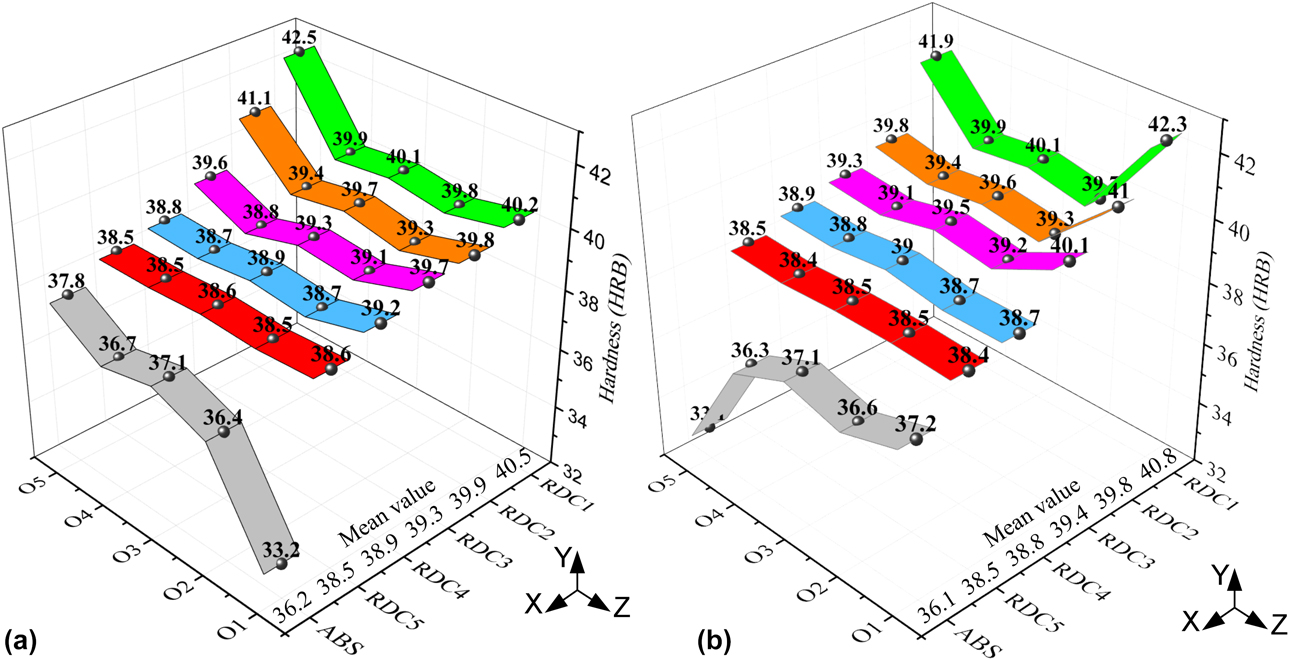
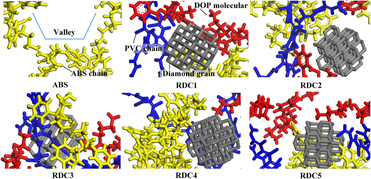
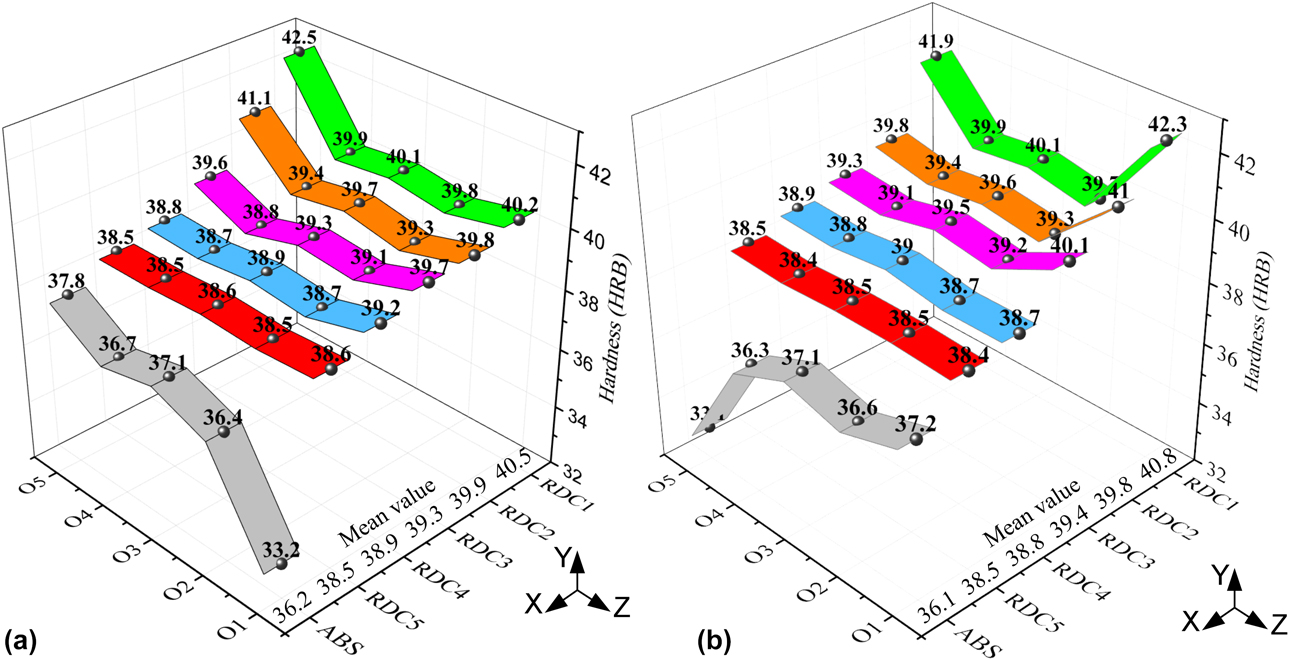
Figure 4 presents the hardness distribution of the pure ABS and RDC specimens in groups G1 and G2. Figure 4(a) shows that the hardness values of the ABS specimen in group G1 were lower than those of the RDC specimens. The mean hardness value of the ABS specimen was 36.2 HRB, and those of the RDC1–RDC5 specimens were 40.5, 39.86, 39.3, 38.86, and 38.54 HRB, respectively. For the specimens in group G2, as shown in Fig. 4(b), the mean hardness value of ABS was 36.06 HRB, and those of RDC1–RDC5 were 40.78, 39.82, 39.44, 38.82, and 38.46 HRB respectively. Each carbon atom in a diamond lattice is closely connected to other four carbon sources to form a solid crystalline body, which results in the particularly high hardness of diamond. ABS exhibits large fluctuations in hardness and poor stability compared with the RDC specimens. Figure 5 illustrates the molecular views of the pure ABS and RDC1–RDC5 specimens obtained using the MS software. The chains of ABS and PVC in the RDC materials tightly wound with diamond particles to form dense clusters of molecules. When the polar ester groups of the DOP molecules inserted into the ABS and PVC molecular chains, the flexibility and dispersity of the molecular chains improved. Thus, the dense molecular clusters became evenly distributed, causing the hardness to be uniform. The large gaps between the molecules could cause the hardness to fluctuate. The hardness of the RDC samples decreased as follows: RDC1 > RDC2 > RDC3 > RDC4 > RDC5, because the diamond content also decreased from RDC1 to RDC5. For the G1 and G2 groups, the hardness increased as follows: RDC1 < RDC2 < RDC3 < RDC4 < RDC5.
Hardness distribution for groups (a) G1 and (b) G2.
Molecular views of pure ABS and RDCs.

Surface roughness analysis
Figure 6 illustrates the surface micrographs and roughness of ABS and RDCs. The microgrooves on the surface of RDCs were thinner than those of ABS. The surface roughness values decreased as follows: ABS > RDC1 > RDC2 > RDC3> RDC4 > RDC5. This result could be explained from the molecular view by the diamond particles filling the small gaps produced by the entanglement of the polymer chains of ABS and PVC, which caused the micro surfaces of the RDCs to become increasingly flat.
Surface micrographs of ABS and RDCs.

Infrared spectrum analysis
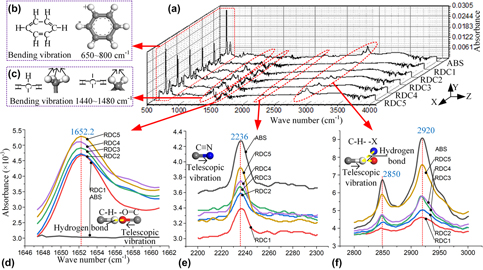
Figure 7(a) presents the infrared spectra of ABS and RDCs. As shown in Fig. 7(b), the absorption peaks in the 650–800 wave number range were generated by the C–H bond of the benzene ring absorbing infrared light. The peak heights decreased as follows: ABS > RDC5 > RDC4 > RDC3 > RDC2 > RDC1. The absorption peaks in the 1440–1480 wave number range were generated by the bending vibration of methyl –CH3 and methylene –CH2– in Fig. 7(c). The absorption peak corresponding to wave number 1652.2 was produced by the telescopic vibration of the hydrogen-bonded carbonyl C=O, as shown in Fig. 7(d), and the peak intensities decreased as follows: RDC5 > RDC4 > RDC3 > RDC2 > RDC1 > ABS. The carbonyl C=O bond of RDCs only existed in the DOP molecule. The contents of DOP and diamond decreased from RDC1 to RDC5. This finding was beneficial to the formation of the HD associated with the carboxyl C=O bond, which caused the number of HD of RDC5 to be the highest of all specimens. The weak absorption peak corresponding to the wave number 2236 was induced by the telescopic vibration of the C≡N chemical bond in ABS. In Fig. 7(e), the intensities of the peaks decreased as follows: RDC5 > RDC4 > RDC3 > RDC2 > RDC1 > ABS. As shown in Fig. 7(f), the absorption peaks generated by the hydrogen-bonded C–H occurred at wave numbers 2850 and 2920, and the HD included C–H–N and C–H–O bonds (where —represent HD). The intensities of the peaks at the wave number 2850 decreased as follows: ABS > RDC5 > RDC4 > RDC3 > RDC2 > RDC1, and the corresponding values of the absorption peaks were 0.00907, 0.00757, 0.0058, 0.00575, 0.00503, and 0.00461. This result indicated that ABS contained the highest total number of HD, followed by RDC5, whereas RDC1 contained the least number of HD.
(a) Infrared spectra of ABS and RDCs in wave number ranges of (b) 650–800, (c) 1440–1480, (d) 1646–1662, (e) 2200–2300, and (f) 2800–3000.
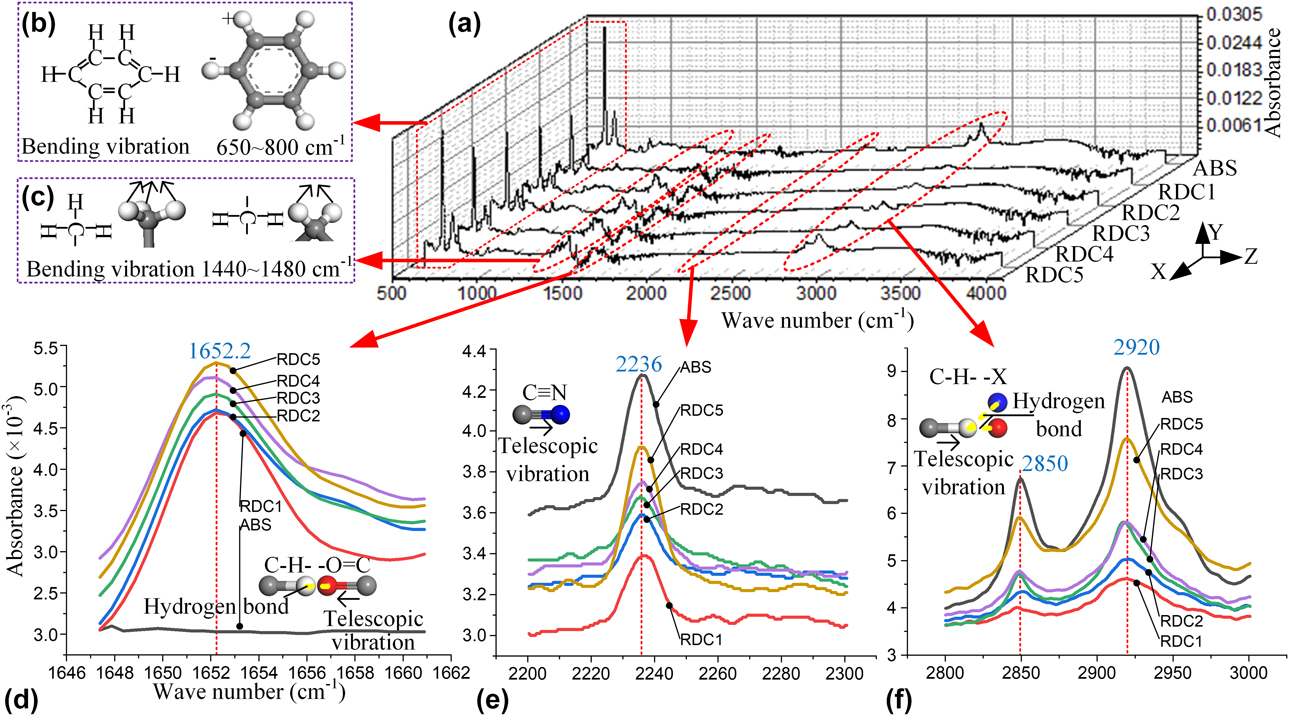
The main substances involved in the formation of HD in RDCs were ABS and DOP. The intermolecular HD of ABS was beneficial for enhancing the intermolecular forces and improving the tensile strength and mechanical stability of RDC. However, DOP mainly formed intramolecular HD, and formation of intramolecular HD would hinder the formation of intermolecular HD. The ABS content increased gradually from RDC1 to RDC5, whereas the DOP and diamond contents gradually decreased. Diamond is chemically inactive and cannot form HD. Thus, the intermolecular forces of RDC5 were the strongest, and its mechanical properties were superior to other RDCs.
Discussion
The design and performance of a novel RDCs were studied by hot pressing molding for fabricating grinding wheel. Through constructing and simulating five RDCs, including ABS/PVC/diamond grain/DOP materials with different mass ratios, we analyzed the physical and mechanical properties of new RDCs. Diamond grains presented good compatibility with the ABS–PVC–DOP copolymer and could improve the mechanical properties of RDCs. Several ABS and RDC1–RDC5 samples were fabricated, and their hardness, surface roughness, and infrared spectra were analyzed. Compatibility and mechanical properties of RDC depended on molecular conformation and mass ratio. The optimal mass ratio of ABS/PVC/diamond/DOP was 62.5/18.6/10.7/8.3. Diamond can improve the mechanical properties of ABS–PVC–DOP under stronger interactions. This new material can be used to fabricate the micro resinous diamond grinding wheel with good performances by FDM technology. At present, solving the serious waste through traditional fabrication of the micro grinding wheel is difficult, forming difficulty and non-uniform distribution of diamond grains. Finding a novel material for FDM micro resinous diamond grinding with good physical and mechanical properties is important. This study provided a practical reference for the use of RDCs as modified polymer composites prepared for resinous diamond grinding wheels with good performances.
Conclusions
Novel RDCs fabricated by hot pressing molding was proposed for preparing grinding wheel. Five ABS/PVC/diamond grains/DOP hybrid systems with different mass ratios were fabricated and simulated by using the MD method to analyze the compatibility and mechanical properties of the novel RDCs. The best RDC composition ratio was 62.5 wt% ABS, 18.6 wt% PVC, 10.6 wt% diamond grains, and 8.3 wt% DOP and corresponded to RDC5. As the ABS/PVC mass ratio increased, the intermolecular forces within RDCs increased and the densities decreased accordingly. Moreover, the rigidity and brittleness decreased and then undulately increased. Last, the ductility and flexibility values of RDCs decreased and then increased. The RDC5 specimen exhibited the highest values of all these properties. After the formation experiment, the hardness values of the RDCs were greater than that of ABS, and the hardness and surface roughness of RDC5 were the smallest of all RDC specimens. Infrared spectral analysis showed that the hydrogen bond types for pure ABS only included C–H–N, whereas the hydrogen bond types for RDC included both C–H–N and C–H–O bonds. The hydrogen bonding forces between the molecules were the largest for the RDC5 specimen. This study provided a practical reference for the use of RDCs as modified polymer composites prepared for resinous diamond grinding wheels with desirable performances in precision and ultraprecision machining.
Experimental
Experimental setup
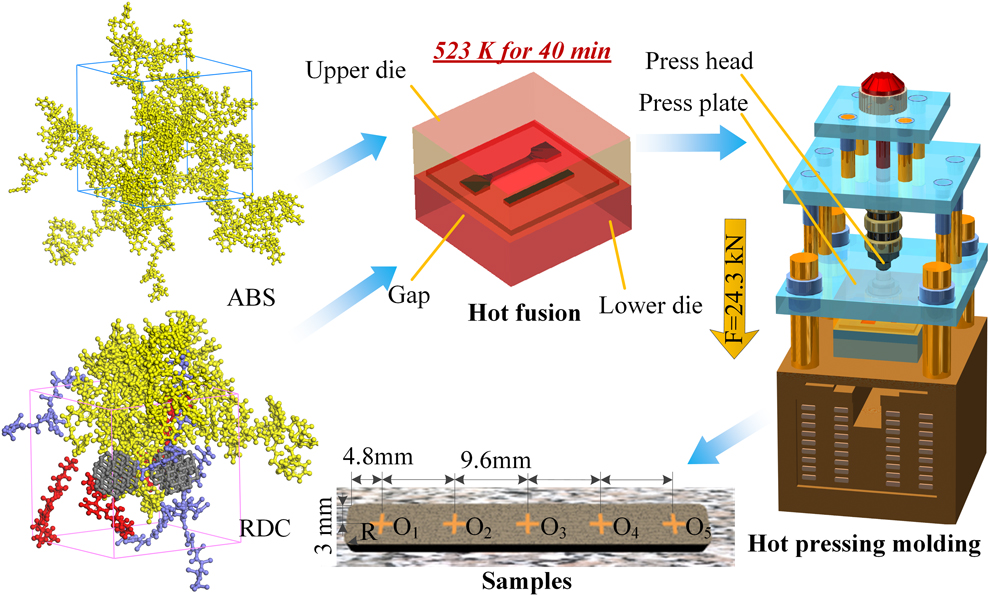
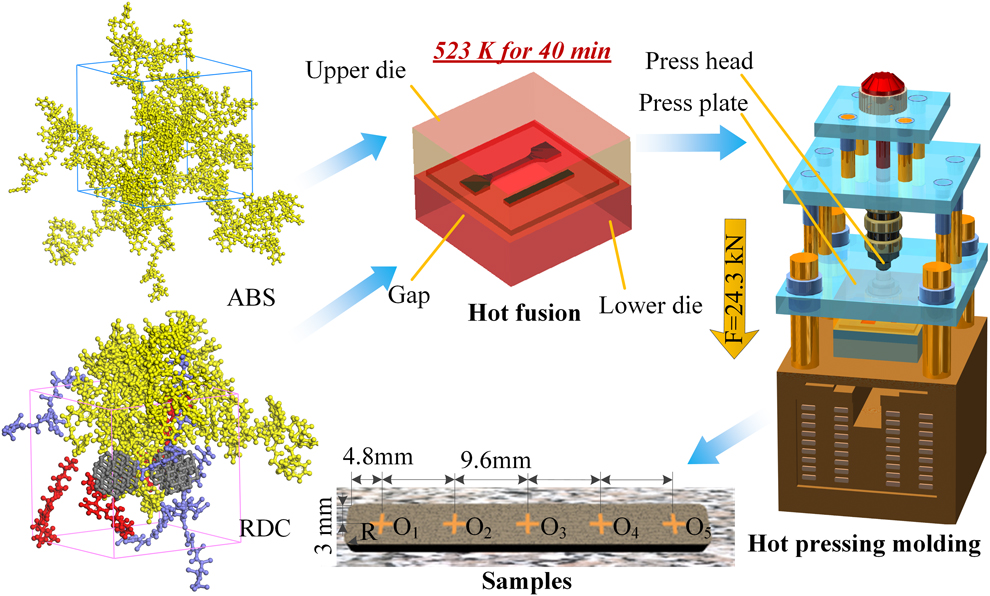
Figure 8 shows the preparation processes of the ABS and RDC samples. The pure ABS powder and RDCs with different components were mixed into molds. After heating for 40 min at 250 °C, the materials were completely molten. To obtain compact samples with precise shapes, the heated molds were quickly placed on a press and applied the pressure head to the press plate at a pressure of 24.3 kN. The specimens formed quickly, and the excess material was extruded along the gap between the upper and lower dies. The prepared samples were polished using 600# sandpaper until the surfaces of the ABS and RDC samples became smooth. The length, width, height, and fillet radius of the samples were 48, 6, 2.5, and 1 mm, respectively.
Preparation processes of samples.
Test methods
The pure ABS and prepared RDC samples were labeled as group G1 and group G2. The locations of the O1–O5 test points were marked. HRB Rockwell hardness was measured using a 100 kg load and 1.5875 mm diameter hardened steel ball. The back surface of the G1 group was observed using a VHX-2000C 3D (KEYENCE, Osaka, Japan) microscope featuring a 500× magnification. A white light interferometer (NewView7000, Zygo, Berwyn, Pennsylvania) was used to measure the surface roughness of the specimens. Infrared spectroscopy (Nicolet iS10, Thermo Fisher Scientific, Hillsboro, Oregon) was used to analyze the back surfaces of the samples in group G1.
Acknowledgments
This work was supported by the Science Technology Project of Hunan Province (Grant No. 2017WK2031).