The kingdom of Khotan lay 2,628 kilometres to the north-west of the Tang capital at Chang'an. Strategically located in the south-west of the Taklamakan Desert, Khotan was a meeting point of different ethnic groups, languages, cultures and traditions, and was renowned as a centre of Buddhism. With its unique combination of influences, Khotanese society was quite different from that of Turfan to the north of the Taklamakan. In addition to the indigenous practices and traditions that developed in Khotan, this kingdom was always under the influence of major external political powers: Khotan was a vassal kingdom of the Hephtalites or Turkic peoples during the sixth century, came under increasing Chinese influence in the seventh and eighth centuries, was under Tibetan occupation from the 790s to 840s, and thereafter under the Chinese again. The secular documentary evidence from Khotan, written in Khotanese and Chinese, from the seventh and eighth centuries reflects everyday life there, and reveals the impact of Chinese administrative changes on traditional practices.
The aim of this article is to determine whether textiles were used as money in Khotan during the seventh and eighth centuries, and if so, how? The article is arranged in four parts. Part 1 concerns the sources and important Khotanese textile terminology. Part 2 explores this question, with special reference to legal documents and tax records. Part 3 seeks to identify any changes in the production or use of textiles that came about in Khotan in the third quarter of the eighth century, as a result of changes in the civil and military administration following the An Lushan Rebellion in central China in 755–763. Part 4 looks at the impact on Khotanese textiles in the early ninth century, during Tibetan rule (790s–840s).
Part 1: Sources and Textile Terminology
The sources
The main sources for this study are the accounts by the Chinese monks Faxian and Xuanzang, who visited Khotan in the fourth and seventh centuries, respectively, and the seventh- and eighth-century secular documents, in Khotanese and Chinese, that have been excavated in Xinjiang and that mostly relate to the period when Khotan was a protectorate of the Tang empire (648–904). By surveying the contemporary documents chronologically it is possible to trace developments in the production and use of textiles in Khotan. For this article, the most useful documents have been those that record law cases (pāḍā) and tax payments: they provide evidence of what the state demanded of its people and tell us how ordinary people responded to those demands. It should be pointed out that dating Khotanese documents is difficult (because so few of them bear dates) and often involves cross-referencing a number of documents to find recurring personal names.
Textile terminology in Khotan
Khotan has long been known for its textile industry. The Buddhist monk Xuanzang wrote of the legendary origins of silk in ancient Khotan, the famous story of the princess from the “eastern country” who brought mulberries and silkworms to a place five or six li distant from the royal town. When a monastery was later built at this place, it was given the name Mashe jialan 麻射伽蓝, “the workshop monastery”, harking back to the princess's silkworm-breeding workshop that once stood on this site.Footnote 2 From early times there was official promotion of a workshop-style silk industry, and there seems to have been a revival of this industry during the Tibetan occupation of Khotan in the seventh century.
Xuanzang also noticed the skilled workers of Khotan and the textiles they produced:
[Khotan] produces woollen carpets and felts and is good at producing floss silk . . . Most [of the people] wear floss silk and white cotton cloth.Footnote 3
Xuanzang refers to the floss silk textiles in Chinese as chichou 絁紬. This is an unusual term. It suggests that Xuanzang had noticed that the silk produced in Khotan was visibly different from that produced in central China, and may have deliberately selected characters that were different from the more usual Chinese term for woven silks, which is juan 绢. The Khotanese equivalent for Xuanzang's shichou 絁紬 is thau. In the bilingual Khotanese-Chinese documents Hedin 15 and 16, thau is translated as chichou 絺紬,Footnote 4 again emphasising that this was a particular kind of silk that was quite different from the spun silk of central China. In Tang times there were different methods of silk production in central China and Khotan. In central China the silkworm inside the cocoon was killed before it could develop into a moth. Thus, there was no moth to break through the cocoon, and the silk fibre could be unravelled in a continuous length. However, in Khotan, as in India, the silkworm was allowed to develop into a moth, which then broke through the cocoon and flew away, thereby breaking the continuous fibre into much shorter lengths. The differences in production explain the differences in the visual appearance of the woven silk textiles.
Many of the surviving Khotanese documents were unearthed in the Dandan Uiliq area, and reflect everyday life there. They show that Dandan Uiliq (Kh: Gaysāta; Ch: Jiexie 杰谢) was a centre for textile production, producing silk, brocades and cotton, and that merchants would travel there to place orders for textiles.
Secular documents of the late eighth century throw light on the importance of the textile industry for the Khotanese economy. Indeed, the Khotanese language contains several terms that relate specifically to the silk industry. For example, the Khotanese measure-word buna was used specifically to denote the size of mulberry orchards.Footnote 5 We can compare buna with the measure-words bo 薄 and bu 步 (“step”), seen in Chinese documents from Turfan and Dunhuang: bo 薄, seen in Chinese documents from Turfan, was used for measuring rented mulberry land;Footnote 6 bu 步, seen in Chinese documents from Dunhuang, was used specifically to measure mulberry orchards.Footnote 7 It seems likely that there was a common standard for measuring mulberry orchards in north-western China at that time.
We have already seen the Khotanese word thau, meaning silk. From this developed the Khotanese measure-word thauna (the suffix –na transforms the noun into a measure-word). Khotanese documents of the mid-eighth century show that the measure-word thauna was used solely for bolts of silk. For example, in the bilingual Chinese-Khotanese documents Hedin 1 and 13, thauna is used as the Khotanese equivalent of the Chinese pi 匹 (“bolt”) of silk. Also from the root thau is the word thaunaka, which, as the Khotanese document Hedin 26 dated 773 ce shows, referred to a specific unit of woven fabric, rather than a fabric measured by length.Footnote 8 The word thaunaka appears quite frequently in Khotanese documents of the late eighth century, and I will look at it in more detail later in this article.
It is possible that the Khotanese thau may have been used quite generally for woven silk. As Yoshida demonstrated, the Khotanese pe'mīnaa- thau is the full equivalent for the Chinese chichou 絺紬.Footnote 9 But there are also instances where the Khotanese thau and Chinese 絺紬 chichou are used as equivalent terms: for example, in the bilingual Khotanese-Chinese documents which record deliveries of textiles to the Tibetan ruler (bstan-po) in 801 ce (Hedin 15 and 16).Footnote 10 Thus, Khotanese thau and pe'mīnaia- thau were both used for Chinese zhichou. Yoshida has identified pe'mīnai as silk floss.Footnote 11 This identification is supported by a Khotanese document dated to the 15th year of an unidentified king, which is a regulation for the head tax per “half man” (meaning half the labour obligation of an able-bodied man) of Gaysāta and states the amounts of textiles that are to be collected.Footnote 12 Pe'mīnaia- thau was recorded, along with kāhṃi thau “hemp cloth”, as a kind of material used to make “summer clothes”, and Yoshida's floss silk fabric would be appropriate for this purpose.
Khotan was also known for its production of silk brocades, especially in records relating to the tenth century, somewhat later than our discussion. But by this time, hu–brocade (hujin 胡锦 “foreign brocade”) was firmly associated with Khotan, and its production there must have begun much earlier. It is recorded that Khotan paid tribute to the Chinese court in hu–brocade in 961 and 1077;Footnote 13 and two tenth-century Chinese documents found at Dunhuang (S. 4215, P. 4908)Footnote 14 record the term xiao hu jin zhenzi 小胡锦褥子 that can be rendered either as “small mattress made of hu-brocade” or “mattress made of small hu-brocade”. It also seems that the Tibetan men-dri, which designated a special kind of silk cloth, may have referred to brocade.Footnote 15
Xuanzang also saw “white cotton” (Ch: baidie 白 氎; Kh: kapāysa) in Khotan. Indeed, he recorded silk, wool and cotton textiles but did not mention the hemp fabric (Kh: kāṃha) that we know was also produced in Khotan.
A closer look at thaunaka
Unlike other textiles which were measured by length or by weight, thaunaka were reckoned by the unit. This is clear in the Khotanese documents found at Dandan Uiliq which record life at Gaysāta, and show that thaunaka were bought and sold by the unit (Hedin 26), that these units were used in tax payments (SI.P.103.33) and to pay for the rental of mulberry trees.Footnote 16 The documents show that their value was reckoned in mūra, and that the values ranged from 150 mūra per thaunaka (Hedin 26) to 250 mūra per thaunaka (SI.P.103.33). The nature and size of the thaunaka is not indicated, but the fact that they were reckoned by the unit suggests that the thaunaka came in a standard size and quality. One document (Or.11252/28) confirms that there was a clear difference between thaunaka and pe'mīnaa- thauna, and that thaunaka was not a woven textile made of floss silk. The Khotanese documents, especially Hedin 13 and Or.11252/28, indicate that thaunaka were more precious and more expensive than woven floss silk. After discussing the evidence with Zhao Feng, of the National Museum of Chinese Silk, in Hangzhou, it seems safe to conclude that a thaunaka was a piece of silk brocade for the following reasons: brocade requires more silk fibre than a textile woven in spun silk; 3.2 feet was a normal length for brocade, and brocades were usually reckoned by the piece, as attested in Chinese documents from Dunhuang and Turfan.Footnote 17
Part 2: Were Textiles Used as Money in Khotan?
The contemporary documents from Khotan show that coins played a very significant role in the Khotanese economy. The most useful documents for this study are the lawsuits, contracts and records of tax payments. These specify what the authorities required, and how ordinary people made their payments. Enough of them are dated, or datable, for us to determine the forms of money that were used in Khotan in the seventh and eighth centuries. Above all, they show that there were two tax systems in Khotan – a local tax collected in coin and a Chinese tax collected in grain – and that the impact of An Lushan Rebellion in central China in the 750s and 760s was felt as far away as Khotan.
The evidence in the lawsuits (pāḍā)
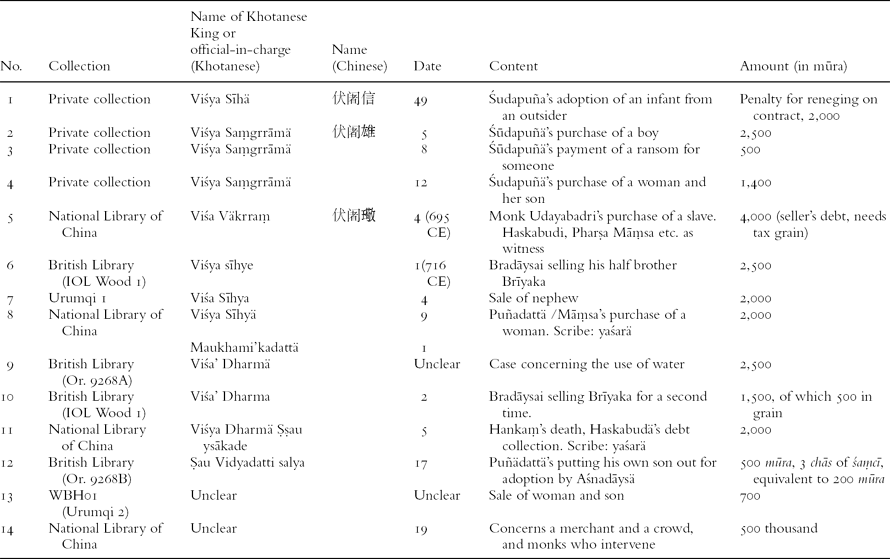
Eleven out of 13 lawsuits (pāḍā) discussed here have secure dates, ranging from the seventh century through the eighth century (see Table 1, which gives a separate entry for different parts of the same document). The table presents the data in a very concise way, allowing us to see the types and sums of money involved and the nature of the cases, and enabling us to track any changes over time. The pāḍā indicate that the mūra, generally agreed to be a bronze coin,Footnote 18 was the unit of account, recorded in amounts of 10s, 100s and 1,000s. The exceptions are a payment in grain in 729 and a payment in woven silk in c. 767.
The ‘lawsuits’ (pāḍā) from Khotan

Approaching the 11 documents in chronological order, we see that the first four pāḍā concern a rich man, Śudapuña, of the second half of the seventh century. Śudapuña lived through the reigns of two kings of Khotan, the first of whom was Viśya Sīhä, who was King of Khotan at the time of Xuanzang's visit there. He is known to have supplied Xuanzang with a wealth of goods and coins on his return to Chang'an in c. 645,Footnote 19 and to have visited the Tang court himself in the autumn of 650.Footnote 20 The sums of money involved are all expressed in mūra, in amounts of 2,000, 2,500, 500 and 1,400. The documents originated in Birgaṃdara, the location of the imperial palace several kilometres distant from Gaysāta, and were handed to Śudapuña for retention at his manor.
Pāḍā 5 concerns the purchase of a slave (Kharsa, of the Ishkäli clan) by a monk from the Ustāka monastery.Footnote 21 The sale took place in c. 695, and the price of 4,000 mūra was the highest price paid for a slave among all the documents of Khotan. The vendor sold the slave because he owed a debt over 2,000 mūra, plus interest on the loan, and grain for the Chinese tax.
Pāḍā 6 and 10 are two parts of the same wooden document, which have different dates. They concern a man called Bradāysai, who, in 716, was not able to fulfil his quota of state labour (yi 役) and thus had to pay the corvée exemption tax (yong 庸). Bradāysai sold his half brother Brīyaka for 2,500 mūra in order to pay the tax.Footnote 22 In 729 Bradāysai loaned 1,000 mūra to three brothers from Māmatti, and the interest on the loan was to be repaid as 30 kusa (a weight term) of wheat. Bradyāsai also appears in a document dated 722, which is a list of payments that he made in grain. These documents suggest that in the early decades of the eighth century, coins and grain were collected in as tax.
Pāḍā 8 and 12 concern a man, known in his youth as Māṃsa, the son of a groom at the royal palace, and towards the end of his life as Puñadatta of Ustāka (Ch: Pei Na裴). Pāḍā 8 concerns his purchase of a woman who might bear him a son. He paid for her using his own “special money”.Footnote 23 The vendor was selling his niece because she needed clothes, and he owed grain to the Chinese, and he needed to pay the state tax. Puñadatta's name also appears in the bilingual Chinese-Khotanese wooden tablets dated 722. The date is expressed in the Chinese style as the tenth year of the Kaiyuan reign period, thus indicating the use of some Chinese administrative practices in Khotan at this time.
A further 39 wooden tablets dated 722 confirm that tax payments for the Tang court were collected primarily in wheat.Footnote 24 In addition to tax payments in grain, male residents of working age also had to do the state labour service or pay an exemption fee of the equivalent amount in coin. This is confirmed in a later document dated 785 (Or.6396.2), which indicates that the exemption fee for able-bodied men was 213 mūra per head, reduced to 106 mūra per head for disabled men (hālai).Footnote 25 By contrast, the local ‘state tax’ (kṣīru haṃbāta) of Khotan was reckoned in coin. In the first half of the eighth century, the wealth of Khotan's state treasury was measured primarily in coin, and the description of the groom using his own “special money” suggests that different types of coins were in circulation in Khotan at that time.Footnote 26
Pāḍā 12 is unique among the legal records as it concerns a payment in silk. It concerns the ageing Puñadatta who, fearful for his three-year-old son's future, wished to entrust him to his sister-in-law's care. The adoptive parents needed clothes. Puñadatta paid for the clothes, but the payment was short by three feet (Kh: 3 cha, approx. 1 m) of śaṃcī Footnote 27 worth 200 mūra, and there were 500 mūra outstanding. The document is dated to the 17th year (the king's name is not given) and is likely to date to around the 760s.Footnote 28 Clearly Puñadatta did not have enough coins or textiles to complete the required payment. Is it possible that he was short of funds generally (though this seems unlikely, given his status as an official) or that he did not have sufficient funds in the required form of money?
The situation in the mid-eighth century
The An Lushan Rebellion of the 750s and 760s in central China caused serious disruption to the Tang dynasty's centralised system of government. After the rebellion, the Chinese-run military, which was cut off from the capital, managed its own military affairs and financial administration, and raised its own troops in order to safeguard its regional powers. Proof of this is seen in a document from Khotan (BH1–10) inscribed “Militia Unit of Frontier Mercenaries” followed by a list of names, mostly of Khotanese people.Footnote 29 The “Militia Unit of Mercenaries” was a term belonging to a particular military organisational system that had existed since the seventh century, and that spread more widely after the An Lushan Rebellion.Footnote 30 Under this system, the local government was responsible for the recruitment of troops and for supplying them with what they needed. The contemporary documents confirm that this system was implemented at Khotan, and that Khotan now had to provide local manpower and supplies to the Chinese-run army that was still in Khotan. A group of 45 documents found by Hedin reflect the tax system of Khotan in the eighth century and throw light on how supplies were collected.
The evidence in the tax records
The 45 documents found by Hedin have inscriptions written in Khotanese, in black ink on wooden tablets. Among them are more than 30 wooden tablets that were obtained in Domoko. Some resemble a dagger in shape, with one end planed down to form a handle, and the other end narrowed to form a point (this is particularly clear in Hedin 32). Others have parallel sides at one end that narrow to a point at the other end.Footnote 31
The 32 wooden tablets were all issued to a man called Vaśa'rasaṃgä, whose name appears in its Chinese transcription, Wu-ri-sang-yi 勿日桑宜, in a Chinese wood strip, dated 767.Footnote 32 This allows us to date the 32 Khotanese tablets to the mid- to late-eighth century. The Chinese document further identifies him as a resident of Birgaṃdara, the location of the royal palace. Although Yoshida has concluded that he was a village official responsible for collecting taxes, I reserve judgement on this and prefer to think of him as a rich householder and taxpayer. All of the 32 documents are addressed to him as the head of a family. They show that this family paid taxes in coins, livestock, grain and textiles. Of particular interest to our discussion, they point to particular types of textiles being used in tax payments.
I believe that the dagger-shaped wooden document was the traditional form for an order from the Khotanese court, and that Hedin 33, which is dagger-shaped, can be regarded as a tax-collection order from the court. It records that there were five men in Vaśa'rasaṃgä's family who were required to pay the head tax (Kh: kamalajä haṃbā). The tax was 400 mūra per man, plus an additional 9 mūra (the function of the additional tax is not yet clarified).Footnote 33 Vaśa'rasaṃgä therefore had to pay a total of 2,045 mūra (409 × 5 = 2,045). He also had to pay another tax in coins for assesFootnote 34 this time the tax was 260 + 5 coins per person, and six people were obliged to pay, making a total of 1,590 mūra (265 × 6 = 1,590). This is a straightforward order requiring the tax to be paid in coin.
However, some of the wooden tablets ask for tax payments to be made in silk. Many of these are in a poor condition, and we cannot learn much from them. The exception is Hedin 46, which has an intact inscription:Footnote 35
The spāta Vimaladattä so orders: to Vaśi'rasaṃgä: Now for the Chinese force they ask for bolts of silk for summer clothing. Each 5 men [must deliver] 2 bolts. You have 5 men. Your [quota of] bolts is two. Deliver today. The bolts of silk must be 10 foot (chā) long.Footnote 36
This document tells us that the Khotanese palace collected tax payments in silk on behalf of the Chinese military garrison, and marks a shift from the payments in grain. The Khotanese thauna is given as the measure-word for woven silk, which was to measure 10 feet (cha) in length. This suggests that the size of the thauna was not in accordance with the standard of the Tang system which was 40 feet (chi). Although the Khotanese thauna and Chinese pi 匹 are both translated into English as “bolt”, they were not necessarily of equal length.
The orders issued to Vaśa'rasaṃgä not only tell us that textiles that were used in tax payments but also provide information about their relative values at that time. For example, Hedin 48 tells us that textiles made of floss silk and hemp, both of which were special products of Khotan, were used to reckon tax payments:
The spāta Vimaladattä so orders: clear [words] to Vaśa'rasaṃgä: Now from the āmāca-minister the order has come: “He ordered the amount for 1 weaver-manFootnote 37 to be delivered [to be] 6 mūra, 9.5 feet of floss silk, 2.5 feet of hemp cloth. You have 2 men. Your [payment of] mūrā comes to 212 and 3 feet of floss silk. Deliver at once, with 5 feet of hemp cloth.”Footnote 38
On this occasion the total tax obligation for Vaśa'rasaṃgä's two men was reckoned at 12 mūra, 16 feet of cloth made of floss silk, and 5 feet of hemp cloth. But he was ordered to pay this obligation in the form of 212 mūra, 3 feet of cloth made of floss silk and 5 feet of hemp cloth. Does this mean that he had to exchange 16 feet (Kh. chā) of floss silk into coins to pay the tax? If so, we can calculate that the price of floss silk at that time was 12.5 mūra per foot (200 ÷ 16 = 12.5). In the Tang system, one bolt measured 40 feet. Converting the price per foot into the price per bolt here gives us 500 mūra per bolt (12.5 × 40). This compares reasonably well with the price of 465 wen (the Chinese word for coin) for a bolt of silk in the north-west frontier regions in 742–743, as seen in a Chinese document recording purchases for the Doulu army (P.3348).Footnote 39
Hemp was also a local product of Khotan that was used in tax payments. The documents show that hemp was collected in two different ways during Vaśa'rasaṃgä's lifetime: as woven cloth and by weight (using the weight terms śigä and thaṃga). For example, in Hedin 48, each tax-paying male was to pay 2.5 feet in hemp cloth. In Hedin 47, Vaśa'rasaṃgä was required to pay 1 śigä-measure of hemp for every two tax-paying males. In Hedin 51, which required tax payments in cotton and hemp, the rate was one thaṃga-measure of hemp per tax-paying male.Footnote 40 Śigä and thaṃga were both measures of weight.
Although Xuanzang noticed that the people of Khotan also liked to wear cotton clothes,Footnote 41 the Khotanese term kapāysaji thau “cotton cloth” did not appear in the tax orders addressed to Vaśa'rasaṃgä.Footnote 42 However, cotton was used in tax payments in the form of unprocessed cotton fibre, measured by weight. In Hedin 51, Vaśa'rasaṃgä's payment in cotton is as follows:
The spāta Vimaladattä so orders: clear [words] to Vaśa'rasaṃgä: Now they request cotton for the Inner Fort and hemp. One and a half man [are to deliver] 1 thaṃga-measure of cotton, and one man and a half man [is to deliver] 1 [thaṃga-measure] of hemp. In your house you have 2 men. Cotton is to be delivered.Footnote 43
This tax payment in cotton is reckoned in thaṃga, a Khotanese weight measure. In Hedin 66, the royal court of Khotan collected tax payments in cotton together with other things measured in kiṇä, also a weight measure, being a phonetic rendering of the Chinese jin 斤. From the collection of wooden documents recording Vaśa'rasaṃgä's tax payments, we know that in about the 760s (or at least at some time during Vaśa'rasaṃgä's lifetime) cotton fibre (by weight) played a more important role in tax payment than woven cotton cloth.
The importance of coins in Gaysāta in the late eighth century
Many of the surviving Khotanese documents relate to life in Gaysāta, a small textile- producing centre several miles from the Khotanese palace at Birgaṃdara. However, despite its size and location, Gaysāta appears to have had a very good supply of coins (mūra). The documents tell us that coins arrived in Gaysāta with merchants and from the Tang military garrison; and that the people of Gaysāta paid taxes in coins. A few examples are given below. Hedin 26 can be dated to the mid-eighth century because it mentions the ṣau-official Vidyadatta, who we know from other documents lived at that time:Footnote 44
14th day of the month of Braṃkhaysja, in the seventh year. In the year of the Ṣau-official Vidyadatta. This document is [prepared] as a record that the Gaysāta-residents, with the village head Daḍūsi as the first, received mūra from ṣī-śī’na (carrier (?)) of hvā-cai Footnote 45 , for [producing] pieces of cloth. At 150 [mūra] per piece [of thaunaka], 7,500 [mūra] will produce 50 pieces [of thaunaka]. In the month of Skarhvāra he will deliver these pieces. In addition to this, they will receive 2,525 mūra for a ṣaṃga-measure of sesame, the ṣaṃga-measure being equivalent to 10 kusa-measures of sesame. In the month of Mūñaja they will deliver. They received these mūra having requested them instead of grain, for . . . things . . . This document will become effective when the villager puts [his] finger on it. [A list of names follows.]Footnote 46
Hedin 26 is quite different in form from the wooden edict-type documents that were traditionally used to record tax payments in Khotan, and is not written in the formal language of edicts. Indeed, the tone is more businesslike. This document concerns the commissioning of textiles from the ordinary people of Gaysāta. They were asked to weave a special kind of silk that was reckoned by the piece,Footnote 47 with the prices, or values, calculated in mūra.
Merchants, especially Sogdian merchants, played an essential role in Khotanese economic life. They came to Gaysāta, ordered textiles, paid the people of Gaysāta in advance in coin, then returned at the agreed time to pick up the finished goods. The advance payments were regarded as loans, and if the goods were not ready on time, the merchants charged a high rate of interest or penalty, which appears to have been calculated in textiles. The following document (Or.6394/1) is an order to spāta Sīḍakä of Gaysāta, and thus of the late eighth century, charging him with the responsibility of returning an advance payment, with interest:
The Ṣṣau phvaiṃ-hvuhi orders thus: to the spāta Sīḍakä in Gaysāta and to those men who promised floss silk and did not deliver the cloths. Now here the merchant Sāmada and Harttākaṃ ask for 10,300 mūra. From these mūra they claim [an interest of] hemp [worth] 300 [mūra] and [an interest of] thaunaka [worth] 500 [mūra].Footnote 48 With them we claim [an interest] of 30 feet of floss silk. When you hear the order, at the expiry of the days, pay the mūra fully together with interest so that they [these mūra] do not clear up 2 for one [meaning “double”]. . . The order went out to you on the 10th day of Ttuṃjārā.
Again, the prices, or values, were calculated in mūra. However, the interest payment is expressed in floss silk.
The Tang military garrison was also a source of coins. One Chinese manuscript dated 779–780 (Dx.1890) records that the Tang military garrison paid the people of Gaysāta for their labour using coins. This manuscript consists of two vouchers, one recording a payment of 7,000 coins, the other of 11,000 coins for transport of the spring clothing for the soldiers of the garrison.Footnote 49
The Khotanese documents regarding tax payment throw light on the prices, or values, of particular types of textiles and raw materials in Gaysāta. The following passage is from Godfrey 2:
In the 15th regnal year, these quantities were ordered for [each] half man in Gaysāta: a total of 606 mūra per capita; and hemp cloth for winter clothing, 9.2 feet. At 70 [mūra] per foot the mūra become 616.Footnote 50 And hemp cloth for summer clothing was ordered, 8.6 feet. At 60 [mūra] per foot the mūra become 516. And floss silk cloth for summer was ordered, 1.5 feet. At 150 [mūra] per foot the mūra become 225. A [general] levy of 170 mūra for summer clothing was ordered. And for a half man, in total, 2,133 mūra was ordered, with the exception of the amount of 70 feet for the gracious lords.Footnote 51
This document tells us that the total tax payment for a half man came to 2,133 mūra, and that the prices of the woven textiles were as follows: 70 mūra per foot of hemp cloth for winter clothes; 60 mūra per foot of hemp cloth for summer clothes; and 150 mūra per foot of floss silk cloth for summer. The price of floss silk cloth seems to be extremely high compared with the price of 12.5 mūra per foot, as seen in Hedin 48. Although the name of the king and regnal period are not given, the high price surely suggests that this dates to the 15th year of Viśa’ Vāhaṃ, the last king of Khotan before the Tibetan rule, thus corresponding to the year 781.Footnote 52
Another document, a bilingual Chinese-Khotanese contract dated 781, shows that the people of Gaysāta were required to carry out corvée obligations, and that this tax could be commuted and paid in coin.Footnote 53 The contract concerns the sale of a wild camel, which a commoner from Gaysāta sold for 16,000 coins (Ch: wen) in order to pay the required amount instead of doing his corvée duty.
Two Khotanese documents provide further examples of taxes paid in coin at Gaysāta. The first (Or.6395/2), dated 783, records that tax payments were due from a total of 55 people (including the elderly), and that the amount was reckoned at a total of 5,500 mūra.Footnote 54 The second (Or.6386/2), dated 785, records the tax payments due from the residents of Gaysāta: a total of 41 tax-paying males were to pay 213 mūra each, and 12 people in the category of disabled, child or elderly were to pay 106 mūra each.Footnote 55
These documents show the importance of coins in everyday life in Khotan in the 780s. It is possible that coins were not used in every transaction, but there is no doubt that the mūra was the main unit of account.
Part 3: Can We Detect Changes in Textiles in Khotan in the Late Eighth Century?
We have seen in the documents from Gaysāta that coins continued to play a crucial role in the Khotanese economy. But there are indications that there were some significant changes in textile production and textile use in the late eighth century, particularly between the 760s and 780s. This period coincides with the reign of the Khotanese king Viśa’ Vāhaṃ, and the Dali reign period of the Tang dynasty.
In the document Godfrey 2 mentioned above, the price of woven floss silk at 150 mūra per foot appears to be extremely high. A quick conversion gives its price as 6,000 mūra per bolt (40 feet @ 150 mūra = 6,000 mūra). This is much higher than the 4,000 wen per bolt that is recorded for the Dali reign period (766–780), during which time the price of silk in central China reached its peak, before falling again in the Zhenyuan reign period (785–805).Footnote 56 Does the figure of 6,000 mūra suggest that Khotan experienced similar changes in the price of silk, and in a more extreme way?
In this document, the conversions between coin and textiles are stated explicitly, giving precise measurements of textiles and quantities of coins. Furthermore, Hedin 1 and 13, datable to same period, show that the measurements for Khotanese textiles now followed those of the Chinese system. This is highly significant and may represent a standardisation in the production of textiles, and probably also in the use of textiles. The Khotanese foot (chā) was now equivalent to the Chinese foot (chi 尺); and the Khotanese inch (tsuna) was equivalent to the Chinese inch (cun 寸). The inscription in Hedin 1 allows us to make certain calculations which demonstrate that the thauna now also came in a fixed size that was in line with the Tang measurements for textiles:
In the 35th regnal year [there are] 44 weavers.Footnote 57 Each man [has] 23 chā of floss silk; thus accordingly, men have 25 bolts and 12 chā.Footnote 58
With these figures we can calculate that 1 thauna measured 40 feet (chā).
44 men × 23 feet (chā) = 1,012 feet
1,012 feet (chā) ÷ 40 = 25 thauna and 12 feet
Thus, the thauna measuring 40 feet (chā) was now in line with the Chinese bolt (pi):
Khotanese: 1 thauna [ = 4 decafeet] = 40 feet (chā)
Chinese: 1 bolt (pi) = 4 decafeet (zhang) = 40 feet (chi)
We also see in the Khotanese documents the term “great thauna”; for example, in Or. 11252/30. We know that this document is part of a series which records the paying of tribute to the new Tibetan rulers of Khotan, and thus dates between the 790s and 840s. If we consider that the indigenous people of Khotan originally conceived of thauna as a roll of cloth over 10 feet in length (as we saw in Hedin 46), and that for a long time the thauna did not necessarily match the dimensions of the standard size of the Chinese bolt (pi), then it is is quite possible that the Khotanese people differentiated between the two. Thus, it is possible that the thauna could refer to the local Khotanese bolt, and “great thauna” to the full standard-size bolt.
Standard-size would refer to both the length and the width. It seems that the Khotanese thauna probably had the same width as the Tang bolt. Hedin 1, 13 and 16 show that Khotanese officials inspected the silk that was delivered to them, carefully measuring the length down to the inch (tsuna), and sometimes even to the half-inch. However, they did not record the width of those textiles, which suggests that the loom width was probably the same as the regulation Tang width of 1 foot 8 inches.Footnote 59 The only Khotanese document to record the width of woven fabric is Or. 6392/2, which specified that a piece of woven floss silk should measure 11 feet (chā) long by 13.2 feet wide.Footnote 60 This is an exceptionally large width.
Were there any changes to thaunaka? We know that thaunaka were produced to a standard size in Gaysāta, that they were used in tax payments, interest payments and rental of land, and that they were reckoned in single units with the value recorded as 150 mūra, or more commonly, 250 mūra.Footnote 61 The use of thaunaka in tax payments is worthy of further investigation. For example, SI.P.103.33 records the following tax payments:Footnote 62
Altāṃ gave 550 mūra in tax. Vikausa gave one piece of thaunaka [worth] 250 mūra. Budarśaṃ’ gave one piece of thaunaka [worth] 250 mūra. Puñargaṃ gave one piece of thaunaka [worth] 250 mūra. Śalāṃ gave one piece of woven textile [worth] 250 mūra.
This document shows that although the tax was reckoned in mūra, the actual payment was made with thaunaka. This is not the only example in which mūra is the unit of account, and thaunaka is the form of money that is used.
It is useful to consider the size and nature of Gaysāta. It was a small place, less than one-tenth the size of a Tang dynasty canton (xiang 乡). However, the Chinese referred to Gaysāta as a canton, because this was the term used for the smallest tax-paying unit. In the last 20 years of the eighth century, the head of Gaysāta canton was spāta Sīḍakä. He was the main official at the canton level, and was very effective at his job. The Khotanese documents show that one of his duties was to collect taxes from each household, and to forward them on to the appropriate authority. In order to be able to pay the required amounts of tax, and to supply the needs of the mercenary forces, spāta Sīḍakä essentially had a management role in local textile production, as well as being the local tax collector.
For example, three Khotanese documents are deeds, signed by spāta Sīḍakä, for the lease of mulberry trees. Two of the deeds are in St Petersburg; they are dated 785 and 788. The third is in the Khotan Museum, and is not dated.Footnote 63 The document dated 785 is a contract, written on paper, recording that spāta Sīḍakä rented mulberry trees from two family members for a period of one year: to the first man, he paid 750 mūra for the rent of 30 buna of mulberry trees; to the second man, he paid two thaunaka. The second document records that in 788, he paid in livestock for the rent of 30 buna of mulberry trees, and paid two goats for the rent of another 10 buna of young mulberry trees. The Khotan Museum document, which probably dates after 788, records that he paid 3 thaunaka to rent mulberry trees from a craftsman. The rental periods were all for one year. It is noteworthy that these payments do not include any conversions: they record actual payments in the form of 750 mūra, two thaunaka, livestock, and two goats. Clearly, spāta Sīḍakä was able to pay in a variety of forms of money, including thaunaka.
Sīḍakä also rented cotton-farming land. Or.6393/2 is a contract signed by Sīḍakä, recording such an arrangement in 788.Footnote 64 The landowner had insufficient grain and silk to pay his taxes, so Sīḍakä paid the taxes for him in lieu of rent.Footnote 65 Sīḍakä would thus gain from the produce of that land. Indeed, one document, a loan contract dated 782 (SI.P.103.49) tells us that cotton bolls were also used in payment.Footnote 66 It records that Vaśa'rapāña was unable to make the grain payments that he had committed himself to, and that Sīḍakä made the payments for him. Vaśa'rapāña was to repay Sīḍakä an amount of grain that was worth 2,200 mūra. If Vaśa'rapāña was not able to pay the mūra that he owed, then he would give ten mūra in interest on the loan. Just before Vaśa'rapāña's fingermark (instead of a signature), there are two lines written in Chinese which translate as:
Within 3 months (I) will respectively pay 1 small cloth and 6 cheng of cotton that (in total) is estimated to be equivalent to 1 shuo and 6 dou (grain).Footnote 67
This inscription is revealing. In the Khotanese inscription, the weight measure for the grain is the Khotanese term ṣaṃgha (one ṣaṃgha was equal to one Chinese dou measure).Footnote 68 In the Chinese inscription, the weight measure for the cotton bolls is the Chinese term cheng. The value of the grain is calculated in mūra, and any interest would also be payable in mūra. But the Chinese inscription indicates that the repayment was to be made neither in grain, nor in mūra but in a small cloth and cotton. Was “small cloth” (xiao bu 小布) the Chinese term for the Khotanese thaunaka? According to the Chinese inscription,
1 small cloth + 6 cheng of cotton bolls = 1 shuo and 6 dou = 2,200 mūra
If we follow the value of 250 mūra per thaunaka as seen in the deeds for leasing mulberry trees, then 6 cheng of cotton bolls would have a value of 1,950 mūra, and one cheng of cotton would have a value of 325 mūra. If this price is reasonable then it would confirm that xiao bu (“small cloth”) was the Chinese term for thaunaka.
Part 4: Can We Detect Any Changes During the Tibetan Occupation?
Hedin 13 was written in 801, the 35th year of Viśa’ Vāhaṃ, and by this time, Khotan was under Tibetan control. Khotanese society had undergone, and was still undergoing, a series of changes as it shifted from the kingdom of Khotan under the Tang royal court, to a more Tibetan-style Khotan. Changes to the traditional social structure were implemented, including the organisation of the Khotanese people into “tribes” (buluo 部落). The traditional Khotanese system of tax collection also collapsed. Textiles had previously been collected as tax; now they were collected as tribute paid to the Tibetan rulers.
Hedin 13 records the process of collecting in textiles to be submitted as tribute. The document is arranged in three parts. Part 1 records that there were 44 weaversFootnote 69 in the Six Towns area,Footnote 70 and that they were each to pay 23 feet (chā) of woven floss silk in tribute. The tsīṣī and other rich householders of Khotan were to collectively contribute 7 bolts and 30 feet (chā) of cloth. The total amount came to 33 bolts and 2 feet. Part 2 records those payments that were made in goods as substitutes for woven silk floss, and their values in mūra. Part 3 is a list of the names of the people who could not pay. Part 2 is of interest to our discussion:
Hedin 13: Part II, lines 8–10:
śe hvaṃḍyi hatcą 3 chā kṣi tsuna hālai ca'hause-paṃjsāsī chā mūri himārä ysārä kṣi-se tcahau'si
āskvīra paṃji hvaṃḍā thaunakā nva mūri himārä 8 ysārä dvī 10 8 chā drai tsuna thau va
phaṃnājā u pa'jā hvaṃḍi(?) thaunakā mūri himārä 10 4 ysā’ca drrai-se 10.
Each man has the size of 3.65 feet. At 450 [mūra] per foot the mūra will come to 1,640.
In Āskura [there are] 5 men. According to [their] thaunaka the mūra come to 8,200 mūra for 18.3 feet for silk.
From the men of Phaṃnā and Pa’ the mūra for the thaunaka come to 14,310.
We can only understand this part of Hedin 13 when we compare it with Or.11252/28. Hedin 13 tells us that woven floss silk was given as tribute to the Tibetan rulers. Or.11252/28 records that for these payments some people delivered thaunaka in place of woven floss silk:Footnote 71
tti hvaṃḍi cu pe'mīnā thaunā va thaunaka hauḍādi . . . . . .śe hvaṃḍye pe'mīnai thau vī hacaṃ śtāka drai chā [dv]i tsuna
These men who have delivered thaunaka instead of bolts of floss silk. . .In place of cloth made of floss silk, for each man the size must (at least) be of 3.2 feet.
According to this document, when thaunaka was paid in place of woven floss silk, the thaunaka had to measure (at least) 3 feet 2 inches in length. In fact, the five men from Āskura each presented one thaunaka (3.65 feet in length), making a total length of 18.3 feet, with a value of 8200 coins. This would make a value of about 448 mūra per thaunaka (8200 ÷ 18.3 = 448 approx.). According to Or. 11252/28, in the area of Phaṃnā each man was required to present 3.2 feet of thaunaka, giving a total length in thaunaka of at least 19 feet. This would suggest that 5–6 men paid in thaunaka (19 ÷ 3.2 = almost 6 people).
According to Hedin 13, the areas of Phaṃnā and Pa’ made tax payments in silk to the total value of 14,310 mūra. At the rate of 450 mūra per foot, this equates to a total length of 31.8 feet paid by these two places (14310 ÷ 450 = 31.8). From this we can calculate that there were four men in Pa’ who paid in thaunaka (31.8 feet – 18.3 feet = 13.5 feet; 13.5 feet ÷ 3.2 feet = just over 4 men).
Hedin 13 and Or. 11252/28 are of great importance in unravelling the mysteries surrounding silk and prices in the early ninth century. A total of 15 men – 5 from Āskura, 6 from Phaṃnā, and 4 from Pa’ – were weaver-men as denoted in Hedin 13. Each of them delivered a thaunaka instead of 23 feet (chā) of woven floss silk. A thaunaka of 3.2 feet in size should have a value of 1440 mūras (450 × 3.2) that was equal to the 23 feet of woven floss silk. We can work out the price per foot and the price per bolt of woven silk floss as 62.5 mūra per foot (1440 ÷ 23 = 62.5) and 2500 mūra per bolt (62.5 × 40 = 2500). Dividing 1440 mūras by 23, gives a price of 62.5 mūras per chā and 2500 mūras per bolt for cloth made of floss silk. This was the actual price, or value, of woven floss silk in Khotan in 801.
If we compare these prices with the 150 mūra per foot and 6,000 mūra per bolt in 781 (as seen in Godfrey 2), we see that the price of woven floss silk has more than halved. As observed by Li Jinxiu, the value of spun silk began to depreciate after the Zhenyuan reign period (785–805) of the Tang dynasty, and by the Yuanhe reign period (806–821) it fell as low as 800 wen to 900 wen per bolt.Footnote 72 The documents from Khotan thus tell us that the rise and fall in the price of woven silk floss in Khotan broadly followed the same rise and fall in the Tang dynasty.
Conclusion
It is clear from the Khotanese documents that mūra, or bronze coins, were the primary form of money in Khotan, and were the unit of account. Local taxes were collected in mūra; taxes for the Chinese were collected in grain. There can be no question that mūra were important in the Khotanese economy and for the Khotanese people. But textiles also played a crucial role in the Khotanese economy, and brought mūra to the people of remote locations such Gaysāta. Textiles were used in payments or exchanges, measured either by size or weight. The exception was the thaunaka, which appears to have been a special product certainly of Gaysāta, and probably of other places in Khotan, and was reckoned by the unit. In the late eighth century there appears to have been not only an increase in the use of textiles in payments but also a programme of standardisation of the textiles produced in Khotan, apparently to match the specifications of Chinese silks. This is probably linked with the changes in military administration after the An Lushan Rebellion, and suggests that Khotan may have been trying to produce its own silks so that they might function in the same way as Chinese silks.
Most of the Khotanese documents reflect life in the settlement of Gaysāta. Overall, the documents suggest that the people of Gaysāta produced silks and other textiles mainly for paying taxes and supplying the Chinese military garrison. This would parallel the production and use of textiles in central China. The Khotanese people also produced silks and other textiles for merchants who came specially to order textiles, and who paid for them in mūra. The thaunaka, counted by the unit, and made to a specific size, initially suggested that this Khotanese product might have functioned as a regular form of money. But the evidence suggests otherwise. Thaunaka was silk brocade, a more complex weave, and was a special product of Khotan, desired by merchants. It was used in tax payments, and for rent (which was paid by local people to other local people, usually when the landowner was short of funds to fulfil his tax obligations). Indeed, the spāta Sīḍakä stepped in several times to rent land, paying in thaunaka and animals, and seems to have managed the local economy very effectively. On the other hand, woven floss silk was the simpler and more regular textile and, logically, is far more likely to have functioned as an everyday form of money in Khotan. But the fact remains that mūra persisted as the unit of account, and may well have been the primary form of money in Khotan throughout the Tang dynasty. Textiles were used in payments, though probably to a lesser degree than mūra.
Although far away in the north-western part of the Tang empire, Khotan felt the repercussions of events in central China, and, as I have shown, events such as the An Lushan Rebellion and the reorganisation of the military administration had an impact on the production and use of textiles in Khotan in the late eighth century. More drastic changes were made under the Tibetan occupation, which involved altering the social structure of Khotan, and required presenting textiles as tribute rather than tax to the Tibetan authorities. These changes also had an impact on the production and use of textiles.