Introduction
The crichtonite group includes a series of complex Fe–Ti-rich oxides (also V-rich paseroite; Mills et al., Reference Mills, Bindi, Cadoni, Kampf, Ciriotti and Ferraris2012) with the general crystal-chemical formula XIIAVIBVIC18IVT2Φ38, where major cations are: XIIA = K, Ba, Sr, Ca, Na, La, Ce and Pb; VIB = Mn, Y, U, Fe, Zr and Sc; VIC 18 = Ti, Fe, Cr, V, Nb, Mn and Al; IVT2 = Fe, Mg, Zn and Mn; and Φ = O, OH and F (superscript Roman numerals indicate coordination numbers; e.g. Orlandi et al., Reference Orlandi, Pasero, Duchi and Olmi1997).
Over the last few years, we have been comprehensively investigating a suite of Cr-rich pyrope xenocrysts picked up from the heavy-mineral concentrates of the highly diamondiferous middle Palaeozoic Internatsionalnaya kimberlite pipe, Mirny field, Siberian craton. A remarkable feature of these pyrope samples is the occurrence of abundant Ti-rich oxide mineral inclusions, such as Cr- and Cr–Nb-rutile, Mg-rich ilmenite and complex chromium titanates of the crichtonite group (Malkovets et al., Reference Malkovets, Rezvukhin, Belousova, Griffin, Sharygin, Tretiakova, Gibsher, O'Reilly, Kuzmin, Litasov, Logvinova, Pokhilenko and Sobolev2016; Rezvukhin et al., Reference Rezvukhin, Malkovets, Sharygin, Kuzmin, Gibsher, Litasov, Pokhilenko and Sobolev2016a, Reference Rezvukhin, Malkovets, Sharygin, Kuzmin, Litasov, Gibsher, Pokhilenko and Sobolev2016b, Reference Rezvukhin, Malkovets, Sharygin, Tretiakova, Griffin and O'Reilly2018). The latter are of particular interest due to their capability to incorporate a wide array of trace elements that are incompatible in common mantle minerals (e.g. silicates). The first occurrence of titanate inclusions compositionally similar to crichtonite-group minerals in Internatsionalnaya pyropes was documented as early as 1996 (Varlamov et al., Reference Varlamov, Garanin and Kostrovitskiy1996). Further mineralogical examination of titanate minerals encapsulated in the pyrope xenocrysts from our collection has proved the affinity of these complex oxides to the crichtonite group (Rezvukhin et al., Reference Rezvukhin, Malkovets, Sharygin, Tretiakova, Griffin and O'Reilly2018). The crichtonite-group minerals studied are chromium-enriched Zr–Al-bearing phases dominated by Ca, Sr and in a few cases Ba in the A site, showing compositional similarities to other crichtonite-group species that occur in the lithospheric mantle (i.e. loveringite, lindsleyite and mathiasite). However, specific details of their crystal-chemistry promoted more detailed research. In particular, Rezvukhin et al. (Reference Rezvukhin, Malkovets, Sharygin, Tretiakova, Griffin and O'Reilly2018) suggested the Sr-specific crichtonite-group minerals could represent new members of the crichtonite group, based on their unique combination of dominant cations.
Note that prior to 1997 only A-site cation occupancy was considered when discriminating among species of the crichtonite series (according to the formula AM21O38; e.g. Grey et al., Reference Grey, Lloyd and White1976). As the compositional data for the crichtonite family expanded, the necessity for changes in the outdated nomenclature became clear. In the modern nomenclature (introduced by Orlandi et al., Reference Orlandi, Pasero, Duchi and Olmi1997), the occupancies of four different structural sites are employed for mineral identification (the M3, M4 and M5 sites are still grouped together under the common ‘С site’ because of their similarity). This approach resulted in an increase in the number of approved crichtonite-group members and allowed a greater flexibility in the identification of minerals, which may occur in a variety of paragenetic settings (magmatic, metasomatic, metamorphic and hydrothermal) and thus show an extremely diverse range of compositions with only Fe and Ti always being present.
In accordance with the updated crichtonite-group systematics, here we introduce two new Sr-characteristic mineral species of the crichtonite group: botuobinskite and mirnyite. These minerals are fairly similar in appearance, composition and physical properties; they differ, however, in the occupancy of the B site. Both new species and their names (symbols Btb and Mny) have been approved by the Commission on New Minerals, Nomenclature and Classification (CNMNC) of the International Mineralogical Association (IMA), under the numbers 2018-143a (Rezvukhin et al., Reference Rezvukhin, Rashchenko, Sharygin, Malkovets, Alifirova, Pautov, Nigmatulina and Seryotkin2020a) and 2018-144a (Rezvukhin et al., Reference Rezvukhin, Rashchenko, Sharygin, Malkovets, Alifirova, Pautov, Nigmatulina and Seryotkin2020b), respectively. The holotype specimens of botuobinskite and mirnyite are stored at the Central Siberian Geological Museum, Sobolev Institute of Geology and Mineralogy, Siberian Branch of the Russian Academy of Sciences, Novosibirsk, Russia, under the catalogue numbers VII-99/1 and VII-100/1, respectively. Botuobinskite is named in honour of members of the Botuobinskaya exploration expedition (founded in 1959), who discovered several prominent kimberlite diamond deposits in Yakutia, Russia, including the Internatsionalnaya kimberlite pipe in 1969. Mirnyite is named after Mirny town (the ‘diamond capital’ of Yakutia, the administrative centre of Mirninsky District), which is located close to the Internatsionalnaya kimberlite pipe, and also after the namesake Mirny kimberlite field.
Sample location and general description
The Mirny kimberlite field comprises seven diamondiferous kimberlite pipes (Internatsionalnaya, Mir, Sputnik, Amakinskaya, 23rd Party Congress, Dachnaya and Taezhnaya), emplaced in the middle Palaeozoic at ~360 Ma (Sobolev et al., Reference Sobolev, Kaminsky, Griffin, Yefimova, Win, Ryan and Botkunov1997; Kiselev et al., Reference Kiselev, Yarmolyuk, Ivanov and Egorov2014; Malkovets et al., Reference Malkovets, Rezvukhin, Belousova, Griffin, Sharygin, Tretiakova, Gibsher, O'Reilly, Kuzmin, Litasov, Logvinova, Pokhilenko and Sobolev2016; Skuzovatov et al., Reference Skuzovatov, Zedgenizov, Howell and Griffin2016; Agashev et al., Reference Agashev, Nakai, Serov, Tolstov, Garanin and Kovalchuk2018). This area represents a stable ancient craton core featuring a thick diamondiferous keel (Griffin et al., Reference Griffin, Ryan, Kaminsky, O'Reilly, Natapov, Win, Kinny and Ilupin1999a). The two mantle-derived Cr-pyrope xenocrysts hosting inclusions of the new minerals (INT-15 and INT-66; Fig. 1) are a subset of a large collection of pyrope grains (>200) with mineral inclusions picked from the heavy-mineral concentrate of the Internatsionalnaya kimberlite. The Cr-pyrope grains examined are of lherzolitic paragenesis and show concave-upwards (normal) chondrite-normalised REE patterns (Rezvukhin et al., Reference Rezvukhin, Malkovets, Sharygin, Tretiakova, Griffin and O'Reilly2018). These samples are considered as common lherzolitic garnets; they exhibit no particular features apart from hosting the inclusions of the new minerals.
Inclusions of botuobinskite (a) and mirnyite (b) in mantle-derived Cr-pyrope xenocrysts from the Internatsionalnaya kimberlite pipe, Siberian craton. Holotype samples, VII-99/1 and VII-100/1, respectively.

Botuobinskite forms needle- and blade-like acicular inclusions up to 1 mm in length and up to 30 μm in diameter, a large platy inclusion (700 × 700 × 80 μm) and roughly isometric grains (up to 80 μm). Mirnyite occurs as needle-and blade-like elongated crystals (up to 1 mm) similar to those of botuobinskite (Fig. 1). Within the host pyrope xenocryst, mirnyite is associated with a picroilmenite inclusion, whereas botuobinskite is a single mineral in pyrope INT-15. Within the pyrope population from Internatsionalnaya as a whole, however, both minerals are frequently associated with other Ti- and Cr-rich oxides, i.e. rutile, picroilmenite and Cr-spinel.
After a series of preliminary studies, host pyropes were crushed and needle-like inclusions of botuobinskite and mirnyite were extracted to determine their physical and optical properties as well as to perform single-crystal X-ray examinations. Subsequently, the minerals were embedded into individual epoxy mounts for chemical analysis.
Results
Physical and optical properties
Botuobinskite and mirnyite share similar physical and optical properties; these were determined at the Fersman Mineralogical Museum, Moscow, Russia. Cleavage and parting are not observed, crystals are brittle and the fracture is uneven. Density, hardness and streak were not measured because the amount of material available for our study was limited. Using the empirical formula and unit-cell volume from single-crystal X-ray diffraction data, the calculated density is 4.3582(5) g/cm3 for botuobinskite and 4.3867 (3) g/cm3 for mirnyite.
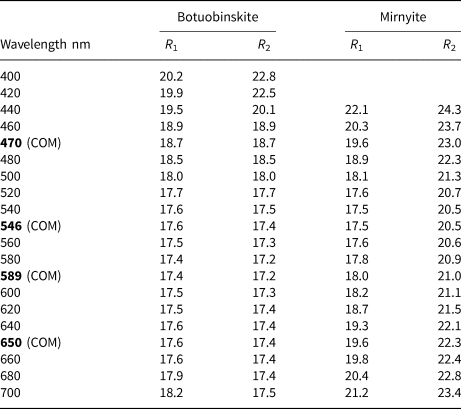
Both botuobinskite and mirnyite bear a close macroscopic resemblance to other crichtonite group-members as well as to ilmenite. The examined species are opaque and jet-black in colour. In very thin slices under focused transmitted light, however, they are brown to deep cherry-red. In plane-polarised reflected light, both minerals are greyish-white with a weak brownish tint. Between crossed polars, botuobinskite and mirnyite are anisotropic in shades of bluish grey to greenish brown. No bireflectance, pleochroism, or internal reflections were observed. The reflectance values are provided in Table 1.
Reflectance values*.

*Measurements in air; silicon carbide used as standard; the reference wavelengths required by the Commission on Ore Mineralogy (COM) are given in bold.
Chemical composition
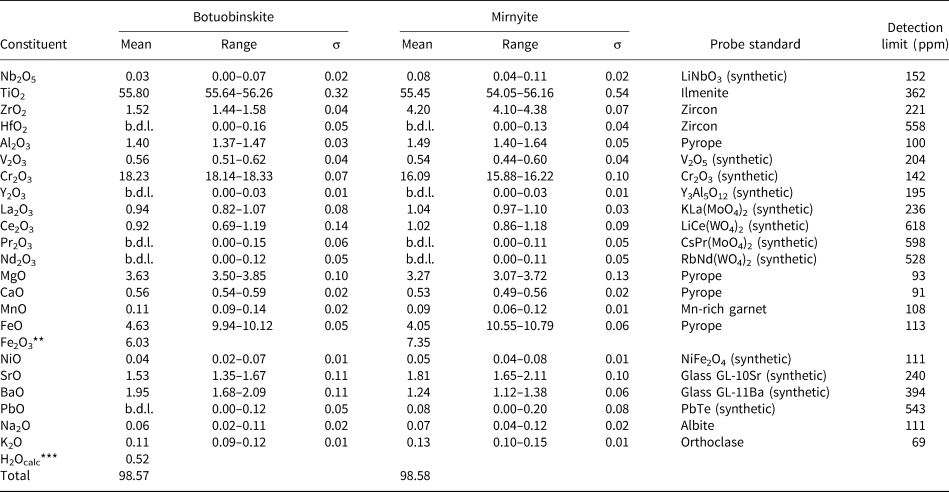
Chemical composition of the minerals was determined by wavelength-dispersive spectrometry (WDS) using a Jeol JXA-8100 instrument at the Analytical Centre for Multi-elemental and Isotope Research, Sobolev Institute of Geology and Mineralogy (IGM SB RAS), Novosibirsk, Russia. The chemical data, probe standards and detection limits appear in Table 2. The analyses were performed with a 20 kV accelerating voltage, 100 nA sample current, a beam diameter of ~1–2 μm, and counting times of 10 s for peaks and 5–10 s for each side of the background. Raw X-ray intensities were corrected for matrix effects with a ZAF routine.
Compositional data for botuobinskite and mirnyite*.

*Analysis was performed using WDS on the holotype samples with: 20 kV; 100 nA; beam diameter 2 μm; n = 14 for botuobinskite; and n = 18 for mirnyite.
**The range for the analysed FeO; Fe3+/Fe2+ is estimated taking into account that Fe is trivalent in the C site and divalent in the B and T sites.
***Calculated based on FTIR data.
b.d.l. – below detection limit.
The empirical formulae of botuobinskite and mirnyite calculated on the basis of 38 anions per formula unit (pfu) are as follows:
A(Sr0.26Ba0.22Ca0.18La0.10Ce0.10K0.04Na0.03□0.07)Σ1.00B(Fe2+0.75Zr0.22Mn2+0.03)Σ1.00C(Ti12.33Cr4.23Fe3+0.83Al0.48V3+0.13)Σ18.00T(Mg1.59Fe2+0.41)Σ2.00 X(Fe0.48)(O36.98(OH)1.02)Σ38.00 for botuobinskite and:
A(Sr0.31Ca0.17Ba0.15La0.11Ce0.11K0.05Na0.04□0.06)Σ1.00B(Zr0.61Fe2+0.37Mn2+0.02)Σ1.00C(Ti12.45Cr3.80Fe3+1.10Al0.52V3+0.13)Σ18.00T(Mg1.45Fe2+0.55)Σ2.00 X(Fe0.65)O38 for mirnyite.
The ideal formula for botuobinskite is SrFe2+(Ti4+12Cr3+6)Mg2[O36(OH)2], which requires (wt.%) SrO 6.14, FeO 4.25, TiO2 56.76, Cr2O3 27.00, MgO 4.77, H2O 1.07. For mirnyite the ideal formula is SrZr(Ti4+12Cr3+6)Mg2O38, which requires (wt.%) SrO 6.02, ZrO2 7.16, TiO2 55.66, Cr2O3 26.48, MgO 4.68.
Description of the crystal structure
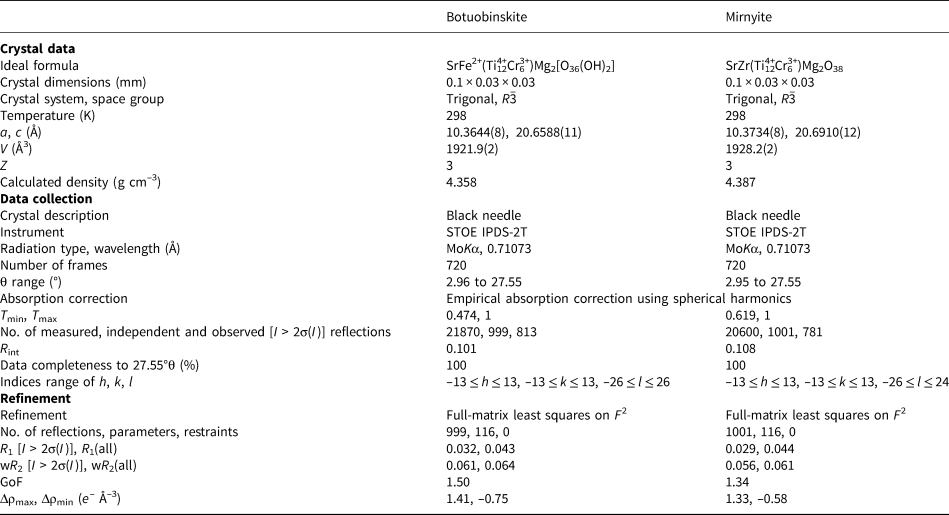
Single-crystal diffraction data from botuobinskite and mirnyite crystals were measured at a STOE IPDS diffractometer equipped with a Mo X-ray tube, graphite monochromator and image plate detector. Measured frames were integrated in CrysAlisPro software and the ESPERANTO protocol was used for data transfer (Rothkirch et al., Reference Rothkirch, Gatta, Meyer, Merkel, Merlini and Liermann2013). The structure was solved using the SUPERFLIP routine (Palatinus and Chapuis, Reference Palatinus and Chapuis2007) and refined in the Jana2020 package (Petříček et al., Reference Petříček, Dušek and Palatinus2014). Crystal data, data collection and structure refinement details are listed in Table 3.
Crystal data, data collection and structure refinement details.

The solved crystal structures of botuobinskite and mirnyite both correspond to the crichtonite structural type with large 12-coordinated A cations, octahedral B and C sites, and tetrahedral T sites (Fig. 2).
Crystal structure of botuobinskite/mirnyite. 12-coordinated A cations are shown without their coordination polyhedra, octahedral B sites are shown in brown, octahedral C sites are shown in blue, and tetrahedral T sites are shown in orange. Low-populated additional octahedral sites X1–X4 are marked by corresponding symbols.

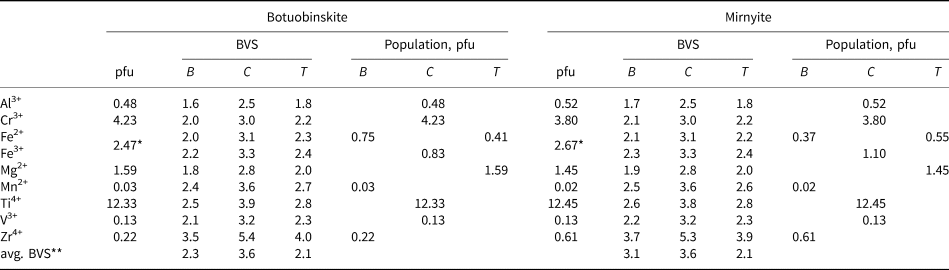
Whereas large cations (Sr, Ca, Ba, La, Ce, K and Na) can be ascribed unambiguously to the 12-coordinated A site, the distribution of the remaining cations between the B, C and T sites was performed using the combination of bond-valence analysis after Chen and Adams (Reference Chen and Adams2017) (Table 4) and the refined electron density in the sites (Tables 5 and 6): [1] according to the bond-valence sums, Al, Cr, Ti and V should occupy only the C site, and Fe3+ contributes to the remaining electron density of this site; and [2] although bond-valence sums for Mg and Zr fit both B and T sites, the electron densities explicitly suggest that Mg resides in the T site with a mean atomic number of 14, and Zr in the B site with a mean atomic number of 21 (in botuobinskite) or 28 (in mirnyite). The remaining electron density in the B and T sites corresponds to Fe2+ distributed between them.
Bond-valence sums (BVS) for cations in the B, C and T sites of botuobinskite and mirnyite.

*The excess of Fe (0.48 pfu for botuobinskite and 0.65 for mirnyite) is attributed to the X sites.
**Calculated based on the ascribed site occupancies.
Distribution of cations between crystallographic positions of botuobinskite.

M.a.n. – mean atomic number; epfu – electrons per formula unit.
Distribution of cations between crystallographic positions of mirnyite.

M.a.n. – mean atomic number; epfu – electrons per formula unit.
The resulting distribution of Fe between the B, C, and T sites generally fits the observed electron densities of the sites (Tables 5 and 6) taking into account accommodation of a certain amount of cations in additional X sites (see below); the bond-valence approach also allows interpreting Fe in the C site as trivalent and thus estimating the Fe3+/Fe2+ ratio of the samples.
Besides the A, B, C and T sites characteristic for the structural type, densely occupied in the reported structures, four additional sparsely populated octahedral sites X1–X4 were also located after a careful examination of the Fourier maps (Fig. 2). The total electron density distributed between the X1–X4 octahedral sites is ~27 electrons per formula unit for the botuobinskite structure (Table 5) and 35 electrons per formula unit for the mirnyite structure (Table 6). However, one should note that side-sharing between X1O6 / X2O6 and TO4 polyhedra means that the populated X1 and X2 sites are associated with vacancies in the T site and vice versa. Another relationship controls the X4 and A sites: the occupied X4 octahedral site requires the large cation A site to be populated by an oxygen anion. The correspondence between the X1–X4 sites and previously reported low-occupation cation sites in the crichtonite-group members is summarised in Table 7.
Correspondence between the X1–X4 sites and previously reported low-occupied cation sites in the crichtonite-group members.

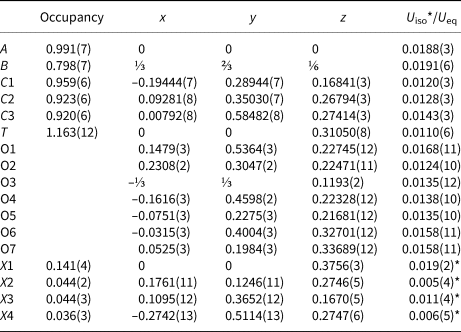
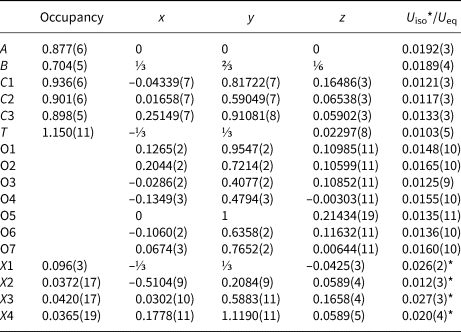
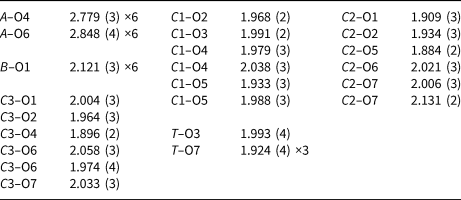
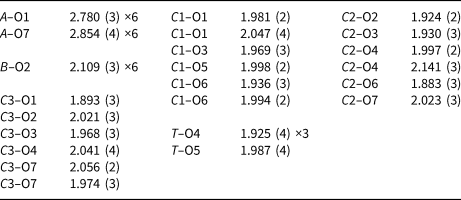
Fractional atomic coordinates and isotropic or equivalent isotropic displacement parameters for botuobinskite and mirnyite are presented in Tables 8 and 9, respectively, whereas bond lengths appear in Tables 10 and 11. The crystallographic information files have been deposited with the Principal Editor of Mineralogical Magazine and are available as Supplementary material (see below).
Fractional atomic coordinates and isotropic or equivalent isotropic displacement parameters (Å2) for botuobinskite. Effective occupancies correspond to dominant cation (Sr, Fe, Ti, Mg and Fe for the A–X sites, respectively).

Fractional atomic coordinates and isotropic or equivalent isotropic displacement parameters (Å2) for mirnyite. Effective occupancies correspond to dominant cation (Sr, Zr, Ti, Mg and Fe for the A–X sites, respectively).

Bond lengths (Å) for botuobinskite.

Bond lengths (Å) for mirnyite.

Raman spectroscopy
Both botuobinskite and mirnyite are isostructural with other crichtonite-group minerals and crystallise in the R $\bar{3}$ space group. Thus, based on the crystallography and crystal structure refinement parameters the fundamental phonons at the Γ point (i.e. Brillouin zone centre) can be represented by factor-group analysis (using the Bilbao Crystallographic Server, Kroumova et al., Reference Kroumova, Aroyo, Perez-Mato, Kirov, Capillas, Ivantchev and Wondratschek2003) as follows:
Γoptic = 30Ag (R) + 31Au (IR) + 301Eg (R) + 311Eu (IR) + 302Eg (R) + 312Eu (IR),
where R and IR are Raman-active and infrared-active modes, respectively. Due to the centre of symmetry in the rhombohedral unit cell, all the phonons that are infrared appear as forbidden for Raman, and vice versa (Porto et al., Reference Porto and Krishnan1967).
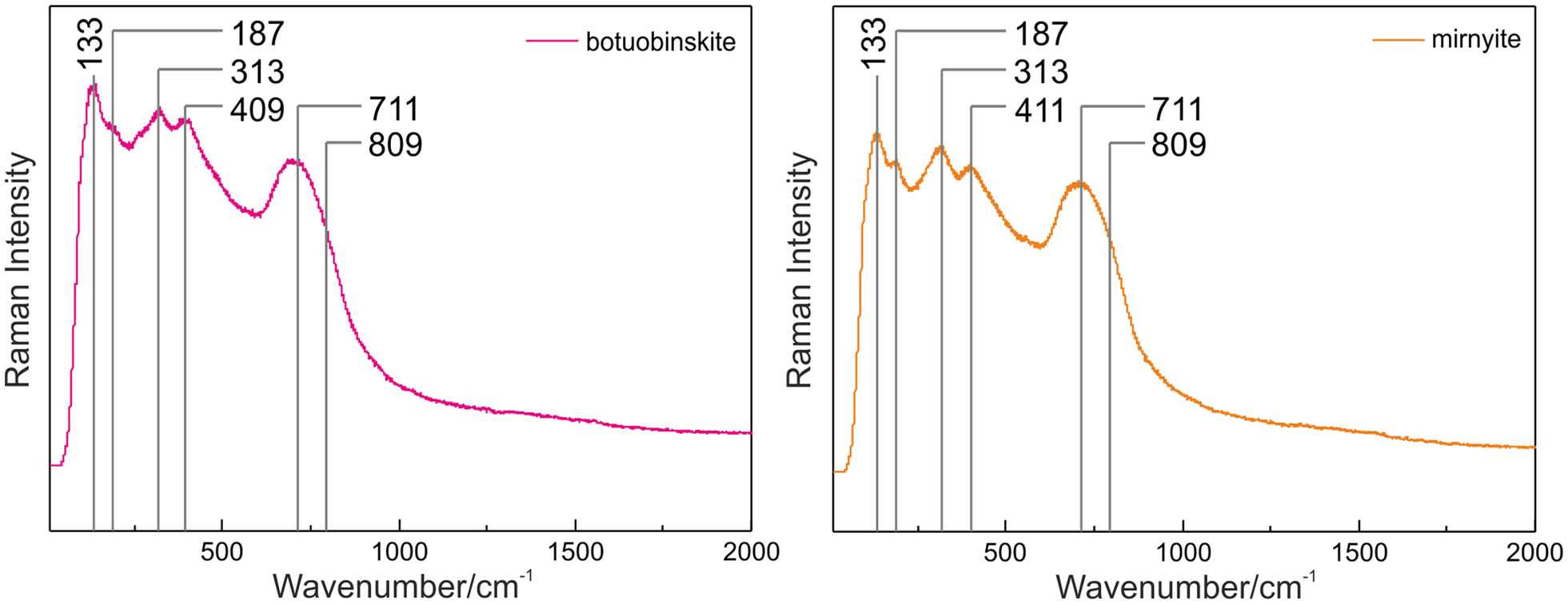
The Raman spectra of the minerals are shown in Fig. 3. The spectra were obtained with a Horiba Jobin Yvon LabRam HR 800 mm spectrometer coupled with a Nd:YAG 532 nm excitation wavelength laser and an Olympus BX41 microscope at IGM SB RAS. Further analytical details were provided by Alifirova et al. (Reference Alifirova, Rezvukhin, Nikolenko, Pokhilenko, Zelenovskiy, Sharygin, Korsakov and Shur2020).
Raman spectra of botuobinskite (left) and mirnyite (right).

The Raman peaks are located in the region 80–1000 cm–1. According to the factor-group analysis, the influence on the Raman spectra comes from phonon modes related to the 6c and 18f Wyckoff positions. In the unit cell they refer to the motions within M2 tetrahedral (T) and M3–M5 octahedral (C) units (i.e. internal modes) as well as to the rotations and translations of those entire units (i.e. external modes). The A and B positions have no impact on the Raman spectra. The phonon modes predicted above are located at 133, 187, 313, 409–411, 711 and 809 cm–1 (Fig. 3). The Raman modes can be revealed mostly by means of the Raman spectrum fitting procedure. The spectral bands in the O–H stretching region are expected to be inactive for Raman and do not occur in the obtained spectra at chosen parameters. Further assignment of theoretically predicted Γ point phonons was not made for this study.
The comprehensive Raman data on botuobinskite and other crichtonite-group minerals included in mantle garnets from a suite of Siberian kimberlites and lamprophyres were reported in (Alifirova et al., Reference Alifirova, Rezvukhin, Nikolenko, Pokhilenko, Zelenovskiy, Sharygin, Korsakov and Shur2020).
Fourier-transform infrared spectroscopy (FTIR)
A piece of the largest botuobinskite grain (Fig. 1) was polished from both sides to get a 50 μm thick plate. The spectra were recorded in air at room temperature using a Bruker Vertex 70 spectrometer equipped with a Hyperion 2000 infrared (IR) microscope at IGM SB RAS. IR spectroscopy data were acquired in a wavelength range of 7000–600 cm–1, with a resolution 2–4 cm–1, 30–70 scans and a 50 × 50 μm aperture.
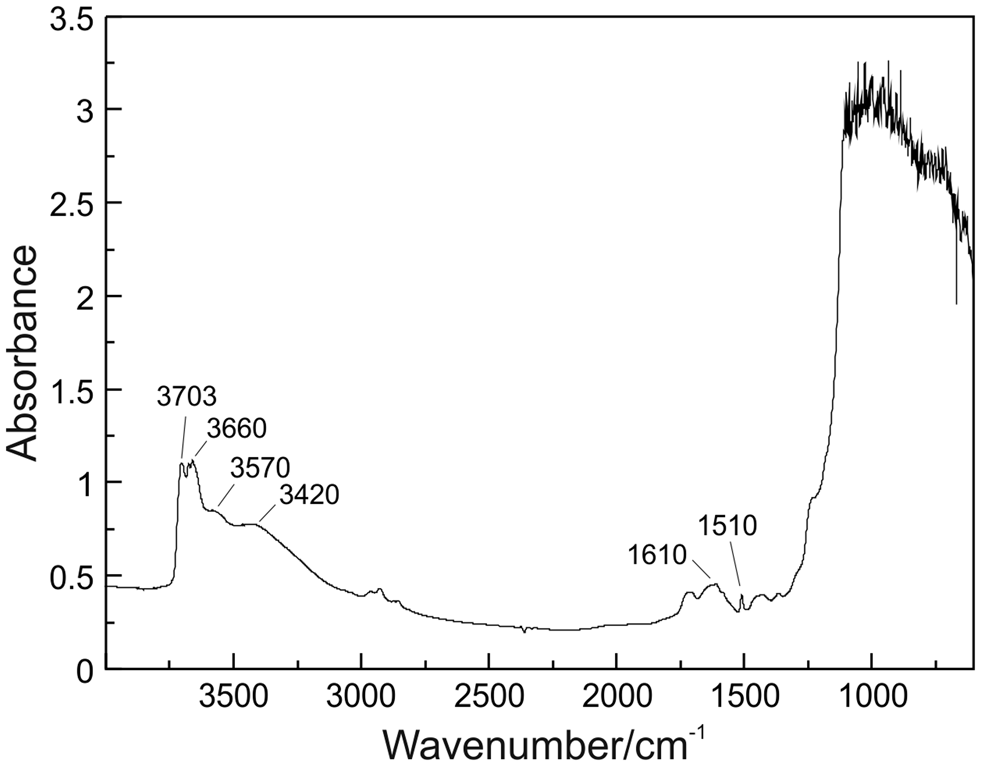
The absorption bands corresponding to O–H bond vibrations are observed within the ~3750–3100 cm–1 and ~1650–1400 cm–1 wavelength regions (Fig. 4). A broad absorption band in the former region is characteristic of the H–O stretching of the hydroxyl groups, showing strong bands at 3703 and 3660 cm–1 as well as shoulders at 3570 and 3420 cm–1. Minor weak bands at 1610 and 1510 cm–1 may be attributed to the metal–O–H overtones and to H–O–H bending, respectively. The amount of water was calculated following the Beer–Lambert law A = ε⋅t⋅c, where A is absorbance, ε is the molar absorption coefficient, t is the plate thickness and c is the concentration of the absorbing species in the sample. The integrated absorbance values (band areas) and the integrated molar absorption coefficient obtained by the calibration of the Libowitzky and Rossman (Reference Libowitzky and Rossman1997) were used in the equation. The calculated amount of water is 0.52 wt.% H2O, which corresponds to 1.02 OH– pfu.
Infrared spectrum of botuobinskite.

Discussion
Relationship to other mineral species of the crichtonite group
Comparative data for the new minerals and related species of the crichtonite group in terms of site occupancies are given in Table 12. Both minerals exhibit compositional similarities to other crichtonite-group species occurring in the lithospheric mantle (i.e. loveringite, lindsleyite and mathiasite). Mirnyite may be considered as a Sr-dominant (in the A site) analogue of these mantle-derived species, whereas botuobinskite shows A- and B-site occupancies different from other mantle crichtonites.
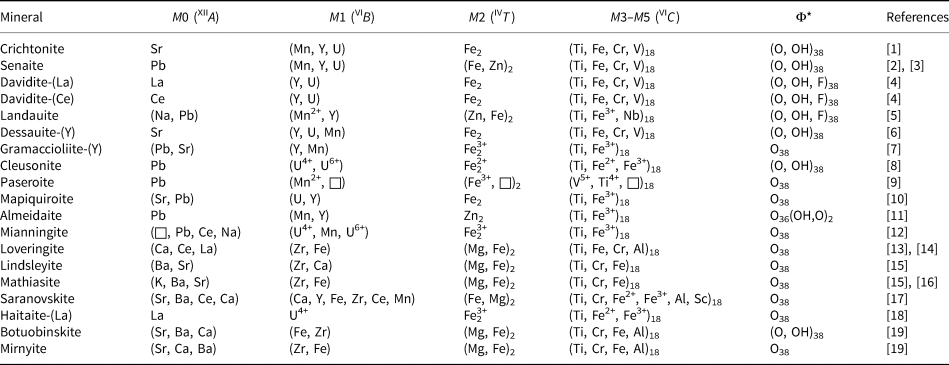
Crichtonite-group minerals approved by IMA–CNMNC and their structural formula.

Data are from the IMA List of Minerals, updated in November 2022 (Pasero, Reference Pasero2022). *Φ = 38 for all members of the crichtonite group. Possible additional cations in octahedral sites (Armbruster and Kunz, Reference Armbruster and Kunz1990; Gatehouse et al., Reference Gatehouse, Grey and Smyth1983; Orlandi et al., Reference Orlandi, Pasero, Duchi and Olmi1997) are not considered.
Key references: [1] Grey et al. (Reference Grey, Lloyd and White1976); [2] Grey and Lloyd (Reference Grey and Lloyd1976); [3] Armbruster and Kunz (Reference Armbruster and Kunz1990); [4]Gatehouse et al. (Reference Gatehouse, Grey and Kelly1979); [5] Grey and Gatehouse (Reference Grey and Gatehouse1978); [6] Orlandi et al. (Reference Orlandi, Pasero, Duchi and Olmi1997); [7] Orlandi et al. (Reference Orlandi, Pasero, Rotiroti, Filippo, Demartin and Moëlo2004); [8] Wülser et al. (Reference Wülser, Meisser, Brugger, Schenk, Ansermet, Bonin and Bussy2005); [9] Mills et al. (Reference Mills, Bindi, Cadoni, Kampf, Ciriotti and Ferraris2012); [10] Biagioni et al. (Reference Biagioni, Orlandi, Pasero, Nestola and Bindi2014); [11] Menezes et al. (Reference Menezes, Chukanov, Rastsvetaeva, Aksenov, Pekov, Chaves, Richards, Atencio, Brandão, Scholz, Krambrock, Moreira, Guimaraes, Romano, Persiano, Oliveira and Ardisson2015); [12] Ge et al. (Reference Ge, Fan, Li, Shen, Chen and Ai2017); [13] Gatehouse et al. (Reference Gatehouse, Grey, Campbell and Kelly1978); [14] Kelly et al. (Reference Kelly, Campbell, Grey and Gatehouse1979); [15] Haggerty et al. (Reference Haggerty, Smyth, Erlank, Rickard and Danchin1983); [16] Gatehouse et al. (Reference Gatehouse, Grey and Smyth1983); [17] Chukanov et al. (Reference Chukanov, Rastsvetaeva, Kazheva, Ivanov, Pekov, Agakhanov, Van, Shcherbakov and Britvin2020); [18] Wang et al. (Reference Wang, Fan, Li, Ge, Wu, Wang and Yao2021); [19] this study.
Alternatively, both botuobinskite and mirnyite can be considered as analogues of other Sr-dominant crichtonite-group minerals that are of crustal origin, such as crichtonite (sensu stricto), dessauite-(Y), mapiquiroite and saranovskite, yet showing different B- and T-site occupancy as well as characteristic enrichment in magnesium and chromium.
Review of botuobinskite and mirnyite occurrences
From the available literature data, one may trace a few other occurrences of botuobinskite and mirnyite in samples derived from the subcontinental lithospheric mantle. Botuobinskite and mirnyite appear to be relatively abundant as mineral inclusions in Cr-rich peridotitic garnets worldwide. More specifically, a mineral with a composition corresponding to botuobinskite was reported in a Cr-pyrope xenocryst from the Zagadochnaya kimberlite (Ziberna et al., Reference Ziberna, Nimis, Zanetti, Marzoli and Sobolev2013). Both minerals have been documented in pyrope crystals from an ultramafic diatreme of the Garnet Ridge cluster, Arizona, USA (Wang et al., Reference Wang, Essene and Zhang1999). Botuobinskite has also been recognised in composite polymineralic inclusions in Cr-pyrope crystals from the Aldanskaya lamprophyre dyke, Chompolo field, southeastern Siberian craton (Rezvukhin et al., Reference Rezvukhin, Nikolenko, Sharygin, Rezvukhina, Chervyakovskaya and Korsakov2022). Apart from the findings in intimate association with pyrope, mirnyite occasionally occurs in association with the typical LIMA series (lindsleyite–mathiasite solid solution) Zr-enriched titanates in metasomatised peridotite xenoliths sampled by South African kimberlites (Haggerty et al., Reference Haggerty, Smyth, Erlank, Rickard and Danchin1983; Haggerty, Reference Haggerty and Lindsley1991; Gregoire et al., Reference Gregoire, Bell and Le Roex2002; Konzett et al., Reference Konzett, Wirth, Hauzenberger and Whitehouse2013).
Implications for mantle metasomatic processes
Crichtonite-group titanates are important repositories of incompatible elements within the subcontinental lithospheric mantle. As estimated by Jones (Reference Jones and Bell1989), “approximately 1 part in 1000 titanate, occurring as discrete grains or grain boundary phases, would double the content of Ba, LREE (La, Ce), Rb, Sr, and U in average mantle”. The Sr-specific mineral species of the crichtonite group (i.e. botuobinskite and mirnyite) are particularly notable for their association with Cr-pyrope of lherzolitic paragenesis in the lithospheric mantle assemblages (e.g. Wang et al., 1999; Rezvukhin et al., Reference Rezvukhin, Malkovets, Sharygin, Tretiakova, Griffin and O'Reilly2018, Reference Rezvukhin, Nikolenko, Sharygin, Rezvukhina, Chervyakovskaya and Korsakov2022). To the best of our knowledge, crichtonite-group titanates have never been documented in association with depleted harzburgitic or dunitic garnet. These minerals are thus indicative of lherzolite-producing metasomatism (refertilisation) that is accepted to be a widespread phenomenon in the lithospheric mantle of ancient cratons (e.g. Stachel et al., Reference Stachel, Aulbach, Brey, Harris, Leost, Tappert and Viljoen2004; Malkovets et al., Reference Malkovets, Griffin, O'Reilly and Wood2007; O'Reilly and Griffin, Reference O'Reilly and Griffin2013). The crichtonite-group minerals probably exert a strong control on the trace-element partitioning during refertilisation, although numerical modelling is currently lacking. During the metasomatic harzburgite-to-lherzolite transition Sr and LREE partition strongly into newly-formed clinopyroxene (e.g. Griffin et al., Reference Griffin, Shee, Ryan, Win and Wyatt1999b). In this regard, it is probably important that the crichtonite-group minerals that frequently accompany pyrope and clinopyroxene in lherzolites represent previously overlooked (yet significant) components that effectively scavenge Sr and LREE as well.
The diversity of incompatible elements that may occupy positions A and B makes mantle-derived crichtonite-group titanates a potential tool for deciphering the processes of metasomatism in the lithospheric mantle of ancient cratons as well as for reconstructing the composition of the metasomatic agents (melt or fluids). In particular, the mantle-derived pyrope-hosted crichtonite-group titanates from the Internatsionalnaya kimberlite pipe are characterised by compositions rich in Na, Ca, Sr and REE, whereas those from South African kimberlites (LIMA series) are mostly Ba and K rich. The former also have larger Al contents than the latter, which probably reflects equilibrium with the host garnet (Rezvukhin et al., Reference Rezvukhin, Malkovets, Sharygin, Tretiakova, Griffin and O'Reilly2018, Reference Rezvukhin, Nikolenko, Sharygin, Rezvukhina, Chervyakovskaya and Korsakov2022). These differences indicate that the compositions of the metasomatic melts or fluids circulating in the lithospheric mantle of the Siberian and Kaapvaal cratons were not identical.
The crichtonite group currently comprises 19 mineral species, of which seven have been discovered over the last ten years. The diverse range of mineral compositions of known crichtonite-group species (Table 12) and the existence of a plethora of structural positions for isomorphic substitutions promise new systematic discoveries within this mineral group in the future.
Acknowledgements
SEM-EDS examinations, crystal data collection and structure refinement studies were supported by the Russian Science Foundation project No. 18-77-10062-P (https://rscf.ru/en/project/21-77-03004/). Electron microprobe WDS analyses were performed within the Russian Science Foundation project No. 18-17-00249. Sample preparation, Raman and FTIR studies were carried out within the state assignment project of IGM SB RAS.
We thank Dmitriy Belakovskiy (Fersman Mineralogical Museum, Moscow) for fruitful discussions and help in determining physical properties of the minerals. We are also grateful to Yurii Kupriyanov (IGM SB RAS) who assisted with FTIR analyses of botuobinskite. Thanks are extended to William L. Griffin (Macquarie University, Sydney) for editing English. Journal Editors Stuart Mills and Helen Kerbey provided efficient editorial handling. The manuscript benefited from the comments of Stuart Mills and three anonymous reviewers.
Supplementary material
To view supplementary material for this article, please visit https://doi.org/10.1180/mgm.2023.10
Competing interests
The authors declare none.