I. INTRODUCTION
The thermomechanical treatment has been used successfully in the past 30 years for steels containing allotriomorphic ferrite and pearlite, but recently adopted for the new bainite steels.Reference Bhadeshia and Scholes1–Reference Wang, Liu and Wang3 The accumulated strain and stress in the deformed austenite should have a great effect on the subsequent bainite transformation, i.e., the state of austenite was one of the main factors on the transformation. Therefore, the related researches have been studied.
The effect of stress on bainite transformation in alloy steels has been studied in some researches.Reference Chang and Bhadeshia4–Reference Shipway and Bhadeshia7 The external tensile stress below the yield strength of the austenite has been confirmed to accelerate the bainite transformation and favor for the development of certain crystallographic variants of bainite.Reference Chang and Bhadeshia4 Kang et al.Reference Kang, Suh, Cho, Oh and Lee5 studied the effect of external stress on the orientation distribution of ferrite grains, and showed that the deviation angle of the ferrite orientation from the K-S relationship increased when the transformation took place under an external stress. The increase in the deviation angle of ferrite grains from the K-S relationship was considered to make the coalescence of ferrite grains difficult during growth.
The influence of deformation on bainite transformation was different with various experimental conditions since the bainite transformation mechanism was complicated. In some researches, predeformation was generally presumed to promote the rate of bainite reaction.Reference Bhadeshia8,Reference Huang, Yang and Wang9 On the other hand, the different trend had been claimed. For example, Davenport et al.Reference Davenport, Miner, Kot and Balance10 used hot-rolled samples, which demonstrated that the austenite which was deformed to a larger extent tended to transform to bainite at a lower temperature during continuous cooling. Larn and YangReference Larn and Yang11 presented that the overall transformation kinetics became to be slower and the final attained amount of bainite decreased in deformed austenite after the isothermal transformation was finished. The effect of deformation on the microstructure was also investigated.Reference Lambers, Tschumak, Maier and Canadinc12 The additional energy provided by the plastic deformation promoted the growth of bainite lath along a preferred orientation. These studies mostly focused on the continuous cooling process rather than the isothermal transformation, and they did not create conditions in which both promotion and inhibition occurred in the same steel.
G55SiMoV steel is an impact-resistant bearing material. The investigation of austempering applied to this steel needs to be studied systematically.Reference Tian, Kong, Cui, Feng and Li13,Reference Tian, Ao and Li14 The purpose of the present work is to show the influence of compressive deformation of austenite and externally applied stress on the subsequent isothermal transformation of bainite in G55SiMoV steel via microstructure observation and kinetic analysis. The investigation of the present work not only can be used to analyse the mechanism of bainite transformation, but also provide a theoretical support on plastic forming and thermomechanical treatment of the material.
II. EXPERIMENTAL PROCEDURES
G55SiMoV steel is a new commercial medium carbon impact-resistant bearing steel whose main chemical composition is shown in Table I. Comparing with the typical high carbon chromium bearing steel, the contents of C and Cr in the G55SiMoV steel is relatively low. In addition, the elements of Mo and V in the G55SiMoV steel can refine grains, enhance hardness, and fatigue strength. To ensure the cleanliness and solidification structure quality of the steel, electric furnace terminal process control and refining narrow composition control technologies were applied in smelting process, and an electromagnetic stirring was applied in continuous casting process. The experimental specimens were cut from the hot-rolled bars with the average grain size rating of 7–8.
Chemical compositions of the G55SiMoV (wt%).

The steels annealed at 780 °C for 4 h with furnace cooling were machined and used for the thermal simulation in the size of Φ 10 mm × 15 mm. Thermal simulation was implemented using Gleeble-3800 thermal simulated test machine (Data Sciences International, St. Paul, MN).
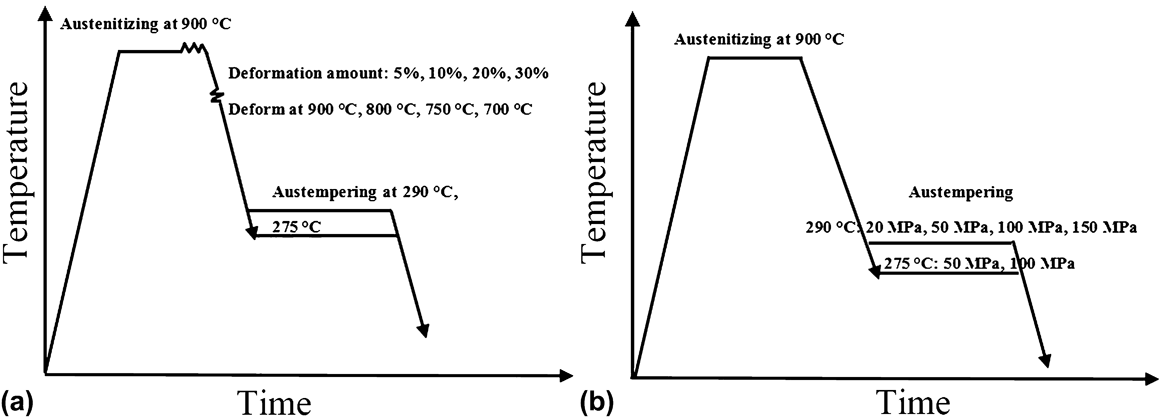
In the thermal simulation, different deformation reductions (5, 10, 20, and 30%), different deformation temperatures (700, 750, 800, and 900 °C), and different austempering temperatures were selected to simulate the isothermal quenching process under different deformation conditions, as shown in Fig. 1(a).
Schematic illustration of thermal simulation processes: (a) deformation; (b) stress.

For simulating the influence of stress on bainite transformation, the samples were prepared by heat treatment for 30 min at 900 °C, and then quenched in salt bath furnace at 275 and 290 °C for 30 min. Different externally applied stresses (20, 50, 100, and 150 MPa) were applied in the isothermal process, as shown in Fig. 1(b).
There were also some samples austempered at 275 and 290 °C without deformation and externally applied stress (PS: 2 MPa stress was load on the samples to fix them).
The radial dilation was selected as the indicator of bainite transformation since the axial dilation had an error caused by the cooling of fixture. Since the size of samples after deformation was different, the normalized processing was used for radial dilation, i.e., the dilation of sample reaching isothermal temperature at first time was considered to be 0, and then the samples with deformation reduction of 5, 10, 20, and 30% needed to be divided by 1.05, 1.1, 1.2, and 1.3, respectively.
The microstructures of samples were detected by JSM-6610LA scanning electron microscope (SEM; JEOL Co., Ltd., Tokyo, Japan) and JEM-2100 transmission electron microscope (TEM; JEOL Co., Ltd., Tokyo, Japan). The phase composition was determined by DMAX-2500 x-ray diffraction (XRD; Rigaku Corporation, Tokyo, Japan), and the content of residual austenite was measured by direct comparison method of XRD.
III. RESULTS AND DISCUSSION
A. Predeformation of austenite
1. Different deformation reductions
In this part, all the samples are austempered at 290 °C. The dilatometric curves of samples deformed at 900 °C with different deformation reductions are shown in Fig. 2. When the deformation reductions of the samples are 10 and 20%, the bainite transformation becomes faster and the final attained bainite fraction increases. The large deformation (30%) can suppress the bainite transformation and bring a pronounced decrease of bainite amount. Comparing with the deformation reduction of 20%, the bainite transformation is faster when the deformation reduction is 10%.
Dilation curves of samples austempered at 290 °C after deformation at 900 °C with different deformation reductions.
The dilatometric curves of samples deformed at 750 °C are shown in Fig. 3. The bainite transformation is suppressed with different deformation reductions, such as 10, 20, and 30%, and the bainite fraction decreases with the deformation reduction increasing. The fractions of obtained bainite in the deformed samples are lower than in the sample without deformation.
Dilation curves of samples austempered at 290 °C after deformation at 750 °C with different deformation reductions.
The acceleration on bainite transformation can be considered that an additional driving force for transformation and more position for nucleation are supplied by the deformation.Reference Zuyao15 The suppression of bainite transformation is caused by the increase of dislocation density which can constitute effective obstacles on the way of the bainite phase front,Reference Lambers, Tschumak, Maier and Canadinc12 and although the deformation does introduce more heterogeneous nucleation sites in correspondence with high defect density, the other potential positions of nucleation provided by interaction are drastically reduced.Reference Bhadeshia and Christian16 In addition, there is other strong evidence indicating that the mechanical stabilization of austenite is against to the bainite transformation.Reference Yang, Huang, Hsieh and Chiou17
The results shown in the present work are generally presumed as the comprehensive result of promoting and inhibiting factors. Moderate deformation can accelerate bainite transformation because of the additional transformation driving force and nucleation position; and the acceleration is offset partly with increasing inhibiting factors caused by dislocation and mechanical stabilization of austenite; when the inhibiting factors are stronger than the promoting factors, the bainite transformation becomes to be slow. There is a critical value between the acceleration and inhibition. The effect of work hardening which is more significant at a low deformation temperature leads to a decrease of the critical value with decreasing deformation temperature.
Martensite/bainite duplex microstructure is detected in samples produced by austempering at 290 °C after deformation at 900 °C with different deformations as shown in Fig. 4. The black acicular bainite distributes on the martensitic matrix. Comparing with undeformed sample, the bainite contents in deformed samples with 10%, 20% reduction are slightly increased, while it is decreased in sample with 30% deformation. The bainite contents of samples are estimated by quantitative metallographic method. The results indicate that the bainite contents are 20, 25, 23, and 17% respectively, corresponding to 0, 10, 20, and 30% deformation. This is consistent with the law of dilation curve.
Microstructure of samples with different deformation reductions (observed by OM): (a) 0%, (b) 10% (c) 20%, and (d) 30%.
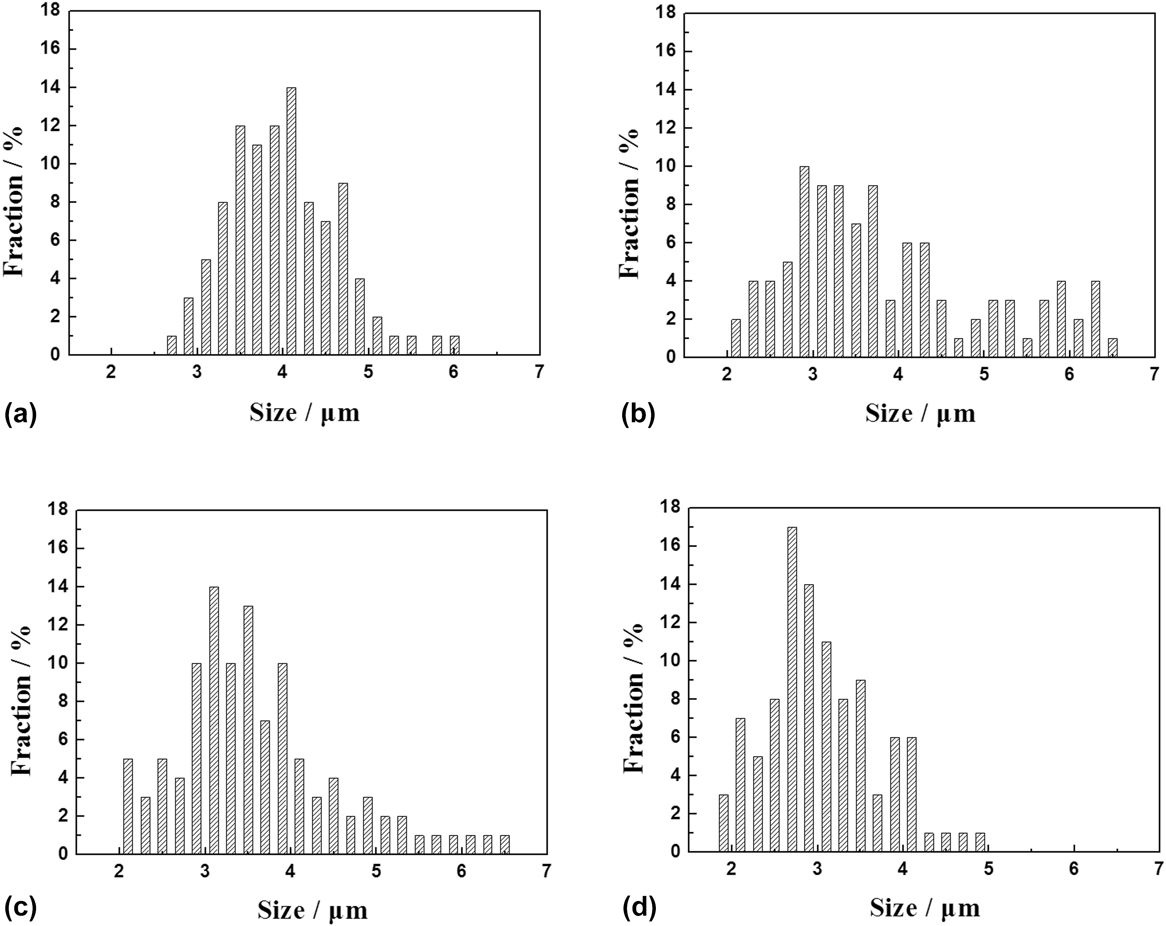
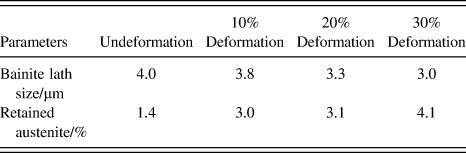
Figure 5 presents the bainite size distribution of the deformed samples, and the related parameters of the microstructure are shown in Table II. The size of bainite lath means the length of bainite lath in this study. The data are the result of 200 times statistics. It can be found that the size of bainite lath in the sample without deformation is from 3 to 5 μm. Deformation changes the size distribution, and the peak of size distribution deviates to the small size with increasing deformation reduction. The mean size of bainite lath decreases with increasing deformation reduction, which is corresponding to 4.0, 3.8, 3.3, and 3.0 μm when the deformation reductions are 0, 10, 20, and 30%, respectively. The retained austenite is also affected by the deformation reduction, and the samples with deformation of 0, 10, 20, and 30% have contents 1.4%, 3.0%, 3.1%, 4.0% of retained austenite, respectively. The increase of retained austenite reflects the effect of deformation on the stability of austenite.
Bainite size distribution of samples with different deformation reductions: (a) 0%, (b) 10%, (c) 20%, and (d) 30%.
Microstructure parameters affected by deformation reduction.
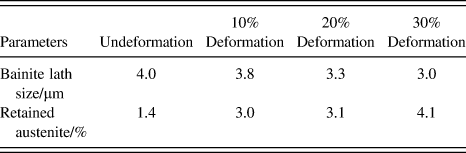
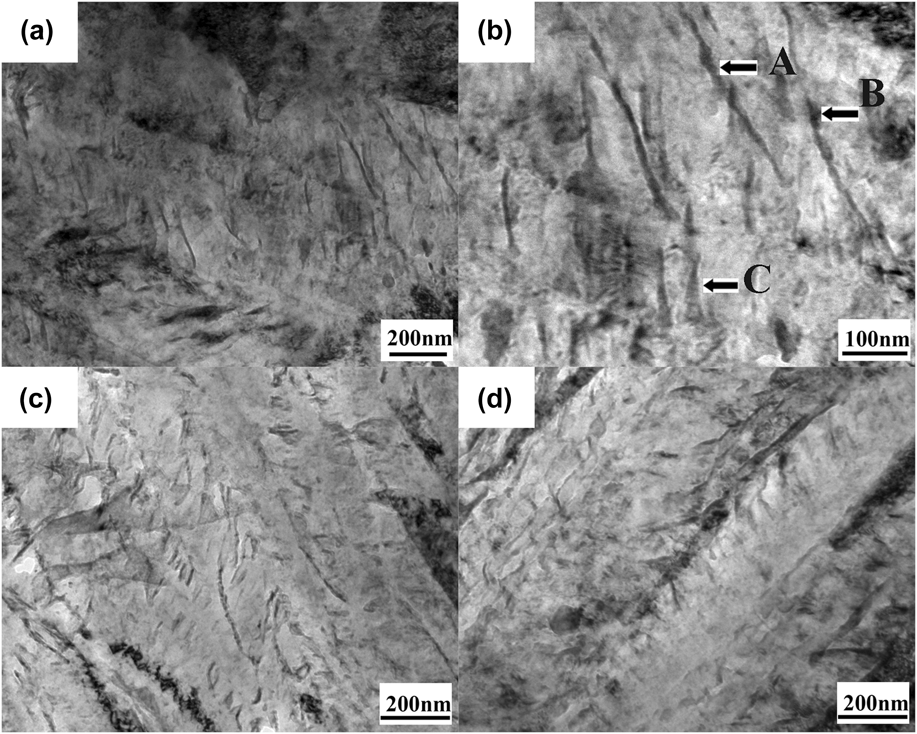
Figure 6 presents the microstructure of samples with and without deformation observed by TEM. As shown in Fig. 6(a), the microstructure of undeformed sample is typical low bainite with carbides directionally distributing on the ferrite matrix. The angle of carbides and ferrite boundary is in the range of 55°–60°. The distribution of carbides is shown in Fig. 6(b). The result indicates that most carbides distribute on the boundary of ferrite or in the ferrite, but some carbides across two pieces of ferrite (as indicated by arrows A and B). Carbides distributing in ferrite was once regarded as the evidence of carbides precipitating within the ferrite and the proof of shear transformation.Reference Fang, Feng, Deng, Deng, Zhang and Bai18 The phenomenon of carbides across two pieces of ferrite indicates that the growth of bainite ferrite and carbides are competitive, and the carbides do not precipitate from bainite ferrite.
Microstructure of samples with and without deformation (observed by TEM): (a) undeformed, (b) undeformed, (c) 10%, and (d) 30%.
Some bainite carbides are of strip-shape, while other bainite carbides are of wedge-shape. These carbides are coarser on the boundaries and tapering away from the boundaries [as indicated by arrows C in Fig. 6(b)]. According to step growth theory, a carbon concentration field will be formed near ferrite subunits.Reference Fang, Feng, Deng, Deng, Zhang and Bai18 The carbon concentration is high near ferrite boundary and gradually becomes low away from the boundary, therefore the carbide is taper. The microstructure of samples with deformation [as shown in Figs. 6(c) and 6(d)] indicates that bainite carbides in deformed samples are finer and shorter and no long strip-shaped carbides present, comparing with the undeformed sample. These indicate the effect of deformation on bainite carbides morphology. The mechanism of carbide morphology affected by deformation has not yet been reported. We consider that the growth of bainite ferrite and carbides is competitive. Increase of ferrite nucleation rate caused by distortion and dislocation will suppress the growth of bainite carbides and make most carbides without full growth be finer and shorter.
2. Different deformation temperatures
According to Figs. 2 and 3, it can be found that the deformation temperature has a significant impact on bainite transformation kinetics. Figures 7 and 8 present the effect of deformation temperature on bainite transformation kinetics under two conditions (deformation accelerates or inhibits bainite transformation). Figure 7 shows that the bainite transformation is suppressed when the samples are austempered at 290 °C with the deformation reduction of 30% comparing with the sample without deformation. In addition, the suppression of bainite transformation is more strong when the deformation temperature decreases from 900 to 700 °C. Figure 8 shows that 10% deformation reduction can accelerate the bainite transformation in various deformation temperatures when the samples are austempered at 275 °C. Comparing with the sample deformed at 900 °C, it has comparatively low final attained amount of bainite in the sample deformed at 750 °C.
Dilation curves of samples with 30% deformation reduction austempered at 290 °C deformed at different temperatures.
Dilation curves of samples with 10% deformation austempered at 275 °C deformed at different temperatures.
Therefore, whatever the bainite transformation is promoted or suppressed by deformation reduction, the inhibiting factors will be strengthened by decreasing the deformation temperature. It also can be found that the austempering temperature has a significant impact on bainite transformation kinetics. The effect of austempering temperature is discussed subsequently.
3. Different austempering temperatures
Dilation curves of the samples austempered at 275 °C with different deformations are shown in Fig. 9. It indicates that the bainite transformation is accelerated when the deformation reduction is in the range of 5–30%, and the acceleration becomes weak with increasing deformation reduction. The results are slightly different when the samples are austempered at 290 °C, which show that the large deformation reduction (30%) is against to the bainite transformation and brings a pronounced decrease in bainite amount.
Dilation curves of samples austempered at 275 °C with different deformation reductions.
Comparing with the results of Figs. 2 and 9, it can be found that the dilation of undeformed sample austempered at 290 °C is larger than the samples austempered at 275 °C, i.e., the dilation are 0.55 and 0.48 mm, respectively. Therefore, the influence of austempering temperature should be considered when the effect of predeformation on bainite transformation is discussed.
B. Externally applied stress
Figures 10 and 11 show the effect of externally applied stress on bainite transformation at different austempering temperatures. The results indicate that the bainite transformation is accelerated by stress when austempering temperatures are 275 and 290 °C. The acceleration of bainite transformation is more strong with increasing stress due to the higher additional driving force for the transformation.Reference Patel and Cohen19 When the stress is in the same degree, stress promotes bainite transformation obviously at high austempering temperature, since the additional driving force is more significant and the chemical driving force is relatively low when the samples are austempered at high temperature.
Dilation curves of samples austempered at 275 °C applying different stresses.
Dilation curves of samples austempered at 290 °C applying different stresses.
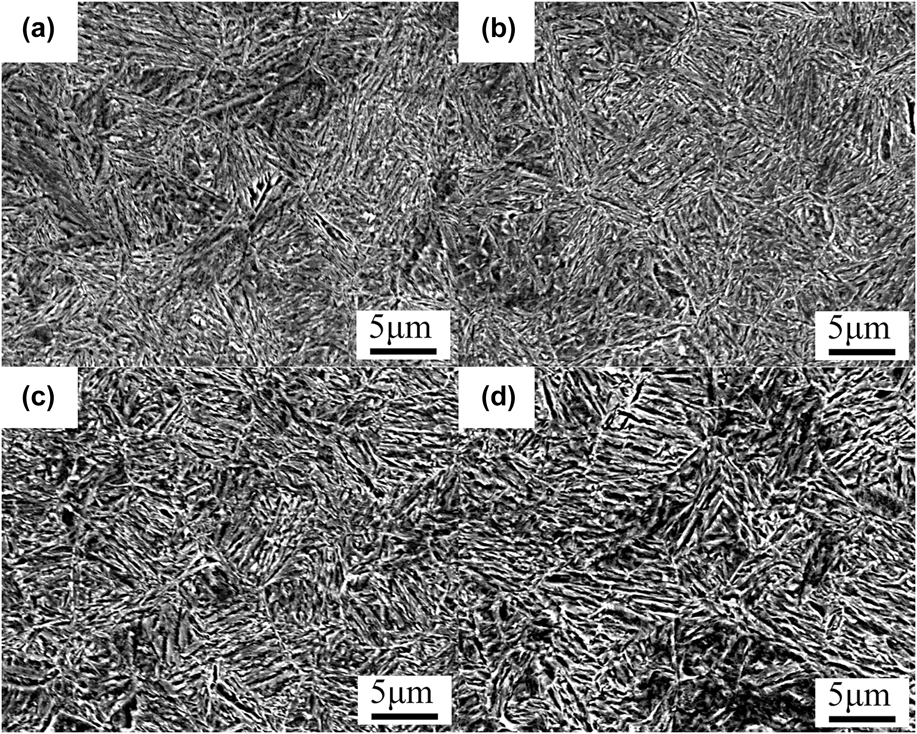
Figure 12 shows the microstructures of samples austempered at 290 °C with different stresses. It indicates that the low stress (20 MPa) does not affect the microstructure obviously. The great applied stress can affect the distribution of bainite lath. When the stress increases to 150 MPa, the bainite lath becomes to be nonrandom in a bainite packet.
Microstructures of samples applying different stresses: (a) 0 MPa, (b) 20 MPa, (c) 100 MPa, and (d) 150 MPa.
IV. CONCLUSIONS
The effect of deformation reduction, deformation temperature, and externally applied stress on the isothermal bainite transformation has been investigated in the present work. The results showed that the bainite transformation kinetics became faster and the final attained amount of bainite increased under the applied stress condition. The promoting effect was more significant at higher austempering temperature. When the stress increased to 150 MPa, the microstructure became to be nonrandom. Moderate predeformation of austenite could promote the bainite transformation while superfluous predeformation prevented the bainite transformation. The influence of deformation on bainite transformation was generally presumed as the comprehensive result of promoting factors and inhibiting factors, and these two factors worked competitively. Bainite carbides in deformed samples are finer and shorter and no long strip-shaped carbides present, comparing with the undeformed sample.
ACKNOWLEDGMENTS
The authors wish to thank Laiwu Iron and Steel Group Co., Ltd. for supplying the steels used in the test. This work was also financially supported by Science and Technology Development Planning Program of Shandong Province (2011GGX10202) and College Independent Innovation Program of Ji'nan (201102048 and 201202073).