




No CrossRef data available.
Article contents
Density dependence and overdispersion in the transmission of helminth parasites
Published online by Cambridge University Press: 09 March 2005
Abstract
The influence of density-dependent processes on the transmission of parasitic helminths is determined by both the severity of the regulatory constraints and the degree of parasite overdispersion among the host population. We investigate how overdispersed parasite distributions among humans influence transmission levels in both directly- and indirectly-transmitted nematodes (Ascaris lumbricoides and Onchocerca volvulus). While past work has assumed, for simplicity, that density dependence acts on the average worm load, here we model density-dependence as acting on individual parasite burdens before averaging across hosts. A composite parameter, which we call the effective transmission contribution, is devised to measure the number of transmission stages contributed by a given worm burden after incorporating overdispersion in adult worm mating probabilities and other density-dependent mechanisms. Results indicate that the more overdispersed the parasite population, the greater the effect of density dependence upon its transmission dynamics. Strong regulation and parasite overdispersion make the relationship between mean worm burden and its effective contribution to transmission highly non-linear. Consequently, lowering the intensity of infection in a host population using chemotherapy may produce only a small decline in transmission (relative to its initial endemic level). Our analysis indicates that when parasite burden is low, intermediate levels of parasite clustering maximize transmission. Implications are discussed in relation to existing control programmes and the spread of anthelmintic resistance.
Keywords
Information
- Type
- Research Article
- Information
- Copyright
- © 2005 Cambridge University Press
INTRODUCTION
The rate of transmission of helminth infections is influenced by density-dependent mechanisms acting at various stages of the parasite's life-cycle. Density dependence in worm fecundity, survival and establishment affects transmission dynamics and has important implications for understanding the epidemiology of the infection and the impact of control programmes (Dietz, 1988). The precise impact of density dependence upon parasite population regulation depends critically on the distribution of worms between hosts (Anderson & May, 1978; Keymer, 1982; Medley, 1992), since parasites tend to be highly aggregated within their host population, with a few hosts harbouring the majority of parasites (Crofton, 1971; Anderson & May, 1985).
Density dependence has been modelled as acting upon the mean worm burden per host in the population in some deterministic frameworks (Basáñez & Boussinesq, 1999). This explicitly assumes that for a given mean, all parasites in a population experience the same regulatory constraints. This underestimates constraints operating within heavily infected individuals whereas overestimating those occurring within hosts with low worm counts. Some individual-based, microsimulation models, though treating the density-dependent stages of the parasite's life-cycle deterministically allow each host to contribute individually to transmission (e.g., density-dependent microfilarial uptake by insect vectors in the ONCHOSIM and LYMFASIM models presented by Plaisier et al. (1990, 1991, 1998). Other ‘hybrid models’ include those that are essentially deterministic but contain probabilistic elements in the form of a frequency distribution of the worm number per host (Anderson, 1982; Norman et al. 2000). [For alternative frameworks in which both the mean and the variance of all parasite stages are modelled explicitly see Grenfell et al. (1995).]
Here we model density dependence as a process operating upon an individual host's worm burden rather than upon the population mean. Among the few existing models which explicitly investigate the effects of a density-dependent mechanism in an overdispersed parasite population is that of May (1977). May's model describes the probability with which dioecious (separate sexes) parasites mate within a host. In obligatory parasites, adult worms are confined to their definitive host so reproduction of dioecious helminths may be restricted due to single sex infections (Macdonald, 1965). The mating probability (denoted Φ (W, k)) indicates the fraction of the female population co-inhabiting with male worms in the same host, depending on the average worm burden (W) and the degree of parasite overdispersion (as measured by parameter k of the negative binomial distribution). For a completely polygamous parasite (meaning that if only one male is present within a host all females within that host will be mated), the mating probability is

(May, 1977).
This paper extends this analytical framework to incorporate other aspects of helminth biology. We investigate both positive (up-regulating) and negative (down-regulating) density-dependent mechanisms and quantify their complex relationship with transmission. High aggregation increases transmission (positive feedback) as the majority of parasites are clustered within a few individuals and the mating probability will approach unity. However, this clustering will also reduce the per-parasite rate of transmission if negative feedback mechanisms are operating (e.g. density-dependent reductions in parasite fecundity, or limitation of parasite uptake by vectors). More generally, density dependence, parasite aggregation and intensity of infection are inter-related and affect the stability of the parasite population (Anderson & May, 1978; Adler & Kretzschmar, 1992; Kretzschmar & Adler, 1993; Rosà & Pugliese, 2002; Rosà et al. 2003; but see also Medley, 1992). These papers clearly demonstrate the strong stabilizing impact of density dependence on the dynamics of the host–parasite system, and the importance of parasite distribution. However, these models primarily concentrate on a scenario where host demographic (both birth and death) rates are strongly dependent on parasite load, which is thought not to be the case for the chronic helminth infection of humans discussed here. [An association between microfilarial load and excess host mortality has been demonstrated in onchocerciasis, though it is thought to account only for approximately 5% of all deaths (Little et al. 2004).]
The models presented in this paper shall assume that the degree of helminth overdispersion remains constant, as no consideration is given to the mechanisms which may generate aggregation, such as host predisposition (Quinell, 2003), heterogeneity in exposure (Shaw, Grenfell & Dobson, 1998), clumping of infective stages (Isham, 1995; Quinnell, Grafen & Woolhouse, 1995), or density-dependent mechanisms themselves (Anderson & Gordon, 1982); also see Galvani (2003). Rosà & Pugliese (2002) showed that overdispersion introduced by heterogeneity in the host population (e.g. exposure or susceptibility) is much more stabilizing than overdispersion introduced by clumped infection.
We apply the model framework developed to human helminth infections with direct (Ascaris lumbricoides) and indirect (Onchocerca volvulus) life-cycles. Both species are targets of large-scale, mass chemotherapy control programmes (WHO, 1998; Richards et al. 2001), making the understanding of the relationship between infection and transmission intensity particularly relevant (Basáñez et al. 2002).
METHODS
Within this paper the term effective transmission contribution (denoted Θ) is introduced to describe the net number of transmission stages (eggs or larvae) contributed by a given worm burden in the presence of (positive and negative) density-dependent processes within the parasite's life-cycle. For directly-transmitted worms such as gastrointestinal helminths, Θ will refer to the number of eggs per gram of faeces excreted by a host. For the indirectly-transmitted filarial worms, it will be a measure of the number of infective (L3) larvae developing per arthropod (dipteran) vector that has fed on a (definitive) host. The effective transmission contribution will depend on the average number of adult worms (W, or mean worm burden) per individual host in the population and the degree of parasite clumping among hosts (measured by parameter k), i.e., Θ(W, k).
We assume the parasite population to have a 1[ratio ]1 sex ratio on average; to be completely polygamous (Schulz-Key & Karam, 1986); and for the total number of worms (both male and female) to be negative binomially distributed among hosts. The choice of the negative binomial distribution is motivated by its simplicity; its two parameters are the mean worm burden and k, an inverse measure of overdispersion (Elliott, 1977; Anderson & May, 1985). It also describes adequately many observed parasite distributions in both vertebrate and vector hosts (Cheke, Garms & Kerner, 1982; Guyatt et al. 1990).
Direct life-cycle
The intestinal nematode A. lumbricoides is known to exhibit density-dependent fecundity (for a recent review see Hall & Holland, 2000), which can heuristically be described using the exponential function (Anderson, 1982). Density-dependent net fecundity, f (i.e., the mean number of eggs per gram of faeces produced by a given worm burden), can be described by the equation,

where n is the number of female worms within a host, cF is a measure of the severity of density-dependent fecundity, and λ0 is the maximum number of eggs produced per gram of faeces per adult female worm for very small n or when cF tends to 0.
1The units of λ0 depend on how equation (1) is parameterized; λ0 can represent a per capita fecundity rate (the intrinsic, density-independent number of eggs produced per female worm per unit time (Anderson & May (1992)) or a per capita fecundity density (per gram of faeces). We have chosen the latter due to availability of data in this format (Hall & Holland, 2000). In order to express λ0 per unit time we would also need the daily rate of faecal excretion. We have assumed that such rate would be independent of parasite density and therefore irrelevant to our argument.

Fig. 1. The influence of density dependence on the net production of parasite transmission stages in observational (A) and experimental (B) data. (A) The relationship between the concentration of eggs per gram of faeces, grouped according to mean worm burden, and the number of Ascaris lumbricoides female worms (assuming a 1[ratio ]1 sex ratio) infecting children. Equation (1) was fitted (solid line) to the data (open squares) giving λ0=3120 eggs per female worm per gram of faeces and cF=0·106 per female worm. Data are from Hall & Holland (2000). (B) The relationship between the mean number of larvae per fly (L) that successfully pass into the haemocoele or thorax of West African (savannah) Simulium damnosum and the mean number of microfilariae of Onchocerca volvulus ingested per fly. (The number of haemocoelic or thoracic larvae has been shown to be a good predictor of the number that will reach the infective stage.) The relationship between skin microfilarial load per milligram of skin (M) and microfilarial intake per bite is assumed to be linear with proportionality constant aV as in Table 1 (Basáñez et al. 1994; Basáñez & Boussinesq, 1999). The equation (solid line) was fitted to the data (open squares), yielding =0·043 and c=0·026 per microfilaria. Data are as collated by Basáñez et al. (1995).
It has been assumed that the average of equation (1) across all hosts can be obtained by applying equation (1) to the mean worm burden, resulting in

where W=mean number of worms per host (so

=mean number of females). However, this mean-based expression, while simple, is not the correct expected value of f(n).
To calculate the net contribution of transmission stages from infected hosts we must first formulate the density-dependent processes operating within each individual host and then sum across all possible host infection states as follows,

Here ΘA (W, k) denotes the effective transmission (egg) contribution of adult Ascaris as a function of both mean worm burden and overdispersion. P(N, n1) is the probability that a host contains a total number of N adult worms, of which n1 are females. Assuming that the joint negative binomial distribution describes adequately the (male and female) parasite overdispersion in this macroparasite-host system, the effective contribution to transmission stages of A. lumbricoides (ΘA (W, k)) in human populations can be described by the following closed form (the derivation of which is detailed in Appendix A),

In the limit of severe density dependence (cF→∞), ΘA(W, k) tends to zero proportionally to the fraction of hosts containing a mated female,

The expression for such fraction of hosts was derived by May (1977). With extreme density dependence, all hosts containing at least one male and female worm will contribute the same number of eggs, irrespective of their overall worm burden, so transmission will be proportional to the prevalence of hosts with mated females and not to the intensity of mated female worm infections.
As the value of cF→0 (weak density-dependence), ΘA (W, k) tends to

which corresponds to the situation explored by May (1977), with

being the mean number of females per host. At high levels of parasite intensity, the mating probability Φ (W, k) (the expression within the outer brackets of equation (6)) tends to unity and ΘA becomes linearly proportional to the mean worm burden.
Indirect life-cycle
The life-cycle of O. volvulus, the filarial parasite responsible for human onchocerciasis (river blindness), has been shown to exhibit density-dependent larval establishment within its West African (savannah) Simulium damnosum vector (Fig. 1B; Basáñez et al. 1995; Soumbey-Alley et al. 2004). The model presented above can be extended to filarial nematodes if we assume that the number of stages available for transmission to the vector (microfilariae) is proportional to the number of female worms within the host (Denham et al. 1972a; Trees et al. 1992; Duke, 1993). The combined influence of single sex infection (within the human host) and density-dependent larval establishment (within the insect vector) can be quantified to estimate the number of infective (L3) larvae contributed by a given worm burden. We focus on the parasite transmitted in West African savannah here due to its public health importance (WHO, 1995). For the purposes of this paper, other density-dependent mechanisms such as parasite-induced vector mortality (Basáñez et al. 1996) will be ignored, and it will be assumed that once larvae are established within the fly they will develop into infective, 3rd-stage larvae.
An existing onchocerciasis population dynamics model describes mean parasite loads per human and fly with the following set of ordinary differential equations (modified from Basáñez & Boussinesq, 1999),


where M(t) denotes mean microfilarial load in the skin of the human host, L(t) the mean number of L3 larvae per fly, and W(t) the mean number of adult parasites per human host (at time t), with half the worms being females; all parameters are defined in Table 1. Prior to the commencement of control perturbations, the number of skin microfilariae can be assumed to be at (endemic) equilibrium. Since in this case we are not assuming the operation of density-dependent fecundity, the number of microfilariae available to a host-seeking fly will be directly proportional to the (fertilized) worm burden of every individual host i.e., directly proportional to the number of mated females. [Although the life-spans of microfilariae and infective larvae are much shorter than that of the adult female worm, and it would be customary to set the faster parasite stages to equilibrium, we focus here on the contribution to infective larvae by a given worm burden. The numbers of infective larvae in blackfly vectors are commonly measured in onchocerciasis surveys (Duke, 1968; Walsh et al. 1978; Basáñez & Boussinesq, 1999).] Equation (8) becomes,


By analogy with equation (4), and likewise assuming a joint negative binomial distribution of male and female worms, the effective transmission contribution of O. volvulus infective larvae by a given worm burden, ΘO (W, k), can then be written as

where

is the density of microfilariae per mg of skin per female worm (akin to the density of eggs per gram of faeces per female worm in equation (4)), and caV has units of skin microfilariae−1. In this case the proportion of parasites establishing within the fly (instead of female worm fecundity) decreases exponentially with increasing microfilarial load from an intrinsic maximum

with severity of density dependence c (and aV is the proportion of skin microfilariae ingested per bite). Therefore, the rate of change with respect to time of the number of L3 larvae per fly can be written as a function of the effective transmission contribution

where β is the biting rate per fly on humans.
For A. lumbricoides and O. volvulus we examine, respectively, the behaviour of equations (4) and (10) as we vary W and k, and in the case of onchocerciasis we also present the temporal dynamics of parasites invading entirely susceptible host populations.
RESULTS
The difference between the results derived from mean-based models for Ascaris and Onchocerca, and our equations is shown in Fig. 2A and B, respectively. Models ignoring the interaction between overdispersion and density dependence (e.g., Basáñez & Boussinesq, 1999) will tend to overestimate the level of transmission. At low intensities of infection the mean-based model does not capture restrictions imposed by single sex infections, particularly if the parasite population which the model intends to mirror were to exhibit high values of k (low levels of parasite overdispersion among hosts) (May, 1977; Anderson & May, 1992). At high mean worm burdens the mean-based model underestimates the impact of density-dependent down-regulatory mechanisms. Furthermore, at high mean worm burdens there will be a greater discrepancy between the mean-based and the new estimates for lower values of k (describing increasingly aggregated parasite populations). As k tends to infinity (indicating Poisson distribution of worms between hosts) the results of the new equations approach the mean-based model if density-dependence is weak, but remain divergent for strong density dependence. In the latter case our model predicts that every infected host produces parasite offspring at the same rate as does a host infected with a single mated female (equation (5)), while the mean-based model fails to reproduce this limit correctly.

Fig. 2. The relationship between the effective transmission contribution as defined in this paper (see equations (4) and (10) for (A) (Ascaris lumbricoides, eggs per gram of faeces) and (B) (Onchocerca volvulus, L3 per fly), respectively) and the intensity of infection measured as mean adult worm burden. The graphs compare the mean-based transmission equations (broken lines) with the novel individual-based estimates (solid lines). Broken lines: mean-based model (see equation (2) and the function in the outer (curly) brackets of equation (9) (with Φ=1) for Fig. 2A and B, respectively). Solid lines: equation (4) for A. lumbricoides and equation (10) for O. volvulus with k=1 (moderate aggregation, thin line) and k=0·1 (stronger aggregation, thick line). Parameter values are derived from Fig. 1A and B. Both A. lumbricoides (Guyatt et al. 1990) and O. volvulus (Basáñez et al. 2002) tend to have k values between 0·1 and 1. The maximum mean worm burdens plotted are motivated by field data. In mesoendemic areas of Nigeria, Ascaris expulsion studies indicated a mean worm burden W=13 worms per host (Hall & Holland, 2000). Mathematical projections for O. volvulus in hyperendemic areas of northern Cameroon (Duke, Anderson & Fuglsang, 1975) indicated mean worm burdens as high as 200 worms, corresponding to a a mean of 3 palpable nodules per person (Basáñez & Boussinesq, 1999).
Density dependence causes the relationship between the mean worm burden and its contribution to transmission to be non-linear (Fig. 2A and B). This non-linearity becomes more accentuated as the degree of parasite overdispersion increases. For example, in a hyperendemic onchocerciasis village, with a highly overdispersed parasite population (k=0·1), it would be necessary to reduce adult worm burden, using chemotherapy, by approximately 80% in order to reduce the (L3) contribution to transmission by 50% (Fig. 2B). The steep gradient of the curve at low worm burdens and increasing levels of parasite aggregation indicates that relative transmission remains high, and can quickly recover to near pre-control levels if chemotherapy were relaxed without achieving local elimination. For onchocerciasis, the non-linear relationship between worm burden in the human host and infective larval load in the vector would be exacerbated with the inclusion of other regulatory constraints operating on vector (Basáñez et al. 1996) and human host survival (Little et al. 2004), parasite fecundity or survival (Duerr et al. 2004), and parasite establishment within the human host (Basáñez et al. 2002; Duerr et al. 2003). It should be noted that Fig. 2A and Fig. 2B illustrate the functional relationship between the effective contribution to transmission and the intensity of infection, measured as mean worm burden, for varying k, and do not represent plots of equilibrium solutions (i.e., they depict the behaviour of equations (4) and (10), which are not null isoclines). It should also be noted that some of the parameter values may be locale specific, as is the case of the severity of density-dependent fecundity in A. lumbricoides (Hall & Holland, 2000), or the degree of density-dependent parasite uptake by O. volvulus vectors (Demanou et al. 2003; Soumbey-Alley et al. 2004).
The interplay between parasite distribution and density dependence will determine not only the contribution to transmission but also the rate of parasite invasion. Fig. 3 shows the numerical solutions (see Appendix B) for the temporal dynamics of O. volvulus introduced into an entirely susceptible human population. The rate of invasion is of particular relevance since it will indicate the speed of recrudescence following the cessation of chemotherapy, or the spread of a drug-resistant genotype.

Fig. 3. Influence of parasite overdispersion on the temporal dynamics of human onchocerciasis (time since introduction of the parasite) in West African savannah settings. The graph compares the results of mean-based transmission equations (broken lines) with those derived from the novel individual-based estimates (solid lines) for different degrees of worm aggregation: (A) mean number of adult worms per person; (B) mean number of infective (L3) larvae per fly; (C) microfilarial prevalence (expression contained within outer (square) brackets of equation (5)). Broken lines in (C) and solid lines in all three graphs correspond to: k=1 (thin lines, moderate aggregation) and k=0·1 (thick lines, stronger aggregation). The differential equations and parameter values describing adult worm (dW/dt) and infective larval dynamics (dL/dt) are based on the model presented by Basáñez & Boussinesq (1999) and outlined in Appendix B. Initial conditions simulate the introduction of O. volvulus into a fully susceptible host population with W(0))=0·1 per person. For comparison with the results shown here, measurements from villages in northern Cameroon gave 0·02–0·1 L3 per fly, and 50–98% microfilarial prevalence (Basáñez & Boussinesq, 1999). Parameter values not already listed in Table 1 are as follows: annual biting rate (mβ): 28000 bites person−1 year−1; =0·16; =0·0032; cH=0·0137 L3−1 yr, and ρW=0·12 yr−1.
The parasite distribution at which maximum contribution of transmission stages is achieved for a given worm burden will be a compromise between opposing density-dependent processes. Down-regulatory density-dependent mechanisms (e.g., density-dependent fecundity) will reduce transmission at high levels of infection intensity and parasite clumping. Conversely, at low mean worm burdens such aggregation will increase a parasite's probability of mating, due to the higher chance that male and female worms will co-inhabit the same host. Consequently, our analysis predicts that, for low intensities of infection, optimal production of transmission stages will occur at intermediate levels of parasite clustering. The lower the worm load in the host population, the smaller the value of k for which maximum transmission will be achieved (Fig. 4).

Fig. 4. The relationship between the effective transmission contribution for directly transmitted intestinal helminths (as defined in equation (4)) and the degree of parasite overdispersion (as measured by parameter k of the negative binomial distribution) for different intensities of infection. Thin line: W=2 per host; thick line: W=1 per host. The degree of aggregation at which maximum transmission is achieved changes due to the operation of opposing density-dependent mechanisms, such as the mating probability and constraints on worm fecundity (see text). The model has been parameterized for Ascaris lumbricoides with levels of density-dependent fecundity as those estimated from data in Hall & Holland (2000) (i.e., cF=0·106 per female worm, as in Fig. 1A).
DISCUSSION
The influence of overdispersion on density-dependent mechanisms in the transmission of parasitic helminths with a direct life-cycle had been investigated by Anderson (1982) and others, though there appears to be some inconsistency in the way this phenomenon is represented mathematically (Anderson & May, 1992; Medley, Guyatt & Bundy, 1993; Norman et al. 2000). A comparison of the behaviour of our results (equation (4)) with those for the directly-transmitted macroparasite model in Anderson & May (1992) is shown in Fig. 5. In addition to underestimating transmission, previous models fail to yield the correct expected levels of transmission across the full parameter range. For example, at high levels of regulatory constraint, transmission should become proportional to the fraction of mated females (expression contained within the outer brackets of equation (5)), yet this is not reproduced by any of the existing deterministic models. Though our paper concentrates on the overdispersion of parasites in host populations, the principles of how individual distributions will interact with regulatory mechanisms should be considered in a wider ecological context. Patchy distributions of individuals in either space or time are ubiquitous in nature and should be considered in any modelling setting (Hartley & Shorrocks, 2002; Murdoch, Briggs & Nisbet, 2003).

Fig. 5. A comparison between model outcomes for parasite egg output (the effective transmission contribution) as predicted by equation (4) derived in this paper (solid line), and its equivalent in published accounts (e.g., Anderson & May, 1992) (dotted-dashed line). Models are parameterized for Ascaris lumbricoides (Hall & Holland, 2000) under: (A) Varying mean worm burdens with λ0=3120 eggs per female worm; cF=0·106 per female worm; and k=1; (B) Varying severities of density-dependent fecundity as measured by parameter cF with λ0=3120 eggs per female worm; W=13 worms per host; and k=0·1.
We have shown that simple deterministic models describing the relationship between adult worm burden and the production of transmission stages do not represent correctly the interaction between (positive and negative) density dependence and parasite overdispersion. We have introduced a quantity, the effective transmission contribution which highlights how mean-based models may overestimate the level of transmission a host population will subsequently be exposed to. Our description, though useful, is by no means complete as we shall proceed to discuss.
We have assumed throughout that the instantaneous parasite burden of a host determines the level of parasite regulation, rather than the history of infection (Tallis & Leyton, 1966; Woolhouse, 1992; Roberts, 1995). However, density-dependent fecundity may be driven by the host's immune response, either with adults, eggs or incoming larvae providing the antigenic stimulus that translates into reduced egg numbers whilst having minimal impact on the life-expectancy of adult worms (Wakelin, 1978; Woolhouse, 1992). If the mechanisms generating density dependence are immune mediated and elicit a long immunological memory, host re-infection would be delayed as the relaxation of density-dependent regulation following chemotherapy will be less pronounced. Density-dependent establishment, survivorship and fecundity have been shown to be mediated by the host immune response in the rat nematode Strongyloides ratti, yet results indicate that density-dependent fecundity is unaffected by prior exposure to infection (Paterson & Viney, 2002).
The degree of parasite aggregation is thought to change with the intensity of infection in the host population. We have, however, assumed aggregation to be constant, although we have explored the effects of changing the degree of overdispersion by changing the value of the negative binomial k parameter. Both in A. lumbricoides (Guyatt et al. 1990) and O. volvulus (Basáñez et al. 2002) the value of k has been reported to be positively associated (the degree of overdispersion decreasing) with, respectively, increasing mean worm burden and increasing microfilarial load. Additionally, parasite distribution may change under chemotherapy (Anderson & Medley, 1985), depending, among other things, on the level of coverage, drug efficacy, and patterns of adherence (e.g., systematic non-compliance would appear to increase overdispersion). Therefore, if the degree of parasite aggregation were negatively associated with intensity of infection, the contribution to transmission stages would be higher in areas with low mean worm burdens than would have been the case if overdispersion were independent from the mean. (For an analysis of macroparasitic infections with variable aggregation see Pugliese, Rosà & Damaggio, 1998.)
The influence of the interplay between parasite overdispersion and the opposing density-dependent processes is evident in the analysis of the temporal dynamics of the parasite population, and will have important implications for the dynamics of introduction and persistence of the parasitic infection. The more aggregated the worm population the faster the rate at which it will be able to invade the host population. This will obviously influence rates of recrudescence, reinvasion, and spread of anthelmintic resistant genotypes. Although the levels of infection prevalence and intensity achieved at endemic equilibrium will be lower, the stability and resilience of the parasite-host system will be higher. Stronger degrees of overdispersion, i.e., higher heterogeneity in worm loads among hosts, will translate into a greater difficulty to eradicate the infection. Rosà & Pugliese (2002) have demonstrated how density-dependent regulation in transmission acts as a strong stabilizing process for a system which incorporates parasite-induced host mortality.
The above example is intended, however, to highlight the importance of the issues discussed within this paper, rather than to provide realistic values for the rates of reinvasion. The basic principles described here will need to be extended to demographically-explicit models that take into account age- (and sex-) structure, and which incorporate other aspects of the parasite's and host's life-cycle (Duerr et al. 2003, 2004). In our case, omission of age-structure may not detract from the qualitative features highlighted in this paper, but its incorporation will be essential if we wished to fit models to actual data (Murdoch et al. 2003). Parasite aggregation can also vary between population sub-groups (Quinnell et al. 1995) and the amalgamation of all results into a single category can overestimate the true degree of aggregation (Shaw et al. 1998). The dynamics of the system at low intensities of infection will be highly prone to stochastic fluctuations, increasing the chance of parasite elimination. Rosà et al. (2003) have used individual-based models to demonstrate how density dependence will reduce the probability of extinction in host-macroparasite systems.
In the presence of severe density dependence, the greatest reduction in the availability of transmission stages is achieved when the parasite is nearly eliminated from the host population. Existing onchocerciasis control programmes aim to eliminate the parasite by reducing transmission to the vectors, using the microfilaricidal drug ivermectin (Richards et al. 2001). Ivermectin temporarily sterilizes adult parasites (Kläger et al. 1993, Kläger, Whitworth & Downham, 1996), and since there is no mechanism for measuring an individual host's worm burden directly, there is considerable uncertainty as to how long mass chemotherapy campaigns need to be maintained for (Winnen et al. 2002). Our analysis indicates that, due to the relaxation of density-dependent constraints under chemotherapy, a considerable proportion of pre-control transmission may be maintained despite low microfilarial loads. Indeed, recrudescence has been observed in an African mesoendemic area when chemotherapy was halted after microfilarial prevalence had been reduced to 2–3% in 1997 (Borsboom et al. 2003).
Our work highlights the need to understand the issues surrounding parasite distribution as well as the nature and severity of density-dependent mechanisms operating upon helminth populations. These issues are important to both parasitologists and policy makers in the light of the global elimination and control programmes now in place, such as the African Programme for Onchocerciasis Control (Sékétéli et al. 2002), and the Global Programme for the Elimination of Lymphatic Filariasis (Molyneux & Zagaria, 2002), among others. Even complex, stochastic simulation models such as ONCHOSIM, extensively used within the context of the Onchocerciasis Control Programme in West Africa, have underestimated the risk of recrudescence upon relaxation of chemotherapy (Borsboom et al. 2003; Soumbey-Alley et al. 2004). ONCHOSIM is an individual-based model so does not suffer from the over-simplifications that pertain to mean-based models discussed in this paper. However, failure to capture all density-dependent processes operating within the complex life-cycles of many human parasites may cause reinfection and rates to be underestimated.
Of particular relevance is how the interaction between density dependence and overdispersion will influence how anthelmintic-resistant parasites will spread throughout a population under the selection pressures exerted by chemotherapy. Following treatment, the regulatory mechanisms acting on the surviving (resistant) parasites will be relaxed disproportionately, increasing their probability of transmission. As a result, a relatively small population of resistant worms may have a substantial representation in the genetic composition of the subsequent transmission stages following chemotherapy, meaning that the establishment of resistance in helminth populations may occur at a substantially faster rate than previously thought.
We thank the Medical Research Council (T.S.C., N.M.F. and M.G.B.) and the Royal Society (N.M.F.) for financial support. João Filipe helped to prepare Appendix A and participated in many helpful discussions. We also thank the anonymous referees that have commented on and helped considerably to improve earlier versions of the manuscript.
APPENDIX A
This appendix shows the derivation of equation (4) in the main text. Assuming that the probability of being either male or female is adequately described by the binomial distribution (i.e., the processes generating helminth overdispersion are independent of the worms' sex.), and that the parasite distribution among hosts is given by the negative binomial distribution, the joint probability density for N (the total number of worms) and n1 (the number of females) can be described as

where

and ω is the probability of being a female worm. If we assume that ω=1/2, and that one male is enough to mate all females, equation (3) of the main text becomes

where

. Adding and subtracting appropriate terms (corresponding to n1 and N), and using the normalisation of the binomial distribution gives,

using the normalization of the negative binomial distribution and rearranging gives,

Substituting in the definitions of α and A yields equation (4).
APPENDIX B
We now proceed to outline the coupled differential equations used to produce the numerical solutions plotted in Fig. 3. The individual-based model uses equation (B 1) below and equations (10) and (11) in the main text to describe, respectively, the rate of change with respect to time of the number of adult worms per host and of infective larvae per fly with the modifications outlined in the main text, to the model originally presented by Basáñez & Boussinesq (1999),

where

is the maximum, intrinsic proportion of parasites establishing in the human host as the number of infective larvae inoculated per person per unit time becomes very small;

represents parasite establishment at the other end of the spectrum (i.e., as the rate of transmission becomes, asymptotically, infinitely large); cH is a measure of exposure rate-dependent, down-regulation of parasite establishment within the human host; m is the vector to host ratio, and ρW is the sum of the annual per capita death rates of adult worms and human host. Parameter values are taken from Basáñez & Boussinesq (1999) with a vector density (mβ) of 28000 bites person−1 year−1.
For the mean-based model, we integrated equation (B1) above for the adult worms, and equation (9) of the main text for the infective larvae, setting the mating probability (Φ (W, k)) to 1. Solutions were obtained using the Berkeley Madonna numerical integration software for Windows, version 8.0.1 (Macey & Oster, 2000) with 4th order Runge-Kutta.
References
REFERENCES
ADLER, F. R. &
KRETZSCHMAR, M. (
1992).
Aggregation and stability in parasite-host models.
Parasitology
104,
199–205.CrossRefGoogle Scholar
ANDERSON, R. M. (
1982).
The population dynamics and control of hookworm and roundworm infections. In
Population Dynamics of Infectious Diseases
(ed. Anderson, R. M.), pp.
67–108.
Chapman and Hall,
London.CrossRef
ANDERSON, R. M. &
GORDON, D. M. (
1982).
Processes influencing the distribution of parasite numbers within host populations with special emphasis on parasite-induced host mortalities.
Parasitology
85,
373–398.CrossRefGoogle Scholar
ANDERSON, R. M. &
MAY, R. M. (
1978).
Regulation and stability of host-parasite population interactions. I. Regulatory processes.
Journal of Animal Ecology
47,
219–247.Google Scholar
ANDERSON, R. M. &
MAY, R. M. (
1985)
Helminth infections of humans. Mathematical models, population dynamics, and control.
Advances in Parasitology
24,
1–101.Google Scholar
ANDERSON, R. M. &
MAY, R. M. (
1992).
Infectious Disease in Humans: Dynamics and Control.
Oxford University Press,
Oxford.
ANDERSON, R. M. &
MEDLEY, G. F. (
1985).
Community control of helminth infections of man by mass and selective chemotherapy.
Parasitology
90,
629–660.CrossRefGoogle Scholar
BASÁÑEZ, M.-G. &
BOUSSINESQ, M. (
1999).
Population biology of human onchocerciasis.
Philosophical Transactions of the Royal Society of London, Series B Biological Sciences
354,
809–826.CrossRefGoogle Scholar
BASÁÑEZ, M.-G.,
BOUSSINESQ, M.,
PRODHON, J.,
FRONTADO, H.,
VILLAMIZAR, N. J.,
MEDLEY, G. F. &
ANDERSON, R. M. (
1994).
Density-dependent processes in the transmission of human onchocerciasis: intensity of microfilariae in the skin and their uptake by the simuliid host.
Parasitology
108,
115–127.CrossRefGoogle Scholar
BASÁÑEZ, M.-G.,
COLLINS, R. C.,
PORTER, C. H.,
LITTLE, M. P. &
BRANDLING-BENNETT, D. (
2002).
Transmission intensity and the patterns of Onchocerca volvulus infection in human communities.
American Journal of Tropical Medicine and Hygiene
67,
669–679.CrossRefGoogle Scholar
BASÁÑEZ, M.-G.,
REMME, J. H. F.,
ALLEY, E. S.,
BAIN, O.,
SHELLEY, A. J.,
MEDLEY, G. F. &
ANDERSON, R. M. (
1995).
Density-dependent processes in the transmission of human onchocerciasis: relationship between the numbers of microfilariae ingested and successful larval development in the simuliid vector.
Parasitology
110,
409–427.CrossRefGoogle Scholar
BASÁÑEZ, M.-G.,
TOWNSON, H.,
WILLIAMS, J. R.,
FRONTADO, H.,
VILLAMIZAR, N. J. &
ANDERSON, R. M. (
1996).
Density-dependent processes in the transmission of human onchocerciasis: relationship between microfilarial intake and mortality of the simuliid vector.
Parasitology
113,
331–355.CrossRefGoogle Scholar
BORSBOOM, G. J. J. M.,
BOATIN, B.,
NAGELKERKE, N. J. D.,
AGOUA, H.,
AKPOBOUA, K. L. B.,
SOUMBEY ALLEY, E. W.,
BISSAN, Y.,
RENZ, A.,
YAMÉOGO, L.,
REMME, H. &
HABBEMA, J. D. F. (
2003).
Impact of ivermectin on onchocerciasis transmission: assessing the empirical evidence that repeated ivermectin mass treatment may lead to the elimination/eradication in West-Africa.
Filaria Journal,
2.CrossRefGoogle Scholar
CHEKE, R. A.,
GARMS, R. &
KERNER, M. (
1982).
The fecundity of Simulium damnosum s.l. in northern Togo and infections with Onchocerca spp.
Annals of Tropical Medicine and Parasitology
76,
561–568.Google Scholar
CROFTON, H. D. (
1971).
A quantitative approach to parasitism.
Parasitology
62,
179–194.CrossRefGoogle Scholar
CROMPTON, D. W. T. (
1989).
Biology of Ascaris lumbricoides. In
Ascariasis and its Prevention and Control
(ed. Crompton, D. W. T., Nesheim, M. C. & Pawlowski, Z. S.), pp.
9–44.
Taylor and Francis,
London and Philadelphia.
DEMANOU, M.,
ENYONG, P.,
PION, S. D. S.,
BASÁŇEZ, M.-G. &
BOUSSINESQ, M. (
2003).
Experimental studies on the transmission of Onchocerca volvulus by its vector in the Sanaga valley (Cameroon): Simulium squamosum B. Intake of microfilariae and their migration to the haemocoel of the vector.
Annals of Tropical Medicine and Parasitology
97,
381–402.Google Scholar
DENHAM, D. A.,
PONNUDURAI, T.,
NELSON, G. S.,
ROGERS, R. &
GUY, F. (
1972).
Studies with Brugia pahangi. II. The effect of repeatedly infection on parasite levels in cats.
International Journal for Parasitology
2,
401–407.Google Scholar
DIETZ, K. (
1988).
Density-dependence in parasite transmission dynamics.
Parasitology Today
4,
91–97.CrossRefGoogle Scholar
DUERR, H. P.,
DIETZ, K.,
SCHULZ-KEY, H.,
BÜTTNER, D. W. &
EICHNER, M. (
2003).
Density-dependent parasite establishment suggests infection-associated immunosuppression as an important mechanism for parasite density regulation in onchocerciasis.
Transactions of the Royal Society of Tropical Medicine and Hygiene
97,
242–250.CrossRefGoogle Scholar
DUERR, H. P.,
DIETZ, K.,
SCHULZ-KEY, H.,
BÜTTNER, D. W. &
EICHNER, M. (
2004).
The relationships between the burden of adult parasites, host age and the microfilarial density in human onchocerciasis.
International Journal for Parasitology
34,
463–473.CrossRefGoogle Scholar
DUKE, B. O. L. (
1968).
Studies on factors influencing the transmission of onchocerciasis. IV. The biting cycles, infective biting density and transmission potential of ‘forest’ Simulium damnosum.
Annals of Tropical Medicine and Parasitology
62,
95–106.Google Scholar
DUKE, B. O. L. (
1993).
The population dynamics of Onchocerca volvulus in the human host.
Tropical Medicine and Parasitology
44,
61–68.Google Scholar
DUKE, B. O. L.,
ANDERSON, J. &
FUGLSANG, H. (
1975).
The Onchocerca volvulus transmission potential and associated patterns of onchocerciasis at four Cameroon Sudan-savanna villages.
Tropenmedizin und Parasitologie
26,
143–154.Google Scholar
ELLIOTT, J. M. (
1977).
Some Methods for the Statistical Analysis of Samples of Benthic Invertebrates, 2nd edn.
Freshwater biological Association, Scientific Publication 25,
Titus Wilson, Cumbria.
GALVANI, A. P. (
2003).
Immunity, antigenic heterogeneity, and aggregation of helminth parasites.
Journal of Parasitology
89,
232–241.CrossRefGoogle Scholar
GRENFELL, B. T.,
WILSON, K.,
ISHAM, V. S.,
BOYD, H. E. G. &
DIETZ, K. (
1995).
Modelling patterns of parasite aggregation in natural populations: trichostrongylid nematode-ruminant interactions as a case study.
Parasitology
111,
S135–S151.CrossRefGoogle Scholar
GUYATT, H. L.,
BUNDY, D. A. P.,
MEDLEY, G. F. &
GRENFELL, B. T. (
1990).
The relationship between the frequency distribution of Ascaris lumbricoides and the prevalence and intensity of infection in human communities.
Parasitology
101,
139–143.CrossRefGoogle Scholar
HALL, A. &
HOLLAND, C. (
2000).
Geographical variation in Ascaris lumbricoides fecundity and its implications for helminth control.
Parasitology Today
16,
540–544.CrossRefGoogle Scholar
HARTLEY, S. &
SHORROCKS, B. (
2002).
A general framework for the aggregation model of coexistence.
Journal of Animal Ecology
71,
651–662.CrossRefGoogle Scholar
ISHAM, V. (
1995).
Stochastic models of host-macroparasite interaction.
Annals of Applied Probability
5,
720–740.CrossRefGoogle Scholar
KEYMER, A. (
1982).
Density-dependent mechanisms in the regulation of intestinal helminth populations.
Parasitology
84,
573–587.CrossRefGoogle Scholar
KLÄGER, S. L.,
WHITWORTH, J. A. G.,
POST, R. J.,
CHAVASSE, D. C. &
DOWNHAM, M. D. (
1993).
How long do the effects of ivermectin on adult Onchocerca volvulus persist.
Parasitology
44,
305–310.Google Scholar
KLÄGER, S. L.,
WHITWORTH, J. A. G. &
DOWNHAM, M. D. (
1996).
Viability and fertility of adult Onchocerca volvulus after 6 years of treatment with ivermectin.
Tropical Medicine and International Health
1,
581–589.CrossRefGoogle Scholar
KRETZSCHMAR, M. &
ADLER, F. R. (
1993).
Aggregated distributions in models for patchy populations.
Theoretical Population Biology
43,
1–30.CrossRefGoogle Scholar
LITTLE, M. P.,
BREITLING, L. P.,
BASÁÑEZ, M.-G.,
ALLEY, E. S. &
BOATIN, B. (
2004).
Association between microfilarial load and excess mortality in onchocerciasis: an epidemiological study.
Lancet
363,
1514–1521.CrossRefGoogle Scholar
MACDONALD, G. (
1965).
The dynamics of helminth infections, with special reference to schistosomes.
Transactions of the Royal Society of Tropical Medicine and Hygiene
59,
489–506.CrossRefGoogle Scholar
MAY, R. M. (
1977).
Togetherness in schistosomes: its effects on the dynamics of infection.
Mathematical Biosciences
35,
301–343.CrossRefGoogle Scholar
MEDLEY, G. F. (
1992).
Which comes first in host-parasite systems: density dependence or parasite distribution?
Parasitology Today
8,
321–322.Google Scholar
MEDLEY, G. F.,
GUYATT, H. L. &
BUNDY, D. A. P. (
1993).
A quantitative framework for evaluating the effect of community treatment on the morbidity due to ascariasis.
Parasitology
106,
211–221.CrossRefGoogle Scholar
MOLYNEUX, D. H. &
ZAGARIA, N. (
2002).
Lymphatic filariasis elimination: progress in global programme development.
Annals of Tropical Medicine and Parasitology
96,
S15–S40.CrossRefGoogle Scholar
MURDOCH, W. W.,
BRIGGS, C. J. &
NISBET, R. (
2003).
Consumer-Resource Dynamics. Monographs in Population Biology 36,
Princeton University Press.
NORMAN, R. A.,
CHAN, M. S.,
SRIVIDYA, A.,
PANI, S. P.,
RAMAIAH, K. D.,
VANAMAIL, P.,
MICHAEL, E.,
DAS, P. K. &
BUNDY, D. A. P. (
2000).
EPIFIL: The development of an age-structured model for describing the transmission dynamics and control of lymphatic filariasis.
Epidemiology and Infection
124,
529–541.CrossRefGoogle Scholar
MACEY, R. I. &
OSTER, G. F. (
2000).
Berkeley Madonna. Version 8.0.1 for Windows. 1442-A Walnut Street #392-GO, Berkeley, CA 94709-1405,
USA.
PATERSON, S. &
VINEY, M. E. (
2002).
Host immune responses are necessary for density dependence in nematode infections.
Parasitology
125,
283–292.CrossRefGoogle Scholar
PLAISIER, A. P.,
SUBRAMANIAN, S.,
DAS, P. K.,
SOUZA, W.,
LAPA, T.,
FURTADO, A. F.,
VAN DER PLOEG, C. P. B.,
HABBEMA, J. D. F., &
VAN OORTMARSSEN, G. J. (
1998).
The LYMFASIM simulation program for modeling lymphatic filariasis and its control.
Methods of Information in Medicine
37,
97–108.Google Scholar
PLAISIER, A. P.,
VAN OORTMARSSEN, G. J.,
HABBEMA, J. D. F.,
REMME, J. &
ALLEY, E. S. (
1990).
ONCHOSIM – A model and computer-simulation program for the transmission and control of onchocerciasis.
Computer Methods and Programs in Biomedicine
31,
43–56.CrossRefGoogle Scholar
PLAISIER, A. P.,
VAN OORTMARSSEN, G. J.,
REMME, J.,
ALLEY, E. S. &
HABBEMA, J. D. F. (
1991).
The risk and dynamics of onchocerciasis recrudescence after cessation of vector control.
Bulletin of the World Health Organization
69,
169–178.Google Scholar
PUGLIESE, A.,
ROSÀ, R. &
DAMAGGIO, M. L. (
1998).
Analysis of a model for macroparasitic infection with variable aggregation and clumped infections.
Journal of Mathematical Biology
36,
419–447.Google Scholar
QUINNELL, R. J.,
GRAFEN, A. &
WOOLHOUSE, M. E. J. (
1995).
Changes in parasite aggregation with age: a discrete infection model.
Parasitology
111,
635–644.CrossRefGoogle Scholar
QUINNELL, R. J. (
2003).
Genetics of susceptibility to human helminth infection.
International Journal for Parasitology
33,
1219–1231.CrossRefGoogle Scholar
RICHARDS, F. O.,
BOATIN, B.,
SAUERBREY, M. &
SÉKÉTÉLI, A. (
2001).
Control of onchocerciasis today: status and challenges.
Trends in Parasitology
17,
558–563.CrossRefGoogle Scholar
ROBERTS, M.-G. (
1995).
A pocket guide to host-parasite models.
Parasitology Today
11,
172–177.CrossRefGoogle Scholar
ROSÀ, R. &
PUGLIESE, A. (
2002).
Aggregation, stability, and oscillations in different models for host-macroparasite interactions.
Theoretical Population Biology
61,
319–334.CrossRefGoogle Scholar
ROSÀ, R.,
PUGLIESE, A.,
VILLANI, A. &
RIZZOLI, A. (
2003).
Individual-based vs. deterministic models for macroparasites: host cycles and extinction.
Theoretical Population Biology
63,
295–307.Google Scholar
SCHULZ-KEY, H. &
KARAM, M. (
1986).
Periodic reproduction of Onchocerca volvulus.
Parasitology Today
10,
284–286.CrossRefGoogle Scholar
SÉKÉTÉLI, A.,
ADEOYE, G.,
EYAMBA, A.,
NNORUKA, E.,
DRAMEH, P.,
AMAZIGO, U. V.,
NOMA, M.,
AGBOTON, F.,
AHOLOU, Y.,
KALE, O. O. &
DADZIE, K. Y. (
2002).
The achievements and challenges of the African Programme for Onchocerciasis Control (APOC).
Annals of Tropical Medicine and Parasitology
96,
15–28.CrossRefGoogle Scholar
SHAW, D. J.,
GRENFELL, B. T. &
DOBSON, A. P. (
1998).
Patterns of macroparasite aggregation in wildlife host populations.
Parasitology
117,
597–610.CrossRefGoogle Scholar
SOUMBEY-ALLEY, E.,
BASÁÑEZ, M.-G.,
BISSAN, Y.,
BOATIN, B. A.,
REMME, J. H. F.,
NAGELKERKE, N. J. D.,
DE VLAS, S. J.,
BORSBOOM, G. J. J. M. &
HABBEMA, J. D. F. (
2004).
Uptake of Onchocerca volvulus (Nematoda: Onchocercidae) by Simulium (Diptera: Simuliidae) is not strongly dependent on the density of skin microfilariae in the human host.
Journal of Medical Entomology
41,
83–94.CrossRefGoogle Scholar
TALLIS, G. M. &
LEYTON, M. (
1966).
A stochastic approach to the study of parasite populations.
Journal of Theoretical Biology
13,
251–260.CrossRefGoogle Scholar
TREES, A. J.,
WAHL, G.,
KLÄGER, S. &
RENZ, A. (
1992).
Age-related diffrences in parasitosis may indicate acquired immunity against microfilariae in cattle naturally infected with Onchocerca ochengi.
Parasitology
104,
247–252.CrossRefGoogle Scholar
WAKELIN, D. (
1978).
Immunity in intestinal parasites.
Nature, London
43,
617–620.CrossRefGoogle Scholar
WALSH, J. F.,
DAVIES, J. B.,
LE BERRE, R. &
GARMS, R. (
1978).
Standardization of criteria for assessing the effects of Simulium control in onchocerciasis control programmes.
Transactions of the Royal Society of Tropical Medicine and Hygiene
72,
675–676.CrossRefGoogle Scholar
WINNEN, M.,
PLAISIER, A. P.,
ALLEY, E. S.,
NAGELKERKE, N. J. D.,
VAN OORTMARSSEN, G.,
BOATIN, B. A. &
HABBEMA, J. D. F. (
2002).
Can ivermectin mass treatments eliminate onchocerciasis in Africa?
Bulletin of the World Health Organization
80,
384–390.Google Scholar
WOOLHOUSE, M. E. J. (
1992).
A theoretical framework for the immunoepidemiology of helminth infection.
Parasite Immunology
14,
563–578.CrossRefGoogle Scholar
WORLD HEALTH ORGANIZATION (
1995).
Onchocerciasis and its Control.
WHO Technical Report Series. No. 852.
WHO,
Geneva.
WORLD HEALTH ORGANIZATION (
1998).
Guidelines for the Evaluation of Soil-Transmitted Helminthiasis and Schistosomiasis at the Community Level.
WHO,
Geneva.
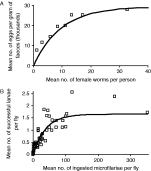
Fig. 1. The influence of density dependence on the net production of parasite transmission stages in observational (A) and experimental (B) data. (A) The relationship between the concentration of eggs per gram of faeces, grouped according to mean worm burden, and the number of Ascaris lumbricoides female worms (assuming a 1[ratio ]1 sex ratio) infecting children. Equation (1) was fitted (solid line) to the data (open squares) giving λ0=3120 eggs per female worm per gram of faeces and cF=0·106 per female worm. Data are from Hall & Holland (2000). (B) The relationship between the mean number of larvae per fly (L) that successfully pass into the haemocoele or thorax of West African (savannah) Simulium damnosum and the mean number of microfilariae of Onchocerca volvulus ingested per fly. (The number of haemocoelic or thoracic larvae has been shown to be a good predictor of the number that will reach the infective stage.) The relationship between skin microfilarial load per milligram of skin (M) and microfilarial intake per bite is assumed to be linear with proportionality constant aV as in Table 1 (Basáñez et al. 1994; Basáñez & Boussinesq, 1999). The equation (solid line) was fitted to the data (open squares), yielding =0·043 and c=0·026 per microfilaria. Data are as collated by Basáñez et al. (1995).
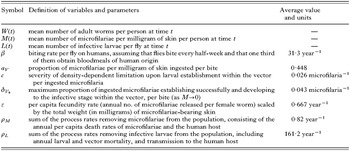
Table 1. Definition and values of parameters and variables for the onchocerciasis population dynamics model (from Basáñez & Boussinesq, 1999)
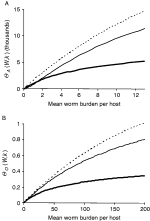
Fig. 2. The relationship between the effective transmission contribution as defined in this paper (see equations (4) and (10) for (A) (Ascaris lumbricoides, eggs per gram of faeces) and (B) (Onchocerca volvulus, L3 per fly), respectively) and the intensity of infection measured as mean adult worm burden. The graphs compare the mean-based transmission equations (broken lines) with the novel individual-based estimates (solid lines). Broken lines: mean-based model (see equation (2) and the function in the outer (curly) brackets of equation (9) (with Φ=1) for Fig. 2A and B, respectively). Solid lines: equation (4) for A. lumbricoides and equation (10) for O. volvulus with k=1 (moderate aggregation, thin line) and k=0·1 (stronger aggregation, thick line). Parameter values are derived from Fig. 1A and B. Both A. lumbricoides (Guyatt et al. 1990) and O. volvulus (Basáñez et al. 2002) tend to have k values between 0·1 and 1. The maximum mean worm burdens plotted are motivated by field data. In mesoendemic areas of Nigeria, Ascaris expulsion studies indicated a mean worm burden W=13 worms per host (Hall & Holland, 2000). Mathematical projections for O. volvulus in hyperendemic areas of northern Cameroon (Duke, Anderson & Fuglsang, 1975) indicated mean worm burdens as high as 200 worms, corresponding to a a mean of 3 palpable nodules per person (Basáñez & Boussinesq, 1999).
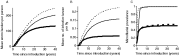
Fig. 3. Influence of parasite overdispersion on the temporal dynamics of human onchocerciasis (time since introduction of the parasite) in West African savannah settings. The graph compares the results of mean-based transmission equations (broken lines) with those derived from the novel individual-based estimates (solid lines) for different degrees of worm aggregation: (A) mean number of adult worms per person; (B) mean number of infective (L3) larvae per fly; (C) microfilarial prevalence (expression contained within outer (square) brackets of equation (5)). Broken lines in (C) and solid lines in all three graphs correspond to: k=1 (thin lines, moderate aggregation) and k=0·1 (thick lines, stronger aggregation). The differential equations and parameter values describing adult worm (dW/dt) and infective larval dynamics (dL/dt) are based on the model presented by Basáñez & Boussinesq (1999) and outlined in Appendix B. Initial conditions simulate the introduction of O. volvulus into a fully susceptible host population with W(0))=0·1 per person. For comparison with the results shown here, measurements from villages in northern Cameroon gave 0·02–0·1 L3 per fly, and 50–98% microfilarial prevalence (Basáñez & Boussinesq, 1999). Parameter values not already listed in Table 1 are as follows: annual biting rate (mβ): 28000 bites person−1 year−1; =0·16; =0·0032; cH=0·0137 L3−1 yr, and ρW=0·12 yr−1.
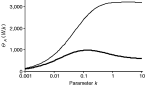
Fig. 4. The relationship between the effective transmission contribution for directly transmitted intestinal helminths (as defined in equation (4)) and the degree of parasite overdispersion (as measured by parameter k of the negative binomial distribution) for different intensities of infection. Thin line: W=2 per host; thick line: W=1 per host. The degree of aggregation at which maximum transmission is achieved changes due to the operation of opposing density-dependent mechanisms, such as the mating probability and constraints on worm fecundity (see text). The model has been parameterized for Ascaris lumbricoides with levels of density-dependent fecundity as those estimated from data in Hall & Holland (2000) (i.e., cF=0·106 per female worm, as in Fig. 1A).
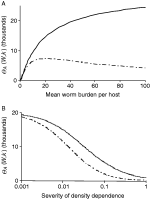
Fig. 5. A comparison between model outcomes for parasite egg output (the effective transmission contribution) as predicted by equation (4) derived in this paper (solid line), and its equivalent in published accounts (e.g., Anderson & May, 1992) (dotted-dashed line). Models are parameterized for Ascaris lumbricoides (Hall & Holland, 2000) under: (A) Varying mean worm burdens with λ0=3120 eggs per female worm; cF=0·106 per female worm; and k=1; (B) Varying severities of density-dependent fecundity as measured by parameter cF with λ0=3120 eggs per female worm; W=13 worms per host; and k=0·1.
 You have
Access
- 62
- Cited by