INTRODUCTION
Rice (Oryza sativa L.) production is a key to world food security. India should add 1.7 million tonnes of additional rice every year to ensure national food security, and the increased production should come from diminishing resources, especially water. Rice cultivation consumes about 70% of the available irrigation water in India (Biswas, Reference Biswas2010) and certain projections indicate rice yield reductions in the near future (Adusumilli and Bhagya Laxmi, Reference Adusumilli and Bhagya Laxmi2011) mainly due to growing water scarcity. In the Indo-Gangetic Plains (IGP), total water requirement for rice ranged from 1566 to 2262 mm (Tripathi, Reference Tripathi1990). About 50–80% of total water input to rice fields percolates deep in soil profile and only 30–40% is utilized consumptively (Koga, Reference Koga1992; Sharma, Reference Sharma1989). Water input to rice can be cut down by minimizing percolation losses through reduced ponded water depth and alternate wetting and drying conditions as envisaged in the System of Rice Intensification (SRI). The SRI method of rice culture includes (1) use of 8–12-day-old seedlings with one seedling hill−1, (2) wider plant spacing (25 × 25 cm to 50 × 50 cm), (3) minimum of three hand-weeding at 10–12, 22–25 and 40–42 days after transplanting, (4) addition of organic manures to supply nutrients, (5) intermittent drainage and soil drying during the vegetative stage and (6) transplanting completed quickly, preferably within 15–30 min of uprooting and with roots placed horizontally (L-shape) rather than bent upwards (J-shape) (Stoop, Reference Stoop2011). The SRI methods enable farmers to reduce their irrigation by 16–50% while realizing higher and more profitable production (Barah, Reference Barah2009; Krupnik et al., Reference Krupnik, Shennan and Rodenburg2012b; Uphoff, Reference Uphoff2006; Zhao et al., Reference Zhao, Wu, Li, Lu, Zhu and Uphoff2009). Now the SRI practices have been promoted and adopted in about 50 countries, including major rice-producing countries such as India, China, Vietnam and Philippines (Glover, Reference Glover2011; Uphoff, Reference Uphoff2012).
Growth and yield of a crop are determined by the physiological processes in plant, chiefly the photosynthesis and distribution of photosynthates among various plant parts. Rice is a profusely tillering crop and the number of tillers plant−1 and productivity of individual tiller play critical roles in determining yield. Tiller production has been reported to be tremendously enhanced under wider spacing as conditioned by SRI. Maintaining a critical level of rice plant population in field is necessary to maximize grain yield, and number of panicles is the most important component of yield that contributes 89% of variations in yield (Baloch et al., Reference Baloch, Soomro, Javed, Ahmed, Bughio, Bughio and Mastoi2002). Not only the number of panicles per unit area but also the size of panicles is important. However, size of tillers and panicles varies greatly within a rice-hill and so is their contribution to overall yield. Development of tillers in rice is asynchronous with primary tillers (PT) producing more good quality grains compared with secondary tillers (ST) and tertiary tillers (TT) that initiate later. Although tillering, number of productive tillers and other growth and development parameters are variety-guided, these are greatly influenced by management practices. Babu (Reference Babu2007) observed wide variability in response of different genotypes to SRI cultivation.
Water is the most important factor governing physiological processes, such as photosynthesis, dry matter partitioning (DMP), growth and yield of the rice crop. However, optimum ground space available to each plant is also important for exploitation of natural resources and realizing the potential growth and yield. In SRI, wider spacing is recommended to allow for vigorous root growth and profuse tillering; however, it may be variety-dependent and location-specific. The square geometry at wider spacing facilitates the movement of mechanical weeder, which is one of the other essential components of the SRI technique. Thus, the individual as well as the interaction effect of key production components, such as genotype, irrigation regime and crop geometry on yield forming processes and yield of rice under SRI need to be investigated.
There have been studies world-over that compared SRI with conventional (recommended) and local practices that show varying or inconsistent results. Krishna et al. (Reference Krishna, Biradarpatil and Channappagoudar2008) reported an enhanced tillering, early flowering, better yield and grain quality in the SRI plots compared with traditional methods. Gani et al. (Reference Gani, Rahman, Rustam, Hengsdijk, Bouman, Hengsdijk, Hardy, Bindraban, Tuong and Ladha2002) also reported an increased conversion of tillers into productive tillers/flowering panicles with the adoption of SRI practice. On the contrary, some disagreement over the presumed benefits of the SRI method has also emerged (Dobermann, Reference Dobermann2004; McDonald et al., Reference McDonald, Hobbs and Riha2006; Tsujimoto et al., Reference Tsujimoto, Horie, Randriamihary, Shiraiwa and Homma2009). However, Uphoff et al. (Reference Uphoff, Kassam and Stoop2008) have refuted the conclusion of McDonald et al. (Reference McDonald, Hobbs and Riha2006) showing that in their study the paired data sets were selectively chosen to support preconceived conclusions. Thakur (Reference Thakur2010) has also offset the criticism and reported in detail the flaws in the conduct of experiments and making comparisons that showed the supremacy of the best management practices over SRI. He concluded that SRI is beneficial than best management practices in terms of yield and productivity of resources, but suggested further research on various components of SRI. Higher rice yields with SRI compared to BMPs have also been reported by Adusumilli and Bhagya Laxmi (Reference Adusumilli and Bhagya Laxmi2011), Avasthe et al. (Reference Avasthe, Verma, Kumar and Rahman2012), Barison and Uphoff (Reference Barison and Uphoff2011), Geethalakshmi et al. (Reference Geethalakshmi, Ramesh, Palamuthirsolai and Lakshmanan2011), Ghritlahre and Sarial (Reference Ghritlahre and Sarial2011) and Nyamai, (Reference Nyamai, Mati, Home, Odongo, Wanjogu and Thuranira2012). Today, the merits of the SRI method have been demonstrated in over 50 countries around the world (Uphoff, Reference Uphoff2012), which testimonies the increasing acceptance of this new method of rice culture across the world. However, real probing into potentials of SRI and its scientific foundations has not been adequately addressed yet (Stoop, Reference Stoop2011). Particularly, the reasons for higher yield with SRI under variable agronomic management need to be understood. Genotype, irrigation regime and crop geometry are the important factors influencing physiological parameters and yield. A greater understanding of physiological and yield responses of SRI to the key production factors will help establishing the merits of SRI and making any policy on the cultivation of rice with the SRI method, especially in the water scarce areas. Hence, the present investigation was carried out to (1) find out the effect of irrigation schedules and plant spacing on physiological parameters, yield and water productivity (WP) of two rice cultivars under SRI, and (2) compare the performance of SRI with conventional transplanting (CT).
MATERIALS AND METHODS
Study area, meteorological parameters and years of study
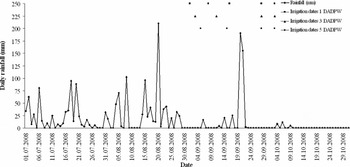
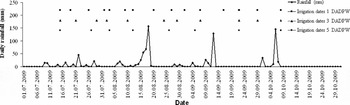
The field experiments were carried out at G. B. Pant University of Agriculture and Technology, Pantnagar (29oN latitude, 79.29oE longitude and 243.8 m above the mean sea level), Uttarakhand, India, during the 2008 and 2009 rainy seasons. The study site is located in the tarai belt (young alluvial soils with shallow to medium water table and no or little tendency for cracking) of IGP of India and is characterized by a sub-humid and sub-tropical climate. During the 2008 season, mean weekly maximum temperature during crop period was 30.6 °C, while the mean minimum 22.8 °C. During the 2009 season, the mean weekly minimum temperature was the same, but the maximum temperature was 2.4 °C higher than that in 2008. Crop season received rainfall of 1986 mm and 983 mm during 2008 and 2009, respectively (Figures 1 and 2). Soil of the experimental site has been classified as Typic Hapludoll (Mollisols). Surface soil (0–15-cm depth) was sandy loam in texture, high in organic C (0.89%) and available P (32.8 kg ha−1), and low in available N (245 kg ha−1) and K (128.3 kg ha−1). Soil reaction was neutral (pH 7.12). Field capacity, permanent wilting point moisture and infiltration rate were 21.9%, 7.49% and 1.3 cm h−1, respectively.
Daily rainfall and irrigation dates during crop period of rainy season transplanted rice in northern India in 2008.

Daily rainfall and irrigation dates during crop period of rainy season transplanted rice in northern India in 2009.

Treatments, experimental design and crop management
The experiment had 14 treatments, (12 under SRI + two controls). The SRI component comprised three irrigation schedules, viz. irrigation at 1, 3 and 5 day(s) after disappearance of ponded water (DADPW), two plant spacing intervals (20 × 20 cm and 25 × 25 cm) and two cultivars (‘Pant Dhan 4’ and ‘Hybrid 6444’). The control treatments consisted of two rice cultivars under CT (4–5-week-old seedlings, two seedlings hill−1 20 × 10-cm spacing, chemical weed control and irrigation at 1 DADPW). ‘Pant Dhan 4’ has been developed by a cross between IR 262 and Ramadja. It is a medium duration (130 days), semi-dwarf, stiff-stemmed, good-tillering and high yielding cultivar, tolerant to bacterial leaf blight, leaf blast and brown spot diseases. It has long slender and translucent grains. Cultivar ‘Hybrid 6444’ is recommended for cultivation in rainy season (June–October) all over India under well-drained irrigated conditions. It is a semi-dwarf (100–120 cm), high-tillering and medium duration (130–135 days) cultivar with high yield potential. It is resistant to neck blast and rice tungro virus. The treatments were set in a factorial randomized complete block design (RCBD) replicated thrice. The experiment had a total of 42 plots of size 4 × 4 m each.
The rice seedlings were produced on raised beds (8 × 1.25 × 0.15 m) using the wet-bed method. Nursery beds were manually constructed with a spade, and soil thoroughly pulverized with a hoe. After pulverizing and leveling of bed surface, 10-kg vermi-compost (VC), 100-g urea and diammonium phosphate (DAP) and 50-g muriate of potash (MOP) were uniformly and thoroughly mixed in the bed soil. The seeds were soaked overnight for sprouting. Thirty grams of seeds were used per square meter area of nursery bed (6-kg seeds for 1-ha area transplanting). Sprouted seeds of rice were poured in 2–3-cm deep furrows opened 10-cm apart and covered with soil to avoid crowding and intermingling (roots) of seedlings. The irrigation was provided as per need (usually twice a day), initially with a water can and later through irrigation channel. Under SRI, 12-day-old seedlings were transplanted. For a uniform square planting at 20 × 20-cm and 25 × 25-cm spacing, marks were manually imprinted in the puddled plots with a ‘marker’. A single seedling hill−1 was planted along with seed hull and nursery-bed soil adhering to the roots at the intersection of markings in wet soil. Seedlings were planted within 10–15 min of uprooting. In the conventional method, 4-week-old seedlings were planted after washing off adhered nursery-bed soil, with two seedlings hill−1. The crop was fertilized with 120-kg N, 60-kg P2O5, 40-kg K2O and 25-kg ZnSO4 ha−1. Ninety-kilogram N was supplied through fertilizers (urea and DAP) and 30-kg N through VC (1.5 t ha−1). P and K were supplied through DAP and MOP, respectively. Sixty-kilogram N (30 kg from fertilizers + 30 kg from VC) and full amount of P, K and ZnSO4 were applied just before puddling and incorporated into the soil. The remaining 60-kg N was top-dressed in two equal installments – the first one at tillering and the second at the panicle initiation (PI) stage.
After establishment of the crop, irrigations were scheduled at 1, 3 and 5 DADPW. However, for the period from PE to 15 days before maturity, a shallow submergence (about 2 cm) was maintained in all the plots under SRI (Krishna et al. Reference Krishna, Biradarpatil and Channappagoudar2008; Thakur, Reference Thakur2010; Thakur et al., Reference Thakur, Rath, Roychowdhury and Uphoff2010). Irrigation for CT was scheduled at 1 DADPW. Due to an unusually high rainfall (1986 mm) during the 2008 cropping season, the total number of scheduled irrigation applications at 1 DADPW was five, while for the other two irrigation schedules it was four (Figure 1). During the 2009 season, the number of irrigations under 1, 3 and 5 DADPW was 16, 12 and nine, respectively (Figure 2). Crop under CT required 12 irrigations. Depth of every irrigation was kept at 6 cm. The amount of irrigation water applied was measured with the help of Parshall flumes. To control weeds in the SRI plots, the conoweeder was run twice manually between rows of rice crop in both directions at 10 and 20 days after transplanting. Under CT, weeds were controlled by spraying butachlor @ 3 L ha−1 on the second day after transplanting, followed by one hand weeding in the third week after transplanting.
Data collection and analyses
The Net photosynthetic rate (NPR) was measured on a bright sunny day between 10 am and 1.30 pm for the topmost, fully opened leaf at tillering stage and that of flag-leaf at flowering stage using infrared gas analyzer (IRGA; model PP SYSTEMS, version 1.02) and expressed in μmol CO2 m−2 s−1. Ten readings were taken from each experimental plot. To determine DMP at harvest, 16 hills from sampling rows in each plot were collected and their stem, leaf and grain portion separated and dried in a hot-air oven at 70 ± 2 °C till constant weights were obtained and recorded. The weights were then converted into weight m−2. During the PI stage, six consecutive hills were closely monitored on alternate days to ascertain date of PI. Three primary shoots from each hill were selected for this purpose. Appearance of panicle primordial in longitudinal section, 2-mm long in any of the main shoots of four out of six selected hills, was used as indication of the PI stage. The number of days taken from the date of transplanting for the SRI method only (2 July for the 2008 season, and 1 July for the 2009 season) till primordial initiation were noted and reported. Although transplanting of rice under CT was done on 17 and 22 July, respectively, the same date (as for SRI) of transplanting was used in the analysis. The same principle was applied in the determination of the 50% PE and 50% flowering. When 90% of the grain-glumes in selected panicles became hard, turned light-brownish (straw) or bronze in colour and did not have any greenish tinge at the lower end, the date was noted as the maturity date.
Twelve panicles, four each from PT, ST and TT, from each plot were identified and clipped with a blade from the base and placed in separate brown paper bags. After sun-drying for five days, the individual panicles of each group were threshed separately and the weight of filled grains obtained from panicles recorded. The average grain weight of four panicles was recorded as the panicle weight for each category of tillers. The contribution of different types of tillers to overall panicle weight was determined by the following expressions:
 \begin{eqnarray*}
&&{\rm Contribution\; of\; primary\; tillers\,\, (\% ) }\\
&&\quad = \frac{{{\rm Total\; weight\; of\; filled\; grains\; from\; primary\; tillers}}}{{{\rm Total\; weight\; of\; grains\; from\; primary} + {\rm secondary} + {\rm tertiary\; tillers}}} \times 100,\end{eqnarray*}
 \begin{eqnarray*}
&&{\rm Contribution\; of\; secondary\; tillers\,\, (\% )}\\
&&\quad = \frac{{{\rm Total\; weight\; of\; filled\; grains\; from\; secondary\; tillers}}}{{{\rm Total\; weight\; of\; grains\; from\; primary} + {\rm secondary} + {\rm tertiary\; tillers}}} \times 100,\end{eqnarray*}
 \begin{eqnarray*}
&&{\rm Contribution\; of\; tertiary\; tillers\,\, (\% )}\\
&&\quad = \frac{{{\rm Total\; weight\; of\; filled\; grains\; from\; tertiary\; tillers}}}{{{\rm Total\; weight\; of\; grains\; from\; primary} + {\rm secondary} + {\rm tertiary\; tillers}}} \times 100.\end{eqnarray*}
Crop from each plot was harvested (leaving aside two outer rows from all the sides). After six days of sun-drying, total produce (grain and straw) from each plot was weighed, threshed by a Pullman thresher, cleaned, dried in sun for three days and weighed again and adjusted at 14% moisture. Grain yield was then subtracted from the total produce to get the straw yield. WP was calculated by dividing the grain yield by the total water (irrigation + rainfall) received by the crop and expressed as kg m−3.
The data were analyzed by using the ‘Analysis of Variance Technique’ as applicable to a factorial RCBD as per the procedures described by Rangaswamy (Reference Rangaswamy2006). Analysis of variance was carried out for the two-year period, considering year as a random effect. The significance of difference among different treatments was tested using F-test. Least significant difference (LSD) values were calculated for the parameters that exhibited significant difference. The treatment means were compared at 5% level of significance.
RESULTS
Net photosynthetic rate (NPR)
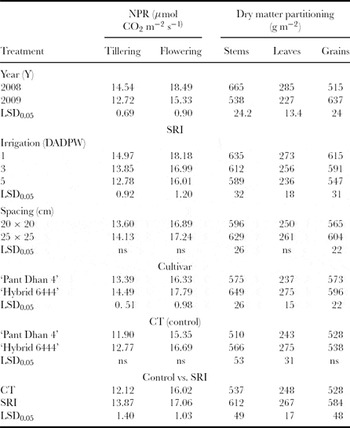
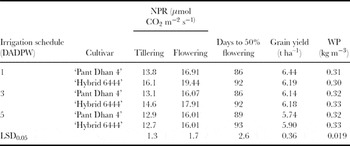
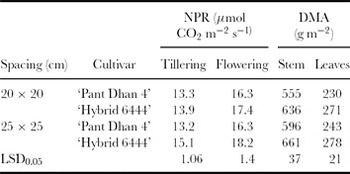
The NPR of the topmost, fully expanded leaf at tillering and that of flag-leaf at flowering stage was affected significantly by the irrigation schedules (Table 1). Irrigating rice crop at 1 or 3 DADPW, being at par with each other, recorded significantly higher NPR than 5 DADPW. Increase in NPR at 1 and 3 DADPW was 17.1% and 8.4% at tillering and 13.6% and 6.1% at flowering stage, respectively, compared with that at 5 DADPW (tillering: 12.78 μmol CO2 m−2 S−1, flowering: 16.01 μmol CO2 m‑2 S−1). Spacing did not influence NPR significantly at any of the crop growth stages. Effect of cultivars on NPR at both tillering and flowering stages was significant under SRI. ‘Hybrid 6444’ exhibited a significantly higher rate of NPR over ‘Pant Dhan 4’ with the increment being 8.2% at tillering and 8.9% at flowering stage. Under CT, both the varieties had statistically similar NPR at all the growth stages. However, ‘Hybrid 6444’ attained numerically higher values of NPR (Table 2). Under SRI, irrigation × cultivar and spacing × cultivar interaction effects were significant. Under ample water supply (1 and 3 DADPW), ‘Hybrid 6444’ showed significantly higher NPR than ‘Pant Dhan 4’, while under scarce water supply conditions (5 DADPW) both cultivars had equal NPR (Table 3). At closer spacing (20 × 20 cm) the cultivars did not differ significantly for NPR at all growth stages; however, at wider spacing (25 × 25 cm), ‘Hybrid 6444’ showed significantly higher NPR than ‘Pant Dhan 4’ (Table 4). Between two methods, SRI recorded 14.4% higher NPR at tillering and 9.9% at flowering stage. Overall, NPR was significantly higher during 2008 than in 2009. Year × treatment effects were non-significant.
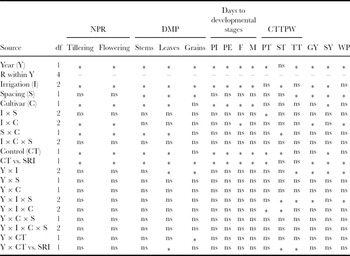
Analysis of variance of various parameters that were measured in this study.

Note: R: Replications; NPR: net photosynthetic rate; DMA: dry matter accumulation; PI: panicle initiation; PE: panicle emergence; F: flowering; M: maturity; CTTPW: Contribution of tillers to total panicle weight; GY: grain yield; SY: straw yield; WP: water productivity; PT: primary tillers; ST: secondary tillers; TT: tertiary tillers; SRI: System of Rice Intensification; CT: conventional transplanting.
*Significant at p < 0.05; ns: not significant.
Net photosynthetic rate at tillering and flowering stages, and dry matter partitioning at maturity under SRI and conventional transplanting.

Note: SRI: System of Rice Intensification; CT: conventional transplanting; DADPW: days after disappearance of ponded water; LSD: least significant difference.
ns: Not significant.
Irrigation × cultivar interaction effects on net photosynthetic rate (NPR), days to flowering stage, grain yield and water productivity (WP).

Note: DADPW: days after disappearance of ponded water; LSD: least significant difference
Spacing × cultivar interaction effects on net photosynthetic rate (NPR) and dry matter accumulation (DMA).

Note: LSD: least significant difference.
Dry matter partitioning (DMP)
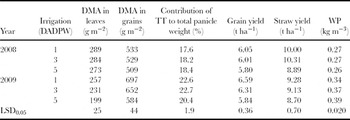
The SRI method recorded an improvement over CT in terms of dry matter accumulation (DMA) in stems, leaves and grains. Increase in dry matter due to SRI was 14% in stems, 7.7% in leaves and 10.6% in grains, over CT (Table 2). Under SRI, dry stem matter in crops irrigated at 1 and 3 DADPW was similar to each other but the crops receiving irrigation at 1 DADPW recorded significantly higher values than those at 5 DADPW. Irrigation schedules at 3 and 5 DADPW were at par in this regard. On the contrary, DMA in leaves and grains declined consistently with delays in irrigation application from 1 to 5 DADPW. Wider spacing enhanced DMA in stems and grains. Under SRI, cultivars differed significantly in DMA in all the three plant parts, and in stems and grains under CT. In each case, ‘Pant Dhan 4’ accumulated significantly lower amount of dry matter than ‘Hybrid 6444’. Further, spacing × cultivar interaction effect revealed that cultivars responded differently to plant spacing. ‘Hybrid 6444’ accumulated identical amount of dry matter in stem at closer and wider spacing, but ‘Pant Dhan 4’ accumulated lower amount of dry matter at closer spacing than at wider spacing. The trend was opposite for DMA in leaves (Table 4). DMA in grains was not affected significantly by spacing × cultivar interaction. Study years exerted significant influence on DMP in different plant parts. DMA in stems and leaves was higher during 2008, while grain-dry matter was higher during the 2009 season. Year × irrigation interaction effects on leaf- and grain-DMA were significant. Irrigation schedules did not bring out significant changes in dry matter accumulated in leaves and grains during 2008, but during 2009, irrigation at 1 and 3 DADPW improved DMA in leaves and grains over 5 DADPW (Table 5).
Year × irrigation interaction effects on dry matter accumulation (DMA) in leaves and grains, contribution of tertiary tillers (TT) to total panicle weight and crop and water productivity (WP) under SRI.

Note: DADPW: days after disappearance of ponded water; LSD: least significant difference.
Days to developmental stages
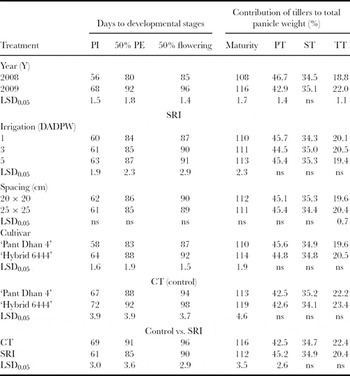
Irrigation schedules caused a significant variation in the number of days to reach various physiological stages. Crop irrigated at 5 DADPW took three to four more days than 1 DADPW to reach PI, PE and flowering stages. Maturity was also delayed by three and two days when irrigations were scheduled at 5 DADPW compared with 1 and 3 DADPW, respectively (Table 6). Plant spacing did not show a significant influence on the duration taken to reach different physiological stages. Under SRI, ‘Hybrid 6444’ took four to seven days more than ‘Pant Dhan 4’ in attaining different physiological stages. Maturity was also late in ‘Hybrid 6444’ by four days under SRI and six days under CT. SRI shortened the period to attain various physiological stages by one week and advanced maturity by four days over CT. A significant interaction effect of irrigation and cultivar was noted on the number of days to flowering. ‘Hybrid 6444’ took the same period of time to reach the flowering stage under all irrigation treatments, but ‘Pant Dhan 4’ took significantly longer period to flower when irrigated at 5 DADPW compared with 1 and 3 DADPW (Table 3). Study years significantly influenced onset of different physiological stages. Onset of each physiological stage was early during 2008 compared with the 2009 season. Year × treatment interaction effects were non-significant.
Days taken to attain development stages, and contribution of different type of tillers to the total panicle weight under SRI and conventional transplanting.

Note: SRI: System of Rice Intensification; CT: conventional transplanting; PT: primary tillers; ST: secondary tillers; TT: tertiary tillers; DADPW: days after disappearance of ponded water; LSD: least significant difference.
ns: Not significant.
Contribution of different types of tillers to total panicle grain weight
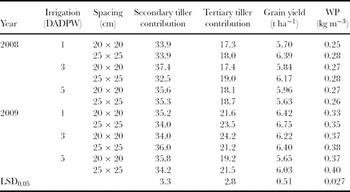
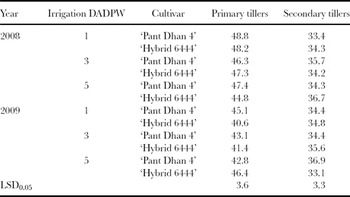
Under SRI, average contribution of PT to the overall panicle weight was the highest (44.5–45.7%). Contribution of ST and TT ranged from 34.3–35.3% and 19.4–20.5%, respectively. Under CT, the tiller contribution decreased from PT to TT in both cultivars. Irrigation schedules did not cause significant variations in contribution of different tillers to total panicle weight (Table 6). Contribution of PT and ST remained statistically similar between closer and wider spacing. However, closer plant spacing recorded significantly higher contribution of TT than wider spacing. The two cultivars under study had similar contributions for all types of tillers under both methods. Between the two methods of cultivation, SRI recorded higher contributions of PT during the two seasons, of ST in 2008 and TT in 2009. Contribution of PT and TT was significantly affected by the study years. Contribution of PT was higher in 2008 than in 2009, but an opposite trend was observed for contribution of TT. Year × irrigation interaction effects on contribution of TT, year × irrigation × spacing interaction effects on contribution of ST and TT and year × irrigation × cultivar interaction effects on contribution of PT and ST were significant (Table 1). Irrigation schedules did not affect contribution of TT to total panicle weight in 2008; however, in 2009 irrigation at 1 and 3 DADPW significantly enhanced contribution of TT over 5 DADPW (Table 5). In 2008, crop planted at closer spacing and irrigated at 3 DADPW showed significantly higher contribution of ST than the crop planted at either of the two spacing intervals and irrigated at 1 DADPW. However, such effects were not significant in 2009. The contribution of TT in the 2009-season crop planted at wider spacing and irrigated at 1 DADPW and the same year crop planted at closer spacing and irrigated at 3 DADPW was significantly higher than the 2008-season crop under any spacing and irrigation schedule (Table 7). In 2008, ‘Pant Dhan 4’ and ‘Hybrid 6444’ irrigated at 1 DADPW recorded significantly higher contribution of PT than the same season crop of ‘Hybrid 6444’ irrigated at 5 DADPW and the 2009-season crop of any cultivar under any irrigation schedule barring ‘Hybrid 6444’ irrigated at 5 DADPW. Further, the 2009-season crop of ‘Pant Dhan 4’ irrigated at 5 DADPW and the 2008-season crop of ‘Hybrid 6444’ under the same irrigation schedule showed significantly higher contribution of ST than the 2009-season ‘Hybrid 6444’ irrigated at 5 DADPW (Table 8).
Year × irrigation × spacing interaction effects on contribution (%) of secondary and tertiary tillers to total panicle weight, grain yield and water productivity.

Note: LSD: least significant difference.
Year × irrigation × cultivar interaction effects on contribution (%) of primary and secondary tillers to total panicle weight.

Note: LSD: least significant difference.
Yield and water
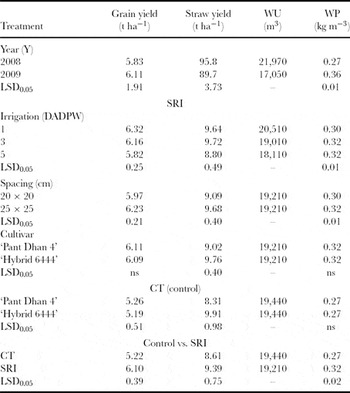
Despite reduction in plant population (hills) per unit area to almost half, SRI produced 16.9% higher grain yield than CT (5.22 t ha−1). Increase in straw yield by SRI over CT was 9.1% (Table 9). The SRI method returned 18.5% higher WP over CT (0.27 kg m−3). Furthermore, in 2009, the SRI crop irrigated at 5 DADPW (nine irrigations of 6 cm each) saved 25% irrigation water while producing 10.2% higher grain yield compared with CT, which required 12 irrigations (6 cm each). In 2008, yield from SRI irrigated at 5 DADPW was 12.9% higher than CT but water saving was not there (year-wise data not given). Within SRI, irrigation at 1 and 3 DADPW resulted in 12.8% and 8.1% higher grain yield, respectively, compared with 5 DADPW (5.84 t ha−1) in 2009 (Table 9). Difference in yield between 1 DADPW and 3 DADPW was not significant in both years. There was a similar trend during 2008 but the differences across 1, 3 and 5 DADPW were not significant. However, all SRI grain yields were higher than those in CT. Wider spacing increased yield by 4.4% over closer spacing (5.97 t ha−1). Straw yield was higher under wider spacing. Both cultivars produced more than 6 t ha−1 grains under SRI and a little above 5 t ha−1 under CT. Grain yields did not differ significantly between two cultivars under either of the two cultivation methods. However, yield response of cultivars differed with variation in irrigation. ‘Hybrid 6444’ yielded similar under all irrigation schedules, but the yield of ‘Pant Dhan 4’ significantly dropped when irrigated at 5 DADPW compared with 1 and 3 DADPW (Table 3). The straw yield was higher with ‘Hybrid 6444’.
Grain and straw yields, water-use (WU) and water productivity (WP) under SRI and conventional transplanting.

Note: SRI: System of Rice Intensification; CT: conventional transplanting; DADPW: days after disappearance of ponded water; LSD: least significant difference.
ns: Not significant.
Water-use (irrigation + rainfall) decreased with delay in irrigation from 1 to 5 DADPW. Overall, water-use was 20,570, 19,010 and 18,110 m3 under irrigation at 1, 3 and 5 DADPW, respectively. WP from irrigation at 3 and 5 DADPW was equal but both of these irrigation schedules recorded higher WP than 1 DADPW. In general, WP was lower in 2008 than that in the 2009 season. WP was similar among irrigation schedules in 2008. However, in 2009, WP was higher with irrigation at 5 DADPW (0.39 kg m−3) compared with 1 DADPW (0.34 kg m−3). WP from irrigation at 3 DADPW was similar to that from irrigation at 5 DADPW. Wider spacing significantly improved WP over closer spacing. ‘Hybrid 6444’ recorded 6.2% higher WP than ‘Pant Dhan 4’. Moreover, ‘Hybrid 6444’ irrigated either at 3 or 5 DADPW showed significantly higher WP than the same cultivar and ‘Pant Dhan 4’ irrigated at 1 DADPW (Table 3)
Effect of years was significant on crop yield and WP. Grain and straw yields and WP were higher in 2009 than in 2008. Year × irrigation and year × irrigation × spacing interaction effects were significant for grain and straw yields and WP. Irrigation schedules did not impact grain and straw yields significantly during 2008. However, in 2009, irrigation at 1 and 3 DADPW resulted in significantly higher grain and straw yields (Table 5). Among various year × irrigation × spacing combinations, the highest grain yield (6.75 t ha−1) was obtained from the 2009-season crop planted at wider spacing and irrigated at 1 DADPW, which was, however, statistically similar to the grain yields produced by the same season crop planted at any spacing and irrigated at 1 or 3 DADPW and the 2008-season crop under wider spacing and 1 DADPW irrigation schedule. The highest WP was obtained from the 2009-season crop planted at wider spacing and irrigated at 5 DADPW, which was similar to WP obtained from the same season crop planted at the same spacing and irrigated at 3 DADPW, and significantly higher than all other year × irrigation × spacing combinations (Table 7).
DISCUSSION
Net photosynthetic rate
Photosynthetic inhibition is one of the primary detrimental effects of water stress (Flexas and Medrano, Reference Flexas and Medrano2002; Lawlor and Cornic, Reference Lawlor and Cornic2002). Lower NPR under irrigation at 5 DADPW compared with 1 and 3 DADPW in the present study could be due to possible moisture stress. Zhou et al. (Reference Zhou, Xie and Wang2003) reported different photosynthetic effects in the rice plant under different irrigation treatments. Wider spacing improved NPR. Widely spaced plants in SRI develop healthy root systems, causing increased transportation and accumulation of N and cytokinin from roots to shoots, and has been reported to maintain higher rates of photosynthesis in rice plant (Jiang et al., Reference Jiang, Hirasawa and Ishihara1988; Ookawa et al., Reference Ookawa, Naruoka, Yamazaki, Suga and Hirasawa2003) and physiological activity of roots. Shrirame et al. (Reference Shrirame, Rajgire and Rajgire2000) also reported that the number of functional leaves and leaf area was higher under wider spacing, which increased the NPR. During the ripening stage, hills with wider spacing had larger root dry weights, produced greater xylem exudates and transported these towards the shoot at faster rates. These features contribute to the maintenance of higher chlorophyll levels, enhanced fluorescence and NPR of leaves of widely than closely spaced plants (Thakur et al., Reference Thakur, Rath, Roychowdhury and Uphoff2010, Reference Thakur, Rath and Kumar2011). Differences between two rice varieties for NPR could be due to variation in the genetic potential make-up of these varieties. The grains and foliage of ‘Hybrid 6444’ were richer in N concentration (data tables not given), which could be responsible for higher NPR of this hybrid than ‘Pant Dhan 4’, especially when irrigated at 1 and 3 DADPW and also when planted at wider spacing. Higher NPR under the SRI practice can be explained by the beneficial effects of planting at wider spacing, including exposing plants to more light and air (Stoop et al., Reference Stoop2011; Thakur et al., Reference Thakur, Rath, Roychowdhury and Uphoff2010). Higher NPR during 2008 was probably due to more favourable temperatures during vegetative and flowering stages. The mean maximum temperature during 2009 (33.0 °C) was 2.4 °C higher than 2008 (30.6 °C).
Dry matter partitioning
Irrigation schedules did not influence the amount of dry matter accumulated in different plant parts in 2008 due to sufficient rainfall, which made water input almost similar for all the irrigation schedules. Decline in average DMA in all plant parts and in leaves and grains during 2009, with delay in irrigation application from 1 to 5 DADPW could be due to development of water stress in plants, which resulted in reduced cellular growth (Hsiao, Reference Hsiao1973), lowering down of leaf-water potential, closing of stomata (Salisbury and Ross, Reference Salisbury and Ross2009) and decline in radiation-use efficiency (Whitefield and Smity, Reference Whitefield and Smith1989). Frequent irrigations (1 and 3 DADPW) created favourable moisture regimes, which enabled the crop plant to grow lavishly by providing conducive micro-climate and increasing solubility, absorption, translocation and assimilation of nutrients by the plants for various physiological processes. Higher DMA in stems and leaves during 2008 and in grains during the 2009 season was due to larger size of sink and efficient translocation of photosynthates from leaves or stems to grains due to better climatic conditions during the grain-filling stage in 2009. Wider spacing enhanced DMA in stems and grains by improving root growth, absorption and translocation of water and nutrients, and exposure of plants to sunlight and CO2 leading to higher production and movement of carbohydrates from leaves to stems and grains. Under SRI, cultivars differed significantly in DMA in all the three plant parts and ‘Hybrid 6444’ demonstrated significant improvement over ‘Pant Dhan 4’. These variations between two cultivars for dry matter portioning among various plant parts are the result of genetic make-up of the cultivars, which was better reflected under wider spacing. The SRI method recorded an improvement over CT in terms of DMA in stems, leaves and grains. Beneficial effects of cono-weeding, wider spacing and planting of young seedlings brought improvements in DMA in all plant parts under SRI compared to CT.
Days to developmental stages
Completion of life cycle by plants depends of the availability of water and nutrients. A water-stressed plant take a longer period to reach reproductive stages and maturity compared with optimally watered plants. In the present study, delay in the onset of various physiological stages and maturity of crop when irrigated at 5 DADPW could be attributed to the occurrence of moisture stress. Sikuku et al. (Reference Sikuku, Netondo, Musyimi and Onyango2010) reported that water-stressed rice plants took the longest time to attain 50% flowering and maturity. Under similar environments, variation in duration taken to PI, flowering and maturity between the two cultivars can be explained by genetic variations in theses varieties for these traits. ‘Hybrid 6444’ maturity was about one week late compared to ‘Pant Dhan 4’. Duration counted from sowing of seed in the nursery bed to onset of respective reproductive stages and maturity was about one week lesser under SRI than CT due to transplanting of younger seedlings (12-day old), which got established quickly in the main field and started growing at a faster rate compared with the seedlings that remained in nursery bed for four weeks before planting under CT. Krishna et al. (Reference Krishna, Biradarpatil and Channappagoudar2008) reported that rice variety ES-18 took 94 days for 50% flowering in the SRI method as compared to 99 days in traditional method. General delay in attaining different physiological stages during 2009 was also due to climatic stress (low rainfall and high temperatures), particularly during transplanting and vegetative stages.
Contribution of different type of tillers to total panicle grain weight
Development of tillers in rice is asynchronous with PT producing more good quality grains compared with ST or TT that are produced later. As expected, in our study contribution of tillers to overall panicle weight decreased drastically from PT to TT. The number of vascular bundles in rice tillers decreases from PT to TT (Hayashi, Reference Hayashi1976), and late-initiated tillers may not have enough number of vascular bundles to sustain the growth of spikelets on their panicle (Kim and Vergara, Reference Kim and Vergara1991). Poor vascularization reduces the supply of assimilates and hormones from source leaves to panicles, and thereby restricts significantly spikelet development (Mahapatra and Kariali, Reference Mahapatra and Kariali2008). In general, irrigation schedules and plant spacing did not produce significant variations in contribution of tillers to total panicle weight. It seems that the maxim of ‘the more the number of tillers plant−1 or plants per unit area, the lesser the number and weight of grains panicle−1 and vice versa’ was operating. Interestingly, wider spacing recorded higher contribution of TT than closer plant spacing. Better exposure of TT to soil and weather resources and less inter-plant competition might have resulted in the greater size of panicles of TT under wider spacing. ‘Hybrid 6444’ showed higher contribution of ST. This could be due to greater expression of variable competition among different types of tillers in these cultivars when planted at closer spacing. No differences among irrigation schedules for contribution of PT and ST of ‘Pant Dhan 4’ during both study years depicts the ability of PT and ST of this deep and robust rooted cultivar to endure or adjust to variations in soil moisture regimes. Higher contribution of PT of ‘Hybrid 6444’ with irrigation at 5 DADPW than at 1 and 3 DADPW during 2009 reveals that PT of ‘Hybrid 6444’ was less affected by moisture stress than later tillers. PT recorded higher contribution under SRI than CT. Under the CT, seedlings were planted at narrow spacing (20 × 10 cm), which meant that plants competed with one another for nutrients, water, solar radiations, CO2, space and other resources. This probably resulted in poor root and shoot growth. Thus, the plants and PT were weaker under CT compared with the healthy and robust plants and tillers produced by the SRI practice.
Yield and water
The System of Rice Intensification produced higher grain and straw yields in all three irrigation regimes compared with CT. This could be due to the higher number of tillers with larger and heavier panicles under SRI. Krishna et al. (Reference Krishna, Biradarpatil and Channappagoudar2008) reported that SRI produced 153% higher number of productive tillers, took five days less to reach 50% flowering and produced 0.60 t ha−1 higher seed yield than CT (2.28 t ha−1). Chen et al. (Reference Chen, Zhu, Rao, Lin and Zhang2006) and Lu et al. (Reference Lu, Huang and Liu2006) attributed greater yield with SRI to increased root activity and delayed root and leaf senescence during later growth stages. Higher straw yield with SRI was the consequence of higher NPR and DMA, which were positively correlated with each other and with grain and straw yields. SRI method, because of higher grain yield, resulted in 18.5% higher WP over CT. Moreover, during 2009 the SRI crop when irrigated at 5 DADPW saved 25% irrigation water while giving 10.2% higher yield and 25.8% higher WP than CT. During 2008, yield from SRI irrigated at 5 DADPW was 12.9% higher than CT but water saving was not there due to high rainfall. These results affirm the yield-enhancing and water-saving benefits of SRI over CT in the IGP of India. Krupnik et al. (Reference Krupnik, Shennan and Rodenburg2012b) have also shown 11–45% increase in WP with SRI compared to recommended management practices in Sahel. Krupnik et al. (Reference Krupnik, Rodenburg, Haden, Mbaye and Shennan2012a) accredited higher WP with SRI compared to recommended management practices to the combination of higher yields and field-level water savings under the former method.
Within SRI, higher grain and straw yields with irrigation at 1 and 3 DADPW compared with 5 DADPW can be explained by relatively wet moisture regimes resulting from frequent irrigations, which led to higher NPR, and DMA in stems, leaves and grains. Wider spacing enhanced yield and WP over closer spacing. Thakur et al., (Reference Thakur, Rath, Roychowdhury and Uphoff2010) reported that during the ripening stage, hills with wider spacing had larger root dry weight, produced greater xylem exudates and transported these towards shoot at faster rates. These features contributed to the maintenance of higher chlorophyll levels, enhanced fluorescence and NPR of leaves and supported important yield attributes and grain yield of individual hill than in closely spaced plants. Higher grain yield was responsible for increasing WP with wider spacing over closer spacing. Grain yield of both cultivars was more than 6 t ha−1 and did not differ significantly. WP of cultivars also did not differ significantly due to similar grain yield and water-use. These results indicate equal suitability of two cultivars for cultivation under SRI. However, the straw yield was higher with ‘Hybrid 6444’ with greater DMA.
CONCLUSION
In the Mollisol soils of the tarai region of India, NPR, DMA, grain and straw yields and WP of two rice cultivars under SRI were greater than those in CT, but these were significantly influenced by irrigation schedules and plant spacing. Delaying irrigation beyond 3 DADPW was detrimental to the rice plant and affected growth (NPR and partitioning of carbohydrates) and yield. Irrigation applications at 1 and 3 DADPW did not differ significantly from each other. These results suggest that rice grown with the SRI method can be irrigated at 3 DADPW without significant reduction in yield, but where water is scarce, the SRI yields and WP at 5 DADPW were significantly greater than those under CT, with a saving of 25% irrigation water. Wider plant spacing (25 × 25 cm), which is also desirable for easy cono-weeder operation, proved better than closer plant spacing (20 × 20 cm). Both cultivars (‘Hybrid 6444’ and ‘Pant Dhan 4’) were found to be suitable for cultivation under SRI. Contribution of tillers to the overall panicle weight decreased significantly from PT to TT. Between the two methods, SRI showed 16.9% increase in yield and four to six days maturing advantage over CT. Hence, the SRI method may be used for achieving higher yield of rice. Under SRI, the crop may be planted at 25 × 25 cm and irrigated at 3 DADPW, or even at 5 DADPW if water supply is limited. The findings are useful for improving rice production in the IGP of India and adjoining sub-humid regions.