Between the mid-1920s and the late 1940s, Arnold Gesell and his team at the Yale Clinic of Child Development made thousands of motion picture records of child behavior, using children from the New Haven community ranging from infancy to adolescence. These research films formed the basis of Gesell's claims about development and served as illustrations for his many publications. The motion picture records were also edited and distributed nationally as educational films about the nature of infant behavior. Along with his many popular writings on child development and rearing, these films helped to make Gesell the most famous and trusted name in parenting before Benjamin Spock. While those films are now more or less neglected and Gesell's theories of child development have a contested legacy, the films and the theories provide an intriguing and instructive case study of the interaction between motion pictures and scientific method. This essay will place Gesell's films and his film analytic method in the context of his career, his theories, and the emerging fields of child study and developmental psychology.
Gesell was not the only psychologist to use motion pictures as a research tool during this period. A number of experts in child development, including Kurt Lewin, Myrtle McGraw, and even John B. Watson used moving images as a matter of course. Certainly, more and more scientists of all stripes were using motion picture technology in the decades since its emergence in the late nineteenth century, and psychology as a field was not to be left behind in this development. But the use of film cameras also corresponds to developmental psychology's emergence as a legitimate field. Not to imply that one caused the other, but it is not entirely coincidental that film's popularity with child study experts came at a time when researchers were calling for more rigorous observational methods. The founders of psychology as a modern scientific discipline, including Wilhelm Wundt and G. Stanley Hall, maintained that developmental psychology's reliance on observational methods made it less likely to yield general and enduring principles, which made it, in their eyes, a second-class psychology (Wundt Reference Wundt1916; Hall Reference Hall1885). So developmental psychologists developed a variety of techniques and technologies to give their observations objective status. Motion picture technology fit into this agenda neatly, as it has for a wide range of scientific disciplines since the 1890s. From physics to biology to meteorology to medicine, motion pictures have helped science make the intangible tangible. In the case of infant behavior, the intangibility in question was not the invisibility of the event so much as its ephemerality. One could observe the child's conquest of the spoon, but motion picture technology allowed one to capture – or construct – this event and submit it to truly scientific scrutiny. In the case of developmental psychology, cinema's flexibility as a tool matched both its agenda and its method. In some cases, the bond between the theory, the method, and the use of motion pictures was particularly strong. The work of Arnold Gesell is one such case.
From 1911 to 1948, Gesell served as director of the Yale Clinic of Child Development, which he founded. Endowed by a variety of philanthropic organizations, including the Laura Spelman Rockefeller Memorial, the Yale Clinic grew from one room with a table and a desk to a world-renowned center for testing, clinical intervention, and medical training. The facilities for photographic and cinematographic recording were complete by 1927 and were the primary laboratory for Gesell's observations. In order to make sense of his use of motion pictures, this essay will examine in turn 1) the role of observation in the rise of developmental psychology and scientific child rearing, 2) Gesell's use of the film camera as an observational tool, especially in the context of child psychology, scientific filmmaking, and the popularization of expert advice about child rearing in the 1920s and 1930s, and 3) Gesell's method of analyzing film and its relationship to his theories of development.
Observation and the Rise of Developmental Psychology
In 1885 British psychologist James Sully mulled over the problems attending the serious study of children. Doubtless the goal was worthy, given the high practical and theoretical significance of child behavior. But “By whom can this line of research be best pursued? . . . He must, to begin with, be a painstaking and exact observer. He must be determined to see children as they actually are, and not to construct them out of his own presuppositions. And this implies a mind trained in observation, and a certain scientific rigor of intellect” (Sully Reference Sully and Christie1885, xiii). In addition to this question of training, there was the issue of opportunity:
Beyond the mother, nurse, and perhaps the doctor, who is there that is privileged to watch the first tremulous movements of the baby-mind? And here the thought naturally occurs, that the mother is the person specially marked out by nature for this honorable task. . . . But has she the other qualifications – the mind severe in its insistence on plain ungarnished fact, trained in minute and accurate observation and in sober methodical interpretation? Here our doubts begin to arise. Few mothers, one suspects, could be trusted to report in a perfectly cold-blooded scientific way on the facts of infant consciousness. (Ibid., xvi)
Indeed, her maternal feelings would lead to “confusion of what is actually observed with what is only conjecturally inferred, to exaggeration and misrepresentation. The very excellences of maternity seem in a measure to be an obstacle to a rigorous scientific scrutiny of babyhood” (ibid.). Maybe the father would be a good candidate, for “his masculine intelligence will be less exposed to the risk of taking a too sentimental and eulogistic view of the baby mind” (ibid., xvii). But no, he has neither the time nor inclination. Sully therefore concludes that only the (male) psychologist has the time, dedication, love of children, and the scientific training needed for this task.
Sully's casual dismissal of the observational powers of the maternal mind was annoying even then. In 1891 Helen Adler, child advocate and one of the founders of what would become the Child Study Association of America, objected to Sully's obvious sexism in her pamphlet, Hints for the Scientific Observation and Study of Children, which gave mothers hoping to participate in the burgeoning field of child study useful directions and tips on keeping a rigorous journal. “I believe that when mothers have once discovered the beneficent influence of a new method,” Adler wrote, “there are numbers of intelligent women throughout the land, who will be able to school themselves to the doing of an ideal purpose” (Adler Reference Adler1891, 3). Indeed, there were many such intelligent women in the child study movement of the late nineteenth century. Crystallizing around social policy and institutions concerning children – the rise of orphanages, juvenile courts and reform schools, and mass education, along with the corresponding decline in the number of children in the labor force, for example – the child study movement encapsulated efforts and issues dear to social reformers and educated women of the day. Depending on any given advocate's point of view, child study was a form of scientific psychology, a science of pedagogy, a support for child-saving and social work, or a source of parental education and guidance (Siegel and White Reference Siegel and White1982, 249; Cravens Reference Cravens1993). Child study comprised a range of goals and social groups, from concerned parents to social workers to scientists, none of whom shared identical visions of its potential for social betterment. Nevertheless, from the 1880s to the 1920s, these competing visions formed an alliance.
But the rift between Sully and Adler points to a larger conflict in the movement between professional and lay methods and goals. Even before the turn of the twentieth century, Sully and other scholars argued that child study desperately needed more rigorous observational methods. Earl Barnes, a Stanford professor of education, admitted in 1895 that general observations of child life “will quicken our interest, broaden our sympathies, and give us a larger understanding of special instances.” But these “unrelated observations and incidents” could not suffice:
if such a work is not accompanied by direct and well-ordered observation, by experimentation and statistical study, leading to some general quantitative results, it is apt to leave us with a feeling that human life is not amenable to law; that circumstance, desire, and will can brush aside everything except the law of gravity. . . . The thing most needed to-day is, however, brilliant studies on masses of commonplace children. (Barnes Reference Barnes1896–1897, 10–11; see also Bryan Reference Bryan1895)
These calls for scientific observation, which implied a strict division of labor between scientist and lay person, would grow stronger throughout the first decades of the twentieth century. By the mid-1920s the professionals were winning the argument; the institutionalization of child study in universities and research stations effectively wrested the agenda and purse strings from educated lay groups, and observation from mothers and nurses. Within the professional ranks, the calls for rigor in observation continued, but with the difference that it was not a choice concerning professional and lay observation, but what kind of scientific observation. In 1929, Dorothy Thomas of Teachers College complained:
The available data in regard to social behavior consist largely of descriptive accounts – case histories and diary records. These are often very illuminating social behavior documents but they present certain difficulties as material for scientific analysis. . . . Even at their objective best, the selection and emphasis are more or less dependent on the recorder. The control of this sort of error in our social data is one of the first problems claiming our attention. In other words, our data must become independent of our observers within a small and predictable range of error. (Thomas Reference Thomas1929, 3)Footnote 1
Thomas here assumes that the observation will be sufficiently scientific, but takes an extra step in suggesting that it must be “independent of our observers,” meaning that some technology – for example, photography or motion pictures – should be employed.
“Observation,” then, was an especially important concept and catchword for psychologists such as Thomas eager to invest the new discipline of developmental psychology with scientific legitimacy. This meant denying not only amateur claims to observational skill, but also amateurish methods – by the standards of the post-World War I generation of psychologists – attributed to such pioneers in child study as G. Stanley Hall. Of course, observation was not the root cause of all changes in child study, but one could argue that, as child study became institutionalized into the disciplines of child and developmental psychology, changes in the field corresponded roughly to the changes demanded by an agenda committed to scientific observation. The hallmarks of professionalization – clinics, research stations, university departments, etc. – were all implicitly an answer to Sully's question about training in method and opportunity to observe children as they grew. This growth in disciplinary infrastructure was primarily a result of the increased commitment of government agencies and philanthropists to scientific child study in the 1920s. By the end of the decade, more than 300 psychiatric clinics for children had been founded, seven major child development research institutes had been established, and the number of scholars studying children multiplied five-fold (Cairns and Cairns Reference Cairns, Cairns and Richard2006, 125; Smuts Reference Smuts2006, 140–141.). Foremost among those foundations committed to “the children's decade” was the Laura Spelman Rockefeller Memorial Foundation (LSRM), which dedicated millions of dollars to child study, principally by establishing four of the seven institutes and providing sustaining grants to the others (Cairns and Cairns Reference Cairns, Cairns and Richard2006, 125; Smuts Reference Smuts2006, 144–147).Footnote 2 Thanks in large measure to (this section of) the LSRM, headed by Lawrence Frank, developmental psychology became a legitimate area of inquiry and its researchers, Gesell included, were able to hone their observational methods.
As Steven Schlossman has noted, Frank and the LSRM were committed not simply to child research, but also its dissemination. The overall plan of the LSRM was “to place all activities in social welfare on a firmer scientific foundation” (Schlossman Reference Schlossman1981, 277). This meant a two-pronged approach: supporting scientific research and finding its practical application. From the beginning, of course, child study had policy implications and aspirations. But for Frank and the LSRM in the 1920s, the dissemination of scientific research was not necessarily primarily through political channels. Instead, Frank more or less invented the parent education movement, a very popular trend of the 1920s. This part of the LSRM agenda included “a program of child study for mothers gathered in small groups and based on scientific research in child development, to be implemented by sponsorship of university-based research centers, fellowships for training scientists and practitioners, and parent organizations to supervise mothers on the local level” (ibid., 280). A top-down approach to parenting, this program appropriated already existing groups such as the Federation for Child Study (which became the Child Study Association in 1924), gave them financial and educational support, and disseminated through them the latest research on child development. The research centers and universities trained the expert practitioners, who would fan out across the country to speak to and help the child study groups. “While research was the main goal of the child development institutes, each was initially to serve also as a training ground for a new profession of parent educators,” Schlossman notes (ibid., 283). In addition, the LSRM funded a magazine, Parents (first issue, October 1926), that greatly expanded the audience for popularized scientific advice on child rearing. If Adler hoped that mothers would contribute to the production of knowledge in 1891, by 1929 mothers would still be involved in child study, but now guided by the experts. Indeed, “scientific” child rearing was all the rage in the 1920s (Schlossmann Reference Schlossman1976; Grant Reference Grant1998; Hulbert Reference Hulbert2003; Apple Reference Apple2006). Observation was still key, however. As Schlossman writes, “The status of the parent education movement was heavily dependent on its purported foundation in scientifically controlled observations of children in laboratory and nursery school settings” (Schlossman Reference Schlossman1976, 276). And by the 1920s, most researchers recognized that motion pictures were a powerful tool for scientific research and its popularization. Arnold Gesell was especially adept at both.
Gesell's Use of Motion Pictures
Arnold Gesell was among the second generation of psychologists specializing in child development who aspired to give their field firmer scientific footing – at the expense of mothers (such as Adler) who participated in the original formation of child study and scholarly “fathers” (such as Hall) who comprised the earliest scientific wing of the movement. Rebelling against what they perceived to be lax and permissive research methods of the previous generation, these researchers were more conservative in their acceptance of what counted as scientific observation. In the process, they worked to make child study a truly scientific endeavor, in that it was controlled primarily by scientists. Yet it is difficult to completely deny one's ancestry; both the scientific and the popular roots of child study continued to exert a hold on child development research in the 1920s and 1930s. Child study in the post-World War I era endeavored to be more “scientific” while simultaneously working to find and to popularize practical, everyday applications. Gesell is an interesting case not only because of his prominence as a scientist and a popular authority within this second generation, but because the scientific and promotional use of motion pictures was so instrumental in establishing that reputation.
Gesell was born and raised in Alma, Wisconsin, where his father was a photographer and proprietor of an art and stationery store, and his mother was a teacher (Hulbert Reference Hulbert2003, 160). Both occupations seemed to have a lasting effect on Gesell; he left for college with the intention of becoming a teacher, and his familiarity with photography surely prompted and aided his future research method. But in college he became interested in psychology, so after receiving his primary and secondary education in Wisconsin, he went to Clark University, where Hall presided over one of the best graduate programs in psychology; Gesell received his Ph.D. in 1906 (Gesell Reference Gesell and Boring1952, 126). His research goals were undefined at the time, however, so it wasn't until after his graduate work that he discovered his plan: “I wished in some way to make a thoroughgoing study of the developmental stages of childhood. But with all my training I lacked a realistic familiarity with the physical basis and the physiological processes of life and growth” (ibid., 128). This required, he decided, a medical degree, so upon receiving an appointment as Assistant Professor of Education at Yale in 1910, he simultaneously enrolled as a medical student there, receiving his MD in 1915. His supervisors were supportive of his plans for a survey of child growth, giving him in 1911 “a room, a table, and a chair,” which would someday become the Yale Clinic of Child Development (ibid., 129). Specifically, Gesell focused on “normalcy as a clinical entity” (ibid., 130). That is, in an era when psychological research had focused on deviations and defects in children, and given a medical tradition that tends to focus on abnormalcy and pathology as conceptual starting points and teaching tools, Gesell wished to ground diagnostic appraisals of childhood development in a firm, scientific understanding of the normal stages of growth. He was also convinced that practical advice about child rearing needed a strong understanding of what was considered “normal” development. No such research existed, however, so Gesell made charting “the normal developmental characteristics” of the first ten years of childhood, especially “of the period of infancy and the pre-school years” his life's work (ibid.). His first book, The Normal Child and Primary Education (Reference Gesell and Gesell1912, co-written with his wife, Beatrice, who was a teacher), indicated this direction. Although it did not have the theory of development that Gesell crafted after his medical studies, this book “redefined child psychology as the study of the normal state” (Cravens Reference Cravens, Joseph and Ray Hiner1985, 429).
Gesell first used motion pictures for his work in 1924. With the help of Pathé Review, a newsreel production company, Gesell and his team photographed children in his laboratory at Yale. Pathé shot two reels of 35mm motion-picture film, which (along with still photographs Gesell shot with a 35mm Graflex) were used as illustrations or “action photographs” for his second book, The Mental Growth of the Pre-School Child (Reference Gesell1925). The pictures portrayed “the developing child in characteristic behavior situations,” and were arranged “so far as possible in a normative series” (Gesell Reference Gesell1925, 160). Even though his resources and illustrations were limited, Gesell was aiming for an atlas of normal behavior, anticipating his monumental Atlas of Infant Behavior (Reference Gesell and Thompson1934): “They are grouped in this chapter so that an examiner may actually use them on occasion as an instrumental aid to classification. . . . A graded series of photographs should prove of some practical value when used in a comparative manner as a means of matching a given case against certain standards such as are portrayed in the photographs themselves” (Gesell Reference Gesell1925, 160). In other words, “normalcy” could be pictured; the photographs would ideally function as indices of normal development. At this point in his research, however, Gesell used the camera to depict stages that he already presumed to be typical; the images were merely illustrations of normalcy. We shall see that, as his research methods evolved, Gesell used the motion picture frame as the empirical basis for his derivations of normalcy.
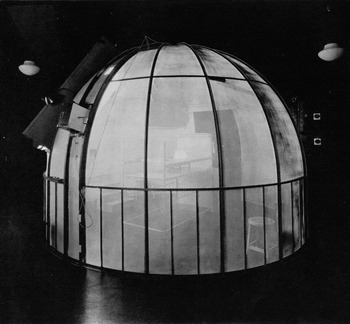
Mental Growth, as the first systematic survey of developmental stages in child behavior, was a landmark. It attracted the attention of the LSRM, which awarded Gesell a grant in 1926, making Yale one of the seven child-research stations (Gesell Reference Gesell and Boring1952, 131). The grant also allowed Gesell to move to more spacious facilities on the Yale campus and implement his plan to systematize, standardize, and promote film technology as the ideal observational tool. If his use of images for Mental Growth had been primarily for illustration, with the grant and new facilities he could deploy the camera as an observational and data-collection tool. Central to this plan was an observational dome rigged with a variety of still and motion picture cameras. The dome, a perfect hemisphere 12 feet in diameter and 12 feet high, was mounted on a heavy iron base so that it could rotate, thus enabling the examiners to see the child from any horizontal angle (fig. 1). Likewise, two cameras were mounted on tracks along the arc of the dome, so that they could record behavior from any vertical angle, including directly above. The dome was covered with white screen panels and wired for electricity. Eight Cooper-Hewitt mercury vapor lamps were mounted along the arc to provide even illumination (Halverson Reference Halverson1928, 126–129). The result was an observational blind, a kind of astronomical dome, except that the observers looked in rather than out. And just as an astronomical observatory is designed to aid observation by shutting out extraneous light, this one sealed in the light but shut out other extraneous and distracting elements (such as the child's mother). With this dome and its cameras, Gesell could, in his imaged-based way, fulfill child psychology's dream of “direct and well-ordered observation” leading to “brilliant studies on masses of commonplace children” (Barnes Reference Barnes1896–1897, 10–11). If Barnes envisioned journals and questionnaires, i.e., the written word, as the raw data of this new science, Gesell instead viewed images as the primary source to be mined for information.
Gesell's observational dome at the Yale Clinic. (Source: Arnold Gesell, An Atlas of Infant Behavior, New Haven, Yale University Press, Reference Gesell1934)

Gesell saw photographic images as a solution to the problem of rigorous observation – or as Thomas put it, data “independent of observers” – that had troubled the scientific legitimacy of psychology. As Lorraine Daston and Peter Galison (Reference Daston and Galison1992 and Reference Daston and Galison2007) have shown, this problem of objectivity was not unique to psychology, of course. But observation-based sciences such as child psychology, which experimented with their subjects only rarely, felt this need especially acutely. Indeed, John B. Watson, the founder of behaviorism (and one who was not against experimenting with or on children), would recommend technology as a solution to the problem of observation: “Without instrumentation . . . many of the phenomena of conduct cannot be brought under adequate scientific control. . . . If we wish to get an accurate picture . . . one accurate enough to compare with that obtained from another individual, systematic observation with instrumental control has to be employed” (Watson Reference Watson1919a, 26). For many psychologists, motion pictures would be one important way to make observation systematic. (It is worth noting that Watson found analysis, or bringing the object “under adequate scientific control,” just as important as observation.) Watson himself is credited with the earliest film made by a psychologist. In the fall of 1919, Watson persuaded his university, Johns Hopkins, to advance him $450 for film stock in order to make a motion picture of child development (Cohen Reference Cohen1979, 142; Harris Reference Harris, Eckardt, Bringmann and Sprung1985).Footnote 3 His film begins by demonstrating motor and reflex behaviors of a newborn infant; this was part of Watson's project to show that even something like handedness is unstable in infancy, and is therefore learned behavior. To drive this home, the next part of the film records the famous “Little Albert” experiment in which a 9-month-old infant, who exhibits no fear of a dog, a rat, or a rabbit, is conditioned to fear them by associating them with a loud noise that Watson makes whenever the child draws near the animal (Watson Reference Watson1919b).Footnote 4 Likewise, German psychologist Kurt Lewin made filmed observations as early as 1923 (Brown Reference Brown1929; Lewin Reference Lewin1926 and Reference Lewin1927; see also Marrow Reference Marrow1969, 50–51, 66; Zeigarnik Reference Zeigarnik1984; Van Elteren Reference Van Elteren1992). In 1929 he came to Yale University to deliver a lecture at the Ninth International Congress of Psychology, and even though he delivered the lecture in German, his charming film of young Hannah trying to sit on a rock for the first time was very persuasive (Lewin [Reference Lewin1929] 1930, 286–288).Footnote 5 After taking a post at the Iowa Child Welfare Research Station in 1935, Lewin continued to make films, as did other members of the Station (Cravens Reference Cravens1993). We should also count Myrtle McGraw, a developmental psychologist at Teachers College, who took over 40,000 feet of film to document the behavior of 68 infants during the course of her famous “co-twin” experimental study of Johnny and Jimmy Woods. McGraw used this film as illustration but also to measure reaction times and as a document for further study of the subjects (McGraw Reference McGraw1935, 24, 46–52). In fact, there are many examples of filmmaking at the various child research stations and beyond; film and psychology have always been extremely close (Beck Reference Beck1938, Reference Beck1942; Michaelis Reference Michaelis1955).
In this regard, psychology only continued science's love affair with the moving image. Throughout the nineteenth century, for example, researchers around the world experimented with and championed the use of photography in scientific inquiry (Michaelis Reference Michaelis1955; Cartwright Reference Cartwright1995; Tosi Reference Tosi and Angelini2005). French physiologist Etienne-Jules Marey's chronophotography in the 1880s is often cited as the start of the cinematic tradition in science that continued with such researchers as cardiologist Ludwig Braun, neurologist Paul Schuster, or cell biologist Jean Comandon (Braun Reference Braun1992; Braun Reference Braun1898; Schuster Reference Schuster1898; Cinémathèque 1967). Just about every conceivable field of scientific endeavor has at one point or another used the motion picture camera, usually regularly; literally hundreds of scientists since the early twentieth century have used the moving image as a research tool or a document. Gesell was not unique in his faith in the fidelity and objectivity of the photographic or cinematic image; his reasons for using the camera echo those recounted since the nineteenth century. First, Gesell was interested in documenting behavior: “The cinema is an ideal instrument for the investigation of behavior patterns because it captures the behavior in its totality; it ‘sees’ the whole field of behavior with equally distributed vision” (Gesell Reference Gesell1946, 470). If the camera “captures the behavior in its totality,” then this justified the substitution of the film for the event and validated the use of film as a “working object” (Daston and Galison Reference Daston and Galison1992 and Reference Daston and Galison2007). Moreover, Gesell perceived the film camera to be an ideal observer: democratic and comprehensive. Second, Gesell felt that the camera was an ideal observer in another way – it was indefatigable, in that it could catch what the human observer might miss through inattention or fatigue. While detailed note-taking acquired a legitimacy of its own through time-honored traditions, Gesell and others perceived the camera to be a productive, efficient, and modern instrument – even if it required a whole apparatus and routine (that some today might question as hugely inconvenient and inefficient) to manage and extract its data. Third, the camera inscribed that behavior onto permanent records, which, he said, “do not fade with time or warp with prejudice, but which perpetuate with impartial fidelity the configuration of the original event” (Gesell Reference Gesell1928, 57). Over the long history of science and film, the fantasy of objectivity and impartiality seems to be the most persistent, recurring dream. And finally, despite its supposed fidelity, it was taken to be an amazingly pliable record: it could be compared with others, or it could be temporally manipulated by speeding it up or slowing it down. Gesell noted, “The function of the camera is to dissolve the encumbrance of chronological age so that the sequences of growth may be glimpsed in close, spatial juxtaposition without the deteriorating tedium of long lapses of time” (ibid.). The film frames allowed the researcher to compare different spatial views, but variable speed of the camera and projector also allowed the researcher to compare different temporal “views.” Motion picture technology, in other words, spatializes time, allowing it to be manipulated and controlled. Consistently over the course of the history of scientific filmmaking, nearly every researcher has justified his or her use of motion pictures in similar ways.
Even with this history of film in science and psychology behind him, Gesell cited the work of Frank and Lillian Gilbreth as his most immediate influence. The Gilbreths were at first followers of, then competitors to Frederick W. Taylor's system of scientific management. Starting in 1912, the Gilbreths used motion picture technology to film workers as they completed their designated tasks. This film would ostensibly be the basis for a close analysis of the workers’ movements, from which they would derive a new work plan, the “one best way” to complete the task in the most efficient – hence cost-saving – way possible. I say “ostensibly,” however, because there is some doubt whether the information derived from the films was actually fundamental to the work re-design. But there is no doubt that the Gilbreths used film to promote their product – the Gilbreth brand of industrial psychology and their system of scientific management – to factory managers and the American public throughout the 1910s and 1920s (Price Reference Price1987; Curtis Reference Curtis, Hediger and Vonderau2009).
Gesell knew that motion pictures could be used to record behavior, but from the Gilbreths he learned that film could be used to analyze that behavior. In Mental Growth, Gesell admiringly mentions Gilbreth's use of a device that allows a stereoscopic view of as many as a dozen stilled images from motion pictures at a time. The “clinical possibilities” of such a device are obvious, according to Gesell, but lacking the device, he contents himself with the atlas-like use of images from film for comparative purposes (Gesell Reference Gesell1925, 160). This would be his approach for his Atlas of Infant Behavior as well, but by that time Gesell had incorporated another Gilbreth technique into his arsenal: frame-by-frame analysis, which will be discussed more thoroughly later in the essay. But Gesell also learned from the Gilbreths (and Watson, Lewin, McGraw, and any of the other psychologists who used film) about the power of moving images to educate, persuade, and promote. With the help of ERPI Classroom Films, Gesell made much of his research footage into educational films to be distributed nationally to classrooms and other non-theatrical venues (Beck Reference Beck1938).
Film was only one medium for Gesell's promotional activities; he also participated in radio shows and wrote a daily column for The Washington Post in 1936 (Gesell Reference Gesell1936; Behrens Reference Behrens2009). This popularization of his research was not a publicity ploy, nor was it (merely) a mandate of the LSRM grant. Instead, he (like many of his colleagues in child study) strove to balance theory and practice, basic research and practical application. For him, this meant that his work in the laboratory had implications for child rearing. In an era when “scientific child rearing” was gaining public acceptance, Gesell fought to make his point of view heard. Against the behaviorist message of Watson (see Harris Reference Harris and Lewin1984), Gesell presented a case for letting the child grow of its own accord. True, he believed that the child's development was largely innate to its biological and hereditary structure. But he did not believe that guidance was unnecessary. Quite the opposite: he believed that the “normal” child of his research was not the average child, but an ideal that could be achieved if the unfolding stages of development were expertly supervised (Hulbert Reference Hulbert2003, 165). All children, Gesell believed, could live up to their hereditary potential under the proper guidance and supervision. Hence the challenge of child rearing was bringing out the child's fullest potential. Gesell's social welfare work, his columns, and his films attempted to educate teachers and parents about “normal” development in order to have a basis for comparison. The parents’ goal, under this program, was to watch for potentially dangerous deviations. So Gesell was constantly counseling mothers to be ever watchful of their children's behaviors in order to catch deviations from the norm and guide the child to its fullest potential. Motion pictures fit into this child rearing program as an educational tool, of course (Gesell Reference Gesell1935a, 8–9). “Child guidance is parent guidance,” he says in one of his films (Gesell Reference Gesell1931). But the films also served as an example of an ideal observer: all-seeing, indefatigable, reliable, accurate, and dispassionate. His films taught parents what to watch for, what could be expected from their child, but they also implicitly taught parents how to watch. The films were not only about babies; they were also about method: study, compare, correlate.
Film Analysis and Gesell's Theory of Growth
The previous sections placed Gesell's use of film in the context of his career goals, child psychology's disciplinary desire for rigorous observation, the history of motion pictures in scientific research, and the use of film to educate parents and to promote scientific child rearing. This section will focus on Gesell's analytic technique as a key element of his engagement with motion pictures as a research tool. Specifically, I want to clarify how his analysis of the footage helped to manage and generate conclusions from the data. Additionally, I want to demonstrate how his method of frame-by-frame analysis encouraged his incredibly detailed stage theory of development. So this section will place Gesell's analytic approach to film in the context of his theories of growth in order to show how the theory and the method were mutually reinforcing. Film was not simply a convenient tool for observation, education, and promotion. The material form of the technology dovetailed with his theory of growth in such a way that neither could have been successful without the other. This section will concentrate on two aspects of his theory in particular: his idea that behavior has form, and his theory of individuation in development. Both ideas can be traced to one of Gesell's primary inspirations, the embryologist George Coghill.
But first, I should say a few words about Gesell's reputation as a “maturationist,” which is what most developmental psychologists would recall when asked about Gesell's theory of growth. Most histories of developmental psychology cite Gesell for his belief that ultimately the child's innate biological development had more influence on motor, sensory, and emotional systems than any environmental forces. It is very easy to extrapolate from this belief the idea that Gesell dismissed environmental forces altogether. It is especially easy considering that Gesell's stance was at least partially polemical. During the 1930s and 1940s, for example, Gesell's claims competed with Watson's through their respective popular publications and syndicated columns on child rearing. Watson, of course, took the view that the child is inherently malleable and that one could condition behavior almost infinitely; his child-rearing advice reflected this dictum. Gesell, on the other hand, recognized the dynamic interplay between nature and nurture, but in his attempt to correct an increasingly behaviorist climate in child study and parenting, he polemically came down on the side of nurture. The observation dome itself – with its clinical, sanitized setting and its exclusion of distracting elements of the environment, including the mother – might serve as a tidy illustration of this theoretical viewpoint. But a close reading of his publications reveals that he did not believe that the child would successfully mature without guidance. In 1930, Gesell even constructed a home-like setting at the clinic in order to record infant behavior in a domestic surrounding (Gesell Reference Gesell1934; idem Reference Gesell and Boring1952, 131). As suggested in the previous section, Gesell was well aware of the importance of environment in shaping a personality.
Nevertheless, Gesell came to an understanding of growth from a biologist's perspective. Gesell was one of the few child psychologists to show an interest in recent discoveries in embryology. Work in the 1920s and 1930s by embryologists such as Hans Spemann, Paul Weiss, Ross Harrison, and George Coghill shed new light on the sequence of early growth, which suggested to Gesell new ways of thinking about the factors potentially shaping child development. Gesell was especially excited by two aspects of Coghill's work, which demonstrated a specific correlation between behavioral development and corresponding changes in the nervous system: 1) the idea that behavior has form and that changes in development can be understood by changes in behavior; and 2) the idea that the process of development is not a synthesis or compilation of increasingly complex patterns, but instead a process of analysis or individuation of smaller patterns from larger patterns over the course of time. Both of these elements of Coghill's work found their way into Gesell's investigations of child development and his use of film as a research tool.Footnote 6
Behavior and form
George Coghill was interested in salamanders. Specifically, he was interested in studying the swimming patterns of salamander embryos. By carefully studying embryonic movements through every stage of development, Coghill correlated developmental changes in somatic behavior with the progressive changes in the structure of the nervous system (Coghill Reference Coghill1929). This was an exciting idea for Gesell, for it made a connection between the biological growth of the organism and its changing behavior patterns. It was also exciting because Coghill came to these conclusions with the aid of motion picture technology. In a procedure that had by this time become rather common within biology, Coghill filmed the swimming salamanders at 17 frames per second, thereby capturing the salamander's flexing behavior at various stages of development. He then projected and traced these films frame by frame in order to further analyze and differentiate the movements. According to Coghill, behavior has form; it is an object in itself that one can trace (literally) in relation to the changing morphology of the organism.
This insight found easy application in Gesell's work on child development. “Posture is behavior,” he wrote. “Postural patterns are behavioral patterns” (Gesell and Thompson Reference Gesell1934, 44). This formulation indicates not only the subtleties of behavioral observation, but also that Gesell assumed, like Coghill, that changes in behavior are outward manifestations of inner growth, specifically growth of the central nervous system. The very concept of “behavior morphology” implies that behavioral patterns have objective form, which could be documented over time and which are indicative of underlying changes in the physical structure of the organism or child itself. This emphasis on visible form changing over time led both Gesell and Coghill to use motion pictures as a way of documenting these changes. Or perhaps more precisely, their use of film endowed behavior with form. That is, what “form” was there except what was in the image? I am not arguing that film created an action that did not otherwise exist. I am suggesting, however, that the camera did not simply “document” behavior patterns, but gave them a specific “form” that Coghill and Gesell then studied intensely. Their faith in the image was such that the leap from object to “working object” was very short, and the only “form” they really worked with was found in or derived from a film frame. The filmic image, not the ephemeral event, was the basis of their calculations.
So if “behavior has form,” for Coghill and Gesell it took the form of a cinematic image. Working with that form meant working with film, which is why analytic technique was so important for Gesell's research program. Observation via the motion picture camera was only part of the process. As Gesell was fond of saying, “Cinematography, in itself, bakes us no bread” (Gesell Reference Gesell1946, 475). That is, the cinematic record was not scientifically useful until it was submitted to a rigorous procedure of analysis, or “cinemanalysis” as he called his method of extracting useful data from the films. According to Gesell, this method depended on his five fundamental presumptions of the motion picture film, which also indicate the ways in which he worked with the images:
1. The film being propelled at a known speed minutely records time values and sequences.
2. Simultaneously and also minutely the film records space relationships and configurations.
3. The film records these spatial and temporal data in a series of discrete, instantaneous registrations.
4. These registrations can be serially reinstated at normal, retarded, and accelerated rates.
5. Any single registration can be individually studied, in terms of time and space, as a delineation of a single phase of a behavior pattern or a behavior event. (Gesell Reference Gesell1935b, 4)
First, Gesell simply notes the value of film for measuring the duration of events. The camera served as a stopwatch and durational marker for his events. Secondly, he indicates its use for the depiction of space. The image served as a “description” of the setting and actions in the behavior event. Third, he notes that the individual frames composing motion picture film are central to any detailed analysis. This idea will be much more important than it first appears; we shall see that the frame itself will serve as the “boundary” of an event.
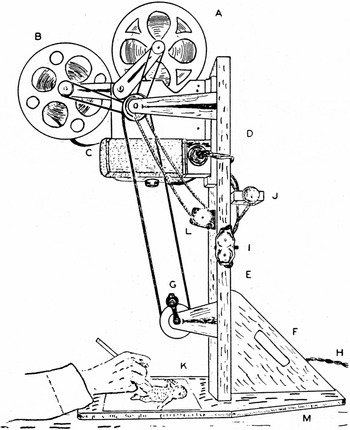
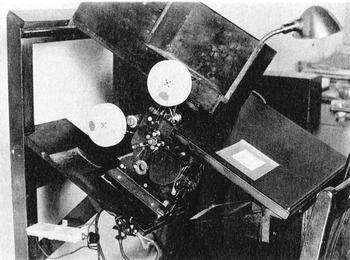
In the fourth thesis, Gesell emphasizes the ability to manipulate time through filmic means. The motion picture is temporally malleable, and one of the easiest ways to study a behavior pattern is through slow-motion projection. “It permits a more intimate and more complete view of any pattern of motion,” Gesell says. “You can indeed see more deeply than with the unaided eye” (ibid., 5). But even this advantage is not enough. Gesell explains: “Even slowed motion is too elusive,” he says, “[but] the stilling devices of a commercial projector proved unsatisfactory for laboratory analysis. It is awkward to work with images on an upright screen. For systematic study it was necessary to make the images more accessible and to bring them under more intimate control” (ibid.). To do this, Gesell and his staff designed an analytic projector that met their needs (see figs. 2 and 3). It had a frame counter, it could be operated continuously at any speed in forward or reverse, and the image could be stilled easily. Gesell explains the implications:
Once the film is in the projector, the operator may freeze or activate the behavior to suit his observational fancy. . . . Any phase or strand of behavior may be exposed to view. . . . Here the dissection of behavior forms has a striking advantage over anatomical dissection. . . . A behavior form can be dissected over and over again in increasing detail without loss of form. . . . If one projects the individual frames [at two frames per second], one gets an illusion of slowed but confluent motion. This rate gives one a good analytic grip on the data under observation. When the grip falters, one simply reverses the crank and then views the sequence again. (Ibid., 6)
Two points are especially noteworthy. First, Gesell's analogy between this method of analysis and anatomical dissection implies a surface/depth model: cutting through the top, superficial layers in order to see what was not visible and thereby obtain a “deeper” understanding. Dissection is both a mental and a manual operation, in that one explores with the hands in order to understand with the mind. Likewise, Gesell's mention of the “analytic grip” here is not merely metaphorical. “Holding” the image was as much a part of analysis and a function of the apparatus as looking at it. If the mechanical, automatic image generated by the motion picture camera offered the illusion of a “hands-off” objectivity, this was belied by the extraordinarily tactile quality of the analytic process. But here dissection also implies “parsing”: “A behavior form can be dissected over and over again in increasing detail,” he says. And so this method encouraged ever tinier divisions of behavior.
An early version of Gesell's analytic projector. (Source: Arnold Gesell, “Cinematography and the Study of Child Development,” The American Naturalist 80 [1946])

A later version of his analytic projector. (Source: Arnold Gesell, An Atlas of Infant Behavior, New Haven, Yale University Press, Reference Gesell1934)

Second, the analytic grip was also tightened by tracing the image onto a sheet of paper. Gesell says, “the cinema registers the behavior events in such coherent, authentic and measurable detail that for purposes of psychological study and clinical research the reaction patterns of infant and child become almost as tangible as tissue” (Gesell Reference Gesell and Boring1952, 132). That “tissue” could be held, parsed, and classified in a way that the ephemeral behavior cannot. But clearly it was not tangible enough; the researcher felt compelled to draw it manually. It was another way of “holding” the object of study, but the act of tracing was also a way to move from individual to ideal. The photographic image of the motion picture camera was apparently too tightly bound to the individual instance. Tracing transformed that individual moment, tied to the flow of time, into what Michael Lynch, after Husserl, calls an “eidetic image,” one stripped of the temporal and concrete and thrust into the transempirical realm of pure essences (Lynch Reference Lynch1988). This move from individual to ideal in experimental method mimicked Gesell's own leap from descriptions of infant behavior to prescriptions of what ought to happen. Or, perhaps more precisely, we could say that this method underwrote that move from description to prescription.
Gesell's analytic technique was a way of managing and extracting data from the filmic image. The means by which he comprehended or “came to grips with” the image were, of course, dependent on the material form of the technology: correlating action with frame rate, frame-by-frame cataloging of the event, slow-motion review of the film, or tracing the image manually.Footnote 7 Understanding the exact “form” of the behavior implied grasping, holding, and “dissecting” the image(s) until it surrendered the information Gesell sought. A born naturalist, Gesell primarily sought to catalog infant behavior, so the information concerned types and frequency of behavior. As we shall see, the technology had a decisive influence on that catalog.
Individuation and analysis
Coghill's theory of individuation deserves mention. Up to this point, embryologists and developmental biologists had assumed that the process of development was a process of synthesis or accumulation of ever more complex patterns. Locomotion, for example, was believed to be a larger motor function that consisted of a synthesis of smaller patterns built up over time. Coghill's motion picture studies of salamanders demonstrated that the opposite was true: that general, larger patterns of behavior are intrinsic to the organism and that specific reflexes are individuated from this larger pattern. That is, over time finer and more specialized reflexes or motor patterns – such as reaching for a graham cracker – are individuated out of larger, more fundamental motor patterns – such as the orientation of the body in space toward food. The process of development is therefore not one of synthesis, but of analysis (Coghill Reference Coghill1930a and Reference Coghill1930b). This theory not only derives from, but almost demands the careful documentation of form that motion pictures can facilitate.
These theories of individuation and growth contributed directly to Gesell's most enduring legacy: the establishment of developmental stages of infant behavior. If maturation was the source of behavior, and behavior had form which became ever more individuated, then Gesell saw his task – like that of a naturalist – simply to catalog and describe the various stages of this development. This he did with admirable tenacity and truly astounding detail. According to Gesell, there are, for example, 91 stages in the development of an infant's reaction to and interaction with a bell. Likewise, there are 53 stages of rattle behavior, 48 items associated with cup behavior, 59 items of consecutive cube behavior, and so on, for as many as 40 different behavior series, including: postural behavior, spoon behavior, pellet behavior, mirror behavior, dangling ring behavior, etc. (Gesell and Thompson Reference Gesell and Thompson1934). Gesell thus raised stage theory to an unprecedented degree of refinement. But beyond merely recording and describing these age-related changes in behavior patterns, Gesell took the further step of prescribing the norms of age-appropriate infant behavior. That is, through his documentation of developmental stages, Gesell simultaneously created developmental norms, thereby transforming the typical into the desirable. Thus his psychology monographs about behavior patterns are matched by his popular books on infant behavior and child rearing, which gave parents a set of guidelines for age-appropriate behavior as an index of biological function. Indeed, if Gesell's theories of behavior are mostly ignored today, it is hard to overestimate how thoroughly we have internalized his ideas about motor milestones and developmental stages in infancy.
Gesell's vision of cinema resembles his (and Coghill's) theories of growth and development. With the theory of individuation, Coghill and Gesell posited an intrinsic or originary unity to the organism's behavior, which progressively individuated into ever more specialized patterns. Likewise, they perceived the raw cinematic record to have an intrinsic unity that, through analysis, generated ever more detailed and specialized elements. The cinematic record, in Gesell's scientific application, was not so much a synthesis of smaller units, but rather a progressive individuation of patterns from a larger totality. Hence there is an analogy between this theory of development as differentiation and the process of film analysis that generates ever finer detail – down to the individual frame – from larger units such as the shot, the reel, or the behavior record as a whole. This, I believe, is the fundamental insight that Gesell brought to his study of infant behavior, one of the reasons why he connected behavior, development, motion pictures, and his analytic technique. In other words, the number of stages in Gesell's account of infant behavior patterns is justified by the theory of individuation and enabled by minute analysis of his motion pictures.
But more than that, in a real way, the behavior event he studied was itself a product of the analytical technique and the material form of the technology. I want to explore this further by returning to Gesell's fifth and final thesis: “5. Any single registration can be individually studied, in terms of time and space, as a delineation of a single phase of a behavior pattern or behavior event” (Gesell Reference Gesell1935b, 4). Gesell here makes a rather remarkable equation between the frame and a phase of the behavior item or moment. He claims that an individual frame can mark out and stand in for a part of the event – that the boundaries of the film frame define the spatial and temporal boundaries of the action. In some way, this is an understandable leap, because he has already argued that the cinematic record captures the event in its entirety and can thus substitute for it. This thesis seems to be an extension and justification of that claim. His deep faith in the frame testifies to the close relationship between his delineation of child development and the method by which he comes to his conclusions. Yet to equate the phase and the frame so closely is rather striking, because the division between frames seems arbitrary. What exactly is the relationship between the film frame and the “boundaries” of a behavior?
In one respect, this equation between the frame and the event is not unusual. Chronophotography, for example, is essentially a record of successive phases of motion: in deciding the time between exposures, the researcher has already conceded that X amount of time will equal a single “phase.” Whether this is explicit, or even whether the difference between two images is counted as a “phase” depends on the researcher. For Austrian cardiologist Ludwig Braun, who in 1897 used motion pictures to record the beating heart of a dog, the equation between the frames and the different phases he wished to study was very close (Braun Reference Braun1898). On the other hand, Eadweard Muybridge was not concerned at all about the scientific validity of his “phases” (Muybridge Reference Muybridge1888).
But the question remains: what is the justification for Gesell's equation of frame and event? We could just as well ask what justifies the equation of picture and developmental stage in the embryological illustrations of Wilhelm His. As Nick Hopwood has demonstrated, nineteenth-century embryologists made a similar equation between a single item and a developmental stage or phase (Hopwood Reference Hopwood2000 and Reference Hopwood2007). But Hopwood shows that the researcher's selection is far from arbitrary – it is the result of a considerable amount of work to render the specimen into a standardized, working object. The selection is also the product of years and years of comparison between countless specimens: which one is more typical? As the nineteenth century wore on, atlas makers were less inclined to make this decision themselves; as photographs replaced drawings, images in the atlases proliferated, leaving the readers to make these comparisons and selections themselves (Daston and Galison Reference Daston and Galison1992 and Reference Daston and Galison2007).
But atlas makers still had to choose which photos to include, especially if they numbered in the dozens or hundreds. Motion picture cameras are, in a significant way, machines for generating images to be compared, apparently making that task of selection even harder. Gesell took the guesswork out the process in two ways. First, with the standardization of infant and setting, the task of rendering the film frame into a working object was partially complete even before the film rolled. The white, middle-class children from New Haven; the dome; the crib; the stimulus and observation; even the presentation and placement of interaction items – were all highly regulated and standardized. And through consistent framing, editing, and even film processing (which they did at the Clinic), the camera completes the rendering process. So when Gesell said that any single frame could be studied as a delineation of a single phase, he alluded to the work that already went into the image to align frame and behavior (fig. 4).
Consecutive cube behavior. (Source: Arnold Gesell, An Atlas of Infant Behavior, New Haven, Yale University Press, Reference Gesell1934)

Second, because of the regulated, consistent, almost numerical quality of the image, Gesell could fit it into a statistical system for classifying and selecting behavioral norms. The data for consecutive cubes behavior – in which an infant was presented with one cube, then another, and so on – shows that each of the 59 behaviors was given a percentage value across age ranges (fig. 5). For example, only 17 percent of infants at 12 weeks approached the cube with one hand, while 96 percent did so at 48 weeks. Gesell used these percentages to come to a numerical understanding of developmental stages. Once these were established, he picked the “most typical” film sequence. But this sequence was not just an illustration; it was only through film that he was able to come to these differentiations. And not just because he used film to count behaviors, but because the counting, even the behaviors themselves, were possible only through a process that so completely equated frame and phase. Yes, an infant may perform these behaviors outside the presence of the camera. But the minute differentiation of behavior – hence the creation of behaviors as observable and divisible objects – was the product of a system that used film as an instrument of statistics.
A table listing the behavior items associated with consecutive cube behavior and their frequency correlated with weeks of development. (Source: Arnold Gesell and Helen Thompson, Infant Behavior: Its Genesis and Growth, New York, McGraw-Hill, Reference Gesell1934)

Psychology's bid for scientific legitimacy has always required it to make intangibles such as “mind” or “growth” visible and tangible. From the tachistoscope to questionnaires to observation journals, the discipline has tackled that dilemma in a variety of ways. Motion pictures promised to standardize observation while simultaneously bringing the object “under adequate scientific control” by means of a rigorous system of frame-by-frame analysis common to the history of scientific filmmaking. Gesell's example is representative, in this regard, of the effort required to render – through motion picture technology – an ephemeral event such as “child behavior” into a working, empirical object subject to analysis, which can eventually support a theoretical claim. Gesell's example is particularly intriguing for the history of scientific filmmaking because his method of analyzing film was such an important, even dominant element of his research program that it had an especially visible impact on his taxonomy and theory of child development. In Gesell's case, then, what becomes as “tangible as tissue” is not just the ephemeral event, but the explanatory theory as well. Gesell's use of motion picture technology is therefore an excellent example of the reciprocal influence of theory, method, agenda, and the material form of film.
Acknowledgments
I wish to thank Janina Wellmann for her faith in and guidance on this essay, as well as John Tresch and two anonymous readers for their crucial and insightful comments on an earlier version.