INTRODUCTION
When people think of an American, what are the stereotypes that come to mind? Who is the typical American? While answers to these questions can vary, research increasingly demonstrates a widespread consensus on the characteristics of a stereotypical American. This is especially true when it comes to race. Whether consciously or unconsciously, Americans associate being American with being white, specifically of primarily northern European heritage (Cheryan and Monin Reference Cheryan and Monin2005; Devos and Banaji Reference Devos and Banaji2005).Footnote 1 Yet race is not the only important marker for being an American. The role of religion has received less attention in the literature, but it too serves as a potentially important national characteristic and is especially interesting in the American context.
Americans take great pride in the United States Constitution and most Americans support the separation of church and state, at least in the abstract. Yet religion in general and Christianity in particular are symbolically and explicitly infused in the national narrative and in what it means to be an American. In addition to putting “In God We Trust” on currency and swearing in presidents on a Bible, major political actors have referred to the United States as a “Christian nation” and received only muted negative reactions.Footnote 2 The lack of controversy surrounding these assertions is indicative of a widespread belief among Americans that the United States is indeed a Christian nation (First Amendment Center 2007).
We investigate the intersection of religion and American identity as it plays out in this context. First, we examine the degree to which Americans associate being American with being Christian. We expect that many Americans will make the connection between being American and being Christian explicitly and implicitly on a non-conscious level, indicating that being Christian is almost certainly included in the collection of traits that help to define who counts as full members of the American national group. In other words, the prototypical American, or the ideal group member that others strive to emulate, is Christian.
Second, we look at the attitudinal and behavioral implications of the association between religion and national identity by testing the extent to which people who do not share a central stereotypical characteristic feel the need to prove they are good, prototypical, national group members. If non-Christians want to be considered fully American, are they more likely to act as prototypical Americans do? Non-Christians who desire inclusion in the national group may exhibit pro-national group attitudes and behaviors like expressing patriotism or setting exclusive group boundaries. Conversely, if non-Christians want to distance themselves from their fellow Americans, they are less likely to act like prototypical Americans. We therefore expect non-Christians to be divided in their expression of pro-national group beliefs and behaviors depending on their desire to be considered prototypical Americans.
We use a combination of data from a national survey and a laboratory-administered Implicit Association Test (IAT; Greenwald et al. Reference Greenwald, McGhee and Schwartz1998) to test our hypotheses. We find strong evidence of a durable and widespread association between being Christian and being a true American. We also find support for our expectations that non-Christians as atypical group members engage in pro-national group behaviors like expressing patriotism and setting exclusive boundaries more frequently when they want to be viewed as prototypical.
THE IMPORTANCE OF BEING PROTOTYPICAL
One of the key insights of self-categorization theory is that whenever people categorize someone, say as Hispanic or a political scientist or an American, they are placing that person within a group that is at least partially defined by certain characteristics or stereotypes (Turner et al. Reference Turner, Hogg, Oakes, Reicher and Wetherell1987). When people think of the group, a set of descriptive stereotypes automatically, and often unconsciously, comes to mind. A person who is categorized as being a member of the group is expected to share the group's stereotypes, and those who do are referred to as being prototypical of the group. According to Hogg and Reid (Reference Hogg and Reid2006, 10), prototypes are
fuzzy sets, not checklists, of attributes (e.g., attitudes and behaviors) that define one group and distinguish it from other groups. These category representations capture similarities among people within the same group and differences between groups. In other words, they accentuate intra-group similarities (assimilation) and inter-group differences (contrast)….[Prototypes] also enhance perceived entitativity, the property of a group that makes it appear to be a coherent and distinct entity that is homogeneous and well structured, has clear boundaries, and whose members share a common fate.
Prototypical members, then, are those group members who hold the key characteristics that allow for assimilation and contrast. These characteristics, which are based on central norms and stereotypes, are not easily altered. History, collective memories, and political leaders all reinforce the characteristics that are prototypical, making it difficult, though not impossible, to alter them.
Group members, especially those who strongly identify with the group, are aware of the group prototypes and of who is prototypical. “People know, and strive to know, with some precision how well they themselves match the prototype, how well others match the prototype, and how prototypical others think one is” (Hogg and Reid Reference Hogg and Reid2006, 13–14). This awareness of who is prototypical is not inherently problematic. If it were possible to have a group that was completely homogeneous, then all group members would share all of the group prototype's characteristics. But groups, especially large ones, are heterogeneous and include many sub-groups to which the larger group stereotypes may or may not apply (for example, the group “the American people” includes many sub-groups, including sub-groups defined by race, class, and religion). What happens when a person is a member of a group but does not fit the group prototype?
Psychologists have repeatedly shown that prototypical group members are treated differently from, and better than, atypical group members. At an individual level, group members think prototypical members are more attractive, more trustworthy, and more loyal to the group, and prototypical members tend to be better liked and are more likely to be chosen for leadership positions (Hogg, Fielding, and Darly Reference Hogg, Fielding, Darly, Abrams, Hogg and Marques2005; Hogg and Reid Reference Hogg and Reid2006; Marques et al. Reference Marques, Abrams, Paez, Hogg, Hogg and Tindale2001; Marques, Abrams, and Serodio Reference Marques, Abrams and Serodio2001). At the group level, members of prototypical sub-groups are given higher status within the overall group, are considered more deserving, and have higher, and less questioned, entitlements (Waldzus et al. Reference Waldzus, Mummendey, Wenzel and Boettcher2004; Wenzel Reference Wenzel2001). Finally, atypical members and sub-groups are much more likely to have their group identity denied, and therefore are denied benefits that might accrue to group members (Cheryan and Monin Reference Cheryan and Monin2005; Mahtani Reference Mahtani2002; Theiss-Morse Reference Theiss-Morse2009). It matters a great deal if a group member or a sub-group is considered prototypical or atypical.
Atypical Americans who want to be prototypical can react to their status by trying to be more American in terms of their beliefs and behaviors, that is, by being more prototypical. What does it mean to be more prototypical? According to Hogg and van Knippenberg (Reference Hogg, van Knippenberg, Berkowitz and Zanna2003, 11), “More prototypical members tend to identify more strongly, and thus display more pronounced group behaviors; they are more normative, show greater in-group loyalty and ethnocentrism, and generally behave in a more group-serving manner. These behaviors further confirm prototypicality and thus enhance social attraction.” If atypical group members want to be more fully accepted as central to the group, they can behave in ways that emphasize the attitudes and behaviors they share with more prototypical group members (Hogg and Reid Reference Hogg and Reid2006). That is, they can hold group-normative attitudes and behave in ways that help to strengthen the group (Branscombe et al. Reference Branscombe, Ellemers, Spears, Doosje, Ellemers, Spears and Doosje1999).
While atypical members can become strong proponents of any important prototypical attitudes or behaviors, we focus on two that are particularly relevant to the American national group: patriotism and the setting of exclusive group boundaries.Footnote 3 Patriotism is a key belief within national groups, signifying loyalty and love of country (Kosterman and Feshbach Reference Kosterman and Feshbach1989), and is a widely held group norm in the United States. Fully three-quarters of Americans claim to be extremely or very patriotic (Morales Reference Morales2010). Since atypical group members often find their group loyalty questioned, a good way to dispel such concerns would be to express a high level of patriotism. Doing so could help atypical Americans be perceived as true Americans.
The setting of exclusive group boundaries is, in many ways, more psychologically interesting. Strong identifiers tend to set exclusive boundaries on their group to clearly establish who counts as a group member and who does not (Theiss-Morse Reference Theiss-Morse2009). Indeed, strong identifiers prefer to err on the side of excluding an in-group member than erroneously including an out-group member (Castano et al. Reference Castano, Yzerbyt, Bourguignon and Seron2002). Prototypical members have this same tendency of setting and enforcing exclusive boundaries to ensure their continued high status in the group (Jost, Banaji, and Nosek Reference Jost, Banaji and Nosek2004). If atypical group members want to be considered more prototypical, they can act like prototypical group members and set exclusive group boundaries, at least along dimensions that do not implicate their own atypical characteristics. Being Christian might be a prototypical characteristic of Americans, but there are other prototypical characteristics that could be emphasized as essential to group membership. Non-Christian Americans could enforce strict national group boundaries using a variety of characteristics while setting aside religion. In this way, they could fit very well within these exclusive national boundaries even if they are not Christian. Atypical members who do not desire prototypicality, on the other hand, will likely set inclusive boundaries. If everyone can be a member of the group, then distinctions between prototypical and atypical group members become unimportant.
PROTOTYPICALITY, RELIGION, AND NATIONAL IDENTITY
The group dynamics that revolve around prototypicality become especially interesting when applied to religion and national identity in the United States. While the United States is largely a secular state with the constitutional separation of church and state, it also has a pronounced orientation toward Christianity. Christians can celebrate their religious holidays more easily than non-Christians; government offices and many businesses close on the major Christian holidays yet remain open on the major holidays of other religions, such as Yom Kippur, Eid ul-Fitr, Eid ul-Adha, and Diwali. The United States Post Office does not deliver mail on Sunday, the Christian day of rest. The Chaplain of the United States House of Representatives, the Reverend Patrick Conroy, oversees the opening prayer for each legislative session.
In many ways, this sort of Christian bias makes sense. Christians share their faith with a majority of their fellow Americans. Three-quarters (78 percent) of Americans identify themselves as Christian (Pew Forum Reference Forum2008), making it less controversial for the government to follow the religious practices of the vast majority of Americans. And the bias toward Christianity in the government is matched by the widespread belief among Americans that the United States is a Christian nation. According to the First Amendment Center, two-thirds of Americans believe the framers established the United States as a Christian nation and 55 percent believe the Constitution officially proclaims the United States to be Christian (First Amendment Center 2007).
Furthermore, the association between Americans and Christianity seems to be processed even at levels that may fall short of full conscious processing. Politicians can use subtly coded religious language and Americans pick up on it, altering their assessments of candidates for elected office (Calfano and Djupe Reference Calfano and Djupe2011). Americans also apply stereotypes of Protestant candidates to candidates with no religious affiliation, apparently assuming they are Protestant (McDermott Reference McDermott2009). Although these works suggests that an implicit association is present between being American and being Christian, they do not directly test the non-conscious elements of the connection between religion and American national identity. We do and expect that:
H1:
Overall, Americans associate being American with being Christian, both explicitly and implicitly.
Given the general lack of controversy surrounding claims that the United States is a Christian nation, we expect a large portion of Americans to associate being American with being Christian explicitly by openly self-reporting that it is important to be Christian to be a true American. In a psychological sense, we expect that this association is also embedded more deeply so that it is activated automatically and relatively non-consciously. Devos and Banaji (Reference Devos and Banaji2005) show in their research on race that there is an implicit association between being white and being considered prototypical of the American national group. They argue that these “implicit associations reflect the knowledge that an individual has acquired through repeated personal experience within a particular cultural context” and that they are not under conscious control (Devos and Banaji Reference Devos and Banaji2005, 448). When confronted with an implicit test, an individual who endorses equality on a conscious level can exhibit unconscious bias that can influence the degree to which a racial sub-group is viewed as part of the larger national group.
Race and religion clearly differ in that Americans are reluctant to make explicit the American = White association yet seem willing to make the American = Christian association. However, we expect to find a similar implicit association between being Christian and being American. Regardless of explicit endorsements of the separation of church and state or egalitarian views of religion, the socio-cultural context is such that the association between Christianity and being American is likely to be automatic and non-conscious, much in the same way that being white is strongly linked to being a true American on an implicit level. When associations are automatic, it takes conscious effort to keep them from influencing attitudes and behaviors, and people are not even aware that they are being influenced by the associations (Devine Reference Devine1989).
Our expectations thus far concern the general tendency of Americans to associate being American with being Christian. We expect, however, that Christians and non-Christians will likely differ in making this association. Wenzel et al. (Reference Wenzel, Mummendey, Weber and Waldzus2003) found that sub-group members tend to project their own group characteristics onto a super-ordinate group. For example, both engineering and psychology students projected their own sub-group characteristics onto the group “students.” We therefore expect Christians to view Americans as Christian and non-Christians to view Americans as not Christian. When it comes to the implicit association, an association that occurs automatically and unconsciously, we expect Christians and non-Christians to associate being American with being Christian. Americans, regardless of their religious beliefs, are steeped in a culture that is heavily Christian. Whether people want to believe that the United States is a Christian nation or not, the pervasiveness of the American = Christian association might be hard to escape. We therefore hypothesize that:
H2:
Christian Americans are more likely to report explicitly that being Christian is prototypical of Americans than are non-Christian Americans, but Christian and non-Christian Americans are equally likely to make an implicit association between being a true American and being Christian.
Finally, we test two hypotheses related to the extent to which both Christians and non-Christians want to be seen as typical Americans. First, we expect that Christians will in general like the idea of being perceived as typical Americans because they are a majority group in American society. Non-Christians, on the other hand, will likely be more divided. Since benefits accrue to prototypical group members, some non-Christians will very much want to be seen as prototypical. Others, however, will likely not want to be prototypical of a group that does not fully accept non-Christians as Americans.
H3:
Christian Americans are more likely to report that they want to be seen as prototypically American than non-Christians.
Second, we anticipate that this variance in the desire for prototypicality will help explain non-Christians' national group attitudes and behaviors. Atypical group members who desire prototypicality can try to prove they are full members of the group by holding pro-group beliefs that are typically expressed by prototypical group members and by behaving in ways that are supportive of group norms (Branscombe et al. Reference Branscombe, Ellemers, Spears, Doosje, Ellemers, Spears and Doosje1999; Hogg and Reid Reference Hogg and Reid2006). An obvious group-normative attitude is patriotism. We test whether non-Christians are more or less patriotic depending on their desire to be seen as prototypical. Many pro-group attitudes and behaviors, though, are about maintaining the group, such as ensuring that the boundaries of the group are definite and secure. Non-Christians who want to prove their “Americanness” can therefore set highly exclusive boundaries on the group, thereby limiting who counts as an American while placing themselves firmly within the group.
H4:
Non-Christian Americans who strongly desire being prototypical Americans will be more likely to be patriotic and to set exclusive boundaries on their national group than non-Christian Americans who do not desire being prototypical.
METHODS
To test these hypotheses, we draw on two data sets. Our major source of data is the Perceptions of the American People survey, a national random-sample telephone survey of about 1,200 United States adult citizens that was administered in early summer 2002 by the Ohio State University's Center for Survey Research. Households in the 48 contiguous states were chosen using random-digit dialing. An English-speaking respondent within the household was randomly chosen using the “last birthday” selection technique (Lavrakas Reference Lavrakas1993). The response rates were as follows: AAPOR Response Rate 5, 34%; AAPOR Cooperation Rate 3, 39%; Modified AAPOR Cooperation Rate 3, 74%. Average length of the interviews was 31 minutes and the data are weighted to match the sample with the population based on the United States Census. The survey included questions on national identity, group boundaries, political knowledge, attitudes and preferences, and standard demographics.Footnote 4
We also conducted an IAT designed to measure the strength of implicit associations between the following concepts: American, Foreign, Christian, and Non-Christian. A total of 64 undergraduates in an introductory political science course at a large Midwestern university completed the protocol in a computer lab on campus in 2011. The sample was 64 percent male and, as is consistent with regional demographics, 89 percent self-identified as white and 87 percent as Christian. The median age in our sample was 20 years old with 80 percent of our sample falling between 19 and 21 years of age. An undergraduate sample provides an appropriate test of our hypotheses on implicit associations because there is sufficient variance on the variables of interest and we do not expect homogeneity on variables like age and education to influence the results from the lab (Druckman and Kam Reference Druckman, Kam, Druckman, Green, Kuklinski and Lupia2011).
Our IAT followed the conventional five-block structure (Greenwald et al. Reference Greenwald, Nosek and Banaji2003; Lane et al. Reference Lane, Banaji, Nosek, Greenwald, Wittenbrink and Schwarz2007).Footnote 5 Each block contained a pre-determined number of trials and each trial consisted of the presentation of a single image on the computer screen along with concept labels that appeared in the upper-right and upper-left corners of the screen. The order of images was randomized within blocks and across trials. During a single trial, participants were asked to sort the image or word that appeared in the center of the screen based on concept labels located in the upper-right and upper-left corners of the screen. Sorting was accomplished by pressing the “e” or the “i” key that corresponded to the correct concept label. The time between the presentation of the image and a correct response from the participant was recorded to produce a reaction time (RT) measured in milliseconds.
The concept labels were different during each block according to the protocol established by Greenwald et al. (Reference Greenwald, Nosek and Banaji2003). Blocks 1, 2, and 4 displayed only one concept label in each corner representing a single concept dimension: American and Foreign or Christian and Non-Christian. These blocks are designed to orient participants to the word pairings that will be used in subsequent trials. During these single-label blocks, if “American” was the concept label displayed in the upper-left corner and “Foreign” was the concept label displayed in the upper-right, a picture of an American flag would be correctly sorted by pushing the “e” key.
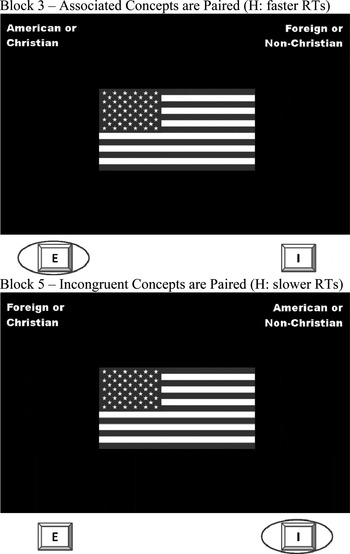
The blocks that are of interest for the purposes of discovering an implicit association between concepts are those for which the concept labels were paired in a potentially congruent or incongruent way. Blocks 3 and 5 were configured in this way with two concept labels appearing in each corner of the screen. For example, in Block 3, “American” and “Christian” would appear together in the upper-left while “Foreign” and “Non-Christian” would appear together in the upper-right. Since we hypothesize that being American and being Christian are strongly associated, using them together as a congruent pair should allow participants to sort the images faster because the paired concepts are related. The pairs of concept labels are then reversed in Block 5, yielding an incongruent set: “Foreign” and “Christian” in the upper-right, and “American” and “Non-Christian” in the upper-left. Since the pairs of labels are now incongruent according to our hypotheses, it should be more difficult for participants to sort the images yielding slower response times. Comparing response times between blocks with congruent and incongruent pairs of concept labels allows us to measure the implicit or non-conscious association between two concepts like American and Christian.
To clarify further, Figure 1 shows examples of the two IAT screens that employ the paired concept labels. In the top screen, the concept labels are seemingly congruent (American-Christian or Foreign-Non-Christian). This is akin to the screens participants saw in Block 3. In the bottom screen, the concept labels are seemingly incongruent (Foreign-Christian or American-Non-Christian) like the screens displayed in Block 5. Participants must sort the presented image (or word) into the correct category, so they would classify the American flag as American. We expect individuals to be able to classify stimuli like the American flag faster when American and Christian concept labels are paired (the top screen) than when American and Non-Christian concept labels are paired (the bottom screen) because we hypothesize that a strong implicit association exists between being a Christian and being an American. If participants gave an incorrect response, they saw a red X appear and were instructed to change their answer as quickly as possible.
Sample IAT screens with paired concept labels.

The images we used closely replicate the concept representations for “American” and “foreign” established by Devos and Banaji (Reference Devos and Banaji2005, 451) in their examination of ethnic-national associations. Images used to represent the “American” concept dimension were: the American flag, the United States Capitol Building, a United States one-dollar bill, a United States quarter coin, Mount Rushmore, a bald eagle, the outline of a map of the United States in red and blue, a picture of President Barack Obama, and a photo of former President George W. Bush. Images used to represent the “foreign” concept dimension were: the United Nations Building in Geneva, a Ukranian bill, a 20-cent Swiss coin, the Arc De Triomphe in Paris, the flag of Kiribati (colors altered, sans bird), a Flemish lion, the Armillary sphere in Geneva, a map of Luxembourg (rotated 90° to the left in green), a photo of Prince Al-Waleed bin Talal of Saudi Arabia, and a photo of Chinese President Hu Jintao in traditional dress.
To represent the concept dimension “Christian” we presented a series of both words (Christian, Easter, Jesus, Virgin Mary, Baptism, Holy Communion) and images (a cross, an ichthys or Christian fish, a portrait of Jesus and a church building). For the non-Christian concept dimension, we again presented a series of words (Rabbi, Qur'an, Judaism, Buddhism, Hinduism, Islam) and images (a Star of David, Buddhist monks meditating, a woman in a headscarf, and a picture of the Buddha). Both words and pictures are employed as stimuli in the IAT literature (Nosek, Banaji, and Greenwald Reference Nosek, Banaji and Greenwald2002; Nosek, Greenwald, and Banaji Reference Nosek, Greenwald and Banaji2005; Smith-McLallen et al. Reference Smith-McLallen, Johnson, Dovido and Pearson2006; Kawakami et al. Reference Kawakami, Phills, Greenwald, Simard, Pontiero, Brnjas, Kahn, Mills and Dovido2012). We followed this convention and included both words and pictures as stimuli to fully define the Christian/Non-Christian concept dimension.
RESULTS
Is Being Christian Prototypical of Americans?
We begin our analysis by addressing the fundamental question of whether people associate being American with Christianity. Respondents in the Perceptions of the American People Survey were asked how important they thought “to be a Christian” is to being truly American (see Appendix for question wordings). The response options were not important at all, not very important, fairly important, and very important.Footnote 6 Overall, 57 percent of respondents said it was fairly or very important to be Christian if one were to be considered truly American. A majority of Americans make an explicit American = Christian association and readily self-report that connection.
The next question is whether Christians and non-Christians differ in the explicit association they make between being Christian and being an American. Our survey results show that Christians and non-Christians dramatically differ in their response to the question on the importance of being a Christian, supporting Wenzel et al.'s (2003) finding that sub-group members project their sub-group characteristics onto the super-ordinate group. Only about one-third of non-Christians (37 percent) believe being Christian is prototypical of Americans whereas almost two-thirds of Christians (63 percent) believe this to be true. Most Christian Americans project their religion onto the overall national group and most non-Christians refuse to accept explicitly the application of this characteristic to the American people. Non-Christians' reluctance to make the explicit association makes sense. If non-Christians accept that being a true American means being Christian, then they are defining themselves outside their national group.
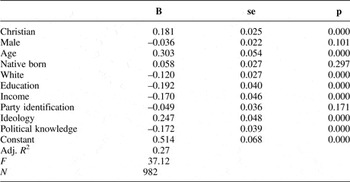
To further examine this explicit association, we regressed the importance of being Christian on whether the respondents were Christian or non-Christian and included a variety of control variables.Footnote 7 As Table 1 shows, Christians believe this characteristic of theirs is an important factor in what makes Americans American. Non-Christians are reluctant to accept this view, at least when explicitly asked about the importance of this characteristic in a survey. These results hold even when several of the control variables are significant predictors of believing Christianity to be prototypical of Americans. Older people, people of color, the less educated, the less wealthy, conservatives, and the less knowledgeable all hold the belief that to be truly American, one must be Christian.
The Importance of Being Christian for Being a True American

Source: Perceptions of the American People Survey, 2002.
Note: The dependent variable is the importance of being Christian to be a true American, which ranges from 0 = not important at all to 1= very important. All of the independent variables range from 0 to 1.
To examine whether there is an implicit association between being Christian and American, we look at RT measures from the IAT described above. The data were prepared and analyzed in accordance with the improved algorithm developed by Greenwald et al. (Reference Greenwald, Nosek and Banaji2003) and commonly followed in the current IAT literature (Lane et al. Reference Lane, Banaji, Nosek, Greenwald, Wittenbrink and Schwarz2007). Our measure is the IAT D index, or the difference between the mean RT for the block with the incongruent concept pairings and the mean RT for the block with congruent concept pairings divided by the pooled standard deviation (Greenwald et al. Reference Greenwald, Nosek and Banaji2003). The index was calculated such that positive numbers reflect slower RTs in the incongruent block than in the congruent block, indicating that participants had more difficulty with the pairing of “American” and “Non-Christian” because of a weaker association between the two than with the pairing of “American” and “Christian.” Raw mean response times are also reported although all statistical analyses were conducted on the IAT D index.
Our results indeed show that individuals were faster at sorting target images when the “American” and “Christian” concept labels were paired (M = 725 ms) than when the “American” and “Non-Christian” concept labels were paired (M = 1260 ms). We conducted a one-sample t-test on the IAT D index to confirm that the difference was statistically different from zero (what we would expect if Mcongruent = Mincongruent) and found that it is highly significant and in the expected direction (MIATD = 0.9695, SD = 0.348, t(63) = 22.31, p < 0.001). This overall result suggests a strong implicit association between “Christian” and “American,” a result that comports with our overall survey result on the explicit association.
When we examine religious sub-groups, however, the implicit and explicit results diverge. Whereas Christians are much more likely than non-Christians to state explicitly that American = Christian, both groups make the association implicitly. Using a one-way ANOVA on our IAT sample, we found no significant difference in response times between Christians and non-Christians (MIATD-Christians = 0.9785 and MIATD-nonChristians = 0.9166, F = 0.192, p = 0.663).Footnote 8 The automatic, unconscious association between being Christian and being American is held by Americans in general regardless of their religion. Christians and non-Christians might differ in their explicit avowals of whether it is important for true Americans to be Christians but both groups unconsciously make this connection.Footnote 9
Group Attitudes and Behaviors, Religion, and the Desire for Prototypicality
For the remaining analyses, we make a distinction between those who want to be prototypical and those who do not. To measure the desire to be prototypical, respondents were asked how strongly they agreed or disagreed with the statement, “I would feel good if I were described as a typical American” (see Appendix). We hypothesize (H3) that Christians would like to be considered prototypical more than non-Christians. Both our survey and experimental results support this hypothesis, yet a majority of non-Christians still say they would like to be seen as prototypical. In the survey, 77 percent of Christians said they would feel good if seen as prototypical, compared to a smaller but still significant 62 percent of non-Christians. Among the IAT experiment participants, 65 percent of Christians and 57 percent of non-Christians said they would feel good if described as a typical American.
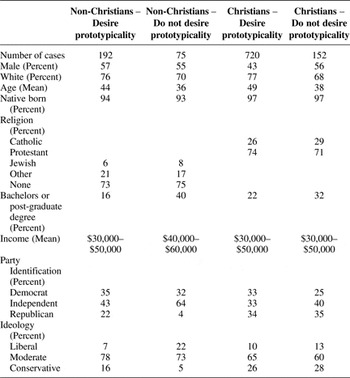
Who are these non-Christians who want to be seen as prototypical Americans? Table 2 provides descriptive data from the survey and reveals some patterns evident across both Christians and non-Christians. For example, people of color are less likely to want to be seen as prototypical than whites, and this is true regardless of religious preference. Similarly, better educated and younger Americans are less likely to desire prototypicality, whether Christian or non-Christian. Non-Christians who do not desire prototypicality stand out, however, in three ways: they are much better educated, they are much more likely to identify as Independents when it comes to party identification, and they are much more likely to consider themselves liberal and less likely to consider themselves conservative when it comes to ideology. Most of the respondents classified as non-Christian indicated that they had no religious preference (rather than being Jewish, Muslim or from another non-Christian religion), although religious preference does not appear to be related to the desire for prototypicality.
Characteristics of Non-Christians and Christians Who Desire or Do Not Desire Prototypicality

Source: Perceptions of the American People Survey, 2002.
When atypical group members want to be perceived as prototypical, they can exhibit the same group-normative attitudes and behaviors as prototypical group members. We examine two of these group-normative attitudes: being patriotic and setting exclusive boundaries on the group. We expect to find, as our fourth hypothesis lays out, that non-Christians who want to be seen as typical Americans will be more likely to be patriotic and set exclusive boundaries than non-Christians who do not have a strong desire to appear prototypical.
To measure patriotism, respondents were asked the extent to which they agreed or disagreed with the following statements: “I feel proud to be an American,” “Generally the U.S. is a better country than most other countries,” and “I cannot think of another country in which I would rather live” (see Appendix).Footnote 10 To measure the setting of exclusive boundaries, we use the same “true American” stem question but exclude responses to the “to be a Christian” question.Footnote 11 The stem question was “Some people say each of the following things is important for being truly American. Others say they are not important. How important do you think each of the following is?” Our exclusive boundaries measure is a multi-item scale that includes responses to the following characteristics: to have been born in the United States, to have United States citizenship, to have lived in the United States for most of one's life, to be able to speak English, and to be white.
Our three main independent variables measure a prototypical characteristic and the desire to be seen as prototypical. We used the dichotomous Christian/non-Christian variable and the desire to be seen as prototypical described earlier. We also included in the analysis an interaction of these two variables to test whether non-Christians who want to be seen as prototypical are more likely to exhibit group-normative attitudes than non-Christians who do not want to be seen as prototypical. As an added benefit, we can determine if Christians are similarly affected by the desire to be seen as prototypical.
We also include several control variables in the analyses. National identity and the desire for prototypicality are intertwined theoretically and are correlated with one another (Pearson's r = 0.46), but they measure two distinct group phenomena. Since our interest in this article is with prototypicality, we include national identity as a control variable to isolate the variance accounted for by prototypicality alone. If we excluded national identity from the model, the desire to be prototypical measure would include the shared effects of national identity. We therefore include national identity so its shared variance with the desire to be prototypical can be controlled. We also include in the analyses basic demographic and political attitude variables. (See the Appendix for the control variable question wordings.)
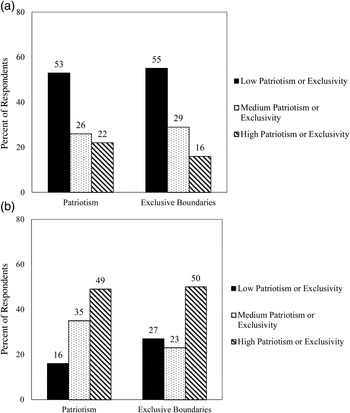
We begin by simply showing the stark differences in pro-group responses by non-Christians who want to be seen as prototypical and those who do not. Figure 2 includes two bar graphs, the top (a) for what we will call the non-Christian atypicals and the bottom (b) for non-Christian prototypicals (those who do not want to be seen as prototypical and those who want to be seen as prototypical, respectively). A majority of non-Christian atypicals score low on patriotic sentiments (53 percent) and sets inclusive boundaries on the national group (55 percent). Less than a quarter of these respondents are highly patriotic or exclusive. The story couldn't be more different for non-Christian prototypicals. Just about half of these respondents who want to be seen as typical Americans are highly patriotic and set exclusive boundaries on their national group. Less than a third has low scores on either of these measures.
Pro-group attitudes, religion, and the desire for prototypicality. Source: Perceptions of the American People Survey, 2002.

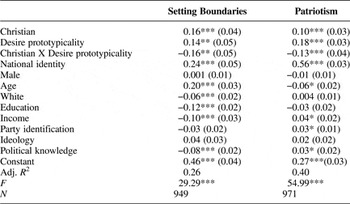
These differences continue to hold up in fully specified OLS regression models (Table 3). While some of the demographic and attitudinal control variables are significant here or there (for example, age is positively related to setting boundaries but negatively related to patriotism whereas income is negatively related to setting boundaries and positively related to patriotism), the three variables of primary interest in this research are consistently and highly significant across both the patriotism and the exclusive boundaries dependent variables. Being Christian or not, desiring to be seen as prototypical or not, and the interaction of these two variables are significant at least at the p < 0.01 level in explaining the setting of exclusive boundaries and patriotism.
Explaining Pro-Group Attitudes by Status: The Role of Religion and Prototypicality

Source: Perceptions of the American People Survey, 2002.
Note: *p<0.05; **p < 0.01; ***p < 0.001. Cell entries are regression coefficients with standard errors in parentheses. The dependent variables are the patriotism scale and the setting of exclusive boundaries scale, both of which range from 0 to 1. All of the independent variables range from 0 to 1 as well.
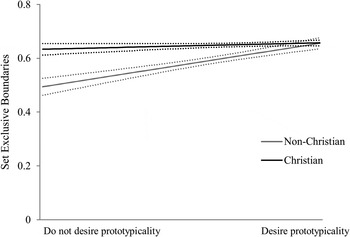
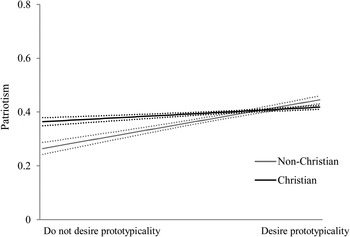
To get a better feel for what these interaction effects mean, we provide graphs depicting each of the interactions (Figs. 3 and 4). The slopes for non-Christians are pronounced and positive, with non-Christian atypicals being much less exclusionary and patriotic than non-Christian prototypicals. What is most interesting, though, is what emerges when non-Christians are compared to Christians. Ceteris paribus, Christians are exclusionary and patriotic regardless whether they desire prototypicality or not. The slopes for Christians are either ever so slightly negative (Fig. 3) or ever so slightly positive (Fig. 4), but the main story is that they are essentially flat, especially when compared to non-Christians.
Interaction of religion and desire to be prototypical to explain the setting of exclusive boundaries. Note: Dotted lines indicate 95 percent confidence intervals. Source: Perceptions of the American People Survey, 2002.

Interaction of religion and desire to be prototypical to explain patriotism. Note: Dotted lines indicate 95 percent confidence intervals. Source: Perceptions of the American People Survey, 2002.

It is also interesting to note that the increased exclusivity and patriotism among non-Christian prototypicals leaves them looking a lot like Christian prototypicals (and atypicals). When looking at the setting of exclusive boundaries, there is no difference between Christians and non-Christians among those who very much desire prototypicality. And non-Christian prototypicals are even more likely to be patriotic than Christian prototypicals. The bottom line is that non-Christians who want to be seen as prototypical hold the same pro-group attitudes as Christians (of whatever stripe), who are considered by many to be prototypical Americans simply because they are Christian.
These findings hold even when national identity, a highly significant predictor of the setting of exclusive boundaries and patriotism, is included in the model. National identity is highly significant in both models (Table 3), yet the results show that the three main independent variables have an effect on setting boundaries and patriotism even after the effects of national identity have been controlled. Being prototypical or not and desiring prototypicality affect these pro-group attitudes even when the driving force of group identity is removed.
The finding that non-Christians, who do not fit the American prototype, are so heavily influenced by whether they want to be seen as typical Americans or not is especially interesting in light of group dynamics. Some people who are marginalized because they do not hold a widely-accepted characteristic of their in-group want to be seen as good group members. Indeed, they want to be good group members. The best way to do this is to be like prototypical group members in terms of shared group norms, attitudes, and behaviors. Atypical group members (non-Christians) who want to be seen as prototypical mimic almost exactly the attitudes of prototypical members (Christians). Our fourth hypothesis is confirmed.
CONCLUSION
The United States is a secular nation that prides itself on its constitutional separation of church and state, yet many Americans are decidedly religious when it comes to their national group. The American people associate being American with being Christian, both explicitly (57 percent think being Christian is fairly or very important to being considered a true American) and implicitly (as shown by the slower response times in the IAT experiment). This widely-accepted association gives politicians leeway to make what are exclusionary claims about the United States being Christian. When politicians and pundits make the association explicit, referring to the United States as a “Christian nation,” few Americans react with outrage. Yet if the United States is a Christian nation, then what happens to non-Christian Americans? What is their status? Research shows that benefits accrue to group members who are accepted fully into the group. These prototypical members are better liked, more often chosen as leaders, more likely to be helped by the group, and less likely to have their loyalty and entitlements questioned. Being defined as outside the group in some important way, such as by being non-Christian in a Christian nation, is therefore not benign. It has real implications for real people.
People can respond in different ways to not being fully accepted into an important, and powerful, in-group. Psychologists have examined the phenomena of identity denial (Cheryan and Monin Reference Cheryan and Monin2005; Mahtani Reference Mahtani2002), marginalization (Hogg, Fielding, and Darley 2005; Marques et al. Reference Marques, Abrams and Serodio2001; Marques, Abrams, and Serodio Reference Marques, Abrams and Serodio2001), and prototypicality (Waldzus et al. Reference Waldzus, Mummendey, Wenzel and Boettcher2004), but not in the context of religion. We set out to examine in this research how Christians and non-Christians respond to their status in the group “the American people.” While Christians are much more likely than non-Christians to state explicitly that people have to be Christian to be true Americans, the perception that being Christian is a prototypical characteristic of Americans is held implicitly by non-Christians as well. What this suggests is that non-Christians are reluctant to place themselves explicitly in an out-group status but they are unconsciously doing so. As research on race shows, unconscious associations lead to biases in behaviors and attitudes, even when people refuse to make associations explicit. Since both Christians and non-Christians accept the American = Christian association at some level, the marginalization of non-Christians within the national group simply goes unnoticed by many Americans or rarely comes under attack. If the American = Christian association seems “natural,” which the IAT results suggest is the case, then public exhibitions of this association seem “natural” as well.
To be accepted as prototypical Americans, non-Christians can do what prototypical Americans do. They can be highly patriotic, thereby displaying their loyalty to their nation. They can set exclusive boundaries on their national group that more fully incorporates them as full-fledged members. Some non-Christians, 24 percent, do not want to be considered typical Americans perhaps in part because their national group so explicitly excludes them. Almost two-thirds of non-Christians (62 percent) would like to be seen as a typical American. For them, not holding this prototypical characteristic is a potential problem. It makes them less typically American. We found that non-Christians who want to be seen as prototypical are more likely to be patriotic and to set exclusive boundaries than non-Christians who do not want to be seen as prototypical. In fact, the former are just as patriotic and set the same exclusive boundaries on their national group as Christians, who are prototypical Americans. Non-Christians who want to be prototypical behave in a very prototypical way. It is non-Christians who do not want to be prototypical who behave the most differently. Their patriotism and their willingness to set exclusive boundaries are significantly lower not only than everyone who wants to be prototypical but also than Christians who want to be atypical.
More work needs to be done in this area to determine how religion is associated with the American prototype and the effect this association may have on attitudes and behaviors. For example, we are interested in the policy implications of the American = Christian association. While not the purview of this research, we offer a glimpse at a possible policy effect drawing on the Perceptions of the American People survey data. Our survey respondents were asked about the extent to which they agreed or disagreed with the following statement: “Only true Americans should be guaranteed their basic rights, such as freedom of speech and freedom of assembly.” Over two-thirds (69 percent) of respondents who explicitly associated being a true American with being Christian agreed with this statement, thereby implying that only Christians (the “true Americans”) should be guaranteed their basic rights. Less than one-third (31 percent) of respondents who did not explicitly associate being Christian with being a true American agreed with this statement.
Some Americans' reaction to the September 11, 2001, terrorist attacks puts a human face on this sentiment. Stories about attacks on Muslim Americans received a fair amount of publicity following September 11 and Muslim Americans rightfully felt nervous. Many years later, in 2007, Muslim Americans still felt frustrated by the continued intolerance directed at Muslims in the United States (MacFarquhar Reference MacFarquhar2007). If being fully accepted as a true American is a prerequisite to being given basic civil rights and liberties in the United States, then non-Christians are in trouble. We intend to examine the policy implications of the American = Christian association in future research.
APPENDIX
The survey items and scales used as independent and dependent variables in the regression analyses were standardized to range from 0 to 1, making comparisons easier. See King (Reference King1986) and Luskin (Reference Luskin1991) for a discussion of how to interpret scales using this method of standardizing variables.
Age: In what year were you born? Recoded to be age in years and transformed to range from 0 to 1 (mean = 0.35 [mean age = 45 years old], sd = 0.23).
Christian: What is your religious preference, or do you not have one? Response options were Protestant (26 percent), Catholic (21 percent), Jewish (2 percent), Muslim (0.1 percent), Orthodox (0.2 percent), Other (33 percent), and None or no preference (18 percent). To create the Christian variable, we coded as 1 all Protestants and Catholics. People who answered “Other” were given the opportunity to expand on their response and we coded as 1 all of these responses that were Christian (for example, if people said they were Christian, Lutheran, Episcopalian, and so on). All non-Christians were coded 0.
Desire to be Prototypical: I would feel good if I were described as a typical American. Response options ranged from 0 = strongly disagree to 1 = strongly agree.
Education: What is the highest grade or year of school you have completed? Coded 0 = less than high school (16 percent); 1= high school graduate (33 percent); 2 = associate certificate (8 percent); 3 = some college (19 percent); 4 = Bachelor's degree (17 percent); 5 = post-graduate degree (8 percent).
Exclusive Boundaries: Some people say each of the following things is important for being truly American. Others say they are not important. How important do you think each of the following is?…to have been born in the United States…to have U.S. citizenship…to have lived in the U.S. for most of one's life…to be able to speak English…to be White. Response options were 1 = not important at all, 2 = not very important, 3 = fairly important, 4 = very important. We created an additive scale from these variables, transformed to range from 0 to 1 (alpha = 0.75, mean = 0.67, sd = 0.21).
Ideology: When it comes to politics, some people think of themselves as liberal, and others think of themselves as conservative. How would you describe yourself? The variable ranges from 0 = extremely liberal to 1 = extremely conservative.
Importance of Being Christian: Some people say each of the following things is important for being truly American. Others say they are not important. How important do you think each of the following is?…to be Christian. Response options were 1 = not important at all, 2 = not very important, 3 = fairly important, 4 = very important. Responses were transformed to range from 0 to 1.
Income: Approximately what was your total household income from all sources, before taxes for 2001? Would you please tell me if it was…. Coded 0 = 0 to $10,000 to 1 = more than $150,000.
National Identity: Created using responses to four questions: Do you identify with the American people? (response options ranged from 1 = not part of the group to 7 = very strongly part of the group); I am a person who feels strong ties to the American people and Being an American is important to the way I think of myself as a person (response options ranged from 1 = strongly disagree to 5 = strongly agree), and I would like you to tell me what you think of the American people as a group. Let's think about being informed about politics. If 1 is extremely uninformed and 7 is extremely informed, with 2 through 6 in between, where would you place the American people?…unselfish or selfish, tolerant or intolerant, and untrustworthy or trustworthy (response options ranged from 1 = negative description to 7 = positive description). Each of these variables was transformed to range from 0 to 1, then added together to create the scale which was transformed to range from 0 to 1 (alpha = 0.65, mean = 0.73, sd = 0.15). Using factor analysis, all four items loaded on only one factor with 50 percent of the variance explained by that factor.
Native-born: Were you born in the United States? Coded 0 = no (4 percent), 1 = yes (96 percent).
Party Identification: Generally speaking, do you think of yourself as a Democrat, a Republican, an Independent, or something else? For those who answered Democrat or Republican, respondents were asked if they would call themselves a strong or not very strong Democrat/Republican. Independent were asked if they leaned toward the Democrats or Republicans. The variable ranges from 0 = strong Democrat to 1 = Strong Republican.
Patriotism: I feel proud to be an American, Generally the U.S. is a better country than most other countries, and I cannot think of another country in which I would rather live. Response options ranged from 0 = strongly disagree to 4 = strongly agree. An additive scale was created and transformed to range from 0 to 1 (alpha = 0.68, mean = 0.83, sd = 0.16). Using factor analysis, all three items loaded on only one factor with 62 percent of the variance explained by that factor.
Political Knowledge: What job or political office does Dick Cheney now hold? (70 percent correct); What job or political office does Tony Blair now hold? (45 percent correct); Who has the final responsibility to decide if a law is constitutional or not? Is it the President, Congress, or the Supreme Court? (53 percent correct); and Which party currently has the most members in the U.S. House of Representatives? (51 percent correct). Responses were coded 0 = incorrect, 1 = correct. An additive index was created and transformed to range from 0 to 1 (mean = 0.55, sd = 0.33).
Race/White: What race or races do you consider yourself? Response options were (1) Alaskan Native; (2) American Indian/Native American; (3) Asian; (4) African American or Black; (5) Hispanic/Latino/Latina/Chicano/Chicana; (6) Pacific Islander; (7) White/Caucasian; (0) Other. The variable was Coded 1 = white/Caucasian (74 percent), 0 = else.
Sex: coded 0 = female (51.7 percent of the sample), 1 = male (48.3 percent).