Wayang, a ‘community of forms’ of western Indonesia that includes rod and shadow puppetry, but also other arts, is produced in its own distinctive networks.Footnote 1 Traditionally manifested in craft villages and local schools of practice, these networks have transformed in the digital-communication age. Indonesians regularly fret about the dangers of hand-held devices in relation to traditional cultures. Cultural commentators worry that Gen Z, the generation coming of age in today's post-traditional society – referred to in Indonesian Internet and media parlance as jaman now (literally the ‘era of now’) – are unable to enjoy wayang as they are attuned to cultural products that are easily accessible, fast-paced and instantly gratifying. In contrast to the doomsayers who view digital media as wayang’s end, I wish to demonstrate, drawing on theoretical insights from sociologist Scott Lash, that there are processes of ‘reflexive traditionalization’ of social media at work in the networks of Indonesian traditional arts. That is to say, digital social media serve to reinforce a commitment to the internal good of craft and support ‘the ethics of commitment and obligation’ to the puppetry community in order to ensure a future for wayang as an art form.Footnote 2
I focus here on traditions of Javanese wayang kulit or shadow puppet theatre, the most widespread of wayang forms. This art is customarily passed down from generation to generation. Dhalang (puppeteers) practising wayang kulit inherit a large repertoire of dramatizations of the Mahabharata and Ramayana, which they retell in constantly updated versions to primarily rural audiences. Post-traditional forms of wayang kulit, radically departing from established dramaturgical norms, exist alongside traditional local performance styles, and sometimes the same dhalang is conversant with and comfortable in both traditional and post-traditional redactions.Footnote 3 But I am concerned in this context predominantly with networks of traditional wayang kulit in order to counterbalance the dominant impression internationally that wayang kulit (like other traditional performance forms in present-day Asia – jingju, bharatanatyam, khon, etc.) are important as ‘root’ sources to be appropriated by contemporary practitioners (whether in the US, Europe, Australia or Asia) but are static objects of ‘mere’ ethnographic interest otherwise. Such forms are regularly not recognized as coeval: they are not viewed as occupying the same historical moment as our own but rather considered as archaic ancestors or completely irrelevant to the contemporary.Footnote 4 In other words, they are viewed as outside jaman now – unless processed as raw materials for Rasaboxes™, Barba-style ‘theatre anthropology’, ‘ethnic fusion’ music and equivalents.Footnote 5 This consideration of the intertwining of traditions of Javanese shadow puppetry with contemporary social media used daily by and familiar to most readers of this article – Facebook and YouTube – is an intervention against such pigeonholing.
Tradition here is taken here not as something fixed, inviolate or sacrosanct, but rather, leaning on Scottish philosopher Alasdair MacIntyre, as a set of inherited practices, a tacit sense of knowing how to perform in the absence of clearly formulated rules or prescriptions.Footnote 6 Internal argument about how a tradition is defined is not a sign of infirmity but of robust health for MacIntyre – e.g., ‘the tradition of Judaism is partly constituted by a continuous argument over what it means to be a Jew’.Footnote 7 Traditions alter when confronting other traditions that provide better solutions for real-world issues and die when they can no longer accommodate new ideas. Drawing on the terms of sociologist Anthony Giddens, traditions will always have their ‘guardians’ who have access to arcane knowledge and whose status insures continuity over generations. But equally vital are the ‘experts’ operating in the public sphere by negotiating old ideas with the new, reformulating practices and rearticulating their nature and present-day merit.Footnote 8
Wayang networks in rural Java: the case of Gegesik
Wayang in village Java up through the 1980s, when I began my own wayang studies, was primarily an oral tradition transmitted through local networks. Networks of this sort have been described and theorized by sociologist Howard Becker and his colleagues as ‘theatre communities … in which people who live close to each other routinely collaborate to produce more or less similar works’.Footnote 9 Puppeteers were – and largely still are – born into puppeteer families, and learned their craft by going along to performances with family, sitting onstage and watching attentively, learning the various gamelan musical instruments that accompany wayang by substituting for members of the troupe when there was a vacancy, playing with puppets and re-enacting performances witnessed at home (sometimes with other children as musicians), asking questions of established puppeteers, listening in on conversations among elders and – very occasionally – getting some concrete pointers. Some older puppeteers were illiterate but possessed fabulous memories; they could keep in mind well over a hundred different play structures, stock phrases and exchanges, sulukan (fragments of Old Javanese poetry sung at appropriate moments in a play), a wide variety of accompanying musical pieces, magical incantations, genealogies, family histories and other sorts of knowledge.
Puppeteers, gamelan musicians and wayang makers were often clustered in villages and small towns known locally as centres for puppetry arts. The town of Gegesik (Cirebon, West Java), where I lived for much of the 1990s, had a dozen active wayang kulit troupes, all headed by members of an extended family, all practising individual variants of the local style or school (kaol) of puppetry. About half of Gegesik's troupes were completely autonomous – meaning that the puppeteers who headed them had their own sets of puppets and gamelan instruments, and their own musicians under exclusive contract; these troupes tended to perform in excess of eighty times a year. The rest shared equipment and musicians amongst them. All benefited from living in close proximity. Bookers who travelled to Gegesik from out of town who discovered that their preferred puppeteer was not available on a particular day could visit another who lived nearby. Artists were often visiting each other's houses, going off together to social functions or performances in other towns and villages, or holding impromptu soirées to discuss trade secrets. A communally funded week-long wayang festival called Saptawara was organized collectively by the puppeteers to celebrate this local heritage and act as a node of knowledge exchange.Footnote 10 The town had a strong sense of civic pride, in part a reflex of development money that flowed into Gegesik at the start of the Green Revolution in the late 1960s and early 1970s.Footnote 11 Micro-politics and competition were omnipresent but puppeteers were proud of their shared craft and committed to a local cultural identity, with all the obligations that entailed. Local pundits dubbed Gegesik an artists’ warehouse (gudang seniman) or the Ubud of Cirebon (in reference to the famed centre of Balinese arts and culture), and the Gegesik style was widely imitated, particularly in the neighbouring regency of Indramayu.
These Gegesik puppeteers were full participants in modernity: they were making occasional trips to Cirebon's elite shopping plaza Grage Mall after it opened in 1995; consuming films made in Hollywood, India and China; critically watching television broadcasts of both wayang golek performed by puppeteers from Sunda (in the southern part of West Java) and wayang kulit performed by puppeteers from Central Java; and occasionally reading books on a variety of subjects – books were considered in one puppeteer's terms to provide useful ‘guidelines’ (pedoman) for performing.Footnote 12 They were generally interested in talking to me and valued my perspective on their art form, an art which gradually I internalized and took on as my own. But it was the local networks which were at the core of the Gegesik sub-style. New puppets, when needed, were commissioned from the Gegesik puppet maker Sawiyah. Paintings on glass of wayang figures and scenes to adorn the houses of puppeteers were purchased from locally famous Gegesik painters such as Rastika or Bahendi. When sponsors requested that a daytime topeng (mask dance) performance precede a night-time wayang kulit performance, puppeteers hired preferentially one of the local topeng troupes. Gegesik puppeteers performed far and wide in Java – from Pandegelang in the far west of the pesisir (north coast) to Tegal (in central Java). Their primary alas (performing turf, literally ‘forest’), however, has always been the north-west of the regency of Cirebon – villages adjacent to Gegesik.
The most networked Gegesik puppeteer in the 1990s was Haji Mansyur, who commanded the highest fees, performed most frequently among his Gegesik peers and was the chapter head of the national, neo-governmental puppeteer union Pepadi for the regency of Cirebon. This position of local authority privileged him as a point of contact for outsiders interested in local wayang traditions. He headed juries at festivals; advised on cultural policy to the local and provincial governments; attended meetings of puppeteers in Bandung, Jakarta and other cities; and selected puppeteers for inclusion in broadcasts of wayang kulit on the provincial state television channel, TVRI Bandung. He himself was often recorded on audio cassette by Dian Records. He devotedly watched wayang television broadcasts by Sundanese and Central Javanese puppeteers, gleaning what he could of television aesthetics – particularly decorative elements (dekor) such as potted plants and over-sized kayon painted on wood to frame the screen – to create televisual ambience in his own live performances.Footnote 13 Mansyur's performances had a sense of decorum and gravitas, derived in part from his networking, which distinguished him from his peers.
Playing with Facebook
While face-to-face contact and oral–aural modes of transmission remain vitally significant, these are today supplemented by texting, Facebook, YouTube and other modes of electronic communication. Innovative, post-traditional strands of wayang achieve high visibility in this sphere, but even village puppeteers are avid consumers and producers of digital media who operate in awareness of and contribute to global mediascapes.
These recent developments in the globalization of wayang have precedents which might be traced back to at least the nineteenth century. Wayang’s shift from a locally produced and consumed art form to a national and international theatrical form manifested through various channels – collection and exhibition of wayang puppets, publication of texts, puppets produced for mass markets, sound recordings, modern institutions of training, radio (and later television) broadcasts, the use of wayang for advertising and propaganda, and the creation of modern wayang forms speaking to international and pan-local issues and cosmopolitan aspirations.Footnote 14 Through these developments wayang became amenable to inclusion in non-local assemblages, discourses and networks.
These earlier advances have shaped the performance and representation of wayang in profound, if sometimes unrecognized, ways. But in relation to how they impacted on the constitution of wayang networks, they pale in significance to the changes wrought through digital culture in the last fifteen years or so. While conducting my doctoral and postdoctoral fieldwork in Gegesik in the 1990s, there was no Internet and no mobile phone coverage in the town. I checked my email by weekly trips to the central post office in the city of Cirebon, some thirty kilometres to the south-east, which had several computers with Internet access available for rental. I was probably the only person living in Gegesik with an email account. A talk I gave in 1994 to an Islamic student society concerning the radical potential of the Internet for local culture was met with laughter and derision – for internet was then known only as the name of a building material.
By 2004, this situation had changed. At this time, I was regularly watching wayang streamed live to the World Wide Web by Indonesian television stations (primarily the private station Indosiar) in my home in Glasgow, Scotland. I took a short trip to Cirebon that year, and reported how I was shocked to witness ‘sinden (female vocalists) checking their messages on mobile phones during performances, and even receiving telephone calls’. I noted as well how ‘video monitors had become de rigueur at rural hajatan (ritual celebrations) in Cirebon so that spectators could watch both the shadow and puppet sides of the screen simultaneously’. Projecting forward, I speculated how ‘in years to come Indonesian puppeteers will be communicating with scriptwriters via email, downloading new pieces for gamelan on mobile phones, and conferencing with potential sponsors on web cameras. Virtual wayang performances in which puppets are manipulated by remotely located puppeteers using animatronics might also arise’.Footnote 15 While I have yet to witness the virtual wayang performance conjectured, other predictions have come to pass, and then some. I would like to describe, and draw some preliminary conclusions regarding, some of the more striking developments that have emerged over the last decade.
I start a decade ago not only because I spent five months of that year based in Yogyakarta in 2009, studying and participating in the city's lively and cosmopolitan arts scene (both online and in person), but also because this was the moment when Indonesia had its sharpest increase in Facebook users – jumping a thousandfold from 209,760 users in July 2008 to 25,912,960 users in July 2010.Footnote 16 Facebook is, and to a great extent remains, the primary point of entry to the World Wide Web for most Indonesians, and using the Internet was in 2009 referred to colloquially as ‘fooling around with Facebook’ (main Facebook in Indonesian, ndolan Facebook in Javanese).
Much Internet activity related to wayang is by self-proclaimed ‘fans’ of particular puppeteers.Footnote 17 These fans upload photographs and videos of performances they attend, digitize and share old commercial audio cassette recordings, advertise upcoming performances, and discuss the merits of their favourite puppeteers and the shortcomings of their rivals. They are particularly prominent on YouTube (sometimes funding the live streaming of their favourite puppeteers) and Facebook, but use other social-media platforms as well. Some of the most active fans are in fact guest workers in countries such as Taiwan – wayang for them acts as a source of familiar solace and cultural belonging in often unwelcoming host countries.
I would hazard that few traditionally trained artists were Facebook users in 2008, but by 2009 many puppeteers, particularly those located in major cities, were starting to figure out professional and personal uses for Facebook. For many, at least at first, it was significant primarily in reinforcing and widening social circles. So, while living in Yogyakarta for some months in 2009, I regularly began my day with an informal chat with the Yogyakarta puppeteer Seno Nugroho. We would exchange pleasantries and discuss upcoming performances and undertakings – such as archival videos of well-known puppeteers Seno was planning to watch on a particular day from his well-stocked personal library. Sometimes I would comment on performances I had seen. In this way, I achieved some insight into the day-to-day routines of one of Yogyakarta's most highly regarded and highest-paid puppeteers. Seno no doubt felt that he was fulfilling his obligation of being a local host to a puppeteer-scholar visiting his town, from the comfort of his own home.
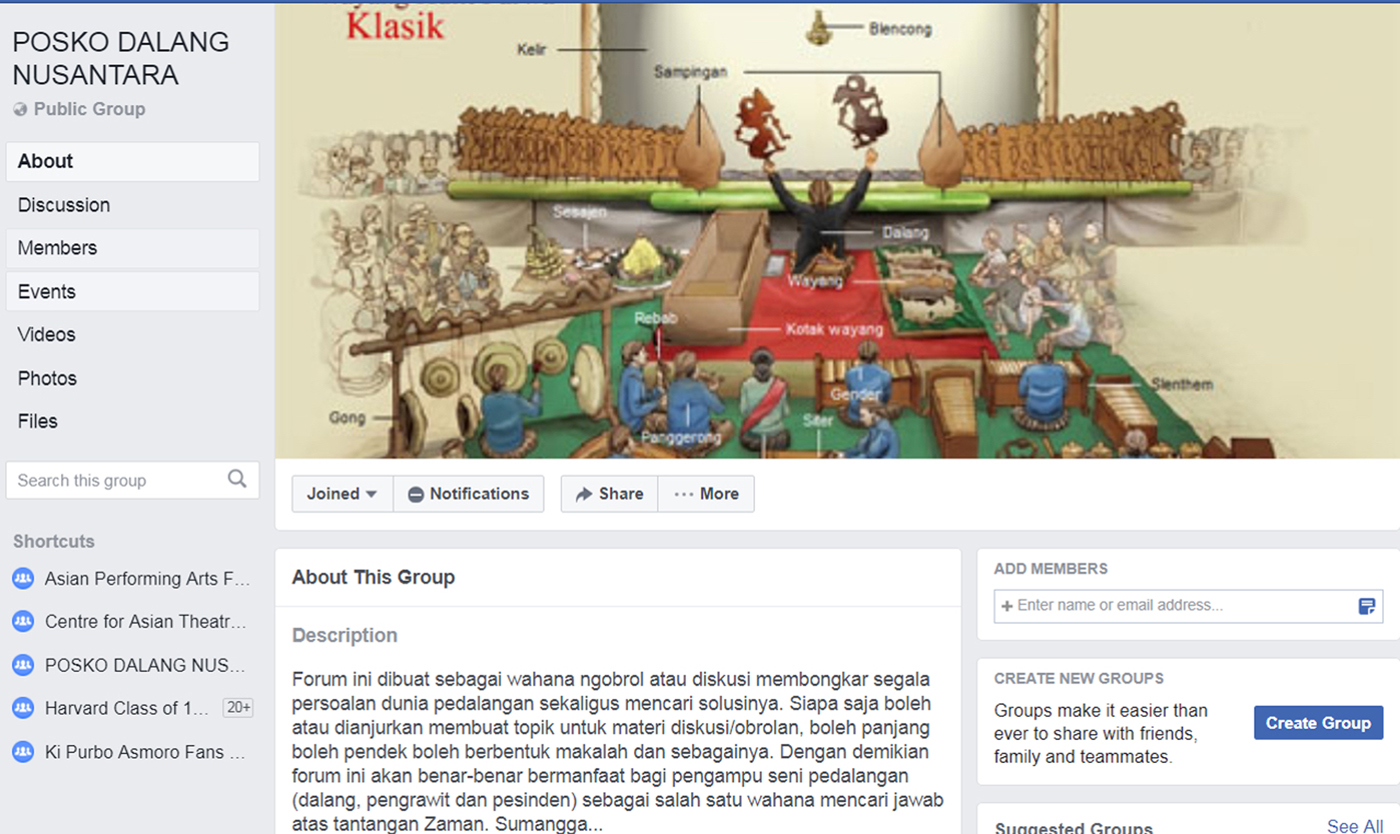
Some puppeteers, or their managers, post their monthly performance schedules on their Facebook pages, but these are more commonly to be found in public groups devoted to particularly popular puppeteers administered by members of puppeteer fan clubs. Younger puppeteers also are prone to posting photographs of their flashy cars as a way to display their wealth, success and standing.Footnote 18 The public group Posko Dalang Nusantara (Commando Post for Puppeteers of the Archipelago) has proved more important for the exchange of information, debate and open philosophical discussion among puppeteers; this was formed on 20 January 2011 by the radical puppeteer Jlitheng Suparman and moderated by him ever since (Fig. 1). Jlitheng is best known for his innovative wayang form, Wayang Kampung Sebelah (Wayang from the Neighbourhood Next Door), which narrates politically critical stories about everyday life, with new figures and new (non-gamelan) music. While coming from a puppeteer family, and trained traditionally by a puppeteer uncle, his tertiary education in literature introduced him to a critical language which allows him to think about wayang in a contemporary, theoretically inflected way. Drawing on Martin Heidegger, we might characterize the aim of this radical wayang puppeteer, and other like-minded post-traditional wayang artists, as being to critique the ‘wayang system’, sloughing off the restrictions of a century of standardization and academism in order to ‘reactivate the tradition’ and allow wayang to communicate directly to matters of import to contemporary audiences.Footnote 19 The Posko group (1,386 members as of 23 June 2018) has a similarly critical edge. Its explicit purpose, as stated in the description of the group in Facebook, is to be a ‘forum’ or a
vehicle for conversation or discussion to unpack all the issues of the world puppetry and look for solutions for them. Anyone can, and is urged to, create a topic as material for discussion/conversation, long or short, in the form of an article or otherwise. In this way, this form will truly be useful for proponents of the art of puppetry (puppeteers, musicians and vocalists) as a vehicle for finding solutions to problems of our Era.Footnote 20
(Colour online) Screengrab of Posko Dalang Nusantara (Commando Post for Puppeteers of the Nusantara) Facebook page.

I became a member of the Posko in March 2011 at the urging of my friend and colleague Joko Susilo, an Indonesian puppeteer who has been living in New Zealand since the 1990s, who reported what an important source of information on current puppetry discourse it was for him. The forum keeps its edge by regular provocations in the form of polemical essays by Jlitheng, and barbed retorts he occasionally offers to the posting of others. Recent Jlitheng posts have concerned inflated claims for innovation attributed to certain puppeteers, the need to rethink training and philosophy of wayang because it is now normative for puppeteers to be fully visible and speak directly to audiences rather than through puppets, the need for a clear political vision in public funding for traditional arts, and the limits of creative freedom. Sometimes posts are sketches for longer essays to appear in print media, or reproduce an essay Jlitheng has published in a newspaper already. Jlitheng implicitly holds with Alasdair MacIntrye's understanding that participating in a tradition such as wayang is ‘a matter of knowing how to go further, and especially how to direct others towards going further, using what can be learned from the tradition afforded by the past to move towards the telos of fully perfected work’.Footnote 21
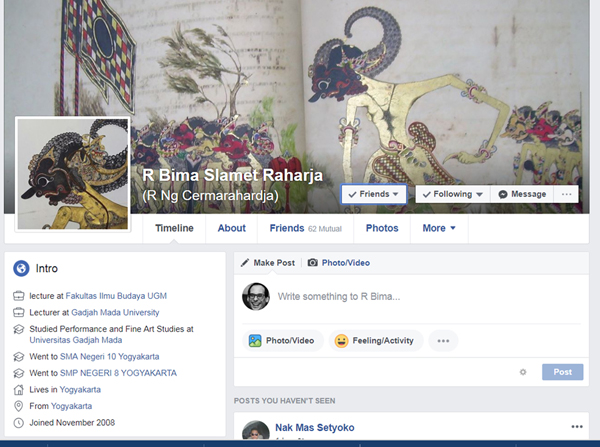
Wayang is not a singular tradition, and Facebook is a site for encounters between puppets from the past and contemporary practitioners, adherents of different regional traditions, and devotees of differing levels of skill and expertise. R. Bima Slamet Raharja, a lecturer in Javanese literature at Gadjah Mada University, actively posts archaic wayang from the different sub-styles of Yogyakarta he encounters in older sets of puppets, manuscript illustrations and archival photographs (Fig. 2). Bima is associated with the royal house of Pakualaman and is charged with conducting the monthly ‘airing out’ (ngisis) of the royal puppets – an arcane ritual not viewable by the public. But outside this restricted context, he is less a guardian of tradition than an expert, in the terms of Anthony Giddens, eager to disseminate knowledge and skills related to wayang.
(Colour online) Screengrab of R Bima Slamet Raharja Facebook page.

In his numerous Facebook posts, Bima comments expertly on wayang craftsmanship, unique features of carving and colouring, and affiliation with different princely houses or village traditions, and occasionally poses questions about the characters represented. He also posts photographs of puppets (sometimes ‘in-process’) he has commissioned, usually tedhakan (literally ‘descendants’) based on his own sketches of older models.Footnote 22 These posts of puppet photographs – which garner huge admiration from friends and followers – serve to highlight the creativity of past practitioners, the range of traditional practices, the abilities of present-day craftspeople, and the scope of heritage collections located in Yogyakarta and internationally. Yogyakarta-style wayang is a regional tradition characterized by a high degree of traditionalization, conservativeness and rigidity, and has been in retreat since at least the 1970s, overwhelmed by the state-backed power of the rival Surakarta regional tradition. Bima holds up these archival puppets as a means to recognize the creative diversity of Yogyakarta's past, emboldening contemporary practitioners to be more experimental in their interpretation of the Yogyakarta tradition. Collections thus are configured as ‘creative technologies’ for generating new impulses in wayang tradition.Footnote 23 He is generous in his knowledge – when I was posting photographs from my first survey of the Dr Walter Angst and Sir Henry Angest Collection of Indonesian Puppets in the Yale University Art Gallery from August to October 2017, he was one of the most active commentators, providing character identifications, the names of wanda (puppet variants) and puppet makers, and important cultural background.Footnote 24 Bima is emphatically not a conservator. As is the case for many experts of his calibre, he also deals in puppets, and a large percentage of the old and newly minted puppets he posts on Facebook are destined for sale, confident that having documented and studied them he is capable also of overseeing the process of their ‘having children’ (mutrani) in the future.
Facebook also serves to highlight and instil respect for the distinct qualities of lesser-known regional styles of wayang. Photographs of an antique set of shadow puppets from Palembang (south Sumatra) posted by the young Palembang puppeteer Novriananda in 2016 were appreciated for the expressiveness of this nearly extinct regional variation. Purjadi – a proponent of the so-called kidulan (southern) sub-style of Cirebonese shadow puppet theatre, who has recently been posting suites of photographs of his own performances in village Cirebon on his Facebook page – was questioned by the Yogyakarta-based puppeteer Catur ‘Benyek’ Kuncoro about why Purjadi uses a microphone on a stand instead of a lapel microphone or a microphone hung around his neck, which is the standard practice in Yogyakarta and central Java. Purjadi responded that this facilitated certain ‘vocal effects’ (efek untuk kebutuhan vocal) as he could play with distance from the microphone.Footnote 25 In dialogues such as this, practitioners gain new perspectives on their tradition, and learn to appreciate how certain elements are emphasized over others.
Online wayang videos
Facebook's visual aesthetics tends to emphasize the visual culture of wayang over performance. But this bias is more than compensated for by the thousands of wayang videos uploaded to YouTube and other online video sites. Moving images of wayang before digital video were scarce. Starting in the 1970s, Indonesian television stations regularly aired wayang performances, mostly shot in studios before a live audience, but these were as ephemeral as performances as they were rarely preserved. With the ready availability of affordable camcorders in the 1980s, Indonesian conservatoires and cultural institutes were able to document live performances on their premises. These were generally internal documents, though it was sometimes possible to request copies. While Indonesian stations rarely preserved recordings of performances aired, a number of non-Indonesian initiatives from the 1990s did. The Verbal Art in the Audio-visual Media of Indonesia project of Leiden University recorded nearly 150 wayang broadcasts, mostly from the private television station Indosiar, from 1996 to 2000.Footnote 26
The advent of the video compact disc (VCD) format in the late 1990s in Indonesia, and online video from the mid-2000s, quickly resulted in the eclipse of audio cassettes as the preferred mode of mediation of wayang. The first wayang VCDs issued in 1999 were elite products aimed at cosmopolitan consumers. A flood of more slipshod VCDs aimed at the mass market, many produced by kitchen-table local publishers, followed. The bulk of these over the last fifteen years have been pirated VCDs reproducing recordings of wayang made by local video companies at hajatan (family celebrations) and communal celebrations.
Such wayang VCDs, and slightly more upscale DVDs, are still available for purchase from roadside vendors. But, once again, this format is being eclipsed by the newer technology of online videos. In September 2004, a comprehensive search of online puppet videos uncovered only four online wayang videos – all made by or intended for non-Indonesian audiences. YouTube, founded five months later, proved to be a game changer in the creation and distribution of wayang videos. Existing wayang VCDs were quickly and easily uploaded; mostly, as already indicated, by fans. Teaching tools, such as a series of one- to two-minute videos in which the ‘superstar’ puppeteer and puppetry lecturer Purbo Asmoro demonstrates principles of sabetan (puppet movement), could also be uploaded.Footnote 27 Experimental wayang animations created for or distributed via YouTube were uploaded by students in technical colleges and universities in order to communicate with, and make wayang accessible to, non-traditional audiences. But the vast majority of YouTube wayang videos are documents of traditional performances, both excerpts filmed casually by spectators with hand-held devices, and full-length recordings with multiple cameras and good-quality sound.
YouTube has radically increased access to performances. Among other effects, this has enabled aspiring puppeteers to study puppeteers located some distance away. Purjadi likened his son Devananta Naraya Prasandha, an aspiring puppeteer who idolizes the spectacularly acrobatic puppetry of the Solo-style puppeteer Bayu Aji Pamungkas (whom he has never met but watches avidly on YouTube), to Ekalaya, the tribal warrior in the Mahabharata who claims to be a student of Dorna by virtue of performing daily pujas and practising martial arts before a Dorna statue. Such long-distance study and observation are contributing significantly to the blurring of regional styles. From the 1970s to the 1990s, Indonesian theatre communities – including local clusters of puppet practitioners in Java and Bali – were much concerned with maintaining the integrity of local styles, which were buttressed through festivals, contests, publications and education.Footnote 28 Purists complain about the contamination of local performance traditions but it seems impossible to stem the tide of cross-style borrowing prevalent in all western Indonesian wayang forms today.
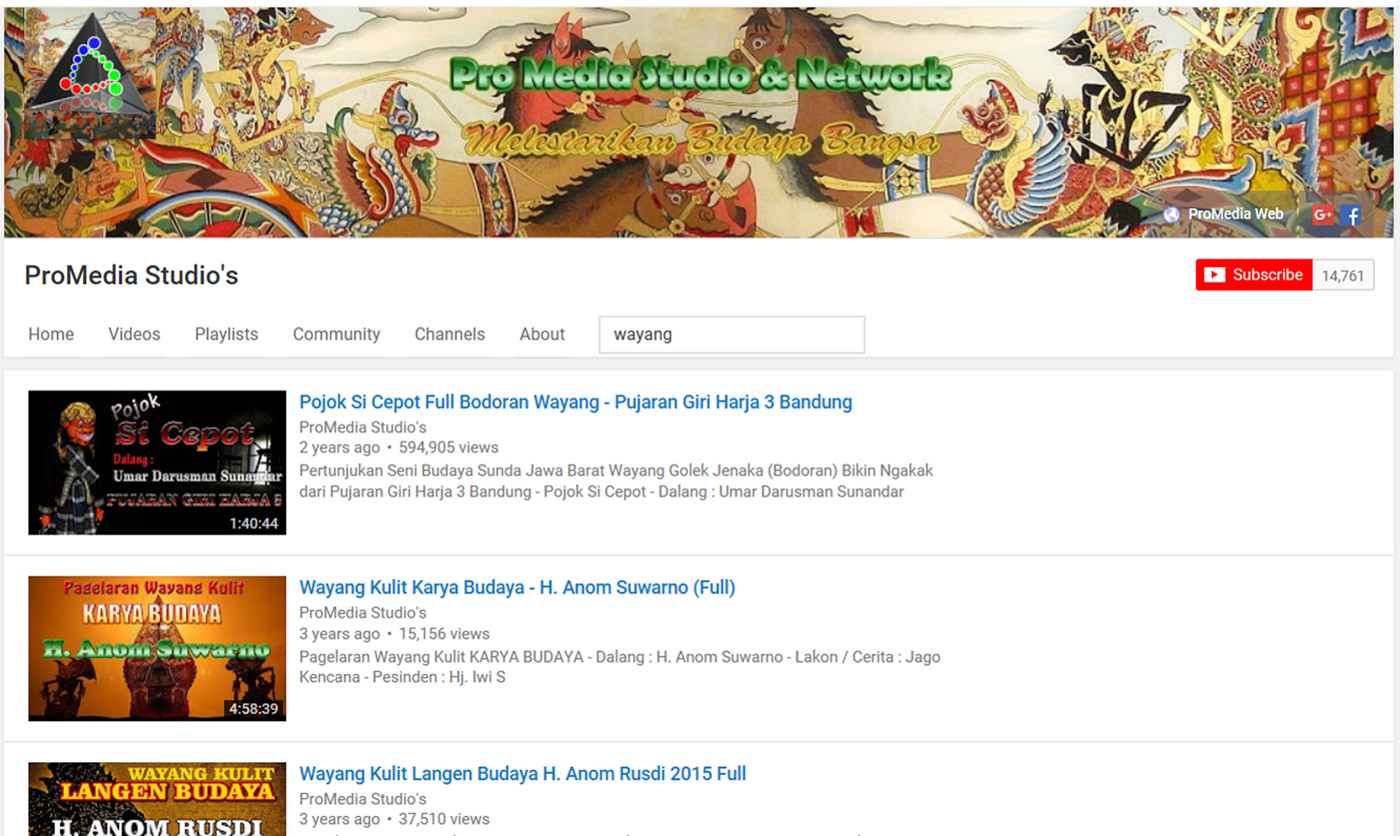
Many online wayang videos, particularly those from the pantura (north coast) region of Java, are uploaded directly by video production companies hired by local hosts to live-stream performances they sponsor in conjunction with hajatan (mostly rites of passage such as circumcisions and weddings). ProMedia, a small company in rural Subang which specializes in video production and wireless networks, has uploaded thousands of full recordings of performances of traditional arts, including wayang kulit and wayang golek (Fig. 3), alongside videos of graduations, weddings, reunions and awards ceremonies. Hajatan in this part of Java are funded to a large extent by remittances sent from abroad by family members working in Malaysia, Taiwan, Hong Kong, Singapore, South Korea and the Gulf states. These munificent relatives are mentioned frequently and prominently in songs in wayang sung by pesinden (female vocalists) and in opening speeches. The live streaming and uploading of these videos thus potentiates their feeling of participation and belonging. Relatively humble hosts in Indramayu and some of the neighbouring regencies are prepared to spend lavishly on top-quality troupes and high-quality videos to insure a good turnout and substantial cash donations from virtually and actually present guests. For scholars of the arts, the videos uploaded to YouTube from village Java provide one of the fullest records of rural arts ever available.
(Colour online) Screengrab of ProMedia Studio & Network YouTube channel.

On a typical evening about a dozen Javanese shadow puppet performances from around Java are live-streamed to YouTube. Viewers typically enter these live-streamed performances through particular portals. Indonesian fans of central Javanese wayang rely on platforms such as the Facebook public group Info Pakeliran Wayang Kulit (Info on Wayang Kulit Performances), where links to live-streamed events are posted alongside notices of upcoming performances.Footnote 29 Fans of the Yogyakarta ‘superstar’ puppeteer Seno Nugroho, who is celebrated for his raucous comedy and sharp political commentary, have their own Internet networks. The go-to YouTube channel is PWKS Live (31,663 subscribers as of 13 July 2018), short for Penggemar Wayang Ki Seno Nugroho Live (Fans of Ki Seno Nugroho's Wayang Live), where his performances are regularly streamed and archived. This is complemented by the Facebook public group PWKS (Penggemar Wayang Ki Seno Nugroho), where the puppeteer's monthly schedule is posted so fans know when to tune in or go to see Seno perform live. PWKS members can also view photographs and selfies taken by fans at Seno performances, e-flyers for upcoming performances and other wayang-related posts.
For non-Indonesian wayang devotees, a major source of information for live-streamed performances has been the Indonesian performing arts listserv. Kitsie Emerson – a Jakarta-based schoolteacher, amateur gamelan musician and wayang devotee who has been following the puppeteer Purbo Asmoro since 2004 – provides live translation into English when Purbo performs overseas or for foreign guests, and has also funded the live streaming of Purbo's performances and the performances of some other puppeteers she has translated. Emerson announces these live-streamed performances with scrolling translation/interpretation via the listserv. These are keenly watched by English-speaking viewers around the world while they are being streamed but are then taken down after the event as Emerson is insistent that her live interpretations are ephemeral and not for posterity.
Live streaming presents a very different experience of watching wayang than either live performance or recorded video. There is a quality of eventness also experienced in the Metropolitan Opera's Live in HD and National Theatre Live screenings, coupled with feelings of cultural intimacy and a sense of community fostered through the chat function that rolls out comments from viewers. As the performance goes on, viewers ‘check in’, typically reporting their location and offering comments on the performance. An online viewer of a Seno Nugroho performance I attended at the Yogyakarta cultural centre Taman Budaya Yogyakarta (TBY) on 12–13 July 2018 posted on the PWKS Facebook site that he was watching the live stream ‘while waiting for my wife's C-section … I request your well wishes, my friends … hopefully the C-section will go well and the baby and my wife will be healthy … amen’.Footnote 30 Others watching online send the puppeteer text messages during performances, which he sometimes reports and comments on in performances. Seno joked at his TBY performance about one such fan who glues his eyelids open to stay up all night and watch him. Viewers see the numbers watching online fluctuate as the night (or day, depending on their location) progresses. As is the case for live performances, few watch wayang streams in their entirety – the live stream of the aforementioned Seno Nugroho performance had nearly forty thousand views but typically about two thousand were watching at any one time. Jan Mrázek, who viewed many of the 150 or so recorded Indosiar wayang broadcasts when he was a postdoctoral scholar researching wayang on television with the Verbal Art in the Audio-visual Media of Indonesia project of Leiden University, recounted in conversations the fatigue and loneliness he experienced in watching recorded wayang on a television monitor by himself. There is, in contrast, a sense of anticipation and excitement at being part of an internationally dispersed viewing body in live-streamed wayang.
This sense of being part of an audience is reinforced by puppeteers in performance, who will announce in comical interludes the cities outside Java and foreign countries where online viewers are located. So, during the first comical interlude (Limbukan) in a performance of a ritual drama, part of an annual village cleaning rite addressing and placating local spirits connected to agriculture, Seno Nugroho referenced online viewers watching in Japan and America.Footnote 31 Seno retains and actively courts his local devotees – about 80 per cent of his performances are in Yogyakarta and its environs – but draws cachet from his extra-local appeal on the Web, in much the same way that he points out, invites onstage and engages in conversations with foreign viewers attending live performances in person.Footnote 32
Ephemerality and connectivity
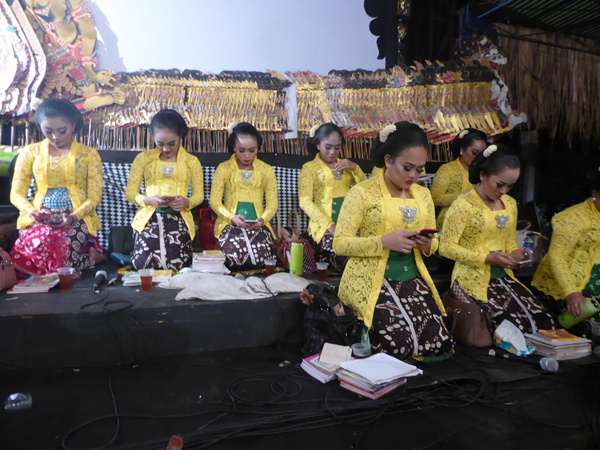
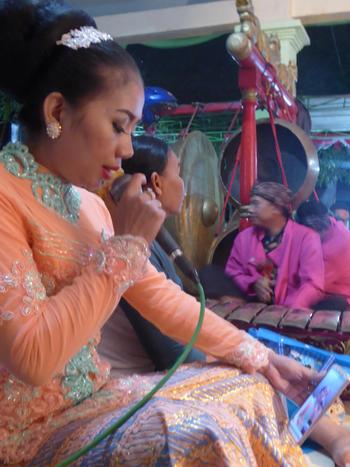
The lines separating live and Web performances are increasingly fuzzy. At Seno's TBY performance, all of the nine pesinden lined up to the puppeteer's right were busy with their mobile phones during the longer dialogue and fighting scenes, when they were not required to sing (Fig. 4). None took or made phone calls: they understood the importance of maintaining decorum. But they were using Facebook, texting on WhatsApp, taking selfies and using their phones in place of mirrors to fix their make-up and hair. Spectators were also busy with their phones and other hand-held devices, illuminating the area around the stage in a way that Seno described in one of the comical interludes as a sea of red lights. And during longer musical pieces (gendhing), moments in which dhalang in the past might enjoy a cigarette or a cup of hot tea, Seno himself was often looking at his own mobile phone, ever at his side, for input and comments from fans and friends. Increasingly wayang is becoming a code/space, an environment co-produced by computation and ‘mediated through connectivity and algorithmic revision’; performances are meaningful to the extent they can be announced on Facebook, be streamed and archived on YouTube, and serve as backdrops for selfies taken by both performers and spectators (Fig. 5).Footnote 33
(Colour online) Pesinden (female vocalists) looking at their mobile phones in a performance by puppeteer Seno Nugroho at the Yogyakarta cultural centre Taman Budaya Yogyakarta (TBY) on 12–13 July 2018. Photograph by Matthew Isaac Cohen.

(Colour online) The pesinden (female vocalist) Nyi Siti Julekha filming herself on her mobile while singing at a performance by the puppeteer Purjadi in the village of Kondangsari (Cirebon) on 22–3 July 2018. Photograph by Matthew Isaac Cohen.

On the Facebook site of the live-streaming company ProMedia, the company explains that its emblem, a multi-coloured circle or ring, ‘symbolizes lastingness and the quality of protection, giving the impression of dynamism, rotation, speed, repetition, continuity, without beginning or end, eternal, eminent, trustworthy, perfection, and life’.Footnote 34 The most affecting online videos related to wayang are not of lively performances affirming the continuity of tradition, however, but videos (accompanied inevitably by texts, email messages, newspaper articles, Facebook postings and other electronic communications) announcing the deaths of friends from wayang networks. Videos showing the sudden death on 16 April 2018 of the Gegesik puppeteer Suherman Alim Basyirun (1970–2018), popularly known as Herman Basari, were personally the most shocking, the greatest reminder that networks are built of people who do have an end, who are not eternal, and who are prone to imperfections in the ways they lived and died.
Herman, at the time of his death, was coaching a group of students aged twelve to fifteen in his sanggar (studio) in Gegesik for an upcoming gamelan performance as part of a provincial celebration of Indonesia's national education and sports day. Next door to his sanggar was an abandoned house that had been converted into a bird's nest factory; the owner had recently elevated its walls to increase production (without planning permission, it turned out).Footnote 35 The wall of this factory collapsed and Herman, his son and assistant Arid (1996–2018) and five of their students in the class were crushed to death. The outpouring of support was instant – with money from Indonesia's president, the Ministry of Education and Culture and the puppeteer union Pepadi; full scholarship offers to Herman's surviving children from the conservatoires; national news coverage and expressions of sympathy on Facebook and other social media.
Funerals in village Java are quick affairs – people are buried on the day they die with minimal spectacle – but are nonetheless meaningful rites of passage to the extent they knit together families, friends and acquaintances in acts of collective remembering. Herman's death, in contrast, played out over the protracted period of a news cycle; details about the victims, the cause of their death and the responses from local and national institutions and actors trickled in over several days. I could not tear myself away from the grim spectacle. Herman had worked as my assistant in the late 1990s and we had both understudied as ‘afternoon puppeteers’ (dhalang awan) to his father Basari in 1999. Herman had been responsible for producing the first draft of the transcript of a performance of the ritual drama Barikan for one of my books and I had acted in a variety of ways to stimulate his career as a puppeteer.Footnote 36 We were close enough for him to have named one of his children after my own daughter. While I have only rarely visited Gegesik since completing my postdoctoral field studies there in the year 2000, I communicated with both Herman and his younger brother Tono (a puppeteer living in Indramayu) through email and Facebook over the years.
As I watched online videos of rescue workers looking for bodies amidst the rubble, sense memories of my years of living in Gegesik flooded in – the pungency of burning rice straw at harvest times, the smack of sweet tea and hot cassavas, the wave of relaxation after a massage, the sounds of street vendors, the sweltering heat in my study as I worked on a transcript with Herman and other assistants, and the relief of cool night air. I gazed at the faces of the townspeople who crowded around the periphery of the demolished studio as the rescue operation proceeded, scanning the crowd for people I had once known, and wondering if anyone present would recognize me today. I fantasized about teleporting into the scene, and at the same time was grateful I was nowhere near the disaster site.
Purjadi, who attended Herman's funeral in the company of VIP guests in his capacity as current head of Cirebon's Pepadi chapter, captioned his photographs of the funeral he posted on Facebook: ‘Farewell my friend, Puppeteer Suherman … Hopefully your path will be lit up’ (selamat jalan sahabatku dalang Suherman … Semoga terang jalanmu).Footnote 37 I experienced Purjadi's presence at the funeral as a surrogate for my own, and his elegant words brought comfort, and concisely expressed with far more grace anything I might post on my own Facebook page.
Claire Holt argues of wayang that ‘the shadow's faith is acceptance of the immutable order of things; the shadows’ will strives to enhance their power, to gain possession of the desired mate, to defend their domain, to make their universe secure’.Footnote 38 Wayang’s power over desired proponents remains evident in contemporary Indonesia, with many practitioners and fans striving to secure a place for wayang in jaman now. But wayang today is hardly immutable; it is fully part of the globalized world, with all its affordances, excesses and shortcomings. In the first comical interlude of his TBY performance, Seno queried why this article's author, a professor of theatre from London, with all London's advanced technology at his disposal, would possibly be interested in a medium such as wayang. His jokey response was that Indonesia was also technologically advanced, proof being that a single motor scooter can be disassembled for parts, effectively multiplying it into a dozen clones. We might extrapolate from Seno's one-liner that such also is the case of wayang in the age of digital reproduction – old puppets are having children, debates are being aired and rejoined internationally, audiences are extended, the scope for celebrating and mourning together is increased. At the same time, these digital media are being domesticated in a DIY and very self-aware fashion – a process of reflexive traditionalization. It is clear that wayang practice remains grounded in local conditions and at the same time responsive to shifting media technologies, changing beliefs, expanding social networks, and evolving noetic economies. Performed in the dark, it lights up this transitory world, and charts what comes after.