1. On ‘something’ in general, and in Danish
This paper revolves around the concept of something – and the grammar it allows and affords. To describe the concept of something as vague is somewhat of an understatement. It would not be an exaggeration to say that something belongs to the most general of all ideas that human thought has produced. It is perhaps precisely because of this that we find something incorporated into a wide array of concepts and constructions in and across languages.
Danish noget ‘something’ is an interesting case in point. As a hyper-general Danish word, noget is employed across all domains in its semantically simple sense, but it is also found in complex, idiomatic constructions. Some of these are of an evaluative nature, and this paper explores in depth the meaning the evaluative noget construction in Danish, for which we can devise the following formula (N = noun):
-
(1) The evaluative noget construction:Footnote 1
Det er noget N!
‘It’s something N!’
The setup of the evaluative noget construction is exemplified in (2), where some common slot-filler nouns have been inserted into its noun slot.
-
(2)


The evaluative noget construction is open in the sense that the N slot can attract a great variety of nouns. At the same time, the construction conventionally attracts a small set of nouns clustered around particular semantic themes. Each of the constructional configurations differ, but they all share at least one important feature: they all transform noget’s hyper-generality into a ‘negative’ component of meaning.
While contemporary Danish morphosyntax is generally well described (see Hansen & Heltoft Reference Hansen and Heltoft2011) and several studies devoted to specific constructions have been undertaken, including some that contain noget (see e.g. Christensen & Jensen Reference Christensen, Jensen, Tanya Karoli, Christina, Torben Juel, Martha Sif, Marie, Nicolai and Pia2018), there is to my knowledge, no previous study of the evaluative noget construction. The descriptive goal of the paper is to provide a new account of this construction, informed by cross-linguistic findings on the semantics and syntax of something. The analytical goal is to provide high-resolution analyses of the cognitive schemas in the construction, and to account for the landscape of lexicogrammar that the constructional configurations constitute. To achieve these goals, the paper employs semantic explication techniques following Anna Wierzbicka’s and Cliff Goddard’s work on grammatical semantics and the grammar–culture interface (Wierzbicka Reference Wierzbicka1988, Reference Wierzbicka2013; Goddard & Wierzbicka Reference Goddard and Wierzbicka2002; Goddard Reference Goddard2018). The paper concludes by discussing the viability of a Cultural Construction Grammar (see Levisen Reference Levisen2018, Reference Levisen, Kerry, Bert and Lauren2020) – a newcomer into the family of construction grammars (Goldberg Reference Goldberg1995, Reference Goldberg2006; Croft & Cruse Reference Croft and Cruse2004; Fried & Östman Reference Fried and Östman2004; Hilpert Reference Hilpert2014; Lyngfelt et al. Reference Lyngfelt, Borin, Ohara and Torrent2018).
2. Cross-linguistic and metalinguistic perspectives
The most thorough cross-linguistic investigations of something and its grammar have been conducted by Cliff Goddard and Anna Wierzbicka over several decades within the Natural Semantic Metalanguage framework (NSM; Goddard & Wierzbicka Reference Goddard and Wierzbicka1994, Reference Goddard and Wierzbicka2002, Reference Goddard and Wierzbicka2014; Goddard Reference Goddard2018).
The NSM approach combines an empirical search for semantic universals with an analytical scope of undertaking in-depth studies of culture-specific meanings across the constructional span: single words, phrasemes and morphosyntactic patterns. The approach applies semantic explication techniques based on simple universal units of meaning, called semantic primes. In order to study concepts and constructions in a way that can be understood cross-linguistically, and which does not hinge on English-only terminologies, the approach has been found highly useful in the study of both specific meanings in language and more broadly in speakers’ linguistic worldviews.
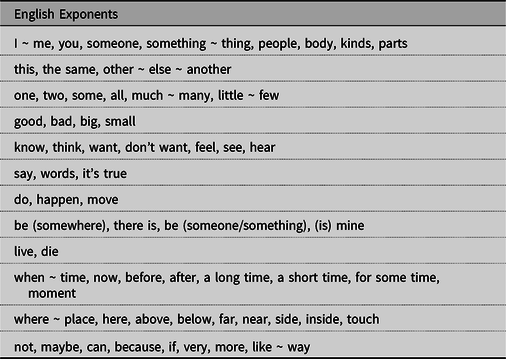
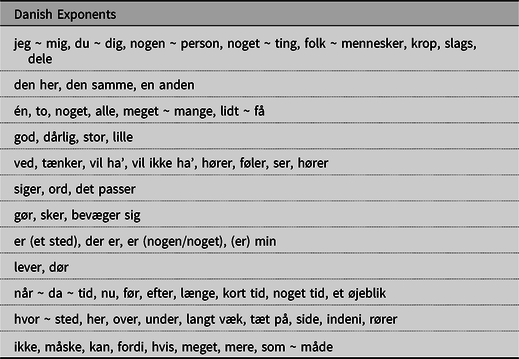
In the NSM framework, something is considered to be a semantic prime. It is a part of an exclusive set of semantic universals. Table 1 shows the list of semantic primes in their English exponents and Table 2 the Danish exponents.
Semantic primes in their English exponents, based on Goddard & Wierzbicka Reference Goddard and Wierzbicka2014.

Semantic primes in their Danish exponents, based on Levisen Reference Levisen2012.

As a semantic-conceptual universal something is theorized to have exponents across the world’s languages, and empirical evidence confirms this. In (3), I have listed a small sub-set of lexicalizations of something that have been well studied from a cross-linguistic perspective.
-
(3)

The lexicalization of something can take different shapes and forms across different languages. Exponents can be a single word that is either formally complex, such as English some + thing, or formally simple such as Danish noget.Footnote 2 There can be formal variants, or allolexy, in NSM terminology (see e.g. Peeters Reference Peeters2006:21; Goddard Reference Goddard2018). In English, for instance, the word thing(s) is a variant. In sentences such as ‘something bad happened’ and ‘some bad things happened’ the forms something and thing(s) are taken to be allolexical. In Bislama, an Anglocreole of the Pacific, samting is the sole exponent. In this language, the English sentence this thing is small, would be translated as samting ia i smol (Levisen Reference Levisen2016). In Danish, ting functions as an allolex of noget (Levisen Reference Levisen2012), and in Swedish, three allolexes for something have been identified: något, någonting, and sak (Goddard & Karlsson Reference Goddard, Karlsson and Cliff2008, Löfstrand Reference Löfstrand2013, Arle Reference Arle2018). Mandarin Chinese has three variants shénme, mŏshì and dōngxī (Wong & Ye Reference Wong and Ye2016, Goddard Reference Goddard2018; see also Tien Reference Tien2009), Arabic has one: shayᵓ (Habib Reference Habib and Zhengdao2017, Reference Habib2019).
Also, something affords an inventory of cross-lingustically shared something-constructions, or cross-translatable ‘mini-grammar’ of something (Goddard & Wierzbicka Reference Goddard and Wierzbicka2014; Goddard Reference Goddard2018:29–30). Some of the most well-tested something-constructions are replicated in (4) in their English and Danish configurations.
-
(4)

Finally, something, either by itself or expanded with descriptors, specifiers, etc., functions as a substantive complement of do, happen, and several other predicates such as feel, say, and know. Some of most simple frames for these combinatorics are as follows:
-
(5)

To sum up, in the empirical-analytical cross-linguistic research on something and its syntax, we can observe three major findings:
-
(i) It appears that in all languages, speakers have one word, several words or word-like elements to express the meaning of something.
-
(ii) It seems that something affords a cross-linguistic syntax, for instance with the evaluators good and bad, and the descriptors big and small, and that it functions cross-linguistically as a substantive complement of certain predicates such as happen, do, know, feel, and say.
-
(iii) Many syntactic combinations based on something-related words in and across different languages are not simple and do not correspond to the simple something. They show traits of conceptual elaboration and form part of language-specific constructional meanings.
These findings are important for the study of something in any language. First, they help us to differentiate between simple and complex examples of something-like configurations, such as between general noget (something), and the evaluative noget construction in Danish. Second, it offers us a metalinguistic vision: by employing a metalanguage consisting of the general something and its simple combinatorics in the study of complex and culturally-specific something-like constructions, we can shed new light on complexity through simplicity, and highly language-specific conceptualizations through cross-linguistically shared concepts.
In the following sections, these ideas will be put to the test in the analysis of the evaluative noget construction.
3. The evaluative noget construction
As we have seen, the evaluative noget construction is productive and attracts certain types of lexical units for its noun slot. The construction allows for a series of negative-evaluative meanings that differ semantically depending on the filler noun. Below I have grouped the meanings into some general themes based on lexical items. This sub-grouping is not be viewed as a comprehensive theme guide, but rather an early attempt to account for patterns that emerge from an intricate, complex construction.
-
(6)

Ranging from (6a) general-negative, and (6b) intensified-negative, to the themes of ‘poor quality’ in (6c), ‘not in order’ in (6d), and negative evaluations of people’s behaviours as in (6e), and ideas in (6f), the evaluative noget construction spreads its net widely.Footnote 3
From a morphological viewpoint, we should also consider the fact that a sub-group of constructions within the evaluative noget construction has a complex morphology, where the noun is comprised of words with the derivational suffix -eri.
-
(7)

Like the English -ery in bakery (Danish: bageri) or butchery (Danish: slagteri), the -eri suffix can signify a place where a specific production or activity takes place. However, a polysemous meaning of -eri has developed in Danish, an evaluative -eri, that affords a frowning upon immoral activities. The meaning of this -eri can be roughly paraphrased as ‘characteristic bad behaviour’. The semantic-conceptual alignment between the evaluative noget construction and the eri-suffix is evident – together, they can co-conspire to create negative-evaluative expressive meanings (an analysis of svineri ‘pig-eri’ will provided in Section 5.5).
Following this general review and introduction, I will now seek to explicate some concrete configurations from each grouping. I will make use mainly of the DaTenTen corpus from Sketch Engine (sketchengine.eu/datenten-danish-corpus). Additionally, I will use two examples from Danish newspapers (see Appendix A). The corpus consists of more than two billion (2,000,000,000) words, and was created in 2017 on the basis of Danish language internet texts. The corpus is used in this study for the purpose of qualitative analysis, and to assist the semantic analysis with authentic examples. I will occasionally consider frequency as one of several parameters for my selection of individual constructions. A frequency count for all constructional configurations mentioned in this paper are listed in Appendix B. One additional caveat to note is the fact that the corpus data is harvested from sources of written registers.Footnote 4 However, there is a spoken-register ring to a substantial number of the corpus examples, and one might speculate that this ‘spokenness’ has to do with the experience-near character of much evaluative language (on experience-near concepts, see also Goddard & Ye Reference Goddard and Ye2016:68–69). More importantly, the theoretical distinction between speaking and writing has been challenged in recent years, and the consensus is moving in the direction of the concept of an ‘orality–literacy continuum’ (for a recent discussion, see Weth & Juffermans Reference Weth, Juffermans, Weth and Juffermans2018). I concur with these emerging non-dichotomous conceptions. At the same time, I agree that ‘the data’ can never speak for itself. It is always potentially misleading if not carefully considered by an analyst with linguacultural insights, and a theoretically informed set of research questions. With these caveats in mind, I will turn to the analysis.
3.1 General negative: Skidt ‘bad, dirt’
Det er noget skidt! is perhaps the most general, and semantically less complex fixed construction of the whole class. In an idiomatic translation into English, the construction might be rendered as that’s bad news! – or simply ‘that’s bad!’. The word skidt is polysemous: skidt 1 ‘dirt, filth’, and skidt 2, ‘bad’.Footnote 5 I take the latter to be the synchronically relevant meaning in regard to the construction, and skidt ‘dirt’, to be historical origin of the contemporary meaning. Whereas skidt 1 is a noun, the status of skidt 2 is normally adjectival, such as in the opposites godt eller skidt ‘good or bad’, but in the construction, word class specification seems irrelevant.
Consider some examples from the corpus:
-
(8)
-
(9)
-
(10)


The semantics of noget skidt is slightly more complex than simply meaning ‘bad’. However, it seems clear from the examples that the expression is both negative and general: it is found across highly different contexts, from the yoga practitioner who feels bad that she cannot focus on her at-home yoga practice, as in (8), to the Wikipedist who has principled objections to auto-translations of Wikipedia pages, as in (9), and a politician who opposes product placement and wants to legislate against hidden ads, as in (10). Based on such examples, I propose the following explication:
-
[A] Det er noget skidt!

This explication has two components. Component (a) provides an evaluative frame with a dictum: ‘I say: …’ which includes a negative valence (‘this is bad’), adding to this a desiderative phrase: ‘I don’t want it to be like this’. Component (b) accounts for the negative feelings linked with the message of the dictum.
3.2 Intensification: Lort ‘shit’
Noget lort is one of the core members of the expletive category, which is a sub-group of the construction that also comprises words such as pis ‘piss’, møg ‘dung’, bæ ‘crap, turd’, fis ‘fart’, and several others. Research on taboo expletives in swearword interjections suggests that such words often add an element of momentary emotive intensity (Gehweiler Reference Gehweiler, Wolfram, Jucker and Schneider2010, Goddard Reference Goddard2015). Something similar seems to be at play with the expletive-based configurations of the evaluative noget construction.
Consider the following examples of noget lort:
-
(11)
-
(12)
-
(13)


Noget lort appears to be an intense evaluator, which often imparts an ‘angry’ or ‘serious’ tone. It co-occurs with fuck, such as in the phrasemic interjection fuck noget lort ‘fuck noget shit!’. In example (11), a person is posting a highly critical, emotional message using capital letters, in which noget lort is used in connection with accusing his opponents of being hjernedøde nørder ‘brain-dead nerds’. Likewise, in (12), a student is imagining his supervisor’s reaction to his draft, and attributes the strong expression of intense disappointment using noget lort to the supervisor. In (13), a painful and serious dental health situation is portrayed by someone who suffers from a split tooth. Based on these and similar examples, I propose the following explication:
-
[B] Det er noget lort!

In comparison to explication [A], this explication emphasises the momentary duration of the evaluation, by adding a ‘now’ i.e. ‘something bad is happening now’. In component (b), the feeling is modelled as intensely negative, and momentary: ‘I feel something very bad now’. Finally, the active or agentive element compatible with angry feelings or threatening events is modelled in component (c) ‘I want to do something because of it’.
For reasons of space, I will not offer explications for the other configurations of the construction based on taboo expletives. I will, however, suggest that they share many elements with explication [B]. At the same time, the expletive-based noun-fillers seem to differ in meanings and affordances, and not only in degrees of intensity. To advance the study of intense evaluatives, each of the constructional configurations, noget pis, noget møg, and so on, would need its own individual explication.Footnote 6
3.3 ‘Poor quality’: Bras ‘junk, trash’
The evaluative noget construction allows for a range of negative evaluations of things that are rated as ‘poor quality’. In the following, my analysis will focus on bras which roughly translates as ‘rubbish, trash, junk, tat’ (ODC, bras), and its near-synonym juks. Other words in this sub-group include words such as hø ‘hay’, makværk ‘botch job’ and the like.
Noget bras can be used to describe concrete things of bad quality, but also abstractions. To illustrate the latter, consider the phrase ideologi er noget bras ‘ideology is noget bras’ an iconic phrase in Danish political discourse coined by former Danish prime minister Poul Schlüter.
Consider these examples from the corpus:
-
(14)
-
(15)
-
(16)
-
(17)


The explication proposed in [C] attempts to account for the meaning of noget bras used across examples such as (14), and (15), where prams from the Danish hypermarket Bilka, and counterfeit goods, are called noget bras, but also examples such as (16) and (17), where mental illness, and postmodernism, are talked about as noget bras. My suggestion is as follows:
-
[C] Det er noget bras

Component (a) repeats the frame that we have seen in [A], and adds an element of the ‘unwantedness of things’ thought of as noget bras cf. ‘no-one wants something like this’. Component (b) conveys the negative emotive potential of thinking about it. Poor quality prams and postmodernism are not typically material for engrossing rumination – rather, bad feelings can be activated if you think about it. With this analysis, what the Danish ex-prime minister conveyed when he famously exclaimed that ideologi er noget bras was this: ideology is something bad, no-one wants things like this, and also he could feel something bad when he was thinking about it.
Consider now the near-synonym juks, a word originating from the Latin jocus ‘jest’. In modern dictionaries, translations include ‘trash, rubbish, tripe’ (ODC, juks), but what is interesting about juks from a constructional viewpoint is that it rarely occurs without noget. It is, in essence, a lexical fossil, which in modern Danish occurs mainly, if not solely, in the construction (det er) noget juks. Consider now the following example:
-
(18)

Example (18) is taken from a newspaper’s problem page. A person is writing to the editor with a dilemma. While checking the spelling and grammar of her friend’s MA thesis as a favour, the writer concludes that the thesis is noget juks, and realises that cosmetic changes alone will not save it. Noget juks, it seems, includes an element of dissatisfaction with the way in which something has been realised, i.e. ‘this is not as I wanted things of this kind to be like’.
The full explication, then, is this:
-
[D] Det er noget juks

While mental illness, postmodernism, and counterfeit goods are always bad, juks seems to be used in cases where something is not meeting one’s expectation. A speciale ‘MA thesis’, unlike a mental illness, could have been a good thing, but the noget juks evaluator conveys that it is not. In that sense, juks builds a bridge to the following series of words – the theme of ‘mess’.
3.4 ‘Lack of order’: Rod ‘mess, disorder’
The theme of things being not ‘in order’ or ‘in a mess’ makes up a core cluster within the evaluative construction, and rod ‘mess, disorder’ is one of the most prominent noun fillers in this sub-category. Rod might be considered a cultural keyword of Danish – a word around which whole discourses are organized (on cultural keywords, see Levisen & Waters Reference Levisen and Waters2017). Consider, for example, the related verb rode literally ‘to mess’, which in Danish ethnosyntax is classified with the dummy subject of ‘weather words’: det regner ‘it’s raining’, det sner ‘it’s snowing’ – and det roder ‘it’s messing’. Rod ‘mess, disorder’, it would seem, is a (natural) force to be reckoned with, and an agent of chaos.
-
(19)
-
(20)
-
(21)


It seems clear that this sub-class of configurations has a more complex conceptual architecture than the ones explored so far. One reason for this is that the evaluative dictum relates to a violated norm, or unfulfilled ideals and expectations. In these configurations, a ‘preamble’ in the explication is needed to make the norms and ideals explicit. In noget rod, for instance, the default expectation needs to be spelled out first. In the examples above, it is expected that British politicians will indeed solve the problem of Brexit, as in (19), that elderly people can expect to receive consistent and appropriate care, as in (20), and, according to the prescriptivist in (21), the expectation is that languages should not be mixed. Noget rod, then, conveys a negative expressive meaning in situations like these, where the expectations or the ideals are violated:
-
[E] Det er noget rod!

In the scenario of the ‘preamble’ (a), a situation is portrayed as going against the ideal, with confusing consequences for people (‘because of this, people can’t know what things are like now’). The dictum follows in (b), where the situation portrayed in (a) is negatively evaluated. It is added that the evaluative stance is anchored in a social norm, i.e. ‘all people here can think the same’. Component (c) models a call for action following the dictum: (‘it is good if someone can do something’) based on a shared social cognition (‘we don’t want things to happen in this way’).
Let us briefly move to sjusk ‘mess, shoddy job’, a synonym from the same class.
-
(22)
-
(23)
-
(24)


Many of the examples of noget sjusk in the corpus have to do with spelling, such as (22). Unlike in language mixing, which was conceptualised as noget rod, bad spelling seems like a prototypical example of noget sjusk. These differences in prescriptive foci are revealing. Noget sjusk is more about an individual not making an effort, whereas noget rod is often signifying systemic failure that has to be solved. It is rare that noget sjusk is used for big issues – it is usually about situations where a person does things quickly, rather than correctly, such as (23), where someone is taking shortcuts, not using the right ingredients in cooking, or a pundit forgetting to fact check some details before posting on his blog, as in (24).
-
[F] Det er noget sjusk!

The core differences in [E] and [F] relate to the more personal aspects of sjusk – it is about how this someone does things, rather than how things happen. Another characteristic of noget sjusk is the theme of ‘wanting to do things well’, which is the norm that is violated, and the prospective demand in (c). The conceptual architecture of the explication closely follows that of [E], and component (b) overlaps fully with noget rod.
3.5 Problematic behaviours: Svineri ‘foulness’
The family of noget constructions has a sub-category that relates to problematic social behaviour, including immoral behaviours and ways of doing things that go against social norms. Some constructional configurations in this sub-family are formed through the -eri suffix, but there are also mono-morphemic members. Noget snyd, noget fusk, noget humbug, with the lexical items snyd ‘cheating, fiddling’ fusk ‘fiddling, fraud’, humbug ‘humbug, dishonesty’ exemplify the latter. The eri-based noun fillers tend to be highly untranslatable and rich in symbolism, such as dyneløfteri, ‘prying into people’s private life’, literally ‘duvet-lifting’; flueknepperi ‘pedantry’, literally ‘fly-fucking’, navlepilleri ‘narcisism’, literally ‘navel picking’, and so on.
Two evaluators within the category, svineri and griseri, are both based on porcine imagery. In the following I will focus on the analysis of noget svineri. This evaluative belongs to the extreme end of the moral scale, unlike its much milder twin term griseri, based on gris ‘pig’. In a previous paper on ‘pig-words’ in Danish (Levisen Reference Levisen2013:355), I wrote:
griseri is ‘not good’… but there is nothing immoral about it. The evaluated action has somehow disturbed the order of things, but it is largely innocent and excusable
Svineri, by contrast, is immoral, and dyssocial. To exemplify, when some people were stealing hand sanitiser from hospitals during the outbreak of the coronavirus pandemic in Denmark in March 2020, their actions were condemned and described as noget forbistret svineri ‘noget darned pig-eri’ (BT, 23 March 2020). In the corpus, there are many examples:
-
(25)
-
(26)
-
(27)


As exemplified in (25), the imagery of svin ‘pig, swine’ in svineri is often construed in opposition to human beings, and in contrast to what is considered to be prosocial, moral, and human (see also Levisen Reference Levisen2013). According to the voice in (26), julehjælp ‘Christmas help’ should be for Christians only, and if Muslim families accept this kind of aid without actually celebrating Christmas, then they are violating the spirit of Christmas. In (27), a politician calls for an end to the production of chewing gum with endocrine disruptors, which was a product marketed to children.
As we can see from the examples, det er noget svineri is a rhetorically poignant expression. It attracts discourses of immorality and dyssociality – based on an analogy to svin ‘pig, swine’. This takes me to the following explication:
-
[G] Det er noget svineri! (based on Levisen 2013)

First, in (a) the idea of ‘breaking a social norm’ is spelled out based on the analogy to the actions of svin ‘pigs, swine’ as opposed to the human way.Footnote 7 This is followed by the evaluative dictum in its social version that includes the phrase ‘all people here can say the same’. The feelings modelled in (c) are intense, like the ones conveyed in configurations based on taboo expletives.
3.6 Bad ideas: Pjat ‘nonsense, silliness’
The final cluster of words to be explored in this paper centres around a ‘nonsense’ theme. Several nouns, such as pjat, vås, vrøvl, and sludder can occupy the noun slot. In the following, I will focus on explicating the configuration det er noget pjat! In English, the noun pjat translates roughly as ‘nonsense’, alternatively as ‘silliness’, and taken as a whole det er noget pjat could perhaps best be translated as ‘that’s silly!’. Let us take a look at some examples of noget pjat.
-
(28)
-
(29)
-
(30)


In (28), a male farmer and father evaluates the claim made by health visitor that his five-month-old son should not eat oatmeal. By using noget pjat in his evaluation, the farmer says that the health visitor doesn’t know what she’s talking about and that it is silly to suggest that his son shouldn’t eat oatmeal. The same combination of silly and ignorant is found in (29), where teachers of classical music in central and eastern Europe deplore the teaching of fancy, new courses in ‘entrepreneurship’ at Danish musical institutions. In (30), psychologists warn parents against saying det er noget pjat if their children are afraid that there is a tiger under their bed (or similar fears). Such noget-pjat-evaluations suggest that it is silly to vocalise one’s fears. Instead, the psychologist’s advice for parents is to acknowledge the child’s feelings and experience, without, of course, accepting that the tiger is really there.
Based on such scenarios, we can draft an explication along the following lines:
-
[H] Det er noget pjat!

This explication begins with a scenario where ‘someone here said something before’ which in turn can result in a situation where ‘some things can happen now’. The dictum, then, responds to this scenario in the standard way ‘this is something bad’, but with the addition ‘it is bad if something happens now because of it’. In component (c) the ‘laughable’ aspect of pjat is modelled,Footnote 8 as a laughter potential (‘people can laugh’) founded in the other person’s putative ‘ignorance’.
4. Cultural Construction Grammar
In this section, I will offer some initial reflections on how Cultural Construction Grammar can become a useful lens for interpreting and explaining constructions. Cultural Construction Grammar is a framework in the making (Levisen Reference Levisen2018, Reference Levisen, Kerry, Bert and Lauren2020). As an approach, it draws on key ideas from the family of construction grammars (Goldberg Reference Goldberg2003, Fried & Östman Reference Fried and Östman2004, Hilpert Reference Hilpert2014) and research in ethnosyntax (Wierzbicka Reference Wierzbicka1979, Reference Wierzbicka1988; Enfield Reference Enfield2002b; Peeters Reference Peeters2015). Taking the integrational idea of a ‘construct-i-con’ as its point of departure, where ‘the totality of our knowledge of language is captured by a network of constructions’ (Goldberg Reference Goldberg2003:219), Cultural Construction Grammar embraces the construction-grammatical principles summarised by Hilpert (Reference Hilpert2014:2):
Everything that speakers know about words, about syntactic patterns, about prefixes and suffixes, about idioms, about the intricacies of what is said and what is meant, everything of this is to be recast as knowledge of constructions.
In my view, this holistic conception on words, morphosyntax, idiomaticity, and the semantics–pragmatics interface has been stimulating at the level of analysis, and has enhanced the predictive power of linguistic theory. Wierzbicka’s early work on constructions was in many ways consistent with what we call ‘construction grammar’ today. She said:
[T]here is no such things as ‘grammatical meaning’ or ‘lexical meaning’. There are only grammatical and lexical MEANS of conveying meaning – and even here no sharp line can be drawn between them. (Wierzbicka Reference Wierzbicka1988:8)
There was, however, another central aspect in Wierzbicka’s thinking that did not receive much attention in what later came to be labelled ‘construction grammar’, namely the cultural shaping of grammar – a nexus explored by the ethnosyntax paradigm. As N. J. Enfield noted in his opening remarks in the anthology Ethnosyntax: Explorations in Grammar and Culture, ‘grammar is thick with cultural meaning’ (Enfield Reference Enfield2002a:3), (on ethnosyntax, see also Burridge Reference Burridge2002; Goddard Reference Goddard2002, Reference Goddard, Bernd and Heiko2010; Gladkova Reference Gladkova and Farzad2014; Peeters Reference Peeters2015). Cultural Construction Grammar seeks to re-unite these two aspects – lexicogrammatical integrationism and linguacultural holism. Translated into the Cultural Construction Grammar framework we can say that ‘constructions and constructicons are thick with cultural meaning’. Cultural Construction Grammar gives prominence to the idea that language and culture are entangled, to the point where it is hardly meaningful to talk about ‘them’ as isolatables, or with a plural pronoun. Linguaculture, the unifying term, is an ‘it’, that is at one and the same time reflected in constructions, and shaped by the affordances of the existing constructions.
In that light, let us now revisit the evaluative noget construction in Danish. Offering a joint space for a specific group of nouns to gather, the evaluative noget construction displays a kind of ‘cryptosyntax light’ effect: Each specialised meaning as well as the clusters of semantic themes reflect an evaluative linguaculture associated with the Danish universe of meaning. However, the connections between these meanings and themes are partially hidden: speakers do not have available to them the full list of noun fillers, let alone the prototypical ones, when they speak. They ritually locate their evaluative speech acts through this pathway, leaving a footprint that serves as a key to understanding the conventional way of elaborating ‘good’ and ‘bad’ in Danish.Footnote 9 These pathways, these footprints, and the typical routes taken, are all a part of the evaluational make-up of Danish.
But what about the general architecture, the semantic template that provides the space for the individual constructional configurations? Is that also a product of linguacultural history, or is it a universal conceptual structure? The provisional answer for this question must be that the capacity to evaluate, or more precisely, to say ‘this is good’ and ‘this is bad’ is a universally applicable configuration of human syntax, along with scenarios such as ‘something good/bad happened to me’. But when it comes to the more specific question about the schema of the Danish construction (det er) noget N we need to seek linguacultural answers.
As we have seen, not all constructional configurations are equally complex, yet they seem to all be based on the dictum ‘I say’, and a negative evaluation. We can generalise the architecture of this construction into the following constructional metaschema:
-
Constructional metaschema for ‘Det er noget N*’
-
[scenario-based preamble]
-
evaluative dictum
-
[feelings], [imagined consequences]
The dictum is the core component of the metaschema. It can be shaped and expanded in a variety of ways, but it hinges on the shared component ‘this is something bad’. In some configurations, a preamble in the form of a when-based prototypical scenario seems necessary. Judging from the analysis of just a few examples, these scenarios seem to have a norm-breaking, or expectation-breaking character. Finally, the dictum can be followed by components elaborating on the emotive state of the speaker, or the consequences that the speakers imagine and expect with regard to the effect of the dictum.
From the viewpoint of Cultural Construction Grammar, there are two things that are specifically worth paying attention to. Firstly, we note that the way in which noget in these constructions always ‘translates’ as ‘something bad’, not just ‘something’. This speaks of a rather particular affordance, and perhaps also of a specific take on the vague as something bad, rather than something neutral or good. Recently, I overheard a conversation where one of the interlocuters said det er noget hest ‘that’s noget horse’. Intuitively, I knew that it meant ‘something bad’ although the noun filler hest ‘horse’ is opaque and, evaluationally speaking, neutral.Footnote 10 The pressing philosophical question for Cultural Construction Grammar is to explain why noget does not ‘translate’ into, say, ‘something good’ or into something else. Is there a link between the emergence of this kind of construction type, and the anti-vagueness language ideologies that characterise low-context linguacultures (see Hall Reference Hall1959)? While such questions can only be speculative at the present state of research, it would be more viable to empirically research the evaluative patterns as linguacultural themes, such as themes like ‘lack of order’, the specific palette of ‘problem behaviours’, and the common ascription of ‘nonsense’-like labels to someone else’s talk.
In answering such question, a broader view is needed. Until now, we have talked about the evaluative noget construction, but in fact Danish has several noget-based constructions of an evaluative kind, such as e.g. noget ADJ noget, or ‘the double noget construction’. This double construction allows specific negative adjectival fillers, such as mærkelig ‘weird’, underlig ‘strange’, sjov ‘funny’, into a construction that affords the negative evaluation of opaque and complex situations: Det er noget underligt noget ‘It’s something strange something’, Det er noget mærkeligt noget ‘It’s is something weird something’, Det er noget sjovt noget ‘It’s something funny something’, all thematise the not-knowing-well, and the not-knowing-why. In its entirety, this construction allows for another glimpse into the workings of Danish evaluative linguaculture.
For future studies in Cultural Construction Grammar, it would be important to both expand the analysis within the same constructicon, and related constructions across the constructicons of other linguacultures. Also, it would be important to study the non-universal aspects of something-like constructions, as well as to test further the universal claims made about something and its cross-translatable syntax.
5. Concluding remarks
The syntax of something reveals two kinds of constructional meanings: the complex and cultural, vis-à-vis the simple and shared. The Danish evaluative noget construction is an example of the former. Idiomatically, this construction transforms the generality of noget ‘something’, into ‘something bad’, and it affords numerous conventional negative evaluative meanings, based on prototypical nouns organised into specific semantic themes. In its totality, the construction is a pathway for linguacultural logics of ‘good’ and ‘bad’, bringing together words, meanings, themes, and values. Assigning metalanguage status to simple, shared syntax (e.g. ‘this is something bad’, and ‘something happened’) this paper provides a high-resolution analysis of these words, meanings, and themes. The results of the study contribute to three fields: (i) the study of something in Danish, and in general, (ii) the study of noget-based constructional evaluatives in Danish, and (iii) the development of a Cultural Construction Grammar as a framework that aims to unite, or reunite, the insights of research in ethnosyntax and construction grammar.
Acknowledgements
A previous version of this paper was presented at a symposium on ‘Skrald, Skidt og Affald’ at Roskilde University, February 2020. I would like to thank the participants for stimulating questions and discussion. I would also like to thank Susana S. Fernández, Sophia Waters, Charlotte Thiemke, and the three anonymous NJL reviewers for their comments and engagement.
Appendix A. Newspaper sources
BT, 23 March 2020. Efter tyveri fra hospitaler og tricktyverier: Indfør dobbeltstraf for corona-forbrydelser, https://www.bt.dk/politik/efter-tyveri-fra-hospitaler-og-tricktyverier-indfoer-dobbeltstraf-for-corona.
Information, 16 February 2019. Brevkassen: Skal jeg fortælle min ven, at hans speciale er noget juks? https://www.information.dk/moti/2019/02/brevkassen-fortaelle-ven-speciale-juks.
Appendix B. Frequency counts for the evaluative noget construction (DaTenTen)