Mary D., a fifty-year-old widow, known to her neighbors as “a half-crazed needy old woman,” was starving.Footnote 2 Not knowing where else to turn, in June 1881 she wrote the mayor of Indianapolis, explaining:
Mayor Grubbs—I have written to you once before, but received no answer. There was a lady called to see me and said or rather asked me if I had written to you. She declined to tell her name, said any one that saw me could see I was not able to work, yet did not do anything for me. I have lived in the city 17 years, worked when I was able. My object in addressing you is to have you come to see me, or send some one that you have confidence in, to see my suffering condition and relieve me. I am unable to work. I have nothing to eat and nothing comfortable. I would prefer to see you, but if you cannot come, please send some responsible person to see me as soon as you receive this. Come to my room No. 8 and oblige Mrs. Mary D.Footnote 3
Unable to make house calls, the mayor instead forwarded the request to the Indianapolis Charity Organization Society (COS), a group created in December 1879 to evaluate cases of alleged distress by researching the histories of charity applicants and investigating their present circumstances, thereby distinguishing cases of true want from fraudulent claims. The Indianapolis COS was among the earliest, longest lasting, and most closely studied of over 100 organizations in towns and cities across America dedicated to the principles of a new reform movement known as “scientific charity.” The movement developed in the late 1870s in response to the economic and social instability that accompanied the nation's rapid industrialization and urbanization.
Indianapolis's residents knew those phenomena well. The flexible relations between economic classes that characterized Indianapolis into the 1860s deteriorated amid the economic turbulence of the 1870s, sparking fears of social disorder or even revolution. Historian Frederick Kershner noted that although the city had sharp, strong class divisions entering the 1870s, “social amalgamation was more characteristic than social cleavage. Rich and poor still moved in the same world, consciously aware of one another as individuals.”Footnote 4 Instead, divisions ran along ethnic and religious lines, ranging from anti-German and Irish sentiments to anti-black rioting. Religious affiliation mattered more than political allegiance, with Methodists, then Baptists and Presbyterians claiming the largest number of practitioners.Footnote 5 Population grew from 18,611 to 48,244 during the 1860s, however. This 160 percent growth rate, matched only by San Francisco and Chicago, was spurred by Indianapolis's position as a railroad hub. Rapid growth tended to erode the level of interclass cohesion evident earlier. The introduction of new wealth also threatened the privileged position of the pre-Civil War elite. As the city expanded, social divisions acquired geographic manifestations, as the rapidly sprawling neighborhoods segregated along economic and ethnic lines.Footnote 6 Moreover, as was common in northern cities right after the Civil War, real estate and railroad speculation fueled Indianapolis's post-war boom, making the city vulnerable to the financial crisis that began in 1873. Regional crop and bank failures made matters worse. By 1875, with unemployment and poverty rapidly spreading, Indianapolis residents discovered that they did not always know who was poor, or why, or how to manage and alleviate their poverty.Footnote 7
In response to such problems, scientific charity advocates sought to establish private charitable organizations in every town and city that would act as centralizing bureaucratic hubs, investigating all applicants for charitable relief in order to sift out the unworthy and unreformable poor. “Friendly visitors” would enforce among the poor the middle-class habits of hard work, modesty, thrift, and cleanliness thought to be lacking among the lower classes. These volunteers would report to relief committees that would further investigate the applicants in order to ensure that only the minimum amount of relief necessary went to those truly in need. By this method they thought charity would not reward laziness and thereby demoralize the industrious among the poor; instead it would coerce or even compel participation in the new wage-based economy of an industrialized society.Footnote 8 These precepts merged with the pro-science enthusiasm common among several strands of American reform ranging from the social gospel movement to social Darwinists, promising that objective investigation and categorization of the poor would reveal scientific laws explaining the causes and proper treatments of their poverty and dependence.
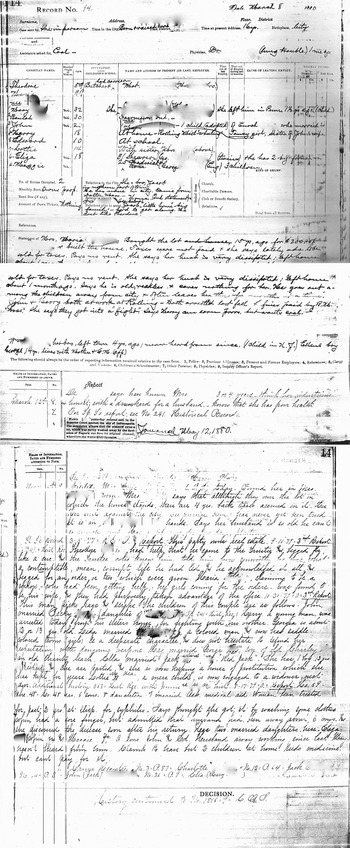
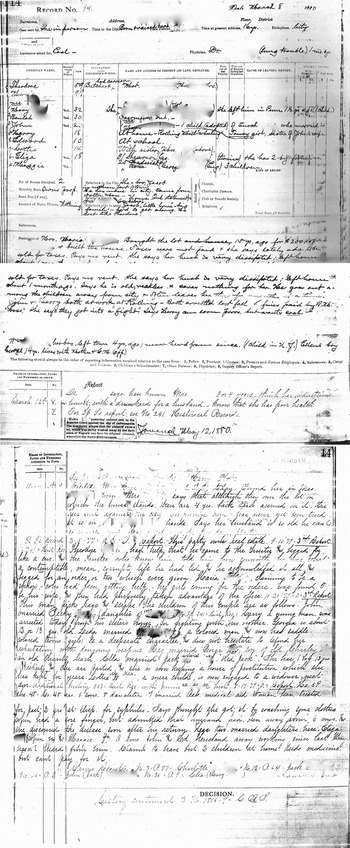
In their pursuit of evidence of the causes of poverty, friendly visitors and investigators quizzed a relief applicant's neighbors, extended family, employers, church leaders, and their children's teachers. In Indianapolis they examined the records of the Center Township trustee, the official responsible for determining need and providing public relief, and they worked to share records with other private charities. Visitors showed up unannounced to investigate the applicant's home, looking for any sign that might be used to disqualify an applicant as unworthy of relief or unable to benefit from it. In the gridded standardization of ledger entries they documented the struggles of the poor. These application forms included entry blanks for the applicant's name, present and former addresses, time spent in the city, and assistance requested. Other requested information was the family members’ names, ages, and schools; relatives in the city who might offer support; occupations and addresses of employers; weekly income; character references; and all other present sources of relief. Several blank lines followed for recording the statement of the applicant or an intercessor, followed by a longer section where investigators entered reports from the police, employers, clergy, schoolmasters, physicians, other relief agencies, and the date of the report. In some cases a file opened in 1880 might contain records transcribed from applications made to the Center Township trustee in the 1870s, then further updates in the report section spanning the 1880s. Finally the form gave space for the relief decision. In principle, the COS did not itself administer relief but instead acted as a gatekeeper to other charitable agencies, advising them of whether relief should be given.Footnote 9 In two pages of ledger, the COS could conceivably record the entire employment and residential history of a family, the opinions and interactions of the family's neighbors, friends, co-workers, and employers, as well as the family's history of encounters with the criminal and charitable institutions of the city. These intrusions drew justification from the vision widely held among reformers of the Gilded Age that charitable gifts and their intended recipients must be disciplined—scrutinized scientifically—as the word was then understood. Only through such strict measures, they contended, could they thwart the menace of pauperism, or willful dependence on charity. Given the presumption that the applicant might be a con or have habits that brought about his poverty, oftentimes the only possible source of evidence that scientific charity investigators failed to consider was that offered by the poor, themselves.
COS Casebook entry for Thomas O., begun March 8, 1880.Footnote 10 Courtesy of the Indiana Historical Society.
The encounters of Mary D. and so many others first with the township trustee and then the COS expose the dissent and bewilderment among the poor toward scientific charity and its adherents’ zeal for investigation, categorization, and discipline. Historian Michael Katz has observed that an emphasis on how charity organization societies acted as a “force of authority in the lives of the very poor” must be balanced with recognition of poor persons’ activities as they sought to respond to the new rules of charity.Footnote 11 Less has been written about how the applicants who showed up at charity organization societies negotiated the new movement's efforts to transform the landscape of poor relief and the poor themselves. Instead, the scientific charity movement has been examined for its significance in the institutionalization of social scientific research; the formation of the modern social work; shifts in Americans’ ideology and discourse concerning dependence; and the rise of the public health, social gospel, eugenics movements, and progressivism, to name just a few.Footnote 12
The responses of the poor to the investigative methods of the scientific charity movement as enacted by the Indianapolis COS reveal a set of strategies ranging from accommodation to outright defiance. Through their complaints, objections, and resistance to the new methods, the poor brought to light and challenged core assumptions of the movement, like the trite optimism professed by scientific charity's theoreticians that objective investigation could quickly sort applicants into distinct categories of the worthy poor and unworthy paupers and that their work would rebuild interclass harmony amid the strike-riddled 1870s and 1880s. In the ways they represented the causes of their misfortune, histories, living conditions, and needs, as well as their personal characters and gratitude, the poor further learned to adapt to the new rules of charitable relief, sometimes seemingly knowing the new standards better than the investigators did. The COS volunteers’ response to the poor furthermore highlights their diverse and often ambiguous interpretations of the movement's supposedly cardinal principles, reinforcing recent historical work presenting the movement as a significantly more flexible one in practice and at least slightly more appreciative of the complex interplay of causes that create dependence than its programmatic statements suggest.Footnote 13
Mary D. and the Fear of Institutionalization
The case record that the COS entered for Mary D. illustrates the suspicion, even hostility, that many charity reform groups in America felt toward relief applicants, but also the efforts of those applicants to retain some modest amount of control over their destinies in the most difficult of circumstances. Mary's husband had abandoned her without further communication for twelve or perhaps fifteen years when he suddenly returned and, discovering she had remarried, cut her out of his pension. Mary's second husband died a short time after this, necessitating that from 1873 onward the Marion County and Center Township of Indianapolis relief agencies support her through the winters with fuel and an occasional payment of her rent. Those sources of relief however often proved unreliable, reducing her to begging. When Mrs. K., a shopkeeper, complained to the township trustee that she “cannot ‘shake’ her” from begging around her store, this prompted one of the trustee's agents to pay Mary a visit in November 1878. Advised that she would have to go to the poor house, Mary threatened to drown herself first.
The COS first sent its own visitor in April 1880 to inspect her circumstances, with the trip yielding a similar conclusion: Mary D. ought not receive charitable relief but should go instead to a public institution like the county asylum or the home for the aged. A visitor sent to follow up on Mary's letter to the mayor in 1881 noted that the rent was too expensive and that Mary D. reportedly had moved to this dwelling “because [she] got into trouble with the janitor” at her previous residence. The visitor was unimpressed by what she saw. The small room was “completely filled by old bedding, trunks, stove, wood,” and Mary herself “was barefooted and moving things about without any particular object that could be discovered.” Intent on identifying any hint of fraud, the visitor noticed that although Mary claimed to have gone three days without food, she “saw some new biscuit and cold victuals in a trunk, evidently given her,” a sin of omission that Mary D. then acknowledged. Again she swore that she “won't go to the P. H. and even if it is made decent to live in, will commit suicide first.” While she proposed that the COS help her find a room somewhere “on a floor where there is water,” the agency decided that unless Mary D. had a change of mind about going to an institution, she did not need further aid.Footnote 14
Mary D.'s refusal to move to the poor house, at the time a sign of her purported insanity or perhaps, as the COS described several other opinionated applicants, “impudence,” might instead have been proof of her lucidity. A few weeks after penning her letter, in July 1881, the former governor of Indiana, Thomas Hendricks, argued a case before a board of commissioners that the Marion County Poorhouse had been mismanaged, resulting in the abuse and neglect of inmates. The governor alleged that the farmer who supervised the poorhouse, Peter Wright, had used a cowhide to beat an inmate, Harry White, because White “had used careless language and was full of fun.” Hendricks further claimed that the professionally inexperienced resident physician, a Dr. Culbertson, who already had on his record an unrelated conviction for assault and battery, ignored the needs of the insane residents.Footnote 15 A former inmate, Ed Atkins, testified that “he had been given the diabetes from drinking a peculiar kind of tea” given to him by Culbertson, who then with Wright's approval refused to provide to Atkins the necessary medicine. Several inmates reported suffering from substandard food and blankets and other injustices and deprivations. Samuel Churchwell testified that his young child had been separated from its mother, left underclothed during winter, and thereby had caught a cold and died. Not all abuse came directly from the hands of the supervisors; an inmate described as an “insane idiot,” Oliver Thomas, whipped Harry White between two to six times in reaction to White screaming after a dog had frightened him.Footnote 16
Charity reformers, many of whom were drawn to the movement by their own revulsion at the care offered at state charitable and correctional institutions, understood this fear and used it to their advantage when dealing with relief applicants who did not show them sufficient deference. An African American couple, Ezra and Milly M., had a reputation for “complaining.” The COS record books included the Center Township trustee's report that Milly “is the woman that does so much talking at the office” and that “if they grumble at … [receiving only] fuel, send them to the Poor House.”Footnote 17 From this and their own visits, the COS concluded the family did not merit relief. Sarah H. similarly resisted sending her eighteen-year-old son, Fred, to any public institution. When a COS visitor arrived at her house, she explained that Fred had “lost his mind” during a spell of “brain fever” at the age of ten. The visitor found him “simple” and “utterly unfit to do anything. The proper place for him would be either the Insane Asylum or County Asylum.” Sarah, however, refused to consent to his institutionalization. The township trustee had noted this reluctance years earlier and complained that a woman long dependent on charity ought to let the county dictate the terms of that relief, including sending Fred to the poorhouse. To Sarah, however, the trustee was a “hard-hearted bugger.” When the COS finally took up the case, it collected testimony from several sources affirming she was an “industrious, honest, hard-working woman” and decided to offer relief during Fred's present bout of illness so that she could pay the rent, but they too affirmed that afterwards the boy must go to the County Asylum. The source of contention became a moot point when the updated entry a week later noted that Fred had died.Footnote 18 That Sarah H. and Mary D. chose to defy the COS by refusing to submit to institutionalization suggests that the poor were well aware of what awaited them in the poor houses and asylums and might risk starvation at home over neglect and atrophy in an institution.
Mary's case—and perhaps Sarah's as well—represent the face of scientific charity most commonly seen by historians: a movement neither especially scientific nor charitable, driven to end public relief and curtail private aid with little scientific justification beyond a crude social Darwinism and a highly moralized view of poverty as an event due to single causes, which could be categorized either as misfortune or misdeeds.Footnote 19 In their first years of implementing charity reform, many of the charity organization societies worked hard to earn the scorn heaped on them by the poor and more traditional charities that saw their work as mean-spirited and insufficient. The Indianapolis COS's response to John and Anna B.'s request for help demonstrates as much. John B.'s work as a packer for a tobacconist had damaged his lungs, and he had been injured the prior autumn when a log rolled over him. He then had a sunstroke and went insane. At the time of application to the COS, he and Anna B. had pneumonia, and a daughter was dying of consumption. John B. died a few weeks later, leaving his wife dependent on the income of her ten-year-old son who worked for a cooper for one dollar a week. She also received 60 cents per dozen overalls that she and the youngest daughters sewed. Other than having the Flower Mission attend to the ill, the COS concluded no relief was needed.Footnote 20
Just Enough Filth
Scientific charity leaders’ fervor for suppressing charitable fraud drew from their belief that paupers were a group economically, morally, and biologically distinct from the normal poor. Using the language of heredity and degeneration, they perceived paupers as biologically different from and inferior to the rest of the population, incapable of improvement. Through the combined forces of heredity and environment, paupers had sunk so far into a state of willful dependence that they could no longer live otherwise. Their supposed licentious ways and aggressive pursuit of alms by any fabrication allegedly consumed the majority of charitable relief given and threatened to drown the nation in an ever-rising tide of chronic beggars. The founder of the Indianapolis COS, Reverend Oscar McCulloch, became a national star of the movement by arguing that his genealogical research into a family that for generations appeared on the relief rolls demonstrated that pauperism was an inheritable trait.Footnote 21 Such genealogical studies affirmed the scientific charity leaders’ faith that dependence could be studied objectively and thereby relieved more efficiently.
McCulloch contended that unsanitary surroundings often marked the onset of pauperism. Scientists had proven, he explained, “that when the rabbit warren was not properly cleaned, the female killed her young and the male became quarrelsome. The organism of the animal was injured and rendered miserable by dirt, and nervous irritability akin to insanity was the result.” Likewise, the “sufferings and crimes” of the pauper might be caused by filthy physical conditions.Footnote 22 The Indianapolis COS's surveys of the poor documented in its 1880 record book further indicate how investigators used dirt and untidiness as a source of evidence pointing toward incurable, biologically based pauperism. An article by the Indianapolis Herald placed in the COS file on Andrew G. warned readers of his children, who allegedly supported the house by begging. Andrew G. was “a victim of hereditary pauperism and bad whisky. He is a good workman spoiled by public indulgence.” His family was “dirty, slothful, and vicious.”Footnote 23
A relief applicant had to thread a narrow needle when the visitor came to inspect her home. If a home looked too well kept, it might be a sign that the applicant did not truly need help. A COS visitor suspected one woman of dishonesty because she was “very toney, dresses well.”Footnote 24 More commonly, however, the homes of the poor struck the visitor as too dirty and decrepit, signifying a lack of “industry” and desire to help one's self. In their reports visitors often sounded obsessed with dirt, treating it as evidence of an applicant's unworthy character. Eliza H., a widowed woman with two children at home sick with whooping cough, lived in rooms that a visitor judged “nearly empty and everything in a very disordered condition. Table knives lying around loose on the bedroom carpet and dirt and filth everywhere. Two beds a stove and a few chairs seemed to constitute the bulk of the furniture. [She] was as slovenly looking as usual and in addition looked sickly.”Footnote 25 A visitor in another case judged Marinda D.'s residence to have “a general look of don't care-a-tive-ness.”Footnote 26 Mary G. was a “lazy careless creature not capable of self-government or support.”Footnote 27 Even when a visitor judged the living conditions of the poor to be a consequence of their poverty, not a sign of pauperism, it did not relieve the poor of their shame. One of the township trustee's investigators bluntly—if perhaps correctly—remarked that the best that could be done for Frank C. would be if someone burned down “that old shell he lives in” and forced him to move to a healthy environment.Footnote 28
Ann L.'s response to her investigators demonstrates the difficulty in presenting a home that was neither hopelessly filthy nor suspiciously tidy. In the spring of 1880, Ann's grandson arrived at the COS office with a letter from Ann L. In it, she referred to the Indianapolis Benevolent Society, the primary charitable relief society that took guidance from COS investigations; she admitted that she “cannot help think it strange that societies claiming ‘Benevolent’ does as they do in this city.” In response to an earlier request for aid, another charity associated with the COS, the Flower Mission, had sent “two young lady callers” who promised to help find some work sewing and bring some flowers, one of the signature small gifts the Mission gave the city's sick. They never returned. Ann L. complained:
We could starve to death waiting on them and I have been sick 10 mos. and never rec'd a flower from them… . I nursed 2 rich sick ladies that had more flowers than was any use, sent by the Mission ladies. We would be glad to get work when able to work; in our case it is work we want but Mrs. Hicks calls us paupers. If that is right I do not know what is wrong. Those who need do not get but those who have abundance get plenty.Footnote 29
Ann L.'s letter is unusual both in its existence—poor persons’ documentations of their encounters with charity organization societies can not help but be dwarfed in comparison to the documentation generated by a group dedicated among other things to better record keeping—and in its stridency. Ann affirmed her willingness to work and explained the circumstance by which at sixty-one she could not sufficiently provide for her “feeble” daughter and grandson. Challenging the intentions or wisdom of the COS, however, brought the risk of being labeled “impudent,” a charge of ingratitude that suggested one did not appreciate the obligation to prefer work over relief and to accept any relief with humility and a tinge of embarrassment. The first charity organization society in London, England, and the many incarnations of scientific charity and charity organization in America all emphasized visiting and investigating as a way of reestablishing social bonds between the middle classes and the poor. These bonds were to fasten the poor to their stations in life, extinguishing any prospects for radicalism as they learned instead to humbly accept manual labor for whatever wages they could receive and to adopt middle-class standards and behavior as best they could. “Industrious” and “sober” were the adjectives most commonly assigned to the worthy poor, and often visits to the poor amounted to purportedly objective measurements of their industriousness, sobriety, and modesty.
Those who called on Ann L. found a woman of industry and sobriety, but also of sharp opinions. She washed, sewed, and nursed when she could and had temporarily moved to the country to seek out a living. Now she was “too old to do much.” She told the last agent of the Center Township trustee to visit before the COS took up the case that nursing no longer paid better than any other work available to a woman as a glut of poor job seekers flooded the market. The visitors were unimpressed with this or with her reported explanation “that old age is creeping on, and she is not able to do regular housework.” The COS's record on Ann L. includes the observation from the trustee's office that “rumor has it that Mrs. L. … is meddlesome and talkative in families,” which “is the cause of her failure,” and that she was “dictatorial and talkative outside, which is against her.”Footnote 30
In addition to the talkative personality that allegedly made her an unpopular choice for housework, Ann L. tried too hard to impress. An October 1880 visit from the COS found “Mrs. L. … dressed up in a nice new calico wrapper and looking the ‘good grandmother’ to perfection. Mrs. C. … [her daughter] occupying a rocking chair and looking well and happy, notwithstanding her statements about severe suffering after cleaning house—her favorite occupation.” Noting the daughter's claim to do some washing for extra money, in spite of it being “too hard” for her, the visitor parenthetically added in her notes, “A tub was in sight, evidently so placed for dramatic effect.”Footnote 31 Ann L. had succeeded too well in presenting exactly the image COS investigators wanted to see: clean, responsible persons willing to work hard and adopt middle-class values. This, combined with her meddlesome, talkative, dictatorial habit of expressing her opinion on the state of charitable relief and the labor market, won for her an unsurprising decision of “no aid” from the COS. The charity reformers’ interests in restoring interclass bonds left all responsibility on the poor to change their tune.
Although most COS investigators did not share the leadership's scientific interests or concern for the supposed biological origin of pauperism, occasionally they too would present dirtiness as symptomatic of an underlying biological condition that gave rise to pauperism. In Anna R.'s case, she visited one of the COS's district offices in March 1880 to explain how her husband had died thirteen years earlier working on the railroad. She added that she did not “think this a good city for the poor. They don't look after the poor enough.” The record of her encounters with the township trustee and then with the COS suggests as much. The COS's investigation into her file with the trustee revealed that in December of 1876 her family was sleeping on a “pile of rags on the floor” and lacked “enough clothing to cover themselves.” Anna went barefoot in the snow. She had five children from the ages of eighteen to thirteen, one of whom at the time of her trip to the COS had typhoid fever, chills, and “lung disease.” Only two or three times had she asked for relief from the township trustee, and she “had always worked,” and her oldest daughter did so when possible. Further examination of the trustee's records revealed that she had been shipped to Indianapolis from Greencastle in 1874, where the local trustee had furnished her with a pass out of town.Footnote 32 The old practice of passing the poor from city to city was still commonplace in Gilded Age America. Indianapolis's solution for many hopelessly poor persons was to pay for a one-way ticket to the city of their nearest relatives and hope the destination point's township trustee did not send them right back.Footnote 33
These tragic circumstances might suggest an immediate need for charitable relief, and indeed the report concluded that Anna R.'s family was destitute. The responsibility, however, was in their own moral and biological failings. “This old Irish fraud depends on public charity for a living,” which “has made her chronic,” explained the trustee's initial report from 1876. She was a “professional liar and beggar.” No amount of help could make the R. family “live any other way than like hogs. They are stable bred and cannot rise above their breeding.” When the COS took up her case in March 1880, its review of the trustee's report resulted in an initial decision to deny the family any relief.Footnote 34
Deeper investigation into Anna's circumstances belied the claims of an easily identified distinction between worthy and unworthy cases of need. When a COS visitor first called on Anna R. at her home, two months later at the end of May, she noted that Anna's thirteen-year-old son Johnny worked when he could but had “typho-malarial fever,” while her oldest, Mary, similarly was too ill to work. She wrote, “This combination of circumstances has made it necessary for her to solicit aid from the benevolent to support her family and pay her rent and in my opinion, under these circumstances, with which I am reasonably well acquainted, I think she is deserving.” In the same entry where the visitor declares Anna R. deserving appears an addendum noting the contrary opinion of Father Bessonies, a member of the COS committee that ultimately determined who would receive relief and in what kind. He found one of the daughters to be a “bad girl” with “not much [that] could be said in her favor.”Footnote 35
Was Anna R. an undeserving hog, a pauper feeding from public and private troughs alike with ill-behaved children inheriting her manners as their birthright, or was she the deserving poor, afflicted by death and disease and old age? The vagaries in investigators’ evaluations of the poor confounded both the leadership of scientific charity and the poor who showed up at their door to request relief. The former earnestly thought that poor relief could and must be brought under proper scientific scrutiny and that by doing so they could easily sift out the paupers who had brought about their own troubles from the poor who suffered through no fault of their own. The poor, meanwhile, both struggled to present themselves as they imagined the investigators desired, and they resented and resisted the intrusions, moral condemnations, and outright coercion. The difference between relief and rejection often might depend on which visitor knocked at the door.
Complaining Versus Stoicism
Charity applicants also walked a narrow and winding path in explaining to investigators the severity and nature of their distress. Scientific charity's mission was predicated on the belief that the industrious, modest poor who were most proud of their self-sufficiency and most deserving of relief were also those least likely to complain or ask for relief. In contrast the duplicitous pauper told sensational tales of suffering in order to beg for relief that rightfully belonged to those who would never advertise their want. How could one in need of relief ever hope to gain it by asking, when just showing up at the COS office might be judged as a sign of being undeserving? Mary D. went to the office to ask for employment or groceries for herself and her eleven- and nine-year-old children. Trained as a nurse, she had left her abusive, reportedly insane husband in Hot Springs, Arkansas thirteen years earlier and headed for Indianapolis. Her children were in the orphan asylum due to her inability to support them, and another child had died in infancy from illness. Evaluating her merit, her former employers informed the COS that she was “competent but somewhat given to complaining of her hard life. Is learning to feel that she has a claim upon charity and to demand aid.” The visitor advised that “nothing more should be given except employment.”Footnote 36
Bringing suffering to the attention of others failed as often as not; for an applicant the key was to have a third party bring her case to the COS's attention and to couch the request in the most reluctant and humble of terms. Mary C. insisted she and her husband “never had a particle of help from any source. Never asked anyone… . Would work fingers off before would ask… . Never thought would have to go a begging.” The first words entered after the COS officer entered after taking her statement were “A worthy case.”Footnote 37 The entry for William L. and his wife Mary began with the statement of a friend asking relief on their behalf. The friend explained that William “has kept poverty to self. No use to explain poverty to everybody.” Further investigation by the COS turned up testimony from two of William L's acquaintances that he was “sober and industrious,” the two adjectives of choice for describing worthy cases.Footnote 38
The L. family almost undid the favorable testimony offered by their friends, ironically, by appearing too congenial and appreciative. A COS visitor, Miss Raridan, complained that they were “very profuse in demonstrations of gratitude for visits.” Such prostrations might be the sign of paupers thinking they had found a naive victim to manipulate; a second opinion would be needed to verify their worth. The following day, that second visitor reported that the L.s “did not show any of the gushiness which Miss Raridan reports on her visit, only expressed themselves as very grateful in the hearty English manner.” The second visitor's more sympathetic interpretation of the family's gratitude prevailed, as they won a recommendation for relief, even after a neighbor advised “don't give money. They both occasionally drink beer.”Footnote 39
The Gossip Mill
Given the assumption that many applicants were not poor but paupers, congenitally predisposed to lying about their circumstances in order to win relief, the COS dismissed virtually all testimony and explanation offered by relief applicants themselves. Instead the COS's relief committee listened to the supposedly more objective views of the friendly visitor and the evidence she accumulated from interviewing neighbors, schoolteachers, and employers concerning the applicant. Oftentimes this amounted in practice to rumor mongering, the COS ledger book filling up with gossip recorded as fact. Elizabeth N. came to the COS on March 10, 1880, with news that her husband, Richard, who had abandoned her on four different occasions, the present one spanning the last five years, wanted to return. There are no records to indicate what investigations or actions the COS took until December 2, 1889, when Richard N. and his new wife, Nancy, applied to the COS for an order of groceries. After commenting on Nancy's maiden name, and the name, medical history, financial history, employment status, and church affiliations of her first husband and children, the COS investigator explained that Richard had left Elizabeth for Nancy and lived with her before Elizabeth's death. Such facts were relevant to the COS's investigators as they might reveal well-to-do relatives who might already be supporting Richard and his family, making their request for relief unfounded.
From there the records turned to Richard's personal life, one reportedly full of sex and violence. Rumors told “about the lady patients of a certain Dr. who were taken to her [Nancy's] house … at night, and were taken away at night, after some days or some weeks.” A talk with Harry L., a former son-in-law of Richard who was now divorced from the daughter, revealed that although he “don't like to talk about the family,” he offered that “N … is a brute” and claimed that “the former wife was found dead, on the floor, with ugly bruises on her person and a chair lying on her head.” Although Harry “does not directly accuse N … , he leaves the impression that he was responsible.” The divorced son-in-law further claimed that “a 14 yr. old daughter died, some yrs. ago, from the effects of an abortion procured [sic] on her at her father's instance [sic].” Nancy's son from the former marriage was either in reform school or prison due to larceny. Concluding, Harry insisted that Richard “is a brute and a scoundrel and his present wife is as bad as he. You need not fear to insist on that as you can prove it by the relatives of the family all of whom know the ugly facts.” Such hearsay suggests that Richard N. likely had done nothing but bring suffering upon himself and anyone nearby, exactly the sort of man that COS investigators understandably sought to dislodge from the city's charitable institutions. However, in addition to not leaving any record of a relief decision, the entry on Richard N. also leaves no indication that anyone checked in with Richard to learn his view of the ugly facts.Footnote 40
To avoid becoming grist in the gossip mill, an applicant might confess her sins to the COS and claim to be reformed. Cynthia R. appeared at the office on March 18, 1880 to ask for help with the rent and explained that she “has been bad, but is now living a good life and intends to.” She admitted to having taken coal each midnight from a railroad watchman who surreptitiously threw it from the passing train, and she agreed to move out of her present neighborhood. Visits from a Mrs. Roberts on behalf of the COS, however, indicated that Cynthia “has the same bold, pseudo-frank manner, persisting that she is doing ‘right’ now.” Talks with her neighbors further revealed that they “all unite in giving her a bad name, that she is the special terror and disgrace of that street” and that “she is on very familiar terms with the railroad men.” That perhaps explains Cynthia's initial admission of receiving coal at midnight from the watchman. Later entries include a newspaper clipping of her involvement in a “bastardy suit” over her second child, and later still an entry reporting she had married, but her husband did not live with her because “his parents won't let him.” In spite of her claims of reform and penitence, the opinions of her neighbors resulted in a denial of relief.Footnote 41
Cynthia R. had good reason to expect that her chosen strategy of admitting her failings and asking for penitence would win her relief; it had worked before. Another applicant to the COS for relief that March, Theodore O., had gone to the Center Township trustee the year before where he “begged for like a cur, and the trustee who knew him told [Theodore] how unworthy he was, what a contemptible, mean, corrupt life he had led, and he acknowledge[d] it all.” The trustee then ordered relief for Theodore.Footnote 42 What accounts for the different results from the same strategy? Especially for women, a reputation for sexual adventures meant a ticket into the “undeserving” category with even more consistency than a man's reputation for drunkenness. Theodore O. for instance was “a drunkard for a husband” even by his own wife's report. This also may have indirectly worked in the O. family's favor; although Theodore was worthless, his wife Maria could be seen as a quiet and worthy sufferer at her husband's side. That it was the township trustee who ordered relief for the family and not the COS certainly also might be a factor. However, for all of the criticism scientific charity reformers leveled at supposedly spendthrift public officials, in Indianapolis the trustee's records often show even greater suspicion and hostility toward the poor than those of the COS. Economic historian Stephen Ziliak has observed that the COS and the trustee at the time, Smith King, generally worked quite well together.Footnote 43
African American Encounters with the COS
The complicated dynamics between charity investigator and applicant that often resulted in idiosyncratic and arbitrary decisions were compounded when the all-white COS volunteers investigated requests from Indianapolis's African American citizens. Scientific charity's leading theorists insisted that their charitable work must encompass all of the poor, not discriminating on the basis of race or creed. An unusual position in 1880s America, this must be understood in reference to the lurking pauper menace. The dividing line between the worthy poor and unworthy pauper concerned scientific charity organizations far more than did racial or religious lines. Poor whites did not hold monopolies on either the trait of industry or of idleness. Similarly, persons of any race of creed might pass on the hereditary taint of pauperism. To ensure that charity was not stolen from the industrious by the idle and to combat the rising tide of biological paupers, all must be investigated; a few movement leaders even added the progressive suggestion that racism might be a cause of much poverty. Stephen Humphreys Gurteen, who advised Oscar McCulloch in the founding of the Indianapolis COS and authored foundational manifestos on the principles of scientific charity, argued that “if there has been in the past one thing more than another that has led to pauperism and all its attendant evils it is the existence of denominational exclusiveness and racial prejudice.”Footnote 44 McCulloch similarly showed compassion toward poor European immigrants in his controversial 1886 sermons defending the Haymarket anarchists.Footnote 45 His private diary entries similarly express concern that the injustices inflicted on African Americans would only end through a violent claiming of rights.Footnote 46
Unsurprisingly, person-to-person interactions in Indianapolis did not always meet this ideal. Nancy H.'s request for groceries included the positive recommendation of her doctor, who thought her “a sober and industrious woman” who was too poor to help her sick son. An inspection of the trustee's records of previous relief, however, indicated that the white man she had brought to “add force to her statements” was in fact “blacker in character than she is in color.” Her oldest boy was a “hoodlum too lazy to work” and the family “a bad crew.”Footnote 47 The COS file does not record any decision either for or against Nancy H. The brief record of Charles and Milbry B.'s application includes the trustee's earlier evaluation that Charles “appears an industrious darky,” but even the typically relief-winning term “industrious” did not motivate the COS to follow up or to record the verdict of its final decision regarding relief.Footnote 48
In one of the rare instances in which a COS publication presented data that broke applications down along racial lines, an 1898 report indicated that only 34 percent of African American cases were “old” or returning applicants, whereas 44 percent of white cases were. This suggests that fewer African Americans felt encouraged by their experience to return to the COS for help. An 1886 report from the trustee further supports this hypothesis. It stated that “negroes” accounted for 60 percent of applicants for public relief, followed by the Irish at 20 percent, “Americans” (that is, native-born whites) at 15 percent, and Germans at 5 percent.Footnote 49 Similarly, a tabulation of the number of follow-up visits conducted by COS visitors in the 1880 record book reveals that the society revisited twenty of thirty-seven African American applications, 54 percent, compared to 104 of 160 Caucasian applications, 65 percent. Entries in African American cases also appear more commonly to be truncated, with perfunctory statements of decision like “no relief” or “no more aid.” John F.'s case indicates only that he was “Col'd” and had lived in the city for three months with his wife Hester and their four children. From the COS, he received the decision: “No more aid needed.”Footnote 50 Through some combination of choice, alternatives sources of relief, and white indifference and racism, African Americans tended to go elsewhere than the COS for help.
That tendency had notable exceptions, underscoring just how unsettled early notions of worthiness and “objective” evidence were in the Indianapolis COS. Hattie L., an African American woman with three children whose husband had deserted her, asked the COS for aid, having been in Indianapolis only three months. Her recent arrival ought to have been cause for suspicion, and her race certainly did not help her with the COS. Yet just eight days after visiting the COS office to request aid, the organization through which the COS dispensed relief, the Indianapolis Benevolent Society, paid Hattie L.'s rent of $2.Footnote 51 For an organization philosophically opposed to casually handing over any sort of “material aid” but especially financial assistance, this fit of generosity is unusual. More confounding are the COS's futile efforts to recoup the $30 they lent Swedish immigrant Oolof Y. to buy a horse and wagon in order that he may resume “huckstering.”Footnote 52 Hattie L. had in her favor her status as an abandoned wife who immediately declared her willingness to work. Oolof's case does not suggest any such justification; the COS normally scoffed at promises such as he made of paying back the loan once he had regained his financial footing.
Accommodation and Defiance to Investigation
Such willingness to provide financial relief defies every official pronouncement of anyone closely associated with the scientific charity movement's first fifteen years. Several historians have criticized scientific charity reformers for holding principles that were perhaps both logically inconsistent and certainly inconsistently applied, and the calculus by which Hattie L. or Oolof Y. were judged worthy must have seemed ineffable to Mary D. and Anna B. as they were informed of their unworthiness. But instead of emphasizing the charity reformers’ record of success or failure in applying their principles of objective, standardized investigation onto the poor, the work of the Indianapolis COS might alternately suggest the unanticipated difficulty in rationalizing and standardizing a process as complex and individualized as the negotiations between strangers over requests for charitable relief.
Faced with few appealing choices, many of the applicants to the COS tried to accommodate the investigators by showing deference to their views of worthiness, as best as those views could be deciphered. Applicants at once professed their dire and tragic circumstances while wearing their best clothing and trying to act as gracious hosts to unannounced visitors. The applicants insisted they did not expect sympathy and did not prefer charity while trying to justify their deservingness for each. Like job hunters they lined up references from respected community leaders, especially physicians and employers, or barring that, at least neighbors, and they actively managed their reputations, trying to diminish, deflect, or deny the most damaging reports of their behavior. Some agreed to accept institutionalization for sick relatives or work arrangements suggested by the COS, no matter how menial. Others changed or ended their drinking habits, moved residences, or called on relatives whom they might have preferred avoiding in order to seek help. In countless ways the poor worked to modulate their appearances and habits in ways that they thought might win the approbation of the COS.
But both as objects for moral reformation and of scientific inquiry, applicants for charity also proved more elusive than scientific charity reformers anticipated. Besides extreme gestures like Mary D.'s threats of suicide, resistance took more subtle forms. Some refused to invite visitors in to inspect their homes or dropped their requests when they thought the lines of questioning became too intrusive. Children begging in the streets learned to lie to visitors who inquired why they were not in school, or they simply ran away. Knowledge of the exact percentage of applicants who were in fact trying to live the life of a pauper, scamming charities for relief, also remained just out of reach: The COS unsurprisingly could not readily coordinate charitable relief across the city or unearth an applicant's lies so as to extinguish pauperism. Hopes of restoring a bygone era of supposed interclass harmony similarly died on the vine. The Indianapolis COS predicated its work on the assumption that the worthy poor needed and wanted to learn the ways of middle-class probity. On the contrary, I have not found a single testimonial from an applicant thanking COS visitors for their moral guidance. Scientific charity reformers looked at the poor as a scientific problem to be studied, managed, and controlled. The poor had no choice but to endure the policy successes of scientific charity as its advocates tightened public and private relief allowances in cities across America. In spite of the COS's efforts, the conditions giving rise to poverty and dependence remained far more ambiguous, their amenability to easy categorization far more restricted, than the proponents of scientific charity cared to admit.