Introduction
Engytatus varians (Distant) (Hemiptera: Miridae) is a zoophytophagous species that feeds both on plants and on insects living on them (Martínez et al., Reference Martínez, Baena, Figueroa, Del Estal, Medina, Guzmán-Lara and Pineda2014). This natural enemy, originally described in Guatemala (Hernández and Henry, Reference Hernández and Henry2010; Ferreira and Henry, Reference Ferreira and Henry2011), seems to be already spread from Southern USA to Argentina (Illingworth, Reference Illingworth1937; Ferreira et al., Reference Ferreira, Da Silva and Coelho2001) and the Caribbean (Castineiras, Reference Castineiras1995; Hernández and Henry, Reference Hernández and Henry2010). Although there is no available data on the abundance or percentage of natural predation, it has been reported that this predator can feed on different development stages of several phytophagous insects including eggs and larvae of Manduca sexta (L.) (Lepidoptera: Sphingidae) (Madden and Chamberlin, Reference Madden and Chamberlin1945) and Heliothis virescens F. (Lepidoptera: Noctuidae) (Ayala et al., Reference Ayala, Grillo and Vera1982) on tobacco (Nicotiana tabacum L.) and on nymphs of Bemisia tabaci (Gennadius) (Hemiptera: Aleyrodidae) on horticultural crops (Castineiras, Reference Castineiras1995; Wheeler, Reference Wheeler2001).
In Brazil and Mexico, E. varians was detected for the first time in 2013 and 2014 feeding on eggs and larvae of Tuta absoluta (Meyrick) (Lepidoptera: Gelechiidae) on tobacco (Bueno et al., Reference Bueno, Van Lenteren, Lins, Calixto, Montes, Silva, Santiago and Pérez2013) and nymphs of Bactericera cockerelli (Sulcer) (Hemiptera: Triozidae) on tomato (Solanum lycopersicum L.) (Martínez et al., Reference Martínez, Baena, Figueroa, Del Estal, Medina, Guzmán-Lara and Pineda2014), respectively. In both countries, several initiatives have focused on ascertaining the potential of this predator as a biological control agent in order to be included in control programs targeting some of the key pests of crops. In the laboratory, E. varians females can consume, per day, 57 eggs and 40 and 34 second- and third-instar, respectively, of B. cockerelli (Pineda et al., Reference Pineda, Hernández-Quintero, Velázquez-Rodríguez, Viñuela, Figueroa, Morales and Martínez2020). Thus, this mirid kills on average 13, 20, and 92 eggs/day of Spodoptera frugiperda (J. E. Smith), Spodoptera exigua (Hübner) (both Lepidoptera: Noctuidae) (Pineda et al., Reference Pineda, Hernández-Quintero, Velázquez-Rodríguez, Viñuela, Figueroa, Morales and Martínez2020), and T. absoluta (Bueno et al., Reference Bueno, Van Lenteren, Lins, Calixto, Montes, Silva, Santiago and Pérez2013), respectively. The last authors have also reported that E. varians was capable of preying on larvae of T. absoluta within leaf mines (Bueno et al., Reference Bueno, Van Lenteren, Lins, Calixto, Montes, Silva, Santiago and Pérez2013). This mirid shows a type III functional response (over a certain range of increasing prey densities, an increasing percentage of prey is killed) to eggs of T. absoluta (van Lenteren et al., Reference van Lenteren, Hemerik, Lins and Bueno2016) and type II (with increasing prey densities, a decreasing percentage of prey is consumed) to nymphs of B. cockerelli (Cortés-Piñón, Reference Cortés-Piñón2017).
In tomato and pepper greenhouses, E. varians can suppress up to 90% of both nymphal and adult populations of B. cockerelli, Trialeurodes vaporariorum (Westwood) (Hemiptera: Aleyrodidae), and Myzus persicae (Sulzer) (Hemiptera: Aphididae) when released at a rate of 1–4 females/plant in spring (Pérez-Aguilar et al., Reference Pérez-Aguilar, Martínez, Viñuela, Figueroa, Gómez-Ramos, Morales, Tapia and Pineda2019; S. Pineda, Unpublished data). Apart from predation features, other aspects of E. varians biology have been elucidated in the past few years: life cycle (Pineda et al., Reference Pineda, Medina, Figueroa, Henry, Mena-Mociño, Chavarrieta, Gómez-Ramos, Valdez, Lobit and Martínez2016), demographic parameters under artificial or natural supplemented diets (Silva et al., Reference Silva, Bueno, Montes and van Lenteren2016; Palma-Castillo et al., Reference Palma-Castillo, Mena-Mociño, Martínez, Pineda, Gómez-Ramos, Chavarrieta and Figueroa2019) and susceptibility to some insecticides (Pérez-Aguilar et al., Reference Pérez-Aguilar, Araújo, Clepf, Martínez, Pineda and Carvalho2018).
To design a biological control program with a natural enemy, it is essential to have an efficient and economic mass-rearing system to make its commercial production possible (Fitz-Earle and Barclay, Reference Fitz-Earle and Barclay1989) but sometimes the mass-rearing produce detrimental sex ratio changes (van Dijken et al., Reference van Dijken, van Stratum and van Alphen1993). The influence of E. varians sex ratio on its reproduction success and offspring is largely unexplored and to gain knowledge on this aspect is very important for understanding the population growth of sexually reproducing organisms (Foster and Soluk, Reference Foster and Soluk2006; Wei, Reference Wei2008). In general, in insect populations, the adult sex ratio does not deviate from a 1:1 (male:female) because of the segregation of the sex chromosomes in the gametogenesis process (Sheldon and West, Reference Sheldon, West and Pagel2002; Hoy, Reference Hoy and Capinera2004). Consequently, they can mate randomly and with an equal resource investment (Hardy, Reference Hardy1994), despite fluctuating response to factors such as mate attractiveness, parental age and condition, and parental investment in offspring (West and Sheldon, Reference West and Sheldon2002). Nevertheless, when the sex ratio is biased toward one sex, the life history traits of the species can be affected and the effect depends on the reproductive physiology and behavior, as reported in some herbivorous insects (Jones et al., Reference Jones, Perkins and Sparks1979; Gou et al., Reference Gou, Wang, Quandahor, Liu and Liu2019). For example, when comparing 11 sex ratios (male: female) of Heliothis zea (Boddie) (Lepidoptera: Noctuidae), a higher number of males increases the rate of egg production and mate but decreases female longevity, being optimal the sex ratio 4:6 for assuring sufficient males for mating and a maximum egg hatch (Jones et al., Reference Jones, Perkins and Sparks1979). Similarly, when seven different sex ratios of Assara inouei Yamanaka (Lepidoptera: Pyralidae) were evaluated, the fertility was significantly higher at the sex ratio of 3:1 (male:female) (He et al., Reference He, Shen, Yin, Yuan and Tian2017). Besides, adult sex ratio can affect mate choice and mate competition in crickets (Wehi et al., Reference Wehi, Nakagawa, Trewick and Mongan-Richards2011). Unfortunately, there is scarce information on the influence of sex ratio in natural enemies.
As E. varians is a promising candidate for IPM programs targeting different key pests of crops (Martínez et al., Reference Martínez, Baena, Figueroa, Del Estal, Medina, Guzmán-Lara and Pineda2014; Morales et al., Reference Morales, Martínez, Viñuela, Chavarrieta, Figueroa, Schneider, Tamayo and Pineda2018), in this study, our aim was to ascertain the influence of E. varians sex ratio on several life parameters in order to optimize the mass rearing. Adult fertility and longevity as well as the duration of the nymphal instars and offspring sex ratio were studied. Besides, the prey preference of E. varians nymphs and adults for the different nymphal stages of B. cockerelli was also evaluated in order to allow planning an adequate timing when the natural enemy is released in the crops. The pest is a polyphagous phloem feeder that can successfully reproduce in many plants including tomato and potato (Solanum tuberosum L.) where it can transmit the zebra chip disease caused by the bacterium ‘Candidatus Liberibacter psyllaurous’ (Hansen et al., Reference Hansen, Trumble, Stouthamer and Paine2008; Liefting et al., Reference Liefting, Southerland, Ward, Paice, Weir and Clover2009).
Materials and methods
Unless different conditions are specifically detailed below, the mass rearing and experiments were conducted under the following laboratory conditions: ~25 °C, 56% relative humidity, and a photoperiod of ~12:12 h (Light:Dark).
Rearing of B. cockerelli and E. varians
The B. cockerelli and E. varians individuals used in this study were obtained from colonies maintained in the Entomology Laboratory of the Instituto de Investigaciones Agropecuarias y Forestales (IIAF) de la Universidad Michoacana de San Nicolás de Hidalgo (UMSNH), Tarímbaro, Michoacán. The B. cockerelli nymphs and adults were kept in a frame box (80 × 80 × 50 cm) entirely covered by a mesh screen, which contained tomato plants (of the Rio Grande variety) (~30 cm in height with 7–8 fully expanded leaves), which were replaced as necessary. The B. cockerelli rearing was maintained in a ventilated greenhouse at 16–30 °C with 60% relative humidity and a photoperiod of ~14:10 h (L:D).
The E. varians individuals were reared on tomato plants in a frame box (45 × 65 × 45 cm) covered by a mesh screen. Every 3 days, plants from the B. cockerelli rearing cages infested with third, fourth, and fifth B. cockerelli instars were used to sustain the predator colony. Eggs of the grain moth, Sitotroga cerealella (Olivier) (Lepidoptera: Gelechiidae) (Bio-bich, Uruapan, Michoacán, Mexico), deposited on tomato leaves were also supplied to the adults and nymphs of E. varians. The tomato plants were used as an oviposition substrate and a water source for the adults and nymphs of this predator.
Biological parameters of E. varians
To determine whether the sex ratio affects the fertility and longevity of the E. varians females as well as the development time and the sex ratio of their offspring, the following three sex ratios (i.e., treatments) were evaluated: (i) 1:1, (ii) 1:2, and (iii) 1:3 (female:male). Prior to the test, freshly emerged unmated females and males (parental generation, F 0) were individualized for 5 days in Petri dishes (9 cm diameter × 1.5 cm height) containing a tomato leaflet infested with a mixture of 15 second and third instar (N2–N3) B. cockerelli. As complimentary food, 10 mg of S. cerealella eggs were dispersed on the tomato leaflet.
For the test, tomato plants (~10–15 cm tall with four fully expanded leaves) were individually transplanted into Dart (Dart de México, Atlacomulco, Estado de México, Mexico) styrofoam cups (1 liter capacity). The two upper leaves were infested with a mixture of 15 N2–N3 B. cockerelli nymphs (7 or 8 nymphs on each leaf). In addition, 10 mg of S. cerealella eggs was added to these tomato leaves. The tomato plants were covered with cylindrical plastic tubes (15 cm height × 12 cm diameter), which were open at both ends. The top of the cylinder was covered with a fine mesh screen to permit air circulation and to prevent the escape of the insects. Afterwards, naïve E. varians adults (5 days old) were introduced, in accordance with the previously described treatments. The adult predators were released through a side opening (0.5 mm diameter), which was made in the middle section of the plastic tube and covered with a piece of cotton. The tomato plants, with a mixture of N2–N3 B. cockerelli and S. cerealella eggs, were replaced every 4 days when the E. varians adults were 9, 13, 17, 21, 25 days old. Seven replicates were used for each treatment.
To evaluate fertility, the tomato plants on which the E. varians females had oviposited endophytically (Pineda et al., Reference Pineda, Medina, Figueroa, Henry, Mena-Mociño, Chavarrieta, Gómez-Ramos, Valdez, Lobit and Martínez2016) were maintained under laboratory conditions mentioned above until the emergence of the nymphs (first filial generation, F1). For each E. varians female age, the number of nymphs emerged in each plant and treatment was recorded every 8 h. In addition, the total fertility was also determined as the cumulative number of nymphs per female during its lifespan. To determine their longevity, the females of each treatment were observed every 24 h until their death. The record of the males' longevity was interrupted when the last female died.
After emergence, each nymph of the F1 generation derived from each treatment was placed into an individual Petri dish, which contained an excised tomato leaflet with a mixture of 15 N2–N3 B. cockerelli and 10 mg of S. cerealella eggs. Each nymph was maintained under these conditions until nymphal development was completed. The food was replaced every 48 h. The petiole of each leaflet was enveloped with a piece of moist cotton to delay dehydration. Each Petri dish was examined at 24 h intervals to determine when the nymphs had moulted, and the shed exuviae if present, were removed. From the number and timing of the moults, the number and duration of the nymphal instars as well as the total duration of nymphal development (duration from the first to last instar) were determined. After emergence, the adults were sexed, and the sex ratio was calculated as the percentage of females [females/(females + males) × 100].
Predation of E. varians: choice tests
The preference of nymphal instars, males and females of E. varians for the different nymphal instars of B. cockrelli was tested in the laboratory. Each experiment consisted of seven replicates per predator life stage and nymphal instar of the prey. The individuals representing the life stages of E. varians were starved for 6 h before the bioassay to induce a higher feeding rate. After 24 h of exposure, the number of consumed B. cockerelli nymphs for each developmental stage of the predator was recorded using a 50× stereoscopic microscope. Bactericera cockerelli nymphs that had been preyed upon were distinguishable because no more hemolymph was left in the body and because of the presence of a little brown spot on their dorsum, indicating the place where the predator inserted its stylet for feeding.
Bactericera cockerelli nymphs on different leaflets
For this bioassay, tomato leaves with four leaflets were used. These leaflets were consecutively numbered from the bottom to the top and from the right to the left as leaflet number 1, 2, 3, and 4. On the adaxial surface of these leaflets, five N2, N3, N4, or N5 B. cockerelli nymphs (24 h old) were placed using a small brush, in total 20 B. cockerelli nymphs. To avoid dehydration, the petiole of the tomato leaf was placed in a plastic cup (3.8 cm diameter × 3 cm height) containing approximately 28 ml of a 15% nutritive solution described by Hoagland and Arnon (Reference Hoagland and Arnon1950). Afterwards, this tomato leaf was enclosed in a cylindrical plastic tube (15 cm high × 12 cm diameter), which was open at both ends. Finally, N3, N4, or N5 nymphs (all 6 h old) or females or males (both 6 h old) of E. varians were individually released into the cylinder. The top of the cylinder was covered with a fine mesh screen to permit air circulation and to prevent the escape of the insects.
Bactericera cockerelli nymphs on the same leaflet
This test was performed using the same procedure described for the first assay, but randomly placing the five nymphs of each instar (N2, N3, N4, and N5) of B. cockerelli (i.e., the prey) on a single tomato leaflet.
Data analysis
A generalized linear model procedure (PROC GLM), with the LSMEANS test (P < 0.05) to separate means, was used for all analyses, except for evaluating the sex ratio of F1 generation where a binomial distribution model was used. All the analyses were performed without transforming data because they met the assumption of normality (PROC UNIVARIATE) and homoscedasticity (PROC GLM).
Fertility of E. varians females in F 0 generation and the duration of nymphal instars of F1 generation was studied with a 3 × 5 factorial design with treatments as a common factor (1:1, 2:1, 3:1 sex ratios) and different female ages (9, 13, 17, 21, 25-day-old) or nymphal instars (N1, N2, N3, N4, N5), respectively. Predation of E. varians on B. cockerelli in the two different choice tests was analyzed independently. In both cases, the experiment consisted of a 5 × 4 factorial design with different E. varians developmental stages (female, male, N5, N4, and N3) and different B. cockerelli preys consumed (N2, N3, N4, and N5). Analyses were performed using the fixed-effects model. All statistical tests were performed using SAS/STAT (version 8.1; SAS Institute, Cary, NC, USA) and all data are expressed as the mean ± SE.
Results
Fertility and longevity of E. varians
The sex ratio affected the fertility of E. varians females (Table 1). In the 1:3 sex ratio, the 9, 13, and 17-day-old females produced significantly more nymphs/female (6 or 7) than those of the same ages in the 1:1 and 1:2 sex ratios (between 3 and 5 nymphs/female). In contrast, irrespective of the treatment, when the E. varians females were 21 and 25 days old, they produced 2–3 and 1 nymph/female, respectively, and no significant differences were observed. In addition, throughout their lifespan, females in the 1:3 sex ratio significantly produced 1.8 and 1.6 more nymphs than females in the 1:1 and 1:2 sex ratios, respectively (Table 1).
Fertility (number of nymphs/female ± SE) of Engytatus varians females of different ages from three sex ratios

Means followed by the same letter in the same column are not significantly different (P < 0.05; GLM, LSMEANS test).
a F = 14.16; df = 14, 90; P < 0.0001.
b F = 10.96; df = 2, 18; P < 0.0008.
Regarding longevity, E. varians females in the 1:1 and 1:2 sex ratios lived 1.14 and 1.43 days, respectively (27.28 ± 0.36 and 27.57 ± 0.48 days, respectively), more than the females in the 1:3 sex ratio (26.14 ± 0.34 days). Although minimal, this difference was statistically significant (F = 3.60; df = 2, 18; P = 0.04).
Nymphal development and sex ratio of the F1 generation of E. varians
The nymphs of the F1 generation derived from E. varians females of the three sex ratios tested had five instars. Irrespective of the sex ratio, the duration of the N1 and N5 instars was around 4 days, and that of N2, N3, and N4 instars around 3 days (Table 2). Some slightest differences in duration were however registered in some cases. The duration of N2 and N3 instars derived from females in the 1:3 sex ratio was significantly higher than in the others and that of N4 and N5 instars derived from females in the 1:2 sex ratio significantly shorter compared to the 1:1 sex ratio.
Duration (days ± SE) of the nymphal instars (N) of the F1 generation of Engytatus varians derived from females from three sex ratios

Means followed by the same letter in the same column are not significantly different (P < 0.05; GLM, LSMEANS test). n, represents the number of specimens studied.
a F = 41.76; df = 14, 1830; P < 0.0001.
b F = 3.94; df = 2, 363; P < 0.02.
The total duration of nymphal development of the individuals derived from the females in the 1:1, 1:2, and 1:3 sex ratios was between 16.93 and 17.45 days (Table 2) and, although minimal, significant differences were only observed between the last two sex ratios.
The sex ratio of the parents did not influence the sex ratio of their offspring (F = 1.29; df = 2, 366; P = 0.27). The percentage of females of the F1 generation derived from the females in the 1:1, 1:2, and 1:3 sex ratios was 58 ± 5, 58 ± 4, and 50 ± 5%, respectively.
Predation of E. varians
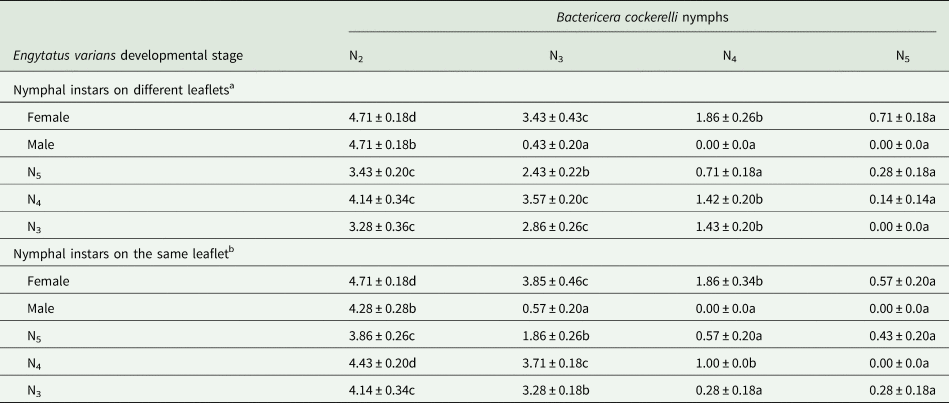
When B. cockerelli nymphs were exposed to E. varians either on different or on the same tomato leaflet, the predation depended on the developmental stage of the predator (the nymphal instar and sex of the adults), as well as on the nymphal instar of the prey (Table 3). During 24 h, the females and males as well as the N3, N4, and N5 nymphs of E. varians preyed, in general, significantly more on the N2 nymphs of B. cockerelli than the other three nymphal stages in both types of choice tests bioassayed.
Predation of Engytatus varians adults and nymphs (N) on different nymphal instars (N) of Bactericera cockerelli placed on one or multiple tomato leaflets

Means followed by the same letter in the same row are not significantly different (P < 0.05; GLM, LSMEANS test).
a F = 56.08; df = 19, 120; P < 0.0001.
b F = 63.20; df = 19, 120; P < 0.0001.
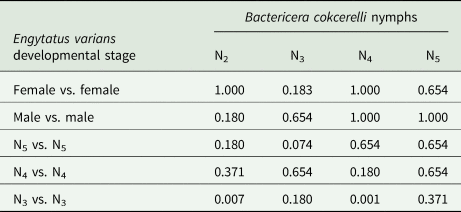
In general, no significant differences were observed on the voraciousness of the different development stages of E. varians when fed on N2, N3, N4, or N5 nymphs of B. cockerelli, regardless of the prey was exposed on different or on the same tomato leaflet (P ≥ 0.074 in all cases; Table 4). However, N3 nymphs of the predator consumed significantly more N2 (P = 0.007) and less N4 (P = 0.001) nymphs of the prey when they were placed on the same tomato leaflet.
Influence of Engytatus varians adults and nymphs (N) on the predation rate of Bactericera cockerelli (second, third, fourth, and fifth instars; [N]) placed on one or multiple tomato leaflets

F = 58.17; df = 39, 240; P < 0.0001 (P < 0.05; GLM, LSMEANS test).
Discussion
Biological control – the use of natural enemies to decrease the density of key pest organisms – is one of the most environmentally safe and effective IPM management tactics in many crops worldwide (Williams et al., Reference Williams, Arredondo-Bernal and Rodríguez-del-Bosque2013; Nafiu et al., Reference Nafiu, Dong and Cong2014). To release natural enemies, the implementation of optimal rearing methods is required to obtain a large quantity of good quality individuals (van Lenteren, Reference van Lenteren2012). Therefore, it is important to know the biological life parameters of natural enemies as well as those of their offspring. In this study, both the fertility and longevity of E. varians females from three different sex ratios were evaluated.
It has been reported that the pre-oviposition period of E. varians females was 3.5 or 3.6 days (S. Pineda, Unpublished data; Silva et al., Reference Silva, Bueno, Montes and van Lenteren2016) and that the type of diet influences the fertility. The fertility of E. varians was high (107 nymphs/female) when fed with a mixture of eggs and first instars larvae of T. absoluta (Silva et al., Reference Silva, Bueno, Montes and van Lenteren2016). Similarly, females of Tupiocoris cucurbitaceus (Spinola) (Hemiptera: Miridae) fed with T. vaporariorum Westwood (Homoptera: Aleyrodidae) nymphs produced significantly more nymphs throughout their lifespan (62 nymphs/female) than those fed with S. cerealella eggs (36 nymphs/female) (López et al., Reference López, Arce-Rojas, Villalba-Velásquez and Cagnotti2012). In our study, the sex ratio had an influence on fertility, which was significantly higher with the sex ratio 1:3 than with 1:2 and 1:1. The fertility values recorded in the present study are much lower (14–24 of nymphs/female for the three sex ratios bioassayed) than those reported by López et al. (Reference López, Arce-Rojas, Villalba-Velásquez and Cagnotti2012) and Silva et al. (Reference Silva, Bueno, Montes and van Lenteren2016). In these studies, the total fertility of T. cucurbitaceus and E. varians is also estimated, but using ≤1-day-old instead of 5-day-old females as in our study. Therefore, the females used were non-naïve in mating experience as ours, which could have wasted some time accepting males and mating and consequently, the fertility potential could have been underestimated. Besides, tests of Silva et al. (Reference Silva, Bueno, Montes and van Lenteren2016) were done under different climatic conditions [24 ± 1 °C, 70 ± 10% RH and 12:12 h (L:D)] than ours [~25 °C, ~56% RH, and ~12:12 h (L:D)], which could have also influenced results. Our findings cannot explain the greatest E. varians offspring when the females were placed with a higher number of males. Nevertheless, considering that in insects with sexual reproduction, sperm transference from males during mating has important effects on the reproductive parameters and longevity of females (Simmons, Reference Simmons2001; Wedell et al., Reference Wedell, Wiklund and Cook2002), this increase in fertility could be indicative of the adaptive phenomenon known as polyandry. In some insect species, females mate with different males to ensure fertilization of their eggs, which increases the genetic diversity and maintain the mean level of offspring fitness (Fedorka and Mousseau, Reference Fedorka and Mousseau2002). As a consequence of this phenomenon, a greater offspring production has been observed in several insect species, e.g., Rhynchophorus ferrugineus (Olivier) (Coleoptera: Curculionidae; Abdel-Azim et al., Reference Abdel-Azim, Vidyasagar, Aldosari and Mumtaz2012), Pieris napi L. (Lepidoptera: Pieridae; Wiklund et al., Reference Wiklund, Kaitala, Lindfors and Abeniu1993), and Euborellia plebeja Dohrn (Dermaptera: Anisolabididae; Kamimura, Reference Kamimura2003). In the females of mirid species, however, information related to the occurrence of polyandry is very limited. The only available study (Franco et al., Reference Franco, Jauset and Castañe2011) shows that N. tenuis females are polyandrous and mate regularly to maintain a good sperm supply; nonetheless, it is unknown whether the fertility of this predator can increase as a consequence of this phenomenon. Therefore, more studies must be performed to confirm whether polyandry could be responsible for the increase in fertility found in E. varians females in the present study.
In the 1:3 sex ratio, the longevity of E. varians females was ~0.95 times shorter and the fertility was 1.6 and 1.8 times higher than those recorded in the other two sex ratios tested (1:2 and 1:1, respectively). Our findings are in agreement with Arnqvist and Nilsson (Reference Arnqvist and Nilsson2000) who argue that insect females gain from multiple matings an increase in lifetime offspring production despite a negative effect on longevity. Therefore, we hypothesize that in the presence of various males, E. varians females could have had multiple matings, which is very costly in terms of energy and this could have originated the decrease in the lifespan. Besides, the higher fertility, the higher the energy demand for embryonic development (Arnqvist and Nilsson, Reference Arnqvist and Nilsson2000), which could have also played a role in the decrease. The studies of Silva et al. (Reference Silva, Laumann, Cavalcante-Ferreira, Blassioli-Moraes, Borges and Cokl2012) seem to support our hypothesis because of the longevity of Edessa meditabunda (F.) (Hemiptera: Pentatomidae) females, at a 1:1 sex ratio (female:male), also decreased 0.9-fold when they had two or more matings compared with the longevity of females that did not mate.
There is no information available regarding the transgenerational effects caused by the sex ratios in zoophytophagous mirids. In the present study, it was observed that the number of E. varians instars of the F1 generation derived from the females in the three sex ratios tested was the same (five instars) as those recorded previously by Pineda et al. (Reference Pineda, Medina, Figueroa, Henry, Mena-Mociño, Chavarrieta, Gómez-Ramos, Valdez, Lobit and Martínez2016) for this same species as well as for other mirid predators (e.g., N. tenuis; Kim et al., Reference Kim, Lee, Yu, Yasunaga-Aok and Jung2016, and Macrolophus pygmaeus Rambur; Perdikis and Lykouressis, Reference Perdikis and Lykouressis2002). Also, in general, the total nymphal development duration recorded in the three sex ratios studied was similar (~17 days) to that reported previously (15–17 days) in the species (Pineda et al., Reference Pineda, Medina, Figueroa, Henry, Mena-Mociño, Chavarrieta, Gómez-Ramos, Valdez, Lobit and Martínez2016) or in M. pygmaeus (Mollá et al., Reference Mollá, Biondi, Alonso-Valiente and Urbaneja2014). It is very important to point out that all these authors determined either one or another of these biological parameters using cohorts of individuals from laboratory-rearing cultures instead of offspring derived from different sex ratios, as was done in the present study. Only the N2 and N3 stages of the nymphs derived from the females in the 1:3 sex ratio had durations 1.1 times longer than those recorded for the nymphs of the same instars derived from the females of two other sex ratios (1:1 and 1:2; female:male). An increase in the number of an insect's larval or nymphal instars, or in the length of the developmental period, could be indicative of inadequate nutrition (Slansky and Rodriguez, Reference Slansky, Rodriguez, Slansky and Rodriguez1987). In the present work, however, the parental females of the three sex ratios as well as their offspring received the same high-quality diet (a mixture of N2–N3 B. cockerelli nymphs and S. cerealella eggs). The mechanism by which these effects might be exerted is poorly understood; therefore, they merit further study.
In general, the first nymphal instars of zoophytophagous mirids feed on their host plants (Lucas and Alomar, Reference Lucas and Alomar2001); nevertheless, this dietary habit can change according to the abundance or availability of their preys (Goula and Alomar, Reference Goula and Alomar1994; Urbaneja et al., Reference Urbaneja, Tapia and Stansly2005; Dalin et al., Reference Dalin, Demoly, Kabir and Björkman2011). In the choice tests performed in the present study, regardless of whether the prey was offered on different or on the same leaflet, the consumption by all the E. varians life stages tested (females and males and the N3, N4, and N5 nymphs) on B. cockerelli was generally N2>N3>N4>N5. In agreement with our results, other zoophytophagous mirids showed similar trends in the consumption of their preys either in choice- or no-choice tests. In choice tests, Dicyphus hesperus (Knight) (Hemiptera: Miridae) females consumed more N2 and N3 nymphs than N4 nymphs of the prey B. cockerelli (Ramírez-Ahuja et al., Reference Ramírez-Ahuja, Rodríguez-Leyva, Lomeli-Flores, Torres-Ruiz and Guzmán-Franco2017), while N5 nymphs of M. pygmaeus consumed more N1 and N2 nymphs than N3 and N4 nymphs of the prey M. persicae (Sulzer) (Hemiptera: Aphididae) (Fantinou et al., Reference Fantinou, Perdikis, Labropoulos and Maselou2009). Also, in no-choice tests, E. varians females and males consumed more N2 nymphs than N3 nymphs of B. cockerelli (Pineda et al., Reference Pineda, Hernández-Quintero, Velázquez-Rodríguez, Viñuela, Figueroa, Morales and Martínez2020), while the unsexed adults of N. tenuis consumed more N1–N2 nymphs than N3–N4 nymphs of the prey T. vaporariorum (Valderrama et al., Reference Valderrama, Granobles, Valencia and Sánchez2007). Size and mobility are two factors that can explain the dietary preference of all these mirid predators for the earlier instars of their prey (Fauvel et al., Reference Fauvel, Malausa and Kaspar1987). Bigger prey offers greater nutritional content, but they are more difficult for predators to handle (Fantinou et al., Reference Fantinou, Perdikis, Labropoulos and Maselou2009). Similarly, younger instars of some preys have a very limited mobility (e.g. T. vaporariorum) and predatory mirids such as N. tenuis preferred them because of the easier manipulation (Valderrama et al., Reference Valderrama, Granobles, Valencia and Sánchez2007).
In our study, in general, each developmental stage of E. varians consumed a similar amount of the different B. cockerelli instars regardless if they were exposed on different or on the same tomato leaflet. Even though we do not have a clear explanation for these results yet, our hypothesis is that the optimal foraging theory can help explaining the results. According to this theory, a predator makes a decision on whether to attack an available prey or to move to a new patch of a more preferable prey type (Pyke, Reference Pyke1984). In addition, a predator is able to rank prey types according to their suitability and prey selection by preference is based on a mechanism of prey discrimination (Chesson, Reference Chesson1983). More studies should be conducted in E. varians to fully understand its prey foraging.
In conclusion, this is the first report about the influence of the sex ratio on some biological parameters of the adults of the predator E. varians and on their offspring. One of the main findings was that females had greater offspring when they could mate with more males in spite of the decrease in longevity. Besides, some aspects of the dietary behavior have been revealed: the natural enemy preferred to attack younger nymphal stages when different developmental stages were available. This allows using together other ecologically acceptable options to complement the control of B. cockerelli if needed, such as the ectoparasitoid Tamarixia triozae (Burks) (Hymenoptera: Eulophidae), which prefers parasitizing more mature nymphs (Morales et al., Reference Morales, Martínez, Figueroa, Espino, Chavarrieta, Ortiz, Rodríguez-Enríquez and Pineda2013). Both findings could contribute to improve the rearing method of this predator in laboratories, with a view to obtaining a larger number of individuals and to improve the timing of field releases, since other natural enemies preferentially attacking older nymphal instars.
Acknowledgements
Laura Verónica Mena-Mociño received a premaster's fellowship from Consejo Nacional de Ciencia y Tecnología-Mexico. This work was financially supported by the Coordinación de la Investigación Científica, Universidad Michoacana de San Nicolás de Hidalgo.