



















1 Introduction
Let M be a von Neumann algebra equipped with a normal faithful state
 $\varphi $
. Let
 $T\colon M\to M$
be a positive map such that
 $\varphi \circ T\leq C_1\varphi $
on the positive cone
 $M^+$
, for some constant
 $C_1\geq 0$
. Assume first that
 $\varphi $
is a trace (that is,
 $\varphi (xy)=\varphi (yx)$
for all
 $x,y\in M$
) and consider the associated noncommutative
 $L^p$
-spaces
 ${\mathcal L}^p(M,\varphi )$
(see, e.g., [Reference Dodds, Dodds and de Pagter6, Reference Pisier and Xu19] or [Reference Hiai10, Chapter 4]). Let
 $C_\infty =\Vert T\Vert $
. Then for all
 $1\leq p<\infty $
, T extends to a bounded map on
 ${\mathcal L}^p(M,\varphi )$
, with
 $$ \begin{align} \big\Vert T\colon {\mathcal L}^p(M,\varphi)\longrightarrow {\mathcal L}^p(M,\varphi)\big\Vert\leq C_\infty^{1-\frac{1}{p}}C_1^{\frac{1}{p}}; \end{align} $$
see [Reference Junge and Xu16, Lemma 1.1]. This extension result plays a significant role in various aspects of operator theory on noncommutative
 $L^p$
-spaces, in particular for the study of diffusion operators or semigroups on those spaces; see, for example, [Reference Arhancet1, Reference Duquet and Le Merdy7, Reference Hong, Ray and Wang11] or [Reference Junge, Le Merdy and Xu14, Chapter 5].
Let us now drop the tracial assumption on
 $\varphi $
. For any
 $1\leq p\leq \infty $
, let
 $L^p(M,\varphi )$
denote the Haagerup noncommutative
 $L^p$
-space
 $L^p(M,\varphi )$
associated with
 $\varphi $
[Reference Haagerup8, Reference Haagerup, Junge and Xu9, Reference Hiai10, Reference Terp22]. These spaces extend the tracial noncommutative
 $L^p$
-spaces
 ${\mathcal L}^p(\cdots )$
in a very beautiful way and many topics in operator theory which had been first studied on tracial noncommutative
 $L^p$
-spaces were/are investigated on Haagerup noncommutative
 $L^p$
-spaces. This has led to several major advances; see in particular [Reference Haagerup, Junge and Xu9], [Reference Junge and Xu16, Section 7], [Reference Caspers and de la Salle4], [Reference Arhancet2] and [Reference Junge and LaRacuente13].
The question of extending a positive map
 $T\colon M\to M$
to
 $L^p(M,\varphi )$
was first considered in [Reference Junge and Xu16, Section 7] and [Reference Haagerup, Junge and Xu9, Section 5]. Let
 $D\in L^1(M,\varphi )$
be the density of
 $\varphi $
, let
 $1\leq p<\infty $
and let
 $\theta \in [0,1]$
. Let
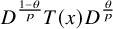
 $T_{p,\theta }\colon D^{\frac {1-\theta }{p}} MD^{\frac {\theta }{p}}\to L^p(M,\varphi )$
be defined by
 $$ \begin{align} T_{p,\theta}\Big(D^{\frac{1-\theta}{p}} x D^{\frac{\theta}{p}}\Big) = D^{\frac{1-\theta}{p}} T(x) D^{\frac{\theta}{p}},\qquad x\in M. \end{align} $$
(See Section 2 for the necessary background on D and the above definition.) Then [Reference Haagerup, Junge and Xu9, Theorem 5.1] shows that if
 $\varphi \circ T\leq C_1\varphi $
, then
 $T_{p,{\frac {1}{2}}}$
extends to a bounded map on
 $L^p(M,\varphi )$
, with
 $$ \begin{align*}\Vert T_{p,{\frac{1}{2}}}\colon L^p(M,\varphi)\longrightarrow L^p(M,\varphi)\Vert\leq C_\infty^{1-\frac{1}{p}}C_1^{\frac{1}{p}}. \end{align*} $$
This extends the tracial case (1.1); see Remark 2.5. Furthermore, [Reference Haagerup, Junge and Xu9, Proposition 5.5] shows that if T commutes with the modular automorphism group of
 $\varphi $
, then
 $T_{p,\theta }=T_{p,{\frac {1}{2}}}$
for all
 $\theta \in [0,1]$
.
In addition to the above results, Haagerup–Junge–Xu stated as an open problem the question whether
 $T_{p,\theta }$
is always bounded for
 $\theta \not ={\frac {1}{2}}$
(see [Reference Haagerup, Junge and Xu9, Section 5]). The main result of the present paper is a negative answer to this question. More precisely, we show that if
 $1\leq p<2$
and if either
 $0\leq \theta < 2^{-1}(1-\sqrt {p-1})$
or
 $2^{-1}(1+\sqrt {p-1})<\theta \leq 1$
, then there exists
 $M,\varphi $
as above and a unital completely positive map
 $T\colon M\to M$
such that
 $\varphi \circ T=\varphi $
and
 $T_{p,\theta }$
is unbounded; see Theorem 6.1.
We also show that for any
 $M,\varphi $
as above and for any
 $2$
-positive map
 $T\colon M\to M$
such that
 $\varphi \circ T\leq C_1\varphi $
for some
 $C_1\geq 0$
, then
 $T_{p,\theta }$
is bounded for all
 $p\geq 2$
and all
 $\theta \in [0,1]$
; see Theorem 4.1. In other words, the Haagerup–Junge–Xu problem has a positive solution for
 $p\geq 2$
, provided that we restrict to
 $2$
-positive maps. We also show, under the same assumptions, that
 $T_{p,\theta }$
is bounded for all
 $1\leq p\leq 2$
and all
 $\theta \in [1-p/2,p/2]$
; see Theorem 4.3.
Section 2 contains preliminaries on the
 $L^p(M,\varphi )$
and on the question whether
 $T_{p,\theta }$
is bounded. Section 3 presents a way to compute
 $\Vert T_{p,\theta }\Vert $
in the case when
 $M=M_n$
is a matrix algebra, which plays a key role in the last part of the paper. Section 4 contains the extension results stated in the previous paragraph. Finally, Sections 5 and 6 are devoted to the construction of examples for which
 $T_{p,\theta }$
is unbounded.
2 The extension problem
Throughout we consider a von Neumann algebra M and we let
 $M_*$
denote its predual. We let
 $M^+$
and
 $M_{*}^+$
denote the positive cones of M and
 $M_*$
, respectively.
2.1 Haagerup noncommutative
 $L^p$
-spaces

Assume that M is
 $\sigma $
-finite, and let
 $\varphi $
be a normal faithful state on M. We shall briefly recall the definition of the Haagerup noncommutative
 $L^p$
-spaces
 $L^p(M,\varphi )$
associated with
 $\varphi $
, as well as some of their main features. We refer the reader to [Reference Haagerup8], [Reference Haagerup, Junge and Xu9, Section 1], [Reference Hiai10, Chapter 9], [Reference Pisier and Xu19, Section 3] and [Reference Terp22] for details and complements. We note that
 $L^p(M,\varphi )$
can actually be defined when
 $\varphi $
is any normal faithful weight on M. The assumption that
 $\varphi $
is a state makes the description below a little simpler.
Let
 $(\sigma ^\varphi _t)_{t\in {\mathbb R}}$
be the modular automorphism group of
 $\varphi $
[Reference Takesaki20, Chapter VIII], and let
 $$ \begin{align*}\mathcal R = M \rtimes_{\sigma^\varphi} \mathbb{R}\subset M\overline{\otimes} B(L^2(\mathbb{R})) \end{align*} $$
be the resulting crossed product; see, for example, [Reference Takesaki20, Chapter X]. If
 $M\subset B(H)$
for some Hilbert space H, then we have
 $\mathcal R \subset B(L^2(\mathbb {R};H))$
. Let us regard M as a sub-von Neumann algebra of
 ${{\mathcal R}}$
in the natural way. Then
 $(\sigma ^\varphi _t)_{t\in {\mathbb R}}$
is given by
 $$ \begin{align} \sigma^\varphi_t(x) =\lambda(t)x\lambda(t)^*,\qquad t\in\mathbb{R},\ x\in M, \end{align} $$
where
 $\lambda (t)\in B(L^2(\mathbb {R};H))$
is defined by
 $[\lambda (t)\xi ](s)=\xi (s - t)$
for all
 $\xi \in L^2(\mathbb {R};H)$
. This is a unitary. For any
 $t\in \mathbb {R}$
, define
 $W(t) \in B(L^2(\mathbb {R};H))$
by
 $[W(t)\xi ](s) =e^{-its}\xi (s)$
for all
 $\xi \in L^2(\mathbb {R};H)$
. Then the dual action
 $\widehat {\sigma }^\varphi \colon \mathbb {R} \to \mathrm {Aut}({{\mathcal R}})$
of
 $\sigma ^\varphi $
is defined by
 $$ \begin{align*}\widehat{\sigma}^\varphi_t(x) = W(t)x W(t)^*,\qquad \ t\in\mathbb{R},\ x\in {\mathcal R}. \end{align*} $$
(See [Reference Takesaki20, § VIII.2].) A remarkable fact is that for any
 $x\in {{\mathcal R}}$
,
 $\widehat {\sigma }^\varphi _t(x)=x$
for all
 $t\in \mathbb {R}$
if and only if
 $x\in M$
.
There exists a unique normal semifinite trace
 $\tau _0$
on
 ${{\mathcal R}}$
such that
 $$ \begin{align*}\tau_0\circ \widehat{\sigma}^\varphi_t =e^{-t}\tau_0,\qquad t\in\mathbb{R}; \end{align*} $$
see, for example, [Reference Hiai10, Theorem 8.15]. This trace gives rise to the
 $*$
-algebra
 $L^{0}({{\mathcal R}},\tau _0)$
of
 $\tau _0$
-measurable operators [Reference Hiai10, Chapter 4]. Then for any
 $1\leq p\leq \infty $
, the Haagerup
 $L^p$
-space
 $L^p(M,\varphi )$
is defined as
 $$ \begin{align*}L^p(M,\varphi) = \big\{ y\in L^0({{\mathcal R}},\tau_0)\, :\, \widehat{\sigma}^\varphi_t(y) =e^{-\frac{t}{p}}y\ \text{for all}\ t\in\mathbb{R}\big\}. \end{align*} $$
At this stage, this is just a
 $*$
-subspace of
 $L^0({{\mathcal R}},\tau _0)$
(with no norm). One defines its positive cone as
 $$ \begin{align*}L^p(M,\varphi)^+= L^p(M,\varphi)\cap L^0({{\mathcal R}},\tau_0)^+. \end{align*} $$
It follows from above that
 $L^\infty (M,\varphi )=M.$
Let
 $\psi \in M_{*}^+$
, that we regard as a normal weight on M, and let
 $\widehat {\psi }$
be its dual weight on
 ${{\mathcal R}}$
[Reference Takesaki20, § VIII.1]. Let
 $h_\psi $
be the Radon–Nikodym derivative of
 $\widehat {\psi }$
with respect to
 $\tau _0$
. That is,
 $h_\psi $
is the unique positive operator affiliated with
 ${{\mathcal R}}$
such that
 $$ \begin{align*}\widehat{\psi}(y) =\tau_0\Big(h_\psi^{\frac{1}{2}} yh_\psi^{\frac{1}{2}}\Big), \qquad y\in{{\mathcal R}}_+. \end{align*} $$
It turns out that
 $h_\psi $
belongs to
 $L^1(M,\varphi )^+$
for all
 $\psi \in M_{*}^+$
and that the mapping
 $\psi \mapsto h_\psi $
is a bijection from
 $M_{*}^+$
onto
 $L^1(M,\varphi )^+$
. This bijection readily extends to a linear isomorphism
 $ M_* \longrightarrow L^1(M,\varphi )$
, still denoted by
 $\psi \mapsto h_\psi $
. Then
 $L^1(M,\varphi )$
is equipped with the norm
 $\Vert \,\cdotp \Vert _1$
inherited from
 $M_*$
, that is,
 $\Vert h_\psi \Vert _{1}=\Vert \psi \Vert _{M_*}$
for all
 $\psi \in M_*$
. Next, for any
 $1\leq p<\infty $
and any
 $y\in L^p(M,\varphi )$
, the positive operator
 $\vert y\vert $
belongs to
 $L^p(M,\varphi )$
as well (thanks to the polar decomposition) and hence
 $\vert y\vert ^p$
belongs to
 $L^1(M,\varphi )$
. This allows to define
 $\Vert y\Vert _p=\Vert \vert y\vert ^p\Vert ^{\frac {1}{p}}$
for all
 $y\in L^p(M,\varphi )$
. Then
 $\Vert \,\cdotp \Vert _p$
is a complete norm on
 $L^p(M,\varphi )$
.
The Banach spaces
 $L^p(M,\varphi )$
,
 $1\leq p\leq \infty $
, satisfy the following version of Hölder’s inequality (see, e.g., [Reference Hiai10, Proposition 9.17]).
Lemma 2.1. Let
 $1\leq p,q,r\leq \infty $
such that
 $p^{-1}+q^{-1} =r^{-1}$
. Then for all
 $x\in L^p(M,\varphi )$
and all
 $y\in L^q(M,\varphi )$
, the product
 $xy$
belongs to
 $L^r(M,\varphi )$
and
 $\Vert xy\Vert _r\leq \Vert x\Vert _p\Vert y\Vert _q$
.
Let D be the Radon–Nikodym derivative of
 $\widehat {\varphi }$
with respect to
 $\tau _0$
, and recall that
 $D\in L^1(M,\varphi )^+$
. This operator is called the density of
 $\varphi $
. Recall that we regard M as a sub-von Neumann algebra of
 ${{\mathcal R}}$
. Then
 $D^{it}=\lambda (t)$
is a unitary of
 ${{\mathcal R}}$
for all
 $t\in \mathbb {R}$
and
 $$ \begin{align} \sigma^\varphi_t(x) = D^{it}xD^{-it},\qquad t\in\mathbb{R},\ x\in M. \end{align} $$
Let
 $\mathrm {Tr}\colon L^1(M,\varphi )\to \mathbb {C}$
be defined by
 $\mathrm {Tr}(h_\psi )=\psi (1)$
for all
 $\psi \in M_*$
. This functional has two remarkable properties. First, for all
 $x\in M$
and all
 $\psi \in M_*$
, we have
 $$ \begin{align} \mathrm{Tr}(h_\psi x) = \psi(x). \end{align} $$
Second if
 $1\leq p,q\leq \infty $
are such that
 $p^{-1}+q^{-1} =1$
, then for all
 $x\in L^p(M,\varphi )$
and all
 $y\in L^q(M,\varphi )$
, we have
 $$ \begin{align*}\mathrm{Tr}(xy) = \mathrm{Tr}(yx). \end{align*} $$
This tracial property will be used without any further comment in the paper.
It follows from the definition of
 $\Vert \,\cdotp \Vert _1$
and equation (2.3) that the duality pairing
 $\langle x,y\rangle =\mathrm {Tr}(xy)$
for
 $x\in M$
and
 $y\in L^1(M,\varphi )$
yields an isometric isomorphism
 $$ \begin{align} L^1(M,\varphi)^*\simeq M. \end{align} $$
As a special case of equation (2.3), we have
 $$ \begin{align} \varphi(x)=\mathrm{Tr}(Dx),\qquad x\in M. \end{align} $$
We note that
 $L^2(M,\varphi )$
is a space for the inner product
 $(x\vert y)=\mathrm {Tr}(y^*x)$
. Moreover, by equation (2.5), we have
 $$ \begin{align} \varphi(x^*x)=\Vert xD^{\frac{1}{2}}\Vert_2^2\quad\text{and}\quad \varphi(xx^*)=\Vert D^{\frac{1}{2}} x\Vert_2^2,\qquad x\in M. \end{align} $$
We finally mention a useful tool. Let
 $M_a\subset M$
be the subset of all
 $x\in M$
such that
 $t\mapsto \sigma ^\varphi _t(x)$
extends to an entire function
 $z\in \mathbb {C}\mapsto \sigma _z^\varphi (x) \in M$
. (Such elements are called analytic). It is well known that
 $M_a$
is a
 $w^*$
-dense
 $*$
-subalgebra of M [Reference Takesaki20, Section VIII.2]. Furthermore,
 $$ \begin{align} \sigma_{i\theta}(x)=D^{-\theta}xD^{\theta}, \end{align} $$
for all
 $x\in M_a$
and all
 $\theta \in [0,1]$
, and
 $M_aD^{\frac {1}{p}} = D^{\frac {1}{p}}M_a$
is dense in
 $L^p(M,\varphi )$
, for all
 $1\leq p<\infty $
. See [Reference Junge and Xu15, Lemma 1.1] and its proof for these properties.
2.2 Extension of maps
$M\to M$

Given any linear map
 $T\colon M\to M$
, we say that T is positive if
 $T(M^+)\subset M^+$
. This implies that T is bounded. For any
 $n\geq 1$
, we say that T is n-positive if the tensor extension map
 $I_{M_n}\otimes T\colon M_n\overline {\otimes } M \to M_n\overline {\otimes }M$
is positive. (Here,
 $M_n$
is the algebra of
 $n\times n$
matrices.) Next, we say that T is completely positive if T is n-positive for all
 $n\geq 1$
. See, for example, [Reference Paulsen18] for basics on these notions.
Consider any
 $\theta \in [0,1]$
and
 $1\leq p<\infty $
. It follows from Lemma 2.1 that
 $D^{\frac {1-\theta }{p}} x D^{\frac {\theta }{p}}$
belongs to
 $L^p(M,\varphi )$
for all
 $x\in M$
. We set
 $$ \begin{align} {{\mathcal A}}_{p,\theta} = D^{\frac{(1-\theta)}{p}} M D^{\frac{\theta}{p}} \subset L^p(M,\varphi). \end{align} $$
It turns out that this is a dense subspace; see [Reference Junge and Xu15, Lemma 1.1].
Let
 $T\colon M\to M$
be any bounded linear map. For any
 $(p,\theta )$
as above, define a linear map
 $T_{p,\theta }\colon {{\mathcal A}}_{p,\theta }\to {{\mathcal A}}_{p,\theta }$
by equation (1.2). The question we consider in this paper is whether
 $T_{p,\theta }$
extends to a bounded map
 $L^p(M,\varphi )\to L^p(M,\varphi )$
in the case when T is
 $2$
-positive and
 $\varphi \circ T\leq \varphi $
on
 $M_+$
. More precisely, we consider the following:
Question 2.2. Determine the pairs
 $(p,\theta )\in [1,\infty )\times [0,1]$
such that
 $$ \begin{align*}T_{p,\theta}\colon L^p(M,\varphi)\longrightarrow L^p(M,\varphi) \end{align*} $$
is bounded for all
 $(M,\varphi )$
as above and all
 $2$
-positive maps
 $T\colon M\to M$
satisfying
 $\varphi \circ T\leq \varphi $
on
 $M_+$
.
As in the introduction, we could consider maps such that
 $\varphi \circ T\leq C_1\varphi $
for some
 $C_1\geq 0$
. However, by an obvious scaling, there is no loss in considering
 $C_1=1$
only.
Remark 2.3. Question 2.2 originates from the Haagerup–Junge–Xu paper [Reference Haagerup, Junge and Xu9]. In Section 5 of the latter paper, the authors consider two von Neumann algebras
 $M,N$
, and normal faithful states
 $\varphi \in M_*$
and
 $\psi \in N_*$
with respective densities
 $D_\varphi \in L^1(M,\varphi )$
and
 $D_\psi \in L^1(N,\psi )$
. Then they consider a positive map
 $T\colon M\to N$
such that
 $\psi \circ T\leq C_1\varphi $
for some
 $C_1>0$
. Given any
 $(p,\theta )\in [1,\infty )\times [0,1]$
, they define
 $T_{p,\theta }\colon D_\varphi ^{\frac {1-\theta }{p}} M D_\varphi ^{\frac {\theta }{p}}\to L^p(N,\psi )$
by
 $$ \begin{align*}T_{p,\theta}\Big(D_\varphi^{\frac{1-\theta}{p}} x D_\varphi^{\frac{\theta}{p}}\Big) = D_\psi^{\frac{1-\theta}{p}} T(x) D_\psi^{\frac{\theta}{p}},\qquad x\in M. \end{align*} $$
In [Reference Haagerup, Junge and Xu9, Theorem 5.1], they show that
 $T_{p,{\frac {1}{2}}}$
is bounded and that setting
 $C_\infty =\Vert T\Vert $
, we have
 $\Vert T_{p,{\frac {1}{2}}}\colon L^p(M,\varphi )\to L^p(N,\psi )\Vert \leq C_{\infty }^{1-\frac {1}{p}} C_{1}^{\frac {1}{p}}$
. Then after the statement of [Reference Haagerup, Junge and Xu9, Proposition 5.4], they mention that the boundedness of
 $T_{p,\theta }$
for
 $\theta \not ={\frac {1}{2}}$
is an open question.
Remark 2.4. We wish to point out a special case which will be used in Section 5. Let B be a von Neumman algebra equipped with a normal faithful state
 $\psi $
. Let
 $A\subset B$
be a sub-von Neumann algebra which is stable under the modular automorphism group of
 $\psi $
(i.e.,
 $\sigma ^\psi _t(A)\subset A$
for all
 $t\in \mathbb {R}$
). Let
 $\varphi =\psi _{\vert A}$
be the restriction of
 $\psi $
to A. Let
 $D\in L^1(A,\varphi )$
and
 $\Delta \in L^1(B,\psi )$
be the densities of
 $\varphi $
and
 $\psi $
, respectively. On the one hand, it follows from [Reference Haagerup, Junge and Xu9, Theorem 5.1] (see Remark 2.3) that there exists, for every
 $1\leq p<\infty $
, a contraction
 $$ \begin{align*}\Lambda(p)\colon L^p(A,\varphi)\longrightarrow L^p(B,\psi) \end{align*} $$
such that
 $[\Lambda (p)](D^{\frac {1}{2p}}xD^{\frac {1}{2p}}) = \Delta ^{\frac {1}{2p}}x \Delta ^{\frac {1}{2p}}$
for all
 $x\in A$
.
On the other hand, there exists a unique normal conditional expectation
 $E\colon B\to A$
such that
 $\psi =\varphi \circ E$
on B by [Reference Takesaki20, Theorem IX.4.2]. Moreover, it is easy to check that under the natural identifications
 $L^1(A,\varphi )^*\simeq A$
and
 $L^1(B,\psi )^*\simeq B$
(see equation (2.4) and the discussion preceding it), we have
 $$ \begin{align*}\Lambda(1)^*=E. \end{align*} $$
Now, using [Reference Haagerup, Junge and Xu9, Theorem 5.1] again, there exists, for every
 $1\leq p<\infty $
, a contraction
 $E(p)\colon L^p(B,\psi )\to L^p(A,\varphi )$
such that
 $[E(p)](\Delta ^{\frac {1}{2p}}y \Delta ^{\frac {1}{2p}}) = D^{\frac {1}{2p}}E(y)D^{\frac {1}{2p}}$
for all
 $y\in B$
. It is clear that
 $E(p)\circ \Lambda (p)=I_{L^p(A,\varphi )}$
. Consequently,
 $\Lambda (p)$
is an isometry.
We refer to [Reference Junge and Xu15, Section 2] for more on this.
Remark 2.5. Let
 $T\colon M\to M$
be a positive map, and let
 $\varphi ,D$
as in Subsection 2.1. Assume that
 $\varphi $
is tracial and for any
 $1\leq p<\infty $
, let
 ${\mathcal L}^p(M,\varphi )$
be the (classical) noncommutative
 $L^p$
-space with respect to the trace
 $\varphi $
[Reference Hiai10, Section 4.3]. That is,
 ${\mathcal L}^p(M,\varphi )$
is the completion of M for the norm
 $$ \begin{align*}\Vert x\Vert_{{\mathcal L}^p(M,\varphi)} = \big(\varphi(\vert x\vert^p)\big)^{\frac{1}{p}},\qquad x\in M. \end{align*} $$
In this case, D commutes with M and
 $$ \begin{align*}\Vert D^{\frac{1}{p}} x\Vert_{L^p(M,\varphi)} = \Vert x\Vert_{{\mathcal L}^p(M,\varphi)},\qquad x\in M; \end{align*} $$
see, for example, [Reference Hiai10, Example 9.11]. Hence,
 $T_{p,\theta }=T_{p,0}$
for all
 $1\leq p<\infty $
and all
 $\theta \in [0,1]$
and moreover,
 $T_{p,0}$
is bounded if and only if T extends to a bounded map
 ${\mathcal L}^p(M,\varphi )\to {\mathcal L}^p(M,\varphi )$
. Thus, in the tracial case, the fact that
 $T_{p,0}$
is bounded under the assumption
 $\varphi \circ T\leq C_1\varphi $
is equivalent to the result mentionned in the first paragraph of Section 1; see (equation 1.1).
3 Computing
$\Vert T_{p,\theta }\Vert $
on semifinite von Neumann algebras

As in the previous section, we let M be a von Neumann algebra equipped with a normal faithful state
 $\varphi $
and we let
 $D\in L^1(M,\varphi )^+$
be the density of
 $\varphi $
. We assume further that M is semifinite, and we let
 $\tau $
be a distinguished normal semifinite faithful trace on M. For any
 $1\leq p\leq \infty $
, we let
 ${\mathcal L}^p(M,\tau )$
be the noncommutative
 $L^p$
-space with respect to
 $\tau $
. Although
 ${\mathcal L}^p(M,\tau )$
is isometrically isomorphic to the Haagerup
 $L^p$
-space
 $L^p(M,\tau )$
, it is necessary for our purpose to consider
 ${\mathcal L}^p(M,\tau )$
as such.
Let us give a brief account, for which we refer, for example, to [Reference Hiai10, Section 4.3]. Let
 ${\mathcal L}^0(M,\tau )$
be the
 $*$
-algebra of all
 $\tau $
-measurable operators on M. For any
 $p<\infty $
,
 ${\mathcal L}^p(M,\tau )$
is the Banach space of all
 $x\in {\mathcal L}^0(M,\tau )$
such that
 $\tau (\vert x\vert ^p)<\infty $
, equipped with the norm
 $$ \begin{align*}\Vert x\Vert_{{\mathcal L}^p(M,\tau)}=\big(\tau(\vert x\vert^p)\big)^{\frac{1}{p}}, \qquad x\in {\mathcal L}^p(M,\tau). \end{align*} $$
Moreover,
 ${\mathcal L}^\infty (M,\tau )=M$
. The following analogue of Lemma 2.1 holds true: Whenever
 $1\leq p,q,r\leq \infty $
are such that
 $p^{-1}+q^{-1}=r^{-1}$
, then for all
 $x\in {\mathcal L}^p(M,\tau )$
and
 $y\in {\mathcal L}^q(M,\tau )$
,
 $xy$
belongs to
 ${\mathcal L}^r(M,\tau )$
, with
 $\Vert xy\Vert _r\leq \Vert x\Vert _p\Vert x\Vert _q$
(Hölder’s inequality). Furthermore, we have an isometric identification
 $$ \begin{align} {\mathcal L}^1(M,\tau)^*\simeq M \end{align} $$
for the duality pairing given by
 $\langle x,y\rangle =\tau (yx)$
for all
 $x\in M$
and
 $y\in {\mathcal L}^1(M,\tau )$
.
Let
 $\gamma \in {\mathcal L}^1(M,\tau )$
be associated with
 $\varphi $
in the identification (3.1), that is,
 $$ \begin{align} \varphi(x)=\tau(\gamma x),\qquad x\in M. \end{align} $$
Then
 $\gamma $
is positive and it is clear from Hölder’s inequality that for any
 $1\leq p<\infty $
,
 $\theta \in [0,1]$
and
 $x\in M$
, the product
 $\gamma ^{\frac {1-\theta }{p}} x \gamma ^{\frac {\theta }{p}}$
belongs to
 ${\mathcal L}^p(M,\tau )$
.
It is well known that
 ${\mathcal L}^p(M,\tau )$
and
 $L^p(M,\varphi )$
are isometrically isomorphic (apply Remark 9.10 and Example 9.11 in [Reference Hiai10]). The following lemma provides concrete isometric isomorphisms between these two spaces.
Lemma 3.1. Let
 $1\leq p<\infty $
and
 $\theta \in [0,1]$
. Then for all
 $x\in M$
, we have
 $$ \begin{align*}\big\Vert\gamma^{\frac{1-\theta}{p}} x \gamma^{\frac{\theta}{p}}\big\Vert_{{\mathcal L}^p(M,\tau)} = \big\Vert D^{\frac{1-\theta}{p}} x D^{\frac{\theta}{p}}\big\Vert_{L^p(M,\varphi)}. \end{align*} $$
Before giving the proof of this lemma, we recall a classical tool. For any
 $\theta \in [0,1]$
, define an embedding
 $J_\theta \colon M\to L^1(M,\varphi )$
by letting
 $$ \begin{align*}J_\theta(x)=D^{1-\theta}xD^\theta,\qquad x\in M. \end{align*} $$
Consider
 $(J_\theta (M), L^1(M,\varphi ))$
as an interpolation couple, the norm on
 $J_\theta (M)$
being given by the norm on M, that is,
 $$ \begin{align} \big\Vert D^{1-\theta}xD^\theta\big\Vert_{J_\theta(M)} = \Vert x\Vert_M,\qquad x\in M. \end{align} $$
For any
 $1\leq p\leq \infty $
, let
 $$ \begin{align} C(p,\theta)=\big[J_\theta(M), L^1(M,\varphi)\big]_{\frac{1}{p}} \end{align} $$
be the resulting interpolation space provided by the complex interpolation method [Reference Bergh and Löfström3, Chapter 4]. Regard
 $C(p,\theta )$
as a subspace of
 $L^1(M,\varphi )$
in the natural way. Then Kosaki’s theorem [Reference Kosaki17, Theorem 9.1] (see also [Reference Hiai10, Theorem 9.36]) asserts that
 $C(p,\theta )$
is equal to
 $D^{\frac {1-\theta }{p'}}L^{p}(M,\varphi )D^{\frac {\theta }{p'}}$
and that
 $$ \begin{align} \big\Vert D^{\frac{1-\theta}{p'}}y D^{\frac{\theta}{p'}}\big\Vert_{C(p,\theta)} =\Vert y\Vert_{L^p(M,\varphi)},\qquad y\in L^p(M,\varphi). \end{align} $$
Here,
 $p'$
is the conjugate index of p so that
 $D^{\frac {1-\theta }{p'}}y D^{\frac {\theta }{p'}}$
belongs to
 $L^1(M,\varphi )$
provided that y belongs to
 $L^p(M,\varphi )$
.
Likewise, let
 $j_\theta \colon M\to {\mathcal L}^1(M,\tau )$
be defined by
 $j_\theta (x)=\gamma ^{1-\theta }x\gamma ^\theta $
for all
 $x\in M$
. Consider
 $(j_\theta (M), {\mathcal L}^1(M,\tau ))$
as an interpolation couple, the norm on
 $j_\theta (M)$
being given by the norm on M, and set
 $$ \begin{align} c(p,\theta)=[j_\theta(M), {\mathcal L}^1(M,\tau)]_{\frac{1}{p}}, \end{align} $$
regarded as a subspace of
 ${\mathcal L}^1(M,\tau )$
. Then arguing as in the proof of [Reference Kosaki17, Theorem 9.1], one obtains that
 $c(p,\theta )$
is equal to
 $\gamma ^{\frac {1-\theta }{p'}} {\mathcal L}^{p}(M,\tau )\gamma ^{\frac {\theta }{p'}}$
and that
 $$ \begin{align} \big\Vert\gamma^{\frac{1-\theta}{p'}}y \gamma^{\frac{\theta}{p'}}\big\Vert_{c(p,\theta)} =\Vert y\Vert_{{\mathcal L}^{p}(M,\tau)},\qquad y\in {\mathcal L}^{p}(M,\tau). \end{align} $$
Proof of Lemma 3.1.
We fix some
 $\theta \in [0,1]$
. We start with the case
 $p=1$
. Let
 $x\in M$
. For any
 $x'\in M$
, we have
 $\tau (\gamma xx')=\mathrm {Tr}(Dxx')$
and hence
 $\vert \tau (\gamma xx')\vert =\vert \mathrm {Tr}(Dxx')\vert $
, by equations (2.5) and (3.2). Taking the supremum over all
 $x'\in M$
with
 $\Vert x'\Vert _M\leq 1$
, it therefore follows from equations (2.4) and (3.1) that
 $$ \begin{align} \big\Vert\gamma x\big\Vert_{{\mathcal L}^1(M,\tau)} = \big\Vert Dx\big\Vert_{L^1(M,\varphi)},\qquad x\in M. \end{align} $$
Now, assume that
 $x\in M_a$
(the space of analytic elements of M). According to equation (2.7), we have
 $D\sigma ^\varphi _{i\theta }(x)=D^{1-\theta }xD^{\theta }$
. Likewise,
 $\sigma ^\varphi _t(x)=\gamma ^{it}x\gamma ^{-it}$
for all
 $t\in \mathbb {R}$
, by [Reference Takesaki20, Theorem VIII.2.11], hence
 $\sigma ^\varphi _{i\theta }(x)=\gamma ^{-\theta }x\gamma ^\theta $
. Hence, we have
 $\gamma \sigma ^\varphi _{i\theta }(x)=\gamma ^{1-\theta }x\gamma ^{\theta }$
. Applying equation (3.8) with
 $\sigma ^\varphi _{i\theta }(x)$
in place of x, we deduce that
 $$ \begin{align} \big\Vert\gamma^{(1-\theta)} x \gamma^{\theta}\big\Vert_{{\mathcal L}^1(M,\tau)} = \big\Vert D^{(1-\theta)} x D^{\theta}\big\Vert_{L^1(M,\varphi)}. \end{align} $$
Consider the standard representation
 $M\hookrightarrow B(L^2(M,\varphi ))$
, and consider an arbitrary
 $x\in M$
. Assume that
 $\theta \geq {\frac {1}{2}}$
. There exists a net
 $(x_i)_i$
in
 $M_a$
such that
 $x_i\to x$
strongly. Then
 $x_iD^{\frac {1}{2}}\to xD^{\frac {1}{2}}$
in
 $L^2(M,\varphi )$
. Applying Lemma 2.1 (Hölder’s inequality), we deduce that
 $D^{1-\theta }x_iD^{\theta }=D^{1-\theta }(x_iD^{\frac {1}{2}})D^{\theta -{\frac {1}{2}}}$
converges to
 $D^{1-\theta } xD^{\theta }$
in
 $L^{1}(M,\varphi )$
. (This result can also be formally deduced from [Reference Junge12, Lemma 2.3].) Likewise,
 $\gamma ^{1-\theta }x_i\gamma ^{\theta }$
converges to
 $\gamma ^{1-\theta } x\gamma ^{\theta }$
in
 ${\mathcal L}^{1}(M,\tau )$
. Consequently, equation (3.9) holds true for x. Changing x into
 $x^*$
, we obtain this result as well if
 $\theta <{\frac {1}{2}}$
. This proves the result when
 $p=1$
.
We further note that the proof that
 ${{\mathcal A}}_{1,\theta }=D^{(1-\theta )} M D^{\theta }$
is dense in
 $L^1(M,\varphi )$
shows as well that the space
 $\gamma ^{1-\theta } M \gamma ^{\theta }$
is dense in
 ${\mathcal L}^1(M,\tau )$
. Thus, equation (3.9) provides an isometric isomorphism
 $$ \begin{align*}\Phi\colon L^1(M,\varphi)\longrightarrow {\mathcal L}^1(M,\tau) \end{align*} $$
such that
 $$ \begin{align*}\Phi\big(D^{1-\theta} x D^{\theta}\big) = \gamma^{1-\theta} x \gamma^{\theta},\qquad x\in M. \end{align*} $$
Now, let
 $p>1$
and consider the interpolation spaces
 $C(p,\theta )$
and
 $c(p,\theta )$
defined by equations (3.4) and (3.6). Since
 $j_\theta =\Phi \circ J_\theta $
, the mapping
 $\Phi $
restricts to an isometric isomorphism from
 $C(p,\theta )$
onto
 $c(p,\theta )$
. Let
 $x\in M$
. Applying equations (3.7) and (3.5), we deduce that
 $$ \begin{align*} \big\Vert\gamma^{\frac{1-\theta}{p}} x \gamma^{\frac{\theta}{p}}\big\Vert_{{\mathcal L}^p(M,\tau)} & = \big\Vert\gamma^{1-\theta}x\gamma^\theta\big\Vert_{c(p,\theta)}\\ & = \big\Vert D^{1-\theta}x D^\theta\big\Vert_{C(p,\theta)}\\ &= \big\Vert D^{\frac{1-\theta}{p}} x D^{\frac{\theta}{p}}\big\Vert_{L^p(M,\varphi)}, \end{align*} $$
which proves the result.
The following is a straightforward consequence of Lemma 3.1. Given any
 $T\colon M\to M$
, it provides a concrete way to compute the norm of the operator
 $T_{p,\theta }$
associated with
 $\varphi $
. Note that in this statement, this norm may be infinite.
Corollary 3.2. Let
 $1\leq p<\infty $
, let
 $\theta \in [0,1]$
, and let
 $T\colon M\to M$
be any bounded map. Then
 $$ \begin{align*}\Vert T_{p,\theta}\Vert = \sup\Big\{ \big\Vert\gamma^{\frac{1-\theta}{p}}T(x) \gamma^{\frac{\theta}{p}}\big\Vert_{p}\, :\, x\in M,\ \big\Vert\gamma^{\frac{1-\theta}{p}} x \gamma^{\frac{\theta}{p}}\big\Vert_{p}\leq 1\Big\}. \end{align*} $$
Let
 $n\geq 1$
be an integer, and consider the special case when
 $M=M_n$
, equipped with its usual trace
 $\mathrm {tr}$
. For any
 $\varphi $
and
 $T\colon M_n\to M_n$
as above,
 $T_{p,\theta }$
is trivially bounded for all
 $1\leq p<\infty $
and
 $\theta $
since
 $L^p(M_n,\varphi )$
is finite-dimensional. However, we will see in Sections 5 and 6 that finding (lower) estimates of the norm of
 $T_{p,\theta }$
in this setting will be instrumental to devise counterexamples on infinite dimensional von Neumann algebras. This is why we give a version of the preceding corollary in this specific case.
For any
 $1\leq p<\infty $
, let
 $S^p_n={\mathcal L}^p(M_n,\mathrm {tr})$
denote the p-Schatten class over
 $M_n$
.
Proposition 3.3. Let
 $\Gamma \in M_n$
be a positive definite matrix such that
 $\mathrm {tr}(\Gamma )=1$
and let
 $\varphi $
be the faithful state on
 $M_n$
associated with
 $\Gamma $
, that is,
 $\varphi (X)=\mathrm {tr}(\Gamma X)$
for all
 $X\in M_n$
. Let
 $T\colon M_n\to M_n$
be any linear map. For any
 $p\in [1,\infty )$
and
 $\theta \in [0,1]$
, let
 $U_{p,\theta }\colon S^p_n\to S^p_n$
be defined by
 $$ \begin{align} U_{p,\theta}(Y) = \Gamma^{\frac{1-\theta}{p}} T\big(\Gamma^{-\frac{1-\theta}{p}} Y\Gamma^{-\frac{\theta}{p}}\big)\Gamma^{\frac{\theta}{p}}, \qquad Y\in S^p_n. \end{align} $$
Then
 $$ \begin{align*}\big\Vert T_{p,\theta}\colon L^p(M_n,\varphi)\longrightarrow L^p(M_n,\varphi)\big\Vert = \big\Vert U_{p,\theta}\colon S^p_n\longrightarrow S^p_n\big\Vert. \end{align*} $$
4 Extension results
This section is devoted to two cases for which Question 2.2 has a positive answer. Let M be a von Neumann algebra equipped with a faithful normal state
 $\varphi $
, and let
 $D\in L^1(M,\varphi )^+$
denote its density.
Theorem 4.1. Let
 $T\colon M\to M$
be a
 $2$
-positive map such that
 $\varphi \circ T\leq \varphi $
. For any
 $p\geq 2$
and for any
 $\theta \in [0,1]$
, the mapping
 $T_{p,\theta }\colon {{\mathcal A}}_{p,\theta }\to {{\mathcal A}}_{p,\theta }$
defined by equation (1.2) extends to a bounded map
 $L^p(M,\varphi )\to L^p(M,\varphi )$
.
Proof. Consider a
 $2$
-positive map
 $T\colon M\to M$
such that
 $\varphi \circ T\leq \varphi $
. We start with the case
 $p=2$
. For any
 $x\in M$
, we have
 $$ \begin{align*}T(x)^*T(x)\leq \Vert T\Vert T(x^*x), \end{align*} $$
by the Kadison–Schwarz inequality [Reference Choi5]. By equation (2.6), we have
 $$ \begin{align*}\Vert T(x)D^{\frac{1}{2}}\Vert_2^2= \varphi\big(T(x)^*T(x)\big)\leq \Vert T\Vert\varphi\big(T(x^*x)\big) \leq \Vert T\Vert\varphi(x^*x)=\Vert T\Vert\Vert xD^{\frac{1}{2}}\Vert_2^2. \end{align*} $$
This shows that
 $T_{2,1}$
is bounded. The proof that
 $T_{2,0}$
is bounded is similar.
Now, let
 $\theta \in (0,1)$
and let us show that
 $T_{2,\theta }$
is bounded. Consider the open strip
 $$ \begin{align*}{{\mathcal S}}=\big\{z\in\mathbb{C}\, :\, 0<\mathrm{Re}(z)<1\big\}. \end{align*} $$
Let
 $x,a\in M_a$
, and define
 $F\colon \overline {{{\mathcal S}}}\to \mathbb {C}$
by
 $$ \begin{align*}F(z)= \mathrm{Tr}\Big(T \Big(\sigma^{\varphi}_{\frac{i}{2}(1-z)}(x)\Big) D^{\frac{1}{2}} \sigma^{\varphi}_{-\frac{iz}{2}}(a) D^{\frac{1}{2}}\Big). \end{align*} $$
This is a well-defined function which is actually the restriction to
 $\overline {{{\mathcal S}}}$
of an entire function. For all
 $t\in \mathbb {R}$
, we have
 $$ \begin{align*} F(it) & = \mathrm{Tr}\Big(D^{\frac{1}{2}}\,T \Big(\sigma^{\varphi}_{\frac{i}{2}}\big(\sigma^{\varphi}_{\frac{t}{2}}(x) \big) \Big) D^{\frac{1}{2}} \sigma^{\varphi}_{\frac{t}{2}}(a)\Big)\\ & = \mathrm{Tr}\Big(D^{\frac{1}{2}}\,T \Big(D^{-{\frac{1}{2}}}\sigma^{\varphi}_{\frac{t}{2}}(x) D^{\frac{1}{2}} \Big) D^{\frac{1}{2}} \sigma^{\varphi}_{\frac{t}{2}}(a) \Big)\\ &= \mathrm{Tr}\Big(T_{2,0} \Big(\sigma^{\varphi}_{\frac{t}{2}}(x) D^{\frac{1}{2}} \Big) D^{\frac{1}{2}} \sigma^{\varphi}_{\frac{t}{2}}(a)\Big), \end{align*} $$
by equation (2.7). Hence, by equation (2.2),
 $$ \begin{align*} \vert F(it)\vert &\leq \Big\Vert T_{2,0} \Big(\sigma^{\varphi}_{\frac{t}{2}}(x)D^{\frac{1}{2}}\Big)\Big\Vert_2 \Big\Vert D^{\frac{1}{2}} \sigma^{\varphi}_{\frac{t}{2}}(a)\Big\Vert_2\\ &\leq \big\Vert T_{2,0}\big\Vert \big\Vert D^{\frac{it}{2}}(xD^{\frac{1}{2}})D^{-\frac{it}{2}}\big\Vert_2 \big\Vert D^{\frac{it}{2}}(D^{\frac{1}{2}} a)D^{-\frac{it}{2}}\big\Vert_2\\ &= \big\Vert T_{2,0}\big\Vert \big\Vert xD^{\frac{1}{2}}\big\Vert_2 \big\Vert D^{\frac{1}{2}} a\big\Vert_2. \end{align*} $$
Likewise,
 $$ \begin{align*}F(1+it) = \mathrm{Tr}\Big(T_{2,1} \Big(\sigma^{\varphi}_{\frac{t}{2}}(x) D^{\frac{1}{2}} \Big) D^{\frac{1}{2}} \sigma^{\varphi}_{\frac{t}{2}}(a)\Big), \end{align*} $$
hence
 $$ \begin{align*}\vert F(1+it)\vert \leq \big\Vert T_{2,1}\big\Vert \big\Vert xD^{\frac{1}{2}}\big\Vert_2 \big\Vert D^{\frac{1}{2}} a\big\Vert_2. \end{align*} $$
By the three lines lemma, we deduce that
 $$ \begin{align*}\vert F(\theta)\vert \leq \big\Vert T_{2,0}\big\Vert^{1-\theta} \big\Vert T_{2,1}\big\Vert^\theta\big\Vert xD^{\frac{1}{2}}\big\Vert_2 \big\Vert D^{\frac{1}{2}} a\big\Vert_2. \end{align*} $$
To calculate
 $F(\theta )$
, we apply equation (2.7) again and we obtain
 $$ \begin{align*} F(\theta) & = \mathrm{Tr}\Big(T \big(D^{-\frac{1-\theta}{2}} x D^{\frac{1-\theta}{2}}\big) D^{\frac{1}{2}} D^{\frac{\theta}{2}} a D^{-\frac{\theta}{2}}D^{\frac{1}{2}}\Big)\\ & = \mathrm{Tr}\Big( D^{\frac{1-\theta}{2}}\,T \big(D^{-\frac{1-\theta}{2}} x D^{\frac{1}{2}} D^{-\frac{\theta}{2}}\big) D^{\frac{\theta}{2}} D^{\frac{1}{2}} a \Big)\\ & = \mathrm{Tr}\Big(T_{2,\theta}\big(xD^{\frac{1}{2}}\big) D^{\frac{1}{2}} a\Big). \end{align*} $$
Thus,
 $$ \begin{align*}\Big\vert \mathrm{Tr}\Big(T_{2,\theta}\big(xD^{\frac{1}{2}}\big) D^{\frac{1}{2}} a\Big) \Big\vert\leq \big\Vert T_{2,0}\big\Vert^{1-\theta} \big\Vert T_{2,1}\big\Vert^\theta\big\Vert xD^{\frac{1}{2}}\big\Vert_2 \big\Vert D^{\frac{1}{2}} a\big\Vert_2. \end{align*} $$
Since
 $M_aD^{\frac {1}{2}}$
and
 $D^{\frac {1}{2}}M_a$
are both dense in
 $L^2(M,\varphi )$
, this estimate shows that
 $T_{2,\theta }$
is bounded, with
 $\Vert T_{2,\theta }\Vert \leq \big \Vert T_{2,0}\big \Vert ^{1-\theta } \big \Vert T_{2,1}\big \Vert ^\theta $
.
We now let
 $p\in (2,\infty )$
. The proof in this case is a variant of the proof of [Reference Haagerup, Junge and Xu9, Theorem 5.1]. We use Kosaki’s theorem which is presented after Lemma 3.1; see equations (3.4) and (3.5). Let
 $\theta \in [0,1]$
. Let
 ${\mathfrak J}_\theta \colon M\to L^2(M,\varphi )$
be defined by
 ${\mathfrak J}_\theta (x)=D^{\frac {1-\theta }{2}} xD^{\frac {\theta }{2}}$
for all
 $x\in M$
. Equip
 ${\mathfrak J}_\theta (M)$
with
 $$ \begin{align} \big\Vert D^{\frac{1-\theta}{2}} x D^{\frac{\theta}{2}}\big\Vert_{{\mathfrak J}_\theta(M)} = \Vert x\Vert_M, \qquad x\in M. \end{align} $$
Consider
 $({\mathfrak J}_\theta (M),L^2(M,\varphi ))$
as an interpolation couple. In analogy with equation (3.4), we set
 $$ \begin{align*}E(p,\theta)=\big[{\mathfrak J}_\theta(M),L^2(M,\varphi)\big]_{\frac{2}{p}}, \end{align*} $$
subspace of
 $L^2(M,\varphi )$
given by the complex interpolation method. Let
 $q\in (2,\infty )$
such that
 $$ \begin{align*}\frac{1}{p}\,+\,\frac{1}{q}\,=\,{\frac{1}{2}}. \end{align*} $$
We introduce one more mapping
 $U_\theta \colon L^2(M,\varphi )\to L^1(M,\varphi )$
defined by
 $$ \begin{align*}U_\theta(\zeta) = D^{\frac{1-\theta}{2}}\zeta D^{\frac{\theta}{2}}, \qquad \zeta\in L^2(M,\varphi). \end{align*} $$
By equation (3.5),
 $U_\theta $
is an isometric isomorphism from
 $L^2(M,\varphi )$
onto
 $C(2,\theta )$
. Since
 $U_\theta $
restricts to an isometric isomorphism from
 ${\mathfrak J}_\theta (M)$
onto
 $J_\theta (M)$
, by equations (3.3) and (4.1), it induces an isometric isomorphism from
 $E(p,\theta )$
onto
 $\big [J_\theta (M),C(2,\theta )\big ]_{\frac {2}{p}}$
. By equation (3.4) and the reiteration theorem for complex interpolation (see [Reference Bergh and Löfström3, Theorem 4.6.1]), the latter is equal to
 $C(p,\theta )$
. Hence,
 $U_\theta $
actually induces an isometric isomorphism
 $$ \begin{align} E(p,\theta) \stackrel{U_\theta}{\simeq} C(p,\theta). \end{align} $$
Since
 $\frac {1}{p'}={\frac {1}{2}}+\frac {1}{q}\,$
, we have
 $$ \begin{align*}U_\theta\big(D^{\frac{1-\theta}{q}} y D^{\frac{\theta}{q}}\big) = D^{\frac{1-\theta}{p'}} y D^{\frac{\theta}{p'}} \end{align*} $$
for all
 $y\in L^p(M,\varphi )$
. Applying equations (3.5) and (4.2), we deduce that
 $$ \begin{align*}E(p,\theta) = D^{\frac{1-\theta}{q}}L^{p}(M,\varphi)D^{\frac{\theta}{q}}, \end{align*} $$
with
 $$ \begin{align} \big\Vert D^{\frac{1-\theta}{q}}y D^{\frac{\theta}{q}}\big\Vert_{E(p,\theta)} =\Vert y\Vert_{L^p(M,\varphi)},\qquad y\in L^p(M,\varphi). \end{align} $$
Now, let
 $$ \begin{align*}S=T_{2,\theta}\colon L^2(M,\varphi)\longrightarrow L^2(M,\varphi) \end{align*} $$
be given by the first part of the proof (boundedness of
 $T_{2,\theta }$
). By equation (4.1), S is bounded on
 ${\mathfrak J}_\theta (M)$
. Hence, by the interpolation theorem, S is bounded on
 $E(p,\theta )$
.
Using equation (4.3), we deduce that for all
 $x\in M$
,
 $$ \begin{align*} \big\Vert D^{\frac{1-\theta}{p}} T(x) D^{\frac{\theta}{p}}\big\Vert_{L^p(M,\varphi)} & = \big\Vert D^{\frac{1-\theta}{2}} T(x) D^{\frac{\theta}{2}}\big\Vert_{E(p,\theta)}\\ & \leq \big\Vert S\colon E(p,\theta)\to E(p,\theta)\big\Vert \big\Vert D^{\frac{1-\theta}{2}}x D^{\frac{\theta}{2}}\big\Vert_{E(p,\theta)}\\ & = \big\Vert S\colon E(p,\theta)\to E(p,\theta)\big\Vert \big\Vert D^{\frac{1-\theta}{p}} x D^{\frac{\theta}{p}}\big\Vert_{L^p(M,\varphi)}. \end{align*} $$
This proves that
 $T_{p,\theta }$
is bounded and completes the proof.
Remark 4.2. Let
 $T\colon M\to M$
be a
 $2$
-positive map such that
 $\varphi \circ T\leq C_1 T$
for some
 $C_1\geq 0$
, and let
 $C_\infty =\Vert T\Vert $
. It follows from the above proof and an obvious scaling that for any
 $p\geq 2$
and any
 $\theta \in [0,1]$
, we have
 $$ \begin{align*}\big\Vert T_{p,\theta}\colon L^p(M,\varphi)\longrightarrow L^p(M,\varphi)\big\Vert \leq C_{\infty}^{1-\frac{1}{p}}C_1^{\frac{1}{p}}. \end{align*} $$
Theorem 4.3. Let
 $T\colon M\to M$
be a
 $2$
-positive map such that
 $\varphi \circ T\leq \varphi $
, and let
 $1\leq p\leq 2$
. If
 $$ \begin{align} 1 -\frac{p}{2}\,\leq \theta \leq \,\frac{p}{2}, \end{align} $$
then
 $T_{p,\theta }\colon {{\mathcal A}}_{p,\theta }\to {{\mathcal A}}_{p,\theta }$
extends to a bounded map
 $L^p(M,\varphi )\to L^p(M,\varphi )$
.
Proof. We will use Theorem 4.1 on
 $L^2(M,\varphi )$
, as well as the fact that
 $T_{1,{\frac {1}{2}}}$
is bounded; see [Reference Haagerup, Junge and Xu9, Lemma 5.3] or Remark 2.3. Let
 $p\in (1,2)$
, let
 $\theta $
satisfying equation (4.4), and let
 $$ \begin{align*}\eta= \frac{\theta -\big(1-\frac{p}{2}\big)}{p-1}. \end{align*} $$
Then
 $\eta \in [0,1]$
. This interpolation number is chosen in such a way that
 $$ \begin{align} \frac{\eta}{p'}\, +\, \frac{1-\theta}{p}\, =\, \frac{\theta}{p}\,+\, \frac{1-\eta}{p'}\,=\,{\frac{1}{2}}\,, \end{align} $$
where
 $p'$
is the conjugate number of p.
We set
 $$ \begin{align*}S=T_{1,{\frac{1}{2}}}\colon L^1(M,\varphi)\longrightarrow L^1(M,\varphi). \end{align*} $$
Let
 $V\colon L^2(M,\varphi )\to L^1(M,\varphi )$
defined by
 $V(y)=D^{\frac {\eta }{2}} y D^{\frac {1-\eta }{2}}$
for all
 $y\in L^2(M,\varphi )$
. According to equation (3.5), V is an isometric isomorphism from
 $L^2(M,\varphi )$
onto
 $C(2,1-\eta )$
. Hence, for all
 $x\in M$
, we have
 $$ \begin{align*} \big\Vert S(D^{\frac{1}{2}} x D^{\frac{1}{2}})\big\Vert_{C(2,1-\eta)} & = \big\Vert D^{\frac{\eta}{2}} D^{\frac{1-\eta}{2}} T(x) D^{\frac{\eta}{2}} D^{\frac{1-\eta}{2}} \big\Vert_{C(2,1-\eta)}\\ & = \big\Vert D^{\frac{1-\eta}{2}} T(x) D^{\frac{\eta}{2}}\big\Vert_{L^2(M,\varphi)}\\ &\leq \big\Vert T_{2,\eta}\big\Vert\big\Vert D^{\frac{1-\eta}{2}} x D^{\frac{\eta}{2}}\big\Vert_{L^2(M,\varphi)}\\ & = \big\Vert T_{2,\eta}\big\Vert\big\Vert D^{\frac{1}{2}} xD^{\frac{1}{2}} \big\Vert_{C(2,1-\eta)}. \end{align*} $$
Here, the boundedness of
 $T_{2,\eta }$
is provided by Theorem 4.1. This proves that S is bounded on
 $C(2,1-\eta )$
.
By equation (3.4) and the reiteration theorem, we have
 $$ \begin{align*}C(p,1-\eta)=\big[C(2,1-\eta),L^1(M,\varphi)\big]_{\frac{2}{p}-1}. \end{align*} $$
Therefore, S is bounded on
 $C(p,1-\eta )$
. Using equation (3.5) again, as well as equation (4.5), we deduce that for any
 $x\in M$
,
 $$ \begin{align*} \big\Vert D^{\frac{1-\theta}{p}} T(x) D^{\frac{\theta}{p}}\big\Vert_{L^p(M,\varphi)} & = \big\Vert D^{\frac{\eta}{p'}} D^{\frac{1-\theta}{p}} T(x) D^{\frac{\theta}{p}} D^{\frac{1- \eta}{p'}}\big\Vert_{C(p,1-\eta)}\\ &= \big\Vert D^{\frac{1}{2}} T(x) D^{{\frac{1}{2}}}\big\Vert_{C(p,1-\eta)}\\ & \leq \big\Vert S\colon C(p,1-\eta)\to C(p,1-\eta)\big\Vert \big\Vert D^{\frac{1}{2}} x D^{{\frac{1}{2}}}\big\Vert_{C(p,1-\eta)}\\ & = \big\Vert S\colon C(p,1-\eta)\to C(p,1-\eta)\big\Vert \big\Vert D^{\frac{1-\theta}{p}} x D^{\frac{\theta}{p}} \big\Vert_{L^p(M,\varphi)}. \end{align*} $$
This shows that
 $T_{p,\theta }$
is bounded.
5 The use of infinite tensor products
In this section, we show how to reduce the problem of constructing a unital completely positive map
 $T\colon (M,\varphi )\to (M,\varphi )$
such that
 $\varphi \circ T=\varphi $
and
 $T_{p,\theta }$
is unbounded, for a certain pair
 $(p,\theta )$
, to a finite-dimensional question. In the sequel, by a matrix algebra A, we mean an algebra
 $A=M_n$
for some
 $n\geq 1$
.
Lemma 5.1. Let
 $A_1,A_2$
be two matrix algebras, and for
 $i=1,2$
, consider a faithful state
 $\varphi _i$
on
 $A_i$
. Let
 $B=A_1\otimes _{\mathrm {min}} A_2$
and consider the faithful state
 $\psi =\varphi _1\otimes \varphi _2$
on B. Let
 $T_i\colon A_i\to A_i$
be a linear map, for
 $i=1,2$
, and consider
 $T=T_1\otimes T_2\colon B\to B$
. Then for any
 $1\leq p<\infty $
and any
 $\theta \in [0,1]$
, we have
 $$ \begin{align*} \big\Vert T_{p,\theta}\colon L^p(B,\psi) &\to L^p(B,\psi)\big\Vert \geq \\ &\big\Vert\{T_1\}_{p,\theta}\colon L^p(A_1,\varphi_1)\to L^p(A_1,\varphi_1)\big\Vert \big\Vert\{T_2\}_{p,\theta}\colon L^p(A_2,\varphi_2)\to L^p(A_2,\varphi_2)\big\Vert. \end{align*} $$
Proof. Let
 $n_1,n_2\geq 1$
such that
 $A_1=M_{n_1}$
and
 $A_2=M_{n_2}$
and let
 $n=n_1n_2$
. For
 $i=1,2$
, let
 $\Gamma _i\in M_{n_i}$
such that
 $\varphi _i(X_i)=\mathrm {tr}(\Gamma _iX_i)$
for all
 $X_i\in M_{n_i}$
. As in Proposition 3.3, consider the mapping
 $\{U_i\}_{p,\theta }\colon S^p_{n_i}\to S^p_{n_i}$
defined by
 $\{U_i\}_{p,\theta }(Y_i)= \Gamma _i^{\frac {1-\theta }{p}} T_i\big (\Gamma _i^{-\frac {1-\theta }{p}} Y_i\Gamma _i^{-\frac {\theta }{p}}\big )\Gamma _i^{\frac {\theta }{p}}$
for all
 $Y_i\in S^p_{n_i}$
. Using the standard identification
 $$ \begin{align} B=M_{n_1}\otimes_{\mathrm{min}} M_{n_2}\simeq M_n, \end{align} $$
we observe that
 $\psi (X) =\mathrm {tr}\big ((\Gamma _1\otimes \Gamma _2)X)\big )$
for all
 $X\in M_n$
. Hence, using the identification
 $S^p_n=S^p_{n_1}\otimes S^p_{n_2}$
inherited from equation (5.1), we obtain the the mapping
 $U_{p,\theta }$
defined by equation (3.10) is actually given by
 $$ \begin{align*}U_{p,\theta}=\{U_1\}_{p,\theta}\otimes \{U_2\}_{p,\theta}. \end{align*} $$
For any
 $Y_1\in S^p_{n_1}$
and
 $Y_2\in S^p_{n_2}$
, we have
 $\Vert Y_1\otimes Y_2\Vert _p = \Vert Y_1\Vert _p \Vert Y_2\Vert _p$
. Hence, we deduce
 $$ \begin{align*} \Vert\{U_1\}_{p,\theta}(Y_1)\Vert \Vert\{U_2\}_{p,\theta}(Y_2)\Vert & =\Vert\{U_1\}_{p,\theta}(Y_1)\otimes \{U_2\}_{p,\theta}(Y_2)\Vert\\ & =\Vert U_{p,\theta}(Y_1\otimes Y_2)\Vert\\ & \leq \Vert U_{p,\theta}\Vert \Vert Y_1\Vert_p\Vert Y_2\Vert_p. \end{align*} $$
This implies that
 $\Vert \{U_1\}_{p,\theta }\Vert \Vert \{U_2\}_{p,\theta }\Vert \leq \Vert U_{p,\theta }\Vert $
Applying Proposition 3.3, we obtain the requested inequality.
Throughout the rest of this section, we let
 $(A_k)_{k\geq 1}$
be a sequence of matrix algebras. For any
 $k\geq 1$
, let
 $\varphi _k$
be a faithful state on
 $A_k$
. Let
 $$ \begin{align*}(M,\varphi)=\overline{\otimes}_{k\geq 1}(A_k,\varphi_k) \end{align*} $$
be the infinite tensor product associated with the
 $(A_k,\varphi _k).$
We refer to [Reference Takesaki21, Section XIV.1] for the construction and the properties of this tensor product. We merely recall that if we regard
 $(A_1\otimes \cdots \otimes A_n)_{n\geq 1}$
as an increasing sequence of (finite-dimensional) algebras in the natural way, then
 $$ \begin{align} {{\mathcal B}}:=\bigcup_{n\geq 1} A_1\otimes\cdots\otimes A_n \end{align} $$
is
 $w^*$
-dense in M. Further,
 $\varphi $
is a normal faithful state on M such that
 $$ \begin{align*}\varphi_1 \otimes\cdots\otimes\varphi_n = \varphi_{\vert A_1\otimes\cdots \otimes A_n}, \end{align*} $$
for all
 $n\geq 1$
.
Proposition 5.2. Let
 $1\leq p<\infty $
and
 $\theta \in [0,1]$
. For any
 $k\geq 1$
, let
 $T_k\colon A_k\to A_k$
be a unital completely positive map such that
 $\varphi _k\circ T_k=\varphi _k$
. Assume that
 $$ \begin{align*}\prod_{k=1}^n\big\Vert\{T_k\}_{p,\theta}\colon L^p(A_k,\varphi_k)\to L^p(A_k,\varphi_k)\big\Vert \longrightarrow\infty\qquad\text{when}\ n\to\infty. \end{align*} $$
Then there exists a unital completely positive map
 $T\colon M\to M$
such that
 $\varphi \circ T=\varphi $
and
 $T_{p,\theta }$
is unbounded.
Proof. For any
 $n\geq 1$
, we introduce
 $B_n=A_1\otimes _{\mathrm {min}}\cdots \otimes _{\mathrm {min}} A_n$
and the faithful state
 $$ \begin{align*}\psi_n=\varphi_1 \otimes\cdots\otimes\varphi_n \end{align*} $$
on
 $B_n$
. According to [Reference Takesaki21, Proposition XIV.1.11], the modular automorphism group of
 $\varphi $
preserves
 $B_n$
. Consequently (see Remark 2.4), there exists a unique normal conditional expectation
 $E_n \colon M\to B_n$
such that
 $\varphi =\psi _n\circ E_n$
, and the preadjoint of
 $E_n$
yields an isometric embedding
 $$ \begin{align*}L^1(B_n,\psi_n)\hookrightarrow L^1(M,\varphi). \end{align*} $$
Likewise, let
 $F_n\colon B_{n+1}\to B_n$
be the conditional expectation defined by
 $$ \begin{align} F_n(a_1\otimes\cdots\otimes a_n\otimes a_{n+1}) = \varphi_{n+1}(a_{n+1}) \,a_1\otimes\cdots\otimes a_n, \end{align} $$
for all
 $a_1\in A_1,\ldots , a_n\in A_n, a_{n+1}\in A_{n+1}$
. Then the preadjoint of
 $F_n$
yields an isometric embedding
 $$ \begin{align*}J_n\colon L^1(B_n,\psi_n)\hookrightarrow L^1(B_{n+1},\psi_{n+1}). \end{align*} $$
We can therefore consider
 $\big (L^1(B_n,\psi _n)\big )_{n\geq 1}$
as an increasing sequence of subspaces of
 $L^1(M,\varphi )$
. We introduce
 $$ \begin{align*}\mathcal L :=\bigcup_{n\geq 1} L^1(B_n,\psi_n)\,\subset\, L^1(M,\varphi). \end{align*} $$
Let
 $D\in L^1(M,\varphi )$
be the density of
 $\varphi $
. It follows from Remark 2.4 that
 $$ \begin{align*}\mathcal L = D^{\frac{1}{2}} {{\mathcal B}} D^{\frac{1}{2}}, \end{align*} $$
where
 ${{\mathcal B}}$
is defined by equation (5.2). Since
 ${{\mathcal B}}$
is
 $w^*$
-dense, it is dense in M for the strong operator topology given by the standard representation
 $M\hookrightarrow B(L^2(M,\varphi ))$
. Hence, by [Reference Junge12, Lemma 2.2],
 ${{\mathcal B}} D^{\frac {1}{2}}$
is dense in
 $L^2(M,\varphi )$
. This implies that
 $\mathcal L$
is dense in
 $L^1(M,\varphi )$
.
For any
 $n\geq 1$
, let
 $$ \begin{align*}V(n) := T_1\otimes\cdots\otimes T_n\colon B_n\longrightarrow B_n. \end{align*} $$
This is a unital completely positive map. Hence, its norm is equal to 1. Let
 $$ \begin{align*}S_n=V(n)_*\colon L^1(B_n,\psi_n)\longrightarrow L^1(B_n,\psi_n) \end{align*} $$
be the preadjoint of
 $V(n)$
. Then
 $\Vert S_n\Vert =1$
. We observe that
 $$ \begin{align} J_n\circ S_n = S_{n+1}\circ J_n. \end{align} $$
Indeed by duality, this amounts to show that
 $V(n)\circ F_n=F_n\circ V(n+1)$
, where
 $F_n$
is given by equation (5.3). The latter is true because
 $\varphi _{n+1}\circ T_{n+1}=\varphi _{n+1}$
.
Thanks to equation (5.4), one may define
 $$ \begin{align*}{{\mathcal S}}\colon \mathcal L \longrightarrow \mathcal L \end{align*} $$
by letting
 ${\mathcal S}(\eta )=S_n(\eta )$
if
 $\eta \in L^1(B_n,\psi _n)$
. Then
 ${{\mathcal S}}$
is bounded, with
 $\Vert {{\mathcal S}}\Vert =1$
. Owing to the density of
 $\mathcal L$
, there exists a unique bounded
 $S\colon L^1(M,\varphi )\to L^1(M,\varphi )$
extending
 ${{\mathcal S}}$
. Using the duality (2.4), we set
 $$ \begin{align*}T=S^*\colon M \longrightarrow M. \end{align*} $$
By construction, T is a contraction. Furthermore, for each
 $n\geq 1$
,
 $S_n^*=V(n)$
is a unital completely positive map and
 $\psi _{n}\circ S_n^*=\psi _n$
. We deduce that T is unital and completely positive and that
 $$ \begin{align*}\varphi\circ T=\varphi. \end{align*} $$
Let
 $1\leq p<\infty $
, and let
 $\theta \in [0,1]$
. Let us use the isometric embedding
 $$ \begin{align} L^p(B_n,\psi_n)\hookrightarrow L^p(M,\varphi) \end{align} $$
as explained in Remark 2.4. If
 $D_n$
denotes the density of
 $\psi _n$
, then it follows from [Reference Haagerup, Junge and Xu9, Proposition 5.5] that the embedding (5.5) maps
 $D_n^{\frac {1-\theta }{p}} x D_n^{\frac {\theta }{p}}$
to
 $D^{\frac {1-\theta }{p}} x D^{\frac {\theta }{p}}$
for all
 $x\in B_n$
. Then the restriction of
 $T_{p,\theta }\colon {{\mathcal A}}_{p,\theta }\to L^p(M,\varphi )$
coincides with
 $$ \begin{align*}V(n)_{p,\theta}\colon L^p(B_n,\psi_n)\longrightarrow L^p(B_n,\psi_n). \end{align*} $$
Finally we observe that by a simple iteration of Lemma 5.1, we have
 $$ \begin{align*}\Vert V(n)_{p,\theta}\Vert\geq \prod_{k=1}^n\big\Vert\{T_k\}_{p,\theta}\colon L^p(A_k,\varphi_k)\to L^p(A_k,\varphi_k)\big\Vert. \end{align*} $$
The assumption that this product of norms tends to
 $\infty $
therefore implies that the operator
 $T_{p,\theta }$
is unbounded.
6 Nonextension results
The aim of this section is to show the following.
Theorem 6.1. Let
 $1\leq p<2$
. If either
 $$ \begin{align} 0\leq \theta<{\frac{1}{2}}\big(1-\sqrt{p-1}\big) \qquad\text{or}\qquad {\frac{1}{2}}\big(1+\sqrt{p-1}\big)<\theta\leq 1, \end{align} $$
then there exist a von Neumann algebra M equipped with a normal faithful state
 $\varphi $
, as well as a unital completely positive map
 $T\colon M\to M$
such that
 $\varphi \circ T=\varphi $
and the mapping
 $T_{p,\theta }\colon {{\mathcal A}}_{p,\theta }\to {{\mathcal A}}_{p,\theta }$
defined by equation (1.2) is unbounded.
This result will be proved at the end of this section, as a simple combination of Proposition 5.2 and the following key result. Recall that
 $M_2$
denotes the space of
 $2\times 2$
matrices.
Proposition 6.2. Let
 $1\leq p<2$
, and let
 $\theta \in [0,1]$
be satisfying equation (6.1). Then there exist a unital completely positive map
 $T\colon M_2\to M_2$
and a faithful state
 $\varphi $
on
 $M_2$
such that
 $\varphi \circ T=\varphi $
and
 $\Vert T_{p,\theta }\Vert>1$
.
Proof. Let
 $c\in (0,1)$
, and consider
 $$ \begin{align*}\Gamma =\begin{pmatrix} 1-c & 0 \\ 0 & c\end{pmatrix}. \end{align*} $$
This is a positive invertible matrix with trace equal to
 $1$
. We let
 $\varphi $
denote its associated faithful state on
 $M_2$
, that is,
 $\varphi (X)=\mathrm {tr}(\Gamma X)=(1-c)x_{11} +cx_{22}$
, for all
 $X=\begin {pmatrix} x_{11} & x_{12} \\ x_{21} & x_{22}\end {pmatrix}$
in
 $M_2$
.
Let
 $E_{i,j}$
,
 $1\leq i,j\leq 2$
, denote the standard matrix units of
 $M_2$
. Let
 $T\colon M_2\to M_2$
be the linear map defined by
 $$ \begin{align*}T(E_{11})=(1-c)I_2,\quad T(E_{22})=cI_2,\quad \text{and}\quad T(E_{21})=T(E_{12})= \big(c(1-c)\big)^{\frac{1}{2}}\big(E_{12}+E_{21}\big). \end{align*} $$
Let
 $A=\big [T(E_{ij})\big ]_{1\leq i,j\leq 2}\in M_2(M_2)$
. If we regard A as an element of
 $M_4$
, we have
 $$ \begin{align*}A=\begin{pmatrix} 1-c & 0 & 0 & (c(1-c))^{\frac{1}{2}} \\ 0 &1-c & (c(1-c))^{\frac{1}{2}} & 0\\ 0 & (c(1-c))^{\frac{1}{2}} & c & 0 \\ (c(1-c))^{\frac{1}{2}} & 0 & 0 & c\end{pmatrix}. \end{align*} $$
Clearly, A is unitarily equivalent to
 $B\otimes I_2$
, with
 $$ \begin{align*}B= \begin{pmatrix} 1-c & (c(1-c))^{\frac{1}{2}} \\ (c(1-c))^{\frac{1}{2}} & c\end{pmatrix}. \end{align*} $$
It is plain that B is positive. Consequently, A is positive. Hence, T is completely positive, by Choi’s theorem (see, for example, [Reference Paulsen18, Theorem 3.14]). Furthermore, T is unital. We note that
 $\varphi (T(E_{11}))= \varphi (E_{11})=1-c$
,
 $\varphi (T(E_{22}))= \varphi (E_{22})=c$
,
 $\varphi (T(E_{12}))= \varphi (E_{12})=0$
and
 $\varphi (T(E_{21}))= \varphi (E_{21})=0$
. Thus,
 $$ \begin{align*}\varphi\circ T=\varphi. \end{align*} $$
Our aim is now to estimate
 $\Vert T_{p,\theta }\Vert $
, using Proposition 3.3. We let
 $U_{p,\theta }\colon S^p_2\to S^p_2$
be defined by equation (3.10). We shall focus on the action of
 $U_{p,\theta }$
on the antidiagonal part of
 $S^p_2$
. First, we have
 $$ \begin{align*}\Gamma^{-\frac{1-\theta}{p}}E_{12}\Gamma^{-\frac{\theta}{p}} = (1-c)^{-\frac{1-\theta}{p}} c^{-\frac{\theta}{p}} E_{12}. \end{align*} $$
Hence
 $$ \begin{align*} T\big(\Gamma^{-\frac{1-\theta}{p}}E_{12}\Gamma^{-\frac{\theta}{p}}\big) & = (1-c)^{-\frac{1-\theta}{p}} c^{-\frac{\theta}{p}} T(E_{12})\\ & = (1-c)^{-\frac{1-\theta}{p}} c^{-\frac{\theta}{p}} (c(1-c))^{\frac{1}{2}}\big(E_{12}+E_{21}\big). \end{align*} $$
Hence,
 $$ \begin{align*} U_{p,\theta}(E_{12}) & = (1-c)^{-\frac{1-\theta}{p}} c^{-\frac{\theta}{p}} (c(1-c))^{\frac{1}{2}}\Big(\Gamma^{\frac{1-\theta}{p}}E_{12} \Gamma^{\frac{\theta}{p}} +\Gamma^{\frac{1-\theta}{p}}E_{21} \Gamma^{\frac{\theta}{p}}\Big)\\ & = (1-c)^{-\frac{1-\theta}{p}} c^{-\frac{\theta}{p}} (c(1-c))^{\frac{1}{2}}\Big( (1-c)^{\frac{1-\theta}{p}} c^{\frac{\theta}{p}} E_{12} + c^{\frac{1-\theta}{p}} (1-c)^{\frac{\theta}{p}} E_{21}\Big)\\ & = (c(1-c))^{\frac{1}{2}}\biggl( E_{12} + \Big(\frac{1-c}{c}\Big)^{\frac{2\theta-1}{p}}E_{21}\biggr). \end{align*} $$
Likewise, we have
 $$ \begin{align*}U_{p,\theta}(E_{21}) = (c(1-c))^{\frac{1}{2}}\biggl(\Big(\frac{c}{1-c}\Big)^{\frac{2\theta-1}{p}}E_{12} + E_{21}\biggr). \end{align*} $$
Set
 $$ \begin{align} \delta=\Big(\frac{1-c}{c}\Big)^{\frac{2\theta-1}{p}}. \end{align} $$
Consider
 $$ \begin{align*}Y=\begin{pmatrix} 0 & a \\ b & 0\end{pmatrix} \qquad\text{with}\quad \vert a\vert^p+\vert b\vert^p=1 \end{align*} $$
so that
 $\Vert Y\Vert _p=1$
. Then
 $$ \begin{align*} U_{p,\theta}(Y) & = (c(1-c))^{\frac{1}{2}}\big(aE_{12} +a\delta E_{21} + b\delta^{-1} E_{12} + b E_{21}\big)\\ & = (c(1-c))^{\frac{1}{2}}\big((a+b\delta^{-1}) E_{12} + (a\delta +b)E_{21}\big). \end{align*} $$
Hence,
 $$ \begin{align} \Vert U_{p,\theta}(Y)\Vert_p^p= (c(1-c))^{\frac{p}{2}}\big( (a+b\delta^{-1})^p +(a\delta +b)^p\big). \end{align} $$
To prove Proposition 6.2, it therefore suffices to show that for any
 $1\leq p<2$
and
 $\theta \in [0,1]$
satisfying equation (6.1), there exist
 $a,b>0$
and
 $c\in (0,1)$
such that
 $$ \begin{align*}a^p+b^p=1\qquad\text{and}\qquad (c(1-c))^{\frac{p}{2}}\big( (a+b\delta^{-1})^p +(a\delta +b)^p\big)>1, \end{align*} $$
where
 $\delta $
is given by equation (6.2).
We first assume that
p > 1. We let
 $q=\frac {p}{p-1}$
denote its conjugate exponent. Given
 $c\in (0,1)$
and
 $\delta $
as above, we define
 $$ \begin{align} a=\biggl(\frac{\delta^q}{1+\delta^{q}}\biggr)^{\frac{1}{p}} \qquad\text{and}\qquad b=\biggl(\frac{1}{1+\delta^{q}}\biggr)^{\frac{1}{p}}. \end{align} $$
They satisfy
 $a^p+b^p=1$
as required. Note that these values of
 $(a,b)$
are chosen in order to maximize the quantity
 $(c(1-c))^{\frac {p}{2}}\big ( (a+b\delta ^{-1})^p +(a\delta +b)^p\big )$
, according to the Lagrange multiplier method.
We set
 $$ \begin{align*}c_t={\frac{1}{2}}+t,\qquad -{\frac{1}{2}} <t<{\frac{1}{2}}. \end{align*} $$
Then we denote by
 $\delta _t,a_t,b_t$
the real numbers
 $\delta ,a,b$
defined by equations (6.2) and (6.4) when
 $c=c_t$
. Also, we set
 $$ \begin{align*}\gamma_t=(c_t(1-c_t))^{\frac{p}{2}}\qquad \text{and}\qquad {\mathfrak m}_t= \gamma_t\big( (a_t+b_t\delta_t^{-1})^p +(a_t\delta_t +b_t)^p\big). \end{align*} $$
It follows from above that it suffices to show that
 ${\mathfrak m}_t>1$
for some
 $t\in \big (0,{\frac {1}{2}}\big )$
. We will prove this property by writing the second-order Taylor expansion of
 ${\mathfrak m}_t$
.
We have
 $$ \begin{align*}(a_t+b_t\delta_t^{-1})^p +(a_t\delta_t +b_t)^p = (1+\delta_t^{-p})(a_t\delta_t +b_t)^p. \end{align*} $$
Moreover,
 $$ \begin{align*}a_t\delta_t = \frac{\delta_t^{\frac{q}{p} +1}}{(1+\delta_t^q)^{\frac{1}{p}}}\, =\frac{\delta_t^{q}}{(1+\delta_t^q)^{\frac{1}{p}}}\,. \end{align*} $$
Hence,
 $$ \begin{align*}(a_t+b_t\delta_t^{-1})^p +(a_t\delta_t +b_t)^p = (1+\delta_t^{-p}) (1+ \delta_t^q\big)^{p-1}. \end{align*} $$
Consequently,
 $$ \begin{align*}{\mathfrak m}_t = \gamma_t (1+\delta_t^{-p}) (\delta_t^q +1 \big)^{p-1}. \end{align*} $$
In the sequel, we write
 $$ \begin{align*}f_t\equiv g_t \end{align*} $$
when
 $f_t=g_t+o(t^2)$
when
 $t\to 0$
.
We note that
 $c_t(1-c_t)=\big ({\frac {1}{2}}+t\big )\big ({\frac {1}{2}}-t\big ) =\frac 14\big (1-4t^2\big )$
. We deduce that
 $$ \begin{align} \gamma_t\equiv \frac{1}{2^p} (1-2pt^2). \end{align} $$
We set
 $\lambda =2\theta -1$
for convenience. Then we have
 $$ \begin{align*} \delta_t & =\Big(\frac{1-2t}{1+2t}\Big)^{\frac{\lambda}{p}} \\ &\equiv \big((1-2t)(1-2t+4t^2)\big)^{\frac{\lambda}{p}} \\ &\equiv (1-4t +8t^2)^{\frac{\lambda}{p}} \\ &\equiv 1 -\frac{4\lambda}{p} t + \frac{8\lambda}{p}t^2 + {\frac{1}{2}}\,\frac{\lambda}{p}\Big(\frac{\lambda}{p}-1\Big)(4t)^2\\ &\equiv 1 -\frac{4\lambda}{p} t + \frac{8\lambda^2}{p^2}t^2. \end{align*} $$
This implies that
 $$ \begin{align*} \delta_t^q & \equiv 1 -\frac{4\lambda q}{p} t + \frac{8\lambda^2 q}{p^2}t^2 +{\frac{1}{2}}\,q(q-1)\Big(\frac{4\lambda}{p}\Big)^2 t^2\\ &\equiv 1 -\frac{4\lambda q}{p} t + \frac{8\lambda^2 q^2}{p^2}t^2. \end{align*} $$
Likewise,
 $$ \begin{align} \delta_t^{-p} \equiv 1 +4\lambda t + 8\lambda^2t^2. \end{align} $$
Since
 $p-1=\frac {p}{q}$
, we have
 $$ \begin{align*} (1+\delta_t^q)^{p-1} & \equiv 2^{\frac{p}{q}}\Big( 1 -\frac{2\lambda q}{p} t + \frac{4\lambda^2 q^2}{p^2} t^2\Big)^{\frac{p}{q}}\\ & \equiv 2^{\frac{p}{q}}\Big(1 -2\lambda t+\frac{4\lambda^2 q}{p} t^2 +{\frac{1}{2}}\,\frac{p}{q}\Big(\frac{p}{q}-1\Big) \Big(\frac{2\lambda q}{p}\Big)^2 t^2\Big)\\ &\equiv 2^{\frac{p}{q}}\big(1-2\lambda t + 2 \lambda^2 qt^2\big). \end{align*} $$
Combining this expansion with equations (6.5) and (6.6), we deduce that
 $$ \begin{align*} {\mathfrak m}_t &\equiv \frac{1}{2^p} (1-2pt^2)\,\cdotp 2(1 +2\lambda t + 4\lambda^2t^2) \,\cdotp 2^{\frac{p}{q}}(1-2\lambda t + 2 \lambda^2 qt^2)\\ &\equiv (1-2pt^2)(1+2\lambda^2 qt^2). \end{align*} $$
Consequently,
 $$ \begin{align} {\mathfrak m}_t \equiv 1+\alpha t^2\qquad\text{with}\qquad \alpha = 2(\lambda^2q-p). \end{align} $$
The second-order coefficient
 $\alpha $
can be written as
 $$ \begin{align*} \alpha & = 2q \Big((2\theta -1)^2 -\frac{p}{q}\Big)\\ & =8q\Big(\theta^2-\theta +\frac{q-p}{4q}\Big)\\ & =8q(\theta-\theta_0)(\theta-\theta_1), \end{align*} $$
with
 $$ \begin{align*}\theta_0={\frac{1}{2}}\big(1-\sqrt{p-1}\big) \qquad\text{and}\qquad \theta_1={\frac{1}{2}}\big(1+\sqrt{p-1}\big). \end{align*} $$
Now, assume equation (6.1). Then
 $\alpha>0$
. Hence, equation (6.7) ensures the existence of
 $t>0$
such that
 ${\mathfrak m}_t>1$
, which concludes the proof (in the case
 $p>1$
).
We now consider the case p = 1. We apply the same method as before, with
 $$ \begin{align*}a=1\qquad \text{and}\qquad b=0. \end{align*} $$
According to equation (6.3), it will suffice to show that whenever
 $\theta \not ={\frac {1}{2}}$
, there exists
 $c\in (0,1)$
such that
 $(c(1-c))^{\frac {1}{2}}(1+\delta )>1$
.
Again, we set
 $c_t={\frac {1}{2}}+t$
, for
 $-{\frac {1}{2}}<t<{\frac {1}{2}}$
, we define
 $\delta _t$
accordingly, and we set
 $$ \begin{align*}{\mathfrak m}_t = (c_t(1-c_t))^{\frac{1}{2}}(1+\delta_t). \end{align*} $$
It follows from the previous calculations that
 $$ \begin{align*}(c_t(1-c_t))^{\frac{1}{2}} ={\frac{1}{2}} +o(t)\qquad\text{and}\qquad \delta_t = 1 -4(2\theta-1) t +o(t). \end{align*} $$
Consequently,
 $$ \begin{align*}{\mathfrak m}_t =1 -2(2\theta-1) t +o(t). \end{align*} $$
This order one expansion ensures that if
 $\theta \not ={\frac {1}{2}}$
, then there exists
 $t\in \big (-{\frac {1}{2}},{\frac {1}{2}}\big )$
such that
 ${\mathfrak m}(t)>1$
, which concludes the proof (in the case
 $p=1$
).
Proof of Theorem 6.1.
Let
 $(p,\theta )$
satisfying equation (6.1). Thanks to Proposition 6.2, let
 $T_0\colon M_2\to M_2$
and let
 $\varphi _0$
be a faithful state on
 $M_2$
such that
 $\varphi _0\circ T_0=\varphi _0$
and
 $\Vert \{T_0\}_{p,\theta }\Vert>1$
. We apply Proposition 5.2 with
 $(A_k,\varphi _k,T_k)=(M_2,\varphi _0,T_0)$
for all
 $k\geq 1$
. In this case,
 $$ \begin{align*}\prod_{k=1}^n\big\Vert\{T_k\}_{p,\theta}\big\Vert = \Vert\{T_0\}_{p,\theta}\Vert^n, \end{align*} $$
and the latter goes to
 $\infty $
when
 $n\to \infty $
. Hence,
 $T_{p,\theta }$
is unbounded.
Remark 6.3. With Theorem 4.1, Theorem 4.3 and Theorem 6.1, we have solved Question 2.2 in the following cases: (i)
 $p\geq 2$
and
 $\theta \in [0,1]$
; (ii)
 $1\leq p<2$
and
 $\theta \in \big [1-p/2,p/2\big ]$
; (iii)
 $1\leq p<2$
and
 $\theta \in \big [0,2^{-1}(1-\sqrt {p-1})\big )$
; (iv)
 $1\leq p<2$
and
 $\theta \in \big (2^{-1}(1+\sqrt {p-1}),1\Big ]$
.
However, we do not know the answer to Question 2.2 when
 $1\leq p<2$
and
 $$ \begin{align*}\theta\in\big[2^{-1}(1-\sqrt{p-1}), 1-p/2\big) \qquad\text{or}\qquad \theta\in\big(p/2, 2^{-1}(1+\sqrt{p-1})\big]. \end{align*} $$
Writing a
 $(+)$
when Question 2.2 has a positive answer, a
 $(-)$
when it has a negative answer and a
 $(?)$
when we do not know the answer, we obtain the following diagram:

Acknowledgements
We thank Éric Ricard for several stimulating discussions.
Competing interest
The authors have no competing interest to declare.
Financial support
The first author was supported by the ANR project noncommutative analysis on groups and quantum groups (No./ANR-19-CE40-0002). The authors gratefully thank the support of the Heilbronn Institute for Mathematical Research and the UKRI/EPSRC Additional Funding Program.


 Open access

