





Introduction
Judicial decisions, legislative reforms, and administrative measures that address contested social issues are often perceived as benefiting some groups at the expense of others (Gibson Reference Gibson2024). Such a dynamic can make justice measures appear, at least tentatively, polarizing (Davis and Hitt Reference Davis and Hitt2025; Gibson Reference Gibson2025a, Reference Gibson2025b; Levendusky et al. Reference Levendusky, Patterson, Margolis, Pasek, Winneg and Jamieson2024). This observation raises the question of whether justice measures exacerbate or mitigate social divisions, an issue that is particularly pressing in light of increasing polarization in many societies.
This article investigates the question through three strategic moves. First, we draw on theoretical perspectives from the field of transitional justice, which examines how societies deal with legacies of gross human rights violations and other large-scale historical injustices committed in authoritarian regimes, wars, and similar contexts (see, e.g., Elster Reference Elster2004; Gibson and Gouws Reference Gibson and Gouws2003; Gibson Reference Gibson2004a, Reference Gibson2004b; Kritz Reference Kritz1995; McEvoy Reference McEvoy2007; Olsen et al. Reference Olsen, Payne and Reiter2010; Rowen Reference Rowen2017a; Stan and Nedelsky Reference Stan and Nedelsky2023; Teitel Reference Teitel2000). This literature offers the most developed theoretical frameworks for examining how justice measures are evaluated in contexts affected by historical injustices and entrenched group divisions. Unlike studies on the impact of controversial judicial decisions in increasingly polarized societies, the point of departure for the transitional justice literature lies in deeply divided contexts.
Second, we recognize that even studies in the transitional justice literature have faced limitations in empirically capturing the underlying historical divisions. Following periods of transition, individuals may realign along new political or ideological cleavages, which makes it rather difficult to precisely determine whether historical divisions were rectified in response to justice measures.Footnote 1 To address this problem, we shift the unit of analysis. Instead of attempting to identify divisions within societies, we examine justice measures across clearly defined groups separated by state borders. We focus on bilateral relations between Japan and South Korea.Footnote 2 The history of Japanese colonization of Korea between 1910 and 1945 has long burdened relations between the two countries despite an extensive effort to address the past, combining elements of reconciliation and confrontation (Kim and Schwartz Reference Kim and Schwartz2010; Lee Reference Lee1985; Machida Reference Machida2023; Tatsumi Reference Tatsumi2021).Footnote 3
Third, analytically, when divisions can be identified, much of the quantitative literature treats them as control variables. This approach is useful for isolating average effects, but it does not provide a full picture of the impact of justice in divided contexts. Regardless of whether a society is becoming more or less divided, dominant approaches treat these divisions as falling under an “all else equal” assumption. Fortunately, the innovative method of fully randomized conjoint survey experiments, and the development of statistical tools for their analyses, including average marginal component effects (AMCEs) (Hainmueller et al. Reference Hainmueller, Hopkins and Yamamoto2014) and marginal means (MMs) (Leeper et al. Reference Leeper, Hobolt and Tilley2020), are particularly well-suited to examine how different policy components are evaluated within groups and how these evaluations translate into differences between them.
To examine the effects of justice measures, we designed a fully randomized conjoint survey experiment, which manipulated seven policy dimensions for addressing historical injustices and their variants. The experiment was embedded in large online stratified surveys in Japan (n = 2,700) and Korea (n = 3,000) in collaboration with Cross-Country Research Japan and Gallup Korea, respectively. The samples were nationally stratified by gender, age-group, and geographic location.
We examine the effects of these justice measures on the perceptions of fairness. Fairness provides a straightforward assessment of how justice measures are evaluated across groups. It is substantively important in divided settings because it shapes how people perceive past wrongs and the legitimacy of responses to them. Unlike concepts such as reconciliation or polarization, which are multidimensional and difficult to capture experimentally, fairness represents a specific outcome. Fairness can nevertheless inform debates about multi-demensional concepts, such as reconciliation and polarization.
The article proceeds as follows. First, in the “Studying justice in divided contexts” section, we review existing theoretical approaches in the transitional justice literature and revisit fundamental questions about studying justice in divided contexts. This involves rethinking divided contexts, reconceptualizing the effects of justice measures, and deriving mechanism-based hypotheses about convergence and divergence. Second, in the “Contested justice in Japan–Korea relations” section, we characterize key controversies in dealing with the past in Japan and Korea, which form the basis for the experimental design. Third, in the “Research design” section, we describe the experimental research design. Fourth, in the “Findings” section, we present the results, reporting AMCEs in Japan and in Korea, and MMs to assess differences between them.
The analyses yield findings that challenge the structure of our hypotheses. They reveal a relatively consistent pattern: justice measures generate divergent responses in Japan and Korea but simultaneously facilitate convergence between them. We conceptualize this pattern as the paradox of justice. In the final section “Conclusion,” we discuss the paradox of justice and its implications for the study of justice in divided contexts.
Although this article focuses on a specific bilateral context and a specific category of justice measures, the logic of the paradox may extend to other divided contexts and other policy interventions. This paradox feeds directly to ongoing debates in the literature about whether justice measures and controversial judicial decisions reconcile or deepen social divisions. It suggests that existing research findings may capture different dimensions of the same process depending on what is being measured. Understanding this paradox makes it possible to refine the results of existing studies on justice in divided contexts and may inform future research on social conflict, conflict resolution, and polarizing policy interventions acrossdisciplines.
Studying justice in divided contexts
Transitional justice scholarship offers particularly relevant insights for the study of justice in increasingly divided contexts. Over more than three decades, it has developed an impressive corpus of knowledge on how societies deal with historical injustices (see generally Elster Reference Elster2004; Gibson Reference Gibson2004a, Reference Gibson2004b; Kritz Reference Kritz1995; McEvoy 2007; Rowen Reference Rowen2017a; Stan and Nedelsky Reference Stan and Nedelsky2023; Teitel Reference Teitel2000). The rich set of perspectives on the role of various justice processes in deeply divided contexts thus informs this research. At the same time, transitional justice has faced contextual limitations (David Reference David2017), which have obscured the measurement of its outcomes and their generalizability. Therefore, to achieve our main research objective – to determine the role of justice in divided contexts – we revisit its insights in three areas: (i) the identification of social divisions; (ii) the conceptualization of the effects of justice measures on these divisions; and (iii) the formulation of hypotheses about itseffects.
Identifying social divisions
Any study of divided contexts requires identifying the relevant social divisions. This poses a general challenge for empirical research, particularly in settings characterized by multiple and evolving cleavages, such as political ideology, partisanship, class, or ethnicity. Even in the transitional justice literature, where divisions are often framed in terms of past conflicts, shifting political alignments and overlapping identities can make it difficult to identify the groups whose historical positions are at stake.
Transitional justice processes have typically been studied within national contexts, including analyses of specific groups such as victims and perpetrators (e.g., Backer Reference Backer2010; David and Choi Reference David and Choi2009; Brounéus Reference Brounéus2010; Robins Reference Robins2017), as well as survey-based and experimental studies of entire societies (e.g., Bobowik et al. Reference Bobowik, Páez, Arnoso, Cárdenas, Rimé, Zubieta and Muratori2017; Choi and David Reference Choi and David2012; Gibson and Gouws Reference Gibson and Gouws2003). Even global transitional justice datasets rely on within-country indicators (Bates et al. Reference Bates, Cinar and Nalepa2020; Kim and Sikkink Reference Kim and Sikkink2010; Murphy Reference Murphy2022; Olsen et al. Reference Olsen, Payne and Reiter2010). However, evolving group dynamics make it difficult to determine whether observed differences in outcomes reflect justice measures or changes in group boundaries.Footnote 4
To address this problem, we situate our study in the context of bilateral relations. This setting allows for a clearer examination of historical divisions because claimants (e.g., former colonies, occupied countries, victims) and addressees (e.g., former colonizers, occupiers, perpetrators) are separated by state borders into two national publics. In this framework, the two countries are treated as two parts of a single, deeply divided context, allowing us to systematically compare their evaluations of justice measures.
Reconceptualization of justice effects in divided contexts
Some of the studies cited above have adopted cross-sectional surveys, experiments, and survey experiments to study the effects of transitional justice in society. Recognizing that historical divisions need to be taken into account, their analyses often control for these divisions, as manifested in voting behavior, ideological self-placement, self-identified association, or opposition with the previous regimes. This approach allows them to determine the average “effects” (in cross-sectional surveys “associations”) of justice measures in society as a whole. In doing so, they treat the historical social divisions – the critical phenomenon that is likely to be affected by the justice measures – as falling under an “all else equal” assumption. This approach, however, obscures the observation of what is actually happening in the divided society. Justice measures are likely to affect evaluations by each side of these divisions, but simply controlling for these divisions does not reveal how.
We therefore need to consider two types of populations, which correspond with two types of measurements. The first type captures the direction of effects within each part of the divided society. These effects may run in the same or opposite direction across these parts. The second type focuses on intergroup distance. It measures the gap in the absence of a justice measure, which may differ from the gap in its presence. The first type of population thus consists of each part of a divided setting separately, while the second one consists of the entire population. These considerations lead us to formulate three hypotheses: two hypotheses that capture responses within each part of the divided society and one that captures differences between them.
To capture these intergroup dynamics, we use perceptions of fairness as the primary outcome of interest. Fairness provides a straightforward way to assess how individuals, regardless of their position in divided contexts, evaluate justice measures. It has been central to studies of how individuals assess institutional processes (Tyler Reference Tyler2006) and has been widely used as an outcome variable in survey-experimental research on transitional justice and judicial legitimacy (Gibson Reference Gibson2004a, Reference Gibson2004b).
In this article, however, fairness serves as the evaluative foundation through which we assess configurations of intergroup dynamics. Instead of measuring reconciliation or polarization, which are complex multidimensional concepts, we examine how fairness evaluations align or diverge across groups. When groups evaluate a justice measure similarly in terms of fairness, this indicates convergence; this concept corresponds with the “zones of agreement” or “zones of overlap” (Lim and Tanaka Reference Lim and Tanaka2022; Loizides et al. Reference Loizides, Psaltis, Morgan-jones, Sudulich, Popp and Baykiz2022). When their evaluations move in opposite directions in response to a justice measure, this indicates divergence. Thus, reconciliation and polarization are reflected in configurations of fairness evaluations across groups rather than measured as separate outcomes.
Reconfiguration of hypotheses
The transitional justice scholarship has developed an extensive range of theoretical approaches explaining the effects of justice measures. Driven by rapid and innovative institutional developments, it has provided fertile ground for the development of hypotheses rooted in the major dilemmas of transitional justice: prosecution vs. pardon, truth vs. justice, and justice vs. peace (Goldstone Reference Goldstone2005; Huntington Reference Huntington1991; Rotberg and Thompson Reference Rotberg and Thompson2000). However, in the absence of a deeper theoretical anchor, many new middle-range theoretical accounts contradicted one another: international criminal courts, lustration programs, truth commissions, and apologies were seen by some scholars as indispensable preconditions to democracy, reconciliation, and peace, while others saw them as polarizing, controversial, or ultimately divisive measures undermining prospects for democracy, reconciliation, and peace. Some of these contradictions may have contributed to the scathing critiques of the scholarship (Mendeloff Reference Mendeloff2004; Parker Reference Parker2007).
To overcome these controversies, scholars turned to empirical research, which resulted in a substantial body of rigorous studies conducted over the last decade (e.g., Bates et al. Reference Bates, Cinar and Nalepa2020; Bobowik et al. Reference Bobowik, Páez, Arnoso, Cárdenas, Rimé, Zubieta and Muratori2017; Haas and Lindstam Reference Haas and Lindstam2024; Kohama et al. Reference Kohama, Himichi, Inamasu, Mifune, Ohtsubo and Tago2023). However, this corrective approach works only until contradictions in research findings emerge, which are difficult to accommodate theoretically. We therefore adopt a different approach. We acknowledge that the effects of transitional justice may be context-dependent, which means that justice measures classified, for instance, as revelatory measures may have different effects in different situations (David Reference David2017; Kelsall Reference Kelsall2009). For this reason, we go beyond attaching our hypotheses to particular institutional settings (e.g., truth commissions) or their microlevel expressions (e.g., truth-sharing) and instead anchor them in the social mechanisms on which they are based (e.g., how truth-sharing may help to overcome historical social divisions).
This approach is rooted in considerations developed in the philosophy of the social sciences. According to Elster (Reference Elster1989), explanations in the social sciences should specify the mechanisms through which factors generate observed outcomes, rather than relying solely on empirical regularities. This turns our attention from postulating causal relations to explaining the causal processes underlying them (Hedström and Swedberg Reference Hedström and Swedberg2010). “A mechanism-based explanation opens the black box”, in which the original question is broken down into smaller questions about the causal process (Hedström and Ylikoski Reference Hedström and Ylikoski2010: 51).Footnote 5
Grounding social mechanisms in the literature ensures that both convergent and divergent effects of justice measures are theoretically possible, even for the same measure. Thus, the distinction between convergence and divergence is underscored by delineating distinct social mechanisms linking justice measures to fairness.
To identify these mechanisms, we draw on existing theoretical approaches in the transitional justice literature. We group these approaches into two broad perspectives: those that anticipate convergent effects of justice measures and those that anticipate divergent effects. The former emphasizes the constitutive and transformative role of justice, while the latter highlights the role of political interests and social identities that may override or reshape the effects of justice measures.
Although most of these perspectives have been developed in intrastate contexts, the social mechanisms they identify are not inherently confined to them.Footnote 6 Importantly, the empirical analysis in this study is carried out at the level of individual respondents. The units of observation are individuals in two countries, rather than the countries themselves.
Mechanisms of convergence
Convergent approaches in the transitional justice literature emphasize the capacity of justice measures to generate shared evaluations across divided contexts by transforming how past wrongs are understood and addressed. These perspectives highlight several key mechanisms through which justice measures may lead to convergence in perceptions of fairness.
First, justice measures are argued to play a constitutive role in establishing new normative foundations by delegitimizing past practices and legitimizing new ones (Teitel Reference Teitel2000). This process promotes the development of a human rights culture, trust, and tolerance (Choi and David Reference Choi and David2012; Gibson Reference Gibson2004b; Gibson and Gouws Reference Gibson and Gouws2003), which are widely seen as preconditions for stable democratic governance (Murphy Reference Murphy2022; Sikkink Reference Sikkink2011). Procedural justice research further suggests that procedural fairness, such as neutrality and voice, can generate acceptance across opposing groups, even in contexts of disagreement (David Reference David2017; Gibson Reference Gibson2002; Tyler Reference Tyler2000; Tyler and Blader Reference Tyler and Blader2003). These mechanisms imply that justice measures may be evaluated as fair by both sides of a historical divide.
Second, some transitional justice approaches emphasize the role of acknowledgment and responsibility in reshaping intergroup perceptions. Measures such as apologies, expressions of remorse during court proceedings, or the implementation of reparations signal a dissociation of present actors from past wrongdoing and a commitment to normative change (Barkan Reference Barkan2001; David Reference David2016; David and Tam Reference David and Tam2024; Govier and Verwoerd Reference Govier and Verwoerd2002; Tavuchis Reference Tavuchis1991; Wohl et al. Reference Wohl, Hornsey and Philpot2011). By acknowledging past harms, such measures may be perceived as fair by victims while also allowing perpetrators or their successors to be perceived as reformed.
Third, some justice approaches highlight the role of truth-sharing in reconstructing collective memory and providing recognition to affected groups (Hayner Reference Hayner2010; Van Noorloos Reference Van Noorloos2021). Truth-sharing is not limited to truth commissions but may emanate from criminal trials, lustration processes, and the opening of secret archives (Choi and David Reference Choi and David2012; Stan and Nedelsky Reference Stan and Nedelsky2023). Empirical research suggests that truth-sharing can generate acknowledgment and affirmation toward victims’ group (David Reference David2017; Gibson Reference Gibson2004a), while also fostering understanding among members of the perpetrator-aligned group (Haas and Lindstam Reference Haas and Lindstam2024).
In sum, these approaches suggest that justice measures can generate convergence in fairness evaluations by addressing past wrongs and establishing shared normative standards. These social mechanisms suggest that hypotheses about justice as a factor of convergence are plausible: justice measures have (1a) a positive effect on perceptions of fairness in the claimant group (e.g., victims or the former colony) and (1b) a positive effect on perceptions of fairness in the addressee group (e.g., perpetrators or the former colonizer). Consequently, we expect that (1c) the gap in fairness evaluations between the two groups in a divided context will be larger in the absence of justice measures than in their presence.
Mechanisms of divergence
Divergent approaches emphasize the limited reach of transitional justice and its potentially divisive effects, highlighting how justice measures are shaped by political interests, social identities, and contextual factors. From this perspective, justice measures operate as expressions of underlying conflicts, which may generate opposing evaluations across groups.
First, realist perspectives conceptualize justice as a function of power (Herz Reference Herz1982; Huntington Reference Huntington1991; Zalaquett Reference Zalaquett1991). From this viewpoint, demands for justice by one group may be perceived as a challenge to existing power relations. Justice measures can therefore take on a zero-sum character: what is perceived as a gain for claimants (e.g., victims or former colonies) may simultaneously be perceived as a loss for addressees (e.g., perpetrators or former colonizers). Domestic political dynamics may further amplify these tensions, as actors mobilize around competing interpretations of the past (Horne Reference Horne2017; Rowen Reference Rowen2017b; Szczerbiak Reference Szczerbiak2002). These dynamics suggest that justice measures may be evaluated positively by one group and negatively by another.
Second, approaches rooted in social identity theory emphasize that groups interpret the past and its redress through the lens of collective identity (Bilali and Vollhardt Reference Bilali and Vollhardt2019; Gibson Reference Gibson2006). Claimant and addressee groups often hold distinct narratives about historical events and their moral implications, leading them to evaluate justice measures differently. Measures that affirm one group’s victimhood or assign responsibility to another may therefore produce divergent fairness evaluations across groups (David Reference David2014; Stover and Weinstein Reference Stover and Weinstein2004).
Third, empirical research shows that transitional justice measures can have heterogenous effects on diverse populations (David Reference David2017; Kelsall Reference Kelsall2009; Stan and Nedelsky Reference Stan and Nedelsky2023; Van der Merwe and Chapman Reference Van der Merwe and Chapman2008). Victims differ in the types of gross human rights violations they suffered, their urban or rural residence, their educational background, the time elapsed since the violation, and the timing of justice measures. Even when such measures are implemented as planned, their impact on the heterogenous needs of affected populations may be uneven or contested. Some studies report that victim-centered transitional justice interventions play only a limited role in shaping attitudes among victims or may even generate negative reactions over time and location (Backer 2010; Brounéus Reference Brounéus2010; Jones et al. Reference Jones, Parmentier and Weitekamp2012). These studies suggest that justice measures may not be able to overcome past divisions.
These approaches suggest that justice measures may generate divergence in fairness evaluations, producing positive responses in one group and negative responses in another. These social mechanisms suggest that hypotheses about justice as a factor of divergence are plausible: justice measures have (2a) a positive effect on perceptions of fairness in the claimant group (e.g., victims or the former colony) and (2b) a negative effect on perceptions of fairness in the addressee group (e.g., perpetrators or the former colonizer or vice versa). Consequently, we expect that (2c) the gap in fairness evaluations between the two groups in a divided context will be larger in the presence of justice measures than in their absence.
In sum, the convergent and divergent dynamics represent a variety of mechanisms through which the effects of justice measures may be transmitted. The reviewed literature suggests that both convergence and divergence mechanisms are plausible. Whether the effects of particular justice measures are convergent or divergent is an empirical question to be examined in our experimental study.
Contested justice in Japan–Korea relations
Japan–Korea relations are selected as an appropriate research site to examine justice in divided contexts. This bilateral setting combines three features central to our objectives: a clearly defined historical divide between a former colonizer and a former colony that continues to affect relations between the two democracies (clearly defined group identities); a wide range of measures for dealing with the past, including apologies, reparations, legal rulings, and symbolic acts, or their absence (justice measures), which can be examined through an experimental design; and persistent disagreement over how the past should be addressed despite decades of political and legal engagement (divided context). These characteristics make it possible to examine how justice measures are evaluated in a clearly defined divided context.
Japan’s colonization of Korea (1910–1945) continues to affect relations between the two countries. Despite the normalization of diplomatic relations in 1965 and the “settlement” of claims related to the colonial period, disagreements over the interpretation of these agreements and the adequacy of subsequent measures have persisted (Kim and Schwartz Reference Kim and Schwartz2010; Lee Reference Lee1985; Machida Reference Machida2023; Tatsumi Reference Tatsumi2021). These disagreements concern both structural injustices affecting Korean society as a whole and specific forms of individual victimization, including forced labor and sexual slavery (often referred to as the “comfort women” system).
In this study, justice measures are conceptualized as a set of policies and actions that acknowledge, address, or reinterpret the legacy of Japan’s colonization of Korea. These include both measures that seek to rectify past injustices and measures that relativize or symbolically contest this history (Cohen Reference Cohen2013). This broader conceptualization allows us to capture not only efforts to deal with the past but also the absence, downplaying or rejection of such efforts, both of which are central to ongoing disputes.
For the purposes of this study, these controversies include apologies, compensation, constitutional limits on Japan’s remilitarization, the scale of cooperation, territorial disputes, history textbooks, and Yasukuni Shrine. These controversies and their dimensions are not presented as an exhaustive account of all contested issues in Japan–Korea relations but are selected to capture the key dimensions for the purpose of experimental variations. These controversies are operationalized as distinct policy dimensions with multiple levels, reflecting both observed variation in practice and distinctions emphasized in the literature.
(i) Political apologies vary in their content and scope; they may express remorse, acknowledgment of wrongdoing, acceptance of responsibility, and other attributes (Blatz et al. Reference Blatz, Schumann and Ross2009). Although their effects are subject to important qualifications (Kohama et al. Reference Kohama, Himichi, Inamasu, Mifune, Ohtsubo and Tago2023; Kitagawa and Chu Reference Kitagawa and Chu2021), the wording of apologies has been central to disputes between Japan and Korea and is operationalized as varying levels of apology (David and Tam Reference David and Tam2024; Yeung and David Reference Yeung and David2023).
(ii) Reparations remain contested despite the 1965 settlement (Lee Reference Lee1985), particularly following recent legal rulings in Korea concerning forced labor (Yamaguchi Reference Yamaguchi2023). The experiment varies whether compensation is absent, provided through private funds, or delivered directly by the Japanese government.
(iii) Article 9 of the Japanese constitution, which renounces war, has been debated in Japan and closely watched in Korea due to its implications for regional security (Samuels Reference Samuels2004; Walton Reference Walton2020). The experiment contrasts maintaining or revising this provision.
(iv) Visits to the Yasukuni Shrine, which commemorates Japan’s war dead including individuals convicted as war criminals, remain a symbolic source of tension (Breen Reference Breen2008; Mochizuki Reference Mochizuki, Kim and Schwartz2010). The experiment varies whether such visits occur and by whom.
(v) History textbook controversies concern how Japan’s colonial and wartime actions are represented (Geux Reference Geux2015; Machida Reference Machida2023; Schneider Reference Schneider2008). The experiment contrasts maintaining plural interpretations with adopting a “correct” historical narrative.
(vi) The Takeshima/Dokdo territorial dispute represents a dispute with limited material stakes but significant symbolic and historical salience (Akimoto Reference Akimoto2020; Huth et al. Reference Huth, Kim and Roehrig2021; Schwartz and Yoo Reference Schwartz and Yoo2021; Wiegand and Choi Reference Wiegand and Choi2017). The experiment varies the recognition of sovereignty, arbitration, and the status quo.
(vii) Cooperation refers to the extent and scope of bilateral engagement between Japan and Korea across different domains, including economic, military, and cultural interactions. Bilateral cooperation has fluctuated in response to historical disputes and has been further affected by recent legal conflicts (Lim and Tanaka Reference Lim and Tanaka2022; Machida Reference Machida2023; Yamaguchi Reference Yamaguchi2023). As it reflects the broader consequences of historical disputes, the scope of cooperation may itself become a dimension of justice. The experiment varies the levels of military, cultural, and comprehensive (full) cooperation.
These dimensions are incorporated into a conjoint experimental design, allowing us to systematically examine how justice measures are evaluated across the two countries. Because the theoretical framework distinguishes between convergent and divergent mechanisms, it does not specify ex ante which justice measures will generate convergence or divergence in empirical contexts. Indeed, even a single justice measure may generate opposing effects (David Reference David2017; Kohama et al. Reference Kohama, Himichi, Inamasu, Mifune, Ohtsubo and Tago2023). Rather than assigning specific measures to convergent or divergent categories a priori, the conjoint design allows us to determine whether they generate convergent or divergent patterns.
Research design
Survey experiments have been widely used to study transitional justice, including political apologies and reparations (David Reference David2017; Gibson Reference Gibson2002; Gibson and Gouws Reference Gibson and Gouws2003; Kohama et al. Reference Kohama, Himichi, Inamasu, Mifune, Ohtsubo and Tago2023; Kitagawa and Chu Reference Kitagawa and Chu2021). We use a conjoint survey experiment to examine how different justice measures are evaluated. This design allows us to vary multiple policy dimensions simultaneously and to estimate their individual effects on respondents’ evaluations (Hainmueller et al. Reference Hainmueller, Hopkins and Yamamoto2014; Bansak et al. Reference Bansak, Hainmueller, Hopkins, Yamamoto, Green and Druckman2021). Given the number of justice measures considered in this study, a conjoint design provides a practical way to analyze their complex combinations. Each justice dimension (here referred to as a “factor,” following experimental design nomenclature in psychology and statistics; in conjoint analysis, often termed a “feature”) consists of a set of discrete categories (“levels”), which represent alternative ways in which a given justice dimension can be specified. Levels are randomly combined across dimensions to form a scenario (a combination of levels, referred to in the questionnaire as a “plan”). The experimental layout is presented in Table 1.
Experimental layout

Table 1 Long description
Factors and Levels are listed for seven issues in Japan Korea relations, with one level per factor marked by an asterisk as the reference category. Art. 9 of Japan’s constitution has two levels, remains unchanged and will be revised to acknowledge the existence of Japanese Self-Defense Forces. Apology by Japan for the colonization of Korea has five levels, from no further apology planned through apologies that express remorse, admit responsibility, acknowledge suffering of Korean victims, and declare its past actions were wrong. Compensation to the victims of the colonization of Korea has three levels, no further compensation as claims were settled in 1965, compensation by Japanese industries fund, and compensation by Japan’s government. Cooperation between Korea and Japan has three levels, Japan ceases all punitive trade measures and restores full cooperation in all areas, military cooperation only, and cultural cooperation only. Japans visits to Yasukuni Shrine has three levels, no more visits by public figures, visits by religious leaders only, and visits by parliamentarians only. History, geography and social studies textbooks in Japan has two levels, all Japanese textbooks adhere to a single correct view of history, and retaining the existing variety of textbooks. Territorial dispute between Japan and Korea over Dokdo Takeshima Islands has three levels, keep the current status quo, Japan recognizes Korean sovereignty over the islands, and settle the dispute via international arbitration.
a Reference category. Each factor has its own reference category, which serves as the baseline for the statistical analysis. Like other categories, the reference categories reflect positions articulated in the bilateral discourse, corresponding to the absence of (additional) measures (e.g., no further apology or compensation) or the continuation of existing arrangements (e.g., the status quo). Since choosing the reference levels for statistical purposes does not necessarily reflect their substantive meanings, some contrasts must be interpreted in the reverse direction (e.g., “full cooperation”). While the choice of baselines may introduce framing effects, our analysis focuses on the comparison of differences between countries, which reduces sensitivity to the specific reference category.
b Japanese respondents saw the translation as Takeshima, while Korean respondents saw it as Dokdo.
The experiment was designed using the Conjoint Survey Design Tool (Strezhnev et al. Reference Strezhnev, Hainmueller, Hopkins and Yamamoto2014). Levels were randomly assigned without restrictions. This means that any level from one factor could appear alongside any level from another factor. For example, an entire justice plan could combine a specific type of apology with any level of compensation and any form of cooperation. The sequence of factors was also randomized to avoid order effects. The survey was translated into Japanese and Korean using double-blind reverse translation, and discrepancies in meanings were rectified. The experiment was embedded in surveys administered by Cross Marketing Group in Japan and Gallup Korea in South Korea between November and December 2020. During this period, relations between the two countries were strained, including trade tensions and reduced security cooperation, providing a relevant context for evaluating justice measures.Footnote 7
The samples of 2,700 and 3,000 respondents, respectively, were stratified based on Japanese Census data in 2020 (Statistics Bureau of Japan 2020) and representative sample pools from Gallup Korea. All online panel surveys carry a risk of underrepresenting certain demographic groups, particularly older and rural populations. To minimize this risk, the samples were stratified to match key demographic characteristics, including age, gender, and geographic location (five age-groups in both Japan and Korea; and 7 regions in Japan and 15 in Korea). The online panels in both agencies were calibrated using face-to-face surveys. To assess external validity, we compared selected attitudinal benchmarks with the seventh wave of the World Values Survey and found no significant differences.Footnote 8 Research suggests that conjoint experiments are relatively robust to such imbalances (Hainmueller et al. Reference Hainmueller, Hangartner and Yamamoto2015).
The experiment was repeated five times in Japan and three times in Korea, resulting in 27,000 justice measures’ profiles evaluated in Japan and 18,000 in Korea. This difference reflects survey design considerations, including questionnaire length, and does not affect the comparability of results, as the number of tasks influences the precision of estimates rather than their substantive interpretation. Because each respondent evaluated multiple profiles, standard errors were clustered at the respondent level in all analyses. The random assignment did not result in any major imbalances (see Appendix Figures A1 and A2). The data analyses were conducted in R-based packages cjoint (Barari et al. Reference Barari, Berwick, Hainmueller, Hopkins, Liu, Strezhnev and Yamamoto2018) and cregg (Leeper Reference Leeper2020).
To examine Hypotheses 1a, 1b, 2a, and 2b, we estimate AMCEs, which capture how each justice measure changes evaluations relative to a reference category in each country. Here, the critical aspect is the direction of effects. To assess differences between countries (Hypotheses 1c and 2c), we report MMs, which summarize the average evaluation of each policy combination within each country (Leeper et al. Reference Leeper, Hobolt and Tilley2020).
These evaluations are measured in terms of perceived fairness, which provides a comparable metric for assessing how justice measures are judged across groups. The dependent variable captures respondents’ evaluations of how fair each justice policy scenario is. After evaluating each scenario, respondents were asked: “On a scale from 0 to 10, where 0 indicates that the plan is completely unfair and 10 indicates that it is completely fair, how fair do you find this plan?” Additionally, respondents were asked a binary (forced choice) question, in which they indicated which combination of justice measures (referred to in this survey as a “plan”; in most conjoint experiments, a “profile”) they would prefer (see Appendix Figure A3).
Findings
Figure 1 shows AMCEs of various justice measures captured on an ordinal scale in each country (see also Appendix Figure A3 for the binary outcome variable and Appendix Figure A4 for the differences in effects). Justice measures have negative effects in Japan and positive effects in Korea, suggesting, at first glance, that dealing with the past resembles a zero-sum dynamic. In fact, they almost mirror each other across items, lending support to Hypotheses 2a and 2b regarding divergence in evaluations of justice measures.
The effects of measures for dealing with the past in Japan and Korea.

Figure 1 Long description
Two side by side dot and whisker plots for Japan and Korea share the same vertical list of factors and their levels. The x-axis label is estimated AMCE with tick labels at minus 1.0, minus 0.5, 0.0, 0.5 and 1.0. Each level has one plotted point with a horizontal whisker. In the Japan plot, most points lie to the left of 0.0. In the Korea plot, most points lie to the right of 0.0. The y-axis labels are Factors and their levels. The visible factor and level labels from top to bottom are: Apology to Korea (Acknowledges victims; Admits responsibility; Declarespast actions wrong; No further apology); Art. 9. (Will be revised; Remains unchanged); Compensation (By Japanese government; By Japanese industries’ fund; No further compensation); Cooperation (Military cooperation only; Cultural cooperation only; Full cooperation); Textbooks (Single (correct) view of history; Retaining the existing variety) Yasukuni Sjrine (Visits by religious figures only; Visits by parliamentarians only; No more visits by public figures); Islands Dispute (Japan recognizes Korean sovereignty; International arbitration; Status quo).
A closer inspection reveals that the positive effects in Korea are consistently larger than the negative effects in Japan. In Japan, compensations by the government and by the industries fund have the largest negative effects (b = –0.40; p < 0.001; and b = –0.37; p < 0.001, respectively). These are followed by the negative effects of apologies that express remorse (b = –0.21; p < 0.001), acknowledge wrongdoing (b = –0.30; p < 0.001), admit responsibility (b = –0.23; p < 0.001), and acknowledge victims (b = –0.20; p < 0.001). Recognition of Korean sovereignty over the disputed islands has a negative effect (b = –0.17; p < 0.001), and international arbitration has a small positive effect (b = 0.06; p = 0.044). Reducing cooperation to cultural cooperation also has a positive effect (b = 0.10; p < 0.001). Results concerning remilitarization, Yasukuni Shrine, and the textbook controversy are not significant in Japan.
In Korea, the results are stronger and statistically significant across almost all items, suggesting a greater sensitivity to historical legacies than in Japan. Apologies that explicitly declare past actions to be wrong have the largest positive effect (b = 0.87; p < 0.001), followed by those that acknowledge victims (b = 0.74; p < 0.001), admit responsibility (b = 0.72; p < 0.001), and express remorse (b = 0.68; p < 0.001). The variation in effects of compensation by the Japanese government (b = 0.71; p < 0.001) and by the Japanese industries fund (b = 0.53; p < 0.001) suggests that compensation may be valued for its symbolic meaning (conveying acknowledgment) rather than its material value. This interpretation is reinforced by the fact that the effects of apologies are marginally larger than the effects of compensation. The recognition of Korean sovereignty (b = 0.68; p < 0.001) in the territorial dispute over the two de facto islets may again point to the symbolic rather than material dimensions of dealing with the past in Korea. Koreans oppose visits to Yasukuni Shrine by politicians (b = –0.48; p < 0.001) as well as religious figures (b = –0.23; p < 0.001) and support textbooks with the “correct view” of history (b = 0.26; p < 0.001). In contrast to full cooperation, they do not support cooperation limited to military (b = –0.23; p < 0.001) and cultural cooperation (b = –0.17; p < 0.001).
By showing the size and direction of the effects, the AMCEs’ results provide evidence in support of Hypotheses 2a and 2b derived from the divergence framework. However, the conclusion about Hypothesis 2c depends on the position of the baseline, which is set at zero in AMCEs. The absence of justice measures may also carry a fairness evaluation, which serves as a reference category for comparison.Footnote 9 We therefore need to assess the gap between the presence and absence of justice measures across countries, which can be captured by comparing differences in MMs estimated from the merged dataset.
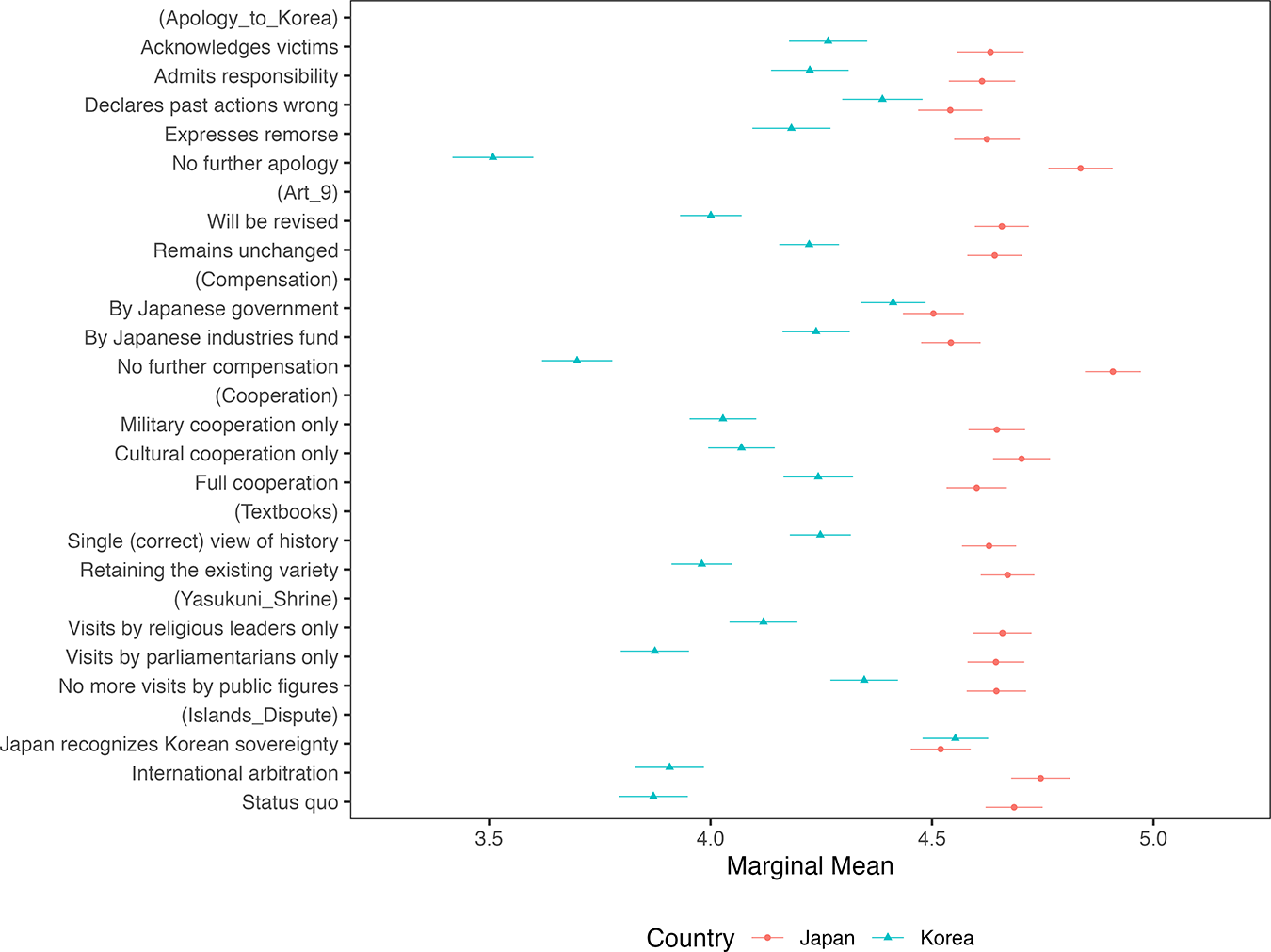
Figure 2, which plots MMs for both countries in a single column, reveals a surprising twist. It shows a striking contrast with the AMCE results in Figure 1. While Figure 1 suggests that justice measures produce contrasting responses, the MMs show that the gap between the two countries is often larger in the absence of such measures than in their presence.
Marginal means of dealing with the past policies in Japan and Korea.

Figure 2 Long description
The dot-and-whisker plot compares marginal means for Japan and Korea across various policy categories. The horizontal axis represents the marginal mean, ranging from 2.5 to 6.0. The vertical axis lists policy categories, such as ′Apology to Korea′ and ′Compensation′. Data points for Japan and Korea are distinguished by color. Notable similarities include marginal means for Korea and Japan in levels like ′Apology declares past actions wrong’. Notable differences between the two countries include ‘No further apology’ and ‘No further compensation.’ The plot reveals clusters around the 4.0 to 5.0 range, with some outliers in categories like ‘No further apology’ and ‘No further compensation.’ The legend indicates the color coding for each country, providing a clear visual distinction between the two.
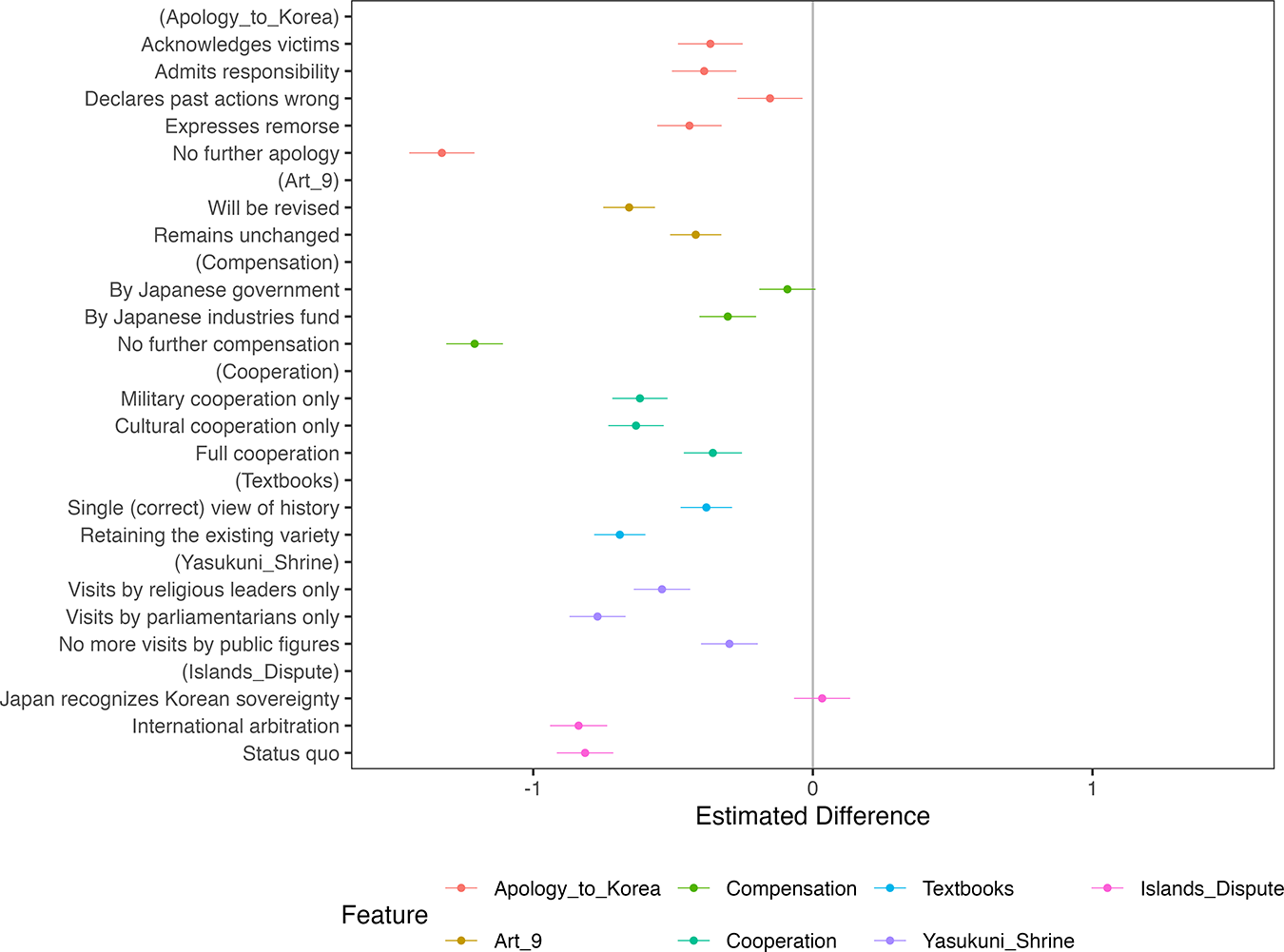
This pattern is further illustrated in Figure 3 (see also Appendix Figures A4 and A6). For example, the absolute difference in MMs (Korea−Japan) is largest in the absence of apology (b = −1.33; p < 0.001), whereas it is substantially smaller for all forms of apology. In fact, the absolute difference is narrowest for an apology declaring past actions wrong (b = −0.15; p = 0.0097). A similar pattern holds for compensation: the absolute difference in the absence of compensation (b = −1.21; p < 0.001) is much larger than for compensation by the Japanese government (b = −0.09; p = 0.076).
Marginal means’ differences between Korea and Japan.

Figure 3 Long description
Feature list on the left with one horizontal point estimate and whiskers per row. The horizontal axis label is, Estimated Difference, with tick labels at minus 1, 0 and 1. A vertical reference line is drawn at 0. The y-axis label is Factor (Feature). The factor labels in brackets and level labels, from top to bottom, are: (Apology to Korea) Acknowledges victims; Admits responsibility; Declares past actions wrong; No further apology; (Art. 9) Will be revised; Remains unchanged; (Compensation) By Japanese government; By Japanese Industries’ Fund; No further compensation; (Cooperation) Military cooperation only; Cultural cooperation only; Full cooperation; (Textbook controversy) Single (correct) interpretation of history; Retaining existing variety; (Yasukuni Shrine) Visits by religious leaders only; Visits by parliamentarians only; No more visits by public figures; (Island Dispute) Japan recognize territorial sovereignty; International arbitration; Maintain status quo. Each row shows a colored point with a horizontal whisker, representing an estimated difference with a confidence interval around the estimate. Two intervals cross the 0 reference line and others do not. A legend at the bottom lists the category names used for the point and whisker colors: Apology, Korea; Art. 9; Compensation; Yasukuni Shrine; Cooperation; Textbook controversy; Island Dispute.
This pattern extends across other policy dimensions. The absolute differences between Korea and Japan associated with other dimensions (representing justice in the eyes of Koreans), such as maintaining the current pacifist status in the Japan’s Constitution (b = −0.42; p < 0.001), restoring full cooperation between countries (b = −0.36; p < 0.001), Japan issuing history textbooks presenting a “correct” interpretation of the past (b = −0.38; p < 0.001), and ending visits to Yasukuni Shrine (b = −0.30; p < 0.001), are generally smaller than the absolute differences associated with alternative policy configurations. In the territorial dispute, the absolute differences under the status quo (b = −0.81; p < 0.001) and international arbitration (b = −0.84; p < 0.001) contrast with the negligible difference when Japan recognizes Korean sovereignty over the islands (b = 0.03; p = 0.51)!
These results thus reveal a counterintuitive pattern: although justice measures generate opposing responses in Japan and Korea, they may reduce the gap between them. In contrast, the absence of justice measures is associated with larger gaps in perceived fairness. Our findings thus provide systematic evidence that dealing with the past is perceived, on average, as more fair in both countries than not dealing with the past. This pattern constitutes the empirical basis of the paradox of justice, which we propose as a conceptual framework for analyzing justice in divided contexts.
This pattern can also be described in relation to the structure of our hypotheses and the statistical measures used to examine them. Hypotheses 2a and 2b capture divergence in the direction of responses across countries, and these expectations are strongly supported by the AMCE results. At the same time, Hypothesis 1c captures convergence between countries and is supported by MMs’ estimates. In sum, while AMCEs indicate divergence, MMs indicate convergence.
Rather than representing a logical contradiction, these findings reflect that the hypotheses capture different types of measurement. Divergence in the direction of effects does not preclude convergence in the narrowing of between-group mean differences. It is precisely the combination of these measurements that constitutes the paradox of justice.
These findings suggest that debates about whether justice measures reconcile or deepen divisions may reflect differences in how outcomes are measured. Analyses focused on responses within groups may observe divergence, whereas those examining differences in the gap between groups may reveal convergence. Analyses that merely control for group divisions may obscure both dynamics. By distinguishing between these dimensions, this article offers a novel account of how justice operates in divided contexts.
Conclusion
In increasingly polarized societies, controversial justice measures are often assumed to deepen social divisions. This article challenges that expectation by showing that such measures may generate divergent effects across groups while simultaneously producing convergence in differences between them. We conceptualize this pattern as the paradox of justice.
To arrive at this conclusion, the article makes three strategic moves. First, it draws on the transitional justice literature, allowing us to organize existing theories into convergent and divergent mechanisms of justice and to formulate corresponding hypotheses. Second, it reconceptualizes the problem of identifying relevant social divisions by treating a divided society as comprising two countries with contested historical legacies. Previously, the evolving nature of historical divisions during and after transition often complicated their identification in research conducted within countries. Third, it leverages relatively recent developments in experimental research, including conjoint designs and associated statistics such as AMCEs and MMs, which enable a more precise measurement of how justice measures are evaluated within and between groups.
Our findings reveal a pattern that cannot be fully captured by either perspective alone. Analyses of effects of justice measures within each country provide strong support for divergence: measures for dealing with the past generate positive effects in the claimant country (Korea) and negative effects in the addressee country (Japan). However, when considering differences between countries, a different pattern emerges. The absolute gap in perceived fairness between Japan and Korea is often larger in the absence of justice measures than in their presence. This means that justice measures are associated with greater convergence between the two countries, despite generating divergent effects within them.
The paradox of justice
We conceptualize this combination as the paradox of justice: justice measures may generate divergent effects across groups while simultaneously reducing the gap between them. In other words, justice measures that appear polarizing may nonetheless bring groups closer together, whereas the absence of such measures may be associated with greater division. Thus, the paradox is not a logical contradiction but a counterintuitive pattern arising from two different types of measurement.
This paradox offers a fresh perspective on the effects of controversial justice measures in divided contexts. Debates about whether justice measures reconcile or deepen divisions may simply reflect differences in how their effects are measured. Analyses focusing on the direction of effects within opposing groups may point to divergence, whereas analyses examining differences in marginal means between these groups may indicate convergence. This distinction suggests that prima facie evidence of disagreement between groups over a controversial justice measure may not fully capture underlying changes in intergroup relations.
Although identified here in a bilateral setting and informed by transitional justice theories, this insight extends to the study of other policies in divided societies. The implementation of any contested policy may, under certain conditions, reduce intergroup polarization. In fact, contemporary social controversies in polarized societies may provide more fertile ground for capturing the paradox and an easier group identification than the context of transitional justice and historical divisions.
The paradox of justice also carries methodological implications. It highlights the need to distinguish between “within-group responses” and “between-group differences.” In conjoint experiments, this requires complementing estimates of AMCEs with MMs and the absolute values of differences in MMs between groups, following Leeper et al. (Reference Leeper, Hobolt and Tilley2020). Focusing solely on the direction of their effects may lead to incomplete or even misleading conclusions about the impact of contested policies.
These considerations point to two general methodological steps for analyzing the impact of a policy dimension in a society divided into Group A and Group B. First, we compare the direction of its effects (AMCEs in conjoint designs) in group A with those in Group B. Second, we compare the absolute values of differences in marginal means (MMs) for that policy dimension between Groups A and B with the corresponding difference in the baseline in the merged sample. Hence, the statistical infrastructure for subgroup analyses in conjoint designs is particularly useful here, although the statistical examinations of the paradox are not limited to this infrastructure.
Conversely, two analytical pitfalls deserve caution. First, when policies are situated in divided contexts, relying solely on effects estimated for the full sample may obscure the underlying dynamics of a divided society. In such cases, opposite effects may offset each other, or the effects may reflect asymmetries in group size. Second, neither statistic alone is sufficient. Effects capture the direction of responses within groups, whereas absolute differences in marginal means capture gaps between groups. Practically, the possibility of a paradox of justice has implications for statistical reporting. To provide a full picture, studies of contested issues in divided contexts should explicitly report effects in group A and effects in group B; marginal means for the absence and the presence of the issue in group A and in group B; and absolute between-group mean differences under the absence and the presence of the contested issue.
The paradox of justice need not be studied only through conjoint designs, although this framework is well suited to its analysis given the availability of statistical and software tools. Other experimental designs and panel surveys may also allow researchers to observe this configuration; cross-sectional surveys are less suitable to capture it.Footnote 10
Configurations of justice effects
The paradox of justice is not a universal property of all justice measures.Footnote 11 It is tied to polarizing (justice, policy) measures in divided contexts and arises under specific conditions. In cases where policies generate “zones of agreement” across groups, convergence may be observed in the same direction of effects and reducing the gap between them. Conversely, when the direction of effects diverges across groups and the gap widens between them, the configuration is divergent. In both situations, the paradox does not emerge. The paradox of justice arises when the two dimensions move in opposite directions: group effects are diverging but the gap (mean differences) between them narrows; and when group responses are converging but the gap widens.
The last constellation indicates a possibility that the between-group gap under a convergent scenario may be larger than that under a paradoxical scenario. In other words, in a divided context, a win–win policy (social policy, reconciliatory measure, justice intervention) may produce modest gains for one group and substantially larger gains for the other, creating a wider gap than a policy that produces modest gains for one group and modest losses for the other. This possibility might be understood as a “second paradox of justice in divided contexts.” We shall label it the “Paradoxical II. (quasi-convergent) configuration”, in contrast to the “Paradoxical I. (quasi-divergent) configuration” observed in this research.
These considerations help us classify different empirical patterns of justice in a divided setting into the following typology: (i) convergent, where both the directions of effects across opposing groups align and the absolute value of between-group differences in means narrows relative to the relevant comparison level (e.g., a level indicating the absence of justice); (ii) divergent, where effects move in opposite directions and the absolute value of between-group mean differences widens; (iii) paradoxical I. (quasi-divergent), where effects move in opposite directions, but the absolute value of between-group mean differences narrows; and (iv) paradoxical II. (quasi-convergent), where effects move in the same direction but the gap widens. We can also distinguish a fifth configuration, (v) undetermined, which captures cases where the directions of effects and mean differences are weak and statistically insignificant.
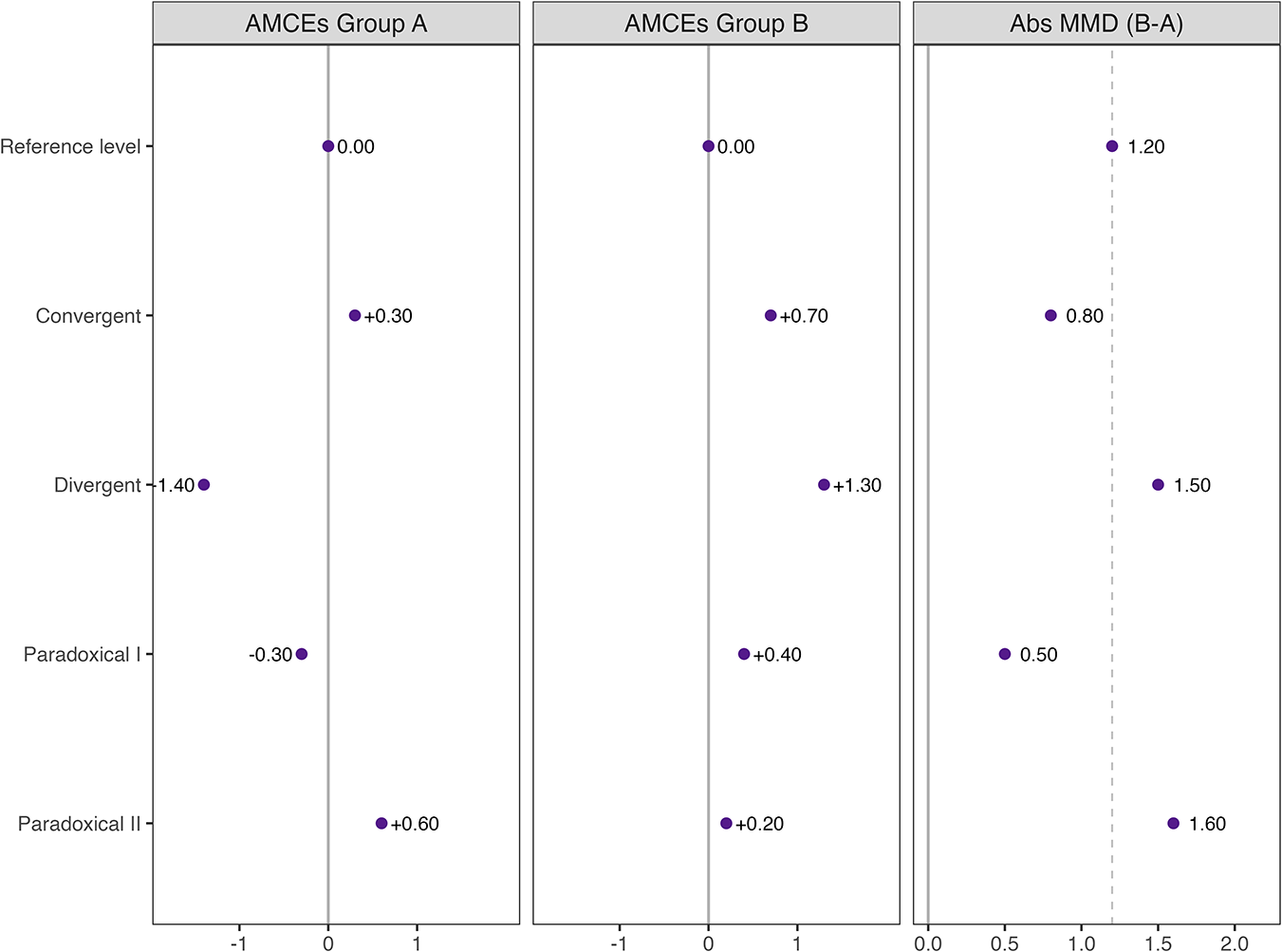
Figure 4 provides a schematic illustration of the four main configurations. The figure is based on simulated data and does not represent observed values from the Japan–Korea case. We expect that paradoxical and divergent configurations are likely to be dominant in divided societies.
Major conceptual configurations of responses to justice measures.

To determine the type of configuration, researchers can follow two steps. First, they assess whether the effects (AMCEs) for Group A and Group B move in the same direction. If so, the configuration is tentatively classified as convergent. If not, it is tentatively classified as divergent. Second, they compare the absolute values of differences in MMs for a justice measure with the baseline. If the difference in the tentatively divergent configuration is smaller than the baseline, the configuration is paradoxical I. (quasi-divergent); if it is larger, the configuration is confirmed as divergent. If the difference in the tentatively convergent configuration is larger than the baseline, the configuration is paradoxical II. (quasi-convergent); if it is smaller, it is confirmed as convergent. However, the substantive meaning of the “baseline” needs to be considered: as in this research, the baseline may represent the absence of justice, complete justice, or a form of justice.
Figure 4 thus illustrates how opposing effects (AMCEs) across groups may coexist with convergence between them (absolute values of differences in MMs), giving rise to the paradox of justice. It is prudent to report the effects for each group separately rather than examine them and report together. In both divergent and paradoxical configurations, effects may cancel each other out when estimated in the full sample, particularly when Groups A and B are of similar size. The data in figure 4 can show what is lost when merely controlling for the group divisions. We can demonstrate it by calculatng the effects for the entire population.Footnote 12 The effect of divergent intervention would almost disappear, although the intervention is highly polarizing. The effect of the quasi-divergent intervention would also almost disappear, obscuring the internal group dynamic. The effects of convergent and quasi-convergent interventions are positive, which would lead to a conclusion about their usefulness. But the gap between the two groups would narrow only for the convergent intervention and widen for the quasi-convergent intervention. As a result, we would miss the intergroup dynamic. Moreover, simply controlling for group membership in an additive model means imposing the same group distance across all cases because the model would give us only a single coefficient for the group control variable. Thus, the heterogeneity of marginal means from Figure 4 would be swept under the “all else equal” carpet.
A model with interaction effects offers a better solution than a simple additive model. However, even with such a model, reporting cannot be limited to the overall coefficient, and coefficients in group A and group B. To understand the intergroup dynamic, we also need to use the model to extract marginal means for each group and the absolute marginal means differences (see note 10). Studies of controversial social issues in societies divided into two camps require understanding not only the effects on these camps but also on the gap between them.
Empirical results for the Japan–Korea case presented in this study predominantly provide strong evidence for the paradoxical I (quasi-divergent) configuration: most justice measures generate effects that move in opposite directions in Japan and Korea while simultaneously reducing the absolute marginal mean differences between them. This pattern is most clearly observed for levels of apologies and compensation (see Figures 1, 2, and A6). However, our results capture how justice measures are evaluated in Japan–Korea relations at a specific point in time. Only repeated observations over time can reveal trends in these relations, including whether paradoxical configurations evolve toward convergence or divergence.
Implications of the paradox of justice
The paradox of justice has implications for the study of divided societies and controversial social issues. In divided contexts, polarization between groups is often a structural condition rather than an outcome. This suggests that researchers should go beyond examining overall effects to delineating how interventions affect and reconfigure the relationship between groups. Accordingly, hypotheses can be formulated in terms of configurations of responses, distinguishing between divergent, quasi-divergent, quasi-convergent, and convergent patterns rather than in terms of effects only.Footnote 13 Recognizing these configurations allows researchers to determine whether seemingly divisive or seemingly reconciliatory policies augment, transform, or mollify existing divisions.
Moving beyond the structure of these effects, this approach also invites studies of how such configurations evolve over time. In contexts of increasing societal polarization, it may accentuate the role of state institutions, such as courts or other authorities, in shaping these configurations. This raises the question of whether and how institutions can prevent divided societies from descending into divergent configurations.
In addition to its possible implications for future research, the paradox of justice invites a reinterpretation of existing studies of social conflict, conflict resolution, and divided societies across social science disciplines. For instance, the paradox may provide analytical leverage for experimental and panel studies of institutional legitimacy of judicial bodies following controversial decisions. Similarly, analyses of “zones of agreement” between conflicting groups may have correctly captured instances of convergence. However, conflict resolution interventions falling outside “the agreement” may be either divergent or quasi-divergent; and seemingly win - win solutions within the zones of agreement may reopen grievances with the realization that one side benefited more from conflict resolution based on the quasi-convergent arrangement.
The underlying logic of the paradox may also qualify some micro-level or experimental studies of justice, conflict and conflict resolution strategies that examine only one side of a historical divide. This approach may capture primarily one dimension: within-group attitudinal changes. While such designs are well suited to addressing certain research questions, such as ethically driven studies of victims of human rights abuses, understanding justice in a divided society requires assessing changes in between-group gaps. While it is obvious that the results of such studies are not sufficient for drawing conclusions about divided societies as a whole, it is less obvious that neither negative nor positive effects observed within that group are sufficient to draw any conclusions about the intervention’s impact on the divide.
Generally, the paradox of justice invites a reconsideration of the assumption that controversial justice measures are inevitably polarizing in divided contexts. It suggests that justice measures that appear polarizing may, under certain conditions, reduce polarization. What appears to be divisive may, in fact, constitute a subtle form of convergence. Conversely, what appears a reconciliatory or win-win solution may, ironically, conceal a subtle form of divergence.
Supplementary material
The supplementary material for this article can be found at https://doi.org/10.1017/lsr.2026.10115.
Acknowledgements
The author thanks P. C. Tam, H. Kim, S. Lim, I. Kasahara, and J. David for their assistance and Cross-Country Research Japan and Gallup Korea for data collection services. The author also thanks three anonymous referees for their insightful comments, which strengthened the article and clarified its main contribution. All datasets are available for review.
Funding Statement
The research project by PI: R. David, CIs: Y. L. Yeung and J. W. Park, titled “Historical Justice and Reconciliation: Dealing with Japan’s Occupation in Korea,” received GRF Award (No. 13643) from the Research Grants Council of Hong Kong.
Conflict(s) of Interest
Nil.
Ethical Standards
Research ethics approval was granted by the Sub-Committee on Research Ethics of the Research Committee, Lingnan University, Hong Kong. Contact Office of Research Support and Knowledge Transfer, Fax: +852 2591 9618, Email: orkt@ln.edu.hk.




 Open access

