Introduction
The two-spotted spider mite (TSSM), Tetranychus urticae Koch (Acari: Tetranychidae) and the western flower thrips (WFT), Frankliniella occidentalis (Pergande) (Thysanoptera: Thripidae) are notorious and economically important pests in various vegetables, ornamental crops and fruit trees worldwide (Kirk and Terry, Reference Kirk and Terry2003; Xu et al., Reference Xu, Borgemeister and Poehling2006). Since the 1970s, WFT has been known as a highly cosmopolitan pest; today, it is recognised as the most important pest of many plants, especially in greenhouses (He et al., Reference He, Guo, Reitz, Lei and Wu2020). Its increasing importance arises not only due to its direct feeding on plant tissues but also because of indirect damage by transmitting various plant viruses (Jones et al., Reference Jones, Scott-Dupree, Harris, Shipp and Harris2005; Reitz, Reference Reitz2009). Furthermore, WFT has developed an extensive resistance to a wide range of pesticides (Gao et al., Reference Gao, Lei and Reitz2012). TSSM is the most critical and polyphagous species of spider mites in greenhouses worldwide (Khanamani et al., Reference Khanamani, Basij and Fathipour2021). This pest is ranked first in a list of ‘top 20 resistant arthropod pests in the world’ because of resistance to 93 pesticide compounds (Whalon et al., Reference Whalon, Mota-Sanchez, Hollingworth and Duynslager2012). Therefore, finding an alternative way of dealing with such a scope of resistance is essential for its successful control. To achieve more sustainable control of WFT and TSSM as well as considering issues arising from the frequent pesticide applications such as pest resistance and their negative impacts on non-target organisms and the environment, it is crucial to implement the most appropriate and safe integrated pest management tools.
Biological control is one of the most important ways that has gained tremendous interest and momentum (Dalir et al., Reference Dalir, Hajiqanbar, Fathipour and Khanamani2021a, Reference Dalir, Hajiqanbar, Fathipour and Khanamanib). Nowadays, this method is best known especially for people who are concerned about the environmental health issues. The phytoseiid mite species are effective natural predators, feeding on a variety of small arthropods, including thrips, spider mites, insect eggs, and nematodes (Alipour et al., Reference Alipour, Fathipour, Farazmand and Khanamani2019; Hashemi et al., Reference Hashemi, Asadi and Khanamani2021; Kadkhodazadeh et al., Reference Kadkhodazadeh, Asadi and Khanamani2021; Khanamani et al., Reference Khanamani, Basij and Fathipour2021; McMurtry et al., Reference McMurtry, Moraes and Sourassou2013). According to the conducted studies, these predators are effective control agents not only in their native environments but also in open-field crops (Xu and Enkegaard, Reference Xu and Enkegaard2010).
The predatory mite, Neoseiulus cucumeris (Athias-Henriot) (Acari: Phytoseiidae) is a type III lifestyle (subtype III-e) phytoseiid mite which is well known as an effective biocontrol agentof small arthropod pests worldwide (McMurtry et al., Reference McMurtry, Moraes and Sourassou2013). One of the best features of this species is its easy rearing and establishment on crops. It has been commercially mass-produced and used against phytophagous mites and insects, especially thrips. This predatory mite has been used in several greenhouses against various thrips and successfully controlled them on different vegetable crops, including cucumber and sweet pepper (Van Lenteren et al., Reference Van Lenteren, Roskam and Timmer1997). Although WFT, onion thrips, Thrips tabaci Lindeman (Thysanoptera:Thripidae), and plague thrips, Thrips imaginis (Bagnall) (Thysanoptera:Thripidae) are the primary targets for N. cucumeris, this predator can also feed on other sources, such as pollen and mites (Afshari-Nejad et al., Reference Afshari-Nejad, Hajiqanbar and Fathipour2023; Gravandian et al., Reference Gravandian, Fathipour, Hajiqanbar, Riahi and Riddick2022; Khanamani and Dalir, Reference Khanamani and Dalir2025; Naqshbandi et al., Reference Naqshbandi, Fathipour, Hajiqanbar and Yazdanpanah2023; Yazdanpanah et al., Reference Yazdanpanah, Fathipour, Riahi and Zalucki2023).
Life table, predation capacity, and switching behaviour are the important tools used to evaluate a predator’s fitness and effectiveness (Fathipour and Maleknia, Reference Fathipour and Maleknia2016; Khodayari et al., Reference Khodayari, Fathipour and Sedaratian2016). Two-sex life table, which is important in understanding a predator’s performance, has been frequently used to make the appropriate population curves because of considering the data of both sexes of an organism (Huang and Chi, Reference Huang and Chi2012). The fitness of N. cucumeris with different prey species has been evaluated and compared using life table studies (Al-Azzazy et al., Reference Al-Azzazy, Al-Rehiayani and Abdel-Baky2018; Al-Shemmary, Reference Al-Shemmary2018; Sarwar et al., Reference Sarwar, Wu and Xu2009; Yazdanpanah et al., Reference Yazdanpanah, Fathipour and Riahi2022; Zhang et al., Reference Zhang, Zhang, Lin and Ji2000). Moreover, sometimes, two or more pests that are consumed by a predator are presented simultaneously in a crop. This may complicate the focus of the control strategy as the predator is able to select prey. In this respect, it is said that the predator displays switching behaviour (Murdoch, Reference Murdoch1969). Although the switching behaviour of some phytoseiid mites has been investigated between different prey species or different stages of one species (Bazgir et al., Reference Bazgir, Shakarami and Jafari2020; Dalir et al., Reference Dalir, Hajiqanbar, Fathipour and Khanamani2021b; Fathipour et al., Reference Fathipour, Maleknia, Soufbaf and Reddy2020; Heydari et al., Reference Heydari, Allahyari and ZahediGolpayegani2016). However, for N. cucumeris there is little information.
Due to the severe and simultaneous infestation of greenhouses with WFT, Frankliniella occidentalis (Pergande) (Thysanoptera: Thripidae) and TSSM, Tetranychus urticae Koch (Acari: Tetranychidae), this study was designed with the following objectives: (a) determining the fitness of this predator when offered the two pest species using a two-sex life table, (b) computing the predation rate of the predator on the two prey species, and (c) potential prey switching of the predator between the most preferred stages of each species when encountering both prey species at different ratios.
Materials and methods
Culture of the mites and thrips
The specimens of T. urticae were collected from a polyhouse in the Faculty of Agriculture, Tarbiat Modares University, Tehran. The spider mite individuals were maintained for several generations on seedlings of the bean plant (Phaseolus vulgaris L. var. Khomein) grown regularly in vermiculite in plastic pods under greenhouse conditions (25 ± 5 °C, 50 ± 10% relative humidity (RH) and 16:8 h (L:D)). The leaves infested with spider mites were cut from plants and transferred to new plants as the initial population.
To establish the colony of F. occidentalis, the adult females were collected from the flowers of eggplant, Solanum melongena L. (Solanaceae), and Chrysanthemum lavandulifolium (Fisch. ex Trautv) (Asteraceae) planted in a polyhouse in the Faculty of Agriculture, Tarbiat Modares University, and transferred to the laboratory. The 300-ml plastic bottles were used for rearing the thrips. A 3-cm diameter hole in both side walls of the bottles was covered with a net to provide ventilation and prevent thrips from escaping. Three green bean pods (P. vulgaris) were added to each bottle every 2 days to allow development and reproduction. To increase the fertility of thrips, a little cattail pollen (Typha latifolia L.) was added as extra food to each rearing container using a fine brush. For obtaining the first-instars of thrips as prey, the females were given time to oviposit on pods for 12 h. Then, the pods were moved into new plastic bottles after shaking them (to remove insects). The new bottles containing thrips eggs were transferred to the incubator at 25 ± 1 °C, RH of 60 ± 5%, and a photoperiod of 16:8 h (L:D). The pods were regularly monitored, and as soon as the first instar appeared, they were used as prey for the experiments.
Neoseiulus cucumeris specimens were purchased from Bio-Planet, Italy. The predator colony was established on artificial arenas consisting of a plastic sheet (20 × 15 × 0.1 cm) situated on water-saturated foam soaked in water in a plastic container (25 × 16 × 12 cm). Moist tissue paper was used to cover all edges of the sheets as a barrier to prevent mites from escaping. Some cotton fibers were attached in the centre of the sheets as shelter and oviposition place. The predatory mite individuals were released on the sheet, and the bean leaves infested with the spider mites were added to the colony every 3 days. A small amount of cattail pollen was added to the colony as a supplementary food source. The units were kept in a growth chamber at 25 ± 1 °C, RH of 60 ± 5%, and a 16: 8 h (L:D) photoperiod.
Life table and consumption rate experiments
Before age standardisation, the predator individuals from the stock colony were reared on T. urticae nymphs and WFT first instars separately for two generations. Then, to obtain the same-aged eggs, 70–100 adult females from the mentioned colonies were introduced to new arenas and they were removed after 24 h. Each new arena is composed of a 7 × 4 cm bean leaf piece placed upside down on a 7 × 4 × 4 cm absorbent piece of sponge fixed onto a plastic container (8 × 5 × 5 cm) half-filled with water. Four edges of the leaf were covered with wet stripes of tissue paper to prevent mites from escaping. To provide excess shelter and oviposition site, some cotton fibers were added to the leaf. After 24 h, the eggs were transferred to the experimental units individually. The only difference between these units and the previous arenas was related to the smaller size of the experimental units, i.e. a bean leaf bit (3 × 2 × 0.1 cm) located abaxial side up on a sponge piece (4 × 2 × 2 cm) into a plastic container (8 × 5 × 5 cm) filled with water. Water was inserted into the containers to keep the leaf fresh and stop mites from exiting. The units were kept in a growth chamber at 25 ± 1 °C, RH of 60 ± 5%, and a 16: 8 h (L:D) photoperiod. To investigate the influence of the different prey species on the predator’s development, after egg hatching, they were fed daily with either the immature stages of TSSM or the first instars of WFT, depending on the tested diet. The units were monitored daily, and the developmental stage, along with immature mortality was recorded. When the mites became adults, male and female individuals were paired and transferred to a new experimental unit and fed with the same diet they were reared on during immature stages. During daily observation, the adults’ longevity, oviposition period, sex ratio, mortality, and adult lifespan were recorded until the death of the last individual. In addition, the eggs laid by the female were recorded to measure fecundity. To prevent leaf senescence and maintain plant quality, the leaf pieces were replaced every alternate day. Before the emergence of adults, the predator individuals were supplied with 10 individuals of TSSM nymphs (protonymph and deutonymph) or the first instars of WFT that they were renewed daily. As soon as adults emerged, the number of prey increased to 30 individuals/unit/day. To calculate the predation rate, the consumed prey was recorded daily during the life table experiments until the last individual death.
Prey switching
The switching of N. cucumeris females was evaluated in two different experiments. The first experiment was tested with protonymphs of TSSM and first instars of WFT, while it was investigated on eggs of TSSM and first instars of WFT in the second test. Females of N. cucumeris were starved for 12 h, then they were supplied with the seven ratios of prey density combinations: 5:35, 10:30, 15:25, 20:20, 25:15, 30:10, and 35:5 either T. urticae protonymphs: F. occidentalis first instars or T. urticae eggs: F. occidentalis first instars. One predator was used per each experimental unit. Each density was tested with 15 replicates. The females were remowed after 24 h, and the consumed prey was recorded by counting the remaining of both prey types in each ratio under a stereomicroscope.
Statistical analysis
The life table data (n = 70 for both TSSM and WFT) obtained from daily observations of experimental units were used to construct the two-sex life table for N. cucumeris. All life table parameters, including the gross reproductive rate (GRR), net reproductive rate (R 0), intrinsic rate of increase (r), finite rate of increase (λ), and mean generation time (T) were computed using the procedure recommended by Chi and Liu (Reference Chi and Liu1985) and Chi (Reference Chi1988) using the TWOSEX-MSChart software (Chi, Reference Chi2021a). Bootstrap procedure (with 100,000 samples) was used to estimate the parameters’ variances and standard errors. Mean comparisons of the parameters between different prey species were carried out by the paired bootstrap test using TWOSEX-MSChart software.
The means and SEs of predation parameters (the finite predation rate (ω), transformation rate (Qp), stable predation rate (Ψ), and net predation rate (C 0) were estimated using the bootstrap resampling method (100,000 samples) by the CONSUME-MSChart software (Chi, Reference Chi2021b; Chi and Yang, Reference Chi and Yang2003). Similarly, the paired bootstrap test was used for multiple comparisons (Chi, Reference Chi2021a).
To analyse the results of switching experiments, Murdoch (Reference Murdoch1969) described the null or no switch model for a system with two prey species as equation (1):
 \begin{equation}{P_{\text{1}}} = C{\text{ }} \times {F_{\text{1}}}/\left( {1-{F_{\text{1}}} + \left[ {C \times {F_{\text{1}}}} \right]} \right)\end{equation}
where F 1 is the proportion of prey 1 in the environment, P 1 is the proportion of prey 1 among all prey consumed, and c is a parameter which was calculated from equation (2):
 \begin{equation}{N_{\text{1}}}{\text{/}}{N_{\text{2}}}{ = c(}{E_{\text{2}}}{\text{/}}{E_{\text{1}}}{\text{)}}\end{equation}
where N 1 and N 2 are the number of prey 1 and 2 available, respectively. Furthermore, E 1 and E 2 are the number of prey 1 and 2 eaten, and c, which shows preference is constant. The latter can be defined as the ratio of prey species 1 to 2 killed when the two prey is equally abundant. Preference does not exist when c = 1; the first prey is preferred when c > 1, and there is a preference for prey 2 when c < 1 (Murdoch, Reference Murdoch1969). Eventually, to test the switching hypothesis, the observed ratio was compared with the expected ratio based on the ratios given.
To compare the prey type favorability for the predator and the intensity of predator preference, for all of density proportions, the means of each prey type consumed by N. cucumeris at each ratio of either WFT first instars to TSSM protonymphs or WFT first instars to TSSM eggs were compared with those consumed by the predator at the same ratio using the t-test (P < 0.05) in Minitab (v. 16). Also, the mean number and percentage of each prey type consumed by the predator at each density proportion was compared using the t-test (P < 0.05) in Minitab (v. 16).
Results
Life table parameters
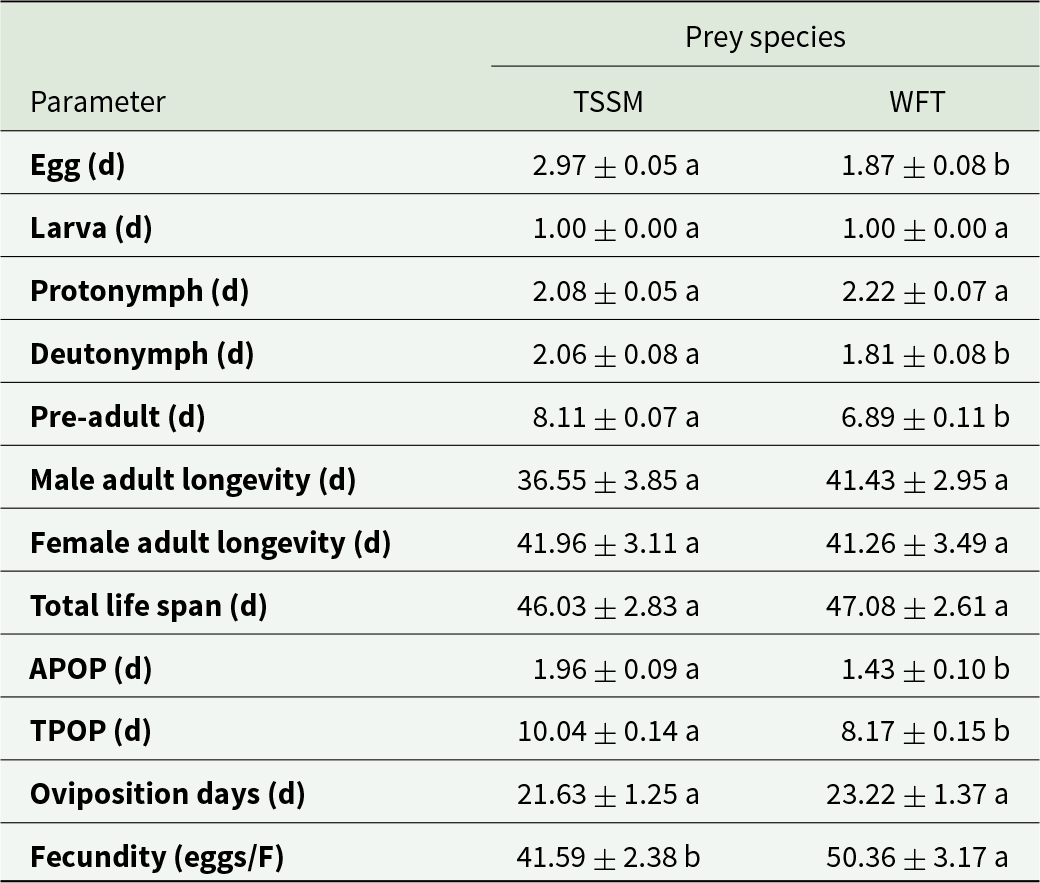
Neoseiulus cucumeris could complete its development from larva to adult on both prey species (table 1). While there was a significant difference between the duration of egg and deutonymphal stages between the predator individuals fed on TSSM and WFT, the durations of larva and protonymph did not differ between the tested species (table 1). The developmental time of the predator individuals fed on TSSM was significantly longer than those reared on WFT. Both female and male longevities and the predator’s total lifespan were not significantly different on TSSM and WFT.
Mean value (±SE) of biological features of Neoseiulus cucumeris fed on two prey types: Frankliniella occidentalis (WFT) first instars and Tetranychus urticae (TSSM) nymphs

APOP, adult pre-oviposition period (the duration from adult emergence to the first oviposition); TPOP, total pre-oviposition period (the duration from egg to the first oviposition).
Means followed by different letters in the rows are significantly different (P < 0.05, Paired bootstrap test).
There was a significant difference between the two prey species affecting the adult pre-oviposition period (APOP) and total pre-oviposition period (TPOP). When the diet was TSSM nymphs, the females had longer pre-oviposition periods than when WFT first instars was the diet (table 1). Oviposition days of N. cucumeris reared on TSSM did not differ from those fed on WFT. Predators praying on WFT laid a significantly higher number of eggs than when feeding on TSSM (table 1).
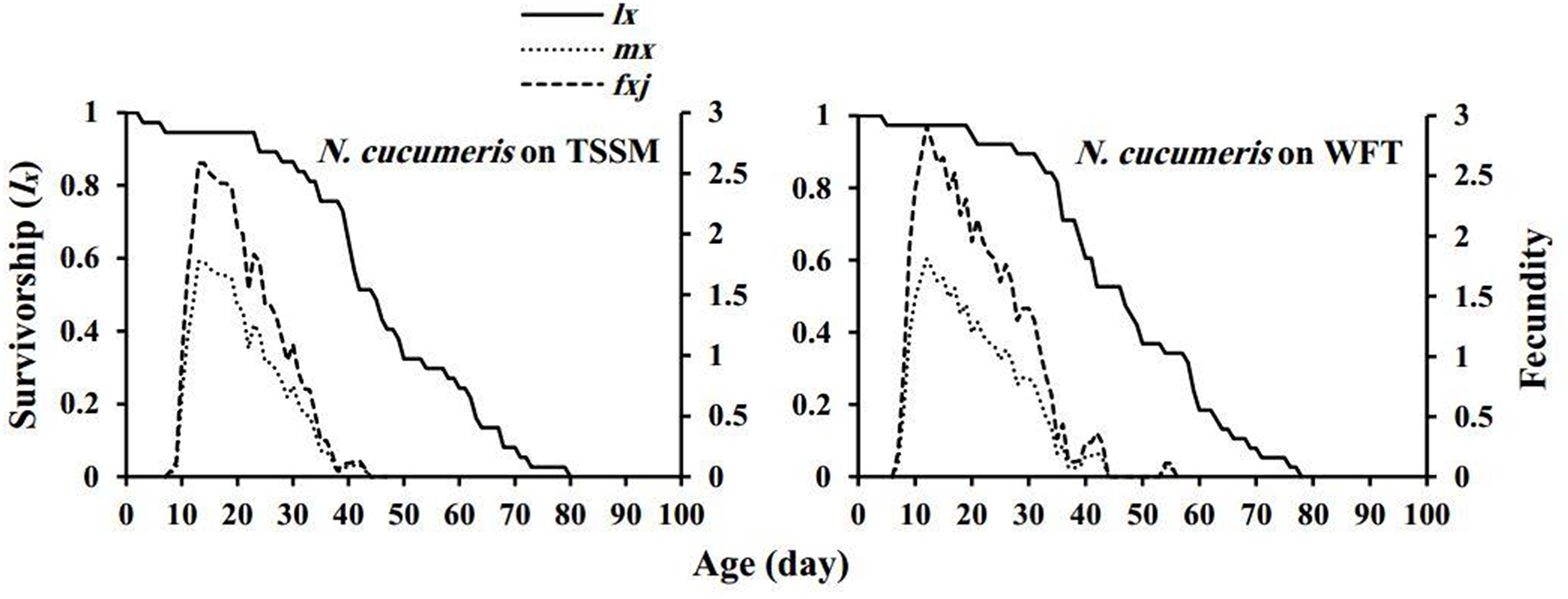
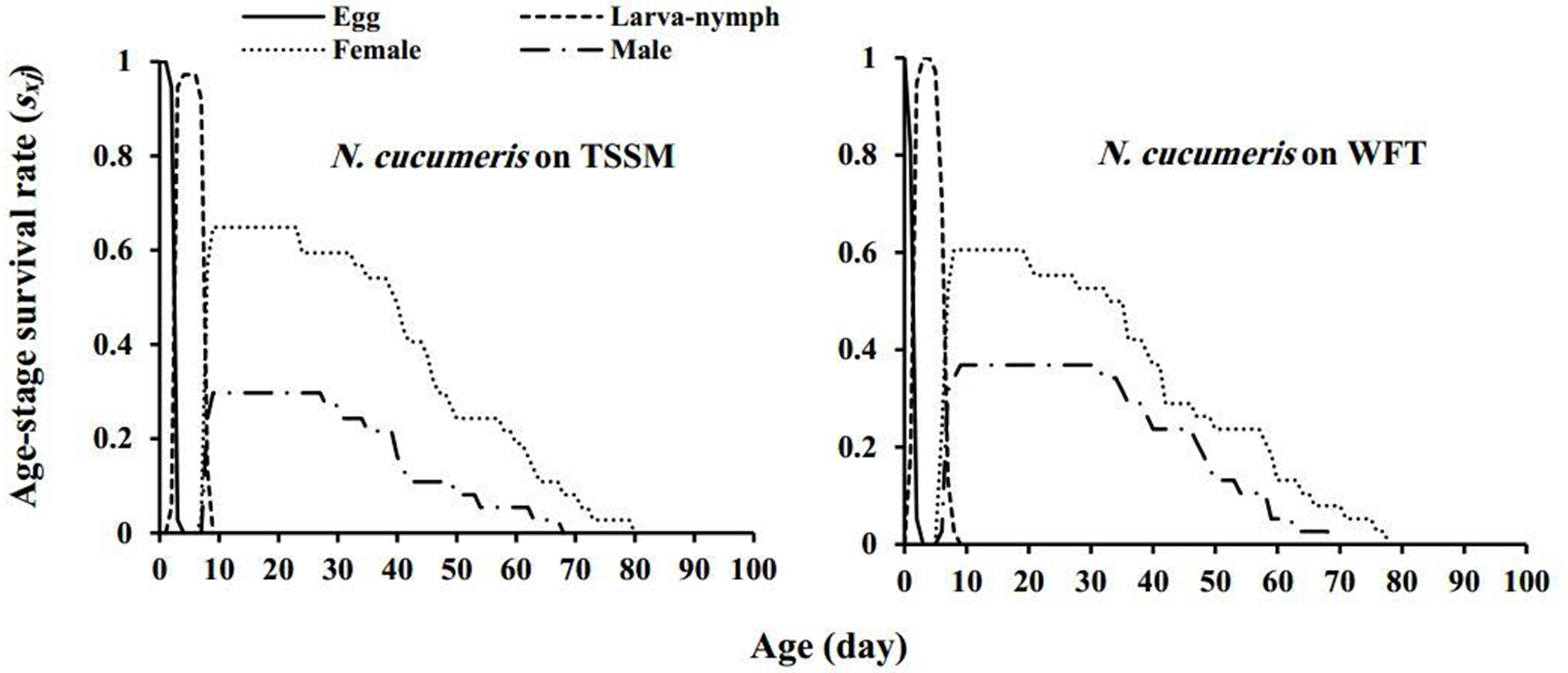
Age-specific survivorship (lx), age-specific fecundity (mx), and age-stage fecundity of female (fxj) of N. cucumeris on TSSM and WFT are depicted in fig. 1. The highest values of mx and fx of this predator when fed on WFT were 1.81 eggs/individual and 2.91 eggs/female, respectively, occurred at the age of 12 days. These parameters were 1.77 eggs/individual and 2.58 eggs/female at the ages of 13–14 days when the food was TSSM (fig. 1). Overlaps among different stages of N. cucumeris, illustrating the age-stage-specific survival rate (sxj) (fig. 2) are due to the variable pre-adult development among individuals. These overlaps cannot be perceived in the age-specific survivorship (lx) curve.
Age-specific survivorship (lx), age-stage fecundity of female (fxj) (offspring), and age-specific fecundity (mx) of Neoseiulus cucumeris reared on two prey types: Frankliniella occidentalis (WFT) first instars and Tetranychus urticae (TSSM) nymphs.

Age-stage-specific survival rate (sxj) of Neoseiulus cucumeris reared on two prey types: Frankliniella occidentalis (WFT) first instars and Tetranychus urticae (TSSM) nymphs.

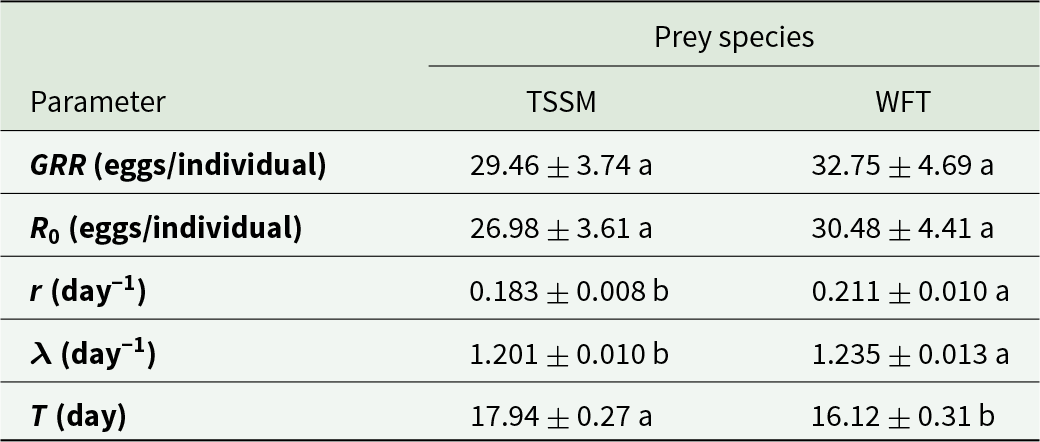
The net reproductive rate (R 0) of N. cucumeris was 26.98 and 30.48 eggs/individual by feeding on TSSM, and WFT, respectively. Under these conditions, the intrinsic rate of increase (r) was 0.183 and 0.211 day−1, respectively, while the finite rate of increase (λ) was 1.201 and 1.235 day−1, respectively. The latter parameters (r and λ) were significantly higher when the prey was WFT than TSSM. A paired bootstrap test between the two prey species indicated no significant difference in gross and net reproductive rates (table 2). The mean generation time (T) was shorter for N. cucumeris fed on WFT than TSSM (table 2).
Mean value (±SE) of population growth parameters of Neoseiulus cucumeris fed on two prey types: Frankliniella occidentalis (WFT) first instars and Tetranychus urticae (TSSM) nymphs

GRR, gross reproductive rate; R0, net reproductive rate; r, intrinsic rate of increase; λ, finite rate of increase; T, mean generation time.
Means followed by different letters in the rows are significantly different (P; < 0.05, Paired bootstrap test).
Predation parameters
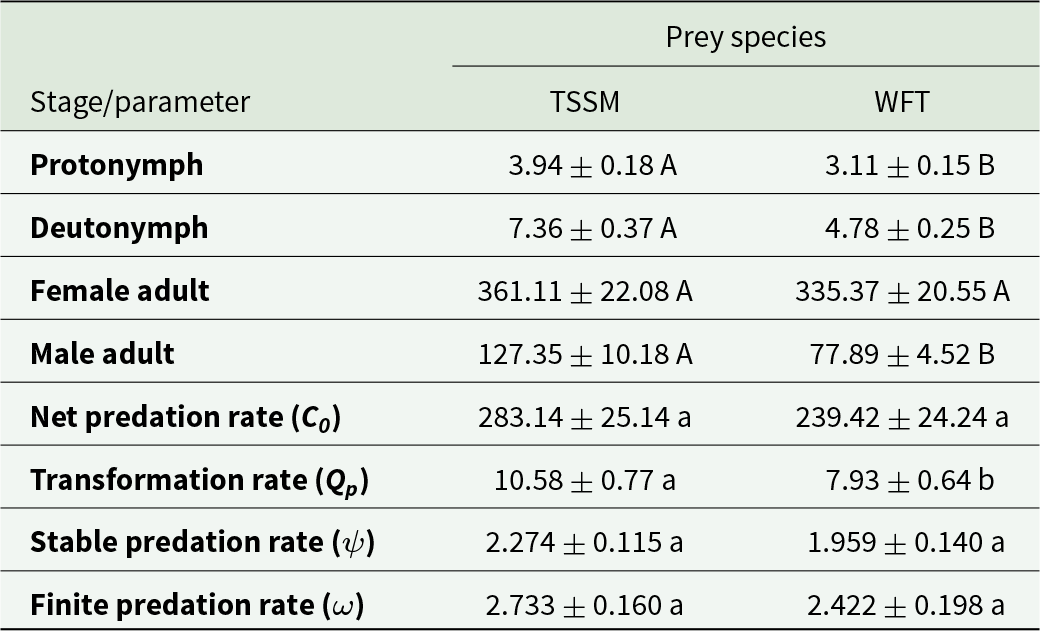
There was a significant difference in the predation capacity most of different life stages of N. cucumeris when fed on two different prey species (table 3). Protonymphs, deutonymphs, and males of N. cucumeris consumed significantly more TSSM than WFT (table 3). In addition, there was no significant difference in net predation rate, stable and finite predation rates of this predator between the two prey species. The Qp indicated that N. cucumeris required an average of 10.58 and 7.93 TSSM immatures and WFT first instars to produce a single predator egg, respectively (table 3).
Mean value (±SE) of predation rates of Neoseiulus cucumeris fed on two prey types: Frankliniella occidentalis (WFT) first instars and Tetranychus urticae (TSSM) nymphs

The means followed by different capital letters in the rows are significantly different (P < 0.05, Tukey). The means followed by different small letters in the rows are significantly different (P < 0.05, Paired bootstrap test).
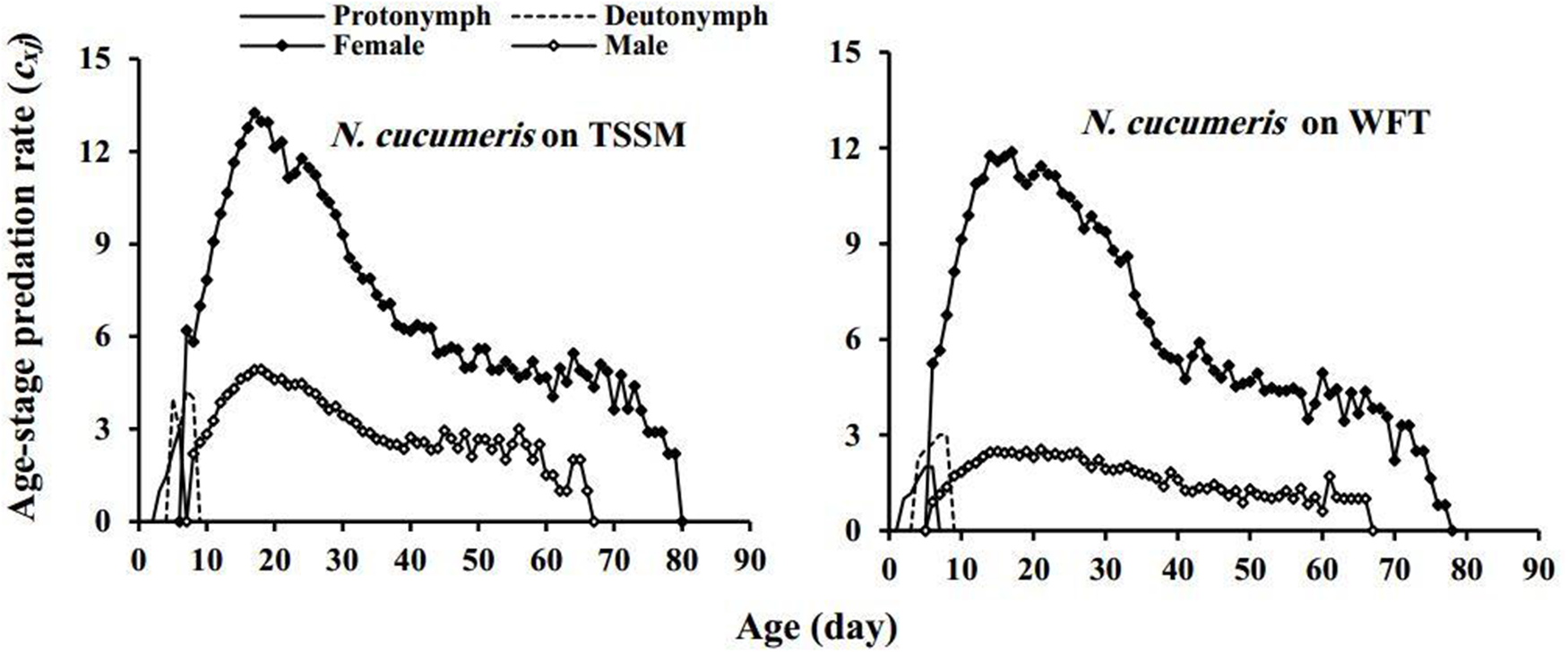
Age-stage-specific consumption rates of (Cxj) of immatures and adult of N. cucumeris is shown in fig. 3. Adults consumed more prey than immatures, and deutonymphs ate more prey than protonymphs. Furthermore, the daily consumption rate of females in the oviposition period was more than in pre- and post-oviposition periods (fig. 3). The highest value of Cxj was 13.25 and 11.87 prey for females, while it was 4.94 and 2.49 prey for males when TSSM and WFT were the diet, respectively (fig. 3).
Age-stage-specific predation rate (cxj) of Neoseiulus cucumeris reared on two prey types: Frankliniella occidentalis (WFT) first instars and Tetranychus urticae (TSSM) nymphs.

Prey switching
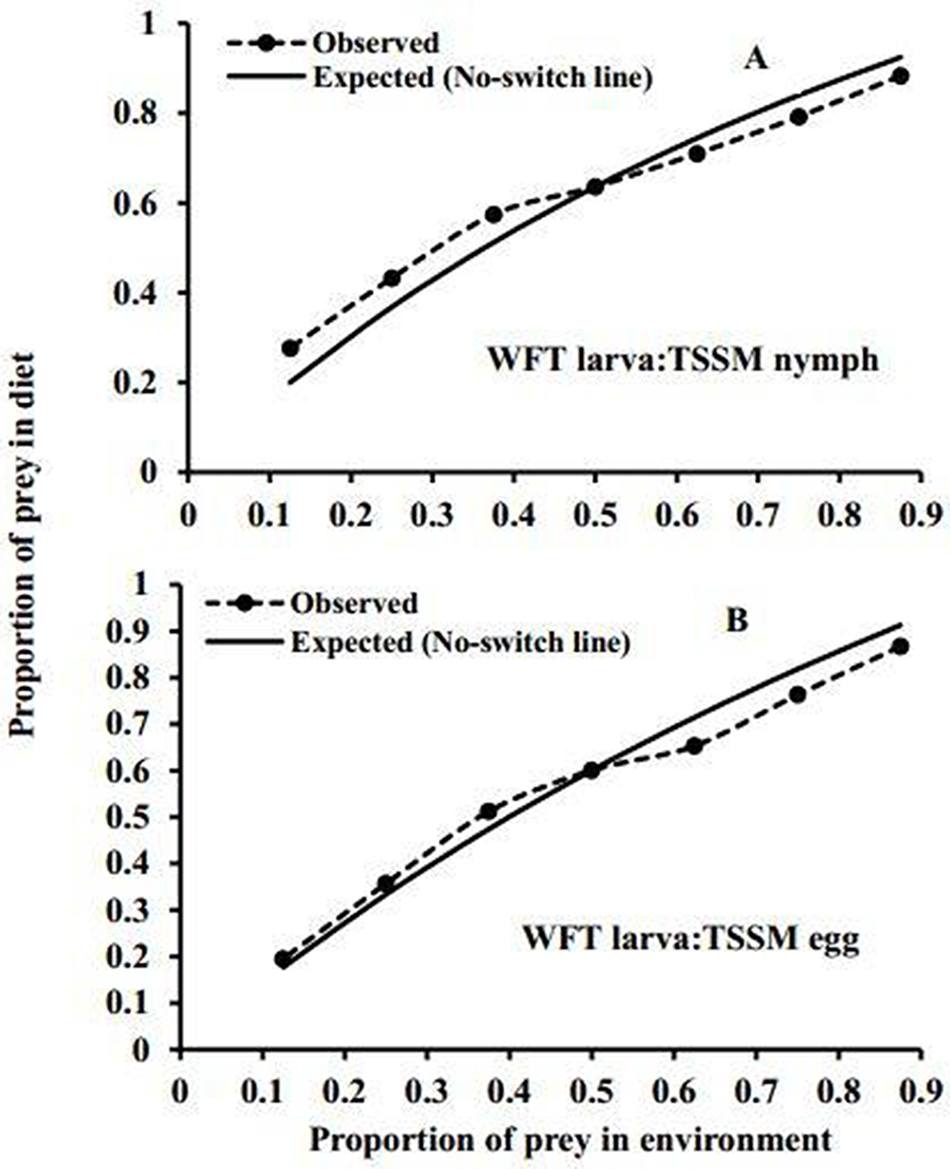
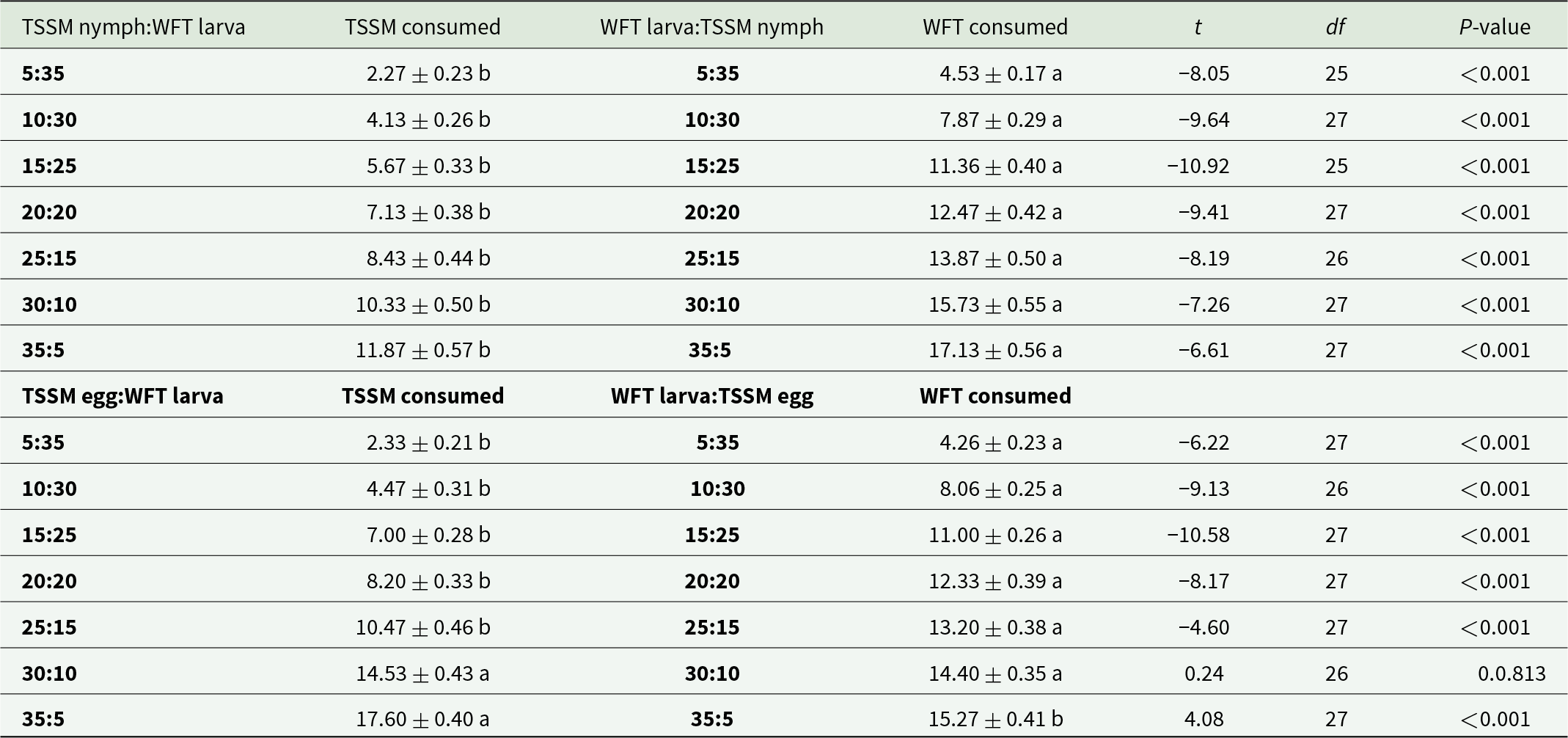
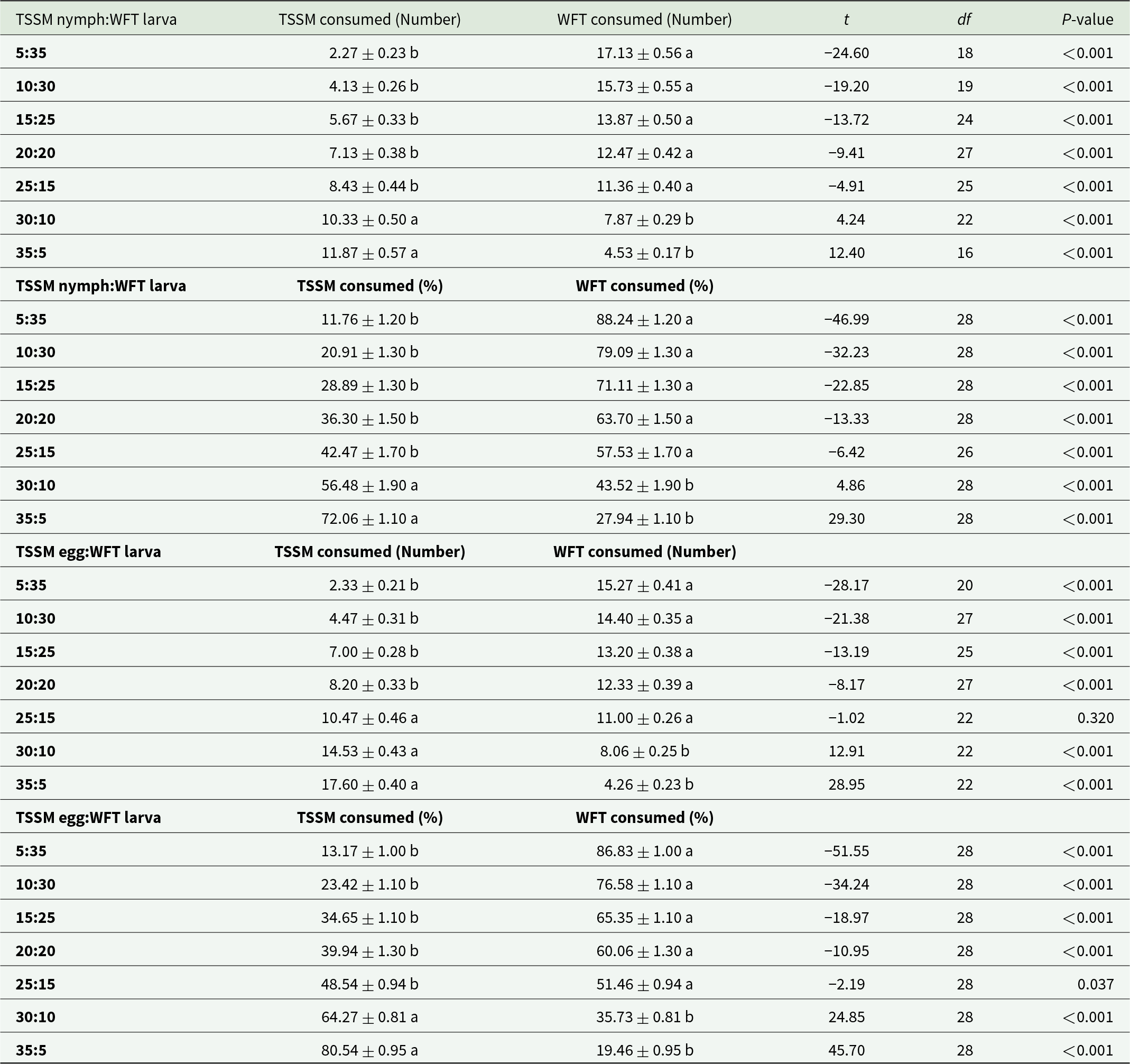
We found a distinct negative switching in the behaviour of N. cucumeris in the presence of TSSM and WFT (fig. 4). The predator switched from TSSM nymphs when they were abundant to WFT first juvenile instar that were rare and vice versa (fig. 4A). At all ratios of TSSM nymphs to WFT first juvenile instars, a higher predation rate on WFT occurred in its lower proportions and this trend gradually decreased as its abundance increased, showing the negative switching behaviour (fig. 4A, table 4). Furthermore, in the equal numbers of TSSM and WFT, the predation rate of the predator on WFT was higher than on TSSM. Similarly, such behaviour was observed when TSSM eggs and WFT first juvenile instar were offered to N. cucumeris (table 4, fig. 4B). In the both switching experiments, at all relative densities of WFT first juvenile instars to either TSSM nymphs or TSSM eggs, WFT were significantly preferred over TSSM except for the ratios of TSSM eggs to WFT first juvenile instar of 30:10 (t 26 = 0.24, P = 0.813) and 35:5 (t 27 = 4.08, P < 0.001), which represents the predator consumed more TSSM eggs than WFT first juvenile instar (table 4). Moreover, at all relative densities, WFT first juvenile instars consumed by the predator were significantly higher than TSSM (nymphs or eggs) except for the treatments of 30:10 and 35:5 (TSSM:WFT) (table 5). The preference value (c) calculated with Murdoch’s index was used to depict Murdoch’s no-switch line (fig. 4). It is apparent from this figure that preference changed with rising relative density. For example, at the relative density of 30:10 (0.75) (TSSM nymph:WFT first juvenile instar), TSSM nymphs were significantly preferred over WFT first juvenile instar (table 4, fig. 4A).
Proportion of Frankliniella occidentalis (WFT) larvae in Neoseiulus cucumeris diet as a function of their relative abundance in environment in the switching experiments between WFT first instars and Tetranychus urticae (TSSM) protonymphs (A) and eggs (B).

Mean number (±SE) of Frankliniella occidentalis and Tetranychus urticae consumed by Neoseiulus cucumeris at the same density of different ratios of either F. occidentalis first instars to T. urticae protonymphs or F. occidentalis first instars to T. urticae eggs

The means followed by different letters in the rows are significantly different (P< 0.05, t-test).
Mean number and percentage (±SE) of Frankliniella occidentalis and Tetranychus urticae consumed by Neoseiulus cucumeris at different ratios of either F. occidentalis first instars to T. urticae protonymphs or F. occidentalis first instars to T. urticae eggs

The means followed by different letters in the rows are significantly different (P < 0.05, t-test).
Discussion
In this study, the life table parameters and foraging behaviour which are the most critical procedures in investigating the efficiency of a predator were evaluated for N. cucumeris on two prey species. The results of the current study showed that the biological parameters of N. cucumeris depended on prey type. Neoseiulus cucumeris could successfully complete its development from egg to adult on both prey species tested in this study. Such a successful development for this predator has been documented while predating on different arthropod species such as Panonychus citri (McGregor) (Acari: Tetranychidae) (Zhang et al., Reference Zhang, Zhang, Chen, Lin and Chen2001), Polyphagotarsonemus latus (Banks) (Acari: Tarsonemidae) (Li et al., Reference Li, Yang, Qu and Wu2003), T. tabaci (Abou-Eella and Abou-Eella, Reference Abou-Eella and Abou-Eella2001), and Aculops lycopersici (Massee) (Acari: Eriophyidae) (Al-Azzazy et al., Reference Al-Azzazy, Al-Rehiayani and Abdel-Baky2018). We found a reduction in the pre-adult duration and an increase in fecundity when the predator was fed with thrips compared with the mites. The positive impact of F. occidentalis than T. urticae on the juvenile development of N. cucumeris in this study is in agreement with our previous study (Dalir et al., Reference Dalir, Fathipour, Khanamani and Hajiqanbar2024) with Amblyseius swirskii (Athias-Henriot) (Acari: Phytoseiidae), in which the predator performs very well on thrips. Although both prey was shown to be appropriate for A. swirskii reproduction resulting in insignificant fecundity, oviposition day and growth rate (Dalir et al., Reference Dalir, Fathipour, Khanamani and Hajiqanbar2024). Unlike our study, Abou-Eella and Abou-Eella (Reference Abou-Eella and Abou-Eella2001), reported a faster development of this predator on T. urticae than T. tabaci. Furthermore, less fecundity and more extended immature development were observed when the predator fed on F. occidentalis as prey than when given T. urticae (Sarwar et al., Reference Sarwar, Wu and Xu2009). However, the observed opposite trend can be attributed to some differences between this study and our work including different experimental design, different total prey items offered to the predator, and heterogeneous size of preys given.
The intrinsic rate of increase (r) is one of the most important criteria used to evaluate the efficiency of a predator on different prey or several predators on one prey (Sabelis, Reference Sabelis, Helle and Sabelis1985). Because this parameter results from various parameters such as male and female longevity, fecundity, survival, and developmental time, it is considered the best criterion for determining specimen efficiency. Considering the results of this study, it is revealed that the r value of N. cucumeris on WFT (0.211 day−1) was significantly higher than TSSM (0.183 day−1). Since feeding on TSSM resulted in an obvious lower r, fecundity, and longer developmental time, APOP, and TPOP compared to WFT, we can conclude that it has poor nutritional quality than thrips for N. cucumeris.
The reported r and fecundity values of A. swirskii on WFT (0.176 day −1, 33.51 egg) and TSSM (0.157 day −1, 39.12 egg) (Dalir et al., Reference Dalir, Fathipour, Khanamani and Hajiqanbar2024) are lower than our finding for N. cucumeris. Differences in the results obtained, despite using the same prey, indicate that phytoseiid mite species differ in their ability to utilise prey species. In the studies of Al-Azzazy et al. (Reference Al-Azzazy, Al-Rehiayani and Abdel-Baky2018) and Yazdanpanah et al. (Reference Yazdanpanah, Fathipour and Riahi2022), the intrinsic rate of increase was lower than that of our study when N. cucumeris fed on T. urticae. Although, the results of Gravandian et al. (Reference Gravandian, Fathipour, Hajiqanbar, Riahi and Riddick2022) on T. urticae were closer to our study (after 10 generations rearing of the predator on pollen), their findings were generation-dependent and are affected by the long-term rearing on alternative diet. Furthermore, prey, A. lycopersici (Al-Azzazy et al., Reference Al-Azzazy, Al-Rehiayani and Abdel-Baky2018), and non-prey food diets such as pollen grains (Afshari-Nejad et al., Reference Afshari-Nejad, Hajiqanbar and Fathipour2023; Ranabhat et al., Reference Ranabhat, Goleva and Zebitz2014; ), resulted in an apparent lower population growth rate compared to our results. It is difficult to compare the food quality among laboratory and field studies for a given predator due to the differences in the populations of prey or predator, their history and storage condition, estimation of parameters, and experimental designs.
The ability of various species of phytoseiid mites to feed on different prey species is different and dependent to a large extent on the interactions between prey and predator. It has been proved that only first and second thrips instars can be attacked by the members of Phytoseiidae because of the predator–prey size ratio, and N. cucumeris can feed only on first juvenile instar of thrips (Bakker and Sabelis, Reference Bakker and Sabelis1989). Although the recorded predation rate of N. cucumeris immatures and males on young WFT first juvenile instar was lower than TSSM immatures in our study, it did not differ for the females. Considering the small size of immatures and males, possibly related to reduced physical intensity if compared to females, and the better females’ performance (higher oviposition and growth rates) on thrips first instars, it can be concluded that the lower feeding capacity of immature and male predator cannot be due to the lower palatability or the lower nutritional value of thrips. The lower predation rate of immatures and males can probably be attributed to the well-reported capability of thrips juveniles to show anti-predator behaviour against predators by shaking their abdomen and distributing rectal droplets (Bakker and Sabelis, Reference Bakker and Sabelis1989). In addition, we found that this predator consumed 283 TSSM and 239 WFT during its life span, with no statistically significant differences. In some relevant studies, a higher net predation rate was reported on T. urticae immature for this predator (Gravandian et al., Reference Gravandian, Fathipour, Hajiqanbar, Riahi and Riddick2022; Naqshbandi et al., Reference Naqshbandi, Fathipour, Hajiqanbar and Yazdanpanah2023; Yazdanpanah et al., Reference Yazdanpanah, Fathipour, Riahi and Zalucki2023). In these reports, the initial number of prey offered to the predator was considerably higher than that of our study which resulted in the higher prey consumption based on the functional response concept. It is also necessary to be noted that the long-term effect of rearing on pollen diet could be effective in increased prey consumed in the mentioned studies. However, in the study of Popov and Kondryakov (Reference Popov and Kondryakov2008), this value was 201 on Tetranychus atlanticus McGregor (Acari: Tetranychidae).
The variable patterns of predation may be found when the presence of multiple prey species differs in prey accessibility, acceptance, and adaptability of a predator (Chow and Mackauer, Reference Chow and Mackauer1991). Positive switching behaviour occurs when a natural enemy parasitize/attacks disproportionately more of the most abundant host/prey (Murdoch, Reference Murdoch1969). Conversely, negative switching behaviour happens in cases where a natural enemy has a strong preference for a rare host/prey and accepts disproportionately more of that (Chesson, Reference Chesson1984). Such negative switching was found in our experimental data. Our study indicated that N. cucumeris strongly preferred prey species with less density, so switching to the most abundant prey did not happen. In other words, this predator sustained its diet composition nearly constant regardless of changes in TSSM or WFT density and unfixed trophic interactions by raising the predation mortality of a prey species whose abundance had declined. Similarly, Dalir et al. (Reference Dalir, Fathipour, Khanamani and Hajiqanbar2024) reported that A. swirskii did not switch to the more abundant prey type once the other type of prey became scarce. In other words, the predator switched from the abundant prey to the rarer prey. At all ratios of T. urticae nymphs/eggs to F. occidentalis first juvenile instars, a higher predation rate of F. occidentalis occurred in its lower proportions and this trend gradually decreased as its abundance increased, showing the negative switching behaviour (Dalir et al., Reference Dalir, Fathipour, Khanamani and Hajiqanbar2024). Chesson (Reference Chesson1984) found the mechanisms which could give rise to negative switching, including when (1) the predator’s preference is highly inconsistent, (2) food is adequately plentiful that functional responses are close saturation, and (3) individuals have no switching behaviour. These last two mechanisms may well happen together in nature. Abrams and Matsuda (Reference Abrams and Matsuda1993) have a suggestion for negative switching as the effect of prey which is actively attempting to avoid the predator when the predation risk is high.
To date, no clear explanation have provided for negative switching. However, this is a behavioural feature that may be exhibited by a predator facing two different preys and with a changing in their relative densities. In a patch with two different preys, probably the predator is sure about the availability of abundant prey in the following of its prey-searching activity that may end up to have a low tendency of consuming high-density prey compared to the rarer prey type. Blackwood et al. (Reference Blackwood, Schausberger and Croft2001) found a similar result, adult females of Euseius finlandicus (Oudemans) (Acari: Phytoseiidae), Galendromus occidentalis (Nesbitt) (Acari: Phytoseiidae), Neoseiulus fallacis (Garman) (Acari: Phytoseiidae), and Phytoseiulus persimilis Athias-Henriot (Acari: Phytoseiidae) showed negative prey-stage switching to eggs of T. urticae due mainly to the changes in prey-stage ratios offered. Similarly, the trend was toward negative switching, with Eotetranychus frosti (McGregor) (Acari: Tetranychidae) preference slightly increasing as the relative abundance of Cenopalpus irani Dosse (Acari: Eriophyidae) rises (Bazgir et al., Reference Bazgir, Shakarami and Jafari2020). In addition, G. occidentalis and Neoseiulus californicus (McGregor) (Acari: Phytoseiidae) showed negative prey-switching on nymphs versus eggs of P. citri (Xiao and Fadamiro, Reference Xiao and Fadamiro2010), such response has also been reported in parasitoids (Ghaemmaghami et al., Reference Ghaemmaghami, Fathipour, Bagheri, Talebi and Zalucki2023). Conversely, some phytoseiid predators, such as Phytoseius plumifer (Canestrini & Fanzago) (Acari: Phytoseiidae) and Typhlodromus pyri Scheuten(Acari: Phytoseiidae) showed a positive switching behaviour (Blackwood et al., Reference Blackwood, Schausberger and Croft2001; Khodayari et al., Reference Khodayari, Fathipour and Sedaratian2016). Furthermore, no switching behaviour was reported for A. swirskii and P. persimilis in the studies of Asadi et al. (Reference Asadi, Sedaratian-Jahromi, Ghane-Jahromi and Haghani2019) Heydari et al. (Reference Heydari, Allahyari and ZahediGolpayegani2016) and Xiao and Fadamiro (Reference Xiao and Fadamiro2010).
It should be noted that, in the mixed species prey trials, it is likely that F. occidentalis juveniles feed on T. urticae eggs or nymphs (Trichilo and Leigh, Reference Trichilo and Leigh1986; Wilson et al., Reference Wilson, Trichilo and Gonzalez1991), potentially may affect the results of the study. In total, previously we have sometimes observed the feeding activity of thrips nymphs on T. urticae eggs and also antipredator behaviour by thrips developmental stages (except first instar) against eggs of A. swirskii and N. cucumeris during our studies. The pretest without a predator was conducted as a control treatment to know if the other factors cause mortality in T. urticae eggs or nymphs and thrips first juvenile instar. However, we did not observe any mortality in prey individuals. Additionally, switching trial usually takes 24 h, and to minimise experimental error we tried to use the new-born first instars for the switching experiments with a careful timing. Early first instars are distinguishable by their white colour. It is however necessary to be considered that various switching behaviour patterns are more likely to occur in limited experimental arenas and under laboratory conditions; these data might not accurately reflect these interactions in the field. Other factors, such as inter/intra specific interactions, complicated and heterogeneous spatial conditions, and fluctuating weather circumstances, could be effective in predator-prey interactions and performance of biological control agents. Thus, further studies could be helpful in verifying the applicability of our laboratory data under field or semi-field conditions.
In conclusion, we found that N. cucumeris could find, attack, and feed on both F. occidentalis and T. urticae. Also, we did not find any significant differences in the finite predation rate, which is believed to be the most crucial parameter in evaluating the predator performance between the two prey species. Therefore, the intrinsic rate of increase can be considered the best criterion. Because of a higher value of this parameter on WFT than TSSM, it can be concluded that F. occidentalis is a more suitable prey for the development and oviposition of this predatory mite. Furthermore, the prey preference of N. cucumeris was independent of the prey comparative abundance, i.e. the predator did not switch from F. occidentalis when it became scarce to T. urticae, which was more numerous. This negative switching behaviour disables N. cucumeris to survive successfully in circumstances with a low density of WFT juveniles and to regulate the population density of the co-existing pest (T. urticae) in the same ecosystem. Therefore, when almost complete control of WFT is the purpose, N. cucumeris is a good candidate for use. By contrast, when controlling WFT and preserving natural enemies is essential, biocontrol agents with positive switching can be helpful. Together, the current study’s findings are expected to be utilised to improve the efficiency of N. cucumeris in optimising the methods of WFT and TSSM control, and therefore they would be helpful in protecting the environment.
Acknowledgements
In memory of Dr. Hamidreza Hajiqanbar, a dear friend and colleague, who was a key contributor to this study. This work is a part of PhD dissertation of the first author, which was funded by Tarbiat Modares University, Tehran, Iran.
Author contributions
Conceptualisation and design of the work: S. Dalir, H. Hajiqanbar and Y. Fathipour; Investigation: S. Dalir, H. Hajiqanbar and Y. Fathipour; Software and statistical analysis: M. Khanamani and S. Dalir; writing: M. Khanamani
Competing interests
None.