

Introduction
The primary mission of the US Food and Drug Administration (US-FDA) is to enforce the Food, Drug and Cosmetic Act (FD&C Act). This act prohibits the distribution of adulterated food that includes products that are defective, unsafe, and filthy, or produced under unsanitary conditions. The filth and other extraneous materials are defined as adulterants under section 402 of the FD&C Act (FDA, 2004); therefore, US-FDA implements the regulatory action criteria for filth and extraneous materials to assess the adulteration of food. To achieve this challenging mission, a series of reviews have been complied and published to provide additional guidelines that include a list of common food pest species. These species are also known as the ‘Dirty 22’ species, and considered by the US-FDA to be a contributory factor for the spread of foodborne diseases (Olsen, Reference Olsen1998 a,b,c; Biles and Ziobro, Reference Biles and Ziobro2000; Olsen et al., Reference Olsen, Gecan, Ziobro and Bryce2001).
Recently, we further classified the ‘Dirty 22’ species into four groups: Group I comprising four cockroach species, Group II comprising two ant species, Group III comprising 12 fly species, and Group IV comprising four rodent species (Sulaiman et al., Reference Sulaiman, Anderson, Khristova, Tang, Sulaiman, Phifer, Simpson and Kerdahi2011). We developed and validated a SSU rRNA gene-based PCR-RFLP assay that can detect and differentiate all four cockroach species (Blattella germanica, Blatta orientalis, Periplaneta americana, and Supella longipalpa) of Group I (Sulaiman et al., Reference Sulaiman, Anderson, Khristova, Tang, Sulaiman, Phifer, Simpson and Kerdahi2011). Subsequently, we developed three degenerate nested PCR primer sets to amplify the regions of small SSU rRNA, elongation factor 1-alpha (EF-1a), and wingless (WNT-1) genes for the sequence characterisation of the two ant species (Monomorium pharaonis and Solenopsis molesta) belonging to Group II (Sulaiman et al., Reference Sulaiman, Anderson, Oi, Simpson and Kerdahi2012).
DNA barcoding is a molecular taxonomic method that uses the short sequence of the mitochondrial cytochrome c oxidase subunit I (COI) gene as the genetic marker (DNA barcode) to establish species-level identification of an organism by comparing the generated sequences from the taxonomically unknown sample with the reference library of known species. Although the DNA barcodes may vary among individuals of the same species to a very minor degree, the greater distinctive genetic variation of the COI barcode region between species efficiently provides species identification. The COI-based DNA barcoding was first proposed in 2003 as the global identification system for animals (Hebert et al., Reference Hebert, Cywinska, Ball and deWaard2003 a). Later, it was suggested that the COI sequences can serve as the standard barcode for almost all animals (Hebert et al., Reference Hebert, Ratnasingham and deWaard2003 b). Thus far, this typing method has been extremely successful in identifying birds, fish, and several other animal groups, except that this tool is recognised as unsuitable for barcoding for most plant species since this gene has a much slower rate of evolution in higher plants compared to animals (Kress et al., Reference Kress, Wurdack, Zimmer, Weigt and Janzen2005). Even though the Class Insecta is the most diverse group within the animal kingdom comprising more species than the combined species of all other vertebrates and invertebrates (May, Reference May1988), the COI barcoding has been effective in the identification and validation of a number of insect species of public health importance (Cywinska et al., Reference Cywinska, Hunter and Hebert2006; Park et al., Reference Park, Zhang, Piao, Yu, Jeong, Yoo, Chung, Jo and Hwang2009; Jones et al., Reference Jones, Peters, Weland, Ivanova and Yancy2013; Jordaens et al., Reference Jordaens, Goergen, Virgilio, Backeljau, Vokaer and De Meyer2015; Nakano and Honda, Reference Nakano and Honda2015).
In this study, we evaluated the robustness of five sets of mitochondrial COI gene primers described previously for DNA barcoding of insects and other organisms (Folmer et al., Reference Folmer, Black, Hoeh, Lutz and Vrijenhoek1994; Simon et al., Reference Simon, Frati, Beckenbach, Crespi, Liu and Flook1994; Meyer, Reference Meyer2003; Hebert et al., Reference Hebert, Penton, Burns, Janzen and Hallwachs2004; Hajibabaei et al., Reference Hajibabaei, Janzen, Burns, Hallwachs and Hebert2006). By modifying the PCR conditions, we successfully used four sets of barcode primers to identify the 18 species in Groups I, II, and III of the ‘Dirty 22’. The assay is an additional tool to help fulfil the US-FDA's mission to keep the food supply chain safe and prevent future foodborne outbreaks.
Materials and methods
DNA extraction
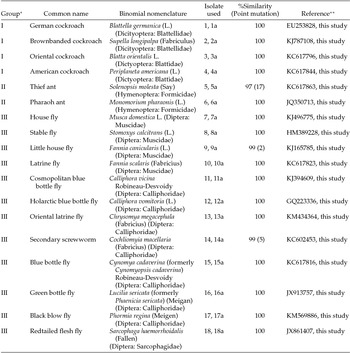
Genomic DNA was extracted from two specimens of each of the 18 ‘Dirty 22’ species belonging to Group I (four cockroach species), Group II (two ant species), and Group III (12 fly species) as described in Table 1. The insect specimens were obtained from various academic and research organisations. In most cases, approximately 1–5 mg of the body portion from a single specimen (preserved in 70% ethanol) was homogenized in liquid nitrogen using a clean, autoclaved mortar and pestle. DNA was purified from the homogenate using a DNeasy® Blood & Tissue DNA Extraction Kit, following the manufacturer's protocol and recommendations for purification of total DNA from insects (QIAGEN, Valencia, CA). The concentration of purified DNA was determined by 260 nm absorbance using a NanoDrop-1000 spectrophotometer (NanoDrop Technology, Rockland, DE). DNA samples were stored at ‒20°C until used.
Cytochrome c oxidase subunit I (COI) gene barcoding data from this study on 18 insect pests belonging to Groups I, II, and III ‘Dirty 22’ species

*List of ‘Dirty 22’ species was further categorized into four *groups by Sulaiman et al. (Reference Sulaiman, Anderson, Khristova, Tang, Sulaiman, Phifer, Simpson and Kerdahi2011) as examples of pests that exhibit the attributes of a contributing factor for the spread of food-borne pathogens and disease.
**The COI nucleotide sequences of 36 isolates of the 18 distinct ‘Dirty 22’ species generated in this study were deposited in the GenBank database under accession numbers KU543634 to KU543669.
PCR amplification
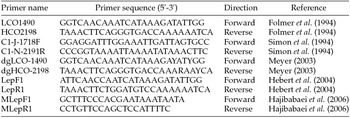
To amplify the barcoding fragments of the COI gene of the 18 insect species in Groups I, II, III of the ‘Dirty 22’ species, five sets of published COI gene primers for insect barcoding (Folmer et al., Reference Folmer, Black, Hoeh, Lutz and Vrijenhoek1994; Simon et al., Reference Simon, Frati, Beckenbach, Crespi, Liu and Flook1994; Meyer, Reference Meyer2003; Hebert et al., Reference Hebert, Penton, Burns, Janzen and Hallwachs2004; Hajibabaei et al., Reference Hajibabaei, Janzen, Burns, Hallwachs and Hebert2006) (Table 2) were used with modified PCR conditions. For the PCR with each set of primers, a 50 µl PCR reaction consisted of 25 µl of HotStarTaq Master Mix (QIAGEN), and 25 µl of PCR grade water containing 200 nM of each primer, 1.5 mM of additional MgCl2 (Promega, Madison, WI) and template DNA (50 ng). The QIAGEN HotStarTaq Master Mix is a premixed solution containing HotStarTaq DNA Polymerase, PCR Buffer, and dNTPs with a final concentration of 1.5 mM MgCl2 and 200 µM each dNTP. The reactions were run for 35 cycles (each cycle: 94 °C for 45 s, 45 °C for 45 s, and 72 °C for 60 s) in a GeneAmp PCR 9700 thermocycler (Applied Biosystems, Foster City, CA), with an initial hot start of 94 °C for 15 min and a final extension of 72 °C for 10 min. Further, PCR was also performed with annealing temperatures of 50 °C and 55 °C for each set of primers. The PCR products were analysed by agarose gel electrophoresis and visualised after ethidium bromide staining.
Cytochrome c oxidase subunit I (COI) gene barcoding primers used in this study

Nucleotide sequencing and data analyses
The COI gene PCR products of all 18 ‘Dirty 22’ species were sequenced using AB Big-Dye 3.1 dye chemistry and AB 3500 XL automated DNA sequencers (Applied Biosystems). Nucleotide sequence accuracy was confirmed by two-directional sequencing. Multiple alignments of the nucleotide sequences were achieved using the BioEdit, ClustalW, and Geneious programmes with manual adjustment.
Phylogenetic analysis was carried out on the aligned sequences to assess phylogenetic relationships among the 18 insect species of the ‘Dirty 22’. In this analysis, the generated COI gene sequences representing Group I (four cockroach species), Group II (two ant species), and Group III (12 fly species) were aligned with the published sequences of the Blattella germanica (S72627), Blatta orientalis (KC617798), Supella longipalpa (EU253834), Periplaneta americana (KC617844), Monomorium pharaonis (JQ350713), Solenopsis molesta (HM179646, HM179653), Musca domestica (HM389238), Stomoxys calcitrans (HM389228), Fannia canicularis (KJ165785), F. scalaris, Calliphora vicina (KJ394609), C. vomitoria (GQ223336), Chrysomya megacephala (KM434364), Cochliomyia macellaria (AF295555, KC568262), Cynomyopsis cadaverina (JQ806977), Lucilia sericata KC473902), Phormia regina (AF262956, AF295550), and Sarcophaga haemorrhoidalis (JN964699) obtained from GenBank. The sequence divergences were calculated using the Kimura two-parameter distance model (Kimura, Reference Kimura1980). The genetic distances were computed and a bootstrap neighbour-joining tree (Saitou and Nei, Reference Saitou and Nei1987) was constructed using Geneious R8 software.
Nucleotide sequence accession numbers
Thirty-six COI nucleotide sequences belonging to 18 insect species in Groups I, II, and III of the ‘Dirty 22’ were deposited in the GenBank database under accession numbers KU543634 to KU543669.
Results and Discussion
In this study, 36 specimens from 18 insect species of the ‘Dirty 22’ were analysed: two specimens each from four cockroach species (Group I), two ant species (Group II), and 12 fly species (Group III) as described in Table 1. Attempts were made to amplify the COI gene from these 36 specimens using five published COI gene-based PCR primer sets (Folmer et al., Reference Folmer, Black, Hoeh, Lutz and Vrijenhoek1994; Simon et al., Reference Simon, Frati, Beckenbach, Crespi, Liu and Flook1994; Meyer, Reference Meyer2003; Hebert et al., Reference Hebert, Penton, Burns, Janzen and Hallwachs2004; Hajibabaei et al., Reference Hajibabaei, Janzen, Burns, Hallwachs and Hebert2006) known for their use in insect-barcoding (Table 2). These primer sets were further tested for their sensitivity and robustness by performing PCR amplification at least three times against the genomic DNA of all 36 specimens using the HotStarTaq Master Mix (QIAGEN) at three different annealing temperatures (45 °C, 50 °C, and 55 °C). Except for the primer set MLepFi/MLepR1 (Hajibabaei et al., Reference Hajibabaei, Janzen, Burns, Hallwachs and Hebert2006), the primer sets tested at 45 oC annealing temperature were able to amplify the COI gene from the 18 insect species. Higher annealing temperatures (50 °C and 55 °C) showed a reduction in PCR amplification (data not shown).
Sequence analysis of the COI gene showed a significant interspecies genetic variation among the 36 specimens of the Groups I, II, and III ‘Dirty 22’ species. However, sequence polymorphism at the intraspecies level was not apparent. The COI sequences generated in this study for 36 specimens from 18 insect species were mostly identical to the published sequences; however, minor variations were occasionally seen (Table 1). Similar results were obtained in our previous studies with the rRNA gene of four cockroach and two ant species belonging to Groups I and II, respectively (Sulaiman et al., Reference Sulaiman, Anderson, Khristova, Tang, Sulaiman, Phifer, Simpson and Kerdahi2011, Reference Sulaiman, Anderson, Oi, Simpson and Kerdahi2012). DNA sequencing of the EF-1a and the WNT-1 loci also showed similar findings at the inter and the intraspecies level for the two ant specimens (M. pharaonis and S. molesta) of Group II (Sulaiman et al., Reference Sulaiman, Anderson, Oi, Simpson and Kerdahi2012).
The primary mission of US-FDA regulatory agency is to prohibit distribution of unsafe and harmful Food, Drug and Cosmetic products, and maintain a safe supply chain for these commodities of public health importance (FDA, 2004). At present, this task has become extremely challenging as the global production of US-FDA regulated goods has rapidly expanded in recent years, due to the phenomenal increase in the consumption of imported materials and finished products from US manufacturers. Thus, the US-FDA has developed several strategies for efficient regulation, which include the estimation of hazardous and nonhazardous filth and extraneous materials accountable for the adulteration of food and food products (Olsen, Reference Olsen1998 a,b,c; Biles and Ziobro, Reference Biles and Ziobro2000; Olsen et al., Reference Olsen, Gecan, Ziobro and Bryce2001; FDA, 2004). A list of the 22 food pests (known as the ‘Dirty 22’ species) was published, which comprises 18 insect and four rodent species, and recommendations were made for the scientific basis for making regulatory decisions based on the presence of common food pests (Olsen et al., Reference Olsen, Gecan, Ziobro and Bryce2001, Sulaiman et al., Reference Sulaiman, Anderson, Khristova, Tang, Sulaiman, Phifer, Simpson and Kerdahi2011, Reference Sulaiman, Anderson, Oi, Simpson and Kerdahi2012).
DNA sequencing-based characterisation of human-pathogenic microorganisms and their vectors has been widely successful in the development of rapid detection methods (Aransay et al., Reference Aransay, Scoulica, Chaniotis and Tselentis1999; Mukha et al., Reference Mukha, Sidorenko, Lazebnaya, Wiegmann and Schal2000; Giribet et al., Reference Giribet, Edgecombe and Wheeler2001; Danforth et al., Reference Danforth, Brady, Sipes and Pearson2004; Kato et al., Reference Kato, Cáceres, Gomez, Mimori, Uezato, Marco, Barroso, Iwata and Hashiguchi2008; Sulaiman et al., Reference Sulaiman, Anderson, Khristova, Tang, Sulaiman, Phifer, Simpson and Kerdahi2011, Reference Sulaiman, Anderson, Oi, Simpson and Kerdahi2012, Reference Sulaiman, Torres, Simpson, Kerdahi and Ortega2013). In addition, these molecular diagnostic tools have been used to understand the taxonomy, epidemiology, and transmission routes of pathogens causing foodborne and waterborne outbreaks (Sulaiman et al., Reference Sulaiman, Lal and Xiao2001, Reference Sulaiman, Lal and Xiao2002, Reference Sulaiman, Jacobs, Simpson and Kerdahi2014; Sulaiman et al., Reference Sulaiman, Fayer, Bern, Gilman, Trout, Schantz, Das, Lal and Xiao2003 a,b). Of the housekeeping genes, the rRNA genes are highly conserved regions of eukaryotic genomes, often with several copies and slower rates of evolution, and consequently are widely used as a phylogenetic marker to reveal taxonomic relationships, and a target for rapid diagnostic methods (Nirmala et al., Reference Nirmala, Hypsa and Zurovec2001; Dittmar et al., Reference Dittmar, Porter, Murray and Whiting2006; Sulaiman et al., Reference Sulaiman, Anderson, Khristova, Tang, Sulaiman, Phifer, Simpson and Kerdahi2011, Reference Sulaiman, Torres, Simpson, Kerdahi and Ortega2013, Reference Sulaiman, Jacobs, Simpson and Kerdahi2014). The genes have also been effective in identifying genetic polymorphism within the four Group I ‘Dirty 22’ cockroach species (Blattella germanica, Blatta orientalis, Periplaneta americana, and Supella longipalpa), and two Group II ‘Dirty 22’ ant species (M. pharaonis and S. molesta) (Sulaiman et al., Reference Sulaiman, Anderson, Khristova, Tang, Sulaiman, Phifer, Simpson and Kerdahi2011, Reference Sulaiman, Anderson, Oi, Simpson and Kerdahi2012). Furthermore, the EF-1a (elongation factor 1-α) and the WNT-1 gene (wingless) loci have been characterised for assessing the phylogenetic relationships between a number of insect species (Danforth and Ji, Reference Danforth and Ji1998; Schubert et al., Reference Schubert, Holland, Holland and Jacobs2000; Cruickshank et al., Reference Cruickshank, Johnson, Smith, Adams, Clayton and Page2001; Danforth et al., Reference Danforth, Brady, Sipes and Pearson2004; Murat et al., Reference Murat, Hopfen and McGregor2010; Simon et al., Reference Simon, Schierwater and Hadrys2010). Recently, the EF-1α and WNT-1 genes were also used as the genetic marker for typing the two Group II ant species, M. pharaonis and S. molesta (Sulaiman et al., Reference Sulaiman, Anderson, Oi, Simpson and Kerdahi2012).
The mitochondrial cytochrome C oxidase I (COI) gene has also been extensively used for insect barcoding to identify and authenticate, and understand the genetic structure of several insect species (Caterino et al., Reference Caterino, Cho and Sperling2000; Bybee et al., Reference Bybee, Taylor, Riley Nelson and Whiting2004). A redescription of a cockroach species, Hebardina concinnai, was achieved through DNA barcoding, and which also confirmed wing polymorphism and distinguished morphological characteristics for field identification (Yue et al., Reference Yue, Wu, Qiu, Hu, Liu, Wei, Chen and Cook2014). This novel tool was further used in a large-scale study of genetic diversity to characterise 284 specimens of the cockroach Periplaneta americana (mostly from New York City, 15 additional US states, and six other countries) that identified interbreeding among deeply divergent mitochondrial lineages in the urban populations of the American cockroach (von Beeren et al., Reference von Beeren, Stoeckle, Xia, Burke and Kronauer2014). Insect barcoding was successful in understanding genetic structure, nest mate recognition and behaviour of two cryptic species of the invasive big-headed ant species Pheidole megacephala (Fournier et al., Reference Fournier, Tindo, Kenne, Mbenoun Masse, Van Bossche, De Coninck and Aron2012), and it was possible to delimit morphologically predefined species (morphospecies) of the hyperdiverse ant genus Pheidole (Formicidae: Myrmicinae) by COI-based barcoding (Ng'endo et al., Reference Ng'endo, Osiemo and Brandl2013). The COI sequences could identify forensically important fly species and their distribution in the coastal region of central California (Sulaiman et al., Reference Sulaiman, Anderson, Oi, Simpson and Kerdahi2012), and the Korean Luciliinae fly species (Diptera: Calliphoridae) in forensic investigations (Nakano and Honda, Reference Nakano and Honda2015). In addition, the CO1 barcodes for Canadian mosquitoes revealed its effectiveness in discriminating various recognised species of mosquitoes (Cywinska et al., Reference Cywinska, Hunter and Hebert2006). Attempts have also been made to use the COI barcode to identify the 22 common pests known to spread foodborne pathogens and disease. Although correct species identification is vital for cost-effective pest control schemes, the COI-based DNA barcoding was used to differentiate pest species of the black fly genus Cnephia (Diptera: Simuliidae) in a successful biological control programme (Conflitti et al., Reference Conflitti, Pruess, Cywinska, Powers and Currie2013). COI barcoding was also employed to identify the five species of flat grain beetles of the genus Cryptolestes (Coleoptera: Laemophloeidae), known as one of the most economically important stored-product pests that feed on agricultural products, markedly grains (Varadínová et al., Reference Varadínová, Wang, Kučerová, Stejskal, Opit, Cao, Li and Li2015). Furthermore, COI barcoding was used to establish new records of the vegetable leafminer fly Liriomyza sativae (Diptera: Agromyzidae) from the islands of Torres Strait of Australia and the central highlands of Papua New Guinea. Liriomyza sativae is a pest of horticultural crops with a wide host-range that can have serious economic implications. Identification can be difficult, and morphologically it can only be assertively identified using features of adult males (Blacket et al., Reference Blacket, Rice, Semeraro and Malipati2015).
More recently, a number of COI-based DNA barcoding studies of public health importance have been successfully carried out. DNA barcoding enabled identification of sandfly species (Diptera: Psychodidae) from leishmaniasis-endemic areas in Peru, and it was suggested that the COI barcodes could distinguish the sandfly taxa and reveal population divergence and cryptic diversity (Nzelu et al., Reference Nzelu, Cáceres, Arrunátegui-Jiménez, Lañas-Rosas, Yañez-Trujillano, Luna-Caipo, Holguín-Mauricci, Katakura, Hashiguchi and Kato2015). DNA barcoding was successful in characterising Turkish Culex mosquitoes, which are considered as the potential vectors of arboviral and parasitic diseases worldwide (Gunay et al., Reference Gunay, Alten, Simsek, Aldemir and Linton2015). In addition, barcoding was used in the identification of Tabanidae (Diptera) vectors of trypanosomes of domestic animals (Banerjee et al., Reference Banerjee, Kumar, Maity, Ghosh, Tyagi, Singha, Kundu, Laskar, Naskar and Rath2015). Two new species of Simulium (Gomphostilbia) (Diptera: Simuliidae) were described based on morphological data, which was confirmed by COI-barcoding: the analysis of barcoding data separated these new species from other species in the subgenus Gomphostilbia (Anbalagan et al., Reference Anbalagan, Arunprasanna, Kannan, Dinakaran and Krishnan2015).
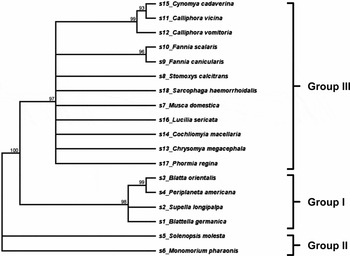
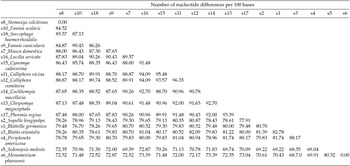
In this study, new PCR methods were developed based on the evaluation of the robustness of five published sets of COI-based insect barcoding primers for the generation of DNA barcodes for the 18 different members of the ‘Dirty 22’ species. PCR with HotStarTaq Master Mix and a primer annealing temperature of 45 oC could amplify COI sequences from all 18 species. Multiple alignments of the COI barcodes revealed distinct sequences for each of the 18 species, and distinct interspecies variations were also observed throughout the COI gene (Table 1). For phylogenetic analysis, a neighbor-joining tree was constructed with aligned COI barcode sequences (Fig. 1). Three distinct clusters were found: the first cluster consisted of four Group I cockroach species: Blattella germanica, Blatta orientalis, Supella longipalpa, and Periplaneta americana; the second cluster consisted of the two ant species in Group II: Monomorium pharaonis and Solenopsis molesta; and the third cluster contained the 12 fly species in Group III: Musca domestica, Stomoxys calcitrans, Fannia canicularis, F. scalaris, Calliphora vicina, C. vomitoria, Chrysomya megacephala, Cochliomyia macellaria, Cynomyopsis cadaverina, Lucilia sericata, Phormia regina, and Sarcophaga haemorrhoidalis (Fig. 1). A close relatedness was also noticed by phylogenetic analysis of COI sequences among the different species within the three groups of ‘Dirty 22’ species (Fig. 1; Table 3). In addition, the analysis also showed genetic distances among the 18 species of three groups of species analysed, and the amount of divergence between species also varied within each group (Table 3). Results of this study show that the COI-gene-based insect barcoding can identify and authenticate species from the three groups of ‘Dirty 22’ species.
Phylogenetic relationships among 18 insect species belonging to the Group I, Group II, and Group III ‘Dirty 22’ species inferred from neighbour-joining analysis of cytochrome c oxidase subunit I (COI) nucleotide sequences. The numbers at the branch points represent the percentage of replicants (bootstrap support) for which the same branching patterns were obtained.

Genetic distances of the cytochrome c oxidase subunit I (COI) barcoding sequences of 18 insect species of the ‘Dirty 22’ Groups I, II, and III

The current filth programme of US-FDA uses insects and insect fragments identified by conventional microscopic characteristics described in insect keys. Sometimes the features for the identification of food pests (the ‘Dirty 22’ species) are lost or decomposed to the extent that the specimen cannot be identified to the family level. Accurate identification is essential for official regulatory sample analysis and for pursuing any violative actions based on the presence of the ‘Dirty 22’ species in food (Olsen et al., Reference Olsen, Gecan, Ziobro and Bryce2001; Sulaiman et al., Reference Sulaiman, Anderson, Khristova, Tang, Sulaiman, Phifer, Simpson and Kerdahi2011). In situations where morphological identification is difficult, COI barcoding of insects could be used to identify and authenticate the three Groups of ‘Dirty 22’ species for regulatory analysis.
Conclusion
In this current study, we generated DNA barcodes for 36 specimens of 18 insect vector species of the ‘Dirty 22’ species that are known to contaminate food and spread foodborne pathogens. These are: Group I (four cockroach species: Blattella germanica, Blatta orientalis, Periplaneta americana, and Supella longipalpa), Group II (two ant species: Monomorium pharaonis, and Solenopsis molesta), and Group III (12 fly species: Musca domestica, Stomoxys calcitrans, Fannia canicularis, F. scalaris, Calliphora vicina, C. vomitoria, Chrysomya megacephala, Cochliomyia macellaria, Cynomyopsis cadaverina, Lucilia sericata, Phormia regina, and Sarcophaga haemorrhoidalis). We demonstrated that COI gene barcoding can be used to accurately identify the 18 insect species of Groups I, II, and III of the ‘Dirty 22’ in a single assay. This tool will help US-FDA to accomplish one of its important mandates of the food safety programme, including routine surveillance of food storage areas and future epidemiologic investigations of foodborne outbreaks caused by insect species of the ‘Dirty 22’.
Acknowledgements
The findings and conclusions made in this manuscript are those of the authors and do not necessarily represent the views or official position of the US Food and Drug Administration (US-FDA). The names of vendors or manufacturers are provided as examples of available product sources; inclusion does not imply endorsement of the vendors, manufacturers or products by the US-FDA. The agency had no role in study design, data collection, and analysis, decision to publish, or preparation of the manuscript. We thank Dr David H. Oi, US Department of Agriculture for providing some insect specimens, and Mickey Anderson for his technical assistance. Thanks are also due to Nicky Sulaiman, Division of Scientific Resources, CDC, for her comments on the manuscript.