Introduction to NIVAL: National Irish Visual Arts Library
The National College of Art & Design (NCAD) occupies a unique position in art and design education in Ireland. It offers the largest range of art and design degrees in the state at undergraduate and postgraduate level. It is the only Irish university institution specialising in art and design and many of the most important Irish artists, designers, and art teachers have studied or taught in the college.
Research is central to teaching and learning at the college and practice-led and theory based scholarship is facilitated through access to two world class on campus libraries. The Edward Murphy Library is the main campus library for staff, students and graduates of the college. It has an unrivalled collection of over 95,000 books and exhibition catalogues with an emphasis on International art, design, and photography from the 19th to the 21st centuries. The core collection is supplemented by content on earlier periods and related subject areas, primarily in the social sciences.
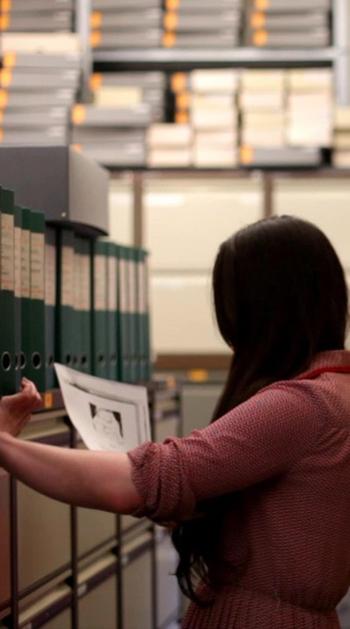
The National Irish Visual Arts Library - or NIVAL as it is commonly known - is a public research facility for the study of 20th- and 21st-century art and design in Ireland. NIVAL is home to the world's largest collection of reference material on the visual arts in Ireland from 1900 to the present day including the archives of leading artists and seminal arts organisations (Fig. 1). It is the brain child of former college librarian Edward Murphy who began collecting Irish visual arts documentation at the start of his tenure in the late 1970s. NIVAL was formally established as a public resource in 1997 through a strategic partnership with the Arts Council of Ireland. It is allocated an annual budget from the College and receives revenue subsidies through application from the Arts Council to support core activities. Over the past twenty years, project grants have been awarded by the Department of Culture, Heritage and the Gaeltacht, the Higher Education Authority, the Heritage Council, Dublin City Council, and the Design History Society, UK.
NIVAL is a public research library at National College of Art & Design Dublin. Image credit Clare Lymer © NIVAL, NCAD.

In documenting contemporary developments in Irish art and design, NIVAL serves the present and future needs of its users. These range from authors and academic researchers to art and design practitioners seeking a secure and accessible repository for visual and textual information on their work. It is the foremost centre for information on contemporary Irish art for researchers nationally and globally.
Collection development in the ‘living library’
In NIVAL, Eddie set in train a model for collection development that would ensure the relevance and currency of acquisitions. The model is based on reciprocity and an understanding that the library is both of and for the arts community and that its success is dependent upon the continuing mutual benefit to both the artist and the institution.
From the outset, NIVAL was conceived of as a democratic project, available to the public without membership, resourced through tax payers' monies and sustained through material contributions from practising artists, arts organisations and other arts workers. The acquisitions remit includes the whole island of Ireland as well as Irish art abroad and resident non-national artists. The acquisitions policy does not discriminate between professional, qualified, self-taught, amateur, Sunday or Outsider artists and passes no judgement on quality, proficiency or reputation.
NIVAL is not a revenue-generating organisation and offers its services free of charge to visitors and contributors to the collection. The library operates a no-cost-to-artists policy, providing benefit-in-kind in archiving and reference services. The appraisal of material documentation and the supply of packaging, storage containers and digital format carriers are provided free of charge to artists pre-deposit. The cost of postage and transport of material to the library is also covered by NIVAL. To facilitate the transfer of artists’ papers, the library will provide free reproduction services and the return of the material to the artist without charge. NIVAL also provides free outgoing loan services to artists who borrow collection items for exhibition alongside their own work or for curatorial projects.
The documentation life-cycle + the symbiotic relationship
Nearly 5,000 artists are represented in the collection, many of whom have donated their own visual and textual material. Most commonly, artists will contribute information-rich material in relation to a current project or exhibition. Artists' statements, images, floor plans and project proposals are donated on a regular basis along with catalogues and publicity material. Artists may also stockpile self-generated material and deposit this under the guise of an archive or work closely with a representative gallery to facilitate the transfer of documentation to the library.
Other artists and arts workers have demonstrated a life-long commitment to collection development by donating extensive personal archives through legal bequest or by leaving explicit instructions with family members for the posthumous donation of materials to the library. Prominent figures in the arts in Ireland following these models include artist Robert Ballagh, art historian S.B. Kennedy, the late artist and designer Patrick Scott, print maker Sara Horgan, artist and gallerist Gerald Davis and art critic Dorothy Walker.
In recent years, NIVAL has reached out to artists to engage with the collections in new ways and to progress their relationship with the library from one of contribution to collaboration and active participation in collection building. Artists have been invited to undertake a dialogue with the intellectual and the material content of the library resulting in the production of new work in ways consistent with their practice and methodology.
Ultimately the new work - be it documented research or the material outcome of the project - is deposited in the library. These works help to broaden and diversify the resources available to other researchers to access. They provide evidence of the regenerative potential of the library to both receive and give back to the arts community it serves.
The artist as contributor
Jennie Guy – Reading Ensemble III
Jennie Guy is an artist and curator based in Dublin. Her practice embraces visual, textual, performance, and event-based output, initiating collaborations and participative environments that feed off of other artists as well as her audience.
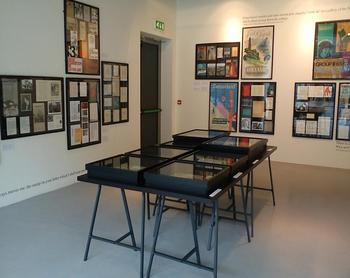
Over a number of days in 2012, Jennie positioned herself in NIVAL observing routine operations and the physical environment. She invited the staff to select texts from the collection to be included in a video project based on the act of reading. She then filmed a group of NCAD students reading these texts out loud in the library space (Fig. 2). Guy prepared a shortlist of texts addressing themes of socially-engaged and participatory practice. Each student selected a text that related most closely to their research interests as developing artists. The video was staged within Document!, an exhibition celebrating 120 years of visual arts documentation in Ireland at the NCAD Gallery in April of that year (Fig. 3). The video was deposited in NIVAL to be made accessible to others for research.
Still image from video Reading Ensemble III by Jennie Guy, 2012. Image courtesy of the artist.

Installation shot from the exhibition DOCUMENT! at NCAD Gallery, 2012. © NIVAL, NCAD.

Archive(ist) – NCAD Communication Design Students
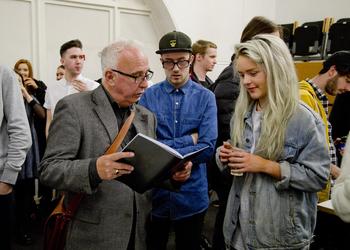
In the past three years, 2nd year students in the department of Communication Design at NCAD were assigned a project brief to put them in direct contact with artists who have contributed to collection development at NIVAL (Fig. 4). Students were asked to consider the form of the book as a platform through which to exhibit their response to a selected artist's file, special collection or archive. Collaboration was a key aspect of the project, where students worked in teams and liaised with external sources including practicing artists and artists’ estates. They were encouraged to consult a sample of the collection of 1000+ artists’ books held in NIVAL to witness the diversity of methods and materials in use. The students’ line of enquiry and depth of engagement with the material dictated the content of the book and was reflected in the designed outcomes.
Letterpress book artist Sean Sills with students on the BA in Communication Design, 2016. Image credit Clare Lymer © NIVAL, NCAD.

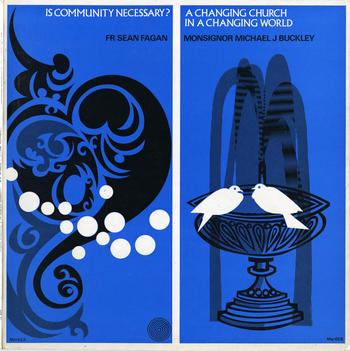
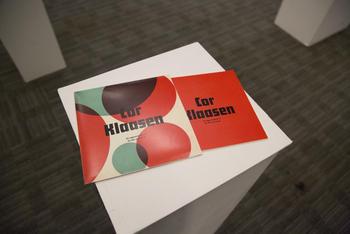
The finished works are exhibited on campus and formally accepted into NIVAL for deposit on the opening night. Highlights from the 2017 project include a two-sided record sleeve based on the design work of Dutch émigré artist Cor Klaasen replicating the bold palette and geometric forms of his work in advertising (Figs. 5, 6) and an illustrated timeline of the work of Irish artist Alice Maher in a format that emulates the artists’ methods and materials.
Record album cover designed by Cor Klaasen, 1970s. Image credit Clare Lymer © NIVAL, NCAD.

‘Cor Klaasen, an appreciation of his life and work’, book designed by NCAD students Gavin Connell, Matthew Dillon, Clodagh Oxley, Siomha Reid, 2017. Image credit Clare Lymer © the artists and NIVAL, NCAD.

Floating World - Unfolding the Archive
The most ambitious example of artists’ participation in collection development has been the collaboration in 2014 with artists’ group Floating World on an exhibition entitled Unfolding the Archive. The project was devised in collaboration with the F.E. McWilliam Gallery, Banbridge, Co. Down, and was exhibited there and at the NCAD Gallery.
Founded in 2003 by Andy Parsons and Glenn Holman, Floating World is a collective of artists based in Ireland, the UK and Japan whose practices encompass painting, sculpture, video and performance.Footnote 1 Central to the development of Floating World has been the wish to put the artists' book centre stage and to afford it the same status as other strands of contemporary practice. The groups’ engagement with NIVAL and the resulting exhibition was their most important and challenging project to date.
The project centred around an exploration of NIVAL's archival holdings and its title is taken from the tangible starting point for engagement with an archive – the simple act of unfolding – and the practice of appraisal, valuation and interpretation that is inherent in this process. Nine artists participated, engaging with the collections on site, through correspondence and remotely via the NIVAL website. Each artist approached the collections from a personal and individual standpoint and in a manner that reflects their concerns and interests. These range from purely visual investigations, to highly conceptual interpretations of the archive as a multilayered and shifting source of information and meaning. The book works were exhibited alongside these new works and deposited in NIVAL after the exhibition. An illustrated catalogue was produced wherein each artist describes his/her experience of researching the archives. The statements contributed by Glenn and Andy, the founders of the group, characterise their participation in collection development at NIVAL.
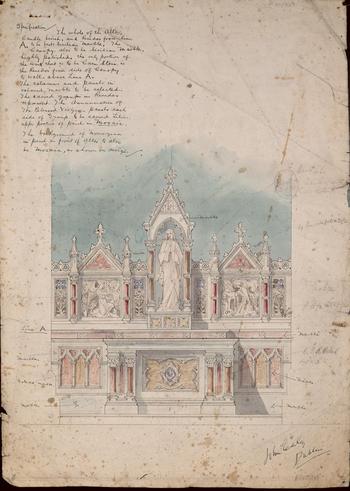
In his text, Glenn Holman makes reference to the Earley & Co Archives – a collection of over 300 design drawings for church furnishings and stained glass windows (Fig. 7). Glenn writes:
Visiting the NIVAL collection from the UK, I was initially overwhelmed by the diversity and density of information contained within and by the manner of its organisation. There is seemingly no attempt to discriminate between the relative value of items, but rather to catalogue and organise them giving equal significance to each. What struck me most forcibly was how the very act of ordering, cataloguing and archiving fundamentally alters how we read and respond to the work.
Having seen the ecclesiastical designs for … altar pieces in the Earley & Company archives at NIVAL, I was fascinated by how the lyrical quality and small scale of this design could be translated by craftsmen into fully realised three-dimensional form. Were these the only designs or were there further design plans now lost from the record?
Returning home, I decided to continue my investigation of these ideas and sought out the digitised images of the Earley designs on the NIVAL website. I observed how the translation of the original, handmade and analogue item to a digital image further alters one's perception of the original meaning and purpose of the works and how the geographical and technological distancing introduced by digital media further disrupts one's visual and cultural understanding and appreciation of the work.
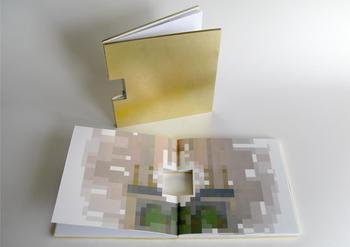
My piece explores this cultural and contextual disconnect from the original physical artefacts and how my attempts to grasp their original purpose and meaning continually drains away (Fig. 8).Footnote 2
Andy Parsons spent a number of days onsite in NIVAL and his response to the collections was simultaneously broad and idiosyncratic. Andy writes:
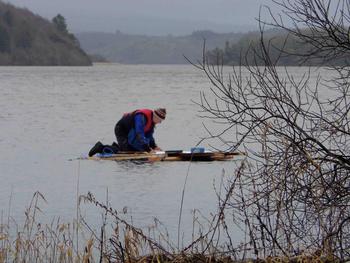
My work is based on a book in the NIVAL collection - ‘Red Hanrahan and the Secret Rose’ by WB Yeats and illustrated by Norah McGuinness. To explore the images and ideas in the book I decided to build a giant floating drawing board and make drawings on Lough Gill in County Sligo. My book is about the slow process of making and using the raft, and all the interactions and mishaps that ensued. The interactions, the book, the drawings and the raft are all the artworks.
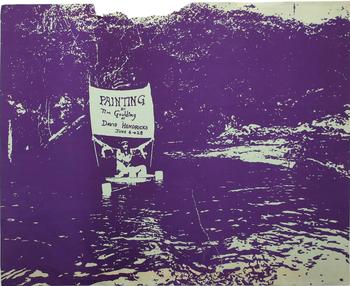
As the project developed I found a beautiful silk screened poster in NIVAL for an exhibition of paintings which seemed to echo my raft idea perfectly, and connect my work with the archive at a deeper level. In the poster, a man floats around on a makeshift raft with a bed-sheet tied to two poles. This gesture seemed to come from the same place as my raft idea, a kind of beautiful folly (Figs. 9, 10).
The works in this exhibition are not an ironic twist on the trope of the Romantic in awe of the landscape, nor a performance which satirises the mores of the art world and its relationship with the public. Like the man on the wobbly raft in the poster they assert a faith in the magic of art making as a way of responding to the world.Footnote 3
With the deposit of project outcomes to the archives the life cycle of arts documentation continues. Once stored and catalogued, the institution fulfills its remit to provide access and safeguard the physical material. The multifaceted narratives of Irish art history grow and diversify and the library, as custodian of the record, facilitates the wider arts community through the process of research and discovery.
Design for altar, [1850–1890], Collection Earley & Company Archives, IE/NIVAL/EC/229. © NIVAL, NCAD.

‘Noun:Verb’, ink jet print on paper with Schlag gold leaf on wood covers, Glenn Holman, 2014. Image courtesy of the artist.

‘Painting by Tim Goulding at David Hendricks’, silk screen print, 1969, Collection NIVAL Posters. © Tim Goulding and NIVAL/NCAD.

Raft for ‘The Heart of the spring’, work in progress, Andy Parsons, 2015. Image courtesy of the artist. © Brian Rutledge.