Background
About 47 million people, 5% of the world’s elderly population, were affected by dementia in 2015, with a predicted increase to 75 and 132 million by 2030 and 2050, respectively, (World Health Organization, 2017). Most live in the community and almost all require various degrees of supportive care. It has been estimated that 75% of this care is provided by informal family caregivers (CGs) (Schulz and Martire, Reference Schulz and Martire2004). Family CGs, also called informal CGs, regularly provide a substantial amount of unpaid care and support to a relative, partner, friend, or neighbor, the care recipient (CR), who needs assistance to manage a variety of tasks because of an acute or chronic physical or mental condition (Reinhard et al., Reference Reinhard, Given, Petlick and Bemis2008; Tomar et al., Reference Tomar, Jha, Gale and Huzzey2019). In the U.S.A., most family CGs are female spouses (Alzheimer’s Association, 2008). However, the high physical and psychological demands of dementia caregiving make these family CGs a vulnerable group (Livingston et al., Reference Livingston2017; Schoenmakers et al., Reference Schoenmakers, Buntinx and Delepeleire2010a).
Family CGs have become more important as providers of cost-effective interventions (Schoenmakers et al., Reference Schoenmakers, Buntinx and Delepeleire2010b; Zarit et al., Reference Zarit, Gaugler and Jarrott1999) in the face of increasing life expectancy with the attendant increased prevalence of chronic diseases and associated cost of health care (Hepburn et al., Reference Hepburn, Tornatore, Center and Ostwald2001; Schulz and Martire, Reference Schulz and Martire2004). However, CGs have been characterized as hidden or invisible second patients because of their well-described vulnerability to physical, mental, and social adverse health consequences associated with the stress and burden of caregiving, reduced attention to their own emotional and healthcare needs, and lack of attention by the health system with higher rates of clinical depression and anxiety than other CGs. (Brodaty and Donkin, Reference Brodaty and Donkin2009; Reinhard et al., Reference Reinhard, Given, Petlick and Bemis2008; Schulmann et al., Reference Schulmann, Llinca and Leichsenring2017). Female CGs and adult children are particularly at risk of depression and anxiety (Watson et al., Reference Watson, Tatangelo and Mccabe2019).
Caring for someone with dementia poses unique caregiving challenges (Schulz and Martire, Reference Schulz and Martire2004) beyond those of other forms of caregiving, associated with the concurrent management of the needs of the CR and the CG’s personal needs (McCabe et al., Reference Mccabe, You and Tatangelo2016). Dementia CGs must cope up with the emotional and practical problems posed by a progressive, untreatable disorder that gradually erodes the fabric of the relationship with the CG, causing attendant emotional loss and grief. Over the years, the CG must learn to navigate a new, unfamiliar and unwelcome lifestyle, increasingly trapped in a role that forces them to cope with an illness that induces behavioral and psychological distress and disturbance in the CR, alters their personality, and impairs independent functioning, capacity for communication and decision making. The documented contributors to CG stress and burden include behavioral and psychological symptoms of dementia (BPSD), care-related stressors, limited financial, personal, and social resources, interference with work, and lower quality of life (Bangerter et al., Reference Bangerter, Griffin, Zarit and Havyer2017; Cerejeira et al., Reference Cerejeira, Lagarto and Mukaetova-Ladinska2012; Livingston et al., Reference Livingston2017; Pearlin et al., Reference Pearlin, Mullan, Semple and Skaff1990; Vaingankar et al., Reference Vaingankar2016). Attention to the psychological morbidity of CGs is clearly important, both to prevent care breakdown and institutionalization of the CR, and to sustain the caregiver (Livingston et al., Reference Livingston2017).
Caregiving for dementia can be rewarding for CGs. Two reviews have highlighted positive as well as negative effects of caregiving on CGs (Bauer and Sousa-Poza, Reference Bauer and Sousa-Poza2015; Quinn and Toms, Reference Quinn and Toms2019): At least 20 different groups of positive aspects of caregiving (PAC) are listed such as satisfactions, gains, meaning, companionship, fulfillment, enjoyment, and rewards. Positive aspects were associated with lower depressive symptoms, burden, better mental health, quality of life, satisfaction with life, and competence/self-efficacy. PAC was not associated with self-rated health or personal strain/stress (Quinn and Toms, Reference Quinn and Toms2019). Unfortunately, positive outcomes appear to be dominated by negative effects (Bauer and Sousa-Poza, Reference Bauer and Sousa-Poza2015).
Interventions for family CGs
Intervention methods for supporting the health and well-being of dementia CGs have included education and psychoeducation, peer-support groups, cognitive behavioral therapy (CBT), and family counseling (Hopkinson et al., Reference Hopkinson, Reavell, Lane and Mallikarjun2019; Livingston et al., Reference Livingston2017; Mittelman et al., Reference Mittelman, Brodaty, Wallen and Burns2008). A 2001 review concluded that about 2/3 of interventions did not result in any improvement in outcome measures (Cooke et al., Reference Cooke, Mcnally, Mulligan, Harrison and Newman2001) while a more recent review concluded that there is support for the effectiveness of multicomponent programs, especially for younger CGs (Cheng et al., Reference Cheng2020).
There is a consistent record of the effectiveness of CBT for dementia CGs (Hopkinson et al., Reference Hopkinson, Reavell, Lane and Mallikarjun2019; Kwon et al., Reference Kwon, Ahn, Kim and Park2017; Pinquart and Sörensen, Reference Pinquart and Sörensen2003) and a systematic review and meta-analysis supported its cost-effectiveness when the intervention is limited to a group format of eight sessions or less (Hopkinson et al., Reference Hopkinson, Reavell, Lane and Mallikarjun2019). The effectiveness of CBT and multicomponent interventions on CGs with depressive disorders were positive with large size effect (Lee et al., Reference Lee, Ryoo, Chung, Anderson, Rose and Williams2019) and medium to small effect size (ES), respectively, (Laver et al., Reference Laver, Milte, Dyer and Crotty2017; Park and Park, Reference Park and Park2015; Schulmann et al., Reference Schulmann, Llinca and Leichsenring2017). Group psychotherapy is an effective intervention for dementia CGs (Gallagher-Thompson et al., Reference Gallagher-Thompson, Coon, Solano, Ambler, Rabinowitz and Thompson2003; Kamkhagi et al., Reference Kamkhagi2015) and evidence supports the effectiveness of multicomponent psychoeducational interventions, cognitive reframing, communication skills training, and professionally led group interventions (Piersol et al., Reference Piersol, Canton, Connor, Giller, Lipman and Sager2017).
Rationale for the CARERS method
In keeping with the evidence that appears to support the effectiveness of multicomponent, programs that include psychotherapeutic interventions which are delivered with sufficient intensity and duration, the Reitman Centre (RC) at Sinai Health (SH) in Toronto developed an integrated model of CG intervention called CARERS (Coaching, Advocacy, Respite, Education, Relationship, and Simulation). This model integrates evidence-based techniques for skills training, problem-solving, psychotherapy, and education delivered in a professionally led group therapy format. CARERS appeared to be a promising modality of intervention in an earlier pilot study (Chiu et al., Reference Chiu, Pauley, Wesson, Pushpakumar and Sadavoy2015).
The RC program is built on four evidence-informed clinical assumptions, which were hypothesized to be necessary components of an effective, integrated, intervention program:
-
1. Specificity of education and information: Clinical experience suggests that CGs are often bewildered by the array of information readily available online, unsure about which information is relevant to their specific situation and how to apply it.
-
2. Therapeutic emotional management: CGs struggle, often alone and unobserved, with the emotional pressures of their role which appears to require specific psychotherapeutic intervention over and above general advice and guidance.
-
3. Specific skills training: Dementia is a complex illness and the management of which requires the CG to learn new skills, especially communication and interpersonal interaction, tailored to the type and presentation of the dementia.
-
4. Problem-solving skills: Effective coping and problem-solving when caregiving for dementia is commonly disrupted by a complex array of concurrent problems – CR and caregiver emotional dysregulation, CR behavioral and psychological symptoms (BPSD), maintaining work and family, planning, managing home support staff, safety, health care, economic issues, daily household management and self-care, among many others.
This paper builds on the rich recent literature describing specific interventions for informal CGs. Examples from IPG include, for example, art-based interventions (Hendriks et al., Reference Hendriks, Meiland, Gerritsen and Droes2019), social support (Mittelman, Reference Mittelman2000), education (Pleasant et al., Reference Pleasant, Molinari, Hobday, Fazio, Cullen and Hyer2017), respite care (Gaugler et al., Reference Gaugler, Jarrott, Zarit and Stephens2003), respite combined with training (Gresham et al., Reference Gresham, Heffernan and Brodaty2018), and exercise (Madruga et al., Reference Madruga, Gozalo, Prieto, Rohlfs Domínguez and Gusi2020). This study adds to the literature on these focal interventions by evaluating the effectiveness of an integrated, theory and evidence-informed, multicomponent intervention designed to address known factors in four key domains that impair caregiver function and increase the burden. These are the needs for skills training specific to each caregiver’s situation; problem-solving training using evidence-based PST derived from CBT principles that address current problem challenges and teach a systematic method of defining and solving with them; uncovering and managing core current emotional struggles and conflicts and addressing them using established group psychotherapy methods; and education and knowledge acquisition about dementia and practical resources specific to each caregiver’s current situation.
Objectives
To measure the effectiveness of the CARERS program on key outcomes when delivered to family CGs of community-dwelling persons with dementia by trained professional mental health clinicians.
To evaluate the effectiveness of the CARERS program on a subset of CGs with known risk factors for higher levels of disturbance on caregiving measures such as a higher degree of depression, greater reliance on maladaptive coping methods, and dealing with greater behavioral challenges (Brodaty and Donkin, Reference Brodaty and Donkin2009; Etters et al., Reference Etters, Goodall and Harrison2008). We hypothesized that this subset of CGs may show a more robust response to the intervention as the CARERS method specifically targets these areas of greater CG challenge.
Design and methods
This study was designed as a quasi-experimental, pre–post evaluation, non-randomized, multiple group, and multisite intervention. An external control group design was not feasible for this study given its naturalistic context. CARERS was delivered by mental health clinicians trained by the RC at 15 sites: SH (RC, Geriatric Wellness Centre, Bridgepoint), Ceridian LifeWorks® Employee Assistance Program(EAP), 7 Ontario Alzheimer’s Society chapters, 3 Ontario and Alberta community sites, and Shalvata Hospital, Israel.
Intervention: the CARERS group method
CARERS is an evidence-based multicomponent psychotherapeutic skills training program developed at the Cyril & Dorothy, Joel & Jill Reitman Centre at SH in Toronto, Canada. Both the CARERS intervention and the systematic training program for the mental health clinicians who lead CARERS groups are manualized and standardized.
CARERS is an 8-week, intensive, small-group intervention for 4–6 family dementia CGs. Spousal CGs are not mixed with adult child CGs. While there are overlapping caregiving elements, the emotional and practical needs and struggles of each group are generally quite different.
Each group session is 2 h long. Predetermined agendas structure the content and process of each group. In sessions 1–4, CGs specific informational needs are addressed, therapeutic group norms and engagement are fostered and CGs trained and coached in problem-solving techniques (PST) adapted for dementia CGs. The goal is to enhance problem-oriented coping mechanisms by training CGs to identify and implement practical, nonemotional solutions to an accurately defined current problem. In sessions 5–8, CGs are trained to effectively communicate with the CR with the goal of enhancing practical communication skills and interpersonal management of dementia symptoms. The training method employs a unique use of “therapeutic simulation”, a hands-on training method that employs specially trained standardized patients (SP) in a carefully guided intervention method developed for this program. Simulation is known as an effective method for adult learning and assessment in health education. (Cant and Cooper, Reference Cant and Cooper2010; McNaughton et al., Reference Mcnaughton, Ravitz, Wadell and Hodges2008). These techniques have been substantially modified for the therapeutic environment and embedded into the group therapy model of the CARERS method.
Informing all aspects of the group process and interventions by the group leaders are group psychotherapy principles that foster the presumed curative factors of group psychotherapy (Yalom and Leszcz, Reference Yalom and Leszcz2005). These include ensuring safe emotional expression, instillation of hope, universality, and reduced isolation, imparting information, altruism, interpersonal learning, and group cohesiveness. Key to the RC method is specificity. The group leaders are trained to elicit and address the specific concerns that each CG is experiencing currently. Generalized, didactic information, or techniques that do not apply directly to the CG’s situation are avoided wherever possible.
Groups are led by mental health clinicians trained and certified in a University of Toronto-accredited CARERS training program at the RC. Clinicians are multidisciplinary professionals with geriatric and psychotherapy backgrounds including social work, psychology, psychiatry, family practice physicians, occupation therapy, and nursing. Prior to beginning the training course, each trainee completes a 10-hour interactive, online, self-guided program based on the manualized RC CARERS method. The ensuing 4-day in-person training course is comprised of didactic, multimedia, and live hands-on simulation training in all aspects of the intervention including psychotherapeutic principles.
Formal adherence measurement at each site, which at the time of the study required onsite observation of the clinicians by the research team, was not feasible given the geographical diversity of the multisite study. However, once clinicians began to lead their first group, most participated in ongoing, online, privacy-compliant mentoring meetings with an RC clinician. In these monthly meetings, clinicians discussed clinical matters that arose when implementing CARERS groups and reviewed and addressed problems and issues related to adherence. The two mentors were senior Reitman Centre clinicians who were well versed in the adherence criteria for CARERS and guided all clinicians to ensure adherence to the manualized methodology. Adherence was further promoted by providing the CARERS manual to the clinicians. Prior unpublished evaluations of clinicians at satellite programs trained by the RC using an adherence measure developed for CARERS indicated acceptable adherence to the method when they began to deliver CARERS groups post-training. Hence, we had confidence that CARERS was delivered as manualized during this study.
A minority of promising models of CG intervention have led to system-wide programs and system change (Gitlin et al., Reference Gitlin, Marx, Stanley and Hodgson2015). CARERS is now a working program that has been successfully brought to scale in Canada and internationally. It is the core program of the Ontario Enhancing Care for Ontario Care Partner program launched in 2017 where it is being delivered by 16 clinicians at 32 locations as well as operating in British Columbia, Alberta, Vermont, Israel, and Singapore.
Ethics
SH Research Ethics Board approved this study and all the participants signed written informed consents prior to entry into the study.
Participants and recruitment
Spousal or adult child family CGs were entered into the clinical trial over about a 4-year period (2013–2017). Eligibility criteria, determined when CGs were recruited to the study at each site, included informal CG of a CR with a diagnosis of dementia who resided in the community; sufficient emotional and physical capacity to participate in the assessment and training sessions; no active suicidality or psychotic illness; willingness to discontinue other CG intervention programs while in the study; and provided signed consent for the study. CGs were referred to the sites for clinical services by primary care and specialty dementia healthcare clinics, Alzheimer’s Societies, and community services or were self-referred.
All CGs assessed and assigned to a CARERS group were approached to participate in the study.
Recruitment
A clinician made initial contact with each caregiver. They assessed each CG employing an in-depth, systematic, semi-structured interview designed to provide a comprehensive picture of the CG’s practical and emotional stressors in their current situation, psychological and physical health, medications, relationship and family issues, and diagnostic and functional history of the CR. If CARERS were acceptable to them and clinically appropriate, they were assigned to a CARERS group. At that point, the clinician briefly explained the study to them and asked their permission to pass their contact information to the research team. A member of the trained research team then obtained consent from the caregiver, enrolled them in the study, and provided the assessment tools to each participant at pre- and post-time periods.
CGs were given contact information for the research team and REB in case they needed to withdraw from the study. Clinicians who collected the data were trained to explain and administer the assessment scales to CGs who completed hard copies or optional online versions using Simple Survey. Site clinicians completed data collection templates developed by the research team.
Participants were informed of the research team’s intention to publish the results of the study. CGs were regularly invited to presentations and activities at the Reitman Centre where researchers presented the progress of the study.
Data collection and study measures
Prior to beginning their CARERS group, (T1) participants completed the demographic questionnaire and the pre-intervention series of self-administered questionnaires following the written instructions specific to each questionnaire. All scales were validated, self-administered scales. When completed data packages were received by the study team, each was reviewed for completeness and all missing data was considered in the analysis.
Immediately post-completion, (T2) participants completed the same series of self-administered questionnaires. CGs were assessed for depression (CES-D – the Center for Epidemiologic Studies Depression Scale-Revised) (Eaton et al., Reference Eaton, Smith, Ybarra, Muntaner and Tien2004; Radloff, Reference Radloff1977); stress, Perceived Stress Scale (PSS) (Cohen et al., Reference Cohen, Kamarck and Mermelstein1983); burden (12-item Zarit Burden Interview, SZBI) (Bedard et al., Reference Bédard, Molloy, Squire, Dubois, Lever and O’Donnell2001); Pearlin scales for role overload, mastery, caregiving competence, and role captivity (Pearlin et al., Reference Pearlin, Mullan, Semple and Skaff1990); and coping measured by Coping Inventory for Stressful Situations-CISS (Endler and Parker, Reference Endler and Parker1990) that measures 3 aspects of coping Emotion-focused coping: answers to questions about blaming yourself for being too emotional, not knowing what to do, being worried about inability to cope, becoming very upset, wishing to change what happened or “how I felt” and focusing on general inadequacies; Task-focused coping; focuses on the problem and is able to see how to solve it, thinks about “how I have solved similar problems”, determines a course of action and follows it, works to understand the situation, takes corrective action immediately, thinks about the event and learns from the mistakes, and analyzes the problem and Avoidance-focused coping: takes time off to get away from the situation, visits a friend, phones a friend, spends time with a special person, buys something, and goes out for a snack or meal. CG reactions to CR’s memory and behavioral symptoms was measured by the Revised Memory and Behavioral Problems Checklist – RMBPC) (Teri et al., Reference Teri, Truax, Logsdon, Uomoto, Zarit and Vitaliano1992). CRs were assessed on basic and complex activities of daily living (Katz Index of Independence in Activities of Daily Living [Katz et al., Reference Katz, Downs, Cash and Grotz1970], Lawton Instrumental Activities of Daily Living Scale [Lawton and Brody, Reference Lawton and Brody1969]). For the full list of indicators and their references, see Appendix A1 published as supplementary material online attached to the electronic version of this paper.
During the intervention, participants did not receive additional supportive sessions from RC clinicians but were permitted to continue other usual care.
Statistical analysis
After preliminary data preparation and checking for violation from normal distribution employing the Shapiro–Wilk Test, we applied a missing value analysis (MVA) for the continuous variables (Cheema, Reference Cheema2014; Olsen et al., Reference Olsen, Kvien and Uhlig2012). To avoid bias, variables with more than 20% missing values were excluded (Dong and Peng, Reference Dong and Peng2013). After checking for missing-completely-at-random (MCAR) values, variables with less than 5% missing values were replaced by the mean; for variables with 5–20% missing values, we used Multiple Imputation (MI) as the best missing data handling method for t-test, producing the lowest normalized root mean squared error (RMSE) (Cheema, Reference Cheema2014).
Descriptive statistics including means, standard deviations, and mean differences before and after the intervention were calculated for the outcome measures. For normally distributed outcome variables, we used paired t-tests for variables and Wilcoxon signed-rank test for normative violations. The ES [Effect size Cohen’s dz :dividing the standardized test statistic by the square root of the number of pairs (Lakens Reference Lakens2013).] was calculated. Large ES is assumed for values of .56–1.2, moderate for .33–.55, and small for 0–.32 (Blom et al., Reference Blom, Zarit, Zwaaftink, Cuijpers and Pot2015). The False Discovery Rate (FDR), using the Benjamini–Hochberg procedure was calculated to address the problem of multiple comparisons for all of the measured p-values (Benjamini and Hochberg, Reference Benjamini and Hochberg1995; IBM, 2020). To evaluate the effect of the CARERS program on the CG subgroup with higher levels of disturbance on entry to the study, we created a subsample by excluding cases with normal or mild problems on each variable. For most measures, we were able to use defined cutoffs to define normal or mild disturbance based on published papers, using optimum sensitivity and specificity. For PSS, CESD (Blank et al., Reference Blank, Gruman and Robison2004), and the 12-item SZBI (Hébert et al., Reference Hébert, Bravo and Préville2000; Yu et al., Reference Yu, Yap and Liew2019) for which we did not find an agreed-upon published standard cutoff, we used medians as a cutoff point and agreed upon 14, 20, and 18 cutoffs, respectively.
Results
Two-hundred and sixty-four CGs of persons with dementia from 15 sites in Canada entered the study and completed pre–post-evaluations, sufficient for determining EF > 0.18 for a two-sided t-test (Dhand and Khatkar, Reference Dhand and Khatkar2014; Van Belle, Reference Van Belle2011). Sample sizes at each site were insufficient to power analysis of site-specific outcomes.
The test for normality of the pretest measures revealed a violation from normality for all outcome measures except PSS. Consequently, we used t-test for PSS and the nonparametric Wilcoxon signed-rank test for the other outcome measures.
Table 1 summarizes the demographic variables. The mean (SD) ages for CGs and CRs were 65.4 (11.7) and 81.9 (9.3) years, respectively. This was a well-educated group with 82% post-secondary education. Over 2/3 of CGs were the sole CG for their CR and most CGs (71.2%) lived with the CR. Almost 70% did not work.
Demographic and descriptive information for CGs and CRs

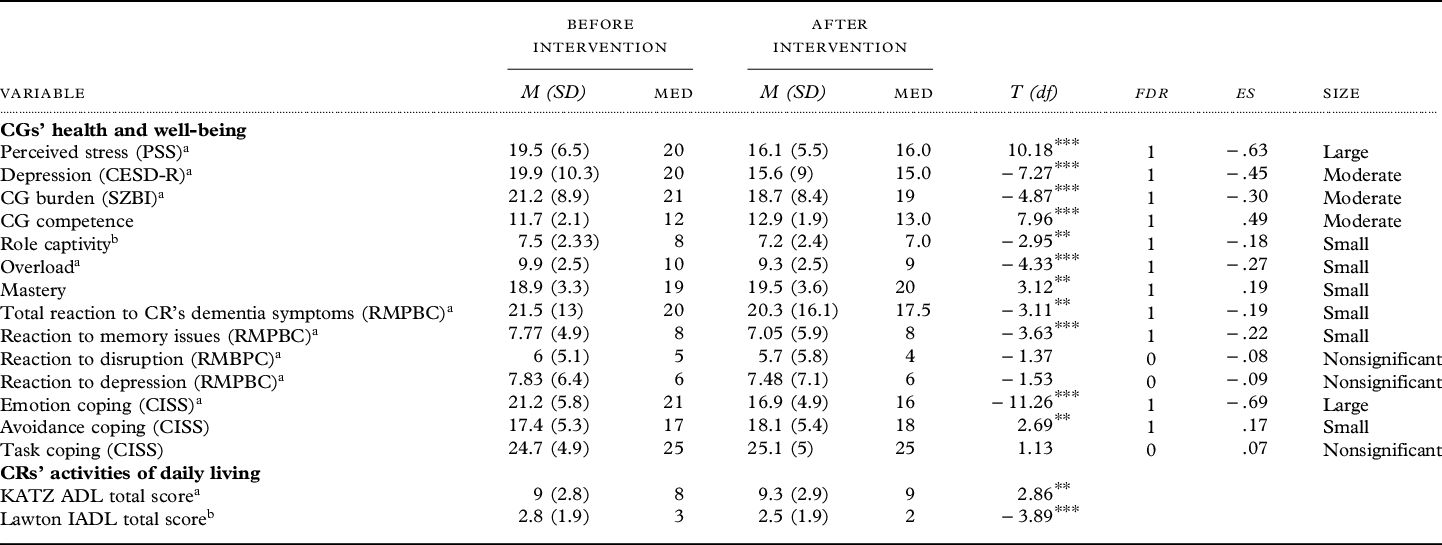
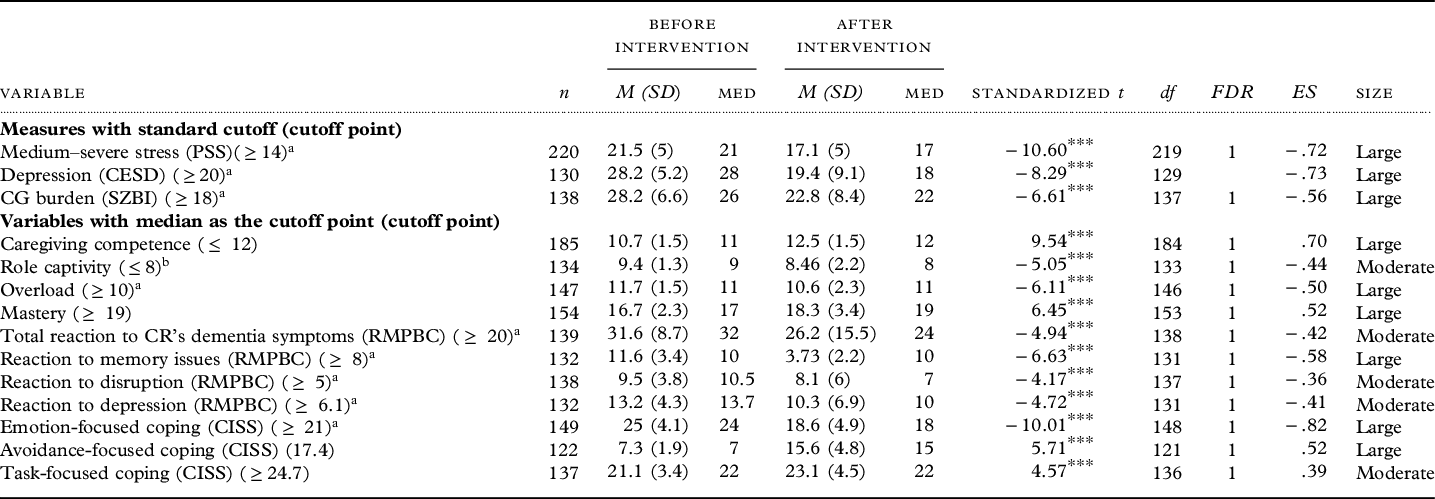
We did not present the results for the demographic variables that we considered unreliable because of high missing values (>20%) with a nonrandom pattern, according to the MVA (Table 1). To add additional perspective for readers, demographic variables with high missing values are as follows: CG gender: 82% female, 12% male (134 respondents, 51% of total sample); CR gender: 57% female, 43% male (102 respondents, 37% of total sample); relationship to CR: 41% child, 53% spouse, and 6% other (139 respondents, 53% of total sample). Pre–post outcomes for all CGs (n = 264) are summarized in Table 2 and outcomes for CGs with more apparent compromised function at entry into the study are summarized in Table 3. About 83% of the study population suffered from medium-to-high levels of stress and about half suffered from CG burden and depression.
Pre–post CG outcomes (n = 264, df = 263) and CRs’ ADL/IADL function

n = sample size, M = mean, SD = standard deviation, Med = median, t: for PSS represents the result of a t-test and for the remaining variables, the standardized test statistic for Wilcoxon signed-rank test ; p = two-sided p-value; df = degree of freedom; FDR = the false discovery rate, 1 = acceptable p-value, 0 = nonsignificant p-value after correction for multiple testing.
Abbreviations: ES, effect size; PSS, Perceived Stress Scale; CESD-R, Center for Epidemiologic Studies Depression Scale – Revised; SZBI, Zarit Burden Interview 20-item version; RMBPC, revised memory and behavioral problems checklist; CISS, Coping Inventory for Stressful Situations; KATZ ADL, Katz Index of Independence in Activities of Daily Living.
*p-value <.05; **p-value<.01; ***p-value<.001.
aHigher score indicates more impaired CRs; blower score indicates more impaired CRs.
Pre-–post outcomes for more compromised CGs and CRs’ ADL/IADL function

n = sample size, M = mean, SD = standard deviation, Med = median, t = standardized test statistic for Wilcoxon signed-rank test; df = degree of freedom, FDR = the false discovery rate: 1 = acceptable, 0 = nonsignificant p-value after correction for multiple testing; ES = effect size; *p-value <.05; **p-value<.01; ***p-value<.001.
aHigher levels indicate more compromised CGs, bthe variable is presented in a negative-oriented scale.
The CG group as a whole showed significant positive change on all post-measures except task-oriented coping, and two RMBPC subgroups. The ES was large for stress and emotion-focused coping, medium for depression, burden, and competence, and small for avoidance-oriented coping, mastery, overload, role captivity, reaction to CR’s memory issues, and total reaction to CR’s dementia symptoms. Both ADL and IADL scores of the CRs showed a significant decline.
The more compromised CG group (Table 3) showed significant (p-value <.001) positive change on all post-measures with large ES for stress, depression, burden, competence, overload, mastery, emotion-focused and avoidance-focused coping, and reaction to CR’s memory issues; and moderate ES for role captivity, task-oriented coping, and RMBPC reaction to CR’s dementia, disruption, and depression.
Discussion
The aim of this study was to evaluate the effect of the Reitman Centre CARERS program on dementia CGs’ health and well-being when delivered by trained mental health clinicians in multiple sites. To our knowledge, at the time of this study, CARERS is unique in integrating PST, simulation learning, CG-specific education, and group psychotherapy principles to improve CGs’ health and well-being. The baseline data indicate that this was a vulnerable CG group. About 80% had moderate-to-severe stress and about half experienced depression or high levels of burden.
In this sample, CARERS, an integrated multicomponent psychotherapeutic skills training program delivered by trained professionals in a group format appears to have led to robust pre–post change on key measures of caregiver well-being and function. Stress, depression, and burden measures all showed a significant positive response with large or medium ES, especially in the more compromised CGs. Similarly, key factors associated with caregiver function including CG competence, and mastery, role captivity and overload, effective coping, and tolerance of the CR showed significant positive change after the intervention. Emotion-focused coping and stress showed the greatest improvement followed by CG competence and level of depression.
In the study group as a whole (n = 264), 10 of the 14 outcome measures improved and all 14 measures improved in more compromised CGs (Table 3), despite the deterioration in activities of daily living scores of CRs during the study period. Meta-analytic data on the effectiveness of CG interventions on various standard measures have shown significant improvements in various outcome measures in controlled studies although, ES has generally been small (Cooke et al., Reference Cooke, Mcnally, Mulligan, Harrison and Newman2001; Laver et al., Reference Laver, Milte, Dyer and Crotty2017; Park and Park, Reference Park and Park2015). In contrast, the ES for the pre–post outcomes for the CARERS intervention in this sample were more robust, especially for the subgroup of CGs with higher levels of stress, burden, and depression and more compromised scores on CG coping and adaptation. In the latter group, all of the ES calculations were large or medium.
Changes in CRs’ functioning was monitored with ADL and IADL measures. Despite some decline in those they were caring for, CGs demonstrated significant improvement.
Despite the smaller number of more compromised CGs in the study, statistical power was retained for this group and showed significant results for all 14 outcome variables.
Conclusions
The robust improvement in this study of CGs’ role functioning, tolerance, coping, sense of mastery, and reduction in depression, stress, and burden support the effectiveness of the CARERS method with a naturalistic sample of CGs providing care for a community-dwelling family member with dementia.
It was beyond the scope of this study to determine if the demonstrated improvements affected the longer-term course of the caregiving journey. The improvement of CGs function and well-being despite some decline in CRs’ is a potentially important finding suggesting that CGs function and well-being can be sustained despite a decline in the CRs function. It may be reasonable to hope that these improvements could enhance CGs’ staying power in their role, improve tolerance and reduce the incentive to seek alternative care such as long-term care facilities, but further research on the longer term effects of the CARERS intervention and its impact on health system utilization and delayed need for institutional alternatives is warranted.
Limitations and generalizability
This was a non-randomized study sample of CGs with attendant vulnerability to unintended bias in the sample.[Following submission of this paper, a subsequent analysis compared the results of this study with a wait list control group. These results are presented in a separate paper currently under review for publication.] About 80% of the CGs in this study had education beyond a high school diploma, higher than the 54% average for Canadians aged 25–64 (Statistics Canada, 2017). This more educated group may have made them more aware of the need for help, the availability of options, increased their motivation to seek help, and improved their capacity to engage in, and benefit from CARERS. The multisite design of the study could have been further strengthened by process evaluation such as examining the regional or organizational differences in the sites. Incorporating evaluation of the implementation circumstances is a goal of future studies. Absence of a control group means we cannot exclude the possibility that other factors, such as an inadvertently biased sample might be responsible for the outcomes, although the multisite design and nonrestrictive eligibility criteria may have helped to reduce the risk of bias. The absence of a control group limits the degree of certainty that the demonstrated improvement was solely produced by the intervention as well as the generalizability of the findings to other populations of CGs such as diverse socioeconomic, cultural, and language groups. Further research in these populations is warranted.
Conflict of interest
None.
Source of funding
Funded by the Canadian Institutes of Health Research (CIHR) grant through the Canadian Consortium of Neurodegeneration and Aging (CCNA).
Description of authors’ roles
J. Sadavoy as principal investigator designed the CARERS program, supervised the study, and co-wrote the manuscript; S. Sajedinejad performed the statistical analysis and co-wrote the manuscript. M. Chiu helped in study design, supervised data collection, and provided feedback on the manuscript.
Supplementary material
To view supplementary material for this article, please visit https://doi.org/10.1017/S1041610220004019.