Introduction
One of the fundamental challenges for gerontological research is to identify and understand the predictors of how interindividual differences in cognitive resources and in vulnerability to cognitive decline in old age emerge. To address this issue, the cognitive reserve concept (e.g. Stern, Reference Stern2009; Reference Stern2012) provides an explanation for such interindividual differences regarding vulnerability to age-related brain changes or pathology. Specifically, it has been postulated that innate cognitive resources, together with cognitive stimulation during brain maturation in childhood (e.g. via education), build up a buffer against cognitive decline in old age. Evidence for such an initial cognitive reserve effect comes from studies showing that higher educational attainment and higher childhood IQ are associated with higher performance in multiple cognitive domains in old age (e.g. Gatz et al., Reference Gatz, Svedberg, Pedersen, Mortimer, Berg and Johansson2001; Fritsch et al., Reference Fritsch, Larsen and Smyth2007; McDowell et al., Reference McDowell, Xi, Lindsay and Tierney2007). In addition, a cognitively engaged lifestyle during adulthood preserves and possibly even increases the buffer against cognitive impairment. This view is supported by findings that a high cognitive level of one's occupation (i.e. the degree of intellectual involvement at work) leads to enrichment effects and thereby makes a contribution to cognitive reserve throughout a person's lifetime and is related to better cognitive functioning in old age (e.g. Schooler et al., Reference Schooler, Mulatu and Oates1999; Kröger et al., Reference Kröger, Andel, Lindsay, Benounissa, Verreault and Laurin2008; Stern, Reference Stern2012; Adam et al., Reference Adam, Bonsang, Grotz and Perelman2013).
In the context of individual's occupation as a marker of cognitive reserve, recent research has examined the effect of timing of retirement on cognitive functioning later in old age. Specifically, some studies suggested that a late retirement and thus remaining longer in the stimulating occupational environment may help preserving cognitive functioning and to delay cognitive impairments in old age (e.g. Lupton et al., Reference Lupton2010; Bonsang et al., Reference Bonsang, Adam and Perelman2012; Mazzonna and Peracchi, Reference Mazzonna and Peracchi2012; Dufouil et al., Reference Dufouil2014; Grotz et al., Reference Grotz2016). Yet, some authors argued that such effects of timing of retirement on late-life cognition may be overestimated (e.g. Grotz et al., Reference Grotz2015). In contrast, it may be even reasonable to predict that not a late but instead an early retirement might be associated with better cognitive functioning in old age. For instance, an early retirement may allow to leave a job with relatively low cognitive stimulation (such as in blue-collar workers) and thereby to free time resources for engaging in more stimulating leisure activities after retirement (see e.g. Coe et al., Reference Coe, Von Gaudecker, Lindeboom and Maurer2012, for a discussion). This view is supported by evidence suggesting that engagement in leisure activities in old age may compensate for cognitive disadvantages potentially imposed by working in occupations that offer fewer cognitive challenges (e.g. Andel et al., Reference Andel, Silverstein and Kareholt2015). This dovetails with findings that also in late and very late adulthood engaging in a variety of leisure activities additionally contributes to cognitive reserve and is related to better cognitive functioning in old age (e.g. Wilson et al., Reference Wilson, Boyle, Yu, Barnes, Schneider and Bennett2013; see Hertzog et al., Reference Hertzog, Kramer, Wilson and Lindenberger2008, for a review on enrichment effects in adulthood; see Opdebeeck et al., Reference Opdebeeck, Martyr and Clare2016, for a recent meta-analysis).
Methodologically, this diversity of a possible timing-of-retirement-cognition relationship suggests that the association of timing of retirement with cognitive functioning in old age may be moderated by correlates of cognitive reserve. One such potential moderator may be the cognitive level of job. Specifically, a late retirement and thus remaining longer in the job may be particularly beneficial for cognitive functioning in later life if the respective occupation is highly stimulating, i.e. with a high cognitive level of job, but less if the cognitive level of job is low (see e.g. Opdebeeck et al., Reference Opdebeeck, Martyr and Clare2016, for a discussion). Likewise, in jobs with high physical demands, a late retirement may be less beneficial for cognitive functioning in old age given that jobs with a relatively high physical demand tend to be less complex and with lower cognitive stimulation (e.g. Hacker, Reference Hacker2003), which has been shown to be related to higher risk of cognitive impairments (e.g. Schooler et al., Reference Schooler, Mulatu and Oates1999; Kröger et al., Reference Kröger, Andel, Lindsay, Benounissa, Verreault and Laurin2008). A further potential moderator may be individual's educational attainment. Evidence suggests that a relatively high cognitive stimulation throughout the life course may help compensating for initially lower cognitive reserve by lower educational attainment (e.g. Lachman et al., Reference Lachman, Agrigoroaei, Murphy and Tun2010; Soubelet, Reference Soubelet2011). Therefore, with respect to the role of one's job for contributing to cognitive reserve, a late retirement and thus remaining longer in the stimulating occupational environment may be particularly beneficial for cognitive functioning in old age in individuals with lower educational attainment (see e.g. Mazzonna and Peracchi, Reference Mazzonna and Peracchi2012, for a discussion). Besides that, timing of retirement may have a smaller importance for cognitive functioning in later life if individuals strongly engage in further stimulation such as leisure activities after retirement, which may additionally contribute to cognitive reserve (e.g. Wilson et al., Reference Wilson, Boyle, Yu, Barnes, Schneider and Bennett2013; Andel et al., Reference Andel, Silverstein and Kareholt2015) and thereby may compensate for possible negative effects of an early retirement. In contrast, with low cognitive stimulation after retirement, such effects of timing of retirement on cognitive functioning may become evident.
Empirically, the moderating role of cognitive level of job, physical demand of job, educational attainment, and leisure activities after retirement on the relation of timing of retirement to cognitive functioning in old age remains inconclusive so far. Therefore, the present study set out to extend the literature by investigating the association of timing of retirement with cognitive performance and its interplay with key correlates of cognitive reserve in a large sample of older adults in more detail. Specifically, our first goal was to examine bivariate relations of timing of retirement to performance in different cognitive measures (i.e. Trail Making Test part A (TMT A), TMT B, Mill Hill vocabulary test) in old age. Our second goal was to evaluate whether these relations varied as a function of cognitive level of job, physical demand of job, educational attainment, and/or leisure activities as respective moderator.
Methods
Participants
Data were collected in 2011 and 2012 and come from the Vivre–Leben–Vivere (VLV) survey, an ongoing project on vulnerability in Switzerland (LIVES). The main cross-sectional sample of 3,080 participants was randomly selected as a representative sample of the population in the cantonal and federal Swiss administrations’ records and stratified by age (65–69 years, 70–74 years, 75–79 years, 80–84 years, 85–89 years, and 90+ years), sex, and canton (Bale, Berne, Geneva, Ticino, and Valais). Of them, 2,480 were fully retired according to the social security standard) and did currently not pursue a voluntary gainful activity. Of these 2,480 individuals, 2,263 participants performed the Mill Hill vocabulary test (see below for further task descriptions) and served as sample for the present study. One thousand six hundred eighty six performed the TMT A and 1,338 the TMT B (see Statistical analyses section for further details). Mean age of the sample of 2,263 individuals was 78.3 years (SD = 8.2, range 65–101). This sample comprised 973 women (43.0%) and 1,290 men (57.0%). All participants gave informed consent and the present study included adherence to the declaration of Helsinki and had been approved by the local ethics commission.
Materials
Cognitive performance
TMT A: We assessed the Trail Making Test part A (TMT A; Reitan, Reference Reitan1958) measuring cognitive processing speed, motor speed, semantic knowledge, and visual acuity. After seven exercise trails, participants had to connect the numbers from 1 to 25 as fast as possible and without error in ascending order. The TMT A completion time was the time in seconds needed to connect the 25 numbers.
TMT B : We assessed the Trail Making Test part B (TMT B; Reitan, Reference Reitan1958) measuring cognitive flexibility, cognitive processing speed, motor speed, semantic knowledge, and visual acuity. After seven exercise trails, participants had to connect the numbers 1 to 13 in ascending order and the letters A to L in alphabetic order while alternating between numbers and letters (i.e. 1-A-2-B-3-C 0. . . 12-L-13) as fast as possible and without error. The TMT B completion time was the time in seconds needed to connect the 25 numbers/letters. Note that for all analyses with TMT B, we controlled for TMT A, in order to specifically pinpoint the demand on cognitive flexibility in the TMT B (see e.g. Sanchez-Cubillo et al., Reference Sanchez-Cubillo2009; Pulopulos et al., Reference Pulopulos, Hidalgo, Almela, Puig-Perez, Villada and Salvador2014).
Mill Hill: We administered the Mill Hill scale (Deltour, Reference Deltour1993) measuring vocabulary. For each item, participants had to underline the word (which was intermixed with five distractor words) that semantically matched the target word. After one practice item, participants had to complete ten items. The Mill Hill score was the proportion of correctly completed items.
Timing of retirement
Participants were asked to indicate when they had retired by choosing one of the following alternatives: (1) early retirement; (2) at legal age for retirement (at age 64 years for women and at age 65 years for men in Switzerland); or (3) late retirement.
Markers of cognitive reserve
Cognitive level of job: Participants were asked to indicate their last profession practiced before retirement, which we thereafter rated on a four-point scale adopted from Nucci et al., (Reference Nucci, Mapelli and Mondini2012), dealing with the degree of intellectual involvement and personal responsibility: (1) unskilled manual/non-manual work (e.g. farmer, car driver, call center operator); (2) skilled manual work (e.g. craftsman, clerk, hairdresser); (3) skilled non-manual or technical work (e.g. trader, kindergarten teacher, real estate agent); or (4) highly intellectual work (e.g. lawyer, physician, university professor, top manager).
Physical demand of job: Participants were asked to indicate whether their last profession practiced before retirement was physically demanding by choosing one of the following alternatives: 0 = “no” or 1 = “yes.”
Educational attainment: Participants were asked to indicate their highest educational level attained by choosing one of the following six levels: (1) primary school level; (2) inferior secondary school level; (3) apprenticeship graduation; (4) superior secondary school level; (5) technical college or superior vocational college degree; or (6) university degree. For analyses, we distinguished the sample into three groups of low versus mid versus high educational attainment according to the categories of low education, leading mainly to unskilled work (i.e. levels 1 and 2) versus vocational education, leading mainly to manual work (i.e. level 3) versus higher (advanced) education, typically leading to intellectual work (i.e. levels 4, 5, and 6; see Gabriel et al., Reference Gabriel, Oris, Studer and Baeriswyl2015).
Leisure activities in old age: Participants were asked whether they had carried out the following 18 leisure activities within the last months: (1) go for a walk; (2) gardening; (3) gymnastics or other physical exercises; (4) other sports; (5) go into a café, restaurant, etc.; (6) go to the cinema, theater, etc.; (7) excursions of 1 or 2 days; (8) journeys of at least 3 days; (9) play a musical instrument; (10) other artistic activities; (11) take courses, go to conferences, etc.; (12) party games (cards, scrabble, etc.); (13) crossword puzzles, sudoku, etc.; (14) needlework (knitting, dressmaking, etc.); (15) handicrafts, repair, carpentry, pottery, etc.; (16) participation in political or labor union activities; (17) participation in municipality or district activities; and (18) participation in sporting events (e.g. visit a football match, etc.). These activities had been a priori selected with respect to different life domains such as mental activities, physical activities, or social activities comprising a large variety of leisure activities (see e.g. Karp et al., Reference Karp, Paillard-Borg, Wang, Silverstein, Winblad and Fratiglioni2006, for similar lists). Those activities that had been carried out were summed up to derive the overall number of activities individuals engaged in.
Procedure
Individuals filled out a socio-demographic survey, the items regarding occupation, retirement, and leisure activities (besides a larger set of other questionnaires) and performed the paper–pencil tests of the cognitive measures. Participants were individually tested.
Statistical analyses
The following analyses were run: First, for descriptive purposes, we inspected bivariate relations between timing of retirement, cognitive level of job, physical demand of job, educational attainment, the number of leisure activities, and cognitive performance (by calculating Spearman's ρ for relations with timing of retirement, cognitive level of job, and educational attainment, point biserial correlation coefficients rpb for relations with physical demand of job, and Pearson's correlation coefficients r for relations with leisure activities).
Second, we investigated whether the relations of timing of retirement to cognitive performance varied as a function of cognitive level of job/physical demand of job/educational attainment/leisure activities. For these moderation analyses, we applied an individual model for each cognitive performance measure/moderator variable. Specifically, we regressed cognitive performance on timing of retirement as predictor plus cognitive level of job/physical demand of job/educational attainment/leisure activities as respective moderator plus an interaction term. In a subsequent set of analyses, we investigated the moderation patterns in more detail to specify the values of the moderator variable for which the effect of the predictor was significant. Specifically, we conducted simple slope analyses to estimate the region of significance, i.e. the specific values of the respective moderator (cognitive level of job/number of activities) at which the regression of cognitive performance on timing of retirement moves from non-significance to significance cf. Preacher et al., Reference Preacher, Curran and Bauer2006).
For all analyses, timing of retirement, cognitive level of job, and educational attainment were considered as ordered categorical variables. Physical demand of job was considered as dichotomous categorical variable. We subsequently repeated all analyses contrasting the three retirement groups to investigate relations to retirement in more detail. To achieve that higher values represented better performance across all variables (as common in correlative studies), for TMT A and TMT B, the distribution of completion time of all participants was reversed based on the sample mean so that interindividual differences remained identical. We calculated relations with performance in the TMT A based on 1,686 participants, relations with performance in the TMT B based on 1,338 participants, and all other relations based on 2,263 participants. Note that in the extensive survey procedure, we had administered the cognitive tests only if there was enough time left (allowing a proper administration of the Mill Hill in 2,263 participants). We had administered the TMT A only if the participant had properly performed all seven exercise trails. Likewise, we had administered the (more complex) TMT B only if the participant had properly performed the TMT A as well as all seven exercise trails of the TMT B. Furthermore, we terminated the TMT A and the TMT B (without any score) when the individual made any error in connecting the 25 numbers/letters in the respective test (allowing a proper administration of the TMT A in 1,686 participants and of the TMT B in 1,338 participants). We applied these restrictive criteria to be able to directly compare the completion times (i.e. completion times would be confounded when including participants who made errors and took additional time to correct them). Due to these restrictive criteria, the remaining sample was slightly younger, better educated, healthier, and contained a larger proportion of men, compared to the main sample (ps < 0.044), but did not differ with respect to timing of retirement (p = 0.427). All analyses were performed with the R environment.
Results
Descriptive statistics
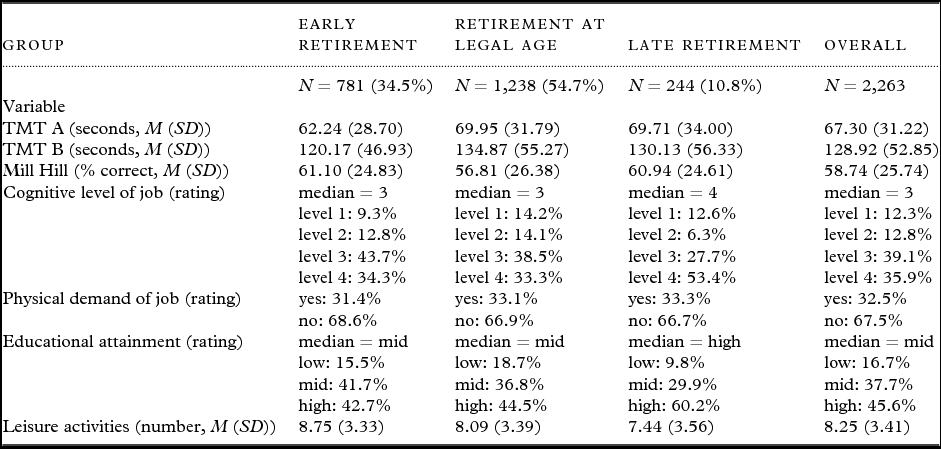
Descriptive statistics of the three cognitive performance measures, cognitive level of job, physical demand of job, educational attainment, and the number of leisure activities are displayed in Table 1, separately for the three groups of early retirement, retirement at legal age, and late retirement as well as for the overall sample.
Descriptive statistics of measures

Note. Descriptive statistics of measures, separately for the three groups of early retirement, retirement at legal age, and late retirement as well as for the overall sample.
Bivariate relations between measures
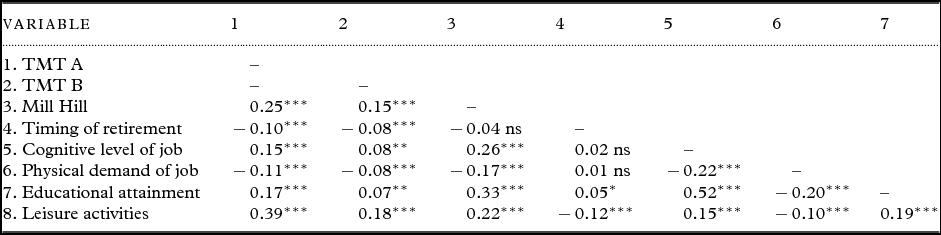
Overall, earlier retirement was significantly associated with better cognitive performance, in the TMT A and the TMT B, but unrelated to performance in the Mill Hill (see Table 2). Subsequently contrasting the three retirement groups revealed that completion times in the TMT A and the TMT B were significantly lower (hence, reflecting a better performance) in individuals with early retirement compared to those with retirement at legal age (TMT A: β = −0.12, p < 0.001; TMT B: β = −0.11, p < 0.001) and to those with late retirement (TMT A: β = −0.11, p = 0.004; TMT B: β = −0.08, p = 0.022). There was no difference between individuals with retirement at legal age and those with late retirement (TMT A: β < 0.01, p = 0.927; TMT B: β < 0.01, p = 0.755). Interestingly, for Mill Hill, subsequent contrasts revealed that performance was significantly better in individuals with early retirement compared to those with retirement at legal age (β = 0.08, p < 0.001) and in individuals with late retirement compared to those with retirement at legal age (β = 0.06, p = 0.024). There was no difference between individuals with early retirement and those with late retirement (β < 0.01, p = 0.928). Moreover, higher cognitive level of job, low physical demand of job, higher educational attainment, and a higher number of leisure activities were significantly associated with better performance in the three cognitive domains. Earlier retirement was significantly associated with lower educational attainment and a higher number of leisure activities, but unrelated to cognitive level and physical demand of job. Lower cognitive level of job was related to a lower number of leisure activities (see Table 2 for the full correlation matrix).
Full correlation matrix of measures

Note. TMT B was controlled for TMT A. Timing of retirement was considered as ordered categorical variable.
***p < 0.001.
**p < 0.01.
*p < 0.05
ns = non-significant.
p > 0.05.
Moderation analyses
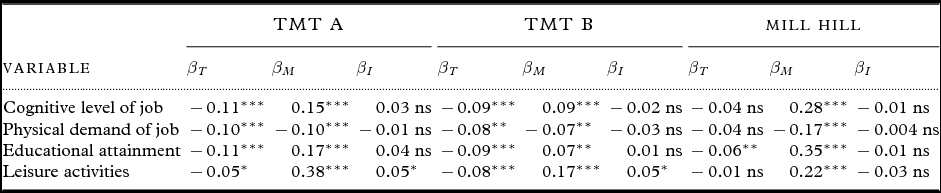
Regarding our second goal, we analyzed whether the relations of timing of retirement to cognitive performance varied as a function of cognitive level of job/physical demand of job/educational attainment/leisure activities (i.e. in terms of a moderation). In these moderation models, overall effects of timing of retirement on cognitive performance remained almost identical as in the bivariate analyses, with earlier retirement being significantly associated with better performance in the TMT A and the TMT B (see Table 3). Again, higher cognitive level of job, low physical demand of job, higher educational attainment, and a higher number of leisure activities were significantly associated with better performance in the three cognitive measures. Yet, there was no significant moderation of the overall effect of timing of retirement on cognitive performance by cognitive level of job, physical demand of job, nor by educational attainment.
Moderation analyses with timing of retirement as predictor of cognitive performance and cognitive level of job/physical demand of job/educational attainment/leisure activities as respective moderator

Note. Moderation analyses with timing of retirement (considered as ordered categorical variable) as predictor of cognitive performance and cognitive level of job/physical demand of job/educational attainment/leisure activities as respective moderator. βT = standardized coefficient of timing of retirement as predictor of cognitive performance. βM = standardized coefficient of cognitive level of job/physical demand of job/educational attainment/leisure activities as respective moderator. βI = standardized coefficient of the respective interaction term. TMT B was controlled for TMT A.
***p < 0.001.
**p < 0.01.
*p < 0.05
ns = non-significant.
p > 0.05.
Interestingly, subsequently contrasting the three retirement groups revealed a significant moderation of the effect of late retirement (compared to retirement at legal age) on performance in the Mill Hill by cognitive level of job (β = 0.14, p = 0.027). A subsequent simple slope analysis revealed that the performance benefit in the Mill Hill with late retirement compared to retirement at legal age was only evident in individuals with lower cognitive level of job (i.e. unskilled manual/non-manual work or skilled manual work; β ≥ 0.05, p < 0.05), but not in individuals with higher cognitive level of job (i.e. skilled non-manual or technical work or highly intellectual work; p > 0.05). This indicated that the benefit of late retirement (compared to retirement at legal age) on performance in the Mill Hill varied as a function of individuals’ cognitive level of job in midlife.
Besides that, there was a significant moderation of the overall effect of timing of retirement on performance in the TMT A and the TMT B by the number of leisure activities (see Table 3). For TMT A, the subsequent simple slope analysis revealed that in individuals with eight or less leisure activities, earlier retirement was significantly related to better cognitive performance (β ≥ 0.05, p < 0.05), but not in individuals with nine or more leisure activities (p > 0.05). For TMT B, the simple slope analysis revealed that in individuals with ten or less leisure activities, earlier retirement was significantly related to better cognitive performance (β ≥ 0.06, p < 0.05), but not in individuals with 11 or more leisure activities (p > 0.05). This indicated that the relation of timing of retirement to performance in the TMT A and the TMT B varied as a function of the number of leisure activities that individuals carried out in old age. Subsequently contrasting the three retirement groups regarding this interaction revealed that the performance benefit in the TMT A with early retirement compared to retirement at legal age was only evident in individuals with ten or less leisure activities (β ≥ 0.05, p < 0.05), but not in individuals with 11 or more leisure activities (p > 0.05) and that the performance benefit with early retirement compared to late retirement was only evident in individuals with seven or less leisure activities (β ≥ 0.07, p < 0.05), but not in individuals with eight or more leisure activities (p > 0.05). The performance benefit in the TMT B with early retirement compared to retirement at legal age was only evident in individuals with eleven or less leisure activities (β ≥ 0.06, p < 0.05), but not in individuals with 12 or more leisure activities (p > 0.05) and that the performance benefit with early retirement compared to late retirement was only evident in individuals with nine or less leisure activities (β ≥ 0.08, p < 0.05), but not in individuals with ten or more leisure activities (p > 0.05).
Subsequent hierarchical regression analyses
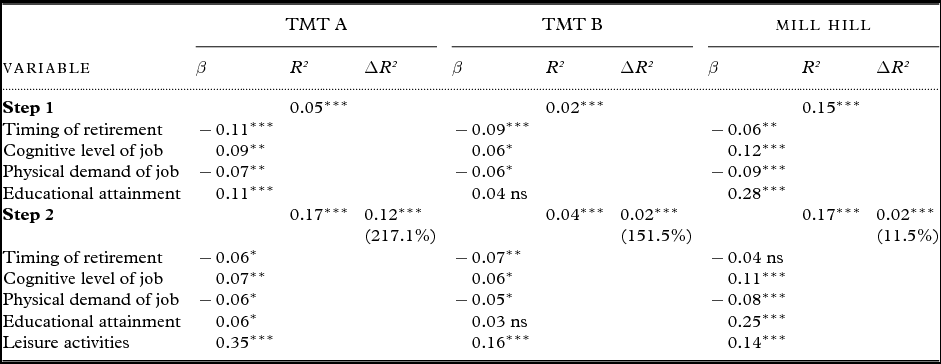
To further explore the role of current leisure activities in old age as additional contributor to cognitive reserve, we subsequently conducted a set of hierarchical regression analyses. Specifically, we examined whether leisure activities currently performed in old age increased explained variance in cognitive performance over and above the effects of cognitive level of job, physical demand of job, and educational attainment (as contributors to cognitive reserve in early and midlife) as well as timing of retirement (which were simultaneously entered in Step 1 as predictors of cognitive performance). Entering current leisure activities in Step 2 as additional predictor significantly increased explained variance in the TMT A and the TMT B and constituted the strongest predictor of these two measures (see Table 4). Subsequently contrasting the three retirement groups revealed that entering current leisure activities in Step 2 as additional predictor significantly increased explained variance in the TMT A and the TMT B in all models (all ps < 0.001). This indicated that leisure activities currently performed in old age may lead to further enrichment effects and thereby may make a further contribution to cognitive reserve throughout a person's lifetime.
Hierarchical regression analyses predicting cognitive performance

Note. Hierarchical regression analyses with timing of retirement (considered as ordered categorical variable), cognitive level of job, physical demand of job, and educational attainment simultaneously entered in Step 1 as predictors of cognitive performance and with leisure activities entered in Step 2 as additional predictor. β = standardized coefficient of the respective predictor. R² = resulting total variance that is accounted for by the entered predictors. ΔR² represents the amount of increase in explained variance by entering leisure activities as additional predictor in Step 2 (in parentheses, the percentage regarding the increase relative to the initial amount of explained variance in Step 1 is given). TMT B was controlled for TMT A.
***p < 0.001.
**p < 0.01.
*p < 0.05.
ns = non-significant.
p > 0.05.
Discussion
The present study set out to investigate the association of timing of retirement with different measures of cognitive performance and its interplay with key correlates of cognitive reserve in a large sample of older adults. First of all, we found that performance in the Mill Hill was better in individuals with early retirement compared to those with retirement at legal age and in individuals with late retirement compared to those with retirement at legal age. Performance in the TMT A and the TMT B was better in individuals with early retirement compared to those with retirement at legal age and to those with late retirement. This is in contrast to some studies that suggested that a late retirement may be generally related to preserved cognitive functioning in old age (e.g. Lupton et al., Reference Lupton2010; Mazzonna and Peracchi, Reference Mazzonna and Peracchi2012; Dufouil et al., Reference Dufouil2014) and, given the differential findings for Mill Hill and TMT, this indicates that the link between retirement and cognitive functioning in old age is more complex than suggested by current biomedical or epidemiological models (see e.g. Grotz et al., Reference Grotz2015, Reference Grotz2016, for a discussion). Moreover, in line with prior evidence (e.g. Schooler et al., Reference Schooler, Mulatu and Oates1999; Gatz et al., Reference Gatz, Svedberg, Pedersen, Mortimer, Berg and Johansson2001; Hertzog et al., Reference Hertzog, Kramer, Wilson and Lindenberger2008; Opdebeeck et al., Reference Opdebeeck, Martyr and Clare2016), we found that higher cognitive level and low physical demand of one's occupation, higher educational attainment, and greater engagement in a broad variety of leisure activities after retirement were related to better performance in all three cognitive measures in old age. This confirms the conceptual perspective that cognitive stimulation throughout the life course may contribute to cognitive reserve thereby being related to better cognitive functioning in old age (Stern, Reference Stern2009, Reference Stern2012; see also Hertzog et al., Reference Hertzog, Kramer, Wilson and Lindenberger2008; Opdebeeck et al., Reference Opdebeeck, Martyr and Clare2016).
Following our second goal, we investigated the interplay of the timing-of-retirement-cognition relationship with these variables. In these moderation models, we found that the association of late retirement (compared to retirement at legal age) with performance in the Mill Hill varied as a function of individuals’ cognitive level of job in midlife. Specifically, a subsequent simple slope analysis revealed that the performance benefit in the Mill Hill with late retirement compared to retirement at legal age was only evident in individuals with lower cognitive level of job (i.e. unskilled manual/non-manual work or skilled manual work), but not in individuals with higher cognitive level of job (i.e. skilled non-manual or technical work or highly intellectual work). This, together with our observation that lower cognitive level of job was also related to less engaging in leisure activities after retirement, suggests that remaining longer in the occupational environment, even if the stimulation is not high, may provide at least some enrichment effects, if individuals would not have other stimulation after retirement due to low engaging in leisure activities (see e.g. Coe et al., Reference Coe, Von Gaudecker, Lindeboom and Maurer2012; Grotz et al., Reference Grotz2016, for a discussion). In contrast, with a high cognitive level of job individuals may already have gained a strong contribution to cognitive reserve and it may not make a substantial difference whether they retire at legal age or later.
Besides that, the moderation analyses indicated that the relation of timing of retirement to performance in the TMT A and the TMT B varied as a function of the number of leisure activities that individuals carried out in old age after retirement. Specifically, simple slope analyses revealed that the performance benefits in the TMT A and the TMT B with early retirement compared to retirement at legal age and compared to late retirement were only evident in individuals with a moderate number of leisure activities, but not in individuals with a relatively large number of leisure activities. This suggests that timing of retirement may play a minor role for cognitive functioning in later life if individuals strongly engage in further cognitive stimulation such as leisure activities after retirement. This may be because even in old age leisure activities may additionally contribute to cognitive reserve (e.g. Wilson et al., Reference Wilson, Boyle, Yu, Barnes, Schneider and Bennett2013; Andel et al., Reference Andel, Silverstein and Kareholt2015). In contrast, with moderate cognitive stimulation after retirement, an early retirement may be beneficial for cognitive functioning in old age. This may be because an early retirement may allow freeing time resources for engaging in stimulating leisure activities after retirement. This is reflected in the finding of earlier retirement (compared to late retirement) being associated with greater engaging in leisure activities after retirement in our study.
Conceptually, one may argue that early retirement could be positively related to cognitive performance in individuals with a larger number of leisure activities (and not in those with a lower number, as we found) as this could presumably offer greater opportunity for cognitive stimulation to off-set the lack of on-the-job stimulation. Yet, we found the opposite, which again indicates that the relation of retirement to cognitive functioning in old age is more complex than suggested by current conceptual views. Based on our data, we argue that for individuals who engage only in few activities in old age it may be beneficial to start with that relatively early, for example, by an early retirement that then would free time for engaging in (at least some) activities. Thereby, the stimulating environment of one's occupation may not necessarily need to be maintained in any case as long as possible if one takes the opportunity to engage in other cognitive stimulation such as in leisure activities after retirement. In this case, engaging in different leisure activities may constitute a more varied stimulation and provide enrichment effects (Hertzog et al., Reference Hertzog, Kramer, Wilson and Lindenberger2008). Thereby, the life changes along with one's retirement may not inevitably have to be related to disadvantages if one is able to invest into these changes (Adam et al., Reference Adam, Bonsang, Grotz and Perelman2013). Although the detailed mechanisms will have to remain speculative for now, notably, even a moderate engagement in leisure activities in old age may be supportive for cognitive functioning if one can relatively early free time resources for engaging in stimulating leisure activities such as by an early retirement to make a further contribution to cognitive reserve in old age (e.g. Wilson et al., Reference Wilson, Boyle, Yu, Barnes, Schneider and Bennett2013; Andel et al., Reference Andel, Silverstein and Kareholt2015). Of course, in general, engaging in a larger number of activities is beneficial for cognitive functioning in old age (as we found). Yet, results showed that then (possibly due to the strong contribution to cognitive reserve in old age) it would not matter whether one had retired early or late.
To further explore the role of leisure activities in old age as additional contributor to cognitive reserve, we subsequently conducted a set of hierarchical regression analyses. Notably, in these analyses, leisure activities in old age constituted the strongest predictor of performance in the TMT A and the TMT B. In addition, results underline the key role of leisure activities in old age as additional contributor to cognitive reserve over and above the effects of other contributors to cognitive reserve in early and midlife (such as cognitive level of job, physical demand of job, and educational attainment) as well as timing of retirement. Thereby, leisure activities more than doubled explained variance in the TMT A and the TMT B beyond the initial contribution of these variables. All in all, results further corroborate the view that leisure activities even in old age may lead to further enrichment effects and thereby may be related to better cognitive functioning (e.g. Wilson et al., Reference Wilson, Boyle, Yu, Barnes, Schneider and Bennett2013; Andel et al., Reference Andel, Silverstein and Kareholt2015).
In the context of the latter notions, we acknowledge that data on individuals’ leisure activities have not been assessed with respect to their engagement between retirement and cognitive performance assessment. Yet, it seems plausible that individuals’ report regarding leisure activities is indicative of their activity engagement not only at the time of their cognitive performance assessment but also before. Nevertheless, the present study is limited by its cross-sectional design that does not allow for causal inferences. The directionality of observed relationships cannot be established with present cross-sectional data. Thus, we cannot clearly disentangle between individuals who decline because of reducing cognitive stimulation and individuals who reduce cognitive stimulation because of cognitive decline. More generally, analyses of the present study give only information about interindividual differences in cognitive status but do not allow drawing conclusions regarding cognitive decline (i.e. intraindividual changes over time), which needs to be evaluated with longitudinal data. This would be of particular importance to disentangle interindividual and intraindividual sources of variance to contribute to the ongoing debate of whether a longitudinal relation between cognitive stimulation and cognitive functioning is due to preserved differentiation (i.e. cognitively engaged individuals may have simply a higher initial cognitive ability level) or differential preservation (i.e. cognitively engaged individuals may show less cognitive decline over time). Moreover, future research will need to disentangle the role of different life course determinants of the transition to retirement and its interplay with cognitive stimulation before and after retirement and cognitive functioning in old age. In this context, one may argue that the interplay of timing of retirement, cognitive performance, and the examined contributors to cognitive reserve (education, activities, and occupation) may differ between women and men or may vary as a function of age. Yet, relations were not moderated by these variables. Additionally controlling for individuals’ health status revealed the same pattern of results. Moreover, one may argue that the finding of earlier retirement being beneficial, not detrimental, for cognitive performance, for those engaging in fewer leisure activities may be (at least partly) related to the quality of the leisure activities in terms of promoting cognitive reserve. Yet, with the present activity questionnaire and due to the overall activity measure used, it was not possible to disentangle the contribution of specific activities, which might be investigated in future studies.
We further acknowledge that observed effects of timing of retirement were of relatively small size, but they were statistically significant. Note that the influences of cognitive stimulation during the life course on cognitive functioning in old age are multifaceted (see e.g. Hertzog et al., Reference Hertzog, Kramer, Wilson and Lindenberger2008; Opdebeeck et al., Reference Opdebeeck, Martyr and Clare2016, for a discussion). Therefore, timing of retirement is only one angle within such mechanisms. In the present study, we assessed the TMT A, the TMT B, and the Mill Hill. Thus, we acknowledge that present results hold (at least) for these specific tests. Future longitudinal research will have to disentangle the role of timing of retirement and subsequent engagement in stimulating leisure activities for a larger variety of cognitive measures with respect to their differential trajectories in aging in more detail. Moreover, we acknowledge that due to the restrictive criteria for the TMT A and the TMT B (see Statistical analyses section for further details), there was a certain selection of the remaining sample. It may be possible that participants who properly did the test had better cognitive functioning than those who did an error. Thus, future research might investigate whether the present pattern of results holds also for individuals with cognitive impairments, which could give further insights into the link between timing of retirement, cognitive stimulation before and after retirement, and cognitive functioning in old age.
Conflict of interest
None.
Description of authors’ roles
A. Ihle formulated the research question, analyzed the data, and wrote the paper. C. Grotz and S. Adam contributed to formulate the research question and assisted with writing. M. Oris, D. Fagot, and R. Gabriel conceptualized the study, supervised the data collection, and participated in writing. M. Kliegel contributed to formulate the research question and was involved in writing the paper.
Acknowledgments
This publication benefited from the support of the Swiss National Center of Competences in Research LIVES – Overcoming vulnerability: life course perspectives, granted by the Swiss National Science Foundation. The authors are grateful to the Swiss National Science Foundation for its financial assistance. Catherine Grotz was supported by the Fund for Scientific Research (F. R. S. – FNRS), Belgium (www.frs-fnrs.be).