“I get by in life, French or English, mais that's alright”
Introduction
In this article, we examine use of English discourse markers in Louisiana Regional French (LRF) to determine the linguistic and extralinguistic motivations for the use of codeswitched markers in situations of language contact, and to better understand the nature of discourse markers themselves. In particular, we bring new acoustic evidence to the debate, and we examine the phenomenon using data from a situation of language shift and cultural revival rather than one of stable diglossia or simple decline. We first provide an overview of English discourse-marker use in French discourse, and then we examine two markers more in depth: English but and its counterpart, French mais. Quantitative and discursive analysis of their use in context confirms a correlation seen in de Rooij (Reference de Rooij2000) between discourse markers and pauses. Our findings, however, also challenge past claims (de Rooij Reference de Rooij2000:448) that discourse markers may not carry social meaning and suggests that the use of foreign markers and their placement adjacent to pauses may be motivated by many interacting factors, the need for maximal contrast (Maschler Reference Maschler1997) being only one of several possibilities.
The nature of discourse markers has been the subject of intense linguistic inquiry over the past fifty years. Despite years of research, agreement has not yet been reached over the matters of identifying and defining these particles with “puzzling semantics, puzzling pragmatics, puzzling syntax, and interesting morphological diversity” (Nemo Reference Nemo and Fischer2006:375). Discourse markers, also called discourse particles, are more common in speech than in writing, and are indeed a hallmark of informal speech (Szlezák Reference Szlezák2007). Because oral communication cannot be visually separated into coherent units (sentences, paragraphs), listeners must rely on aural cues to properly organize what is said. Defining discourse markers is central to their analysis. Scholars agree that particles are function words that share semantic unity (Fischer Reference Fischer and Fischer2006:14). Commonly cited functions of discourse markers include focus, contrast, coherence, and establishing common ground (Schiffrin Reference Schiffrin1987; Fraser & Malamud-Markowski Reference Fraser and Malamud-Markowski1996; de Rooij Reference de Rooij2000; Fuller Reference Fuller2001). However, while some scholars prefer a broad definition that is largely based on the function of the word, others prefer to include in their definitions only those particles that also fill syntactic or intonational properties as well. Fischer (Reference Fischer and Fischer2006:9) proposes a scale in this regard, with broad definitions including words that she suggests are integrated into the surrounding text (like connective but) and on the other end markers that are largely independent of it (markers that manage conversation). Maschler (Reference Maschler1994, Reference Maschler1997, Reference Maschler2009) defines discourse markers as particles that serve metalinguistic functions—they talk about talk. She refers to this as metalanguaging. She suggests that discourse markers are maximally detached from the discourse they frame (Reference Maschler2009:7), operating not to convey information about the extralingual world, but to convey information about the text in which they occur.
In this article we borrow Maschler's concept of metalanguaging, but also follow scholars such as Redeker (Reference Redeker and Fischer2006) and de Rooij (Reference de Rooij2000) in selecting a broad definition of discourse markers that does not require a reduction in referential semantic load, and define them as particles—often though not exclusively found at boundaries—that serve largely metapragmatic functions. Maschler (Reference Maschler2009:5) suggests that there are three types of metalingual utterances: textual, interpersonal, and cognitive. By our definition, discourse markers are function words that connect parts of a text to other parts of the text (whether short utterances or longer blocks of discourse) or to the cognitive processes of the speaker. English examples include but, so, well, eh, and you know. Particles like but and so link parts of a text together, where markers like you know and eh ensure audience participation. Hesitations such as um may signal a cognitive action on the part of the speaker (Maschler Reference Maschler2009:5). We recognize that some researchers (Schiffrin Reference Schiffrin1987, Reference Schiffrin and Fischer2006; Maschler Reference Maschler1997, Reference Maschler2009) may not consider contrastive conjunctions, including but, to be discourse markers. We prefer to retain these particles within our definition, because we feel that joining parts of text is nonetheless a metalinguistic action, and is related to the particle's function in other capacities. For example, using but to set off text as a tangent or a new line of thought maintains an element of the contrast explicit in its use as a conjunction (Redeker (Reference Redeker and Fischer2006:344) refers to these two functions as hypotactic transitions and paratactic transitions respectively). We treat the functions separately, however, in our analysis in recognition of the fact that the slight difference in function may well have an effect on the structure of the utterance itself—key to our analysis.
History of the study of discourse markers in bilingual settings
Discourse markers are easily borrowed across languages (Myers-Scotton Reference Myers-Scotton1992; Szlezák Reference Szlezák2007), a phenomenon that Matras (Reference Matras1998) further specifies may be due to their “pragmatic detachability.” Speakers may use markers from their second language in their first language, and vice versa. In Louisiana French, we find extensive use of English discourse markers, as seen in the following examples.Footnote 1
(1) But je sais pas si ina qu'a appris plein de ça you know
‘But I don't know if anybody learned a lot of that, you know.’
(2) So on nous a vendu ce morceau icitte
‘So they sold us this piece here.’
(3) I mean c'était un p'tit peu différent.
‘I mean, it was a little bit different.’
(4) Nous-autres icitte well on a tout le temps resté avec eux-autres
‘Us here, well, we always lived with them.’
Several authors have addressed the question of why discourse markers are borrowed into other languages. Szlezák (Reference Szlezák2007) argues that switched discourse markers simply indicate that a second language is used to a considerable extent in everyday conversation. The way(s) that discourse markers are borrowed in, however, may provide us with further insight as to their purpose. In some cases, they may take the place of native markers. In dying Texas German, for example, English markers have nearly entirely replaced German ones (Salmons Reference Salmons1990). Foreign markers may be borrowed when they fill a semantic gap: Hlavac (Reference Hlavac2006) shows that bilingual English/Croatian speakers use English markers only when they lack a Croatian equivalent or the English markers are more polyfunctional than the Croatian ones.
In other cases they may exist in tandem with native markers. Brody (Reference Brody and Silva-Corvalán1995) shows this to be the case for Tzutujil, in which Spanish markers appear in doublets with their Tzutujil equivalents. Brody suggests that this is possibly an early stage of replacement, and the Tzutujil markers may eventually disappear altogether. Torres (Reference Torres2002) documents another potential midway case in the Puerto Rican Spanish spoken in Brentwood, New York. In this case, bilinguals and English-dominant speakers maintain the use of both Spanish and English markers in their Spanish discourse, though those more fluent in Spanish use English markers in far more restricted contexts than do less fluent speakers.
De Rooij (Reference de Rooij2000) examines French discourse markers in Swahili and argues that the French markers are used to create and strengthen discourse cohesion and coherence; their obvious identification as foreign makes them salient and therefore particularly useful for maximal clarity of utterance. Maschler (Reference Maschler1994, Reference Maschler1997, Reference Maschler2009) takes this further and suggests that foreign discourse markers are selected because the use of a foreign language iconically performs the same function as the discourse markers themselves. By Maschler's (Reference Maschler2009:7) definition, discourse markers serve as boundary markers, framing items such as different verbal activities, shifts in contexts, or new components in a narrative. Such markers occur most often in clusters of other discourse markers, in turn-initial position, and following terminal intonation contours. In examining English-Hebrew bilinguals speaking English (Maschler Reference Maschler1997), Maschler finds that 98% of all sentence-level conjunctions (i.e. not discourse markers by her definition) used are English; the 2% that appear in Hebrew are markers that indicate a contrast of some sort. When a metalinguistic contrast is in order, however, Hebrew (i.e. foreign) discourse markers are preferred at a rate of 68%. Maschler concludes that the principle of contrast that drives the use of foreign markers in these instances is at the base of an emerging bilingual grammar.
The situation of french in louisiana
Often called Cajun French, Louisiana Regional French is descended from multiple sources, including a variety of regional French dialects, the French of the Acadian refugees (expelled from what is today the province of Nova Scotia in 1755), and the French of the upper classes of early nineteenth-century France, which more closely resembles Modern European French (Klingler Reference Klingler, Mathis-Mosen and Beschof2009). These varied dialects would come into contact with each other in Louisiana in the late nineteenth century to produce the variety—itself variable by region—that is most widely spoken in Louisiana today.Footnote 2 Though LRF features some notable differences from Standard French, the two varieties are largely mutually intelligible.
French in Louisiana has been in decline since the mid-nineteenth century, following the purchase of the territory by the United States and the subsequent arrival of large numbers of Anglophone immigrants. With English as the new language of power and prestige, the elite classes in Louisiana began a shift from French to English in the 1840s (Brasseaux Reference Brasseaux2005). The agrarian classes in particular maintained the French language, however, into the twentieth century, when it came under attack not only from economic and cultural forces,Footnote 3 but also from official decree: in 1916, the state required all children to attend school, and in 1921 the state constitution was rewritten to include a clause requiring that this education be conducted in English only. The events of the twentieth century had a devastating effect on the French language; speaking French became highly stigmatized. It is difficult today to find speakers under fifty years old in most areas, and in fact most speakers are over the age of sixty. In recent years, however, being Francophone has become a source of pride, with younger generations in particular choosing to identify with Francophone ancestry and using language (often in fact a particular form of English) to assert that identity (Dubois & Horvath Reference Dubois and Horvath2000). Still, French remains a language used almost exclusively by older residents, and has become restricted to very limited contexts—primarily personal interactions between those close to each other. Despite a rise in pride in the local variety of French and a sense of urgency on the part of speakers to save the language, residents often note—whether seriously or not—that their language is “broken,” remarking in particular that it contains a fair number of English lexical items.
Methodology and data
The data for this study was collected in lower Terrebonne and Lafourche Parishes. These parishes (the equivalent of counties in Louisiana), situated on the southernmost marshes of coastal Louisiana about an hour and a half southwest of the city of New Orleans, attest some of the highest rates of French speakers in the state. In the lower reaches of the parishes, nearly all elderly residents may well speak the language. In fact, Terrebonne Parish is still home to a few French-dominant speakers. This handful of speakers understand English, but they have no active ability to speak the language.
The primary data for this study comes largely from a series of interviews conducted in the summer of 2006 by a team of interviewers led by the first author.Footnote 4 The corpus comprises twenty-seven interviews with bilinguals, balanced for gender and ethnic identification (Cajun or American Indian). The average age of Indians is approximately ten years lower than that of Cajuns. This pattern is to be expected, as the Indian community, due to social and to some degree also physical isolation, did not have access to schooling (and thus widespread contact with the English language) until at least ten years after the 1921 changes to the Louisiana constitution. Consequently, the Indian community was able to retain French for nearly a generation longer than was the Cajun community. All of the speakers had spent their entire lives in the town in which they were interviewed.
Each interview lasted about an hour and comprised a personal history and a discussion of anything that piqued the interviewee's interest. Popular topics discussed included life in the past, hurricanes, food, and religion. It should be noted here, however, that the explicitly stated purpose of the interview, given by the interviewer at the outset (though not necessarily always fully understood by the interviewee) was to speak and document the French language and culture of the area. A fifteen-minute segment was selected from approximately the midway point in each interview—a point at which the interviewee might reasonably be expected to have relaxed somewhat—and transcribed. In total, the corpus represents almost seven hours of transcribed material.
The interviews were transcribed using NCH Express Scribe software, and discourse markers in both English and French were identified and tallied. Only markers that occurred in speech that was otherwise carried out in French were counted; that is to say, if a speaker switched over to English for more than a handful of words, those sections were not included in the final tally. We should note, however, that it was rare, in the transcribed corpus, that speakers drifted into passages of over a single word or syntactic constituent in English. Given the rarity of this occurrence, we analyzed these few passages separately. A discussion of code mixing in general and the use of French discourse markers in the brief English passages follows the discussion of data from the French-only discourse.
The interviews were then reviewed again and pause durations preceding and following but and mais were measured using Praat. Pauses were marked based on auditory perception with the aid of visual cues from the spectrogram. This method revealed a small number of pauses of very short duration (hundredths of a second long) that had gone unremarked in the original transcription. Possibly, these pauses were so short as to be considered negligible, if perceptible at all, when the transcribers originally listened to the recordings. Nonetheless, rather than attempt to arbitrarily set a minimum duration for identifying pauses, all breaks in sound were simply measured and treated as continuous variables in regression analyses described later in this article. In considering pause adjacency for analysis, the verbal hesitation uh was also included as a pause, though its duration was not measured.
Overview of discourse marker use in the speech of balanced bilinguals
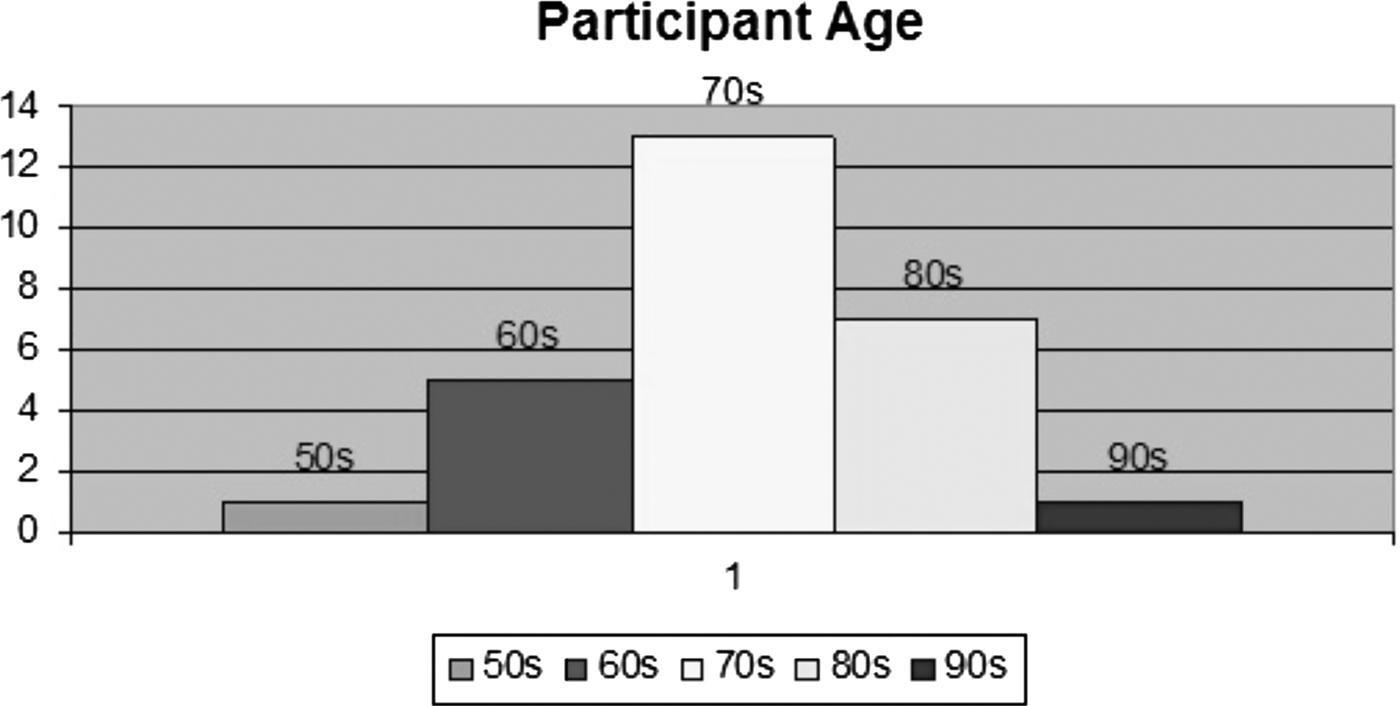
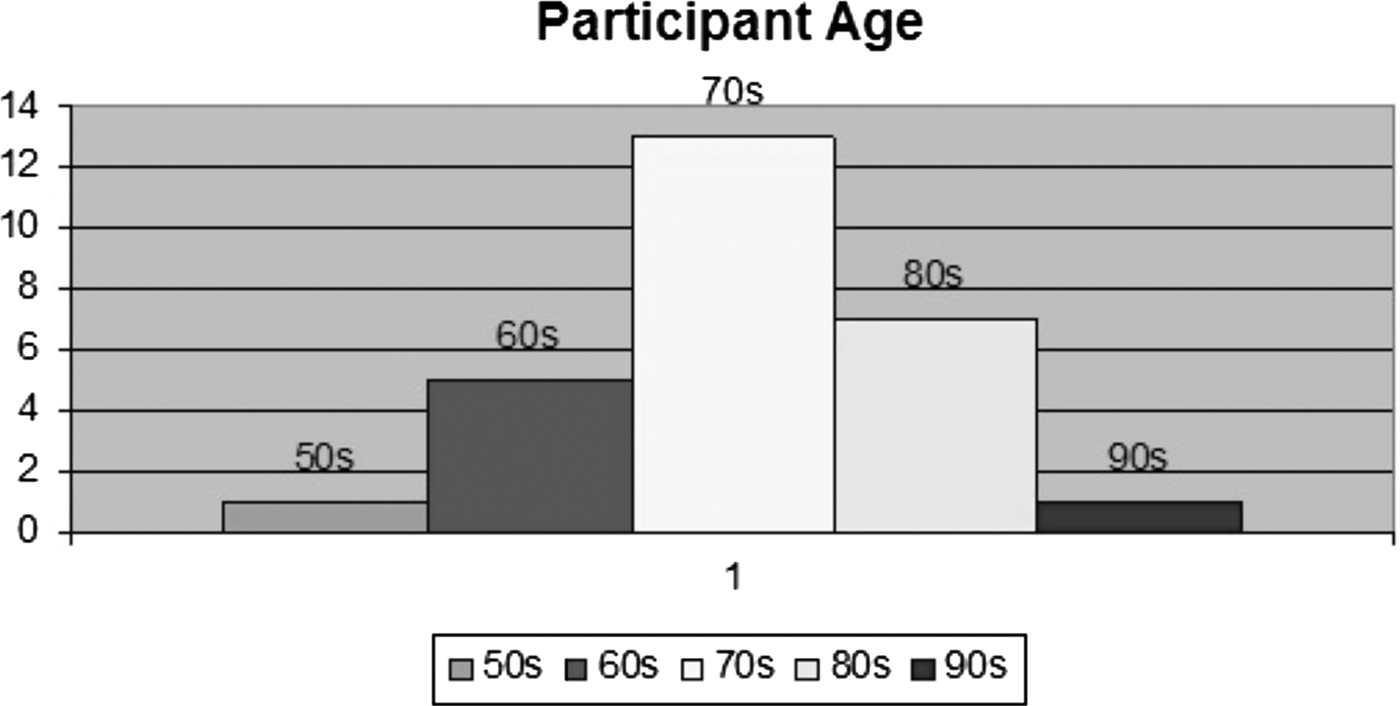
All speakers in the corpus were monolingual in French until they started school, usually at the age of six. Today, most of these speakers use English in more contexts than they do French. They also do find ample opportunity to use French, however, and have thus maintained fluency in the language. They are able to easily switch between the two languages and, given the young age at which they learned English, have native fluency in both. Speakers' ages ranged from fifty-five to ninety-four, with the bulk in their seventies (see Figure 1).
Average age of speakers.
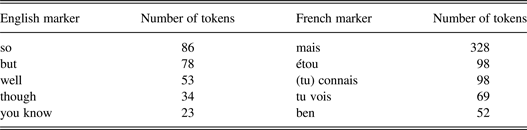
The speakers produced hundreds of tokens, representing dozens of different discourse markers. Table 1 shows the top five for each language.
Discourse markers in balanced bilingual speech.

A few things are immediately apparent from this data. The first is that French markers are much preferred to English markers even in the speech of those who are equally fluent in both languages. In fact, when all of the markers, including those not listed here, are tallied, French markers account for 655 tokens, while English markers add up to roughly half that number at 315. It should also be noted that the 655 French tokens are represented by only nine different markers, whereas the English markers comprise thirty-eight different types (many single attestations of an item). Moreover, several of the top markers in both languages are roughly equivalent: tu connais translates to you know in English, well corresponds to ben, and mais to but. What jumps out most from this list, however, is that the French mais is by far the most frequently used marker overall, yet English but is the second-most often used English marker.Footnote 5 This is particularly notable because mais and but cover much if not all of the same semantic territory. While it is clearly not unusual for markers in both languages covering the same territory to be used, it seems additionally remarkable that the phenomenon should include a marker that is so salient that it has made its way into the English of young people, many of whom do not speak French at all. A few notable examples gleaned from the second author's research on Cajun English (Carmichael forthcoming) serve to illustrate…”
(5) She asked, “Where I can find the tomato sauce?” I said, “Mais, same place you got them six cans you got in your hand!”
(6) Mais I had to go to a school for my engineer's license, you know, to learn all the stuff to pass a test.
In fact, mais has become a stereotype of Cajun English. This can be observed in the telling of Boudreaux & Thibodeaux jokes, a genre of jokes that pokes fun at the eponymous Cajun characters by use of word play and situational comedy, often centered around stereotypical Cajun speech patterns and behavior. Fiedler (Reference Fiedler2006:65) specifically cites use of the word mais in her description of these jokes, writing, “Boudreaux and Thibodaux [sic] are the stereotypically dumb, backward Cajuns that everyone knows at least one of... [t]he Cajun English accent and French flavor words (mais [‘but’]) are important to the telling of Boudreaux and Thibodaux [sic] jokes.” Dubois & Horvath (Reference Dubois and Horvath2002:267) also note the emblematic use of “mais, yeah” by monolingual English speakers, writing that such speakers “are reminiscent of Poplack's (Reference Poplack1980) Puerto Ricans in New York City who could not speak Spanish but who peppered their speech with Spanish words and phrases.” Thus it is clear that the discourse marker mais has a special status in this community, regardless of fluency in French.
A closer look at but and mais
Given the patterns seen above, it seems that but and mais warrant closer examination. As noted, they are semantically similar and fill similar grammatical functions. While both are attested in our bilingual corpus, they are used interchangeably with the same meaning. We classified their use into three categories, two of which have several subcategories.
First, both are contrastive conjunctions that serve to put two adjacent utterances into opposition, as shown in (7) and (8).
(7) Eusse habitude de rester en bas mais là eusse reste à Ashland asteur.
‘They used to live down the bayou but now they live in Ashland.’
(8) La femme à Jim elle comprend but elle parle pas though
‘Jim's wife, she understands [French], but she doesn't speak [it], though.’
Both but and mais were also found as discursive particles used to organize texts, particularly narratives. Within this category we recognized three subsets: the return to the main line of the narrative, an introduction of a new line of narrative or tangential information (as in (9) below), and the signaling of the end of a speaker's turn (an utterance-final trailing but...)Footnote 6.
(9)
L1: Ouais ça chante en français étou / y a quelqu'un qu'est après ye montrer / uh le français / but / uh / équand ce qu'on a été à Nova Scotia on a été: se p—se promener là-bas c'est un p'tit trip et et c'était bien bon qu—d'avoir / appris p—et pouvoir parler français avec le monde de:
‘Yeah, they [school teachers] sing in French, too. There's one who's teaching them [the local children], uh, French. But, uh, when we were in Nova Scotia we went, we visited up there, it was a short trip, and it was good to have... learned and to be able to speak French with the people in...’
L2: Canada ouais
‘Canada, yeah.’
Finally, both were used as introductory particles, without any connotations of contrast.Footnote 7 In this noncontrastive capacity they served three functions. First was to intensify or attenuate a statement, similar to English introductory um, uh, or oh, as shown in (10 and (11).
(10)
L0: Tu parles avec des amis ou euh…
‘You talk [French] with friends or, uh...’
L1: Mais ouais ouais je parle avec euh // des amis mes voisins et /
‘Oh, yeah. Yeah, I talk with, um, friends, my neighbours, and...
(11)
L0: Elle travaille ou euh
‘Does she work, or uh...’
L1: Mais non il travaille pas! / ça reste là-bas
‘No, no, she doesn't work! She lives over there.’
Second, they were both used as introductory particles similar to English well. Footnote 8 Thibault (Reference Thibault, Dessens and Glaunec2014) describes this usage as unique to Louisiana French.
(12)
L0: Et qui il faisait?
‘And what did he do?’
L1: Mais lui, juste là à l'Isle à Jean-Charles, lui il donnait de la tisane et tout.
‘Well, him, just over there on the Island, he gave herbal teas and stuff.’
(13)
L1: Uh / comment je l'ai rencontré?
‘How did I meet him?’
L0: Oui
‘Yes’
L1: ButUh i—il restait ici aussi sur le Île so // on s'a rencontré
‘Well, uh, he—he lived here too, on the Island. So we met.’
And finally, they were used as contemplative or stressing particles along the lines of English now.
(14)
L4: Oh c'est pas que jh'avais pas de choice / mais on faidait plus d'argent là-bas qu'eusse faidait icitte en Houma en Houma eusse travaillait fourteen and seven / mais ça / ça voulait pas payer
‘Oh, it's not that I had no choice, but we made more money there than they made here in Houma. In Houma they worked fourteen and sevenFootnote 9 but they, they [the bosses in Houma] didn't want to pay’
L0: Hmm
L4: Et là-bas sus la rivière mais on faidait de l'argent là / dans ce temps-là
‘And over there on the river, now we made money there, in those days.’
This introductory function is one generally covered in other dialects of French by ben, eh ben, or enfin (Barnes Reference Barnes1995; Thibault Reference Thibault, Dessens and Glaunec2014), which may explain the low attestation of these other markers in our corpus—enfin appears only eleven times in the corpus, and ben (including eh ben and ah ben), though it makes the top five, is nonetheless last on that list and its frequency is dwarfed by that of mais.
The complete overlap in function raises the question—what is the purpose of using a foreign marker? This question becomes particularly pertinent when we consider that interviewees were told that their language was of interest, and consequently we can reasonably expect that they were making every effort to speak as pure a French as possible. In asking this, we recognize that it may be difficult to distinguish a borrowing from a codeswitch, particularly in Louisiana French (Picone Reference Picone, Beals, Denton, Knippen, Melnar, Suzuki and Zeinfeld1994, Reference Picone, Bernstein, Nunally and Sabino1997). Since both particles are attested, however, we assume in this case that we are dealing with a switch and not a borrowing. To determine the reason for the switching, we considered a number of factors.
(i) codeswitching phenomena: Is the use of a given marker conditioned by (or triggering) some other phenomenon related to codeswitching?
(ii) phonological conditioning: Is there a phonological trigger in the environment?
(iii) prosodic factors: Is clausal position, or pause adjacency, a potential trigger?
Codeswitching phenomena
As it happens, there is a slight tendency to use but in the context of other codeswitching phenomena in the utterance. The use of but signals a codeswitch, most often a single-word switch, 17% of the time; this single word is often another discourse marker.
(15) Là je m'ai m'en a pris deux ma paire de bessons pour l'armée / butstill and all // eusse l'a fait
‘I, they took two from me, my pair of twins, to the army. But still and all, they did it.’
In three cases, but signaled the end of an English utterance and a return to French.
(16) Et là et uh ils / they came and then they uh did the blacktop and all that but um / {clears throat} quand j'étais petite fille là o—on avait pas de char
‘And then uh, they, they came and then they, uh, did the blacktop and all that but um, when I was a little girl w—we didn't have a car.’
It would be hard to argue for a correlation with codeswitching in general, however, given the relative infrequency of the occurrence. Seventeen percent of the overall data, plus three isolated cases, are hardly strong buttresses for such an argument. Thus we proceed to other possible explanations.
Phonological conditioning
Another possibility is that something phonological is triggering the use of but. A sample of one hundred and twenty of the tokens provided, however, reveals no patterning in phonological environment. Given the preference in French for open syllables, it is not surprising that the majority of preceding words ended in vowels. Still, consonants were also represented in this position, the most common being /t, z, r, m, k, b/. Sounds following the marker ran the gamut. Consonants and vowels are both represented, and nearly every phoneme in the inventory appears at least once. Given this lack of patterning, we can abandon phonology as a triggering factor, with the exception of silence, to which we return in a moment.
Prosodic factors
We also examined prosodic factors, such as stress and rhythm. Stress in French falls on the last syllable of a rhythmic group. The rhythmic group is somewhat hard to define, but it corresponds roughly (though not perfectly) to syntactic constituents. Primary stress did often precede a discourse marker, but this is perhaps explained away given the final consideration: pause adjacency. The final factor we examined, therefore, was whether adjacency to a pause or other hesitation marker (e.g. verbal pauses such as uh or um) was a factor in choice of discourse marker. The following examples serve to illustrate.
(17) Eux-autres a tout le temps parlé français avec les enfants so eux-autres l'a tout le temps compris le français // but les filles a pas voulu apprendre juste les garçons
‘They always spoke French with their children so they [the children] always understood French, but the girls didn't want to learn, just the boys [did].’
(18) Moi et lui on parlait presque tout le temps français / but / avec les enfants faullait qu'on parle nanglais
‘Me and him, we almost always spoke French. But with the children we had to speak English.’
(19) Je sais pas si vous-autres / lit de la Bible ou pas but / quand Jésus était sus la croix / au milieu de deux criminels / ça c'est comme ça ils ont c— cravassé Jésus
‘I don't know if y'all read the Bible, but when Jesus was on the cross, between two criminals, that's how they k—killed Jesus.’
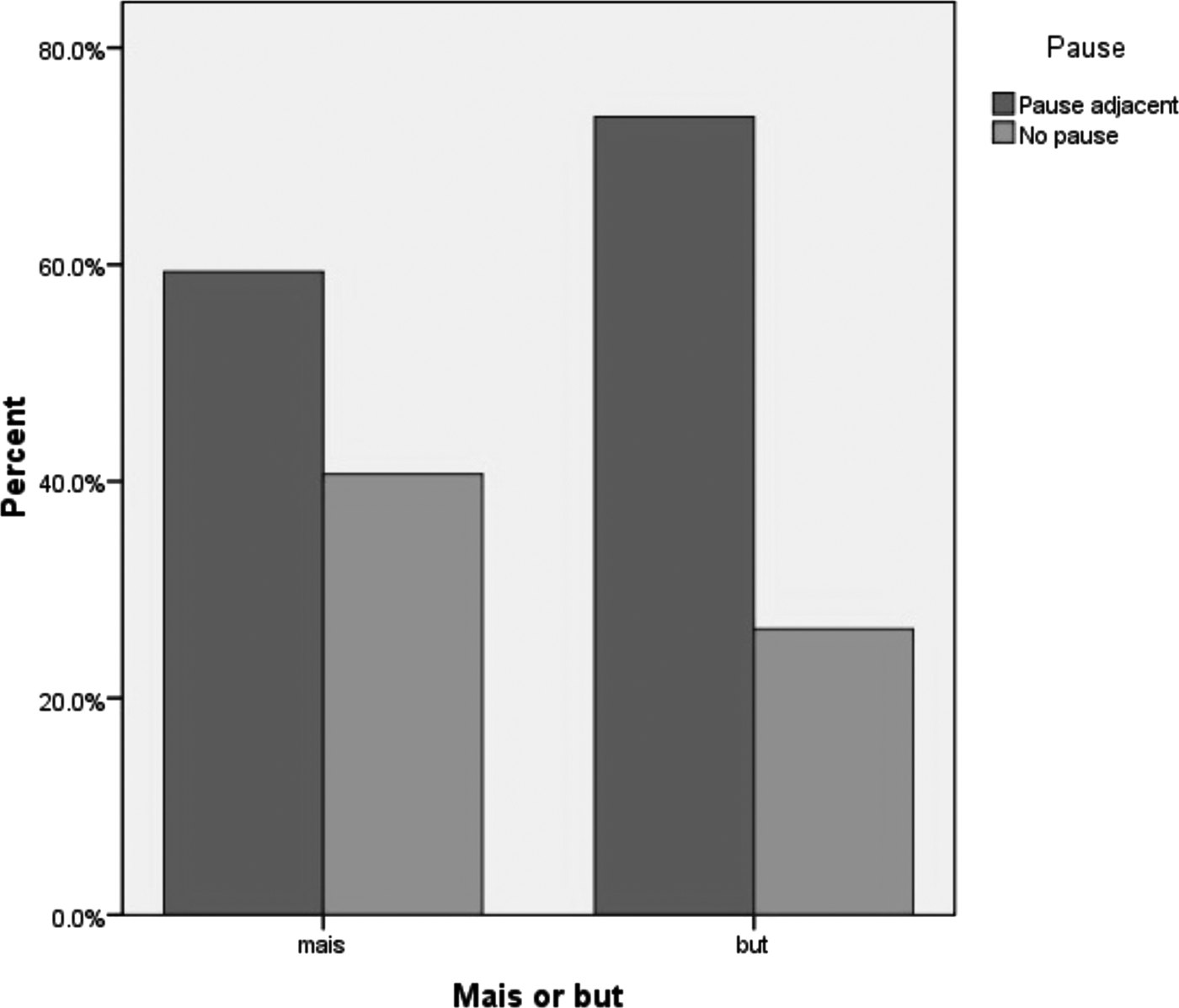
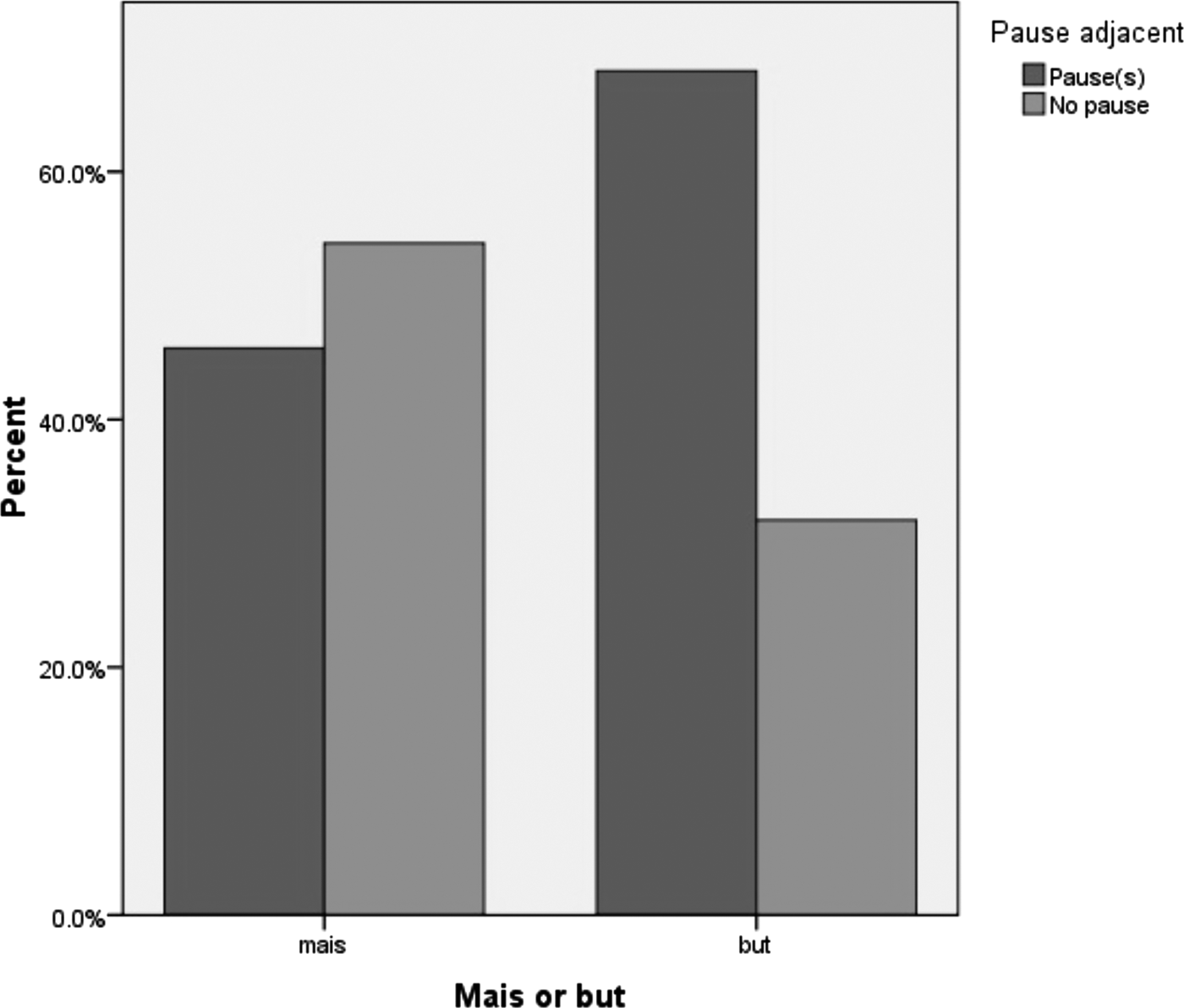
We divided results into tokens that were pause adjacent (which comprises tokens where pauses occurred either before and after—though it was more common for the pause to occur before—or both), and those where there was no pause, indicating that there was no pause either preceding or following the token—it was part of free-flowing speech. When all speakers are combined,Footnote 10 there is a greater tendency for but (73.6%) to appear next to a pause than there is for mais (59.4%; p < 0.014; see Figure 2).
Pause adjacency, all speakers.
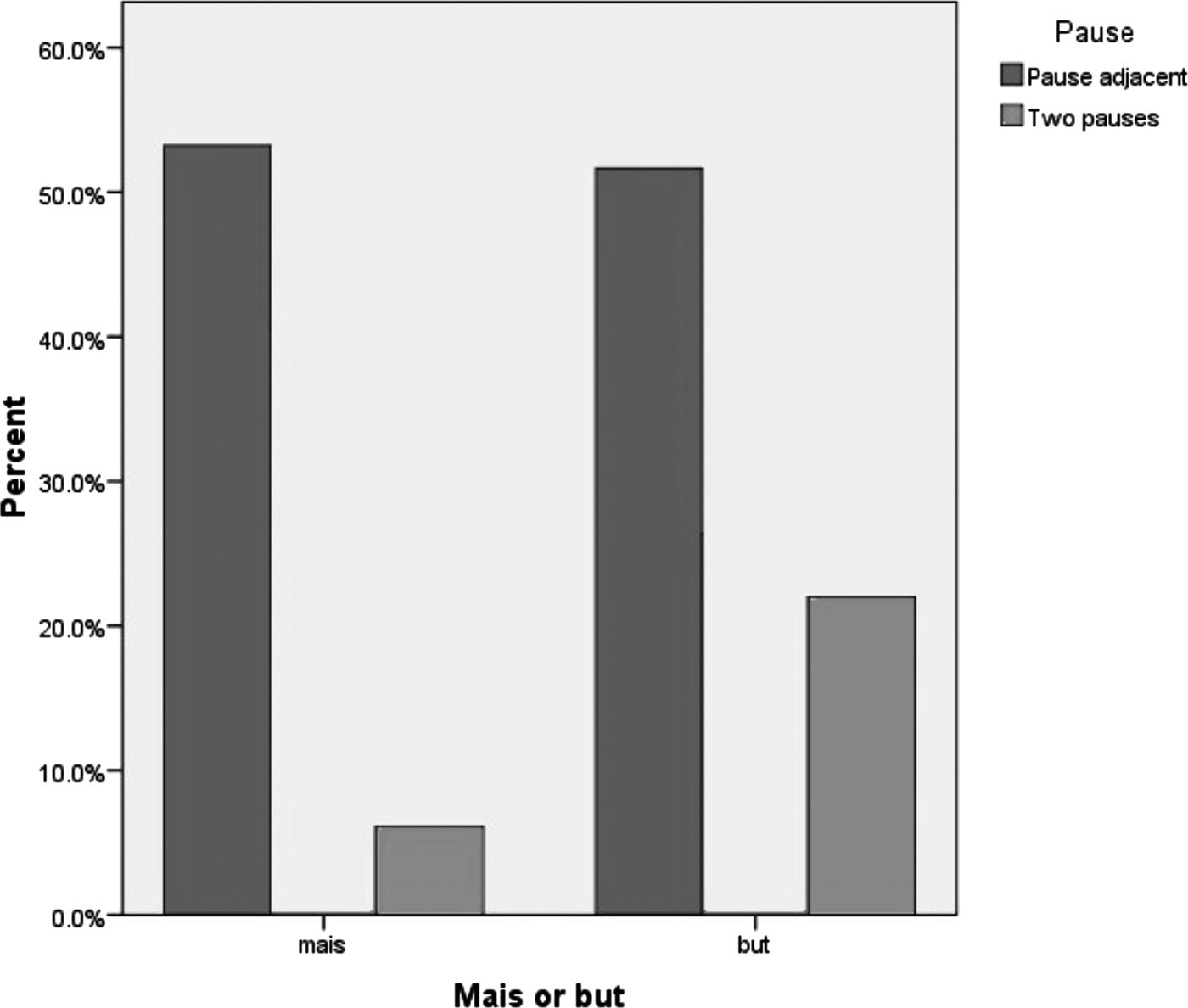
We can also break the numbers down further to account for the fact that some tokens occurred both preceding and following a hesitation—that is, between pauses or hesitation markers. There was a small difference in adjacency counts for but and mais: but was far more likely than mais to appear sandwiched between pauses (see Figure 3).
Pause adjacency, multiple pauses considered.
To account for the possibility, however, that people who did not attest both forms might be skewing the data, we eliminated speakers who only used mais from the sample.Footnote 11 The overall patterns remain unaffected: the rate at which mais is found adjacent to a pause drops insignificantly from 59.4% to 59.3%.
We next wanted to test the effect of utterance boundaries, thus we re-examined the data after excluding tokens of but and mais at utterance boundaries (turn-initial or turn-final position). We did this because the pauses found at utterance boundaries often reflect an organizational function, rather than representing a hesitation. Excluding these tokens affected the results drastically. When considered in the context of nonutterance boundary pauses, there was a clear preference for but in pause/hesitation-adjacent position (see Figure 4).
Pause adjacency, utterance boundaries excluded.
After eliminating tokens adjacent to utterance boundaries, mais is in fact slightly more likely to occur in contexts with no pauses (54.2% no pause vs. 45.8% pause-adjacent), whereas but continues to occur primarily in contexts with pauses (68.1% of the time), though the rate is slightly reduced compared to the full data set (p < 0.000). The results change only very slightly (use of mais in the context of a pause drops from 45.8% to 42.6%) when we exclude speakers who only used mais.
Acoustic analysis of pause duration
We decided to examine pause duration acoustically in Praat to determine whether not only pause adjacency, but duration of pause, affected the choice of discourse markers. In this analysis, we compared only those bilingual speakers who attested both but and mais in their excerpt. Sixteen interviews fit this criterion. Overall, pause duration surrounding but was about 1½ times longer than that surrounding mais (0.309023 seconds vs. 0.195085 seconds). Interestingly, individual rates varied quite a bit: when broken down by individual speakers, 63% of the speakers had longer pauses adjacent to but. It should be further noted, however, that individual rates of use of but and mais also fluctuated: of the six speakers who attested longer pauses adjacent to mais, two of these speakers in fact strongly preferred but to mais overall, thus their patterning is based on only one or two attestations of mais. Because rates for many of the individuals were similarly based on a single token, it consequently makes more sense to consider the group in the aggregate.
In a logistic mixed-effects regression model generated for these data in R with discourse marker choice as the dependent variable and speaker as a random effect, the best predictors of whether a participant chose but or mais were the pause durations preceding (p = 0.006) and following (p = 0.05) the discourse marker.Footnote 12 Also selected as a significant predictor of discourse-marker choice was the function of the discourse marker,Footnote 13 to which we now turn.
Functional analysis
Given the correlation between pause duration and the use of English discourse markers, our data would seem to support the findings of de Rooij (Reference de Rooij2000), who found that French discourse markers in Swahili occurred adjacent to pauses in 84% of cases. He concludes that since the role of discourse markers is to promote cohesion and coherence, maximal salience is necessary. The combination of a pause and a foreign marker would thus seem to be an extremely effective way of attracting attention to an item.
However, given the multiple functions that but may fulfill, as outlined in our three types (contrastive, discursive, and introductory) described earlier, we need to confirm that what we have is not an epiphenomenon; is a hypotactic transition (discursive category) more likely to trigger a pause than a paratactic transition (contrastive category)?
To determine if this were the case, we examined the markers by category in the speech of speakers who used both markers.
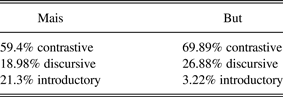
For both markers, the majority of attestations were contrastive conjunctions. Table 2 shows the category distribution for each marker. While both English and French markers are used most often as conjunctions, mais is clearly more evenly distributed over the functions than is but. Table 3 shows the distribution of markers per category, which we examine each in more detail below.
Distribution of discourse marker functions.
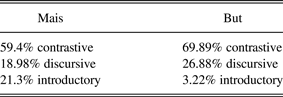
Discourse marker frequency per category.

Contrastive function (conjunctions)
Within the contrastive category, mais is attested 59.4% of the time. Thirty-seven percent of contrastive mais tokens appear in the context of a pause, with 3.7% appearing between two pauses. When the marker is English but, 58.4% occur in the context of at least one pause, with 15.3% between two pauses. Pauses here did not include utterance boundaries; an additional 20% of English markers and 11% of French markers occurred in utterance-initial position. We return to this fact momentarily.
Discursive contrast
In the discursive category, mais was again the favored marker, with 52.6% of tokens. Though only 14% occurred in initial position, most tokens in this category—and more than for conjunctions—appeared in the context of at least one pause (not including utterance boundaries): 63.3% of mais and 77.7% of but. This increased correlation with pauses is in keeping with Maschler's (Reference Maschler1997) observation that prototypical discourse markers occur in clusters and at intonation boundaries. Maschler (Reference Maschler1997), however, showed a preference (68%) for foreign markers in this context. Our data is less conclusive in this regard; but is not preferred in any context within this category. When the category is broken down by subcategory, within the “return to narrative” function, 51.7% of the tokens are mais, with 67% of those appearing in the context of a pause. For English but, that frequency is 93%. Likewise, 65% of tokens introducing new, related lines of narrative and tangents are French mais, and 61.5% of them occur in pause-adjacent position. For but, this frequency is 85.7%. Strikingly, despite the lack of preference for English markers in this context, in both cases, English but is far more likely to appear sandwiched between two pauses (42.8 vs. 6% and 16.6 vs. 1.7%).
Introductory function
While both markers were used as introductory particles, mais was the clear winner in this category, with only three of the thirty-eight tokens (7.8%) in this category attestations of but. This is likely due to the correspondence instead with English well for this category. As noted earlier, however, this correspondence is not complete. A native Cajun English speaking informant, when asked to translate into English a French sentence beginning with introductory mais, translated the particle as mais, saying that he considered using well but then decided nobody from this region would say it that way. That but does occur in this context at least once further suggests the incomplete correspondence between mais and well and suggests that this is at least in part why mais has been borrowed into English. Its status as a foreign marker, however, is of some dispute, and its iconic status as a marker of Francophone identity further complicate the issue (and provide a likely explanation for the heavy preference for mais in this category). Moreover, when the logistic mixed-effects regression model is run with these tokens deleted, marker type no longer has predictive value, suggesting that it was this category that was driving that item's inclusion in the list of factors influencing marker choice. We therefore limit our discussion from this point on to the first two functional categories: contrastive and discursive.
Discussion
Our data would seem to disagree with Maschler (Reference Maschler1997), who showed that prototypical discourse markers were more likely to occur in a foreign language than were connectives. In our data, though the difference is not large enough to be statistically significant, there is a slight preference for the matrix language (i.e. French) for both contrastive and discursive markers. Moreover, the difference between the rates of foreign marker use between the conjunction and discursive categories is small: only 7%. Contrastive conjunctions, however, can be found uniting elements in a single intonational contour as in (7) and (8) and they may also be used to contrast more complex arguments or modify longer texts.
(20) Eusse devrait montrer le français ça que nous-autres parle / quelqu'un m'a dit / eusse croit / eusse devrait montrer / les vrai français / parce que / quand tu vas quand tu vas partir ici / ça va t'aider / quand tu vas aller à les autres places si t—si t'apprends / le vrai français et / ç—ça fait de—un me— un mérite tu connais ça mérite ça peut-être? // butuh si tu vas p—si tu restes icitte / ça serait meilleur si tu ap—t'apprends le français ici
‘They should teach the French we speak. Someone told me they thought they should teach the real French, because when you leave here, it'll help you when you go to other places if you learn the real French and, so it's worth it you know, maybe? But if you stay here, it would be better if you learned the French we speak here.’
Not all of our examples of complex contrasts include such long pieces of text to be connected; however, they all included a composite antecedent. Put most simply, a simple contrast took the form X but Y. A complex contrast took forms such as, “if X then Y but if W then Z,” or “X because Y but W,” and so on.Footnote 14 In possible borderline cases (generally when portions of the text were incomplete), the contrast was designated as complex. In our data, 31% of the contrastive conjunctions are contrasts between such larger pieces of text. When making complex contrasts, the preference for mais disappears entirely: Twenty-five of the forty-nine tokens (51%) are but (Table 4). Again, however, this change in rate is not significant.
Discourse marker frequency in contrastive category.

Thus, while our number suggest there is no preference for foreign markers in nonconjunctions, we can provide some weak evidence to suggest that when greater contrast is needed—as would be the case in contrasting a large piece of text to conditioning or supplementary information—using a foreign marker to create the greatest possible iconic contrast is a strategy that rises in frequency, even if the rate of foreign to matrix language markers is nearly identical in the end. What matters is not that the use of but surpass that of mais, but that it increases at all, and it does. That said, the lack of statistical significance makes this suggestion very weak indeed.
Additionally, despite the lack of difference in rate of marker choice between contrastive and discursive functions, foreign markers are much more likely than matrix markers to appear in the context of at least one pause in all categories. At the simple contrast level, foreign markers are over twice as likely (53.8% vs. 24.2%) to occur in the context of at least one pause. This difference does disappear, however, with higher-level contrasts, for which the difference is 72.8% vs. 70.8%. Within the discursive category, the difference is less stark than for simple contrasts, but again, 86% of foreign markers occur in the context of at least one pause vs. 64% for matrix markers. Foreign markers within the discursive category occur sandwiched between two pauses three times as often as do matrix markers (31.8% vs. 10.7%).
Thus, our data both corroborate and complicate the conclusions of previous researchers. Our findings are in line with de Rooij's (Reference de Rooij2000) in that foreign markers occur most often adjacent to a pause, but they provide only very weak support for the conclusion that foreign markers are used when maximum contrast is necessary. Before we can accept that pause adjacency is necessarily an indicator of a marker's increased visibility, we need to test this by comparing the corpus to the speech of our participants in English-matrix conversation. If contrast/salience are the only important factors at work, we should also expect to find many French markers in English discourse.
There were seven short passages across all of the interviews that consisted of more than very brief forays (in the form of only a handful of words) into English. The only French discourse marker to appear in these passages is mais. No other mixing occurred. Additionally, there were two single-line switches that included but or mais. In total, there were four tokens of mais and six of but in English discourse. The six instances of but fall into three categories. Three are simple contrasts. In all of these instances but occurs adjacent to at least one pause. It appears twice in its discursive function. Again, in both these instances it appears adjacent to at least one pause, and in one instance is part of the cluster but anyway. In the final instance, but appears in its introductory function, as part of the cluster well, but. Whether the adjacency to pauses matches the rate at which this occurs with French markers in a French matrix is impossible to determine, however, from such a small sample.
Turning to mais, two of the four times it appears, it is an introductory particle, once at a turn boundary, and once mid-utterance without any pauses, as shown in (21).
(21) I get by in life French or English mais that's alright
The remaining two times it occurs in discursive and contrastive functions. In the first case it is an utterance-final trailing off. In the second, perhaps more interesting case, it fills a contrastive function, serving to join a longer section of discourse to a new piece of information.
(22) C'est la p‘tite fille qu'a été élevé là là / Dr. Mike / indien / à lui il est marié tu vois / et il a une fille avec lui / and he wanted to find out too so I says well / guess we're going to try / that's why they x nous appelait des S*** / that's wh—they had fun that name / maisthat's not such a thing as the other race S***
‘It's the little girl who was raised over there. Dr. Mike, [he's an] Indian. She'sFootnote 15 married to him, you see. And he wanted to find out, too. So I says, “Well, guess we're going to try.” That's why they x they called us some S***. That's wh— they had fun with that name. But that's not such a thing as the other race S***.’Footnote 16
In this case it was also likely particularly important to the interviewee that we understand her final line—that there is no such thing as the slur she has been accused (by others) of being. That she would use a foreign marker in this case, alongside a pause, supports the notion that maximal contrast, in the form of language alternation, is an effective strategy for drawing attention to an item. A single data point, however, cannot confirm a hypothesis alone, and the high level of code mixing in the excerpt also illustrates a final consideration—that the lack of pattern seen in discourse marker choice may be due to the fact that they are simply due to code-mixing behavior like any other. De Rooij (Reference de Rooij2000) similarly observes no significant use of Swahili markers in otherwise French discourse; however, he is able to rule out this possibility given the systematic use of French markers in Swahili and the clear prestige position French maintains vs. Swahili. In our data, the choice is far more ambiguous, particularly given the changing relationship between French and English. We turn, therefore, to a final consideration: the role of code mixing in general in Louisiana French.
Code mixing in general and its functions in the corpus
The corpus in this case is peppered with English words and expressions left by a long history of contact between the two language varieties (and indeed one speaker notably describes his language as Frenglish). Again, we must stress that it can be difficult to identify codeswitches from borrowings. Rather than try to distinguish one from the other, we instead use the umbrella term code mixing to describe the phenomenon here.
The overwhelming majority of (nondiscourse marker) English items used fall into the category of single item (often multimorphemic) entries, the bulk of which were nouns. Most of these fall into two general categories:
(i) Terms that are systematically used in Louisiana French and may reasonably be considered part of the French lexicon. Such items include drive, retire(d), off (as in, a day off), and back, which is systematically placed after revenir ‘to come back.’ Numbers are also very frequently borrowed from English, particularly years and decades, ages higher than twenty, and large monetary sums.Footnote 17
(ii) Items that were introduced after the separation from France, that is, new technology or technical jargon. In our corpus such words include air condition ‘air conditioner,’ double-wide trailer, game warden, deck hand, tugboat, birth control pills, and lactation.
The items that do not fall into these two categories can be classified alongside the longer switches. Switches of more than one word are almost always limited to a single utterance comprising only a handful of words (usually a syntactic constituent of some sort—NP, VP, etc.) and fall into several categories:
(23)
a. Idiomatic expressions
b. Forgotten term (or one the interviewee never knew)Footnote 18 (Sometimes this triggered a few more words in English.)
c. When speaking about people who don't speak French, or when speaking about the English language itself
d. To cite quoted material
e. The interviewee slipped into English by accident out of habit (likely triggered by the youth and outsider status of the interviewer)
f. The speaker wants to ensure that the outsider interviewer understands. In these cases, the same text was often repeated or paraphrased in English
g. To provide metalinguistic commentary or to make comments outside of the interview
Three categories—(23e,f,g)—suggest that the use of English may have been used symbolically to highlight or set off information; for example, (23f), in which the speaker wants to ensure that the outsider interviewer understands, is shown below in (24).
(24)
L1: Oh ouais // ma mame était plus smart que mon!
L0: {smiles}
L1: You know she she knew th—more than me
L2: Ouais
A subset of this category occurred when interviewees wanted to be absolutely sure they would not be misunderstood. This was particularly true if the interviewee was afraid they might otherwise be taken for a fool, as shown in (25).
(25)
L0: Qui c'est un rougarou?
‘What's a rougarou?’
L1: I—I don't—I don't be—I don't believe in that you know too much um / les rougarousFootnote 19 des uh / le monde voyait des affaires et / je crois pas que c'était là c'est justement ça fait—ça s'imaginait que c'était uh // that's / c'est comme ça que je me—I feel asteur tu connais / que / y avait pas ça seulement mais monde x peut imaginer ça / that's what I believe in
‘I—I don't—I don't be—I don't believe in that you know too much um, the rougarous, the, uh, people saw things and, I don't think anything was there, it's just that they imagined that it was, uh, that's, that's how I feel now, you know, that there was nothing there but that people would imagine it. That's what I believe in.’
In (25) the speaker was afraid that the interviewers might find her silly for believing in children's stories (and in fact, many interviewees are hesitant to discuss the topic and upon being asked about it will simply scoff that “that wasn't real!” and leave it at that).
Reason (23e) is not unexpected from Louisiana French speakers, who are accustomed to foreign French speakers, particularly those who come from France, having difficulty understanding them. Moreover, the youth of the interviewers was also a likely factor; Louisiana Francophones are unaccustomed to speaking French with young people, since modern youth are monolingual in English and often do not even possess a receptive ability in French.
Finally, (23g), in which the speaker provides metalinguistic commentary or makes comments outside of the interview, is shown in (26) and (27) below.
(26)
L1: De— // dans les / danses comme ça (x) / si des fois // l'homme est jaloux? ou la femme est jaloux you know what jealous mean
‘the— in the dances, like that (x), if sometimes the man is jealous or the woman is jealous’
L0: Mmm-hmm
L1: s: you're married or not
L0: Mmm-hmm
L1: Well // when you going to get married // tu voudras pas que ton mari embrasse une autre femme
‘You won't want your husband to kiss another woman.’
(27) Tout parle français / on parlait en anglais mais pas comme il faut mais uh xxx ça c'était / to get by / that's not French now get by
‘Everyone spoke French. We spoke English but not how you're supposed to but uh, xxx it was [good enough] to get by.’
In some cases, of course, multiple motivations may have been present. The examination of code mixing in general reveals that mixing is motivated by complex factors, only some of which include the need to create contrast.
Discussion and conclusion
Our data provides some tentative support for previous researchers' conclusions. Despite the lack of statistical significance, the slight increase in the use of English markers for more complex contrasts and metalinguistic connections seen in our data provides some support for Maschler's (Reference Maschler1994, Reference Maschler1997, Reference Maschler2009) and de Rooij's (Reference de Rooij2000) suggestions that the role of a foreign discourse marker is to provide maximal contrast because the role of discourse markers is to provide cohesion and coherence. In de Rooij's corpus, however, the use of foreign discourse markers was nearly exclusive, and in Maschler's data, the use of foreign terms for discourse markers providing high-level connections was drastically higher than it was for conjunctions. In short, in their data, the use of foreign markers correlated most closely with the metalinguistic function they were filling. In our own data, however, there is less of a preference for foreign markers, and the strongest predictor of the use of a foreign marker is pause adjacency and length. We find a nearly equal distribution of foreign and native markers, and we find foreign markers even in simple contrasts. Regardless of the context in which they are found, however, foreign markers are more likely than matrix-language markers to be found in the context of a pause. It is hard to argue that one contrast requires stronger marking than another at the same level. Consequently, we hesitate to attribute the use of foreign markers to the need for salience alone, nor to attribute any single cause to the correlation. Examination of the use of discourse markers in English is equally inconclusive. Our corpus does not contain a sufficient quantity of such discourse to draw any real conclusions; however, in most of the capacities in which mais appears, it has no connotation of contrast, as documented in the small section of English-matrix text in the corpus. That it is borrowed into English in this capacity suggests that this is not completely unrepresentative.
As Stroud (Reference Stroud1992) and others have pointed out, we cannot assume that bilingual situations are all the same. Maschler's bilinguals are in a different situation than are de Rooij's than are our own. In the case of Louisiana French, we do not have a stable diglossic situation. English and French hold multiple values for speakers. French is the language of intimacy and friendship, yet bilinguals in Louisiana often use English with their parents, friends, and siblings who speak French as well. The complex history of French and English within Louisiana is certainly an important contributing factor to the patterning of discourse-marker choice in this situation. It is clear that many Francophones internalized the lessons of their traumatic first days at school, during which they were made to feel shame for speaking their native language. It was also the language of the larger culture, of the American identity that many fiercely claim simultaneously with Cajun or Indian identity. It is still possible to find people in Louisiana who continue to believe that speaking French is not something to be proud of, and who will actively claim a dislike for it. This attitude is rare today on the lower bayous in which our corpus was collected; however, many interviewees have told us that shame is the reason they did not teach their children to speak French—for fear that they, too, would suffer for it. For many years English was a language of prestige, education, and intelligence. It would be just as easy to suggest that our speaker in example (22), when insisting that she was not a race that did not exist, was speaking in English for the important, content-filled portions of her discourse to display to us that she knew what she was talking about.
If discourse markers are metalinguistic features that can tell us about relationships between portions of text, between interlocutors, and between text and speaker cognition, then the use of English here is not clear cut at all. We may, in fact, have multiple factors operating at once; our discussion of code mixing in general reveals that there are multiple reasons for mixing, and it may be impossible to determine which one(s) are being activated at a given time.
On the one hand, our data shows a slight increase in the use of English markers in contexts in which more contrast may be useful. On the other, the greatest predictor of whether someone will use an English marker or not is not the type of marker they use (i.e. the context in which it appears), but rather the presence of and length of an adjacent pause. We also see a mixing of markers in contexts in which we should expect to see much more matrix language. It is possible, then, that code mixing in discourse markers is as complex as it is elsewhere and may be complicated by several factors. It is equally possible that our speakers use English markers to signal intelligence, knowledge, or affiliation with an American identity as much as they may use them to signal contrast. De Rooij (Reference de Rooij2000:448) suggests that because they are low in referential content, discourse markers cannot carry the same social connotations as nouns, verbs, and so on. Our data suggest that this is perhaps not so. We suggest that the adjacency to pauses would help to highlight the markers and make them maximally salient not simply to help construct the text itself, but also to highlight the cognitive states of the speakers as well. The predominance of noncontrastive French markers in English discourse seem to support the notion that markers may be employed for iconic reasons. In fact, the borrowing of introductory mais into English to signal Louisiana identity is in itself using a discourse marker iconically to convey something metalinguistic.