Introduction
The nature trail idea, first developed in the 1920s as an experiment in outdoor education in North America, was introduced to Britain by the Council for Nature in connection with the National Nature Weeks of 1963 and 1966. The nature trail was presented as an educational and leisure device for urban as well as rural environments, and promoted through publications, press coverage and radio and television broadcasts. From a first experimental trail at Coombe Hill in Buckinghamshire the nature trail spread, offering something relatively simple for national and local nature groups to set up. While trails were to draw attention to sites and features of interest, these were not necessarily rarities or exceptional items. Rather trails would frame and lend cultural value to often prosaic aspects of the natural world, emphasising the human interaction with nature. The nature trail thus had a complex relationship to definitions of ordinary and exceptional landscape, and to categorisations of everyday and special practice. After considering the general debates around the nature trail idea at a national scale, we examine in detail one trail from the early 1970s to show how trails could be utilised to produce a new social landscape.
The nature trail can be understood as an instructive landscape, seeking to educate its users in natural history and encourage particular modes of conduct as part of a wider movement for nature conservation within a regulated countryside. The 1960s saw the consolidation of a movement for countryside planning and management, through the efforts of statutory bodies such as the Nature Conservancy, the National Parks Commission and, from 1968, the latter's successor body the Countryside Commission, set up under the 1968 Countryside Act. Such initiatives reflected an emerging popular environmental concern, although they predated the establishment of a politically radical environmentalism through the establishment of bodies such as Friends of the Earth and Greenpeace at the turn of the 1960s and 70s. In the 1960s, countryside and nature were articulated through initiatives and organisations which sought to mark them out as respectable and mainstream public concerns, most notably through the ‘Countryside in 1970’ conferences organised from 1963 under the patronage of the Duke of Edinburgh. Activities which would in future years be presented as in fundamental conflict, such as agriculture and nature conservation, field sports and care for wildlife, were held in balance through a regulatory outlook styling itself as both paternalistic and modern.Footnote 1 Nature took its place as part of a wider vision of planned countryside conservation and development, with its appreciation seen as a desired element of mainstream culture. The nature trail can indeed be understood as a device through which an activity carrying historic associations of eccentricity could be presented as normal, citizens appreciating the natural world through a carefully ordered encounter with it.
Such an outlook on nature comes through clearly in academic and popular accounts of countryside planning and leisure produced at the time. Thus geographer J. Allan Patmore's Land and Leisure, issued by David and Charles in 1970 and republished as a Pelican paperback in 1972, noted the importance of the nature trail within the conservation of natural heritage, with the Nature Conservancy encouraging educational use of reserves: ‘Nature trails are particularly useful: the Conservancy has actively developed them since 1963 and by 1971 had twenty-four on reserves in England and Wales. At Old Winchester Hill in Hampshire, 10,000 copies of the trail leaflet were distributed in ten weeks in 1967’.Footnote 2 Patmore's book responded to and was informed by a sense that one of the fundamental changes in the countryside since the war had been a growth in leisure, especially via motor transport, reflecting a new prosperity; the need was to channel this in order to both conserve a diminishing countryside resource and better educate the leisure user in the process.
Patmore opens his book with Michael Dower's statement of ‘leisure’ as the post-war ‘fourth wave’ breaking across the country, after industrial towns, rail development and car-based suburbs.Footnote 3 A stock image in such literature is of cars drawn up on open ground to admire a view; the implication is of a diminished landscape experience, indeed a diminished view. Books such as Patmore's evoke through academic text the sensibility expressed by Philip Larkin in his poem ‘Going, Going’, with the sense of an England under the hammer, sold for commerce and battered by development, with its symbols the motorway and the seaside crowd, and the loss of what had been taken for granted as English rurality; going and almost (though not quite) gone. Larkin's poem would be published as ‘Going, Going’ in his 1974 collection High Windows, but first appeared as the commissioned ‘Prologue’ to the 1972 Department of the Environment report How Do You Want to Live? A Report on the Human Habitat; the government excised a verse critical of the government development subsidy, which Larkin restored for High Windows.Footnote 4 If the young crowd in the M1 café figured as a problem for the Department of the Environment, nature trails within country parks were recommended by the report as an important component of the recreational response.Footnote 5
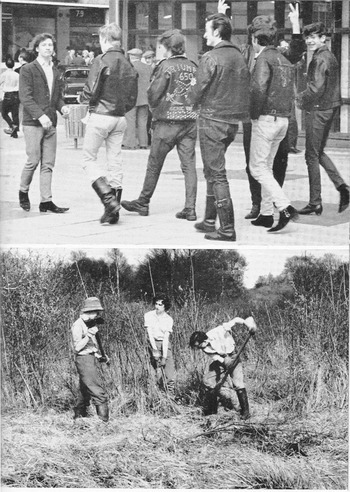
That the judgement of landscape is also a judgement of people, whether in academic analysis, government report or poetic reflection, is also evident in a popular work such as Garth Christian's 1966 Tomorrow's Countryside, subtitled ‘The Road to the Seventies’, published by John Murray, and with a foreword by the Duke of Edinburgh. Christian welcomed the development of nature trails in forest parks and through the 1963 National Nature Week, terming them ‘an ecological walk, an open-air tour of an area of scientific interest’,Footnote 6 and noting a 1964 survey showing that 458 primary schools used nature trails on or near their own grounds.Footnote 7 Trails are part of Christian's wider ethos of education, ‘the one unifying force capable of transforming the outlook of a whole nation’,Footnote 8 and which he presents as the only answer to a ‘hooliganism’ produced by social instability and individual lack of purpose. In his introduction Christian offers a vignette of fires in Ashdown Forest, lighting ‘the night sky to the north’ as he writes his text, and started by ‘highly mobile young hooligans’.Footnote 9 A chapter on ‘Education and the Countryside’ continues the theme, reflecting on the complexities of nature enthusiasm in children, and the possible role of ‘field studies in preventing delinquency and hooliganism’.Footnote 10 A pair of photographs (Figure 1) compare two ways of spending ‘Saturday Afternoon’, a conservation work party contrasting with leather-jacketed New Town teenagers, one of whom holds four fingers (in two separate pairs) to the camera: ‘Youth needs a challenge (Crawley, above) and often only finds it in destruction. A constructive alternative is demonstrated by the Conservation Corps (Woodwalton Fen, below).’Footnote 11
Images from Garth Christian, Tomorrow's Countryside (1966), captioned: ‘SATURDAY AFTERNOON. Youth needs a challenge (Crawley, above) and often only finds it in destruction. A constructive alternative is demonstrated by the Conservation Corps (Woodwalton Fen, below).’

The culture and politics of the 1960s countryside warrants further research; here we seek to provide one way into the story via the nature trail, discussing its development through the Council for Nature via the National Nature Weeks of 1963 and 1966, and examining a Norfolk nature reserve example in detail in order to draw out the ways in which nature education could form part of the making of a new social landscape. The nature trail is worth following in its own right, but is also a story pointing to wider currents in recent rural history which, with the notable exception of John Sheail's institutional researches, have until now been largely neglected.
The origin of nature trails
Access to the countryside and nature has long been a source of contention and debate. Arguments have raged over public access to common land and the establishment and management of rights of way across private land. There have been considerable shifts in power between landowners and others over the ability to wander relatively freely over pastures and moors and through woods. Ben Cowell has shown how, in England, the Commons Preservation Society in the late nineteenth century was keen to reinterpret commons as ‘natural parks’ over which anybody might ‘roam freely’.Footnote 12 The debate over access ebbed and flowed throughout the twentieth century.Footnote 13 One of the key elements of concern was the behaviour of those people visiting the countryside.Footnote 14 One strand in this debate in the twentieth century was the desire to encourage a form of educated access to the countryside in which people would learn about nature and understand how to comport themselves in a ‘proper’ manner.Footnote 15
Nature walks and rambles were firmly established as part of the formal and informal curricula of all kinds of British schools and Sunday schools by the late nineteenth century. They were central to general instruction in natural history. For many teachers they formed a welcome introduction to the wonders of Creation; for others they also allowed the exegesis of Darwinism. Learning was supported by a large number of introductory natural history books and pamphlets.Footnote 16 In the twentieth century with the formal establishment of biology and geography in most schools, local studies of nature became increasingly important. At the same time, there was a growing interest by many adults in the study of botany, ornithology and general natural history.Footnote 17 Nature rambles were ad hoc and informal; they allowed close study of individual species but depended almost entirely on the knowledge and enthusiasm of the teacher. The labelling of individual plants, trees and animals was restricted to arboreta and botanical and zoological gardens.Footnote 18
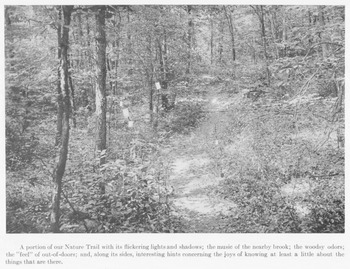
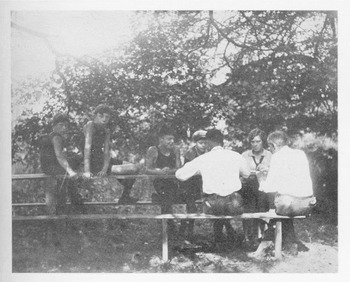
The idea of a nature trail along which individuals could walk and learn from labelled nature, either by themselves or with a guide, was developed in the 1920s in America by the entomologist Frank Lutz who worked at the American Museum of Natural History in New York.Footnote 19 Forty acres of woodland and meadow in the Ramapo Mountains near Tuxedo had been granted to the Entomological Department of the Museum of Natural History by the Interstate Palisades Park and William Averell Harriman (1891–1981), a railway magnate, politician, diplomatist and philanthropist who was a member of the Palisades Interstate Park Commission from 1915 to 1954. This was an area where ‘excursion steamers brought thousands of New Yorkers up the Hudson River’ many of whom were ‘children and young people who lived and worked in the city’.Footnote 20 A station for the study of insects was established in 1925 and in the first season an ‘experiment in teaching about nature in general’ was undertaken.Footnote 21 Two nature trails were set out, a training trail and a testing trail: plants were labelled and stories told (see Figures 2 and 3). The experiment was written up and published the following year and seen as very successful; concerns over damage from visitors were unfounded. Lutz argued that ‘National and State parks are particularly good fields for Nature Trails’ and that the ‘the very best way for making a Nature Trail is . . . to have as many as possible of those whom you wish to teach help you to make it’.Footnote 22 Lutz concluded that it was best to ‘teach about nature where nature is’ rather than in museums. The publication of the experiment popularised the idea of nature trails and many were established in national parks, as at Yosemite and Rainier National Parks.Footnote 23
‘A portion of our Nature Trail’ (Lutz, 1926: frontispiece).

‘At the end of the Testing Trail. Scoring the boys’ papers and chatting with them about their answers’ (Lutz, 1926: p. 27).

Establishing nature trails in Britain: National Nature Week 1963
The National Parks and Access to the Countryside Act (1949) provided the statutory basis for the establishment of the Nature Conservancy, National Nature Reserves and National Parks in Britain. In addition many reserves were established by County Naturalists’ Trusts and organisations such as the Royal Society for the Protection of Birds.Footnote 24 Nature reserves were normally seen as places where nature was protected from humans and from development. Public access was restricted to special open days, or organised walks led by nature reserve wardens and guides. The educational value of nature reserves was recognised for certain local reserves, but not seen as appropriate for nationally important reserves.Footnote 25 As the number of nature reserves and national parks increased in the 1950s there was a growing desire to develop public interest in the management and conservation of nature in reserves and in the countryside more generally.
An early example of this interest is provided by the development of the Gibraltar Point Nature Reserve near Skegness in Lincolnshire. Lindsey County Council had purchased 190 acres of dunes and foreshore in 1937 to protect it from bungalow development. The Lincolnshire Naturalists’ Union, later Trust, drew up an agreement with the County Council in 1949 to manage the site as a nature reserve. Ted Smith argues that ‘The popular concept of a nature reserve at that time was of a place not designed to encourage visitors, an impression which I had certainly received in trying to see some of the Norfolk reserves during my sojourn there in 1947. We knew that Gibraltar Point had to be different.’ The Trust and the Council both agreed that the reserve would ‘for the most part be open to the public, and management would have to reconcile that with the conservation of wildlife and natural features which people would come to see, study and enjoy.’Footnote 26 The County Council delegated day to day management to the Trust which soon developed a field research centre and bird observatory in the reserve. In 1952, it became the first local authority nature reserve under the National Parks and Access to the Countryside Act, 1949. Research was encouraged, and undertaken, for example, by the geographers Cuchlaine King and Frank Barnes of University of Nottingham on the development of the dunes and foreshore and by the botanist C. G. C. Chester on salt and fresh water marsh vegetation.Footnote 27 Members of the Trust were keen to develop measures which allowed the entry of the public and their engagement with study and research while at the same time retaining an element of control over the fragile dunes and marshes. Gibraltar Point is a good example of one of the many places which were increasingly being identified by enthusiastic individuals backed by universities, schools, councils and charitable trusts as fertile reserves for the controlled engagement of people with animals and plants.
At the national level an umbrella body named the Council for Nature was established in 1958 with the support of the Society for the Promotion of Nature Reserves, and by 1963 it had gained the support of 390 conservation organisations.Footnote 28 The Council began planning in 1961 for a National Nature Week for May 1963. The aim was ‘to win for the natural history movement increased support from the public and to improve the financial state of the voluntary bodies in membership of the Council.’Footnote 29 It was hoped that the public profile of nature conservation could be heightened and attention drawn to ‘the problems of conserving Britain's fauna and flora.’ There was a need to increase membership and donations to nature conservation organisations and to produce ‘a climate of opinion in which the naturalists’ voice will command much greater attention.’Footnote 30 This would be achieved through ‘popular lectures, public showings of major natural history films, exhibitions of local natural history and the work of naturalists, rambles arranged for members of the public’ by local societies and museums with natural history collections.Footnote 31
The Council for Nature produced schedules of proposed activities for the 1963 event through 1961 and 1962. A list produced in 1961 includes ‘conducted rambles, visits to reserves, nature guides at popular beauty spots, etc.’Footnote 32 Note that at this stage ‘rambles’ are mentioned, but not ‘trails’. A fuller list produced in 1962 has ‘nature trails’ as one of a series of specific guided engagements with nature reserves:
This is an American idea and a very successful one too on that Continent and already trails are being tried in Europe particularly in Scandinavia. The trails are set in a reserve or on Trust land. Discreet sign posts give direction and display the flora and fauna that might be seen. In some cases geographical sections may be included. Information centres may be set up in conjunction so that the queries from the public could be answered by experts.Footnote 33
Nature trails were distinguished from ‘wilderness trails’ which were similar but are ‘tried in more rugged country’. Other activities included ‘tours for naturalists’, ‘rambles and visits to nature reserves’ and ‘observations from balloons’. The tours, one of the Scottish Highlands, one of Wales and one of East Anglia would involve coaching between reserves and research stations and stays in hotels. The rambles and visits to reserves were described as ‘excursions for the general public . . . to nature reserves or other areas’. The balloon rides would ‘give visitors a bird's eye view and by this means see more of what is going on around than they can do from normal eye level.’Footnote 34
The first ‘experimental Nature Trail’ was made at Coombe Hill, Buckinghamshire in 1962 by the Council for Nature and the Berkshire, Buckinghamshire and Oxfordshire Naturalists’ Trust.Footnote 35 It was referred to frequently both as a novel nature experience, and as a model for other trails. It featured, for example, in the BBC Home Service ‘Town and Country’ programme:
During National Nature Week they (local societies) are going to have, in their own area, perhaps with the local museum, exhibitions; nature trails, for instance the one at Coombe Hill. . . . It's a very interesting site in so much as you've got a different vegetation on the top of the hill as from the sides. The sides are chalk down, the top is acid, and these nature trail Boards tell people all about this.Footnote 36
Coombe Hill is also noted in Fitter's Rural Rides, an ‘illustrated map-guide to the countryside’ published by The Observer to coincide with the Week. In the guide Richard Fitter, well-known natural historian, Director of the Intelligence Unit for the Council for Nature, Observer ‘Open Air’ columnist, and also a member of the Berkshire, Buckinghamshire and Oxfordshire Naturalists’ Trust, showed motorists ‘some of the chief areas of natural beauty and what to look for when there.’Footnote 37
The Council for Nature asked institutions and societies to record their planned activities on a register; nature trails were one category of organised engagement with nature outdoors, distinct from ‘field meetings’, ‘guided rambles’, ‘forestry visits’ and ‘reserve visits’. Fifty-two trails were planned in Britain for the Week, including two ‘museum nature trails’ at the British Museum (Natural History) and Ulster Museum.Footnote 38 Most were organised by local natural history societies such as Camberley Natural History Society (Frimley Park), Buxton Field Club (Contar Woods), and Bristol Naturalists’ Society (Leigh Woods). A nature trail was established in 1963 at Gibraltar Point and a trail guide was published. Smith notes that the rapid increase in car ownership and public interest in the countryside resulted in around 150,000 visitors a year, and that an Information Centre was built by the County Council and opened by Peter Scott in May 1963: ‘Copies of the nature trail were available at the Centre – more than 1,200 were sold in the first year – and volunteers were on hand there at weekends to provide first-hand information’.Footnote 39 The first nature trail in Scotland was established in 1966 at Beinn Eighe National Nature Reserve, the largest area of pinewoods in north-west Scotland. Dick Balharry was appointed as Warden in 1962 and introduced the first nature trails there ‘finding that most people were perfectly happy to confine themselves to well-maintained paths, to learn from signs and leaflets what they might see’.Footnote 40
‘Urban nature trails’ were also considered as a novel way of publicising the Week in towns and cities: ‘The idea of an Urban Nature Trail originated with Mr. Pyrah of Castleford at the Council for Nature Course for Officers of Societies in 1962 as a suitable way of publicising National Nature Week in towns and cities.’Footnote 41 The idea of exploring nature in the city was of course not in itself new, and had indeed been a feature of writings by post-war ‘new naturalists’ including Richard Fitter and Max Nicholson, key figures in the Council for Nature.Footnote 42 For formal urban trails it was thought that ‘Ideally, the trail should start from a special exhibit in, say, the city library and run through a series of 8 or 10 “stops”’ in shop windows which would show cards ‘illustrated either by a photograph or drawing of a rare plant or animal from the area, with a short explanatory caption’. It appears that none of these urban nature trails were set up,Footnote 43 although their possibility would emerge again in the 1966 National Nature Week, discussed below.
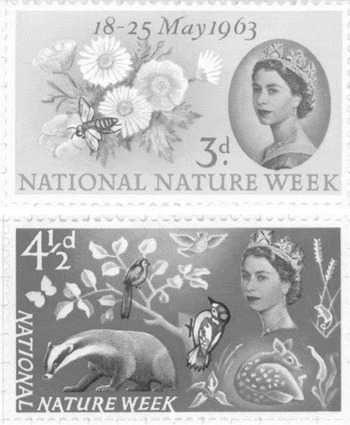
The publicity for National Nature Week 1963 was intense, with an issue of two special stamps by the Post OfficeFootnote 44 (see Figure 4) and considerable newspaper, radio and television coverage. The Week was written into The Archers, listened to by three and a half million people:
Mr. Grenville: Oh, did Mr. Sinclair talk to you about this National Nature Week that starts tomorrow?
Tom Forrest: Oh yes, yes he did, sir. Yes, we've got quite a lot arranged, Mr. Grenville, organised parties from Borchester and Hollerton.
Mr. Grenville: That starts tomorrow, doesn't it, on the 18th?
Tom Forrest: Yes, yes, first lot due in the morning. We worked out a nature trail ramble for ‘em, cover all kinds of points of interest and not likely to do any damage to other parts of the estate.
Mr. Grenville: Ah, good, good. Well, go on helping them all you can, will you? It's a very good scheme to interest townsfolk in what it's really all about.
Tom Forrest: Righto, sir.
Mr. Grenville: It might even act as a kind of counterblast to these more explosive type of townies, eh?
Tom Forrest: Well, there's always a chance at least, sir.
Mr. Grenville: A very good stamp design the Council for Nature and the Post Office seem to have worked out. They sent me some proofs. Have you seen them?
Tom Forrest: No sir. Oh yes, yes these are very pleasant, Mr Grenville. It's a right breath of fresh air, eh?
Mr. Grenville: Yes, there's old Brock the badger there and the daisies and buttercups on the threepenny one there. Yes, they are very attractive indeed. Let's hope the campaign does get people back to the old heritage a bit more. What the country really needs, because I doubt if even you and I know how lucky we are living out in parts like these, well away from the so-called virtues of civilisation.Footnote 45
National Nature Week 1963 stamps. Council for Nature Archive, File 9/11/2.

A key idea behind nature trails was the requirement to educate children and members of the public about behaviour in the field. Norfolk naturalist Ted Ellis, writing in the Eastern Daily Press at the beginning of the 1963 Week advised ‘Young Naturalists’ to check their conduct in relation to the whole field of nature: ‘If you are only interested in birds, you may go on to a nature reserve and trample on rare plants because you do not know any better, and if you are only a botanist, you may disturb a rare bird on its nest if you wander on to a sanctuary at the wrong season.’Footnote 46 In July 1962 John Clegg (Council member of the British Naturalists’ Association, and Education Officer of the Royal Society for the Protection of Birds) wrote to Dr D. J. B. Copp, General Secretary of the Council for Nature, asking him to consider issuing a colour poster during Nature Week to counter ‘the problems arising from the uprooting of wild flowers and the picking of rare plants by children for school competitions at this time of year.’ It would show ‘species of plants, for example: Orchids, that ought not to be picked.’Footnote 47 The idea was taken up enthusiastically and it was felt that the poster(s) should show ‘people how much better it is to leave wild flowers to be seen in their full beauty rather than fading and wiltering (sic) in vases indoors’ and show ‘species likely to suffer great damage due to unthinking picking.’Footnote 48
The artist and naturalist Len Fullerton was commissioned to produce drawings, using as a guide a copy of a flower poster used by the Swiss League for the Protection of Nature. The designs included the advice: ‘country lovers leave wild flowers for others to enjoy’. Towards the end of April 1963 newspapers were running short notes anticipating the poster.Footnote 49 At the end of the Week, a member of the Council for Nature, Margaret Bradshaw (Department of Extra-Mural Studies, Durham University), wrote to Copp asking for extra copies of the poster to distribute to all the schools in her county, and reported that the Week may already have improved public behaviour: ‘My verdict . . . was less litter, less dying flowers, few folks gathering large quantities. I just think the week may have done some good.’Footnote 50 Copp sent her seven hundred posters and was ‘very pleased to hear that you felt that National Nature Week has had some effect on the behaviour of the public in Teesdale.’Footnote 51
In November 1963 the Council for Nature was co-sponsor, with the Nature Conservancy, of the ‘Study Conference on The Countryside in 1970’, with the Duke of Edinburgh as President. Max Nicholson was Conference Secretary, and looked back on the success of the 1963 National Nature Week, with its ‘impressively unanimous and active support’ from national and local nature organisations, as confirming the status of the Council as ‘the all-embracing common service body and spokesman of the entire British nature and conservation movement’.Footnote 52 At the Conference, A.E. Smith, Honorary Secretary of the Society for the Promotion of Nature Reserves’ County Naturalists’ Trusts’ Committee, reflected on the balance between the necessity sometimes to restrict access to reserves, and the need to secure ‘the interest, goodwill and co-operation of the visiting public’. New ways of presenting nature were important in gaining the ‘popular support’ necessary for the future of nature conservation: ‘Trusts are now engaged in many experiments in interpreting nature for the ordinary visitor to reserves. The nature trail, for example, is being extensively used’.Footnote 53
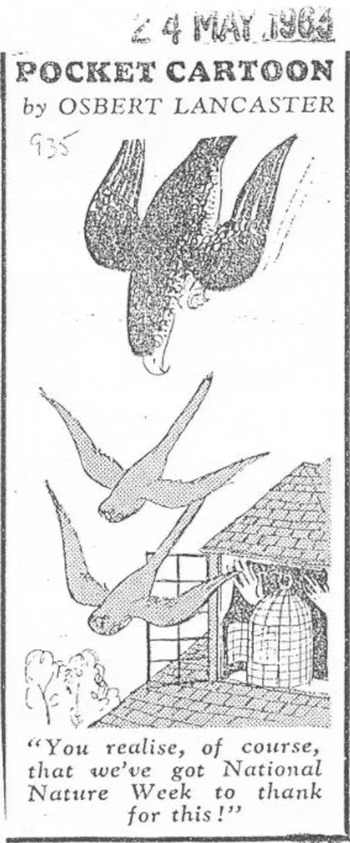
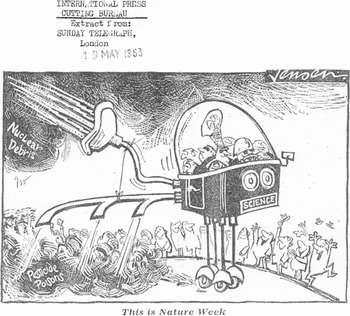
National Nature Week was not received entirely uncritically, and was satirised by cartoonists Osbert Lancaster in the Daily Express and Jensen in the Sunday Telegraph (see Figures 5 and 6). In Lancaster's image domestic caged birds find freedom only to become prey for a raptor, as a distressed owner waves his or her hands in despair.Footnote 54 For Jensen the official celebration of nature carries an irony in a world where other official actions subject the natural world to ‘nuclear debris’ and ‘pesticide poisons’; the scientific understanding informing Nature Week pales beside the destructive effects of modern industrial science. In the Daily Telegraph, under the heading ‘Nature on the Run’, a correspondent argued that ‘National Nature Week’ was to be regarded:
With the deepest distrust and dislike. It is the invention of profoundly unimaginative people who look on Nature not as a living source of beauty and wonder, but as a ‘problem’ like delinquency or disarmament, a dead thing, fit for endless prying and peering and labelling and classifying.
The correspondent thought that ‘anyone who loves Nature as Wordsworth and Ruskin did’ would find:
The whole concept of a National Nature Week . . . both preposterous and repulsive. It is a certain indication that we have really got Nature on the run at last, and are about to drive her into a few holes and corners where she can be killed with scientific kindness.Footnote 55
National Nature Week 1963 Cartoon by Osbert Lancaster in Daily Express. Council for Nature Archive, Cuttings File 9/13.

National Nature Week 1963 Cartoon by John Jensen in Sunday Telegraph. Council for Nature Archive, Cuttings File 9/13.

The ‘nature’ that 1963's National Nature Week was concerned with was largely non-urban. While urban nature trails were considered, and city museums participated, the main focus was the wildlife and landscapes of the countryside, with things urban and industrial presented as encroaching on, expanding over and polluting nature. Richard Fitter wrote in his Observer column on the National Nature Week Wildlife Exhibition at the Natural History Museum: ‘Its theme is the beauty of Britain's wild landscape with its birds, beasts, trees and wild flowers; how it is being destroyed by modern industrial and other developments; and what is being or could be done to save it for future generations.’Footnote 56 On a BBC television programme Peter West and David Dimbleby envisaged wild animals excluded by an enlarging urban and industrial landscape:
Peter West: . . . the big brick walls of industry are on the march and the deer, ponies, foxes, rabbits, owls and squirrels have fewer fields and woods to live in. The grabs and bulldozers of the builders’ men are clawing away at the countryside faster than ever . . .
David Dimbleby: The animals are suffering because our lives are improving. We are building factories, we are building roads, we are building bigger cities and they suffer as a result. Have a look, for example, at the size of London as it was thirty years ago and as it is now and think of the number of animals that have been pushed out of the homes they live in and have had to move off and find somewhere else to live.Footnote 57
Nature trails and National Nature Week 1966
There was a significant change of emphasis with the second National Nature Week of 1966, where the theme was ‘Living with Nature’. There was a new focus on the resilience of nature, on animals and plants that cling on or return:
Implicit in this title is that change in natural surroundings is inevitable and what we think is ‘natural’ our ancestors would have called ‘artificial’. We must not close our eyes to nature if it happens to occur in situations we think artificial. Thus, although as the centuries have passed there has been a steady loss of fauna and flora, there has also been some gain to offset this and surprisingly much has survived in our parks, gardens, reservoirs and other open spaces in built up areas.Footnote 58
In an extension of those urban themes informing post-war new naturalist understanding, the 1966 Week included strands on nature near people's homes; nature in cities, especially London; nature in parks; nature in relation to modern agriculture; nature in derelict industrial sites; nature in modern industrial sites and nature in ordinary places. Previews of national activities reflected these interpretations:
A field meeting in Staffordshire will show the wildlife still to be found along a highly polluted, industrial river. . . . Field meetings at Hampstead heath and Holland Park will show some of the birds of central London . . . Nature trails are being held in the grounds of Sandringham . . . and in a relict oak-birch woodland at high altitude with rich mosses and interesting birds near Sheffield.Footnote 59
Similarly the Radio Times previewed viewing and listening for the Week:
City nature, especially London's, is celebrated. A special Nature Week edition of BBC's ‘Look’, introduced by the Duke of Edinburgh and narrated by Peter Scott, examines the natural history of ‘one of the greatest urban sprawls, London’: pigeons, sparrows, kestrels and owls, ducks on reservoirs, mammals and ‘strange moths clinging on in gardens and wastelands’ and two of Britain's rarest birds, the Black Redstart and Little Ringed Plover.Footnote 60
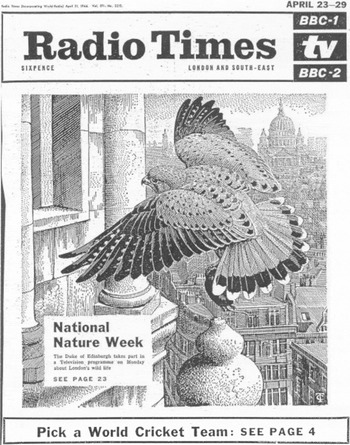
The cover of the Radio Times showed a raptor alighting on a London building with its latest meal, St.Paul's in the background, wild life going on in the capital (see Figure 7).
National Nature Week 1966 Radio Times cover by Charles Tunnicliffe. Council for Nature Archive, File 10/6/3.

In a press release issued in April 1965 Bruce Campbell explained that for the 1966 Week there would be a ‘special emphasis on youth’ and:
The Council for Nature plans to concentrate its efforts nationally in two fields: nature trails and museums. Nature trails, signposted walks pointing out the animals and plants to be seen along a route, were popularised in Britain during the 1963 National Nature Week, when about fifty were mounted. To encourage more organisations to use ‘this unique method of interesting the public,’ Dr Campbell said that the Council had formed a special team of about twenty experts scattered all over the country.
Societies wishing to set up a trail could speak to one of a panel of expert advisers, who were prepared to ‘show officers of societies over an existing trail, or the site of a past or planned one, and to discuss the practical problems involved.’ They could also consult a ‘special booklet on how to run a nature trail’ produced by the Council for Nature.Footnote 61 It is clear from this and other public statements on the Week that nature trails were still thought of as new and unfamiliar. While ‘nature rambles’ and ‘field excursions’ needed no explanation, ‘nature trails’ were always clearly defined. The Times, reporting on the preview press conference explained these new ‘signposted walks’.Footnote 62 The April 1966 press release commenting on the programme of Nature Week Events noted that it:
Includes details of 101 exhibitions, 61 lectures and 48 film shows. In addition, 28 nature reserves will be opening their gates to visitors; there will be 81 nature trails – short nature walks with signposts indicating the wildlife to be seen along the route; and 72 nature rambles and field excursions will be open to the public.Footnote 63
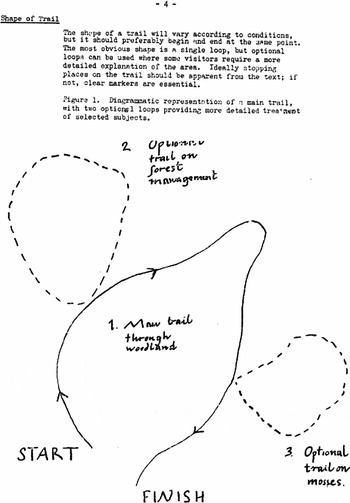
In autumn 1965 various advisory sheets were issued to schools, societies and museums, including the booklet on nature trails promised by Campbell, written by two members of the Council for Nature's youth committee, E. A. J. Buckhurst (Nature Conservancy) and Peter Prosser (Gloucestershire Trust for Nature Conservation). It contained specific practical advice on the design and construction of signboards and markers. The trail should ideally be a loop, rather than a walk between two different points (see Figure 8): ‘The shape of the trail will vary according to conditions, but it should preferably begin and end at the same point’. Rather than, say, opportunities for quiet, solitary engagements with nature, trails were presented as highly popular activities, with the potential to attract crowds:
Easy access for as large a number of users as possible is important so the selected site should . . . be within easy reach of public transport and car and coach parking facilities should be available . . . . Shelter and refreshments should be available.Footnote 64
Nature trails, the booklet suggested, could ‘educate, entertain, or both’. They should be carefully designed, with themes, as ‘a series of unrelated facts, however interesting, will not be retained in the memory’. Trails could also find a place in formal education, as introductory devices, ideal for younger children or children with learning difficulties:
Nature Trails can be an important method of introducing younger children to the working of nature in an exciting way likely to capture their imagination and interest. . . . they have been found successful with backward and even educationally sub-normal children.Footnote 65
Shape of trail ‘Information Sheet No 8: How to plan a Nature Trail’ 20/9/65, p. 4. Council for Nature Archive: 10/1/1.

For older children trails were identified as a treat or supplement that ‘can provide a refreshing contrast to the more academic approach to their work in the classroom.’ They could also be a way to spark ideas for more grown up fieldwork: advanced students ‘can also benefit by using trails especially if they get from them a stimulus to diagnose and follow up field problems.’ The conception of nature trails as an entertaining activity appealing especially to young children is extended in a further advice sheet issued to schools for the Week:
A Nature Trail can gain added enthusiasm if arranged in the form of a treasure hunt. The trail follows the usual pattern with children answering questions rather than reading about features. . . . Instead of a note in the pamphlet reading: ‘Notice the shape and jagged edges of the leaves,’ a question . . . would read: ‘what do you notice about the leaves?’ And the child would answer in the appropriate space.Footnote 66
These ideas of the purpose of a nature trail are almost identical with those espoused by Frank Lutz in 1927. The National Nature Weeks of 1963 and 1966 firmly established nature trails as a simple, instructive way of observing nature in the country and city, and the idea rapidly spread through nature reserves, Country Parks, Forestry Commission plantations and farms open to the public.
East Wretham Heath Nature Reserve and Trail
We now consider a case study to examine in detail the content of a nature trail established by a mainstream conservation organisation, showing the ways in which some of the key issues identified within national discussions, such as education, conduct, the kinds of nature to be highlighted, play out at a local scale. The case study is not intended to be somehow representative of all trails, or to suggest any special status for the Norfolk Naturalists’ Trust which, despite being the oldest county Trust (established in 1926) was one of a number undertaking such initiatives at this time. Rather the study is indicative of the complex motivations and decision making processes shaping what might ostensibly seem to be the simple task of laying out a nature trail. In particular we highlight how the making of a nature trail could entail the production of a new social landscape.Footnote 67
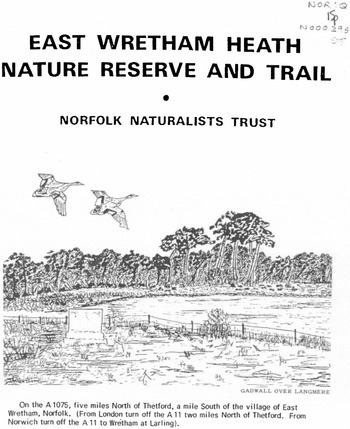
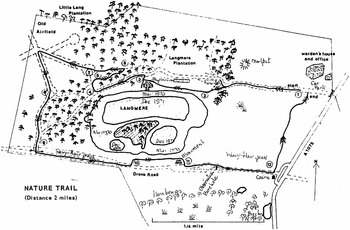
In 1972 the Norfolk Naturalists’ Trust produced a pamphlet entitled ‘East Wretham Heath Nature Reserve and Trail’, marking the establishment of a new public nature trail around a two-mile circuit in the northern part of the reserve, a few miles north-east of Thetford in the Breckland region of south Norfolk (see Figures 9 and 10).Footnote 68 The trail map indicates some of the features to be noted by the visitor: wavy-hair grass, the fluctuating water levels of Langmere, hornbeams, the ‘Big Willow’ which was sometimes in the mere and sometimes not. Human artefacts also feature, such as a marlpit and an old airfield. Inside the leaflet came further explanations and notes and drawings on the bird and animal life to be seen. Numbered points marked the spots to observe specific items, while the leaflet suggested the things to keep one's eyes and ears open for all the way round. East Wretham Heath was a 362 acre site acquired by the Trust in 1938, the land north of Ringmere bequeathed by Claire Rich of East Wretham, and that to the south and east obtained by purchase from Lord Fisher of Kilverstone and the Forestry Commission. The heath was one of a number of Breckland reserves held to preserve segments of a distinct regional ecology, elsewhere threatened by forestry development and urban expansion.Footnote 69 The Norfolk Naturalists’ Trust maintained such sites with a view to public enjoyment, nature conservation, educational use and scientific study, and the trail would seem at first glance to be a straightforward means of extending public interest in a period of increasing enthusiasm for nature. The aims of national nature weeks are realised via local action.Footnote 70
East Wretham Guide cover, Norfolk Naturalists’ Trust, East Wretham Heath Nature Reserve and Trail (Norwich, 1972).

East Wretham map of trail, Norfolk Naturalists’ Trust, East Wretham Heath Nature Reserve and Trail (Norwich, 1972).

In 1969 the Norfolk Naturalists’ Trust, through the East Wretham Heath Nature Reserve Management Committee, set up an East Wretham Heath Working Party, chaired by Lord Fisher, which on 6th June noted:
The Reserve is used for educational purposes from school to university level. . . . So far, however, no attempt has been made to interest or educate the public, and it is therefore suggested that a Reserve leaflet be prepared. Such a leaflet could be quite short and could include a short nature trail.Footnote 71
The reasons for the eventual shape of the trail are discussed below; the impetus for its creation however came from the emergence of East Wretham Heath as a kind of social space running counter to the Trust's sense of what a nature reserve was for. The trail did not establish new actions on a socially blank canvas, but promoted new ways of experiencing landscape on a cleaned slate. The Trust had not previously imposed any restrictions on public use, the reserve being open to visitors and with no warden. By the late 1960s however discussion of the reserve concentrated on the nature of public access, and the nature trail would provide one component within a wider scheme of reserve management.
An exchange of letters in the Norwich-based Eastern Daily Press in May and June 1966, under the headline ‘Breckland “invaders”’, anticipated the behavioural concerns which would prompt the trail. Farmworker and naturalist Alec Bull, of Cranworth, about ten miles north of East Wretham, wrote to complain about standards of public conduct on the heath, and the terms of debate which followed indicate some of the tensions surrounding landscapes of leisure and nature, with issues of freedom and control prominent. Barbara Rowbotham of nearby Attleborough replied to Bull, defending her use of the reserve:
For many years I and my family and dogs have been walking rather indecorously around Langmere (East Wretham), both dogs and children unleashed. . . .
In these days, where every scrap of country is under cultivation or wired off for shooting, there are very few places left where a family can go and learn to know and love nature, and if they choose to do it in the semi-nude, why not? I'm sure the lapwings don't mind.
Too many people think children should spend their spare time in concrete playgrounds and then they get so offended when the children later work off their surplus energy in a good ‘mods and rockers’ set-to, or toss the odd juke box in the sea.
I think there are probably more acres in Norfolk devoted to bringing up birds in their natural habitat than there are to bringing up children in theirs, for which there is just as much need of unrestrained and unspoiled countryside.
There are enough ‘Keep off the grass’ notices in the world today. For goodness sake don't let's have any more in Langmere!Footnote 72
Rowbotham appealed to the sense of nature as a site for human freedom, and fellow dog-walker C. M. High of Feltwell, fifteen miles west of the heath, developed the sense that nature conservation might be an activity restricting human action, noting that:
The dreadful barbed wire fence that encircles the mere is a great hazard. . . . As regards the birds, things have come to a sorry pass if the few remaining pieces of open countryside in Norfolk are to be kept strictly for them; someone has their priorities wrong. They like birds; so do I. But I also like dogs. Surely we can enjoy Langmere together with a little give and take on both sides.Footnote 73
Bull replied by deploying the kind of social distinctions which would become central to the Norfolk Naturalists’ Trust reshaping of East Wretham Heath, appealing to Rowbotham by distinguishing walkers from Attleborough from people that had moved into the overspill development of Thetford from London:
Wretham Heath is a nature reserve designed for people who wish to learn to know more about nature, and to do so in peace. I, too, . . . until recently have never had cause to complain about the behaviour of other people present. . . .
The people of whom I made complaint were of the type who do not know how to behave in the country – from out “Bow Bells way,” I would hazard a guess. Perhaps other visitors will have noticed the sharp increase in the amount of litter on the heath.
Bull suggested that people wishing to bathe should visit Knettishall Heath, a few miles east of Thetford, ‘an official public access site with wide acres of open heath, litter baskets and even a semi-resident ice cream cart’.Footnote 74
In 1951 Thetford, the main settlement in Breckland, was a small town of around four thousand people; by 1974, following development undertaken in conjunction with London County Council, the population was around sixteen thousand. It would seem to be this new social presence in Breckland, combined with the educational ethos represented by the National Nature Weeks, which prompts the Norfolk Naturalists’ Trust to reshape the presentation of local nature. New residents are presented as bringing problems of conduct demanding a management response. The behaviour of those using the reserve area was taken up by the East Wretham Heath Working Party at their meeting at the reserve on 6th June 1969. The party set their work in the context of post-war affluence, increasing recreational demand and the subsequent impact on a site of ‘high scenic value and wild life interest’ which was ‘attractive to both layman and naturalist alike’. The public could drive onto the reserve via two public roads, and ‘public interest’ was set to increase further, ‘particularly as the area becomes known to the overspill population at Thetford’. Problems derived from variations in the kinds of public using the reserve as public space. The report gave a detailed survey:
Activities deleterious to conservation interests
The survey conducted on Easter Sunday, 1969, indicated the magnitude of the problem. Over 1,000 cars were either parked on or adjacent to the Reserve, 2,000 persons plus 250 dogs were recorded and activities ranged from picnicking to canoeing to games of football. Records from visiting naturalists and other interested persons indicate that the following activities have taken place: -

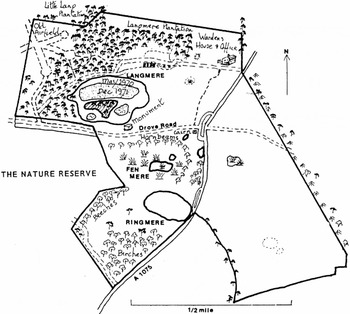
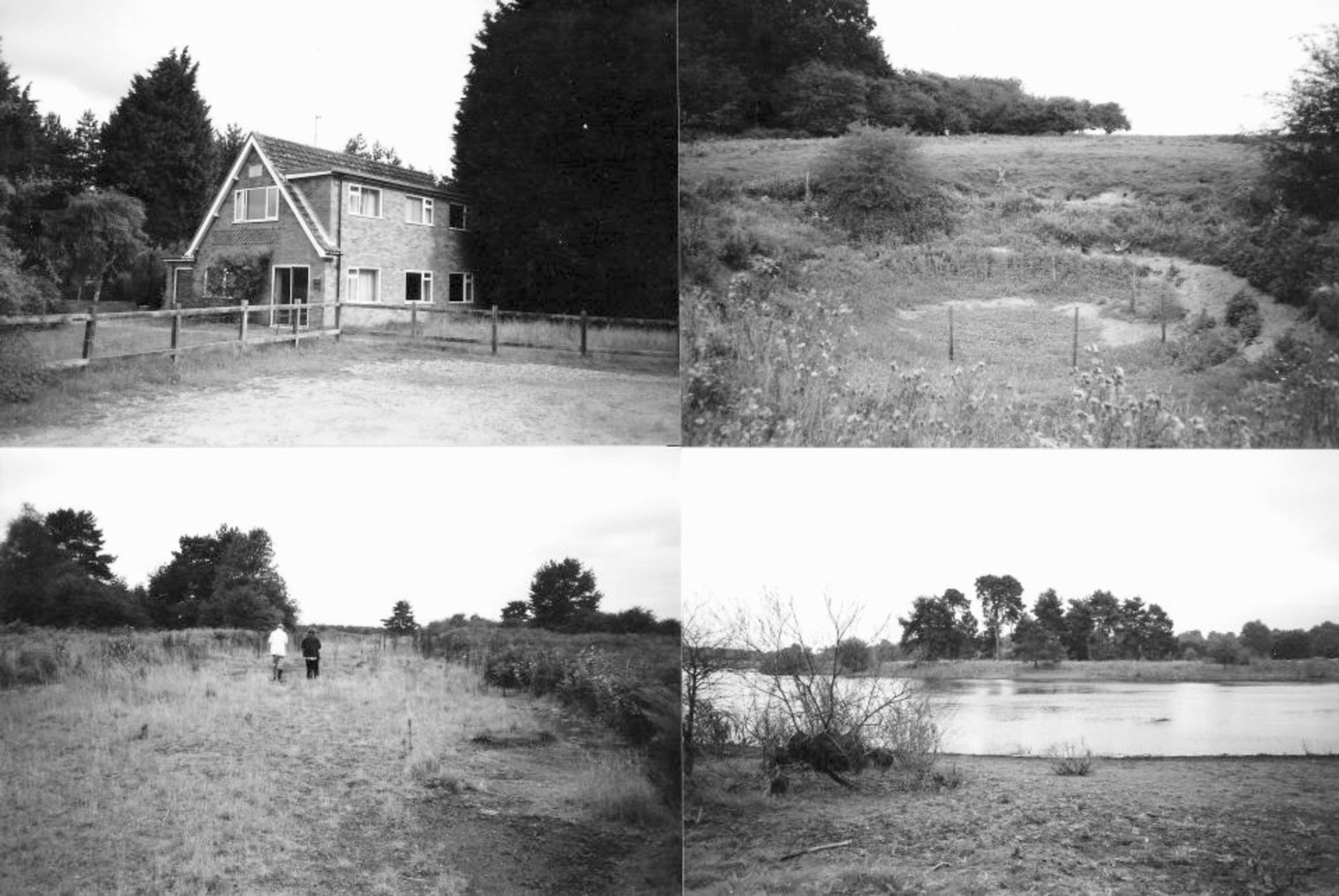
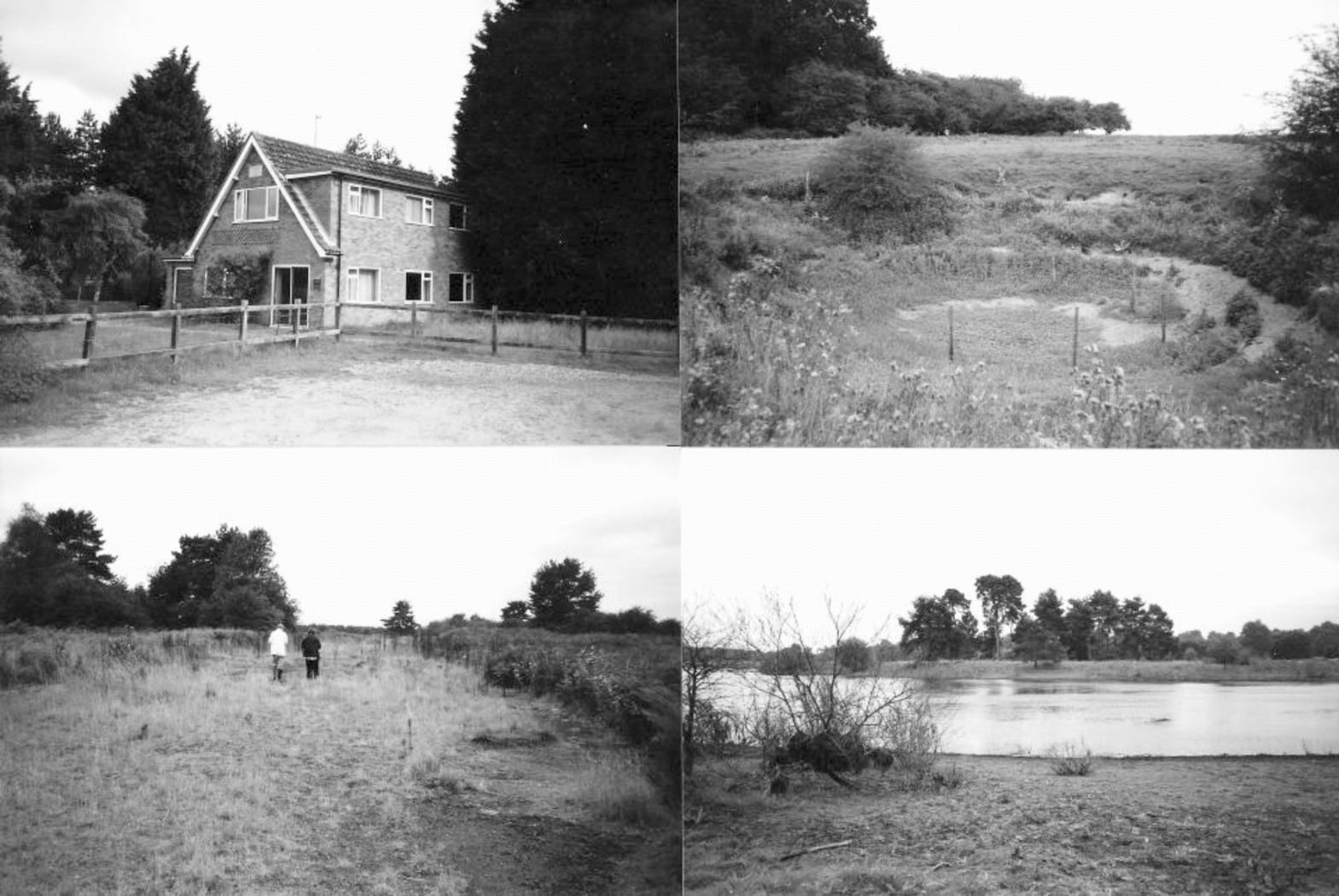
The image here is of ‘visiting naturalists and other interested persons’ surveying and recording a range of activities which for them might be even more exotic than any rare bird or insect. Such activities resulted in disturbance to nesting birds, fire, litter, trampling of vegetation, ‘uncontrolled collecting’, and pollution, including ‘Liberation of raw sewage from campers, swimmers and dogs’. The possible solutions proposed included zoning of the reserve into five areas, with one, east of the Thetford-Wretham road, set aside for car parking and picnicking (see Figure 11). The area north of the Drove Road including Langmere was the most awkward to manage, in part as the Drove Road was a vehicular right of way. The Working Party suggested that a deep furrow ploughed either side would deter ‘even the most adventurous driver’ moving off-road. In this area recreation was not to be banned but controlled, the Party envisaging the reserve maintained under a full-time resident Warden: ‘It will be the Warden's responsibility to ensure that public behaviour is kept to a high standard and the wild life interest is not abused’. The Ringmere area was to be closed to the public. The management strategy would be aided by fencing, effective notice boards, agreement with the military concerning training rights over part of the area (the Stanford Battle Training Area bordered the reserve to the north-west), reduction of publicity, encouragement to go to other campsites and Forestry Commission recreation sites, and educational trails.Footnote 75 The Warden, Captain P. B. Marriott, was appointed by the time of the first meeting of the East Wretham Heath Nature Reserve Management Committee, an expanded version of the Working Party, on 9th April 1970. Plans for a permanent house at the north east entrance to the reserve were approved.Footnote 76 The house, named Lang Mere, would be formally opened on 23rd May 1971 by committee member and well known Norfolk naturalist Ted Ellis (see Figure 12).Footnote 77
East Wretham map of reserve, Norfolk Naturalists’ Trust, East Wretham Heath Nature Reserve and Trail (Norwich, 1972).

East Wretham Nature Reserve photographed August 2002: a) Warden's House; b) Marl Pit; c) Langmere; c) Old Airfield.
In an echo of Bull's discrimination between different visitors, the Norfolk Naturalists’ Trust's discussions moved via distinctions between the respectable and non-respectable user, and via an historical narrative of reasonable use by longstanding local residents, but recent unreasonable use by an expanding and more affluent population. The overspilling of people from London to Thetford is echoed in the overspilling of conduct from respectability to excess. Wariness of increasing numbers of non-educational visitors was a feature of discussions between the Norfolk Naturalists’ Trust and the Countryside Commission as to the need or otherwise for a formal picnic site at the heath. Here the Norfolk Naturalists’ Trust indicated their own nagging concern that, in highlighting the heavy use of the reserve, with figures such as the memorable one thousand cars on one day, they may have both overestimated the problem, and given those concerned with recreation the basis for arguing for more visitor facilities. In April 1970, in correspondence with P. A. Wright, secretary of the Reserve Management Committee, and Assistant Regional Officer for the Nature Conservancy, the Countryside Commission drew attention to the figure of one thousand cars. Highlighting the dangers of such large numbers crossing public highways, the Commission suggested that the Norfolk Naturalists’ Trust might find space on the western side of the main road for a decent car park: ‘The authority suggest that the Trust might be prepared to consider whether, without impinging too much upon their scientific interests, it would be possible to accommodate the requirements of the motorist’.Footnote 78 Group Captain G. R. Montgomery, secretary of the Norfolk Naturalists’ Trust, wrote to Wright in response to the Commission's concerns on 15th May, noting the view of the recently appointed Warden in stating that: ‘I think the figure of visits by 1000 cars in one day has been much overused and it is a pity, as Marriott has said, that we ever used it’. Overestimates did not however make visitors any less of a potential problem:
I am convinced that it is vital for us to do two fundamental things: -
(a) stop visiting cars from going along the north track.
(b) plough a really deep furrow, or build a bank, around the major portion of the western part of the reserve.
Only then shall we begin to secure the future of the scientific value of the place. I am sorry we ever consulted the Countryside Commission!
On thing we must not do is to make a parking and picnic area so pleasant that it will attract more people. We want fewer people; dilution of the pressure is important so that the crowds spread away from us.Footnote 79
The Norfolk Naturalists’ Trust is here seeking in part to assert their right to manage their own property, rather than to follow the advice of a public body whose primary concern is not nature conservation.
The Eastern Daily Press provided the forum for the public dissemination of this public problem. At the Nature Reserve Management Committee meeting of 9th April 1970, Ellis agreed to write an article on the reserve, duly published in his daily ‘In the Countryside’ column on 22nd May under the heading ‘Precious Oasis’. Ellis set out the proximity of the reserve to expanding Thetford, the scenic beauty of its flowers, heath, trees and meres, and the historic associations of the Drove Road. All these offered a ‘magical attraction’, and the Trust over their thirty-two years of ownership had imposed no restrictions on public use. Such ‘open-handedness’ had however been ‘abused’, with summer weekends seeing people ‘flocking to the heaths and the meres in pursuit of happiness, bringing with them hundreds of cars, hundred of carefree dogs, caravans, horses, canoes and even speedboats’. Ellis recognised that the same activities could signal both abuse and happiness to different people, but suggested such a ‘sensitive area’ required management. Captain Marriott as ‘warden and guide’ would manage the site ‘to ensure that although visitors shall still have access to this jewel in the heart of the brecks, they shall treat it more as a priceless heritage than a mere open space for every kind of frolic’. Forestry Commission picnic and camp sites should help relieve pressure on the nature reserve, and Ellis sought to head off any objections to regulation: ‘No doubt some visitors to the meres will find the new regulations unwelcome to begin with, but in practice they are not very irksome, and they should result in more peace for all to enjoy’. Ellis conveys the subtleties of conduct and landscape, shuttling between regulation and the cultivation of appreciation, his own description of the scene seeking to alert the senses of the readers to qualities threatened, possibly by themselves.Footnote 80
The Warden reported to the committee on public use of the reserve in July 1970, following the introduction of new management measures: ‘The whole pattern of public use has changed significantly in all parts of the Reserve except the eastern area, and it is therefore submitted that any previous assessment should now be largely disregarded’. Visitors had indeed proved susceptible to management, and there had been no vandalism to the new gate and notice board at the northern entrance to the reserve:
From this it is deduced that the public as a whole are law abiding, and will respond favourably to firm instructions properly promulgated in unequivocal terms. No isolated acts of disorder or vandalism in the future would in any way invalidate this general conclusion.
Marriott also noted that ‘the numbers reported in the past have possibly been exaggerated’, and that the figure of a thousand cars may have been linked to the fact that reports by ‘well wishers’ were invariably found to be exaggerated by three to four hundred per cent. The total number of cars on the Drove Road and surrounding area on summer weekends in 1970 was never more than fifty. The only failure of management was in the sensitive fen area north of Ringmere, where discouragement rather than prohibition of access had been ineffective, due to fishing in the central mere out of sight of the rest of the reserve, particularly by small boys, with consequent litter and a ‘plague of rats. It is conjectural; but highly probable, that when the fishermen get bored they go “exploring”’. The car park in the eastern area had also failed due to the overgrown nature of the area: ‘it proved almost impossible to make anyone use the area even by verbal persuasion’.Footnote 81 By 12th August 1971 the Warden would report under the heading ‘Control of the Public’ that, while perhaps in some ways ‘it had been overdone’, the Committee's aims had been achieved: ‘The Reserve was now under control as a Nature Reserve rather than a pretty sordid picnic site which it had become’.Footnote 82
It was within this altered social space that the East Wretham Heath Nature Trail was established. On 1st December 1970 the Management Committee noted the trail as a way of guiding conduct rather than simply opening or closing the reserve: ‘to substitute an organised nature trail instead of the total exclusion of the public (which was probably impracticable anyway) would be to produce a positive alternative’. The initial plan was for a trail beginning at the warden's office, passing east of Langmere, past the monument to Norfolk Naturalists’ Trust founder Sydney Long, on to Fen Mere and Ringmere, and back via the Drove Road and west of Langmere to the northern pinewoods. The trail would thus effectively take in the whole reserve west of the A1075 (see Figure 11). The committee decided to make a small charge for entry, suggesting a space worth paying for, and from which one should gain something, and also perhaps a deterrent to those less concerned for nature. Funds had been promised by Philip Wayre to purchase a hide, from proceeds from his Wishing Well at the Norfolk Wildlife Park at Great Witchingham.Footnote 83 Wayre and his wife visited the reserve early in 1971 and a site for the hide at the North West corner of Ringmere was proposed. Wayre was invited onto the sub-committee deciding on the trail route, alongside Ted Ellis, Wright, Marriott and Dr R. L. Jefferies.Footnote 84 By 12th August 1971 discussions, including Mr Cox of the Royal Society for the Protection of Birds, had led to the exclusion of the Fen Mere area south of the Drove Road from any ‘unescorted’ trail. The trail would thus instead focus on the Langmere area, and an opening date of April 1972 was anticipated, with pamphlets to be prepared; the committee considered existing Forestry Commission pamphlets, the Shell series of nature trail leaflets, and the Norfolk Naturalists’ Trust's own experience on their reserve at Redgrave and Lopham Fen in the upper Waveney valley, as possible models, with a view that the leaflet should introduce the wider reserve as well as the specific trail.Footnote 85
The meeting on 1st November 1971 addressed the ‘Theme of the Pamphlet’, and decided to move beyond a narrow focus on the natural world: ‘if the public were to be weaned away successfully from the idea of the Reserve as a picnic place they would have to be presented with an alternative embodying a universal human appeal’. To this end a ‘human and historical theme’ would be ‘fitted in to the technical account of its natural history’, drawing on the presence of the prehistoric Drove Road, the marlpit, the meres now threatened by water extraction schemes, early Scots Pine plantations, and the disused Second World War airfield (Figure 12). The pamphlet would cost 15p, with a picture on the front cover and centre spread map. Marriott was to produce an outline draft. W. G. Clarke's In Breckland Wilds provided the key historical source, and the committee suggested drawing on material already précised from Clarke's work by Wright in a pamphlet produced for the British Ecological Society symposium in July 1970.Footnote 86 Marriott had also been advised by John Peake, who he believed was Deputy Director (Designate) of the Natural History section of the British Museum, who had stayed for two days ‘in connection with a study of snails’ and ‘had plainly made a very deep study of public reaction to presentations of all kinds’. The trail route was outlined, with about fourteen stations overall and two possible short cuts, one of which, omitting the airfield, was held to have ‘severely reduced’ interest.Footnote 87 In the event the pamphlet was ‘held up awaiting sketches’, though the committee noted on 8th May 1972 that ‘two local girls’ had made contributions, and that other images had now been received from Mr Fanthorpe of Raleigh School, Thetford.Footnote 88
The finished pamphlet carried a cover illustration of ‘Gadwall over Langmere’, with the Long monument in the foreground (see Figure 10), and inside drawings of red squirrel, flint tools, lapwing, stone curlew, crossbill and other birds, plants and animals. The pamphlet ended with details of the Norfolk Naturalists’ Trust's other reserves and membership fees. The physical geography and history of Breckland were outlined, with distinctive features of the reserve noted in soil, geology, ancient trackways and older and newer plantations. The nature reserve's history, habitats, and relationship to neighbouring Forestry Commission and Ministry of Defence land (the 20000 acre Stanford Training Area) were described: ‘We benefit greatly from our neighbours’, and the meres’ historic function and continuation explained: ‘They depend entirely for their water levels not, as is usual, on rainfall in a catchment area, but on ground water fed directly from the chalk underneath’. Discussions on water extraction from chalk with the Great Ouse River Authority were noted as having prompted further scientific study to assess likely adverse effects. The effects of myxomatosis on local ecology were also outlined:
The decimation of rabbits by myxomatosis in 1954 brought equally drastic changes to the flora and fauna of the region. The grass and heath, no longer so intensively grazed, have become greatly changed in character, and in addition some areas are gradually being taken over by self-sown Pine, Birch, Elder, Oak and scrub of all kinds previously controlled by rabbits.
Populations of distinctive Breckland birds had consequently declined, although newcomers had arrived, and birds commonly or uncommonly seen were listed, along with notable woodland and heath animals, and plants of the heath and meres. Twenty-four species of butterfly were given, ‘sometimes prolific’ due to the reserve being protected from pesticides.
The visitor reading the reserve pamphlet was taken into a natural history shaped in many ways by human action, and after a map of the reserve as a whole (Figure 11), a map of the trail (Figure 10) was given, followed by an outline of each of the twelve numbered sites and sections. Notes on landscape and ecology, including the death of some vegetation due to high mere levels in 1969 to 1970 and the recent viral attacks on red squirrels, are again mixed with human history; the Neolithic Drove Road, the 1790 Scots pine shelter belt planted to consolidate the sand, accounts by W.G. Clarke and others conveying change and continuity in scenery, the Long ‘monument patch’ and a nearby borehole to check ground water levels, the flint cairn constructed from flints on the reserve, the ‘three protected bomb storages’ from the war to be rehabilitated for working school-parties, and the ‘old airfield’. This latter site is given equivalent attention to Langmere in ecological as well as historical interest: ‘The tarred surfaces date from the Second World War when this was part of a bomber station. They have now been left untended for a quarter of a century and the reclamation by nature can be clearly seen’. Mosses and ground lichens thrive, strong rooted plants break the tarmac, chalk loving plants colonise the chalk brought to the surface during airfield construction, and the open land attracts the stone curlew: ‘They have generally been observed standing or running on the tarmac itself, or else taking to the air and flying low across the heath, their white wing bars being very conspicuous. They are very shy.’ A particular plant may be a relic of recent human presence:
Just by the war-time dug-out on the left is an apple tree of a cultivated variety which occasionally bears fruit. It is interesting to speculate whether this was sown by some airman throwing away an apple core during the war.Footnote 89
Nature and human action are enfolded as curlews take off from runways, and the trail guides visitors around a heath of human and natural history. While human action is in some senses a threat to the natural world, whether via water extraction, myxomatosis or picnic behaviour, in other ways it produces new features with their own natural interest. The nature trail does not set up the natural world as something to be defended as separate from modern human action, rather military relics and state forests take their place as objects of interest and ecological benefit, although the emphasis is also on the reserve as a precious remnant of previously more extensive Breckland heath.
Conclusion
This paper has taken the nature trail as an object of cultural and historical interest in its own right, and as a way into wider questions of countryside politics and culture in the 1960s and early 1970s. If the setting of the nature trail could be rural or urban, trails in rural spaces acted as sites where the visitor from city, suburb or country would encounter objects categorised in various ways as ‘natural’ and/or ‘rural’. For those setting up the nature trail it offered a means to generate an ordered enthusiasm for nature and countryside, with professional and amateur scientific knowledge concerning the natural world translated into popular form. Trails formed part of wider projects and strategies of rural governance in the period, and this is a field and period deserving further research, not least as new archival sources become available, and as the popular cultures of nature and countryside in the period become an object of nostalgia in their own right. As an item of contemporary rural history the nature trail allows an excursion into understandings of natural history, cultural and political values, questions of conduct in the open-air, and institutional arguments and wranglings.
Nature trails were transplanted to Britain in the early 1960s during a period of consolidation and innovation of nature conservation interests through the development of county naturalists’ trusts and the establishment of a national body, the Council for Nature, which actively lobbied for better management of nature reserves. The two National Nature Weeks of 1963 and 1966 made the conservation of nature conspicuous and provided the specific impetus and context for the design and implementation of Nature Trails. This innovation took place at the same period as the development of professional management of public access to the countryside as exemplified by the establishment of Country Parks by local authorities under the Countryside Act of 1968. The case study of East Wretham demonstrates how nature trails brought together the management of people and wildlife to produce a particular form of cultural encounter. What would seem to be a straightforward task of labelling aspects of natural interest is shown to be a complex cultural practice producing a distinctive form of instructive landscape. In October 1972 the East Wretham committee noted that their trail ‘was being increasingly used and was presenting no difficulties in enabling people to find their way unescorted’. Despite some lost pamphlets and ‘some rough treatment’ of notices, the behaviour of the public ‘had continued to improve and although the number of picnicers visiting the Reserve had been reduced, the numbers who came specially to see the Reserve had significantly increased’.Footnote 90 The nature trail had produced a new space of conduct.
Acknowledgements
This paper is in part derived from research funded by Economic and Social Research Council on ‘Cultures of Nature: The Formation of Environmental Knowledges in England 1945–70’, award number R000238559. We are grateful for the insightful comments of referees on an earlier draft of the paper.