Considering the relative modesty of his kingdom, King Ludwig I of Bavaria (1786–1868; r. 1825–1848) embarked upon a remarkably ambitious building program focused on his capital, Munich. Ludwig strove to create a “new Munich” of posh residences, art museums, historical monuments, and prestigious civic institutions constructed in styles reminiscent of ancient Greece and Renaissance Italy. As crown prince, Ludwig had supposedly declared, “I want to make Munich a city that will so honor Germany that none will know Germany if they have not seen Munich.”Footnote 1 Beyond a simple desire to promote the arts or honor the past, Ludwig believed these new historicized spaces would enhance his political authority, legitimize his reign, and represent a monarch dedicated to the betterment of his subjects.
Scholars from a variety of fields have investigated the relationship among architecture, urban design, and political power. This research has demonstrated the entanglements between the representation and contestation of political authority, on the one hand, and cultural identity, on the other.Footnote 2 These dynamics were evident in the massive (re)design projects that swept European capitals during the nineteenth century.Footnote 3 Motivated by the growing cultural saliency of nationalist movements and financed by the unprecedented wealth generated by industrial-colonial capitalism, governments across Europe invested heavily in politically motivated building programs. As Donald J. Olsen has argued, cities have, since antiquity, contained political monuments, but “only in the nineteenth century did they try to become monuments.”Footnote 4 Ludwig's drive to create a new Munich was indicative of this trend, and he made this understanding of his project explicit in one of his many poems: “Munich's art exhibitions, You should never seek in the halls; The exhibition itself, You saw in Munich.”Footnote 5
The early nineteenth century witnessed rapid political and economic change as rising nationalist and democratic sentiment challenged Europe's monarchs and ruling classes. Against this backdrop, Barry Bergdoll argues, monarchs looked to architecture “to rally and focus loyalties and to grant the aura of a glorious past to even the most recently contrived national boundaries.”Footnote 6 Ludwig, sovereign of a kingdom enlarged during the Napoleonic upheavals, saw art and architecture as vehicles to legitimize and historicize his reign by associating it with past golden ages. Ludwig proclaimed his determination to provide his subjects with cultural enlightenment, but his real purposes are better characterized as the “invention of tradition” that would sustain monarchical sovereignty and counter calls for expanded political participation.Footnote 7
Ludwig shaped Munich's new suburbs as a testament to his views of culture, history, and monarchical power. It is relatively easy to describe Ludwig's projects and decipher their representational qualities; gauging public opinion toward Ludwig's building program is more challenging, however. The period witnessed increased political activism among the general populace, even though political parties in the modern sense did not really exist. Instead, as James Brophy notes, “the public sphere should be understood less as a fixed set of institutions and social groups than as an elusive communicative phenomenon in a state of play, movement, and development.”Footnote 8 This article contributes to that understanding by drawing from various travel journals, tourist guidebooks, memoirs, parliamentary debates, and other communicative materials to trace the general contours of contemporary public opinion regarding Ludwig's new Munich. Because of the period and the surviving source materials, the following narrative privileges the perspectives of the educated, wealthy, and male. But it nonetheless contributes toward a broad reappraisal of public opinion concerning Ludwig's kinship and building program. His new buildings, streets, and squares created highly visible expressions of royal authority, but his subjects came to see them as symbols of misappropriated state funds and of a monarch detached from their everyday needs. Ironically, Ludwig's expansive building program would undermine his political standing, erode monarchical sovereignty, and ultimately contribute to his abdication.
Ludwig's “New Munich”
By the mid-eighteenth century, educated Europeans were beginning to make strong associations between past styles and contemporary ideologies. The influential art historian Johann Joachim Winckelmann, for example, viewed ancient Greek sculpture as the embodiment of beauty, intellect, and morality. Friedrich Schiller furthered this idea by arguing that meaningful political reforms could only be realized through aesthetics, connecting the classical aesthetics of the Greeks with idealizations of their republican society. As a result, “the image of Classical order came to be strongly associated with public buildings and the role of public buildings in elevating public virtue.”Footnote 9 This view of classical and neoclassical architecture was increasingly challenged during the nineteenth century, as nationalists sought alternative styles that would embody their national character and history. This architectural aestheticism emerged as an important means by which people associated themselves with broader national communities. Across Germany, especially after 1830, the educated classes shifted toward medieval architecture as inspiration for a new national aesthetic. Set against the growing agitation for national unity that ultimately led to the 1848 revolutions, these architectural debates developed into heated affairs.Footnote 10
Ludwig's belief in the ideological power of historicized architecture emerged within this broader context. Like many of his peers, Ludwig viewed architecture and urban design as tools and symbols of authority and governance—ones that had the power to influence and educate the public. Ludwig's reign coincided with a greatly changed and rapidly evolving political landscape. Bavaria's territory nearly doubled—and its population more than doubled—during the Napoleonic period. The kingdom also expanded from a relatively cohesive Bavarian nucleus with deep ties to the Wittelsbach dynasty to include much of Franconia, Swabia, and the Palatinate region along the Rhine, along with their sizeable Protestant populations. Ludwig hoped to rally these disparate places and groups around a sense of Bavarian patriotism, linked through his dynasty to broader notions of nationalism, conservative Catholicism, and German federalism. Ludwig was also cognizant of the fact that his kingdom was too small to play a leading role in European affairs, and consequently turned to patronage of art and architecture to gain political stature and historical grandeur. He conceived of the arts broadly, as something that should be integral to daily life: “Art may not be considered a luxury; it expresses itself in everything, it goes over into life; only then is it what it should be.”Footnote 11
Ludwig fancied himself a ruler in the tradition of enlightenment absolutism and firmly believed that political authority resided with the king, not with the people or elected assemblies. He had supported constitutionalism in his youth, but seemed to understand constitutions and parliaments as mechanisms to bind the populace to the monarchy instead of to institutionalize popular representation. Unsurprisingly, Ludwig's support for constitutionalism faded rapidly once he ascended to the throne, but he remained committed to monarchism, staunch Catholicism, and an activist role in state affairs. Ludwig was also notorious thrifty—his critics might say miserly—with respect to nearly all expenditures except for art and buildings.Footnote 12 Such conservatism clashed with rising liberal nationalist sentiments. Yet, Ludwig's building program and patronage of the arts featured historicized styles drawn primarily from classical Greece and Renaissance Italy, and thus constituted a type of “aesthetic statism” that would bolster the monarchy and check liberal aspirations.Footnote 13
Indeed, soon after assuming the throne, Ludwig began the process of institutionalizing urban design and aesthetics as state concerns. He established a commission to review designs for all new buildings that drew on public funds, and later did the same for historical preservation. Ludwig saw both endeavors as buttressing his reign and political ideology through history and historicized imagery. He proclaimed history “a specific counterweight against revolutionary innovations and against impatient experiments—he who seriously and worthily directs his mind to the past has nothing to fear in the present—and there is no stronger cement between the people and the dynasty than a correct national history.”Footnote 14
Ludwig was determined to transform Munich into a premier cultural capital, but contemporary reactions suggested that this would be a daunting undertaking. Munich had just become Bavaria's capital in 1777 and remained a modest city. Friedrich Nicolai, a successful Berlin book dealer, travel writer, and proponent of the Enlightenment, found Munich lacking in cultural refinement and architectural grandeur during a visit in 1781. Nicolai described the palace as “a monstrously large, incoherent building without symmetry”; the opera was “no bigger than a normal comedy club (Komödienhaus).”Footnote 15 The rest of Munich seemed ordinary to him: “The remaining fine-looking houses and palaces are not very numerous,” Nicolai continued, “the bourgeois homes are relatively spacious in part, but one hardly sees any beautiful façades.” He concluded that Munich was a thoroughly unimpressive capital: “Quite a few churches, gloomy monasteries with long undecorated façades, here and there a palace, and many sturdy but plain homes, is what one mostly sees. . . . If one comes from Vienna and is accustomed to constant bustle in the streets, then Munich appears very dead.”Footnote 16 Christian Friedrich Daniel Schubart, a respected journalist, composer, and poet, had a similar reaction in 1773, describing Munich as unremarkable except for “a coarseness that is close to bordering on crassness.”Footnote 17 Respected cartographer and writer Adrian von Riedl echoed these sentiments in 1796, when he described a nice but nondescript town whose palace was plain and barely distinguishable from the homes of the commoners. Apart from a few churches, Riedl found little of interest.Footnote 18
Munich may have been an unremarkable town at the dawn of the nineteenth century, but it was poised for a period of remarkable growth. Ludwig's father, Maximilian I, provided the impetus for this expansion. Maximilian ordered the removal of the city's medieval fortifications and began planning new suburbs to the north.Footnote 19 Indeed, the general layout and proportions of these suburbs had been surveyed by the time Ludwig began assuming control over architectural and planning issues in 1812.Footnote 20 His father's preliminary efforts quickly forgotten, Ludwig would eventually secure almost sole credit for these changes. New suburbs soon extended in all directions, but Ludwig focused his attention on the north, where he hoped to create a district of museums, monumental squares, and grand boulevards—all inspired by classical and Renaissance architecture—that would transform his modest capital into a political and cultural center rivaling Berlin or Vienna (see Fig. 1). Ludwig also benefitted from the program of monastic secularization carried out by his father, who had confiscated and centralized many valuable art works in Munich.
This 1850 map of Munich by Gustav Wenng highlights the city's expansion to the north during Ludwig's reign. Buildings commissioned by Ludwig were featured in red on the original map. Source: Munich City Museum.

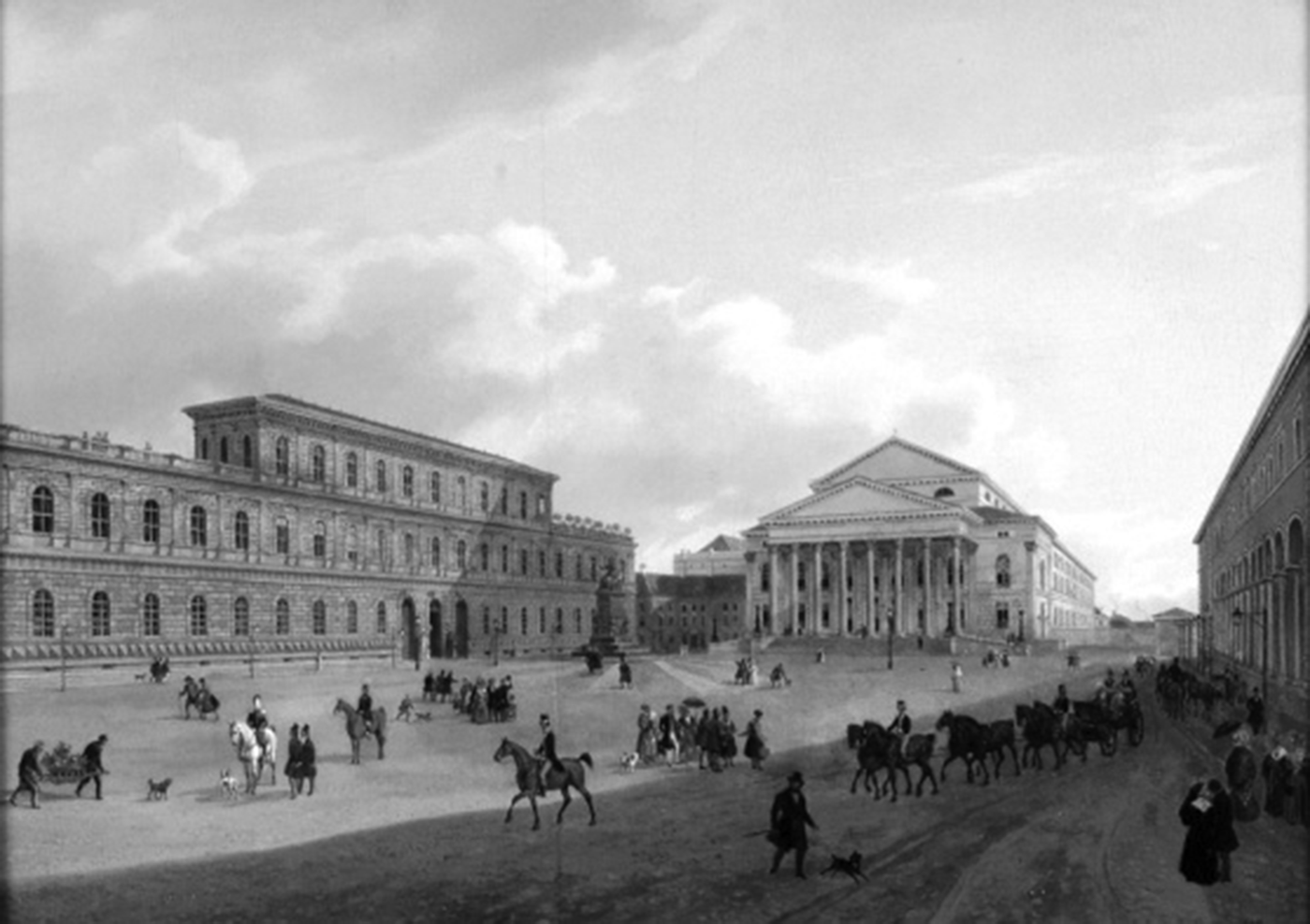
The royal Residence, located on Munich's northern fringe, marked a transitional space between Munich's medieval center and the new northern suburbs. It was no surprise that Ludwig sought to embellish the Residence and surrounding spaces. Much of his activity focused on redesigning the Max Joseph Square: he hoped that this peripheral space would become a new urban hub as Munich's center of gravity shifted north. Reflecting his passion for the Italian Renaissance, Ludwig transformed the square into a tribute to Florence. He commissioned a new tract of his Residence, the Königsbau (King's Building), to be patterned on the Florentine Pitti Palace along the northern side of the square (see Fig. 2). At Ludwig's insistence, the southern side of the square was remodeled to feature an arcaded portico based on Filippo Brunelleschi's early fifteenth-century design for an orphanage in Florence.Footnote 21 Ludwig hoped that this new urban center would position him as a figure of political and cultural consequence comparable to the rulers of Renaissance Florence.
This detail from Heinrich Adam's 1839 painting The New Munich features Ludwig's new Königsbau on the left. Source: Munich City Museum.
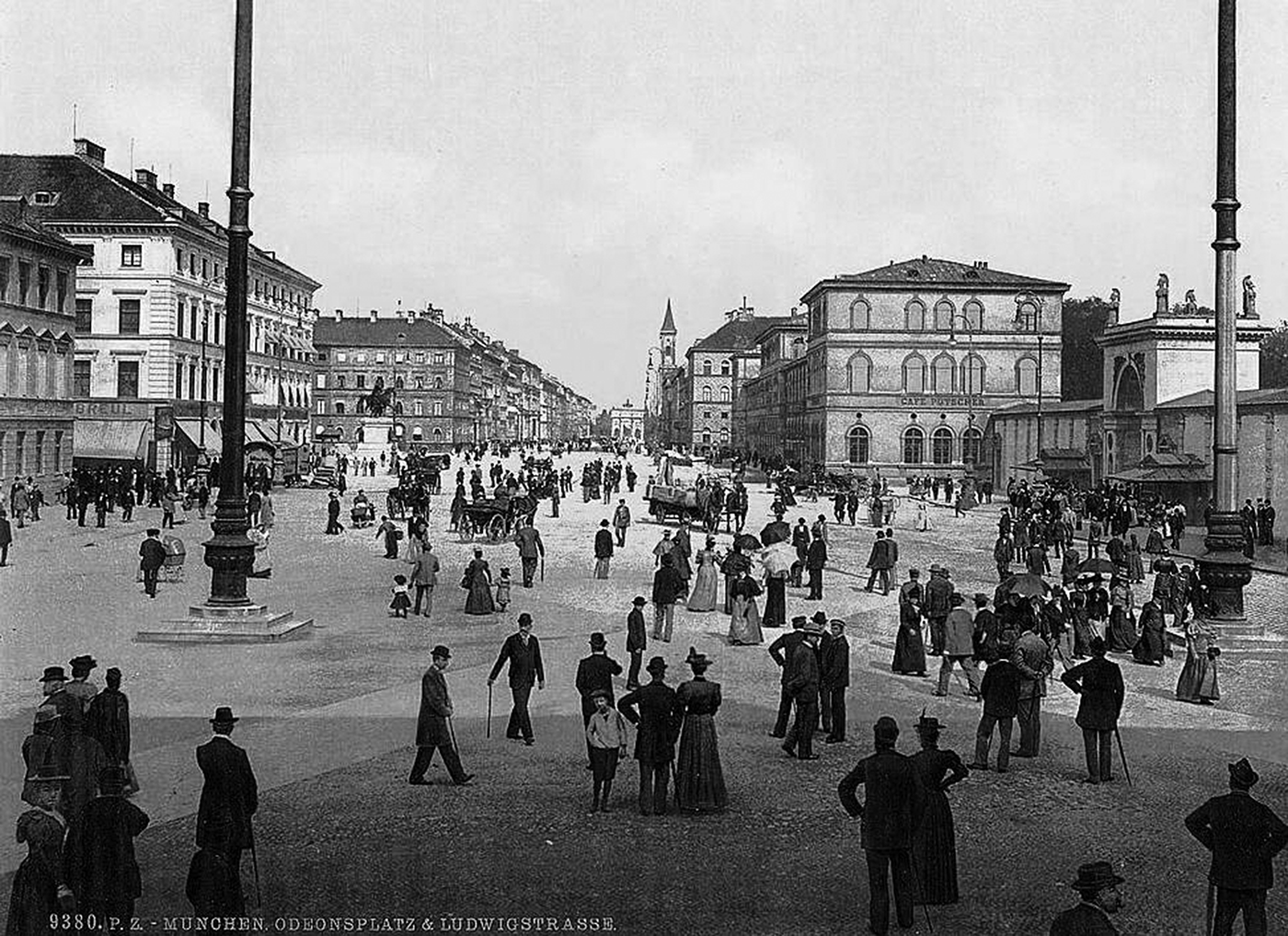
The Ludwigstrasse (Ludwig Street) provided the backbone for the new northern district. Originating near the northwest corner of the Residence, the boulevard ran north approximately thirteen hundred meters (see Fig. 3). In addition to posh homes for some of Munich's elite, the Ludwigstrasse hosted a new concert hall, state library, and university. The southern sections of the street, designed by Leo von Klenze, generally featured neoclassical facades. The northern portions later completed by Friedrich von Gärtner were more closely patterned on neo-Romanesque styles. Both sections drew inspiration from historical structures in Italy, but this was most evident in the monuments marking the boulevard's ends. The southern Field Generals’ Hall and the northern Gate of Victory were inspired, respectively, by the Loggia dei Lanzi in Florence and Constantine's Arch in Rome.Footnote 22 Originating near the Residence, the Ludwigstrasse brought a sense of monumentality to the capital and buttressed Ludwig's claims to political authority and legitimacy.
The Ludwigstrasse, pictured here from the south in 1905, imparted a sense of urban grandeur to Munich. Source: Library of Congress.
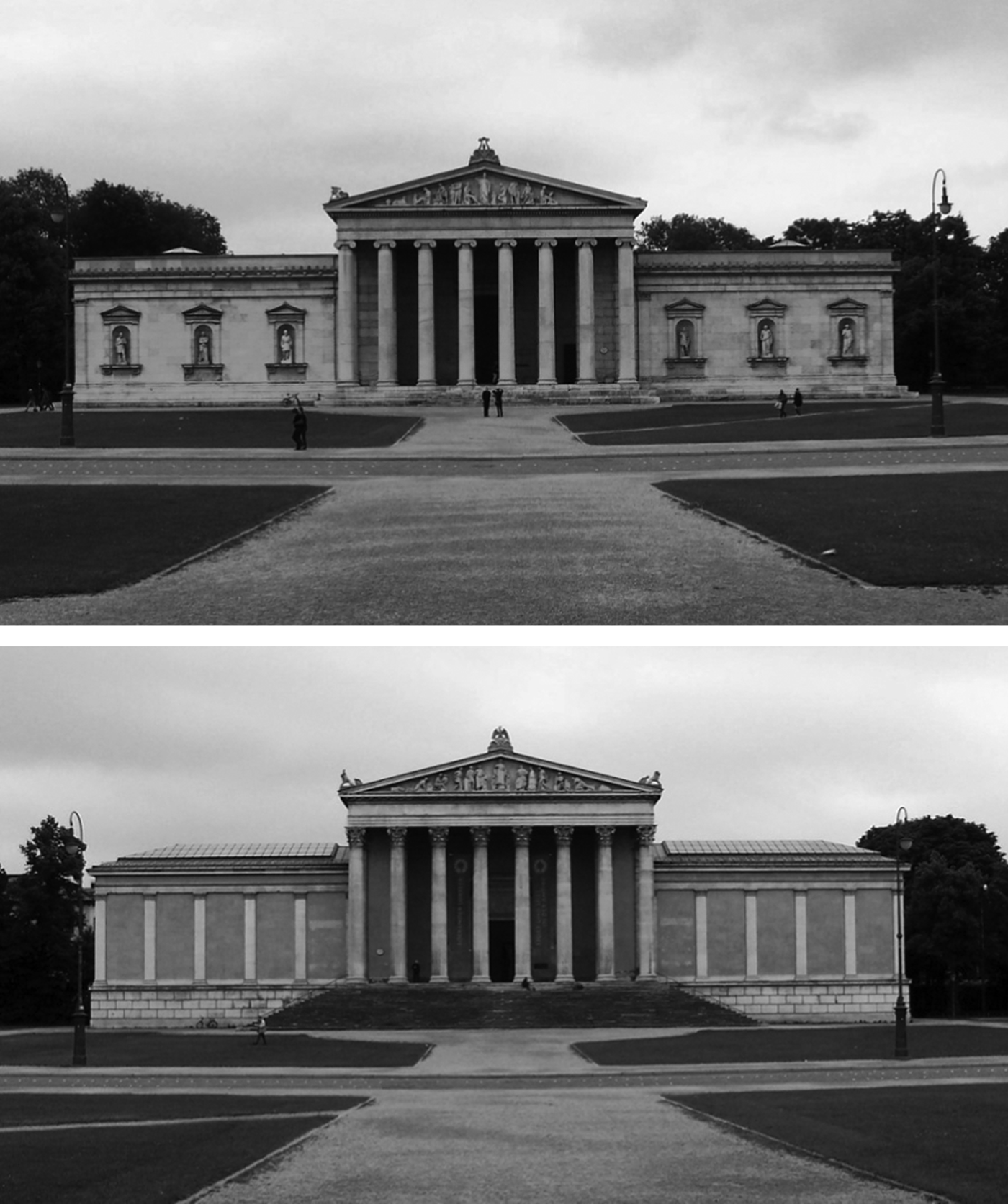
Two areas to the west rounded out Ludwig's program. Ludwig began development of the Königsplatz (King's Square) by commissioning the Glyptothek museum, which was to house his collection of Greek and Roman sculptures. The exterior featured an Ionic entrance portico and niches with statues of famous sculptors (see Fig. 4). Located opposite the Glyptothek, the Exhibition Hall was similar in appearance but featured Corinthian columns. Finally the Propyläen, a triumphal gateway with Doric columns styled on the entrance to the Athenian acropolis, completed the square.Footnote 23 Incorporating Doric, Ionic, and Corinthian styles, the Königsplatz stood as a tribute to the three orders of classical architecture. The square also positioned Ludwig as a benevolent sovereign who enriched his subjects by making his collections available for public edification.
The Glyptothek (top) and the Exhibition Hall were part of Ludwig's tribute to classical architecture. Photos by author.
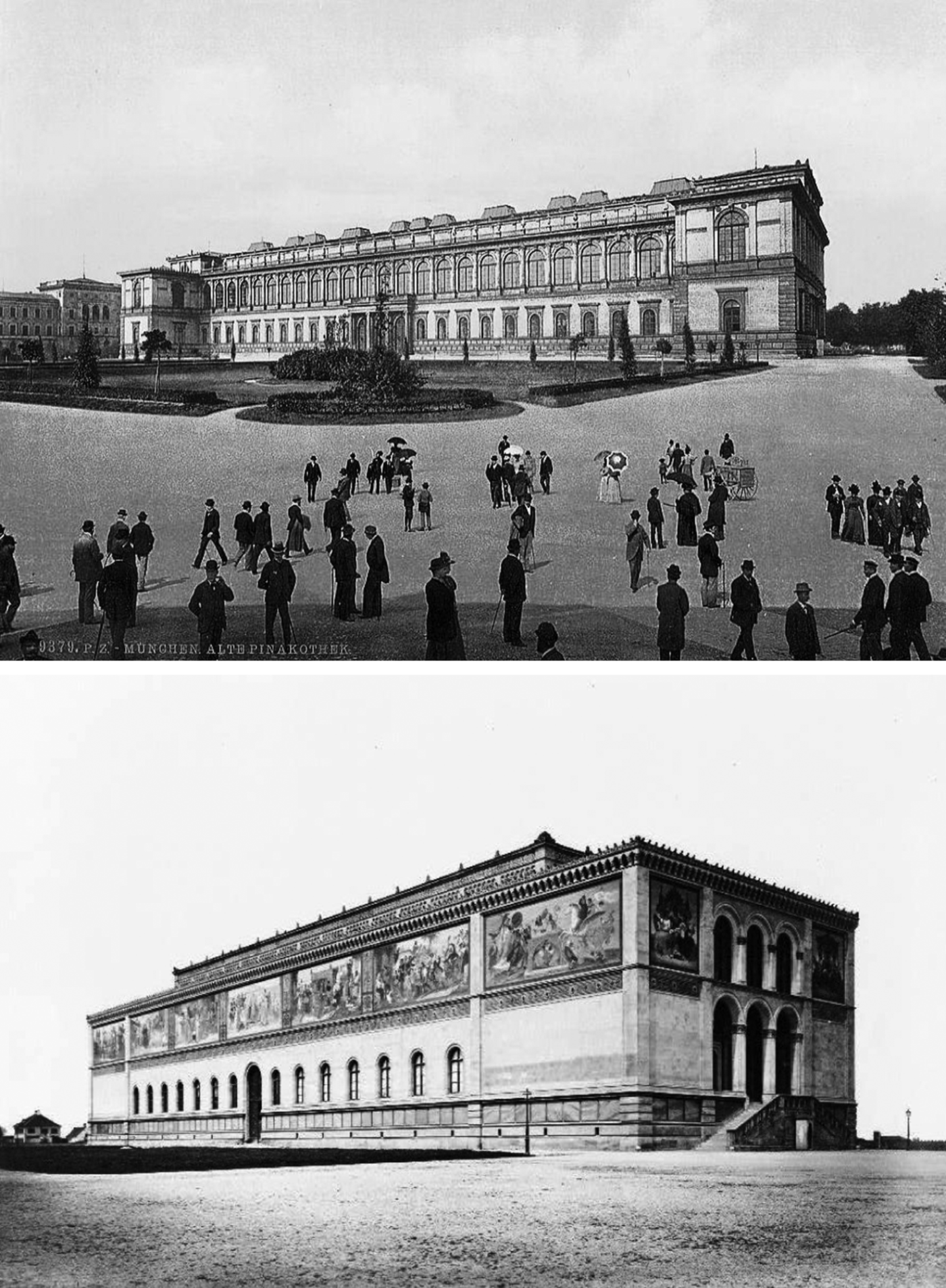
Ludwig commissioned two large public painting galleries a short distance north of the Königsplatz. The first gallery, the Old Pinakothek, was similar in function to the Glyptothek, but presented the evolution of painting instead of sculpture. The exterior was inspired by Italian Renaissance palaces, while the interior presented Renaissance masterpieces as the pinnacle of artistic achievement. The nearby New Pinakothek featured nineteenth-century German painters, many of whom had received commissions from Ludwig (see Fig. 5). This gallery best represented Ludwig's self-image as an authority in the arts through a series of massive exterior murals. The murals began with a depiction of artistic decline, with subsequent scenes leading to the central image of Ludwig inspecting the works of various sculptures, painters, and architects. The next three murals featured stylized groupings of painters, architects, and, finally, sculptors working for Ludwig.Footnote 24 The Old and the New Pinakothek, like the Glyptothek, presented the public with a symbolic narrative of art history culminating with the Italian Renaissance—as well as with another subsequent rebirth inspired by Ludwig's patronage of nineteenth-century German artists.
The Old (top) and the New Pinakothek were monumental structures intended to educate the public on Ludwig's concepts of art history. Source: Library of Congress.
Ludwig had to overcome serious financial obstacles to realize this new Munich. Many writers, both during and after his reign, claimed that Ludwig had personally financed these projects, but that assertion is misleading. Ludwig did fund much of the Glyptothek from his state stipend as crown prince. But this was not nearly enough to achieve his ambitious program, and his truly private sources of income, such as rents from his personal estates, were few and comparatively small.Footnote 25 As king, Ludwig's main source of revenue was the so-called civil list, which covered his expenses, as well as those of the extended royal family. Drawn from tax receipts, the civil list was renegotiated and approved by the state assembly, but Ludwig wanted the annual amount to be guaranteed in perpetuity, thus freeing him from having to negotiate with each assembly. He achieved that goal in 1834, and a permanent civil list was set at just over 2.35 million Gulden annually, i.e., about 10 percent of state revenue. This was a major success for Ludwig, but the value of the fixed amount diminished over time because of inflation. The civil list nonetheless provided a steady stream of funding. Ludwig soon made deep spending cuts, even denying his brother a loan to renovate his own modest palace. Yet, his stinginess was not intended to lower overall spending, but rather to maximize the portion of the civil list available for his projects. Ludwig even managed—as a condition of his abdication—to negotiate an annual payment of half a million Gulden from the civil list for the remainder of his life.Footnote 26
The civil list was a good start, but Ludwig needed much more to achieve his new Munich. He soon turned to other sources of funding, among them the cabinet account, which contained money authorized by the assembly to fund the government's daily operations. Ludwig made deep cuts here as well, slashing ministerial salaries from 20,000 Gulden to a maximum of 12,000 Gulden, for example.Footnote 27 He also reduced expenditures on infrastructure, defense, education, law enforcement, and the bureaucracy, but again, his aim was not to reduce cumulative spending. Instead, Ludwig effectively sequestered funds appropriated by the assembly to create a royal slush fund—estimated by 1843 to have peaked somewhere between 21 million and 24 million Gulden, with some estimates reaching as high as 30 million—to help fund his building projects.Footnote 28
Relations between the assembly and the monarch deteriorated steadily after these machinations came to light, and opposition grew with Ludwig's assertion that any “surpluses” in appropriations fell to his discretion. Ludwig—or more commonly one of his ministers—argued that his building projects added to the common good by generating jobs, overlooking the fact that taxes first had to be collected and funding diverted from other public services in order to finance these projects. There is no evidence that Ludwig cared much about job creation except for artists. In contrast, he played close attention to what purchases were made from which accounts. Funds from the cabinet account generally went to construction costs so that those buildings and their maintenance would become state responsibilities; art was more likely purchased through the civil list so that it could be claimed as royal property tied to the throne.Footnote 29 A final accounting of Ludwig's expenditures from 1825 to 1866 across these various accounts suggested that Ludwig had appropriated a total of nearly 36 million Gulden, with 16.5 million—roughly 46 percent of the total sum—dedicated to art and architecture.Footnote 30
Ludwig faced increasingly assertive political opposition but retained several advantages. The opposition in the assembly normally constituted a slight majority after 1831, but it remained divided largely between two factions: liberals demanding a more representative government and Protestants angered by Ludwig's promotion of Catholicism. This presented opportunities for Ludwig to divide the opposition in order to advance key initiatives. The king was also willing to trade royal prerogatives in return for state appropriations for his building program, agreeing to assembly oversight of budget surpluses in 1843.Footnote 31 His reconciliation with the assembly had clear limits, however: he repeatedly denied, for example, the construction of a new assembly building to replace the current one, a converted merchant house.Footnote 32 It is also important to note that Ludwig's tightfisted approach to spending on public services roughly balanced his profligacy on art and architecture. Ludwig inherited a heavily indebted kingdom, but managed to leave one of the most financially sound kingdoms in Europe.
Because the cost of Ludwig's building program outstripped his various funding schemes, he increasingly manipulated other resources. To complete the northern portions of the Ludwigstrasse, for example, Ludwig “commissioned” the city to pay for the new large Ludwig Church, a strategy that also had the advantage of circumventing the assembly. Municipal authorities balked at the costs, arguing that the church was too expensive and too large for Munich's small Protestant community. Ludwig responded by threatening to move the university and his court out of Munich, giving the city little choice but to comply. Rather than acting as a munificent ruler donating his own wealth, Ludwig increasingly drew revenue for his projects from state, municipal, and civic organizations, coerced through these types of heavy-handed tactic.Footnote 33 Similarly, as costs spiraled beyond approved amounts, Ludwig shifted the additional costs of the concert hall, state library, and Old Pinakothek onto assorted state accounts marked for other uses. This generated a great deal of criticism in both the assembly and the local press.Footnote 34
“Art is not biscuits for the people,” Ludwig explained, “but rather their daily bread”—and he hoped to benefit politically as the gracious provider of this daily bread.Footnote 35 It is ironic that Munich's municipal government had to pass a surcharge on malt, a main ingredient of beer, to cover debts associated with his projects. Since beer was a staple of lower-class diets, Ludwig was forcing commoners to pay a surcharge to finance his building projects.Footnote 36 Furthermore, the kingdom was mired in poverty, slowed by outdated and inefficient agricultural practices, and already lagging behind the incipient industrialization spreading across northern Germany.Footnote 37 Ludwig's determination to realize his building program left him increasingly alienated from his subjects and from the assembly. Indeed, his rule has been described as increasingly “autocratic” and “imperious,” especially after the assembly cut the annual civil list from 3.15 million to 2.3 million Gulden in 1831.Footnote 38
Ludwig's building program reflected his passion for Greece and Italy, but his motivations went far beyond a simple tribute to the past. As James J. Sheehan has noted, the intention was to create an urban aesthetic in Munich “where monarch and nation could be united by their common experience of beauty.”Footnote 39 These various projects represented Ludwig's steadfast desire to transform Munich into a monument to his political authority, as well as into one of Europe's capitals of art and culture. In the words of one of his biographers, Ludwig aspired to create a “kingdom of political historicism” that would enhance his own political and cultural authority by associating his reign with past golden ages.Footnote 40 Ludwig unfailingly participated in groundbreaking, dedication, and other ceremonies associated with his projects, which were typically scheduled to coincide with anniversaries of important historical events. Conversely, Ludwig generally avoided ceremonies for buildings that lacked an obvious representational quality.Footnote 41 The monarch's posturing as a modern-day Renaissance man—and nationalist—was evident in a speech he gave at a cornerstone ceremony in 1846: “This New Pinakothek is dedicated to paintings from this and future centuries,” Ludwig stated, “The higher art of painting had been extinguished, then it rose again, in the nineteenth century, through Germans; … and not only painting, every visual art rose anew, splendid.”Footnote 42
Reactions during Ludwig's Reign
Ludwig greatly increased construction spending after assuming the throne, and visitors soon took note. Carl Friedrich Zelter, director of the Berlin Vocal Academy and founder of Prussia's Royal Institute for Church Music, was generally impressed by the rapid expansion already under way in 1827, although he felt that some of the new streets and squares were too large. Despite this flaw, Zelter saw “Munich, with its twenty some churches, suburbs, palaces, libraries, Pinakothek, and Glyptothek” as “a heavenly city.”Footnote 43 In 1829, Hamburg painter Friedrich Wasmann considered Munich's architecture mostly medieval in character, but praised Ludwig for sponsoring a revival in architecture and painting.Footnote 44 By the 1830s, Ludwig's patronage had prompted a steady stream of accolades. Joseph Freiherr von Hormayr, an Austrian expatriate serving as a Bavarian diplomat, asserted that Ludwig's actions constituted “the rebirth of a new, religious-historical German art.”Footnote 45 In 1833, Prussian composer Otto Nicolai summed up the feelings of many architects and artists: “Munich is a beautiful city and extremely well suited to satisfy every architect and painter, not just the musicians.”Footnote 46 Once a rather unremarkable city, Munich was rapidly gaining a reputation as an artistic center.
It should be noted, however, that these visitors were somewhat predisposed toward approval. Zelter and Nicolai both held royal appointments in Berlin and were likely sympathetic to Ludwig's monarchical politics, which, in any case, were increasingly irrelevant to Prussia's drive toward hegemony. Ludwig's appointment of Hormayr to the Bavarian diplomatic corps had rescued him from a fading career in the Austrian civil service. As for Wasmann, he had become a disciple of the Romantic Nazarene art movement after converting to Catholicism. It is unclear if Wasmann ever received commissions from Ludwig, but the king was a leading sponsor of the movement, and many leading artists—including Peter von Cornelius, Julius Schnorr von Carolsfeld, and Wilhelm von Kaulbach—made important contributions to Ludwig's building program.
That program coincided with the first modern tourist guidebooks. Unlike the largely encyclopedic travel literature of previous centuries, these nineteenth-century guides, which offered relatively concise itineraries and basic descriptions of the main sites, contained increasingly positive portrayals of Ludwig's new Munich—which, as we shall see, was likely attributable to political bias or economic self-interest. Friedrich Wilhelm von Bruckbäu's guide to Munich, which singled out Ludwig as a “high expert and protector of art and science,” may have been the first to assign any special attributes to the monarch. Bruckbäu noted that the Königsbau and the Glyptothek were constructed, respectively, “at the expense of His Majesty the King” and “from his own expenses,” establishing an exaggerated claim that would gradually be accepted as fact.Footnote 47 In reality, Ludwig's projects were, either directly or indirectly, almost entirely funded from public coffers.
An examination of the four most popular Munich guidebooks of the 1830s and 1840s demonstrates how subsequent guidebooks expanded upon the theme of Ludwig as an extraordinary personality of cultural and political importance. The prolific art historian and antiquarian Georg Nagler wrote one of the most successful of these guidebooks. First published in 1834, Munich in Eight Days was expanded and updated periodically, with a tenth edition appearing in 1863. Nagler credited Maximilian with the initial decision to transform Munich into a majestic city, but Ludwig himself was the primary focus of the author's praise: “Since the beginning of the reign of His Majesty King Ludwig I, there arose throughout the city such splendid and artistic monuments that attest to the lofty spirit of their most merciful founder,” Nagler explained, “so that Munich already enjoys widespread fame as one of the European cities most worthy of being seen.”Footnote 48 The first of the book's eight-day itinerary began in Munich's medieval center, but Nagler soon directed visitors to the Residence and the Königsplatz. The remaining seven days center on the various sites and museums commissioned by Ludwig, making it clear that Nagler considered these to be the chief attractions. Like Bruckbäu, Nagler informed readers that the Glyptothek was funded from the king's personal money.Footnote 49 Munich's medieval center was pleasant, Nagler explained in the fourth edition, but “the suburbs . . . offer a treasure of beautiful buildings that have recently helped Munich achieve the completely justified reputation of being one of the most beautiful cities in Germany.”Footnote 50
Ernst Förster, a prolific art historian and painter, wrote another popular guidebook. The second edition of Munich: A Handbook for Visitors and Locals appeared in 1840, and an eighth edition by 1858. For Förster, Ludwig's building program represented a noble endeavor that had transformed Munich into one of Germany's leading artistic centers. Yet, rather than seeing a monarchist trying to legitimize and historicize his reign through architecture, Förster viewed Ludwig's new Munich as representing an almost democratic flavor. Though designed to project a sense of monumental grandeur radiating from the residence, the Ludwigstrasse was, according to the author, “a series of public buildings that one is only accustomed to seeing in the old Italian republics.” Förster affirmed to his readers how lucky they were to be living in a time “unequaled in the history of this country, and in which the holy spirit of the centuries is protected and carried above the stormy waves by a steady hand.”Footnote 51 The steady hand protecting this flowering of art and architecture belonged, of course, to Ludwig.
A landscape painter originally from Breslau, Felix Schiller was similarly attracted to Munich's building boom. Five editions of Schiller's Munich guidebook appeared between 1841 and 1855, including an English translation in 1852. Each begins with a history of Munich and a separate section devoted to Ludwig, the only individual treated in this fashion. Besides describing some of the recent changes, Schiller also provided a list of the various projects and artists sponsored by Ludwig. The result of Ludwig's efforts was, according to Schiller, the transformation of Munich into a quasi-sacred space, “a holy altar on which the arts lay down their most noble and richest gifts.” The guide confidently informed readers that projects such as the Church of St. Boniface were financed “exclusively out of the private means of King Ludwig.” At the same time, the itinerary focused almost exclusively on places personally associated with Ludwig.Footnote 52 Largely ignoring other historical buildings, Schiller's guide clearly prioritized Ludwig's as the top destinations.
Late in Ludwig's reign, the art historian Rudolf Marggraff and his brother, Hermann Marggraff, wrote an extensive volume on Munich's art and architectural history. Their focus was on “what has happened here in Munich in the arts and for the arts through His Majesty the reigning King Ludwig,” whose building program was moving in a “historical-monumental, religious-nationalistic direction.” After lauding Ludwig's accomplishments, the Marggraffs concluded that “we are therefore standing on the border of a new epoch of our art.”Footnote 53 They depicted Ludwig as a pioneering figure whose economic largess and artistic vision had catalyzed a cultural renaissance.
There is reason to question the impartiality of these descriptions. Nagler, Förster, Schiller, and Marggraff certainly had the credentials to speak with authority on the local art scene, but their connections to Ludwig suggest they were more than disinterested observers. It may not be a coincidence, for example, that two years after Nagler had first published his lavish praise, he began serving as a lecturer in architectural history at Bavaria's Royal Building Trade School, an appointment that had required Ludwig's approval. After arriving in Munich, Förster assisted with the interior frescoes for the Glyptothek, Königsbau, and the Royal Garden arcades. His earlier work included an 1834 guidebook to the Königsbau's interior décor. Schiller wrote poetry for the wedding celebrations for Ludwig's son, which was held just one year after the first edition of his guidebook appeared, and he later contributed a painting to the King Ludwig Album, a collection of artwork dedicated to Ludwig. Rudolf Marggraff was appointed professor of art history and secretary of Munich's Royal Academy of the Visual Arts from 1842 until 1855, a time in which he catalogued the various royal collections. There is no evidence to suggest that the public praise of these individuals differed from their private opinions, but there is reason to question their impartiality since they all, to some degree, benefited economically from Ludwig's building program and artistic largesse. It should also be noted that Bavaria’s censorship laws, which Ludwig strengthened considerably through the 1830s, also ensured that local publications generally praised the king’s efforts.
It is unclear how many people were visiting Munich during this period, but the growing number of guidebooks suggests a burgeoning travel industry; in fact, a demand for souvenirs even emerged by the 1830s. Many of these early souvenirs focused on Ludwig's new Munich and served indirectly as royal propaganda. Gustav Kraus, a popular Munich artist, may have created the first Munich souvenir: his Munich Forget-Me-Not, or Memento of a Stay in the German Athens was a small booklet of twenty lithographs, the majority of which featured Ludwig's buildings (see Fig. 6). The title and content buttressed Ludwig's desire to connect his building program and reign with the glories of antiquity. Kraus's lithographs apparently found a ready market. The booklet first appeared in 1835 and was reprinted in 1836, 1838, and then again around 1850.Footnote 54 Other souvenirs followed this pattern. The 1843 Memento of Munich, for example, featured a plan of the city bordered by twenty-two small vignettes, over half of which were Ludwig's projects.Footnote 55
Gustav Kraus's lithographs, like this one of the Glyptothek, celebrated Ludwig's building program. Source: Münchener (1835).
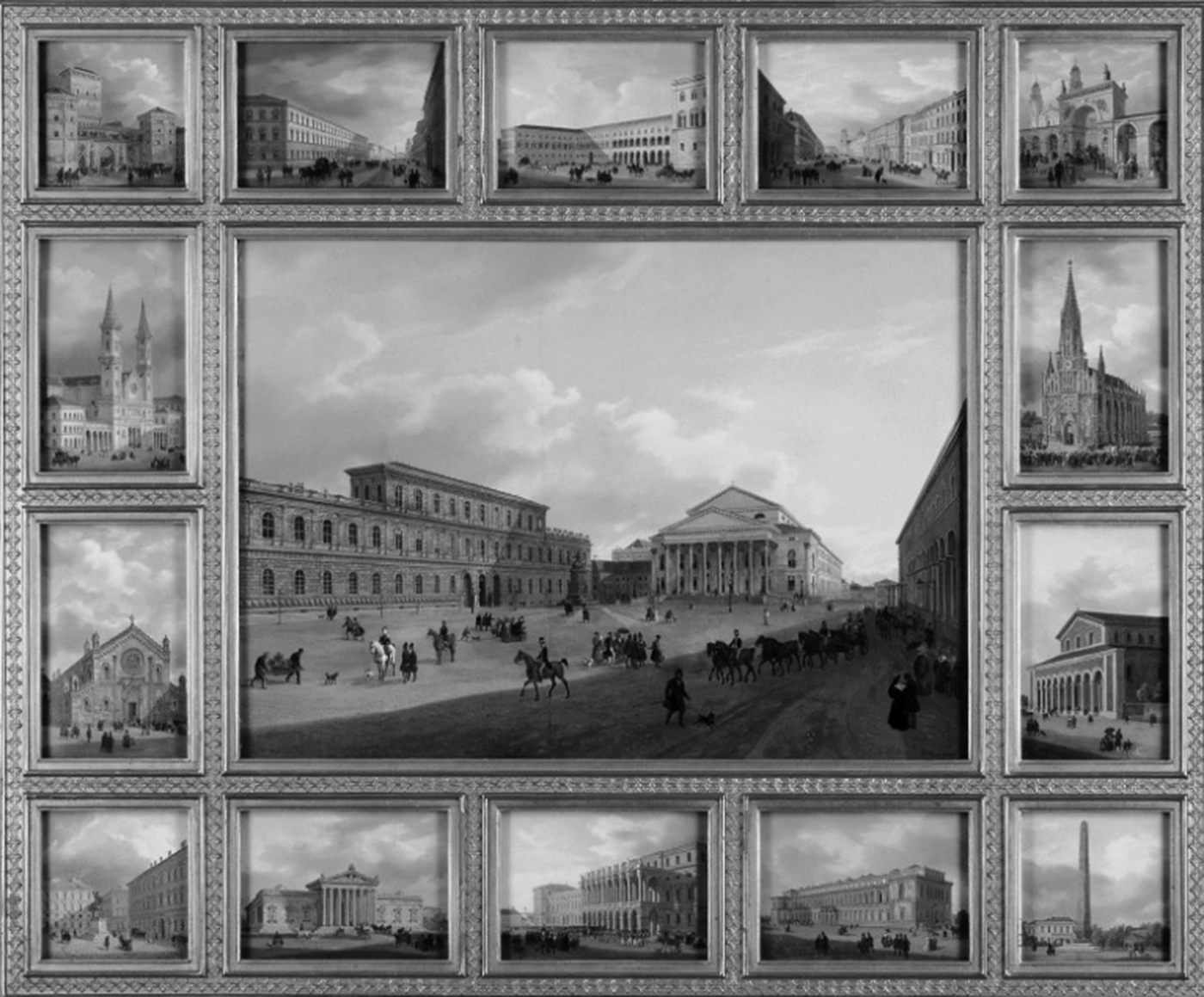
In addition to these relatively inexpensive items, higher priced works also glorified Ludwig's building program. To mark the tenth anniversary of Ludwig's ascension, Gottlieb Bodmer produced a large lithograph, King Ludwig I and His Buildings, featuring the monarch hovering over an idealized collage of his construction projects.Footnote 56 The most vivid homage to Ludwig's building program and the idea of a new Munich came from Heinrich Adam, whose talented brother Albrecht received numerous royal commissions. Adam's The New Munich depicted the royal Residence surrounded by fourteen smaller paintings of Ludwig's other buildings, monuments, and squares (see Fig. 7).Footnote 57 Ludwig was not pictured, but his role was clear enough. Like the guidebook authors discussed earlier, many of these souvenir artists had personal reasons for glorifying Ludwig's reign: Bodmer and Adam clearly sought to curry royal favor, likely in the hopes of gaining future commissions. Even freelance artists without royal connections, such as Kraus, had a vested interest in promoting Ludwig's building program, since they earned money selling Munich souvenirs.
Heinrich Adam's 1839 painting The New Munich paid tribute to Ludwig's building program. Source: Munich City Museum.
Clearly, then, the majority of guidebooks and souvenirs offered lavish praise of Ludwig and his building program, but a few writers remained ambivalent. In one of the first guides to Munich, Johann Wilhelm Koebler, a local police official, described the city as generally heading in the right direction. Perhaps because Ludwig's program was still in its infancy, Koebler merely acknowledged Ludwig as an honorable monarch, but did not portray his building projects as outstanding in any way.Footnote 58 The same could be said for C. A. Baumann's 1832 guidebook, as well as for an 1843 guide by an unidentified author. Baumann begins his description of Munich's general layout with its medieval center and, while not ignoring Ludwig's projects, does not highlight them as anything extraordinary.Footnote 59 The 1843 guide provides a matter-of-fact listing of Munich's principal sites, beginning with local churches.Footnote 60 These three guidebooks do not disparage Ludwig, nor do they single him out for special praise. Unlike the authors offering profuse praise, this trio had no known financial or personal connection to Ludwig.Footnote 61
Some observers were nevertheless critical of Ludwig's building program. As early as 1826, one writer had warned in an architectural journal against devoting too many resources to monumental projects: state spending should be channeled instead toward improving the lives of the poor. It would make a better impression on an observer, the author explained, “when he finds not just the splendors of the capital as worthy of his amazement, but rather meets good taste and suitable organizations across the country and is thereby moved to infer a happy, well-ruled people.”Footnote 62 In 1827, August von Platen, the classicist poet, predicted that “in Munich, it appears, despite all the king's love of art, nonetheless sad enough, and nothing will thrive properly.”Footnote 63 A year later, Heinrich Heine mocked the idea of capturing past golden ages in Munich: “That one calls the entire city a new Athens is, between us, somewhat ridiculous…”Footnote 64
Munich had changed a great deal by the 1830s, but some visitors still remained unimpressed. Famed Austrian playwright Franz Grillparzer described a dreary and lethargic city in 1836. The new state library made “a gloomy impression,” while the Residence was “dull like everything else.” In contrast to other capitals, Munich seemed provincial and its new suburbs too large: “In addition, everything bears the seeds of its destruction,” Grillparzer explained, “since Munich lacks the trade and traffic that could raise the city to the level that these institutions would like to raise it. I like the hustle and bustle of the old Munich better; the new Munich is from the start laid out ruins.”Footnote 65 Two years later, Leipzig-based composer Moritz Hauptmann offered a more direct critique of Ludwig's building program. He admitted that Ludwig had built a great deal, but scorned his eclecticism:
What a heap of anomalies and oddities are to be found at Munich! The new Ludwigstrasse is a choice jumble of styles, Graeco-Roman, Byzantine, Gothic, all combined. The Library is the Venetian Palace at Rome, the Residenz is the Palazzo Pitti at Florence, and the Allerheiligen Kapelle is a pre-gothic Basilica.Footnote 66
Hauptmann noted that Ludwig prized form over functionality and wrote of his building program that “one cannot really approve of it, because it is so unreal. Why on earth should the Munich Library have loopholes? It was a different thing for the Florentines of the fourteenth and fifteenth centuries; they had good reasons for them.”
Several prominent art professionals outside Bavaria added further criticism, especially of Ludwig's propensity to imitate past styles. Rudolf Wiegmann, an artist, professor of architecture, and secretary of the Düsseldorf Art Academy, published a polemic against Ludwig's chief architect, Leo von Klenze. Objecting strongly to Ludwig's propensity for mimicry and eclecticism, Wiegmann described the king's building program as “completely ceaseless and aimless child's play.” For Wiegmann, Ludwig's flirtations with various epochs—with “a Greek temple, a Gothic church, a Florentine palace, a Turkish minaret”—created an “inorganic mixture of ancient and modern elements.” The artist disparaged most of Ludwig's pet projects, likening the Glyptothek to “a thoroughly unharmonious combination of a rich Greek temple with a barren boxlike cage.”Footnote 67 Wiegmann was part of a movement, especially popular among younger architects, that challenged the supposed universality of traditional neoclassicism by promoting a new national style based loosely on Romanesque architecture. His critique of Ludwig's buildings and of the older Klenze must be understood, then, against the backdrop of this generational shift within the German architectural community.
Respected art historian Anton Springer provides a second example. Springer dismissed the idea of an artistic renaissance in Munich “because it is missing the breath of freedom.” He contended that “contemporary religious and political movements are democratic,” and concluded that “art will also develop democratically.” Yet, Munich lacked the open and democratic atmosphere that Springer felt necessary to cultivate new forms of artistic expression. Rejecting the rhetoric of a reawakening of the arts in Munich, Springer noted that the “creator of the ‘glorious era of art’ in Munich is King Ludwig. Accordingly Munich art is less than local: it is a private undertaking.”Footnote 68 In 1833, Friedrich Pecht, an art student who went on to become an influential art critic, wrote similarly in his memoirs that an “intolerable police oppression weighed on the city.” Pecht argued that instead of enlightening his people, Ludwig's building program took advantage of them. “For everywhere, in the academy, in the museums, on the streets,” Pecht explained, “one got the feeling that these institutions were not at all there for the citizens who paid for them, but rather that they were merely allowed to use them as far as the graciousness of the ruler allowed…” Instead of a glorious center for the cultivation of the arts, Pecht saw Ludwig's new Munich as “wretched and arbitrary.”Footnote 69
Ludwig's detractors shared some commonalities. In the first place, none of them appeared to benefit economically from Ludwig's program. Second, they resided outside of Bavaria, with the exception of Pecht, who lived there as a student. Third, several detractors connected their critique of Ludwig's new Munich to increasingly repressive policies implemented during the 1830s in response to the antimonarchic July Revolution in France and the liberal Hambach Festival in the Palatinate. Pecht complained of Munich's heavy-handed police presence, while Grillparzer had long-standing difficulties with government censors back in Austria. Heine and Springer, to differing degrees, both leaned to the political left: as a result of their outspoken personalities, Heine eventually went into self-exile in France, while Springer left the university in Prague for Bonn. Other liberal or leftist writers—Georg Büchner, Gottfried Keller, and Johann G. A. Wirth among them—offered similar critiques of Ludwig's reign and spending priorities.Footnote 70 The Bavarian monarch claimed that his building program was intended mainly to bring cultural sophistication to his subjects, but his critics saw it as an instrument of oppression.
It is not surprising that the published record of local elite opinion was overall positive, given Ludwig's patronage of the local art community, his power over civil servant positions, and his stringent censorship laws. But there is broad evidence that public sentiment in Munich was drifting away from Ludwig, and that the exorbitant outlays for art and construction contributed to his eventual abdication. As we have seen, the assembly had already cut Ludwig's civil list in 1831 in an attempt to curtail construction funding.Footnote 71 In fact, Ludwig faced stiff opposition when he tried to appropriate funding for a concert hall from the defense budget. The assembly denied his request, with one representative claiming that “the rural residents are able to muster little interest in ensuring that one can dance, sing, and be proud of their own splendor in a building in Munich”—while public services fall into disrepair.Footnote 72 Another representative protested that Ludwig was constructing temples to the arts “from the emergency funds of the nation,” while a colleague of his accused Ludwig of financing his projects
with the money of the subjects, … who are pinched from so many charges; with the money of the commoner, who is only in a position to nourish his family from hand to mouth; with the money of the tradesman, who, in addition to the burden of taxes, is cramped by so many other circumstances; with the money of the widows, the poor.Footnote 73
Addressing his colleagues, one assembly member seemed to summarize the opinion of many: “Splendor in the concert hall, splendor in the Pinakothek, everywhere splendor and nothing but splendor: these splendors, gentlemen, are crushing the people.”Footnote 74 Ludwig believed that his building program had cast him as a benevolent monarch enriching his subjects, but it was instead galvanizing public hostility and political opposition. In short, local criticism contrasted Ludwig's extravagant building projects with poorly maintained schools, roads, and a general lack of public services, with inadequate transportation infrastructure the single largest complaint.Footnote 75
This sentiment grew through the 1840s. An Austrian agent sent to Munich in 1847 reported widespread discontent among the populace and government bureaucrats “because he [Ludwig] had arranged and forced upon Munich's citizens and government so many large buildings, which have completely absorbed their considerable municipal wealth.”Footnote 76 Visiting Munich that same year, medical student Adolf Kussmaul, later a distinguished professor, noted ominously that “the youth of the forties [i.e., 1840s] saw in him [Ludwig] only a tyrant of the Medici type, one who wasted the poor Bavarian state's wealth on buildings and on his artistic caprices and inclinations.”Footnote 77 The kingdom as a whole, and Munich in particular, grew at an unprecedented rate, but the perception that Ludwig neglected public services only served to fuel anger. While Ludwig appropriated state funds for new art galleries and monuments, many Munich residents faced outbreaks of cholera and other illnesses because of inadequate water and sewer services.Footnote 78 After negotiating with the assembly's tax committee, Ludwig's ministers reported back to their monarch that general public opinion held “that the government [i.e., Ludwig] stubbornly refuses that which the country badly needs.”Footnote 79 Ludwig acknowledged the apathy and popular hostility toward his buildings when writing about his desire to commission a new beer hall: “I want to build something,” Ludwig explained, “that will have the approval of Munich residents. So far nothing has their unanimous acclaim.”Footnote 80
Ludwig understood his building program as a public service that brought refinement and high culture to the people, but his subjects, confronted with deteriorating public services and oppressive laws, increasingly regarded it as a poor substitute for concrete improvements to their daily lives. Long-standing resentment over Ludwig's autocratic style and profligate building program combined with public outrage over his mistress, the Irish entertainer and courtesan Lola Montez, to trigger widespread rioting across Munich in 1848. Ludwig was ultimately compelled to abdicate, at which point he proclaimed: “I ruled according to the constitution. I dedicated my life to the welfare of the people. I was careful with the state's money, as if I had been a civil servant of a republic.”Footnote 81
Securing a Legacy
Ludwig was ultimately pushed from power by widespread uproar across Munich following his order in February 1848 to close the university, which he had previously moved to town to help complete the Ludwigstrasse. After his abdication, Ludwig claimed: “It was not a sacrifice for me to lay down my crown. The only drawback is the impossibility to continue doing as much for the arts as in the past. For when everything has long sunken into nothingness, art and its works remain eternal.”Footnote 82 Ludwig's statement was a first step in rehabilitating his public image, even if he failed to mention that the terms of his abdication ensured that he continued to receive a considerable sum of money from his son's civil list. Ludwig used these payments to complete the New Pinakothek and Propyläen, among other projects. Their dedication ceremonies provided Ludwig with further opportunities to revive his public standing. Although his building program was clearly driven by his personal tastes and desires, the ex-king cast himself as an apolitical, selfless ruler focused on the cultural edification and enlightenment of his subjects. A cadre of writers facilitated Ludwig's rehabilitation, but, again, many of these writers had personal reasons to cast Ludwig in a better light. Outside observers, especially those with liberal or democratic political views, were far less sympathetic, but Ludwig's preferred narrative nevertheless soon prevailed.
Many of those romanticizing Ludwig's reign after his abdication were, predictably, artists who had benefited from his largesse. As a tribute to their patron, numerous Munich painters contributed works to the 1850 King Ludwig Album pictorial book. All of the paintings indirectly recalled Ludwig's role as a prolific benefactor, but several of them dealt with the subject more directly. August von Kreling, a painter and sculptor, contributed a work titled The Great Ages of the Arts: German Artists Pay Homage to King Ludwig I. The bottom half of the painting depicts Ludwig surrounded by his painters, architects, and other artists. The group is flanked by the Glyptothek and New Pinakothek. The top half uses three scenes to provide historical precedents for Ludwig's patronage: one of Pope Leo X with Michelangelo and Raphael; one of Emperor Maximilian I with Albrecht Dürer; and one of a Venetian Doge with Titian, Paolo Veronese, and Peter Paul Rubens. Another painting—this one by Schnorr von Carolsfeld, titled The German Artists Studying in Rome and their Calling to Munich through King Ludwig I—features various artists working among Rome's monuments, with Ludwig towering above the crowd.Footnote 83 The image reflects a central motif that Ludwig wished to impress on others, namely his quasi-mythical role in initiating a national artistic renaissance.
Many of the King Ludwig Album artists had benefited during Ludwig's reign, and two of them remained connected to the royal family after his abdication. Schnorr von Carolsfeld became a professor at the Munich Art Academy in 1827 and worked on various frescos in the Residence until 1867. Kreling arrived in Munich too late to play a substantial role in Ludwig's building program, but enjoyed the favor of Ludwig's son Maximilian II, who appointed Kreling director of the Nuremberg Art Trade School and awarded him several commissions. Ludwig was no longer king, but he continued his patronage on a smaller scale, earning the continued praise of the art community. In 1844, Ludwig commissioned the so-called Bavaria monument, an allegorical statue representing the kingdom that was finally finished in 1850. Ludwig presided over the unveiling ceremony, which turned into a mass tribute to the former king. Observing the scene, Josephine von Kaulbach recounted how the procession of artists and craftsmen “lasted from twelve to two o'clock, because every coach stopped at the royal pavilion.”Footnote 84
Anger toward Ludwig's spending practices receded following his abdication, and Ludwig's numerous projects eventually became a source of local pride. Gustav Wenng, a successful local cartographer, produced a plan of Munich, for example, that highlighted all the public and private buildings completed “under the high aegis of His Majesty King Ludwig I” (see Fig. 1).Footnote 85 The city eventually paid for an equestrian monument of Ludwig along the Ludwigstrasse and staged extravagant celebrations to commemorate the centennial of his birth. Described as “one of the most important and most beautiful celebrations ever celebrated in Munich,” the centennial represented a dramatic reversal of Ludwig's standing among the local populace.Footnote 86 His reign became less controversial as time passed, and a certain amount of local nostalgia for his “golden age” of art began to emerge. This was especially evident in the obituaries for Ludwig published in the Bavarian press.Footnote 87
Besides local artists, academics contributed to Ludwig's rehabilitation as well. A turning point may have been the publication of Johann Nepomuk Sepp's biography of Ludwig a year after the former monarch's death in 1868. Sepp, a Munich history professor and conservative politician, offered an exceedingly positive and romanticized portrayal of Ludwig. The title—Ludwig Augustus: King of Bavaria and the Age of the Rebirth of the Arts—nicely summed up the author's general thesis. Sepp enthusiastically detailed Ludwig's contributions to the arts and Munich's transformation. In a section titled “New Age of the Art of Monumental Building,” Sepp argued that “if we consider the extent and greatness of King Ludwig's buildings, together with their artistic perfection, it is evident that a new age of architecture began under him.”Footnote 88 In addition to commissioning many buildings, Ludwig supposedly gave Munich a unique character: “Whereas Berlin developed itself as a barracks, Frankfurt as a trading post, Leipzig as a school,” Sepp explained, “Munich took on the character of a museum.”Footnote 89 Ludwig had, Sepp concluded, literally built his own legacy: “The capital Munich itself constitutes his greatest monument.”Footnote 90
Karl Theodor von Heigel, an accomplished historian and president of the Bavarian Academy of Sciences, published another glowing biography in 1872. Some may have argued that Ludwig had impoverished his kingdom, but Heigel misleadingly countered that “all these great sums for buildings and paintings and statues were covered by the king's private funds, so far as they were not accepted by the state.”Footnote 91 Critics lambasted Ludwig's tendency to elevate aesthetics over function, but Heigel responded that every building's style was selected because it best fulfilled the intended use. Heigel also positioned Ludwig's building program as an apolitical, public education project. Ludwig saw the arts, Heigel explained, “as no leisurely pastime, but rather as the noblest means of education. . . . Ludwig kept the educational task of the arts continually in mind; all his undertakings were calculated for the public and were intended to benefit the whole populace.”Footnote 92 Instead of a mere reflection of his personal tastes, Ludwig's patronage of the arts stemmed from his belief that “only the arts can transplant history out of memory and into the heart, out of the scholarly parlor and to the people.”Footnote 93 Yet, Heigel admitted, Ludwig had achieved uneven results since “his subjects came to like the pleasures offered here much less than visitors did.”Footnote 94 Franz Reber, a professor and director of Bavaria's Royal and State Painting Galleries, published a specialized architectural guide to Munich that continued this flowery treatment of Ludwig, whose “structural achievements” were said to “surpass all those of his predecessors put together.” Ludwig could rightfully claim, Reber argued, to “have transformed that previously insignificant Munich into a city of splendid buildings and, in a certain sense, into a world city.”Footnote 95 Like Sepp and Heigel, Reber described Ludwig as a heroic figure who had created a new Munich seemingly single-handedly.
Praise for Ludwig may have peaked with Hans Reidelbach's lavishly illustrated volume, which was published to coincide with Ludwig's birthday centennial. Sepp and Heigel provided detailed coverage of diplomacy, various domestic initiatives, and even important controversies that had taken place during Ludwig's reign, but Reidelbach, a history teacher and royal biographer, proffered a veritable hagiography. His objective was “to sharpen the view of the people for the beauties of Ludwig's artistic creations, to honor his [Ludwig's] artistic sense, but not to promote unfair criticisms and a fault-finding mania.”Footnote 96 Most of Reidelbach's book was a catalogue of Ludwig's commissions, illustrating how the king, “as an active and willing-to-sacrifice ruler of a mere small European state, with artistic creations financed only by his spare private funds, overshadowed great empires and centuries-old dynasties.”Footnote 97 Reidelbach and these other local authors cumulatively published hundreds of pages of gushing praise and celebratory hyperbole. As the controversies of Ludwig's reign receded from memory, these types of work would shape popular opinion of Ludwig through the turn of the twentieth century.
Heinrich von Treitschke may have done more than anyone to bring these positive appraisals of Ludwig's cultural and architectural program to a national readership. The new Munich possessed an overall “strange, motley, and characterless aspect,” Treitschke claimed, and although some individual buildings were attractive, Ludwig's propensity for copying historic buildings was uninspiring.Footnote 98 Treitschke had little praise for Ludwig's politics, but nevertheless declared his new Munich a major triumph:
He made his capital one of those great foci of culture that have become essential to German life, and royally fulfilled his promise to bring to pass that no one could know Germany without having seen Munich. . . . Many of the art-loving king's undertakings that seemed strange to his contemporaries were justified in after days, when commerce grew and when stately mansions clustered round these fine buildings.Footnote 99
Treitschke was a towering figure, and his History of Germany in the Nineteenth Century—in which this assessment appeared—was widely regarded as a definitive source.
It is not surprising that authors of tourist guidebooks continued to praise Ludwig, given their vested interest in promoting travel. The tone of guidebook descriptions of Munich and Ludwig's achievements grew even more celebratory with the passage of time. Two examples—one local and one national—provide a representative snapshot of this trend and of Munich's evolving image. Friedrich Morin's popular local guidebooks, which appeared in six editions between 1854 and 1865, repeated many of Ludwig's standard tropes: “Munich received in our time, through the artistic sense of King Ludwig, such a great number of splendid structures in nearly all known styles, like no other city in Europe.”Footnote 100 National guidebooks offered similar portrayals. Karl Baedeker was the undisputed leader in the travel guide business in Germany by the end of the nineteenth century. Like the authors of local guidebooks, Baedeker portrayed Ludwig as a “munificent patron of art.” The 1868 English-language edition noted that Munich had been “embellished and extended by the erection of new suburbs and numerous palatial edifices during the present century, on a scale almost unknown in any other city in Europe.” Munich was, according to Baedeker, “almost entirely a work of his [Ludwig's] creation, and in treasures of painting and sculpture one of the richest cities in Germany.” German editions echoed this theme: “The actual creator of the new Munich is [Max's] son King Ludwig I. During his twenty-three-year reign, he raised Munich to the foremost rank of German art.”Footnote 101 Regardless of language or edition, Baedeker's guides focused on the districts of Ludwig's new Munich as the principal attraction, thereby shaping the opinions of thousands of visitors.
Many prominent guests agreed with these assessments. For example, Nobel Prize-winning author Paul Heyse visited Munich in 1842 and favorably noted the projects then under way: “Now, twelve years later,” Heyse wrote about a return visit, “I found the beautiful city of art in full splendor.”Footnote 102 Danish writer Hans Christian Andersen concurred, describing Munich in 1852 as “Germany's most interesting city, and it is King Ludwig in particular, through his artistic sense and his untiring effectiveness, who has given rise to this.”Footnote 103 When visiting Munich in 1847, medical professor Adolf Kussmaul noted a general hostility among locals, especially younger adults, toward Ludwig. Kussmaul offered a different assessment in his memoirs, however. He credited Ludwig with creating “one of the most beautiful cities in Germany,” which helped “awaken it [the arts] from a deathlike sleep.”Footnote 104 Numerous historical accounts indicate that Ludwig's subjects had grown to resent the perceived misuse of public funds for his private ambitions, but Kussmaul countered: “Few, if any, guessed that the millions he spent methodically would pay off with fat interest for the Bavarian capital and the entire country, and even for German art. During his reign he earned the thanks only of the artists, for whom he created a grand abode.”Footnote 105 Time had, according the Kussmaul, vindicated Ludwig's spending priorities.
Ludwig's artistic and architectural accomplishments garnered lavish praise from artists and art historians in Bavaria, on the one hand, but harsh critiques from outside professionals, on the other. This discrepancy persisted through the second half of the nineteenth century. Sepp, Heigel, and other local professionals lauded Ludwig, but professional opinion outside Bavaria had been turning against Ludwig's favored classicist forms. Younger German architects increasingly looked to Romanesque and Gothic architecture as inspiration for a new national style, while others experimented with functional designs featuring steel and glass. Despite differences in style and materials, both groups agreed that some type of new style was needed and, as a result, tended to regard Ludwig's approach to architecture as antiquated and irrational.Footnote 106
Ludwig's eclectic tastes also drew criticism, echoing prior comments by Wiegmann. For example, Gottfried Semper, famed architect, democratic activist, and a bitter rival of Klenze, mocked Ludwig's propensity to commission “a Walhalla à la Parthenon, a basilica à la Monreale, a boudoir à la Pompeii, a palace à la Pitti, a Byzantine church, or even a bazaar in a Turkish style…”Footnote 107 Even Klenze, who owed his career to royal commissions, later confided in his memoirs that an “inner emptiness” had caused Ludwig to search for “the gratification of monumental visual desires.” As a result, Ludwig “fluttered like a butterfly from one architectural and artistic flower to the other.”Footnote 108 This sense that inconsistency, happenstance, and contingency had characterized Ludwig's building program resulted from the fact that Ludwig was primarily guided by political considerations and not by a clearly defined theory of architectural aesthetics.
Regardless of the reason, several prominent art professionals outside of Germany shared this view. French architectural theorist Eugène Emmanuel Viollet-le-Duc was initially impressed by Munich, but soon became critical of Ludwig's eclectic copies. An early proponent of functionalism in architecture, Viollet-le-Duc faulted Ludwig for placing form above function. Strolling about Munich, he saw “next to the Pitti Palace a monument of the Italian Romanesque, a Byzantine; something like a Roman building, then something Greek, then an imitation of the Vatican loggia, then a Venetian palace.” Viollet-le-Duc argued that these Mediterranean forms were ill-suited for Munich's northern climate: “When you visit the enormous monumental buildings erected by Ludwig one after the other, then it appears that one had first wanted to try to copy this or that well-known building,” Viollet-le-Duc wrote, adding that “once the copy was completed after a fashion, one then looked for a purpose for the structure.” The new state library was symptomatic of Ludwig's propensity to create visual appeal rather than functional buildings: “A massive staircase takes up a large portion of the library,” Viollet-le-Duc observed, “which, in a building that should not receive any crowds of people, is astonishing.”Footnote 109 Klenze had similarly complained in his memoirs that Ludwig's obsession with monumentality meant that the king “could not have anything high, large, or rich enough.” When working through the designs for a new building, Ludwig merely ensured that the “monumental lines and disposition appealed to his eye and reminded him of something. . . . For him, that is what is good and beautiful in architecture, and everything else is bothersome.”Footnote 110
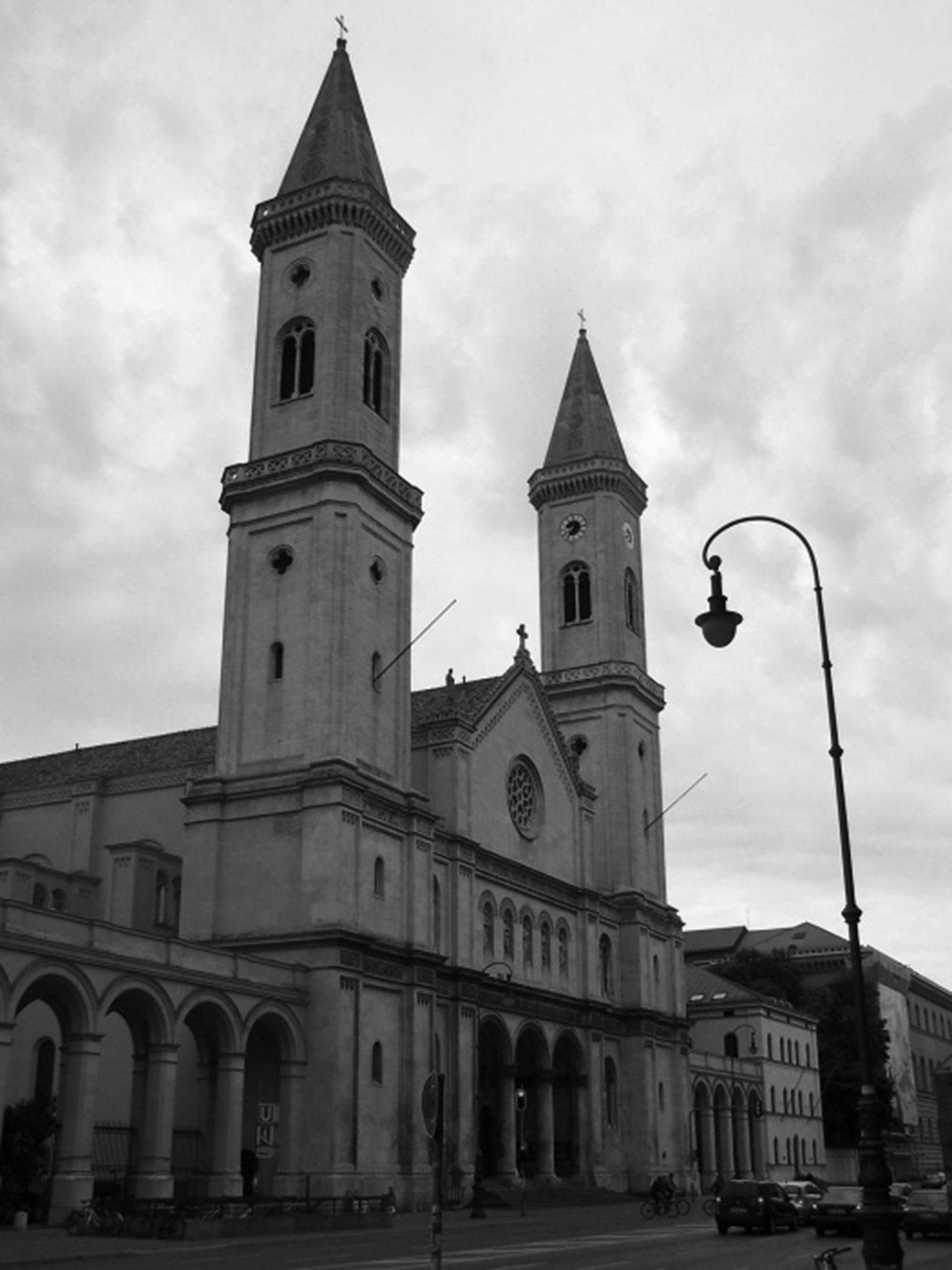
The influential Swiss art and cultural historian Jacob Burckhardt provides a second example of criticism from abroad. Burckhardt shared Ludwig's passion for classical Greece and the Italian Renaissance, but found many of Ludwig's projects repugnant. In an 1877 letter, Burckhardt described the Ludwig Church to be “of such pathetic wretchedness that one can only argue about whether the exterior or interior is worse” (see Fig. 8). In summary, Burckhardt found Ludwig's new Munich “so dull and weak that one becomes ‘relatively sick.’”Footnote 111 Yet, Burckhardt readily admitted that local opinion differed from his assessment. In fact, he quoted a fellow traveler as follows: “In Munich now they don't want to hear anything about him [Ludwig] than that which serves his glory.”Footnote 112
Some decried Ludwig's historicized buildings, including the Ludwig Church (pictured here), as “pathetic wretchedness,” but public attitudes toward Ludwig and his building program became increasingly celebratory during the late nineteenth-century. Photo by author.
Despite such criticisms from professionals abroad, most academic and popular interpretations of Ludwig's building program would later be dominated by the general rehabilitation of Ludwig's legacy then under way in Bavaria. Sepp's work established at least two major themes that resurfaced in most subsequent writings about Ludwig. First, Sepp—like previous supporters keen to point out that Ludwig had financed projects from his private funds—gave Ludwig personal credit for providing all the resources for Munich's transformation. He provided detailed descriptions of Ludwig's buildings and then listed Ludwig's expenditures for each one.Footnote 113 Later writers repeated these themes. Historian Georg Jacob Wolf, for example, praised Ludwig unconditionally for having financed “a golden age of the arts.” Wolf explained that although “unusual sums were put into buildings, given conditions at that time, most of it flowed from Ludwig's private coffers.”Footnote 114 In 1936, Eugen Franz reaffirmed that Ludwig had financed most of his projects himself.Footnote 115 After World War II, historian Benno Hubensteiner not only heaped high praise on Ludwig's streets and squares, but also again raised the financial aspect, noting that the king himself had “alone spent 18 million Gulden for the arts from his private wealth.”Footnote 116
The second theme that Sepp established was a willingness to separate Ludwig's political activities as king from his patronage of the arts and architecture. In reality, the finances were so entangled that any spending decision on patronage was intrinsically tied to decisions on public policy and services. More to the point, Ludwig clearly saw his building program as a mechanism to achieve political objectives: the act of building a new capital was an act of kingship and an expression of political authority. Yet, most writers later accepted Ludwig's building program as a purely cultural undertaking. Ignoring the political component driving Ludwig's architectural program, Norbert Lieb saw Ludwig as “one of the greatest, if not the greatest, initiator of art of the nineteenth century,” while David Watkin and Tilman Mellinghoff contended that “the ideas of Ludwig … were cultural and religious rather than political.”Footnote 117 Historian Heinz Gollwitzer, author of the most comprehensive biography about Ludwig, coined the term art-kingship, which misleadingly divorced Ludwig's cultural activities from politics and government. Gollwitzer relegated Ludwig's activities as an “art-king” to a separate section at the end of the book, and he concluded that Ludwig's art and architecture program may have been counterproductive, but it was a “productive mistake! What an overall achievement! It is without comparison in Germany and Europe in the age of Ludwig I.”Footnote 118
Conclusion
Even before becoming king, Ludwig had already been imagining an ambitious building program to create a new Munich framed around grand boulevards, monumental structures, and historicized spaces. Yet, Ludwig's motivations for constructing these museums, galleries, and monuments went beyond the mere edification of his subjects. Growing demands for national unity and popular political participation made Ludwig and other nineteenth-century monarchs “increasingly determined to construct an effective public image of majesty, power, and stability of monarchy, and of mutuality of affection (and obligation) between caring ruler and devoted subjects.”Footnote 119 Ludwig's new Munich was to be an aesthetic expression of historical legitimacy, political authority, and royal prerogative. In a broader context, though, his reign was defensive: Ludwig's vehement assertions of royal authority masked the very real and steady decline in monarchical power, as Bavaria and most of Europe transitioned from absolutism toward popular sovereignty. Ludwig nevertheless largely succeeded in transforming a significant portion of Munich into a symbolic testament to his kingly authority and his artistic ideals, but the material costs of this expansive building program alienated many of his subjects and their elected representatives. The program ultimately undermined his reign. In this sense, Ludwig succeeded in constructing symbolic spaces and places to reify his rule, but the project failed to achieve its immediate goal because much of the public read a different message.
Ludwig's building program was unable to generate popular political support during his reign, but it did provide the foundation for a general rehabilitation of Ludwig's public image after his abdication—and especially after his death. The reasons for this shift in public opinion in the late nineteenth century are surely complex. The sheer passage of time had a major impact, as the disputes of Ludwig's reign passed from collective memory. Ludwig likely benefitted from his long life after abdication, which was longer than his actual reign. The financial burden of his projects also evolved over time. Whereas earlier taxpayers had to bear upfront the burden of Ludwig's building program and the consequent decline in public services, later residents increasingly reaped the rewards of a growing tourist industry—without bearing the initial costs. All in all, it seems likely that, by the turn of the twentieth century, Ludwig's new Munich had contributed favorably to the local economy.
The shifting political landscape, especially German unification, played a role as well. The focus of political energies quickly shifted to Berlin, while the series of ineffectual and mentally unstable monarchs who succeeded Maximilian II ensured that the Bavarian monarchy would drift into relative irrelevance. Ludwig's assertions of monarchical power seemed distant and quaint in this new political context. At the same time, Ludwig provided a ready source of materials for politicians, historians, and others seeking to further notions of Bavarian particularism in the face of Prussian ascendency. Ludwig II (1845–1886; r. 1864–1886) may have also helped contribute to his grandfather's rehabilitation. Both men embarked on ambitious building programs, but the younger Ludwig generally built pleasure palaces for his personal enjoyment in relatively remote locations, most notably the Neuschwanstein castle. In contrast, the elder Ludwig had expressly intended his buildings to be easily accessible to the local population, as well as to visitors. This distinction mattered little, however, as public veneration of Ludwig II—both in Bavaria and around the world—quickly surpassed that of his grandfather. It is ironic that Ludwig II, the “fairy tale king,” achieved—by incurring reckless debt for the construction of personal pleasure palaces—the type of fame and adoration that Ludwig I had tirelessly sought by building a new Munich of public museums, monuments, and spaces.