Background
In 2019, more than one million licensed Emergency Medical Services (EMS) clinicians in the United States (US) were working for more than 23,000 state-licensed organizations. 1 In Ohio, almost 41,000 EMS clinicians holding active EMS certification 2 were working for more than 1,500 organizations. 3 The rate of occupational injuries/illnesses among EMS clinicians is consistently higher than the average rate for workers in all occupations, whether looking at emergency department (ED)-treated injuries, Reference Reichard, Marsh, Tonozzi, Konda and Gormley4 injuries requiring one or more days away from work, Reference Maguire and Smith5 or injuries covered by workers’ compensation (WC). Reference Reichard, Al-Tarawneh and Konda6 Each of these data sources indicates that sprains or strains, most often to the back, are the leading diagnoses. Back sprains and strains are often linked to over-exertion and bodily motion that occurs while handling patients, equipment, or both. Notably, almost one-half of EMS clinicians whose ED-treated injuries resulted from over-exertion and bodily motion while lifting patients, equipment, or both described the patients as being heavy, overweight, or obese. Reference Reichard, Marsh, Tonozzi, Konda and Gormley4
The total annual WC claim rate among private EMS clinicians in Ohio from 2001 through 2011 was 1.7- to three-times higher than the total annual claim rate for all private industries. Reference Reichard, Al-Tarawneh and Konda6 Around one-half of all Ohio WC claims by private organizations were due to over-exertion injuries from handling patients, equipment, or both.
Universally, EMS clinicians use a variety of patient-handling equipment to lift, move, and transport patients, including powered cots, loading systems, and stair chairs. This equipment can reduce the potential for EMS clinician injuries. However, the type of equipment available and the related ergonomic features can depend on an organization’s financial resources. The use of powered cots reduces injuries, Reference Armstrong, Ferron, Taylor, McLeod, Fletcher, MacPhee and Fischer7,Reference Studnek, Crawford and Fernandez8 but their design and weight are restrictive in some environments. Their costs can be several times those of a manual cot. Loading systems facilitate loading and unloading patients into an ambulance but require varying degrees of exertion and can increase the time required to load and unload. Reference Cooper and Ghassemieh9,Reference Jones and Hignett10 In comparison to using a cot or a backboard, stair chairs have the least biomechanical strain on the EMS clinician when transporting a patient downstairs. Reference Lavender, Conrad, Reichelt, Johnson and Meyer11 Stair chairs with track systems reduce the spinal loading of EMS clinicians compared to manual stair chairs, Reference Fredericks, Butt, Kumar and Amin12,Reference Mehta, Lavender, Hedman, Reichelt, Park and Conrad13 but there are no published studies comparing powered to manual stair chairs.
To encourage organizations to adopt equipment that improves workplace safety, the Ohio Bureau of Workers’ Compensation (OHBWC; Columbus, Ohio USA) has administered a Safety Intervention Grant (SIG) program since 1999. This program has provided Ohio state-funded employers with matching funds up to $40,000 for each eligible cycle year. 14 Participation in the SIG program requires the organization to complete an application and complete a follow-up report after implementing their purchased equipment. This documentation provides a unique opportunity to analyze aggregate data rather than relying on single case studies of equipment adoption. Previous studies analyzed these data to ascertain the program effectiveness Reference Wurzelbacher, Bertke and Lampl15 and evaluate equipment purchases in the construction industry, Reference Lowe, Albers, Hayden, Lampl, Naber and Wurzelbacher16 health care facilities, Reference Park, Bushnell, Bailer, Collins and Stayner17,Reference Fujishiro, Weaver, Heaney, Hamrick and Marras18 material-handling operations, Reference Wurzelbacher, Lampl, Bertke and Tseng19 and manufacturing. Reference Lowe, Hayden, Albers and Naber20
From 2013-2015, 22% of all OHBWC funds were used to purchase EMS powered equipment for patient-handling. In 2016, this percentage rose to 50%. Due to this significant allocation of funds, OHBWC is interested in organizations’ experiences with powered equipment acquired through the SIG grant to better assess the outcomes (eg, injury, risk reduction, productivity) and update the types of equipment eligible through the SIG program. This review analyzed SIG data to describe how EMS powered equipment was acquired and evaluated and organizations’ experience and impressions of the equipment. The data were also used to understand organizations’ rationales for the equipment purchase, how equipment was implemented, and acceptance/rejection of the equipment by organizations and EMS clinicians.
Methods
Investigators applied a mixed-methods approach to analyze quantitative and qualitative OHBWC SIG data from public and private EMS organizations from 2005-2018. The data were obtained from OHBWC in 2019. This activity was reviewed by Centers for Disease Control and Prevention (CDC; Atlanta, Georgia USA), deemed not research, and was conducted consistent with applicable federal law and CDC policy (eg, 45 C.F.R. part 46.102(l)(2), 21 C.F.R. part 56; 42 U.S.C. §241(d); 5 U.S.C. §552a; 44 U.S.C. §3501 et seq).
Data Sources
Each grant file contained the organization’s original grant application (ie, pre-intervention) and one or two follow-up reports (ie, post-intervention) that were submitted one or two years following the implementation of the equipment. The OHBWC also provided a database of quantitative assessments of musculoskeletal-disorder (MSD) risk factors associated with the patient-handling tasks before and after implementation of the equipment. These MSD risk factors were assessed by an OHBWC consultant like a previously published assessment. Reference Schneider21 This assessment provided risk-factor scores for the back/legs and for the upper extremities accounting for posture, gripping/pinching, and hand/arm intensive work.
Selection of Grantees
The database of SIG awardees was searched to identify grants where the occupation was EMS and the purchased intervention was powered equipment. To identify the EMS occupation, a search for classifications in private and public sectors likely to encompass the provision of EMS was performed. 22 Intervention keywords were: cot, patient, chair, ambulance, bariatric, Stryker, Ferno, pro load, stretcher, power load, powered load, and stair climber. There were 566 grants within the designated occupational classifications that included one of the intervention keywords. After manual review, 245 grants were excluded because the grant information was incomplete, out of scope, or in progress as of 2019. Another 24 grants were excluded because the purchases were exclusively manual equipment or pneumatic lifts. The final quantitative dataset consisted of 297 grants. One hundred thirty-one (131) grants were for a single type of powered equipment, and 166 grants were for multiple types of equipment, some including both powered and manual equipment. Qualitative analysis was restricted to SIGs before 2014 (n = 176) because they provided more detail than those after 2014. Grants that purchased only powered stair chairs were excluded in the qualitative sample due to small numbers (n = 7). To represent the geographic variability across Ohio, the sample was randomly selected within rural and urban counties according to the Rural-Urban Continuum Code (RUCC). 23 The sample included grants awarded in 29 rural and 35 urban Ohio counties.
Quantitative Data
The investigators used a Structured Query Language database to capture key quantitative data elements that were identified from the literature Reference Armstrong, Ferron, Taylor, McLeod, Fletcher, MacPhee and Fischer7,Reference Cooper and Ghassemieh9,Reference Mehta, Lavender, Hedman, Reichelt, Park and Conrad13,Reference Sommerich, Lavender, Radin Umar, Li, Park and Dutt24–Reference Tycho26 and discussions with subject-matter experts. Organizational characteristics - population and geographic area served, type of organization (ie, fire, public, or private), highest level of EMS licensure, and career/volunteer/combination makeup of the organization - were abstracted from each grant application and from the publicly-available Ohio EMS Incident Reporting System. 27 Equipment purchase costs were obtained from the grant application budgets and adjusted to 2018 US dollars (USD). 28 Investigators abstracted the number and type of injury claims within a two-year baseline period before implementation. Post-intervention reports were either after one year (n = 281), two years (n = 9), or both one and two years (n = 7). Data were abstracted from the second-year report if reports were submitted both years.
Qualitative Data
NVivo 12 Pro 29 (Lumivero; Denver, Colorado, USA) was used to code narrative text and capture the EMS clinician and organization experiences, although these perspectives were not consistently included in the grant documentation. Initial qualitative analysis involved three analysts reviewing five grant experiences (pre-intervention and post-intervention) to code narrative text into five broad themes related to training, EMS clinician acceptance, equipment design, patient care quality, and productivity effects. To assess coding consistency and refine themes, 30 additional grants were randomly chosen and coded by two of the three analysts. A coding matrix was generated to highlight areas of agreement and discordance and refine the descriptive themes. A codebook was developed to define each theme. The sample size was deemed sufficient as data saturation (redundancy in the themes) was observed upon completion of abstraction.
Results
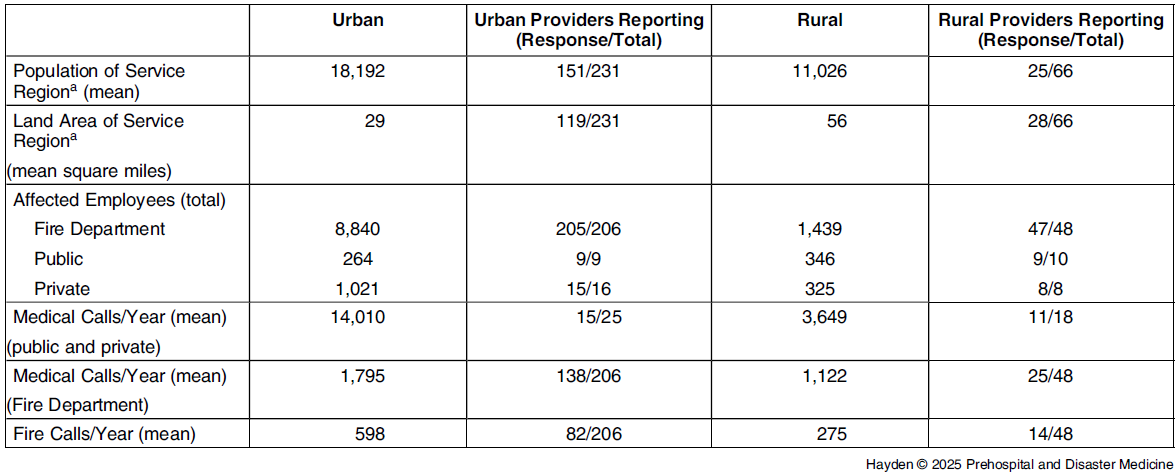
Grants were awarded to fire departments (n = 254) and public (n = 19) and private (n = 24) EMS organizations (Table 1). The majority were within an urban area (78%). Organizations were career (45%), volunteer (20%), and combined career and volunteer (35%). For most organizations, the highest licensure level was paramedic (81%), and for 17%, it was unknown.
Providers’ Response to Urban versus Rural Population and Region Served

a Not a required field in grant application/reporting.
Equipment
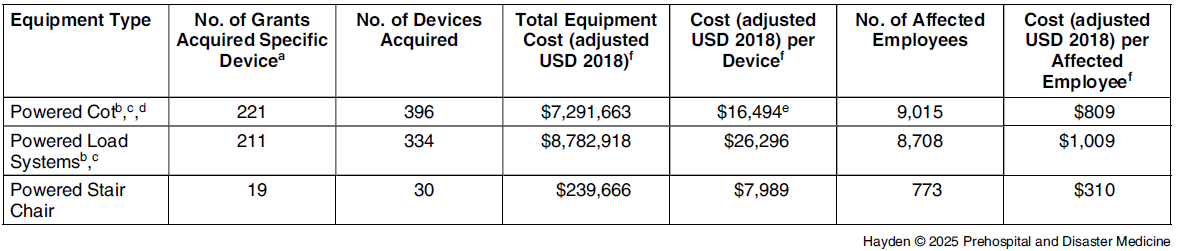
Fire departments accounted for 84% of the 297 SIG total costs, and public and private organizations accounted for the remaining 16%. The OHBWC contributed $10,485,480 adjusted 2018 USD, and the total spent by both OHBWC and organizations combined was $16,674,132 (n = 296 budget sheets available). These totals represent all equipment purchased by organizations through these grants, some which included manual patient-handling equipment or equipment unrelated to patient handling. Some grant costs included accessories or bundled prices with installation, training, or maintenance. The median total equipment cost per grant was $52,983 (range: $6,348-$221,239). One hundred thirteen grants (113; 38%) received the OHBWC maximum $40,000 contribution. Powered loading systems accounted for 54% of total cost for powered equipment ($16,314,247), powered cots 45%, and powered stair chairs one percent (Table 2).
Summary of Purchased Equipment and Adjusted USD 2018 Cost per Device and Affected Employee

Abbreviation: USD, United States Dollar.
a The column “number of grants acquired specific device” does not total to 297 grants. This is because 141 providers purchased powered cots and loading systems. If a provider purchased only one type of device but included different brands then the grant would only be counted once (eg, Stryker powered cot and Ferno powered cot).
b One grant that purchased the powered cot and loading system is missing data for the following columns: number of devices acquired, and total equipment cost, so it is excluded in the calculation for mean of cost per device.
c Calculation for cost per affected employee excluded grants missing cost or affected employee information.
d Grant missing count of affected employees.
e Excludes cost and devices of 31 cots that were considered as outliers.
f Excludes discount for equipment because the vendor discount was applied to the total and not towards each type of equipment.
Injuries and Risk Factors
Claims and Injuries—Almost one-half of organizations (43%) reported at least one WC claim within the two years before their grant application (baseline period) for a total of 450 claims. Of these, 206 claims were determined to be related to patient handling, indicating the acquired powered equipment may have prevented the injury; 74 had no description to determine relevancy to that injury prevention; and 170 were not related to the powered equipment requested or were outside the two-year baseline period for that grant. The 206 related claims were from 84 grants. They were primarily sprain or strain injuries (74%) with the highest proportion occurring to the back.
There were 12 WC claims reported within the post-intervention reports. Only one was possibly related to patient handling and the purchased equipment, but it was unclear if the new powered equipment played a role in that injury.
Risk Assessment
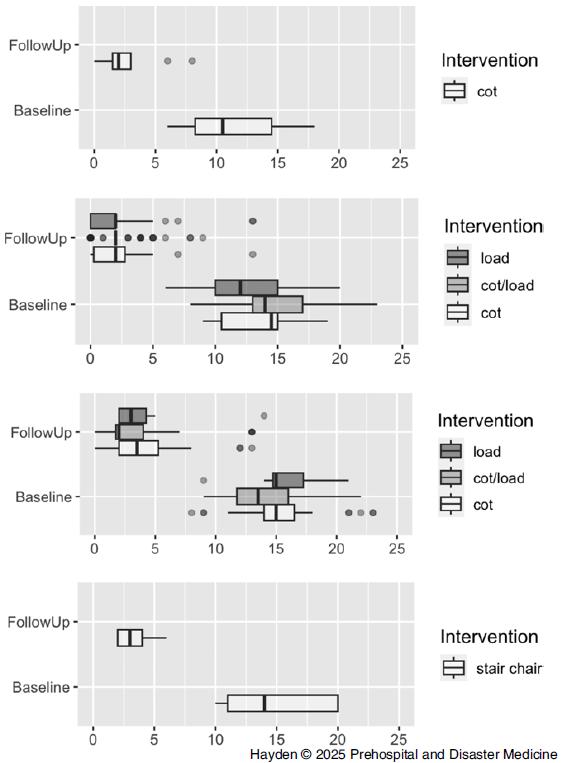
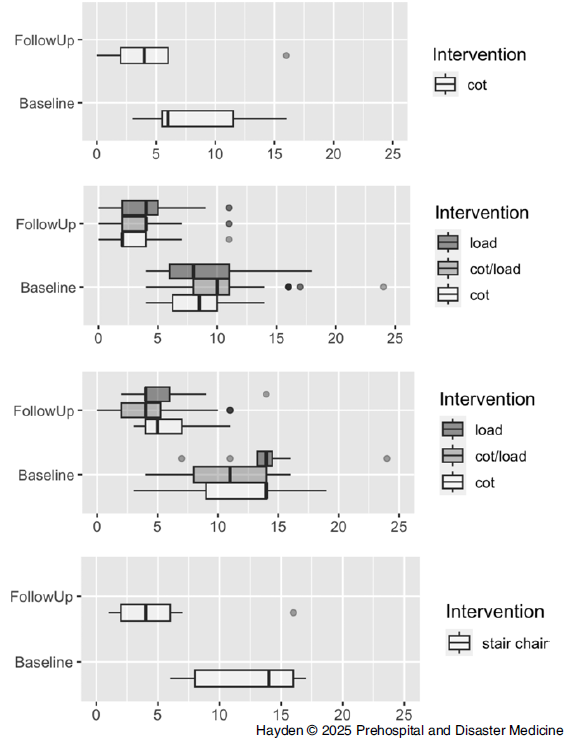
There were 198 completed MSD risk assessments of job tasks related to the powered equipment. These were analyzed by job task and equipment classification. The job tasks were: (1) lifting only, (2) ambulance loading only, (3) lifting and loading, and (4) stair navigation.
Boxplots of pre- (baseline) and post- (follow up) intervention MSD risk factor scores are shown in Figure 1 and Figure 2. All types of powered equipment reduced the risk scores, but the greatest reduction was in the back and leg scores. This corresponds to the reduction in manual forces required when powered equipment is used. As expected, the lifting task of raising the cot with patients from the floor to the transport height was associated with a near elimination of risk factors for the back and legs.
Pre- and Post-Intervention Back and Legs CTD Assessment Scores for Job Tasks: (1) Lifting Only; (2) Ambulance Loading Only; (3) Lifting and Loading; and (4) Stair Navigation.
Note: Stair chair use was specific to the stair navigation task. Tasks describing general patient transportation were assigned to lifting and loading.
Abbreviation: CTD, Cumulative Trauma Disorder.

Pre- and Post-Intervention Upper Extremity CTD Assessment Scores for Job Tasks: (1) Lifting Only; (2) Ambulance Loading Only; (3) Lifting and Loading; and (4) Stair Navigation.
Abbreviation: CTD, Cumulative Trauma Disorder.

Risk Factor Descriptions
Organization-reported pre-intervention risk factors were related to physical patient-handling processes, EMS clinician demographics, patient characteristics, environmental factors, and staffing. The most mentioned physical risks involved loading and moving patients for transport in an ambulance, which involves awkward body positioning, manual force, bending, reaching, and twisting. Shifts in weight distribution from one EMS clinician to another during patient handling were also identified, with increased EMS clinician support required when the cot legs were collapsed during the loading and unloading of manual cots from the ambulance. Organizations emphasized that physical risks were experienced multiple times every work shift.
Some organizations noted that EMS clinician demographics such as age, sex, and height could increase injury risk. Specific to aging, one organization noted “Many of our crew members are aging rapidly, but need to stay active due to our increased turnover rate.” Related to sex and height, they noted predominantly female workforces and short statures. Multiple organizations identified that they regularly transport overweight and bariatric patients who pose additional risks because of the force required to move them and impacts on the stability of the equipment.
Organizations reported risks from environmental factors such as multi-story buildings with no elevators, responses along highways, uneven surfaces, and ice and snow. Several organizations noted that limited staffing can result in available staff lifting more weight than they should.
Organization-reported risks were reduced post-intervention due to the elimination of lifting, bending, twisting, squatting, or awkward body postures. Several organizations reported that EMS clinicians experienced less soreness and pain after their shift. Many reported no related injuries with the powered equipment. One organization noted the reduced physical strain allowed retention of “…two elderly EMS that we[re] contemplating retirement due to the fact of the strain [from lifting and loading].” Some organizations reported lost work time was reduced or eliminated. An unexpected benefit of the powered loading system noted by two organizations was increased safety while working in traffic. One organization reported EMS clinicians were “able to be more aware of traffic issues, thus reducing any chances of being injured by passing traffic.”
A few organizations reported the increased weight of the powered cot. One organization noted “An additional 40 pounds of weight makes carrying the cot up or down stairs slightly more difficult. Crews are still encouraged to utilize stair chairs for this task to reduce the risk of injury.”
Equipment Adoption
EMS Clinicians Input and Acceptance—Although it was not requested information, six percent of organizations reported that EMS clinicians were involved in selecting the purchased equipment. Before purchasing the equipment, a few organizations noted an effort to raise awareness through on-site equipment vendor demonstrations or visits to other organizations using the equipment.
After implementation of the purchased equipment, 215 organizations documented feedback from EMS clinicians. Most feedback was positive. None of the reports indicated outright rejection of the new equipment or discontinuation of use.
Positive comments from EMS clinicians were related to increased safety from less lifting, improved work efficiency, and ease of use. One clinician reported, “I can simply press the button and regardless of the size of the patient, the cot lifts to whichever level I need it to … I have seen a big difference in the amount of effort need to transfer patients from their home or business on our cots into our ambulances.” Negative feedback included concerns related to lifting the cot in manual mode due to power issues, moving the cot over rough terrain or slopes, multiple pinch points, and cot weight.
Training
Most organizations (97%) indicated plans for training on the equipment, and more than one-half (54%) indicated in their post-intervention report that training was completed. Most organizations planned to train all EMS clinicians within one month, which frequently involved the manufacturer providing initial group training on-site. One organization indicated that training would include mutual aid departments. A few organizations indicated plans for refresher training or training for incoming staff.
Intervention Equipment Design Advantages/Disadvantages
Advantages described for powered cots were the hydraulic feature used to lift the cot to waist height and increased stability and weight capacity. Less frequently mentioned advantages were adjustments to cot length to maneuver in tight areas and automatic opening and locking of the cot legs when unloading from the ambulance.
Due to the additional weight of the powered cots, a few organizations prohibited powered cots when transporting patients on stairs, recommending stair chairs instead. One organization noted a weak connectivity charging and duration of the battery, which required them to manually navigate the powered cot on a response.
Powered loading system designs were identified as advantageous because loading and unloading was accomplished with a single button and the cot was supported while the wheels were not on the ground. The locking mechanism to hold the cot in place during transport was an advantage compared to older equipment that was “…secured in the ambulance by a single pin that is ‘clamped’ into an associated bracket. In the event of an accident, the impact could cause the cot to come loose and in turn injure the EMTs [emergency medical technicians] in the back of the squad.” However, a conversion kit must be installed to use this mechanism with older cots. One organization reported a learning curve to use the loading system because the track can catch onto things (eg, extra length of cot straps, oxygen straps hanging down).
Quality and Production Themes
Around one-half of organizations (51%) described an impact on quality of care and patient safety, and 65% described an impact on productivity. Organizations noted increased stability when transporting patients and fewer dropped patients. In addition, patient feedback indicated that patients felt more secure. One organization noted improved quality of care “… [EMS clinicians] can observe the patient and monitor conditions instead of bending down to lift cot legs [and concentrating] on lifting and maneuvering the cot while trying to administer care.” Before purchasing powered equipment, some EMS clinicians had to wait for additional assistance before transporting patients because they were unable to lift them, which could negatively impact the patient’s dignity.
Data related to productivity were limited, appearing in only a small number of reports. There were some discrepancies between the organizations’ productivity experiences regarding time spent on-scene. Some organizations noted a decrease in time on-scene meant they no longer had to wait for additional EMS clinicians to arrive to provide lifting assistance. For example, before purchasing equipment, “when [EMS clinicians] encounter obese patients, we depend on our fire division or mutual aid with area departments … causes additional time on scene and takes multiple units and organizations out of service.” After implementing the new equipment, they reported “… increased timely services, increased longevity of equipment due to fewer miles traveled by extra [EMS clinicians], and reduced potential of uncovered shifts, which has benefited the patients in the district we serve.” Another organization reported increased time to activate the powered cot and loading system when loading the ambulance, but it is “worth the time to reduce aches and pains from lifting.” A few organizations reported no difference with overall time spent on-scene.
Injury Impacts on Staffing and Cost
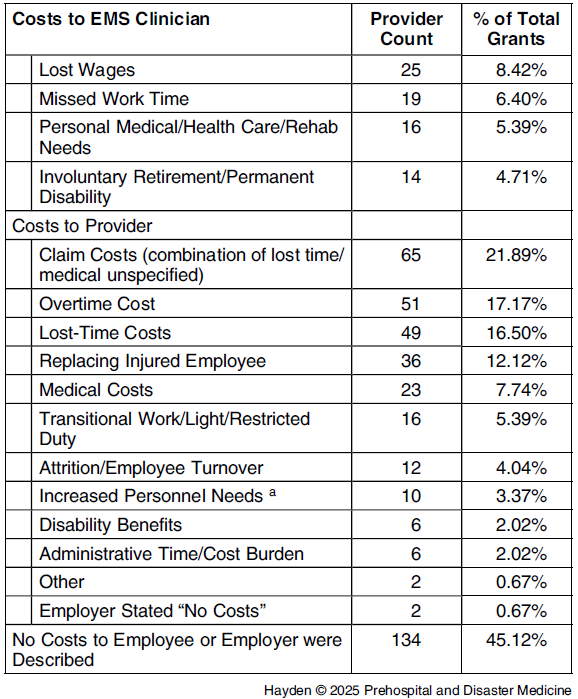
Organizations reported various workforce and financial impacts related to EMS clinician injuries (Table 3). Injuries can require EMS clinicians to take time off from work, which has costs to EMS clinicians and their organizations. Organizational costs include being short-staffed, paying other EMS clinicians overtime to provide coverage, and paying for salary continuation during time away from work. Other injury impacts included increased worker turnover and workers’ transition to early retirement or disability.
Pre-Intervention Monetary Impact to EMS Clinicians and Provider

Note: Multiple choice selection – totals do not sum to 297 between monetary cost to employer and employee.
Abbreviation: EMS, Emergency Medical Services.
a Example is “pulling police from assignments to assist with lifting.”
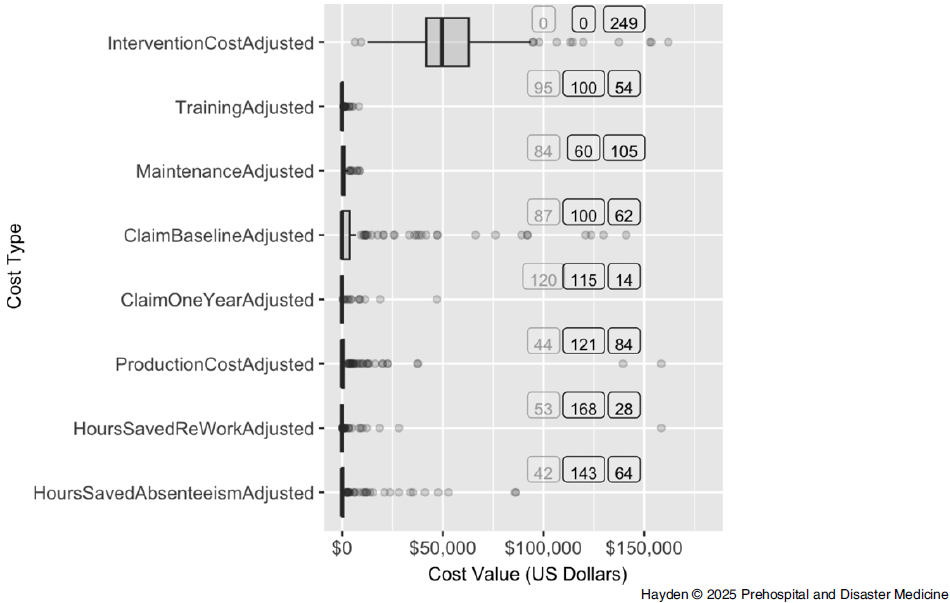
Organization entries into a standardized cost benefit analysis (CBA) form in the post-intervention reports are summarized in a box/whisker plot (Figure 3). There were 249 grants included in these plots after excluding SIGs due to missing CBA forms (28 SIGs) or a clearly incorrect entry of the basic equipment purchase cost (20 SIGs). For example, several organizations erroneously only included their organization costs in the CBA. Training costs and maintenance/other costs were low and often not documented (blank entry) or entered as zero cost.
Box Plot of Cost Benefit Analysis (CBA).
Note: Excludes grants if missing the CBA form or the cost of the intervention was not filled in or filled in erroneously on the CBA form. A CBA cannot be valid if it does not include the purchase cost of the equipment. Numerals in boxes indicate the count of blank entries; entries of zero; and entries when greater than zero.
Abbreviation: CBA, cost benefit analysis.

Discussion
This review used a novel approach to ascertain insight into the implementation of powered equipment and its outcomes related to worker safety and injury prevention. Organizations are concerned about EMS clinicians leaving the profession or retiring early when faced with consistent physical workload demands that result in musculoskeletal pain and injuries. 2–Reference Reichard, Marsh, Tonozzi, Konda and Gormley4,Reference Crowe, Bower, Cash, Panchal, Rodriguez and Olivo-Marston30,Reference Rivard, Cash, Mercer, Chrzan and Panchal31 The workforce demand is increasing, 32 which supports the importance of preserving the current workforce by implementing interventions that reduce injuries and physical demands of the job. The use of powered patient-handling equipment appears to reduce injuries and may help maintain the workforce, but there is limited research evaluating this equipment in the field. Reference Du, Boileau, Wierts, Hignett, Fischer and Yazdani33 The present findings indicated use of the powered equipment was associated with lower ratings of MSD risk factors, and the equipment was well-received by organizations and EMS clinicians.
Organizations were motivated to purchase powered equipment to accommodate staff demographics (eg, physical stature, age) and limited staff resources. Shorter-stature EMS clinicians (ie, height less than 1.73 meters/5.7 feet) are more likely to raise their shoulders when lifting the cot to the ambulance, Reference Prairie, Plamondon, Larouche, Hegg-Deloye and Corbeil34 which may increase the likelihood of musculoskeletal injuries. A survey of EMS clinicians in the US reported a median age of 38 years for career and 41 years for volunteer clinicians, Reference Cash, Rivard, Chrzan, Mercer, Camargo and Panchal35 aligning with organization concerns for older EMS clinicians in the present findings. Organizations also struggled with limited number of staff available to respond to calls. 36
Another motivator was to accommodate the increased number of patients with obesity. The prevalence of adults with obesity in the US has increased from 30.5% in 1999 to 41% in 2020 and severe obesity from 4.7% to 9.2%, 37 which can increase injury risk to EMS clinicians during patient-handling activities. Another study found patients over 300 pounds led to increased time spent on scene. Reference Supples, Vaizer, Liao, Faris, O’Donnell and Glober38
The present findings indicated that powered equipment purchased through the OHBWC SIG program positively contributed to injury risk reduction in the one-to-two years following implementation, similar to laboratory biomechanical studies. Reference Sommerich, Lavender, Radin Umar, Li, Park and Dutt24 Other studies reported powered cots resulted in decreases in MSDs, Reference Armstrong, Ferron, Taylor, McLeod, Fletcher, MacPhee and Fischer7 total claim cost, and lost days. Reference Tycho26 However, not every EMS patient-handling task is amenable to use of a powered equipment, and other studies have reviewed tasks involving assisting patients in tight areas. Reference Xu, Lavender and Sommerich39,Reference Lavender, Sommerich and Bigelow40
Powered cots weigh over 25kg/55lbs more than manual cots, which may increase forces on the hands and lower back. Reference Armstrong, Ferron, Taylor, McLeod, Fletcher, MacPhee and Fischer7 Slightly higher hand force is required, and cumulative lumbar compression forces are experienced during loading and unloading an empty powered cot without a loading system. Reference Potvin and Potvin41 The combined benefits of powered cots and powered loading systems may compensate for the increased weight of the powered cot for loading and unloading tasks. Reference Potvin and Potvin41,Reference Lad, Oomen, Callaghan and Fischer42 The OHBWC updated their guidance for purchasing powered cots in 2015 to require including a powered loading system to reduce injury risk.
Positive feedback from EMS organizations was similar to SIG equipment reviews in construction trades and manufacturing automation. Reference Lowe, Albers, Hayden, Lampl, Naber and Wurzelbacher16,Reference Lowe, Hayden, Albers and Naber20 The steps that many organizations took to ensure EMS clinicians were trained on the new equipment or involvement in equipment selection may have helped. There may also be some positive response bias from grantees because the SIG program allowed them to purchase the equipment, and they may wish to apply again. The limited negative feedback included an increased learning curve for operating the powered loading system and one specific cot model. Lad, et al Reference Lad, Oomen, Callaghan and Fischer42 found similar feedback with increased cognitive demand for a specific cot model.
Limitations
Over time, the SIG program experienced administrative changes in 2007 to clarify reported baseline claims, 14 and in 2009, removed the requirement for a recent related compensable claim. Reference Lowe, Albers, Hayden, Lampl, Naber and Wurzelbacher16,Reference Lowe, Hayden, Albers and Naber20 Removing the claim requirement allowed more organizations to apply.
The SIG documents varied in completeness and detail throughout the years. Qualitative analysis involved the original documentation (pre-2014) that relied primarily on open-ended fields with limited instructions. Because data of interest to this evaluation were often only in a portion of reports, findings likely represent a lower bound or under-estimate. While a reduced number of claims is indicative of positive outcomes from equipment use, reported claims were only assessed for a two-year timeframe and did not include a measure of severity.
The CBA entries for cost savings in production hours, rework hours, and absenteeism hours were difficult to interpret. Several outliers were noted, and these appear to be attributable to errors by the organizations either in the process of data entry or in reporting their specific costs/cost savings consistently with the OHBWC format. Volunteer organizations’ cost-savings estimates varied because they do not have an average employee wage, and it was unclear how they computed their estimates. The productivity and quality framework established by OHBWC are not clearly translatable in service-providing industries such as EMS, which resulted in many “not applicable” or blank responses.
The equipment was aggregated by type regardless of manufacturer. Differences in equipment pricing and service/accessory bundling, between and within manufacturers, made it difficult to compare adjusted costs in some grants.
While the SIG data provided a unique perspective on the purchase, implementation, and efficacy of powered equipment, data quality and utility could be improved. Employers may benefit from seeking additional assistance with OHBWC consultants when completing the forms. Insurance administering programs such as OHBWC should consider standardizing additional data elements to facilitate data analysis and comparison in specific areas of interest (eg, training, purchased equipment design advantages and disadvantages, future equipment needs).
Conclusions
Overall, this review indicated powered equipment appeared to reduce ergonomic risk factors, thus improving EMS clinician safety. Organizations were generally positive about use of the equipment and noted that the safety benefits outweighed the negative aspects of the equipment (eg, heavier cots). To address these downsides, organizations need to provide their EMS clinicians with guidance on how to maintain and use the powered equipment safely. In addition, it is recommended organizations include EMS clinicians in equipment selection to ensure the equipment meets their needs.
Acknowledgements
The authors acknowledge Steven Williams (NIOSH/DSR) for designing the SQL database platform, and the reviewers Daniel Patterson (University of Pittsburgh), Jennifer Marshall (NIST), Gam Wijeunge, and Dave Bryson (NHTSA) for feedback on the data extraction tool. This project was supported in part by an appointment to the Research Participation Program at the Centers for Disease Control and Prevention administered by the Oak Ridge Institute for Science and Education through an interagency agreement between the US Department of Energy and the Centers for Disease Control and Prevention.
Conflicts of interest/disclaimer
The authors declare no conflicts of interest. The findings and conclusions in this report are those of the authors and do not necessarily represent the official position of the National Institute for Occupational Safety and Health, Centers for Disease Control and Prevention, or the Ohio Bureau of Workers’ Compensation. Mention of any company or product does not constitute endorsement by the National Institute for Occupational Safety and Health, Centers for Disease Control and Prevention, or the Ohio Bureau of Workers’ Compensation.