Policy experimentation has long been central to China’s adaptive governance.Footnote 1 Yet its success depends on how local officials navigate relationships with superiors, peers and subordinates within the bureaucracy. This article examines the specific challenges posed by each of these relationships and identifies the conditions under which experiments succeed. Drawing on a detailed case study in Shanghai, we show that failure in any one of these areas can derail an experiment; success requires managing all three simultaneously. When formal power structures prove to be too rigid, informal interpersonal networks can enable local actors to overcome institutional obstacles.
Policy experiments by local governments in China navigate a complex bureaucratic landscape involving multiple levels of governance. These experiments face three distinct challenges, each tied to a specific level of bureaucratic interaction: higher-level authorities, peer institutions and subordinate entities. First, engaging higher-level authorities – those with superior bureaucratic rank, such as municipal or provincial leaders – requires capturing their attention, aligning the experiment with their priorities, securing their support during challenges and earning their approval during evaluation. Second, coordinating with peer institutions, which operate at the same bureaucratic level, for example other district agencies, involves fostering cooperation and preventing actions that could undermine the experiment. Third, ensuring effective implementation by subordinate entities, such as subdistrict offices or community committees under the district’s authority, demands clear communication of the experiment’s intent and robust execution at the grassroots level. Addressing these challenges is critical for the success of local policy experiments. Superiors, subordinates and peers consist of diverse institutions that seldom act cohesively, complicating the experiment initiator’s efforts to gain support from all three.
Overall, the initiators of local policy experiments need to address three challenges: the “agenda challenge” involving higher-level authorities, the “coordination challenge” involving peers, and the “implementation challenge” involving lower-level bureaucrats. These three challenges indicate that local government agencies are situated within a complex bureaucratic power network, and the process and results of the experiments need to be examined within this network.Footnote 2
This article seeks to address two key research questions. First, what kind of power networks are local governments’ policy experiments situated in? And second, how do local officials initiate and sustain an experiment when the inter-organizational power network hinders policy experimentation?
We find that any of the three challenges can serve as a veto condition for local government policy experiments and thus addressing all three is a necessary condition for success. Bureaucratic power networks operate at both organizational and individual levels, encompassing formal relations between departments as well as informal ties between key officials. The network within which policy initiators operate thus includes both inter-organizational and inter-official dimensions. Although all three types of relational challenges hold veto power, overcoming resistance from superiors typically comes first, followed by managing coordination with peers and then motivating subordinates. When formal inter-organizational networks prove to be too rigid, informal inter-official networks can provide the flexibility needed to navigate constraints. Ultimately, the ability of local initiators to construct supportive interpersonal networks is a critical factor shaping the trajectory of policy experiments.
To illustrate the effects of two power networks on policy experiments, we present a case study of the “police–business cooperation” (jingwu wuye liandong 警务物业联动) initiative aimed at promoting social stability in urban China. The research design involves trade-offs, however. Case studies are particularly adept at elucidating causal mechanisms, although their generalizability is frequently constrained. Given that our primary objective is to clarify the mechanisms through which power networks influence policy experimentation, we selected cases supported by the most robust longitudinal evidence and endeavoured to address any omitted variable bias by focusing on cases within the same subdistrict. This study is based on three years (2014–2017) of fieldwork as well as follow-up observations conducted in 20 residential communities in District B in Shanghai. Out of 1,030 residential communities in District B, we first selected 18 early adopters of “police–business cooperation” in the same subdistrict. After the experiment was rolled out across the district, we added two more communities to capture later-stage developments.
Our data collection relied on participant observation, semi-structured interviews and archival research. One of the authors established a close connection with the office of the committee on comprehensive management of public security (CMPS) in District B, the initiator of this experiment, gaining access to key decision-making processes. A full list of anonymized interviewees is provided in the Appendix. In addition, we analysed various archival materials, including relevant laws and regulations, policy memos, government documents, official investigation reports, statistical records and newspaper articles. These sources provided critical contextual insights into the policy experiment’s design, implementation and evolution over time.
Local Policy Experimentation in the Chinese Bureaucracy
The “local policy experiments” discussed in this article refer to experiments spontaneously initiated by local governments, rather than centrally selected pilot projects or the imitation of policies from other regions.Footnote 3 Specifically, this study examines the design, implementation and sustainability of local experiments in social governance innovation.
This article focuses on how power networks within the bureaucratic system influence policy design, implementation and continuation.Footnote 4 When addressing power networks, we believe it is fruitful to “disaggregate the state into different levels and branches of government.”Footnote 5 In China’s bureaucracy, initiators of local policy experiments have to navigate three key actors within power networks: superiors, peers and subordinates.
Drawing on existing literature, we examine how each of these actors influences local policy experiments. The most extensively studied aspect is how higher-level governments influence local policy experiments. China’s local policy experimentation is essentially a form of “experimentation under hierarchy,” where the primary political context for those initiating the experiments is a bureaucracy characterized by a hierarchical structure.Footnote 6 Through extensive surveys and field interviews with the 178 cases that won the “China local government innovation award” between 2000 and 2015, Yu Keping found that 97 per cent of respondents felt that higher-level support is “definitely important” for the sustainability of government innovation.Footnote 7 Similarly, according to a study by Yang Xuedong, two-thirds of local cadres believe that the key factor in successfully advancing government innovation lies in the support of higher-level leaders.Footnote 8
Higher-level authorities have a decisive influence on policy experiments in many ways. First, many local experimental zones or sites are chosen by higher-level governments.Footnote 9 Even spontaneous local experiments only gain legitimacy and feasibility with the approval of higher authorities. Second, in the Xi Jinping 习近平 era, where top-level design is prevalent, lower-level leaders are often pressured to find effective solutions, leading to “experimentation under pressure.”Footnote 10 Third, the final evaluation of experiments relies on higher authorities, whose judgement determines their legitimacy as regional or national policies.Footnote 11 Fourth, the political and legal risks encountered during the experiments typically require protection and support from higher-level authorities.Footnote 12 Finally, if leaders initiate experiments merely to send political signals, there is little incentive to earnestly implement and sustain them.Footnote 13
More research is needed to explore what actions initiators of experiments can take to gain the approval and support of higher-level authorities. Support from higher levels is not a given; sometimes it can be cultivated through the political dynamics of central and local elite interaction.Footnote 14 This article will demonstrate how local leaders create opportunities to insert policy experiments into the work agenda of higher-level leaders.
Peer institutions also play important roles in policy experimentation. In a “fragmented authoritarianism,” local policy experiments are usually initiated and led by a single government department, but the policy issues involve multiple departments.Footnote 15 Whether other relevant departments can cooperate with the experiment is crucial to its success or failure. Unfortunately, to our knowledge, very few studies have explored how relationships between departments at the same level affect the success or failure of these experiments. As one overview paper suggests, the “four patterns of experimental governance” in China (i.e. hierarchical experimentation, comparative trial, selective recognition and adaptive reconciliation) mainly involve vertical intergovernmental relations.Footnote 16 This article aims to address this gap by analysing the horizontal relationships between departments at the same level.
Lower-level government officials are a key agent in the implementation of policy experiments. The existing literature on policy implementation within China’s bureaucracy proposes numerous conceptualizations or models. These conceptualizations include – but are not limited to – selective policy implementation,Footnote 17 collusion among local governments,Footnote 18 policy adaptation,Footnote 19 campaign-style policy enforcement,Footnote 20 enthusiastic policy implementationFootnote 21 and performative governance.Footnote 22 While previous research emphasizes grassroots officials’ reactive responses to top-down constraints, this article highlights their proactive reshaping of policies to achieve desired outcomes. It also shows how initiators used campaigns and manuals to guide accurate understanding and implementation.
Overall, existing research has addressed superiors, subordinates and peers, particularly emphasizing superiors. However, these studies generally discuss the influence of these actors separately, without considering them within a unified power network. Although the “increasingly interactive nature of policy innovation” has been noted,Footnote 23 few studies explore the interaction between formal power networks among organizations and power networks among officials, and how this interaction affects policy experiments.
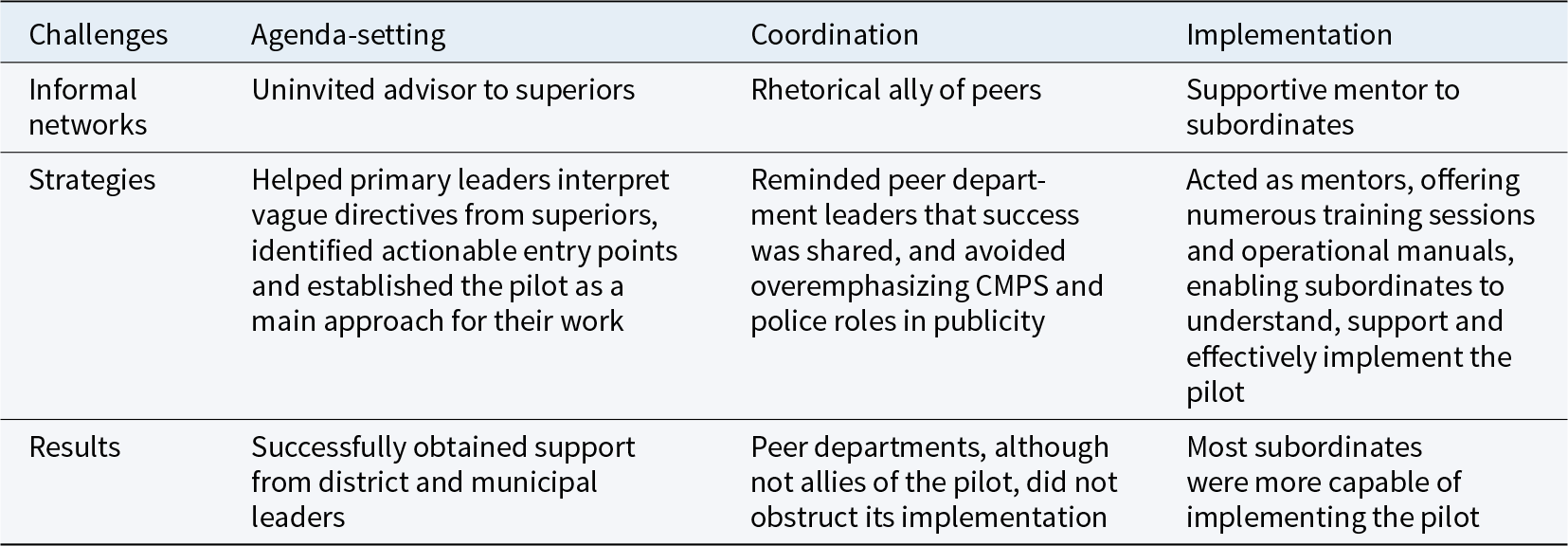
We argue that initiators can perform three strategic roles to forge informal networks that advance agenda-setting, coordination and implementation. First, as “uninvited advisors to superiors,” they assist key leaders in decoding vague directives, pinpointing practical starting points and embedding the pilot within their priorities. Second, as “rhetorical allies to peers,” they underscore collective success and highlight peers’ vital contributions in public narratives. Third, as “supportive mentors to subordinates,” they deliver robust training and detailed operational manuals, equipping subordinates with the skills to comprehend, endorse and execute the pilot effectively. Simultaneously nurturing these informal ties is critical to achieving success.
Below, we demonstrate our argument by analysing the emergence and decline of a local social control initiative in Shanghai, the “police–business cooperation” programme.
Experimenting with “Police–Business Cooperation” for Social Control
The so-called “police–business cooperation” initiative refers to a community security management experiment initiated by the CMPS in District B. Under the experiment, property management companies (PMCs) were mandated by the CMPS to ensure social stability in residential areas by increasing investments in public safety – for example, by hiring more security staff and upgrading facilities like surveillance cameras. It essentially leveraged business entities to maintain order, a role traditionally reserved for the state.
Why would local governments in China, despite the nation’s formidable coercive apparatus, enlist PMCs to uphold social stability? Our observations reveal several underlying motivations, including a desire to solve local governance problems,Footnote 24 individual career incentivesFootnote 25 and innovative personalities.Footnote 26 First, local states, faced with a shortage of formal coercive power such as policing, require assistance from social forces. District B, a population inflow hub for over 20 years, houses many relocated urbanites and migrants who vastly outnumber registered residents. This strains governmental social controls, as resources and personnel, which are allocated according to the number of permanent residents, fall short of rising demands, necessitating social forces’ involvement in management. Second, residential communities are the basic social units of cities, and their stability is the foundation of urban social stability. Research on urban social protests reveals that community governance has long been a focal point for triggering social conflicts.Footnote 27 The Chinese Communist Party (CCP) has always aimed to resolve grassroots conflicts before they escalate.Footnote 28 Third, PMCs are not only one of the main actors in community governance but are also one of the major parties involved in disputes with homeowners.Footnote 29 PMCs monitor urban residents’ daily activities and aid local authorities in managing community conflicts. Well-organized and resource-rich, they are valuable allies in the maintenance of social control. Beyond governance, municipal and district leaders endorsed this experiment to boost their career prospects. We also found that a division director in the CMPS office exhibited an innovative personality, which was characterized by a high degree of self-efficacy and a propensity for taking calculated risks.Footnote 30
How could coercive tasks be delegated to commercial entities? The CMPS leaders skilfully interpreted vague provisions in the 2003 “Regulations on realty management” and the 2009 “Regulations on the administration of security and guarding services” to impose new duties on PMCs in District B. They asserted that these regulations required the PMCs to support local authorities in preventing and mitigating disruptive behaviour in residential areas.Footnote 31 The next step was to translate general duties into specific responsibilities.
The CMPS delineated specific duties for PMCs aimed at containing collective actions. PMCs were required to increase their security personnel and enhance the qualifications of those personnel. They were urged to upgrade their security infrastructure by installing more surveillance cameras, fortifying the perimeters of residential communities, equipping guards with higher-quality communication devices, conducting more frequent and regular patrols, and extending the length of time that surveillance records were maintained.
As per the “Assessment guidelines for property management company security [enhancement and crime] prevention,” PMCs’ security duties were divided into three areas, which were assessed as part of their performance evaluation: security incidents (50 per cent of the overall performance score, based on 110 calls and preventable events), preventive measures (30 per cent, via personnel, materials and technology) and government-assigned tasks (20 per cent). Bonus points were awarded for enhancing security or crime prevention.Footnote 32
The CMPS ensured PMC compliance through coercive measures masked as “administrative guidance.” One key tactic was blacklisting non-compliant PMCs based on a four-tier public credit ranking system, which was based on their performance evaluation scores. Lower rankings risked contract termination or renewal issues, while refusal to aid police in stability maintenance led to blacklisting, barring the PMC from all District B contracts.
Second, to regulate the PMCs, local police empowered “owners’ assemblies” and “owners’ committees” (OCs). While every residential neighbourhood is legally required to establish an owners’ assembly to elect an OC, many communities struggle to do so. To address this, the CMPS, with township government support, helped neighbourhoods elect OCs, with the police on hand to ensure orderly elections. Newly elected OCs received government training to enhance their capabilities. Police also provided a legally vetted “model contract,” which outlined PMCs’ responsibilities, to help the OC leaders navigate potential challenges.
Third, the CMPS implemented regular inspections and tightened security personnel management. Community police conducted monthly checks on “stability maintenance” and publicly displayed the results. A 24-hour supervision system monitored property security, while police provided training for patrols, surveillance, suspect identification and on-site protection.
Fourth, each subdistrict or township established a collaborative platform led by the police station’s deputy director. Community police, PMC heads, residential committee chairs and security leaders joined a “Safe home project” WeChat group to share security updates and prevention measures.
Fifth, the CMPS introduced the evaluation and reward system, as described above, which was aimed at improving PMC security efforts. Property security performance accounted for 20 per cent in the district’s “Joint construction reward” system, with one town allocating 100,000 yuan in incentives, yielding positive social effects.Footnote 33
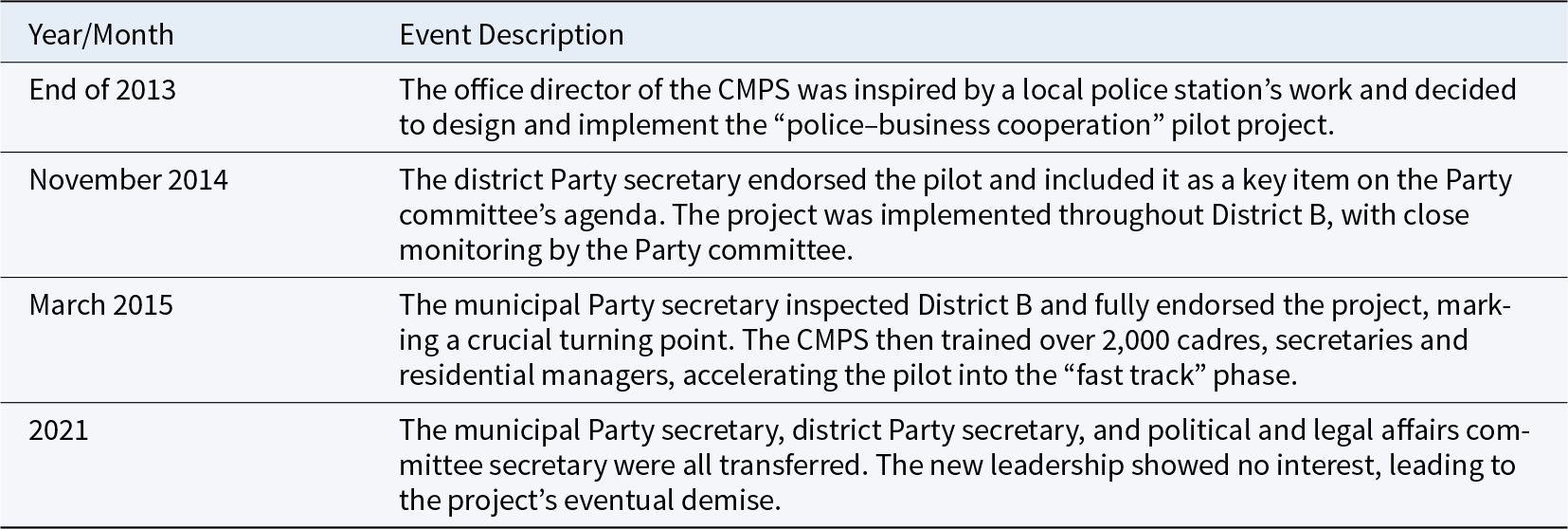
Table 1 presents the timeline of key events in the experiment.
Timeline of the Experiment

Source: Designed by the authors.
In 2015, the municipal Party committee fully endorsed the experiment, recognizing it as one of Shanghai’s “Top ten cases of innovative social governance and deepening public safety.” The municipal Party School recommended the city-wide adoption and promotion of this model in its internal special reports. This experiment also garnered extensive media coverage. For instance, the Legal Daily featured it as a lead story in 2017, and the Shanghai Legal News provided comprehensive coverage across its second and third pages. Numerous self-media platforms also reported extensively on the initiative.
The official report noted that the achievements in social control were significant and impressive. By the end of 2016, 80 per cent of residential communities in the district had established well-structured and effective organizational frameworks. Investment in the district’s “three defences” (anti-theft, fire prevention and public security) infrastructure rose to 126 million yuan in two years, over half of which came from resident-raised funds. The initiative led to the widespread installation and repair of surveillance cameras, anti-theft doors and electronic fences across residential communities. In addition, all property security personnel were equipped with GPS-enabled patrol coverage. Public security also improved significantly. In 2016, reports of burglary-related “110” emergency calls had decreased by 33.6 per cent compared to the previous year, and in the first quarter of 2017, they further declined by 49.1 per cent, the largest reduction in the city. The number of zero-crime communities in the district increased from 115 in 2015 to 347 in 2017, accounting for one-third of all communities in the district. And, in the 2016 city-wide safety perception survey, the ranking of residential communities significantly improved in terms of residents’ sense of security. Although causality is difficult to establish, these official reports indeed left a positive impression on higher-level leaders and motivated peers and subordinates.
Unfortunately, two key changes led to the decline of this experiment. Now, district leaders rarely mention it and no longer actively promote it. The first change was a significant shift in the opportunity structure. Facing economic downturn pressures, the newly appointed leadership of the municipal Party committee re-emphasized that subdistricts and township governments must focus on economic development and actively attract investment, rather than limit their roles to public services and social governance. This new incentive structure prompted grassroots officials to redirect most of their energy towards economic growth. The second change was in municipal and district leadership. Both the municipal Party secretary and the district Party secretary were replaced, and the new leaders brought with them different priorities and little enthusiasm for their predecessors’ initiatives.Footnote 34 The social governance focus of the the new municipal and district leadership shifted to grid-based governance, particularly further refining grids and integrating multiple grid systems to deliver public services and achieve social control more effectively. Compared to the policy experiment discussed in this article, urban grid-based governance is a more comprehensive system that mobilizes all resources within government-defined spatial units (or “grids”) to manage urban affairs.
In the following sections, we will use our analytical framework to explain the rise and fall of this pilot project, revealing the importance of two types of power networks in local policy experimentation.
Challenges from Inter-organizational Power Networks
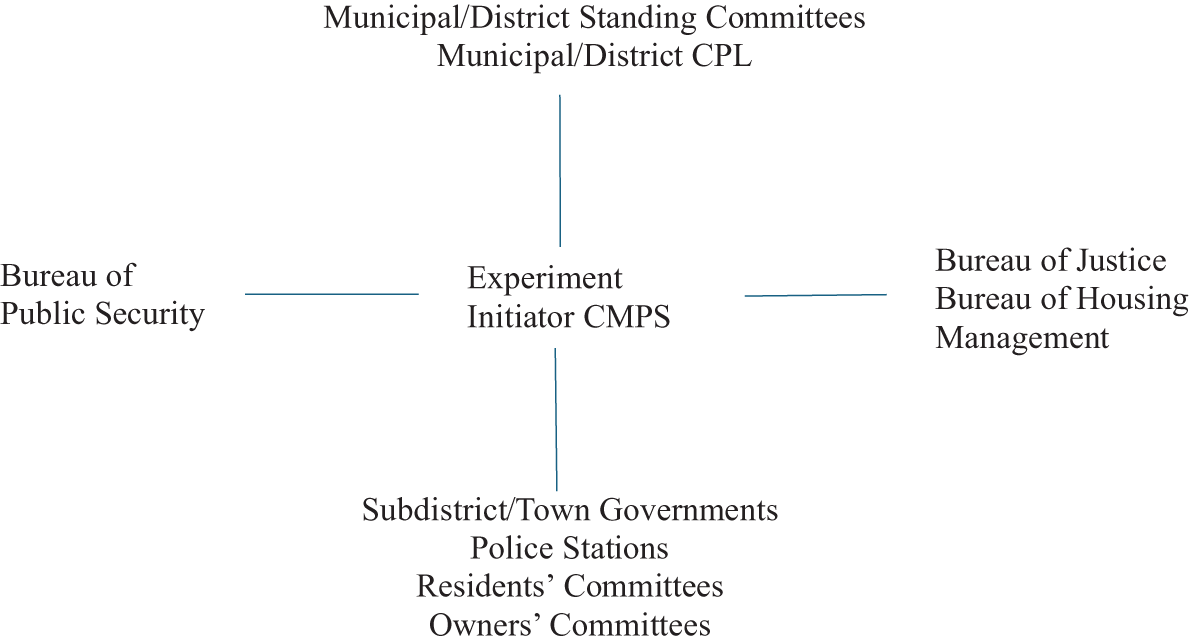
From beginning to end, the police–business cooperation initiative was embedded in a complex power network. Many departments were involved in the policy experiments discussed in this article. Figure 1 illustrates the inter-organizational power network in the design of the scheme.
Major Bureaucratic Players in the Experiment on Police–Business Cooperation

Here, the term “superiors” refers to the district committee for political and legal affairs (CPL), the district standing committee, the Shanghai municipal CPL and the CCP Shanghai municipal standing committee. These institutions all had veto power over the experiment, as its approval required step-by-step reporting up the hierarchy in a decision-making chain that offered multiple veto points to superiors from district leaders to municipal leaders.
As for “peers,” in District B, apart from the experiment’s initiator, the CMPS office, implementation of the experiment also required the cooperation of district-level agencies, including the bureau of public security (BPS), the bureau of housing management (BHM) and the bureau of justice (BOJ).
The “subordinates” comprised the Party committees and governments of subdistricts and towns, police stations, community Party committees, residents’ committees and homeowners’ committees. They had to implement the experiment on the ground.
Unfortunately, this inter-organizational power network proved to be an obstacle to the policy experiment, making it difficult for the initiators to resolve the “agenda,” “cooperation” and “implementation” challenges. The “agenda challenge,” which involved superiors, stemmed from three fundamental flaws in the Chinese bureaucracy. The first is the pervasive tendency among officials to avoid risks and dodge responsibility. The safest strategy is to follow superiors’ instructions and meet performance targets; policy innovation involves risks and offers little advantage for promotion.Footnote 35 In District B, several district leaders at the time believed that “since the CMPS is a comprehensive department, it should issue guiding opinions and push grassroots levels to figure things out on their own through assessments, rather than getting directly involved.”Footnote 36
The second flaw is that the agendas of standing committees – the highest decision-making body in local governments – are typically filled with countless projects.Footnote 37 Capturing the attention of leaders is often the biggest challenge for those driving innovation.Footnote 38 An official from the CMPS explained: “there are so many items that the standing committee needs to decide on during meetings, so it’s very difficult for a motion from our office to catch their attention.”Footnote 39
The third problem is the short-sighted behaviour of local officials. Institutional reforms usually take a long time to prove their effectiveness, and the short tenure of these leaders cannot wait that long.Footnote 40 An official from the CMPS claimed that “many police bureau leaders prefer to combat crime through campaigns because it’s easier to achieve results this way. Solving a few major cases and arresting some people can easily leave a good impression on their superiors, whereas institutional reforms do not yield such obvious results.”Footnote 41
The “cooperation challenge” arising from peer institutions is another fundamental bureaucratic issue. According to the fragmented authoritarianism framework, “policy made at the centre becomes increasingly malleable to the parochial organizational and political goals of various vertical agencies and spatial regions charged with enforcing that policy.”Footnote 42 In the police–business cooperation experiment, coordination challenges involved three peer departments: the BHM, the BOJ and the BPS. The BHM was expected to integrate the PMCs into its public security management, holding them accountable through district-wide evaluations. It strengthened the guidance for the PMCs and homeowner committees, improved professional knowledge and supported financially struggling communities by expanding financing options and bolstering fee collection. However, these expectations significantly increased the BHM’s workload and were unwelcome. The BHM and PMCs had interests in common, and both sides united in resisting the experiment. One deputy division director of the CMPS noted:
In our training sessions, we explained to the public that most property management companies are now profitable, deriving income from property management fees, shared public revenues and government subsidies. Yet, as soon as we dug into their financial records, we offended vested interests. The housing bureau launched inquiries, accusing us of creating conflict during the coordination of property fee hikes, as residents refused to pay more, citing the profitability of most property management companies.Footnote 43
Under the experiment, the BPS was assigned several key tasks, including developing and implementing a three-tiered, colour-coded security alert system, a response mechanism and a property management WeChat group for communities. It was also required to strengthen its daily checks on the PMCs to ensure that they were fulfilling their security obligations, impose legal penalties on companies that were not, and promptly inform residents of inspection and penalty outcomes. The BPS investigated unauthorized security outsourcing, penalized violations and ensured that the PMCs hired only licensed providers. In addition, it drafted assessment guidelines, conducted regular evaluations and required local police to report results annually to subdistrict safety offices, integrating them into PMC security assessments. These duties represented a substantial increase in the BPS workload and did not necessarily align with efforts to generate visible performance outcomes.Footnote 44 As one CMPS official observed:
The leadership at the public security bureau has expressed differing opinions on this reform. They believe that as a comprehensive department, our role should be to issue guidelines and use assessments to motivate grassroots actors to find their solutions, rather than being directly involved in every aspect.Footnote 45
According to the experimental design, the BOJ’s primary responsibilities included mediating property management disputes and assisting the local BPS in formulating guiding opinions on the PMCs’ security service contracts. The BOJ was also tasked with encouraging legal professionals to actively participate in signing property management service contracts within communities and providing guidance to homeowners’ committees, PMCs and residents to ensure the protection of the legal rights of all parties involved.
The newly imposed responsibilities caused significant discomfort for PMCs, leading to resistance. Their immediate response was to feign an inability to meet the new obligations. The most compelling “excuse” they offered was that the property management fees had remained low for many years. One PMC manager told the author that his company had been operating at a deficit for years and lacked the financial resources to invest in additional security infrastructure.Footnote 46 The PMCs illegally cut back on other routine services, which in turn led to conflicts with residents. The BOJ became entangled in more disputes, prompting it to adopt a resistant stance towards this experiment.
The key subordinates comprised the subdistrict and town governments, police stations, residents’ committees and owners’ committees. The residents’ and owners’ committees, in particular, embraced the experiment as it addressed a shared concern among residents – public security – which they were unable to effectively manage on their own.Footnote 47 Both grassroots governments and police stations expressed scepticism and hesitation towards the experiment. Their concerns stemmed not only from the perception that the initiative would add to their workload but also from doubts about its feasibility. As one director lamented, they were already burdened with frequent inspections and assignments from higher authorities and were unwilling to take on additional responsibilities.Footnote 48
Building Conducive Inter-official Power Networks
Chinese bureaucracy has been characterized by an “intriguing dualism between entrepreneurial activism and bureaucratic inertia, between formal rules and informal institutions, and between high responsiveness and noticeable loose coupling.”Footnote 49 This dualism suggests that policy innovation can manifest within the confines of rigid, formal organizational power structures. From an organizational standpoint, the power dynamics within China’s bureaucracy often hinder creative initiatives. However, on an individual level, informal social relationships are prevalent within these bureaucratic organizations, providing flexibility to otherwise rigid structures.
The initiators of local experimentation pilots function as policy entrepreneurs,Footnote 50 cultivating informal yet conducive inter-official power networks that facilitate these innovations. The entrepreneurial behaviour of initiators not only amasses political support from key decision makers, which strengthens their network positions,Footnote 51 but it also builds a conducive relationship with their peers and subordinates.
In the discussed experiment, initiators established informal networks by becoming “uninvited advisors to superiors,” “rhetorical allies to peers” and “supportive mentors to subordinates.” This strategic networking helped to create a favourable power structure that addressed agenda-setting, coordination and implementation challenges, as summarized in Table 2.
Informal Power Networks in the Experiment

Source: Designed by authors.
Uninvited advisor to superiors
A pivotal factor in the police–business cooperation experiment’s success was securing political support from district leaders. The strategy of the CMPS was to focus on building informal relationships with these key stakeholders. Mr Zhang, a division director within the CMPS, played a central role in this effort. He was passionate about experimenting with various initiatives and believed that the best way to earn the trust of leaders was to help them resolve problems, particularly those they might be hesitant to seek advice on. Zhang stated, “If you can anticipate the challenges leaders are facing and offer solutions, you’ve done them a huge favour. This is much better than simply flattering them with words. In short, put yourself in the leader’s shoes – whatever the leader needs, we provide it.”Footnote 52
In January 2015, the 2014 Shanghai Municipal Party Committee’s “No. 1 research project” released its “Opinions on further innovating social governance and strengthening community-level development,” along with six supporting documents. Shanghai aimed to enhance its community-level social governance system and improve its governance capabilities over the next three to five years. In accordance with these documents, subdistricts shifted their focus from attracting investment, along with its associated metrics and rewards, to prioritizing public services, management and safety.
This key shift left district and subdistrict leaders uncertain about their next steps, offering the CMPS a prime opportunity to exert some influence over them. The experiment aligned perfectly with the expectations for strengthening social governance, and the plan was specific and feasible. Director Zhang recalled:
We were waiting for an opportunity, and the opportunity was the release of the “1+6 documents.” Timing was crucial when submitting our experimental plan; we couldn’t report it immediately upon release [of the documents], as that would make the leaders feel our approach was unreliable and hasty, like something rushed out. If we submitted it too late, someone else might take the lead. Once the documents had been released for a while, leaders would undoubtedly have expectations for grassroots initiatives and would inquire about innovations in various places, making that the best time to submit our plan.Footnote 53
With the approval of the CMPS director, Director Zhang led the team in a series of visits to the secretary of the CPL and the district Party secretary, aiming to persuade them to roll out the experiment across the district. Initially, both of these leaders harboured doubts and questioned the feasibility of the initiative.Footnote 54 Director Zhang presented the full details of the experimental plan and enlisted the help of a police station chief. This chief, who represented a subdistrict that had pioneered enlisting PMCs for stability maintenance, patiently addressed all the queries raised by the two leaders, ultimately assuaging their concerns.Footnote 55
In 2014, the district leaders officially designated this experiment as a central focus of the district Party committee’s work for the year. The initiative was led by a member of the district Party committee’s standing committee and the secretary of the CPL, along with the deputy district mayor and director of the BPS. The CMPS made it clear that the performance of various lines and subdistricts in implementing this experiment would be used as a special assessment indicator in their work appraisals.Footnote 56
One leader of the district CPL supported Director Zhang’s hypothesis:
Why [did] leaders at all levels attach such importance to and affirm this model? I believe it is because the practice and results of this model align[ed] with the strategic intentions of the municipal Party committee and the district Party committee, addressing some longstanding challenges in grassroots social governance, and the public … widely welcomed it.Footnote 57
A decisive moment came when Han Zheng 韩正, the-then Party secretary of Shanghai, inspected the experiment. Han had initiated the so-called “No. 1 research project,” which aimed to reshape social governance in Shanghai, and had established a small leadership group to promote this work. The police–business cooperation project attracted Han’s attention. Director Zhang prepared a detailed presentation plan, focusing on two key points – the positive impact of the experiment and its scalability, and the difficulties faced – to leverage the Party secretary’s influence to secure more support and resources, and to encourage cooperation from all parties. Director Zhang’s team even anticipated the questions Han might ask and prepared responses in advance:
If Secretary Han asks, “How exactly does the police station carry out its work?” The answer is: “It is a combination of rigid government oversight and flexible, targeted guidance.” If Secretary Han asks, “Have you encountered any difficulties in your work?” The response would be: “Of course. First of all, community property management cannot rely solely on the police. If more departments and the public are involved in this model, our results will be far more effective.”Footnote 58
In a bold move, Han officially endorsed the experiment, leading district leaders to wholeheartedly embrace the CMPS pilot. Their enthusiasm laid a strong foundation for the initiative’s success.
Rhetorical ally of peers
Using a three-pronged approach, Director Zhang successfully built a coalition with leaders from various departments. He shared the credit for the project with other departments in publicity efforts, appealed to them on a personal level to build reciprocal relationships, and persuaded them that while the initiative might increase their short-term workload, it would ultimately reduce disputes and improve public security, thus easing their burdens in the long run. While this coalition was primarily rhetorical rather than substantive, it played an important role in communications.
In all public relations efforts, Director Zhang instructed the team to downplay the role of the CMPS and instead focus on showcasing this initiative as a collaborative effort among multiple departments. He outlined three publicity principles: avoid disclosing the property management profit details of the PMCs to keep them onboard; frame community security as a shared responsibility, rather than placing the burden solely on the PMCs; and emphasize the groundwork laid by the police while positioning the CMPS as a locally executed guiding framework, thereby avoiding implications that the police handle everything alone. Publicity should foster collaboration among stakeholders, not self-praise.Footnote 59
Director Zhang had some concerns about the tone of the publicity at the time. He believed that there were three core aspects to the components of the pilot programme: legally defined responsibilities, guidance and services, and collaborative governance. However, he was anxious that the publicity approach seemed somewhat skewed, with too much emphasis on the police handling everything:
I [was] a bit worried … because this could place a heavy burden on the police. Some leaders from other departments [had] already said, “This work depends on the police – once the police step in, the problem is solved.” This [went] against the original intent of our innovation. While the police may be the main force in practice, in publicity, we need[ed] to downplay their role.Footnote 60
Director Zhang frequently visited the leaders of the police, housing authority and judicial departments. He often met them privately over tea, invited them to meals or visited their offices to personally explain the necessity and feasibility of the pilot programme, placing a particular emphasis on the long-term benefits for their work. During the design and implementation process, Director Zhang often sought input from these departments, which helped to improve the design of the pilot and demonstrated a respect for their leaders. He openly acknowledged that China is a society built on personal relationships. “If handling matters strictly by the book doesn’t work, then we cultivate personal connections. This can be immensely helpful in advancing our work,” he admitted.Footnote 61
The leaders of the housing authority and judicial departments relayed to the author that the CMPS, and particularly Director Zhang’s enthusiasm for the pilot programme, had moved them. They felt that they needed to “give face” to Director Zhang and the CMPS team by cooperating. They candidly admitted that while the programme did temporarily increase their workload, it posed no significant downsides and could work towards eliminating many potential risks in the long run.Footnote 62 As one official noted, if the experiment succeeded, future property disputes and criminal incidents would likely decrease significantly, an outcome that would benefit all departments involved.Footnote 63 A director of a district-level coordination information platform observed that in a fragmented bureaucracy, functional departments often “legally refrain from acting” – that is, if something is not explicitly mandated by law or policy, they simply do not do it.Footnote 64 This pilot programme enlisted the cooperation of the police, housing authority and judicial departments partly because the CMPS had identified the legal grounds and clarified previously ambiguous responsibilities, and partly because these department leaders wanted to reciprocate the goodwill extended by the CMPS leadership.Footnote 65 However, as the subsequent analysis will reveal, their temporary cooperation proved fragile once the new superiors retracted their support.
Supportive mentor to subordinates
Even the best experimental plans require implementation by grassroots cadres, but subdistrict and town governments, police stations, residents’ committees and owners’ committees have neither the motivation nor the capacity to carry out new initiatives. Thus, the approach of the CMPS team, led by Director Zhang, was to act as supportive mentors to their subordinates, by mobilizing them, offering them guidance and improving their execution capabilities. Their mentorship included holding numerous training sessions, conducting one-on-one conversations and guidance sessions with grassroots leaders, and introducing standardized operational manuals.
Director Zhang believed that the best way to help grassroots cadres understand the significance and methods of the experiment was through training. Once the experiment was officially approved, the CMPS partnered with the district Party school and other departments to organize large-scale training over three consecutive years, with over 10,000 participants in total. The CMPS also worked with public security agencies to bolster the training of property security personnel, resulting in a 26 percentage-point increase in the certification rate of property security guards across the district.Footnote 66 Director Zhang’s team visited every subdistrict, town and residents’ committee in the district, holding training sessions in each place and speaking so frequently that they lost their voices. Eventually, they decided to produce training videos and had them shown repeatedly at all grassroots units.
A second approach is to find ways to gain the trust of grassroots leaders. A CMPS official explained that the hierarchical relationships within government agencies are not as straightforward as in the military, where subordinates must follow the orders of superiors without question. In government, “superiors also need to win over subordinates to implement policies, because subordinates have many ways to feign compliance while subtly undermining directives, leaving no grounds for punishment.”Footnote 67 Director Zhang’s team visited dozens of police stations, subdistrict offices and town governments, patiently explaining the significance of the experiment to the key leaders of these units. While most grassroots leaders expressed support, a few remained dismissive, as they had relatives in leadership positions at the municipal government and held a high opinion of themselves.Footnote 68
Inspired by Japan’s developmental government’s practice of “administrative guidance,” Director Zhang also referred to his approach as administrative guidance. He explained that the CMPS represented the Party in social governance, and that “administrative guidance can exert factual coercive force on the counterpart, effectively transforming the government’s intentions into the voluntary will of administrative counterparts, achieving management outcomes comparable to coercive measures through a softer approach.”Footnote 69 The most critical component of his administrative guidance was designing and disseminating operational manuals for grassroots cadres. In his view, grassroots cadres typically have limited educational backgrounds and professional perspectives. Macro-level designs from higher-ups must therefore be translated into concrete, actionable steps that can be understood and effectively executed. He believed that many leaders failed to grasp this, instead delivering bureaucratic speeches and lofty statements that grassroots cadres cannot comprehend. For Zhang, the key skill of mid-level leaders is to translate the grand visions of higher-ups into specific, feasible steps for grassroots implementation.Footnote 70
The CMPS created numerous standardized operational manuals for grassroots cadres, including materials on the framework of the experiment, departmental responsibility charts, standardized property management contracts, guides for homeowners’ association elections, detailed mechanisms for information reporting, flowcharts for handling emergencies, and specific, quantifiable guidelines on personnel qualifications (for example, security guard certification), hardware standards (for example, intercom systems and surveillance cameras), police patrol frequencies and surveillance record retention periods. With these detailed roadmaps and operational guides, the execution capabilities of grassroots cadres improved significantly.
Conclusion and Discussion
This article examines China’s local policy experiments within the power network of its bureaucracy. It identifies three challenges that must be overcome if an experiment is to succeed: agenda-setting challenges related to superiors, coordination challenges involving peers, and implementation challenges concerning subordinates. Each challenge could serve as a potential veto point. While inter-organizational power networks often hinder local government innovation, entrepreneurial local officials can cultivate informal interpersonal power networks that can facilitate the success of experiments. These informal personal relationships, within certain opportunity structures, can temporarily sustain local policy experiments. Ultimately, however, those informal strategies are insufficient to prevent an experiment’s eventual collapse.
Owing to survivor bias or the tendency of local governments to allocate more resources to ensure the success of certain initiatives, much of the existing research on local policy experimentation in China suffers from case selection bias, disproportionately focusing on successful cases.Footnote 71 In this context, a detailed examination of a policy experiment that achieved brief success but then ultimately failed offers particularly valuable insights. The coexistence of both success and failure mechanisms within a single, partly positive and partly negative case presents a unique analytical opportunity – one that is not observable in fully successful or prematurely aborted policy experiments. The decline of this experiment substantiates certain explanatory mechanisms underlying the unsustainability of local policy experimentation. First, sustained higher-level support is vital, with leadership changes often ending experiments.Footnote 72 Second, peer support is fleeting and fragile, as seen when municipal and district leaders lost interest, prompting the immediate withdrawal of backing.Footnote 73 Third, institutionalizing effective measures promptly is crucial to preventing policy reversal caused by leadership turnover. However, such institutionalization requires time and thus is often at odds with the short tenures of local leaders.Footnote 74 The abandonment of this experiment also refutes several other perspectives on experimental sustainability, namely that strong experimental performance can sustain a trial,Footnote 75 and that the entrepreneurial spirit of mid-level cadres can salvage it.Footnote 76
This article makes two contributions to the existing research on policy experiments. First, it situates experiments within the complex power network of the bureaucracy, emphasizing the critical roles of superiors, peers and subordinates, rather than focusing solely on the independent actions of a single power actor. Second, it introduces informal power networks to the study of local policy experiments. Existing research on China’s bureaucracy has identified various types of informal institutions related to social control,Footnote 77 property rightsFootnote 78 and performance evaluation.Footnote 79 Still, it has rarely linked these informal institutions to discussions of local policy experiments.
This study also contributes to the literature on social control in China. Previous research has shown that state agents often delegate coercive tasks to third parties, including private security firms, casual labourers and psychiatric institutions.Footnote 80 Building on this work, the study shifts attention to property management companies and reveals how the CCP channels social control responsibilities through commercial actors.
This study compels us to further examine the structural and agentic factors influencing the initiation, persistence, legitimation and diffusion of policy experiments. The CCP-led party-state provides the macro-level context for all experimentation, while the meso-level bureaucratic apparatus, especially the cadre evaluation system and power structure, directly shapes the trajectory of policy experiments. The agentic factors emphasized in this paper primarily concern the entrepreneurial spirit of local officials and their efforts to construct informal power networks. The agentic role of local officials in initiating, consolidating and legitimizing policy experiments is limited and unable to fully transcend structural constraints. Nevertheless, within the interstices of these structural constraints, agency can facilitate certain successful experiments and even reshape structural conditions.Footnote 81 China’s reforms and innovations exemplify this interplay between structure and agency.
Acknowledgements
We are deeply grateful to the reviewers for their careful reading and valuable feedback. Their constructive suggestions have significantly improved the quality of this article. All remaining errors and interpretations are the sole responsibility of the authors. This research was funded by the China National Social Science Foundation (No. 21BZZ043).
Competing interests
None.
Appendix: List of Interviewees
We interviewed a diverse group of 49 stakeholders, including 14 officials from relevant district-level government agencies, nine township and subdistrict leaders, nine Party secretaries of residents’ committees, eight heads of residents’ committees, four leaders of homeowners’ committees, and five managers from property management companies. All interviewees have been anonymized to protect their identities.

Huirong CHEN is a professor at the School of International and Public Affairs, Shanghai Jiao Tong University in China.
Yangxin BIAN is a graduate student at the School of International and Public Affairs, Shanghai Jiao Tong University in China.